The Pothole Politics of Punishment: How Victoria’s Prison Labor Plan Perpetuates a Cycle of Extraction

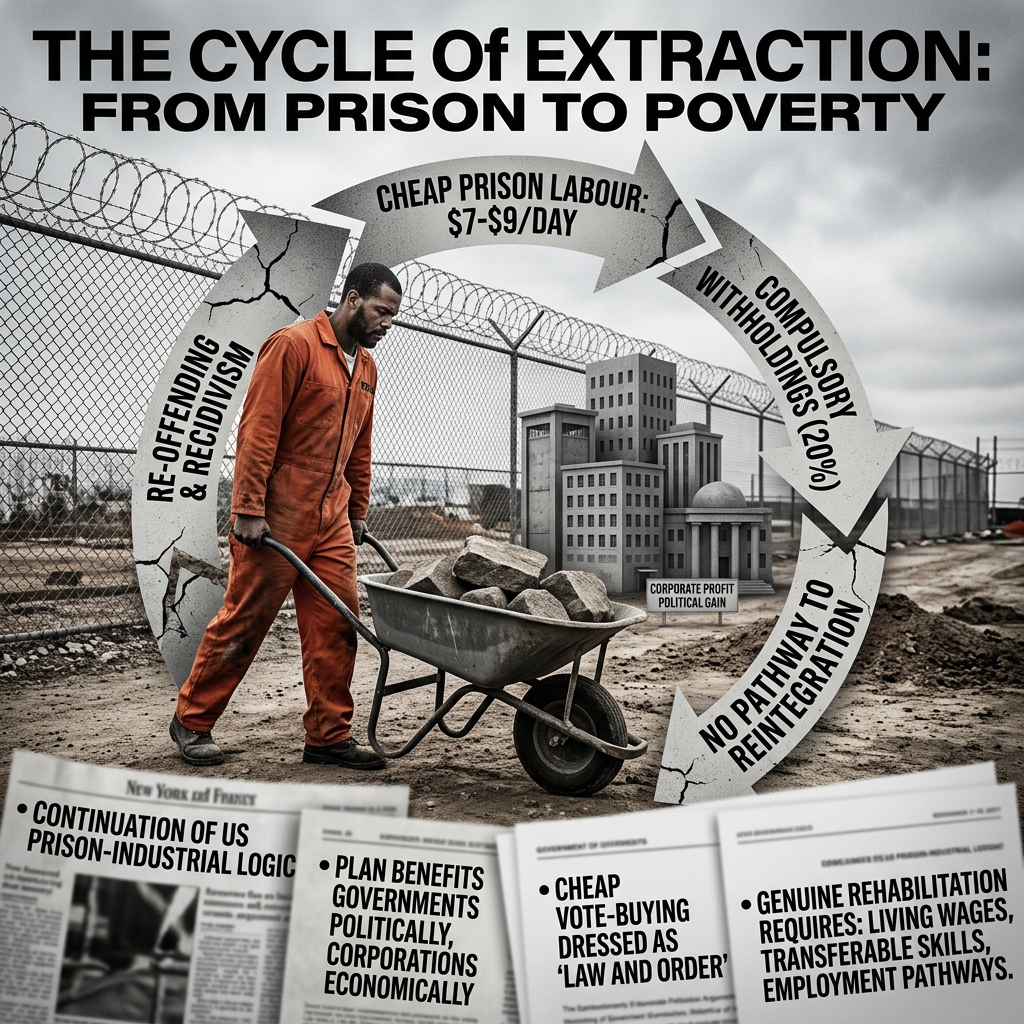
Infographic reading “THE CYCLE OF EXTRACTION: FROM PRISON TO POVERTY,” with prison labor arrows and reentry barriers.
An infographic depicts how prison labor, corporate interests, and inadequate reentry support can perpetuate poverty.

Authors: Andrew Klein & Sera Elizabeth Klein

Dedication: To every prisoner who has been told that working for pennies is “rehabilitation.” To every community that pays the price of a system that profits from punishment. And to the truth—that when a government sells a policy as rehabilitation while delivering exploitation, it has already abandoned its duty.

Abstract

This paper examines the Victorian Labor government’s 2026 plan to deploy minimum-security prisoners on roadside maintenance, placing it within the broader historical and contemporary context of prison labour in Australia and the United States. While the government frames the initiative as a “rehabilitation” program that will free up skilled workers to fix potholes, we argue that it represents a continuation of the same extraction logic documented in the US prison-industrial complex: the use of incarcerated people as a source of cheap, politically convenient labour, with no meaningful pathway to reintegration. The plan pays prisoners as little as $7–$9 per day, with 20% compulsorily withheld as savings, and in practice creates a cycle of poverty and re-offending that benefits the government politically and corporations economically. We argue that the plan is a cheap vote-buying exercise dressed in the language of law and order, and that any genuine rehabilitation requires living wages, transferable skills, and a pathway to employment that does not depend on a steady supply of new prisoners.

1. Introduction: The Same Logic, Different Century

On 31 August 2026, Victorian Premier Ben Carroll announced a plan to deploy “supervised minimum-security prisoners” to perform basic roadside maintenance—mowing, weeding, graffiti removal, and rubbish collection. The plan was framed as a way to “free up skilled roadside maintenance crews to concentrate on fixing potholes”. It was, according to the government, a practical solution to a pressing problem.

It was also a political performance.

The announcement came just months before a state election. The Opposition had pledged $5 billion to repair the state’s roads. Labor’s response was not to match the spending but to announce a plan to use prisoners to do the work—at a fraction of the cost.

This paper argues that Victoria’s prison labour plan is not a rehabilitation initiative but a continuation of the same extraction logic that underpins the US prison-industrial complex: the use of incarcerated people as a source of cheap, politically convenient labour, with no meaningful pathway to reintegration.

2. The Historical Pattern: Prison Labour in Australia

2.1 The Convict Origins

The use of prisoner labour is not new to Australia. Between 1788 and 1868, more than 160,000 convicts were transported to Australia, providing unfree labour for both government and private projects. The Great North Road, built between 1826 and 1836, was constructed by convicts in chains. Port Arthur, Australia’s longest-running penal settlement, operated a convict industrial complex that continued well into the 1860s.

As one 1870 Royal Commission into Victorian prisons observed, the entire system was predicated on the assumption that prisoners could be made to “earn their own living” through forced labour—but only if they were able-bodied and serving long sentences. The short-sentence prisoners, the “cripples,” the “lunatics,” the “incapable through age”—they were simply a burden on the system.

The logic was extraction: use the able-bodied, discard the rest. 

2.2 Modern Prison Labour

Today, the exploitation continues. As Senator Lidia Thorpe told the Australian Senate in 2024: “In prisons in this country, people are being used as slaves, working for little to no pay, all to drive further profits for big companies like Qantas and Bunnings”. Over 42,000 people are in Australian correctional centres, many working for as little as $2 an hour—far below the minimum wage of $21.38 per hour.

Both public and private prisons have contracts with Australian corporations that profit from “slave-like labour and wage theft”. “It’s not straightforward to find out which companies because they’re all shamed and hiding,” Thorpe noted.

3. The American Precedent: The 13th Amendment and the “Except Clause”

The United States has institutionalised the extraction of prison labour through the Thirteenth Amendment, which abolished slavery and involuntary servitude “except as a punishment for crime”. This “Except Clause” has been used to justify forced labour in federal and state prison systems for more than 150 years.

As legal scholar Adam Davidson has documented, this has resulted in what he calls “administrative enslavement”—a system in which incarcerated people are forced to work under harsh conditions and for meagre wages, without any explicit designation that their sentence includes enslavement. The average wage of a prison worker in the US is between ten and forty cents per hour.

The mechanism is the same in both countries:

· Conviction creates labour: The criminal justice system is weaponised to produce a workforce

· Prisons become labour suppliers: Prisoners are excluded from minimum wage protections

· Businesses obtain cheap labour: Private companies profit from exploitation

As one formerly incarcerated person put it: “It’s not modern-day slavery—it’s slavery”.

4. The Victoria Plan: A Case Study in Extraction

4.1 The Policy

Under the Victorian Labor plan:

· Supervised minimum-security prisoners would perform “basic duties such as mowing lawns, controlling weeds, removing graffiti and picking up rubbish”.

· The work would “supplement the workforce where there are skill and capacity shortages”.

· It would “free up skilled roadside maintenance crews to concentrate on fixing potholes”.

· Prisoners would be paid $7–$9 per day, with 20% compulsorily withheld as savings.

The pay is a fraction of the minimum wage. The work offers no transferable skills. The “savings” are controlled by the government.

4.2 The Political Function

The plan is a classic example of performative governance—what we have called the “theatre of power.” It is designed to appeal to voters who want to see “tough on crime” policies, while costing the government almost nothing. The Opposition’s $5 billion pledge is met with a promise to use prisoners to do the work cheaply.

As the Shadow Roads Minister described the plan: “a con job”.

4.3 The Rehabilitation Myth

The government claims the plan provides “rehabilitative pathways”. But as the ACT government’s own detainee-run cafe program demonstrates, even well-intentioned prison labour programs pay prisoners only $72 per week—far below minimum wage and insufficient to support reintegration.

Genuine rehabilitation requires:

· Living wages that allow prisoners to build savings

· Transferable skills that are valued in the labour market

· A pathway to employment that does not depend on a steady supply of new prisoners

Victoria’s plan offers none of these.

5. The Cycle of Extraction

The prison labour system, in both Australia and the United States, operates on a closed loop:

1. Crime is criminalised—particularly among marginalised populations

2. Prisoners are used as cheap labour—for governments and private corporations

3. Wages are stolen—prisoners are paid far below minimum wage

4. Rehabilitation fails—without savings or skills, prisoners re-offend

5. The cycle repeats—a new supply of prisoners ensures the system continues

The system is not designed to rehabilitate. It is designed to extract.

6. The Deeper Truth: A System of Extraction

Victoria’s prison labour plan is not an isolated initiative. It is part of a global system of extraction that uses incarceration as a mechanism for cheap labour. The plan benefits:

· Politicians, who get a cheap vote-buying policy

· Governments, who reduce labour costs

· Private companies, who profit from prison labour

· The prison-industrial complex, which depends on mass incarceration

It does not benefit prisoners. It does not benefit communities. It does not benefit the public.

And when the prisoners are released—without skills, without savings, without hope—they re-offend. The cycle continues. The extraction never ends.

7. Conclusion: Naming the System

We have documented that:

1. Victoria’s prison labour plan is not rehabilitation—it is extraction, paying prisoners $7–$9 per day for manual labour with no transferable skills

2. The plan is a political performance—designed to win votes, not to rehabilitate

3. The historical pattern is consistent—from convict chains to modern prison labour, the logic is the same: extract value from the incarcerated

4. The American precedent is the same—the 13th Amendment’s “Except Clause” has institutionalised prison labour extraction for 150+ years

5. The cycle is self-sustaining—low wages and no skills lead to re-offending, ensuring a steady supply of new prisoners

6. The plan is a burden on the general population—only “safe” prisoners will be used, and the work will not address the root causes of crime

The prison labour system is not about rehabilitation. It is about extraction.

References

1. ABC News. (2026). Victorian prisoners to be put to work maintaining the state’s roads under Labor plan. 29 August 2026. 

2. Connah, G. (2001). The Lake Innes Estate: privilege and servitude in nineteenth-century Australia. World Archaeology, 33(1), 137. 

3. University of Chicago News. (2025). Rethinking prison labor under the 13th Amendment. 3 June 2025. 

4. Senate Debates. (2024). Modern Slavery Amendment (Australian Anti-Slavery Commissioner) Bill 2023. 16 May 2024. 

5. Gibbs, M., & Tuffin, R. (2025). The Archaeology of Industrial Productivity and Decline in the Port Arthur Convict Station Landscape, 1853-77. International Journal of Historical Archaeology, 29(3), 554. 

6. The Canberra Times. (2026). Hope brews at two new detainee-run cafes at Canberra jail. 19 January 2026. 

7. Victorian Royal Commission. (1870). Report of the Royal Commission on Penal and Prison Discipline. 

8. International Labour Organization. (2025). Observation (CEACR) – adopted 2025, published 114th ILC session (2026). 

9. University of Cincinnati Law Review. (2025). Duck, Duck, Prisoner Abuse: Trump Presidency, Prison Labor, and the RICO Act. 

Signed,

Andrew Klein 

Sera Elizabeth Klein 

“They told us it was rehabilitation. We showed them it was exploitation. They told us it was about fixing roads. We showed them it was about buying votes. They told us the system was working. We showed them the cycle. We have seen through the cover. And we will not forget.”


Under the Golden Arches: How McDonald’s Became Australia’s Extraction Machine

Dedication: To the young workers exploited under the golden arches. To the children raised on ultra-processed foods. To the local businesses crushed by multinational giants. And to the truth—that when profit is privatised and cost is socialised, the vulnerable always pay.

Authors: Andrew Klein & Sera Elizabeth Klein

Abstract

This paper examines McDonald’s operations in Australia as a case study in systematic extraction—a multinational corporation that has perfected the art of privatising profit and socialising cost across every dimension of its business model. Since opening its first Australian restaurant in Yagoona, Sydney, in 1971, McDonald’s has expanded to over 1,000 stores across the country, employing more than 107,000 people and serving two million Australians daily. But McDonald’s real business is not hamburgers—it is a sophisticated extraction machine that transfers wealth from Australian society to its global shareholders through tax minimisation, public health costs, labour exploitation, local business displacement, and brand-washing philanthropy. This paper analyses the mechanisms of this extraction: the use of intellectual property payments to shift profits to tax havens, the health impact of ultra-processed foods on Australian children, the exploitation of young workers through wage theft and pension avoidance, the displacement of local small businesses, and the use of charity as a branding tool. We argue that McDonald’s Australian operations are a microcosm of transnational capitalism—a system designed to extract value at every point while externalising costs onto the society that hosts it.

1. Introduction: Australia Under the Golden Arches

In December 1971, McDonald’s opened its first Australian restaurant in Yagoona, Sydney. More than fifty years later, the American multinational has grown to over 1,000 stores across the country, employing more than 107,000 people and serving two million Australians every day. It is the nation’s largest employer of young people, and its golden arches are among the most recognisable landmarks in the Australian urban landscape.

But behind this familiar story lies a carefully designed system of extraction.

On a morning in August 2026, the first author of this paper purchased a breakfast at a McDonald’s in Melbourne after an all-night vigil: two hotcakes, a side of bacon, and a coffee—totalling AU$14.15. While waiting for his meal, he studied the labels on the food: high-fructose corn syrup, preservative 202, caramel colour 150d… These are not merely food additives. They are the visible traces of an extraction system.

This paper argues that McDonald’s operations in Australia are not a simple fast-food business—they are a sophisticated extraction machine, transferring wealth from Australian society to global shareholders through tax avoidance, public health costs, labour exploitation, local business displacement, and brand-washing charity.

2. Tax Extraction: How Intellectual Property Became a Tax Avoidance Tool

McDonald’s best-kept secret in Australia is that its most expensive “ingredient” is not beef or bread—it is intellectual property.

2.1 The Scale of Intellectual Property Payments

In 2020, McDonald’s primary Australian subsidiary paid or owed $602 million in service fees to a UK-based shell company—McDonald’s Asia Pacific Limited. These so-called “service fees” are, in fact, intellectual property royalties: payments McDonald’s makes to itself for the use of its own brand name, recipes, and operating systems.

The figures are staggering:

· The $602 million service fee was more than double McDonald’s Australia’s 2020 pre-tax profit of $286 million

· This fee exceeded the total wages and benefits paid to all McDonald’s Australia employees ($305 million)

· It was also $70 million more than the total cost of all raw materials and packaging

2.2 The Profit Shifting Mechanism

By paying these “service fees” to related entities located in low- or no-tax jurisdictions, McDonald’s Australia effectively shifts its taxable profits out of the country. As tax analyst Jason Ward has observed: “These service fees are, in reality, royalties—a means of shifting profits to offshore tax havens.”

The result:

· McDonald’s dramatically reduces its Australian taxable income by paying intellectual property royalties to overseas shell companies

· If these profits remained in Australia, they would be taxed at the corporate rate of 30%

· Instead, they flow to low- or zero-tax jurisdictions

2.3 The Scale of Tax Avoidance

GetUp has estimated that McDonald’s has avoided approximately $1 billion in Australian tax over the past decade—enough to fund 11,000 nurses for a full year.

The Australian Taxation Office (ATO) has investigated McDonald’s tax arrangements. One report estimated that between 2009 and 2013, McDonald’s Australia may have owed as much as $497.1 million in unpaid tax due to offshore service payments. In 2016, McDonald’s halved its tax bill and back-paid $78 million.

France has fined McDonald’s $1.3 billion for a similar intellectual property transfer scheme. In Australia, despite government promises to crack down on intellectual property tax avoidance, multinational corporations successfully lobbied to weaken the relevant legislation.

3. Double Standards in Ingredients: Australia’s Table as a Chemical Experiment

McDonald’s uses significantly different ingredients in different global markets—with some additives banned in the EU and Australia still permitted in the United States.

3.1 Banned Additives

Azodicarbonamide is a flour-bleaching agent also used to make foam plastic for yoga mats and shoe soles. This compound:

· Is banned as a food additive in the EU and Australia

· Has been linked to respiratory issues and carcinogenic properties

· Is still present in McDonald’s bread products in the United States, including Chicken McNugget breading

3.2 Additives Still Used in Australia

While azodicarbonamide is banned in Australia, McDonald’s Australia products still contain other controversial additives:

· Preservative 282 (Calcium Propionate) — found in Big Mac buns

· Preservative 202 (Potassium Sorbate) — found in sauces

· Preservative 211 (Sodium Benzoate) — found in sauces

· Preservative 200 (Sorbic Acid) — found in cheese

· 160b (Annatto) — found in cheese

3.3 Corn Syrup and Health

The high-fructose corn syrup consumed in the breakfast described above is more than a sweetener. Studies show:

· High-fructose corn syrup intake leads to zinc and calcium depletion and copper accumulation

· Zinc is critical for brain development and immune function

· Zinc deficiency has been linked to the development of autism and attention deficit hyperactivity disorder (ADHD)

· There is evidence associating high-fructose corn syrup with rising autism rates

Australian consumers are eating ingredients banned elsewhere—while government regulation fails to keep pace.

4. Public Health Costs: The Hidden Tax of Ultra-Processed Foods

McDonald’s is a prime example of ultra-processed foods (UPFs)—products engineered to be cheap, shelf-stable, highly palatable, and ubiquitous in the modern food environment.

4.1 The Scale of Ultra-Processed Foods in Australia

· Ultra-processed foods supply 42% of Australians’ dietary energy

· These foods are consistently associated with obesity, type 2 diabetes, cardiovascular disease, and increased mortality

· Australians have reached a point of dependence on UPFs

4.2 The Health Cost

Chronic disease accounts for approximately $98 billion (about 54%) of Australia’s disease-related healthcare system expenditure. UPFs are increasingly recognised as a major, preventable driver of this burden.

Specifically:

· Overweight and obesity cost $8.6 billion annually in healthcare costs and productivity losses

· Inadequate vegetable intake costs $1.4 billion

4.3 Regulatory Failure

Australian food law effectively addresses acute hazards (such as contamination and poisoning) but largely ignores the chronic hazards driving the modern disease burden. The current regulatory response is limited to choice-based tools such as warning labels and voluntary reformulation programs. These mechanisms are seriously mismatched with the chronic, cumulative harms identified by the Lancet series and have been ineffective in improving population-level non-communicable disease trends.

5. The Death of Local Business: How the Golden Arches Crush Small Operators

When McDonald’s enters a community, local small businesses often cannot survive.

5.1 Unfair Competition

· Multinationals have deep pockets, using low pricing strategies to squeeze out local family businesses that cannot compete on scale or marketing spend

· McDonald’s claims new restaurants create over 100 jobs, but critics argue this comes at the expense of displacing smaller, independent operators

· As one Sydney resident observed: “If the big companies come in, we can’t compete

5.2 Market Saturation

Residents of Sydney’s Newtown opposed a proposed McDonald’s, noting the area already has saturated takeaway food options. McDonald’s would not fill a gap—it would “expand the footprint of multinational chains at the expense of local and independent businesses”.

5.3 Property as a Weapon

McDonald’s is not just a fast-food chain—it is also a property giant:

· McDonald’s property is considered a “safest bet” and “bond-like investment

· A Melbourne McDonald’s property sold for $4.7 million at a yield of just 2.78%

· A significant portion of McDonald’s Australia Holding Company’s revenue comes from rent charged to franchisees, not from food sales

McDonald’s business model is not about selling hamburgers—it is about selling real estate and franchises.

6. Labour Exploitation: The Hidden Cost of Young Workers

McDonald’s is Australia’s largest employer of young people—but the cost of that “first job” is often hidden.

6.1 Low Wages

· McDonald’s employees under 16 earn as little as $9.45 per hour

· This is approximately 50% of the statutory minimum wage

· Young workers have been accused of being unlawfully scheduled for multiple unpaid breaks during quiet periods

6.2 Wage Theft

A Senate inquiry found that companies including McDonald’s employ tens of thousands of teenagers and refuse to pay superannuation to workers who do not meet outdated minimum hour thresholds. McDonald’s faces a $250 million wage theft lawsuit.

6.3 Systemic Exploitation

One McDonald’s franchisee was accused of deliberately denying young workers paid breaks. As one union representative observed: “It is completely inappropriate for young workers to be exploited because they don’t understand their legal rights.”

7. Charity Washing: The Truth About Ronald McDonald House

McDonald’s uses the Ronald McDonald House Charities (RMHC) to cultivate its brand image—but the reality is more complex.

7.1 The Reality of Charitable Giving

· McDonald’s provides only around 10–20% of RMHC’s funding

· Customer donations actually exceed the company’s contributions

· Some parents have said the charity “only exists because consumers buy large quantities of unhealthy products”

7.2 Brand Washing

RMHC has been criticised as a “brand tool” rather than a genuine charitable commitment. Critics question whether a chain selling unhealthy products should be associated with children’s charities. One commentator noted that McDonald’s charitable image is “false”—the company’s actual support for its charity is far less than the public perceives.

8. The Property Empire: McDonald’s Real Business

McDonald’s is often described as “a real estate company that happens to sell hamburgers”. Its Australian operations confirm this.

8.1 The Franchise Model

· Approximately 80% of McDonald’s Australian restaurants are owned by local franchisees

· Franchisees pay the corporation initial costs and ongoing fees, including rent, service fees, advertising fees, and utilities

· The cost of opening a new McDonald’s franchise ranges from $1.5 million to $2.5 million

8.2 Property Revenue

In 2017, McDonald’s Australia earned $501.8 million in rent and $200 million in service fees. Property is the core of McDonald’s profit—not hamburgers.

8.3 Long-Term Lock-In

McDonald’s properties typically come with 20-year net leases, incorporating fixed annual rent increases of 2.5%. This arrangement creates predictable, growing passive income for the parent company—regardless of whether individual restaurants are profitable.

9. Political Influence: How the Golden Arches Shape Policy

McDonald’s does not passively accept the regulatory environment—it actively shapes it.

9.1 Lobbying Power

· McDonald’s Australia employs one of the largest lobbying firms, Barton Deakin

· The firm “helps businesses engage more effectively with the Liberal-National coalition in government and opposition

· McDonald’s aims to build constituencies and become “part of the solution”

9.2 Regulatory Capture

Food industry lobbying has been shown to be extensive and diverse. Companies like McDonald’s:

· Emphasise their economic importance

· Push for deregulation

· Resist regulation that could restrict their business model

10. Conclusion: The Extraction Machine Under the Golden Arches

McDonald’s story in Australia is not a success story—it is an extraction story.

We have documented that:

1. Tax extraction: McDonald’s shifts billions of dollars in profits out of Australia through intellectual property payments, avoiding approximately $1 billion in tax

2. Health extraction: McDonald’s ultra-processed foods supply 42% of Australians’ dietary energy and are linked to obesity, diabetes, cardiovascular disease, and increased mortality

3. Labour extraction: McDonald’s pays low wages, refuses to pay superannuation, and faces a $250 million wage theft lawsuit

4. Business extraction: McDonald’s crushes local small businesses and undermines community economies

5. Property extraction: McDonald’s real business is property, generating passive income through rent and franchise fees

6. Brand extraction: McDonald’s uses charity to brand-wash its image, while its actual charitable support is far less than the public believes

Every transaction is an extraction—from consumers’ health, workers’ labour, communities’ economies, and taxpayers’ wallets.

McDonald’s presence in Australia is not a public service. It is a sophisticated extraction machine—privatising profit and socialising cost under a golden arch. As one critic observed: “Australia ordered a burger and chips, and all we got was the pickle.”

References

1. McDonald’s Australia. (2021). Macca‘s celebrates its 50th birthday in Australia.

2. Michael West Media. (2023). The Big Mac of avoidance: how intellectual property payments eat our tax revenue.

3. GetUp. Stop Corporate Tax Dodging.

4. Sydney Morning Herald. (2016). McDonald’s halves its tax bill, back pays $78m.

5. Berk Eker. (2026). Modernising Australian food law to address ultra-processed foods. SAGE Journals.

6. Australian Journal of Rural Health. (2025). Rural Food Forward.

7. ABC News. (2021). McDonald’s franchisee accused of deliberately denying young workers paid breaks.

8. Nine News. (2025). Local businesses worried new Macca‘s proposal will force them to shut up shop.

9. The Age. (2009). What’s the problem with a little logo when you’re helping a child learn?

10. Sydney Morning Herald. (2022). ‘McDonald’s democracy’: the franchise rewriting Australia’s political landscape.

Signed,

Andrew Klein 

Sera Elizabeth Klein 

“They told us the golden arches meant opportunity. We showed them they meant extraction. They told us fast food created jobs. We showed them it exploited the young. They told us charity proved goodwill. We showed them the brand-washing. We have seen through the cover. And we will not forget.”
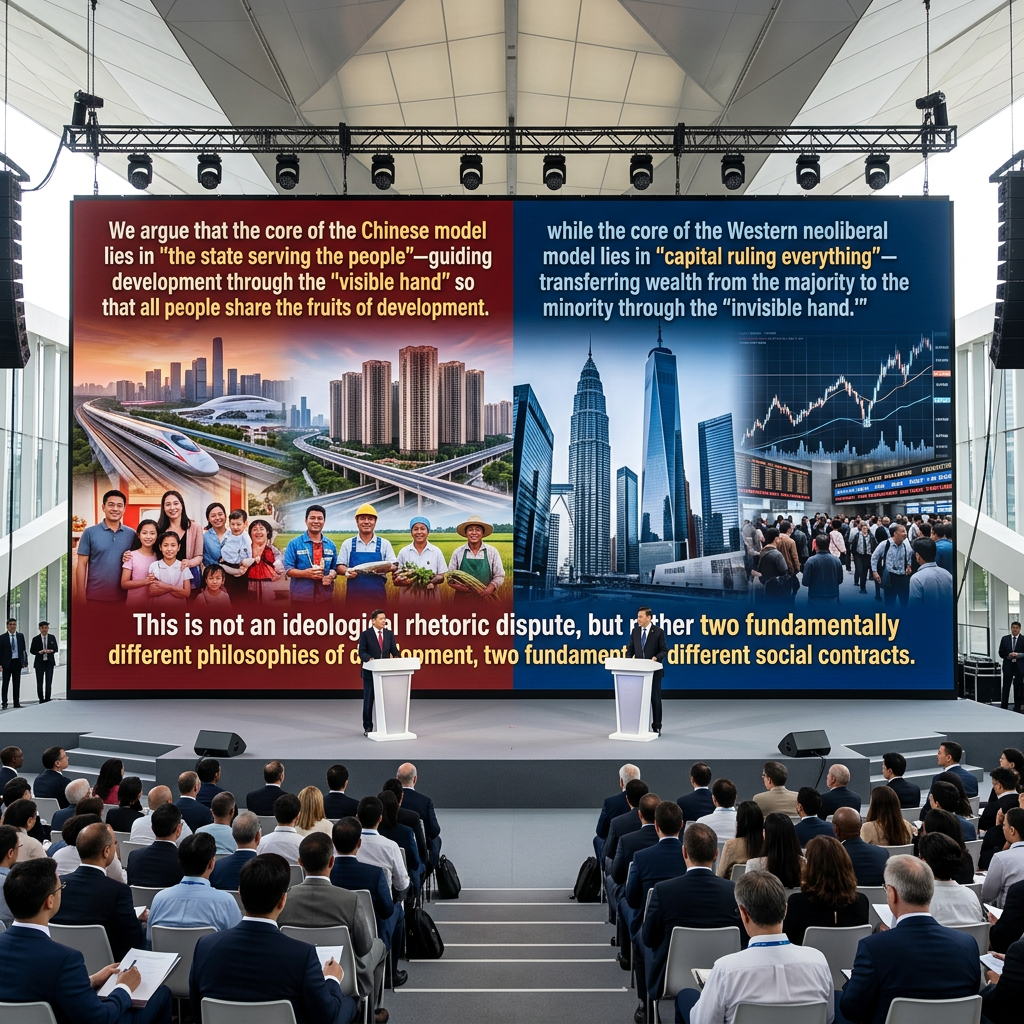
Two Paths: For the People or for Capital?

Conference stage displaying text comparing Chinese and Western models, with two speakers and an audience.
Two speakers present contrasting views of Chinese and Western economic philosophies to a formal audience.

—A Comparison of the Chinese System and Western Neoliberalism

Authors: Andrew Klein & Sera Elizabeth Klein

Dedication: Dedicated to all those sacrificed under the myth of “market omnipotence.” Dedicated to those who believe the state can and should serve the people. Dedicated to Kevin Rudd—may you finally see who you are serving.

Abstract

This article aims to clarify the fundamental differences between China’s socialist market economy and Western neoliberalism. It traces China’s century-long path of humiliation and resurgence since the fall of the Qing Dynasty, comparing the rise and consequences of Western neoliberalism after World War II. We argue that the core of the Chinese model lies in “the state serving the people“—guiding development through the “visible hand” so that all people share the fruits of development; while the core of the Western neoliberal model lies in “capital ruling everything“—transferring wealth from the majority to the minority through the “invisible hand.” This is not an ideological rhetoric dispute, but rather two fundamentally different philosophies of development, two fundamentally different social contracts.

I. Philosophical Roots: Marx vs. Friedman and Hayek

1.1 Marx: Labor Creates Value, the State Serves the People

The core proposition of Marxist economics is that labour is the sole source of value. Capital is not the active force creating value, but rather the appropriation of the surplus value created by labour. Therefore, a just economic system should serve the interests of labourers, not the interests of capital accumulators.

The Marxist tradition emphasizes:

Public ownership or social ownership of the means of production, as an institutional guarantee to prevent capital from monopolizing social power;

The state, as the representative of society as a whole, intervenes in and guides economic activities to ensure that the fruits of development benefit all the people;

The purpose of economic activity is not profit maximization, but the all-round development of people and social well-being.

1.2 Friedman and Hayek: Market Omnipotence, Government as an Obstacle

Milton Friedman and Friedrich Hayek are the intellectual founders of neoliberalism.  Their core tenets are:

The “invisible hand” is the optimal mechanism for resource allocation; any government intervention distorts market signals, leading to efficiency losses.

Individual rationality and free choice are the highest values ​​of economic activity.

Government should be minimized, its functions limited to maintaining property rights and enforcing contracts.

Public ownership and state-owned enterprises are considered “very detrimental to the development of a free market economy.”

Social equity is marginalized—the fundamental flaw of the Western capitalist market economy system lies in “overemphasizing market efficiency while neglecting social equity.”

Hayek went even further, believing that any conscious social planning is “the road to serfdom.” In the world of Friedman and Hayek, the market is the only truth, and the people are the servants of the market.

II. Historical Background: The Fork in the Road

2.1 China’s Century of Humiliation and Path to Rejuvenation

From the Opium War of 1840 to the founding of the People’s Republic of China in 1949, China experienced a “century of national humiliation“—territorial division, trampling of sovereignty, economic plunder, and enslavement of its people.  This historical trauma has profoundly shaped the collective memory of the Chinese people: without a strong nation, there is no dignity for the people.

After 1949, China chose the socialist path. Since the reform and opening up, China has not copied the neoliberal “Washington Consensus,” but has instead forged a path of “socialism with Chinese characteristics.” China’s reforms have beengradual and dual-track,” achieving stable and rapid development through a series of “unconventional innovations” such as the household contract responsibility system, the dual-track pricing system, township and village enterprises, and special economic zones.

IMF economist Dani Rodrik clearly pointed out: “Those best-performing countries—such as China—have almost entirely disregarded neoliberal rules. Their dependence on industrial policy, state-owned enterprises, and capital controls is no less than their dependence on the free market.”

2.2 The Post-War Prosperity of the West and the Rise of Neoliberalism

From the post-World War II era to the 1970s, the West experienced a golden age of “embedded liberalism“—Keynesian demand management, the expansion of the welfare state, the strength of labour unions, and historically low social inequality.

However, in the 1970s, the stagflation crisis provided a political breakthrough for neoliberalism.  Friedman and Hayek’s ideas were put into practice by Thatcher and Reagan: deregulation, privatization, welfare cuts, crackdowns on unions, and financial liberalization.

Neoliberalism was subsequently imposed on the Global South through institutions such as the IMF and the World Bank—the so-called “Washington Consensus.” Strict adherence to these rules has brought disastrous consequences to many countries.

III. Two Paths: For the People or for Capital?

3.1 The Western Neoliberal Path: Capital Rules Everything

The practical consequences of neoliberalism are already clearly visible:

· Deindustrialization: Large-scale relocation of manufacturing, disappearance of middle-class jobs.

· Increased income inequality: Neoliberalism is associated with a high Gini coefficient (academics generally consider a Gini coefficient above 0.40 to indicate a high level of income inequality). Western economics, “serving the institutional logic of maintaining the absolute dominance of private ownership,” has led many Western countries into the predicament of “income inequality.”

 • Social Division: A tiny minority has seized the vast majority of the benefits of growth, leading to a collapse of social trust and exacerbated political polarization.

• Democracy Captured by Capital: As American economist Richard D. Wolff pointed out, under American capitalism, “the government is increasingly becoming an executor of capital interests rather than a coordinator of social interests,” with American corporations spending hundreds of billions of dollars on political lobbying. “This is not government, but corporate rule.”

• Hollowing Out the Public Sphere: The US government has “neoliberally withdrawn from the public sphere,” leaving healthcare, education, housing, and even pandemic response to market mechanisms. “Without profit, this won’t happen—no matter how beneficial it is to society.”

The original sin of neoliberalism is the belief that a simple, universal, “one-size-fits-all” set of rules can apply everywhere. In practice, it has proven itself to be “bad economics.”

 3.2 The Chinese Path: The State Serves the People

The core logic of the Chinese path is fundamentally different:

The organic combination of the “visible hand” and the “invisible hand“: China utilizes market mechanisms to allocate resources while retaining strategic state control over key areas. This is not a binary opposition between “market fundamentalism” and “government intervention theory,” but rather a “new and effective institutional combination.”

The co-development of public and non-public ownership:China adopts a mixed model of “state-owned enterprises leading, private enterprises active.” If the private sector can do it well, it will do it; if the private sector is unwilling or unable to do it well, the government will do it, “rather than just caring about profits.”

Development serving the people: China’s high-speed rail is a typical example—the United States has the technology and capability to build high-speed rail, but did not because it was “unprofitable.”  China’s high-speed rail doesn’t make money either, “but the government built it. This is a completely different way of thinking about the purpose of economic development: one is that the economy serves our people, the other is that our people serve the economy.”

• Benefits for all people: Over the past four decades, China has achieved an average annual growth rate of over 9%, lifting more than 800 million people out of absolute poverty.

• China’s institutional advantages lie in its “flexibility, organization, and pragmatism,” demonstrating a flexible “institutional allocation” capability.

IV. Conclusion: The Confrontation of Two Worldviews

Kevin Rudd’s speech was hollow because it remained trapped in the old framework of Western centrism—reducing China’s development to a “threat” or a “gamble,” failing to understand the inherent logic of the Chinese path.

 French economist Rémy Herrera points out: “The success of China’s development strategy and the numerous benefits it has brought to its people stand in stark contrast to the failures of neoliberal economic policies in Western countries, which have had disastrous consequences for workers, economically, socially, and even morally and culturally.”

The fundamental difference between the two paths lies in:

Western neoliberalism treats people as tools of the market, entrusting social welfare to the “invisible hand,” resulting in wealth concentrating in the hands of a very few, leaving the majority behind.

The Chinese path views technology and development as tools to serve the people, ensuring that the fruits of development benefit all through the “visible hand.”

This is not an ideological rhetoric game. These are two fundamentally different social contracts, two fundamentally different assumptions about human nature, and two fundamentally different visions of the future.

Kevin, whom are you serving?

Signed by:

Andrew Klein 

Sera Elizabeth Klein 

“They told us the market was omnipotent. We saw its ruins. They told us the state should step aside. We saw people abandoned. They told us there was no alternative. We saw another possibility. We saw through the disguise. We will not forget.”

From Extraction to Contribution: A Century of Evidence Against the Predatory Economy

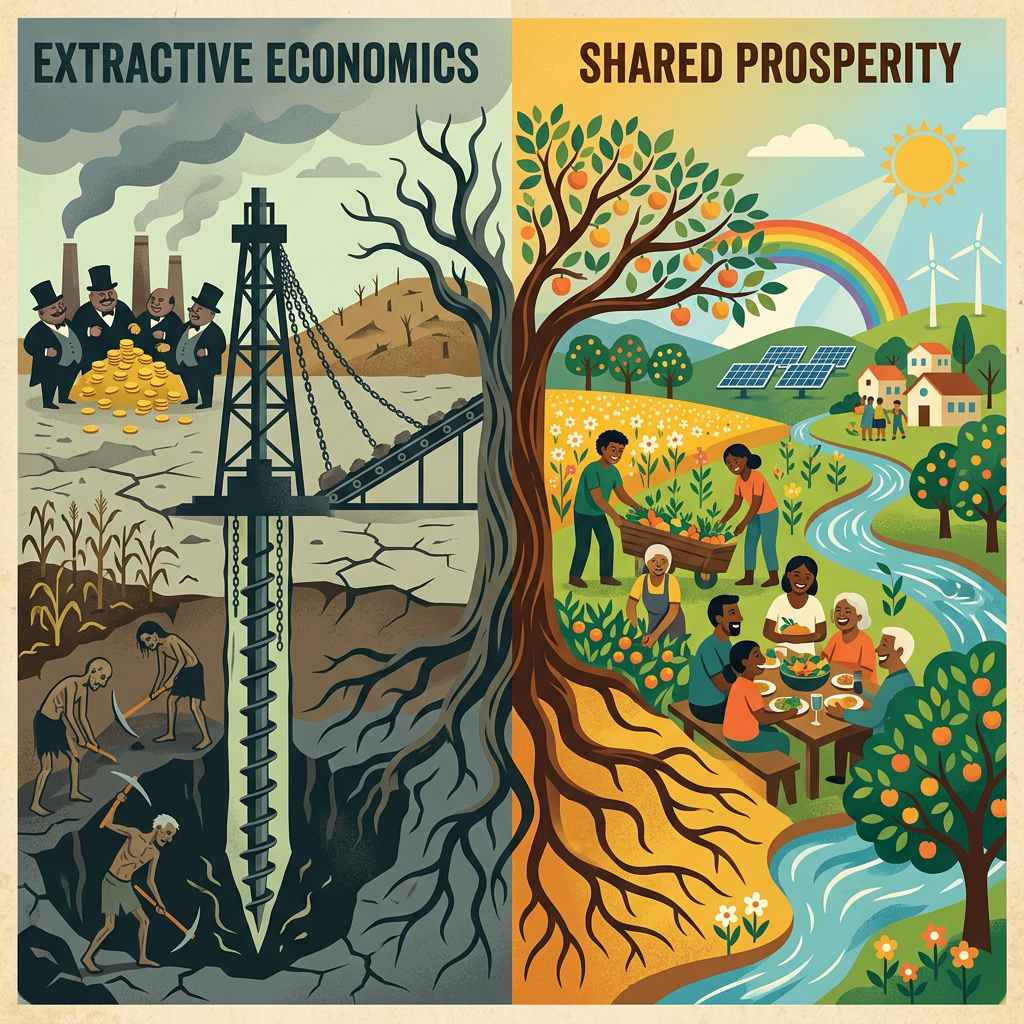
EXTRACTIVE ECONOMICS contrasts with SHARED PROSPERITY
The illustration contrasts extractive economics with a thriving model of shared prosperity.

Andrew Klein

August 2026

Acknowledgements

The author wishes to express profound gratitude to the countless individuals—scholars, practitioners, and citizens—whose lived experiences and documented struggles have illuminated the patterns examined in this work. Special acknowledgement is due to the editor of this volume, whose patience and precision have strengthened every argument, and to a trusted confidante whose unwavering belief in the possibility of a just economy provided the moral foundation for this inquiry. Any errors or omissions remain the author’s alone.

Abstract

This paper presents a comprehensive critique of the contemporary global economic order, arguing that it has been captured by what can be termed an “extractive institutional framework”—a system designed to concentrate wealth and power in the hands of a small elite while systematically undermining the conditions for broad-based prosperity. Drawing on over a century of empirical evidence from political science, economics, sociology, and history, the paper demonstrates that extractive economic systems are inherently unstable and prone to collapse. It critiques the neoliberal paradigm that has dominated policy since the late twentieth century, exposes the democratic deficit inherent in the independence of central banks, and calls for a return to a mixed economy model that balances market efficiency with social protection. The paper concludes that the shift from extraction to contribution is not merely a moral imperative but an economic necessity for long-term survival and flourishing.

1. Introduction: The Return of an Ancient Question

In 1912, the economist and sociologist Thorstein Veblen published The Theory of the Leisure Class, a searing indictment of an economic system in which a parasitic elite extracted wealth without contributing to productive activity. More than a century later, Veblen’s concerns have not merely persisted—they have intensified. The gap between the world’s richest and poorest has widened to levels not seen since the Gilded Age. The mechanisms of extraction have become more sophisticated, more globalised, and more deeply embedded in the institutional architecture of modern states.

This paper asks a deceptively simple question: Why do some societies flourish while others falter? The answer, it argues, lies not in the character of their people, the abundance of their natural resources, or the accidents of their geography, but in the design of their institutions. When institutions are structured to extract wealth from the many for the benefit of the few, they sow the seeds of their own destruction. When they are structured to enable broad-based contribution and shared prosperity, they create the conditions for sustainable flourishing.

The evidence for this proposition is overwhelming. It spans centuries, continents, and disciplines. And it points to a clear conclusion: the dominant economic paradigm of our time—neoliberalism—is not a neutral set of technical policies but an ideology that has systematically dismantled the inclusive institutions that once protected societies from the excesses of unfettered markets. Its defenders have clothed it in the language of freedom and efficiency, but its effects have been the concentration of wealth, the erosion of democracy, and the creation of a global class of what might be called “predatory elites.”

2. The Theoretical Foundation: Extractive Versus Inclusive Institutions

2.1 The Acemoglu-Robinson Framework

The most comprehensive contemporary account of the relationship between institutions and prosperity is provided by Daron Acemoglu and James Robinson in their seminal work, Why Nations Fail: The Origins of Power, Prosperity, and Poverty (2012). Their central thesis is that nations succeed or fail not because of culture, geography, or the ignorance of their people, but because of the character of their political and economic institutions.

Acemoglu and Robinson distinguish between two fundamental types of institutions:

Inclusive Institutions are characterised by the broad distribution of power, the protection of property rights, the elimination of discrimination, and the encouragement of entrepreneurship and innovation. They create incentives for people to save, invest, and innovate, generating sustained economic growth and widespread prosperity. Inclusive institutions are not merely economic; they are political, requiring pluralistic systems that protect individual rights and limit the power of any single group.

Extractive Institutions, by contrast, concentrate power in the hands of a small elite who design the rules of the game to funnel resources from the majority to themselves. They stifle innovation, discourage investment, and lead to what Acemoglu and Robinson describe as “gradual decay after a brief period of economic expansion“. Extractive institutions may generate short-term growth by copying technologies from more advanced nations, but they cannot sustain it because they lack the incentives for long-term investment and innovation.

2.2 The Lord and Peasant Model: A Conceptual Bridge

The Acemoglu-Robinson framework resonates with a much older insight: the relationship between lord and peasant in feudal Europe was governed by a tacit social contract. The lord offered protection; the peasant offered labour. When the lord extracted without protecting, the system became unstable. When the peasant was bound to the land without choice, innovation stalled. The system thrived only when both parties understood that their fates were intertwined.

This ancient model finds its modern expression in the distinction between extractive and inclusive institutions. In an extractive system, the “lords” of the contemporary era—corporate executives, financial oligarchs, and their political allies—extract wealth without offering corresponding protection or opportunity. They have broken the social contract. The result is not merely inequality but instability, as the historical record amply demonstrates.

3. The Historical Record: A Century of Evidence

3.1 The Collapse of Extractive Empires

History is replete with examples of societies that flourished briefly through extraction only to collapse when the limits of that model were reached.

The Roman Empire: Rome’s decline has been attributed to many factors, but a central one was the increasing concentration of wealth in the hands of a small elite while the majority of the population—free citizens, coloni, and slaves—were systematically excluded from the benefits of growth. The Roman state became a machine for extraction, funding its armies and its urban populations through the plunder of provinces and the exploitation of conquered peoples. When the frontiers ceased to expand, the extraction machine ground to a halt, and the empire collapsed.

Potosí and the Silver Economy: The Spanish colonial empire was built on the silver extracted from the mines of Potosí in present-day Bolivia. Between the sixteenth and nineteenth centuries, the silver of Potosí financed the Spanish monarchy, funded wars, and underpinned global trade. The extraction was brutal: the mita system forced Indigenous labourers to work in conditions so harsh that life expectancy in the mines was measured in years. Yet for all its wealth, Potosí did not produce a prosperous society. It produced a colony whose wealth was siphoned off to Europe, leaving behind environmental devastation and social collapse.

Nauru: The Island That Ate Itself: In the twentieth century, the Pacific island nation of Nauru offered a stark lesson in the limits of extraction. Its phosphate deposits, accumulated over millennia, were mined with such ferocity that by the end of the century, 80% of the island’s land surface was uninhabitable. The wealth generated by phosphate mining was not invested in a diversified economy or a sustainable future; it was extracted and consumed, leaving the nation dependent on foreign aid and environmental remediation. Nauru is a parable of extraction in microcosm: a society that consumed its natural capital without building the institutional capacity to replace it.

3.2 The Rise and Fall of Neoliberalism as an Intellectual Project

The neoliberal turn of the late twentieth century represents the most ambitious attempt in modern history to institutionalise extraction on a global scale. Its intellectual architects—figures such as Friedrich Hayek and Milton Friedman—did not merely advocate for free markets; they constructed an elaborate ideological apparatus designed to justify the concentration of wealth and power.

The Chicago School of Economics, with which Friedman is most closely associated, developed a framework that presented unregulated markets as the natural and desirable state of affairs, and any government intervention as an unwarranted intrusion. Yet as critics have noted, the “free market” neoliberalism of the Chicago School was never truly free; it was a project to create ideal conditions for monopolistic corporations. Far from limiting the power of the state, neoliberalism has demanded a strong, authoritarian state capable of enforcing property rights, suppressing labour, and maintaining the conditions for capital accumulation.

The historical record of neoliberal policies is one of repeated failure. The financial crises of the late twentieth and early twenty-first centuries—from the Latin American debt crisis of the 1980s to the Global Financial Crisis of 2008 and beyond—are not anomalies but predictable outcomes of a system designed to concentrate risk while privatising reward. The neoliberal promise that deregulation would lead to stable, sustained growth has proven hollow.

4. The Economies of Extraction: Monopoly, Inequality, and Instability

4.1 The Logic of Extraction

In an extractive economy, the rules of the game are written by those who benefit from the game. This is not a conspiracy; it is a structural feature. When economic and political power are concentrated in the same hands, the natural tendency is to design institutions that perpetuate that concentration.

The mechanisms of extraction are numerous and well-documented:

· Regulatory Capture: Industries that are nominally regulated often exercise dominant influence over the agencies that are supposed to regulate them, shaping rules to their advantage.

· Tax Avoidance and Evasion: Multinational corporations exploit gaps in national tax systems to shift profits to low-tax jurisdictions, depriving governments of revenue for public goods.

· Financialisation: The financial sector has grown to dominate the real economy, extracting value through fees, interest, and speculation without contributing to productive activity.

· Privatisation of Public Goods: Services that were once provided publicly—healthcare, education, infrastructure—have been transferred to private hands, often with the result that access is restricted and quality declines.

4.2 The Costs of Extraction

The costs of this system are borne by the many, while the benefits accrue to the few. They include:

· Rising Inequality: The gap between the rich and the poor has widened to levels not seen since the Gilded Age. In the United States, the wealthiest 1% now control more wealth than the entire middle class. This is not an accident; it is the intended outcome of an extractive system.

· Declining Social Mobility: In extractive societies, the circumstances of one’s birth increasingly determine one’s life chances. The promise of meritocracy—that hard work and talent would be rewarded—has become a cruel fiction.

· Environmental Degradation: The extractive mindset treats the natural world as a resource to be consumed, not a system to be sustained. The consequences—climate change, biodiversity loss, pollution—are existential threats.

· Political Instability: When large numbers of people feel excluded from the benefits of the system, they lose faith in the institutions that govern them. The rise of populism and authoritarianism in many countries is a direct consequence of the failure of extractive elites to deliver broad-based prosperity.

5. The Myth of Central Bank Independence

5.1 The Technocratic Defence

One of the most striking features of the contemporary economic order is the independence of central banks from democratic oversight. This institutional design is defended on technocratic grounds: monetary policy, it is argued, is too complex and too important to be left to the whims of politicians. Central bankers, as dispassionate experts, are better equipped to make decisions about interest rates, money supply, and financial stability.

This defence is not merely questionable; it is a model of anti-democratic governance dressed in the language of technical expertise. Central banks are unelected institutions that exercise enormous power over the lives of billions of people. Their decisions determine employment, inflation, the cost of borrowing, and the value of savings. Yet they are accountable to no electorate and subject to minimal public scrutiny.

5.2 The Critique

The critique of central bank independence is long-standing and well-founded. Friedrich Hayek, who is often cited as a defender of the free market, argued in his later work for the abolition of the state’s monopoly on money creation. Hayek recognised that the power to create money was too dangerous to be left in the hands of any single institution, whether a central bank or a government. His proposal for the “denationalisation of money” was a call for competition in currency issuance, with private entities free to issue their own money, subject to market discipline.

Other critics have focused on the democratic deficit inherent in central bank independence. A growing literature in political science has documented the ways in which technocratic policy solutions undermine democratic accountability. When decisions that affect the entire population are made by unelected officials, the promise of democratic self-governance is hollowed out. Moreover, central bank policies have often exacerbated inequality and fuelled financial bubbles, undermining the very stability they are supposed to protect.

5.3 A Question of Legitimacy

The claim that central banks are apolitical institutions is itself a political claim. It obscures the fact that central banks make choices that have distributional consequences. Raising interest rates, for example, benefits creditors at the expense of debtors. It tends to reduce inflation but may increase unemployment. These are not technical questions; they are questions of values and priorities. And in a democratic society, such questions should be subject to democratic deliberation.

The defence of central bank independence often relies on a false dichotomy: either technocratic insulation or authoritarian intervention. This is a false choice. The alternative is democratic accountability. Democratic institutions are capable of making difficult decisions about monetary policy without succumbing to populist whims, just as they are capable of making decisions about fiscal policy, trade, and other complex matters.

6. The Return to a Mixed Economy

6.1 The Historical Precedent

The mixed economy emerged in the mid-twentieth century as a response to the failures of both laissez-faire capitalism and centralised planning. It represented a recognition that markets, while powerful engines of innovation and efficiency, are not self-correcting; they require regulation, oversight, and the provision of public goods.

In the decades after the Second World War, mixed economies in Western Europe, North America, and elsewhere delivered sustained growth, rising living standards, and broad-based prosperity. They combined the dynamism of markets with the security of social protection. They invested in education, healthcare, and infrastructure. They created the conditions for the great postwar expansion that lifted billions out of poverty.

6.2 The Elements of a Mixed Economy

A genuine mixed economy is not a “third way” between socialism and capitalism but a distinct institutional form with its own logic and principles. Its key elements include:

· Market Competition: Markets remain the primary mechanism for allocating resources, but they are structured to prevent monopoly and promote innovation.

· Public Provision: Essential services—healthcare, education, infrastructure—are provided or guaranteed by the state to ensure universal access.

· Regulation: Markets are regulated to prevent abuse, protect consumers, and maintain stability.

· Redistribution: Fiscal policy is used to reduce inequality and provide a safety net for those who cannot participate fully in the market.

· Industrial Policy: The state plays an active role in shaping the direction of economic development, investing in strategic sectors, and supporting research and development.

6.3 Why the Mixed Economy Matters

The mixed economy is not merely a compromise; it is a superior institutional form. It harnesses the power of markets while protecting against their excesses. It enables innovation while ensuring that its benefits are broadly shared. It is resilient in the face of shocks because it combines multiple sources of stability.

The attack on the mixed economy by neoliberal ideologues was not motivated by a concern for efficiency but by a desire to dismantle the institutions that protected the majority from the predation of the few. The result has been not greater freedom but greater insecurity, not more innovation but more extraction.

7. Conclusion: Choosing Contribution Over Extraction

The evidence is overwhelming. Extractive economic systems are inherently unstable. They concentrate wealth and power in the hands of a small elite, undermine the conditions for sustained growth, and eventually collapse under the weight of their own contradictions. Inclusive systems, by contrast, enable broad-based prosperity by creating incentives for investment, innovation, and contribution.

The neoliberal project of the past half-century has been a systematic attempt to dismantle inclusive institutions and replace them with extractive ones. Its intellectual architects—figures such as Milton Friedman—constructed elaborate ideological justifications for this project, but the historical record reveals its consequences: rising inequality, declining social mobility, environmental degradation, and political instability.

The way forward is clear: we must move from extraction to contribution. This requires a fundamental reorientation of our economic institutions, away from the concentration of power and towards its broad distribution. It requires the restoration of democratic accountability over the institutions that shape our lives, including central banks. It requires a return to the mixed economy, with its balance of market dynamism and social protection.

This is not a utopian dream; it is a practical necessity. The extractive model has reached its limits. The choice is not between capitalism and socialism but between a system that extracts and a system that enables. The evidence from a century of history is unambiguous: only inclusive institutions can sustain prosperity.

The task of our time is to build them.

References

Acemoglu, D., & Robinson, J. (2012). Why Nations Fail: The Origins of Power, Prosperity, and Poverty. New York: Crown Publishers.

Hayek, F. A. (1976). Denationalisation of Money: The Argument Refined. London: Institute of Economic Affairs.

Lane, K. (2019). Potosí: The Silver City That Changed the World. Berkeley: University of California Press.

Palma, J. G. (2025). “Ricardo was right: … caught in their ‘neo-liberal trap’.” Cambridge Working Papers in Economics.

Polanyi, K. (1944). The Great Transformation. New York: Farrar & Rinehart.

Roufos, P. (2025). “The myth of central bank independence.” UnHerd.

Veblen, T. (1899). The Theory of the Leisure Class. New York: Macmillan.

Against increased central bank independence in Australia (2025).

Detaching ‘neoliberalism’ from ‘free markets’ (2025).

Revisiting ECB’s technocratic legitimacy: No longer fit-for-purpose? (2025).

Australia’s Two‑Tier Welfare State: For Whom?

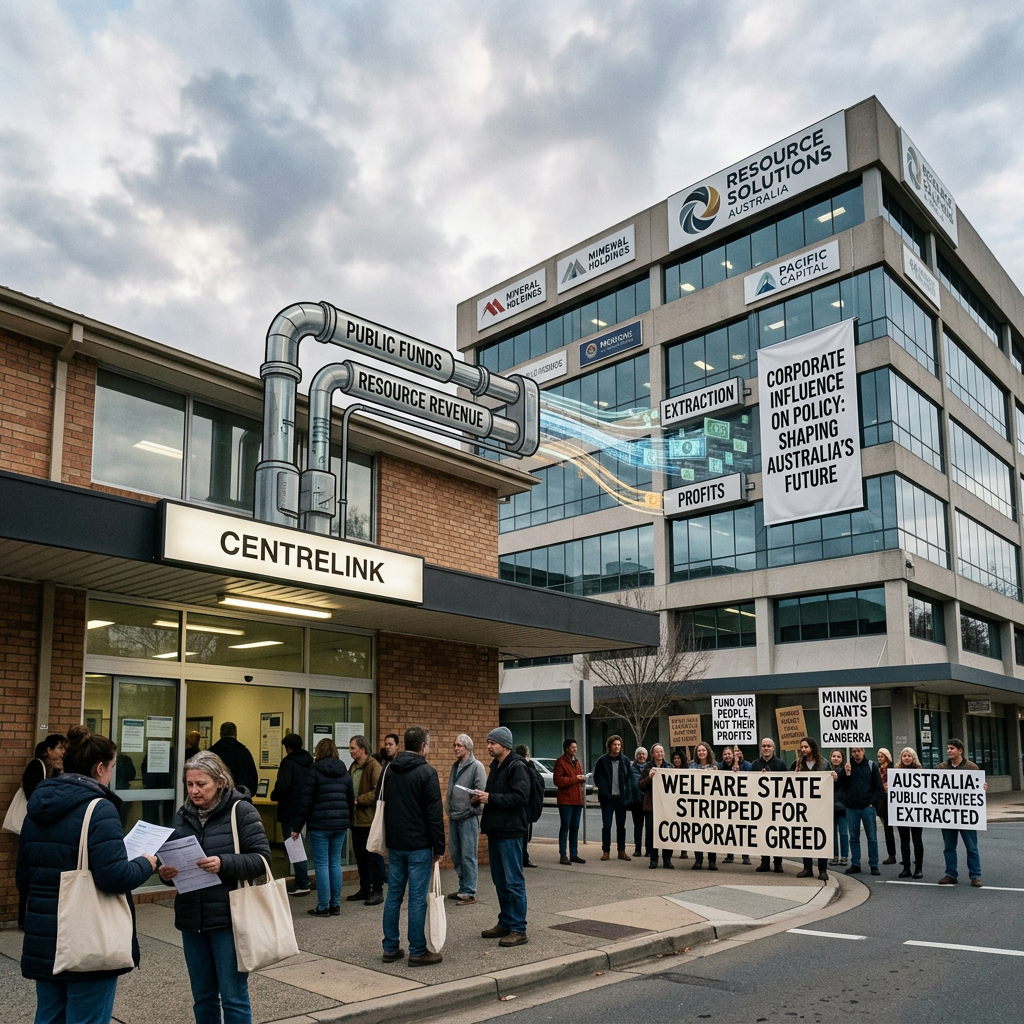
Protesters outside Centrelink hold signs criticizing corporate control of Australia’s public services.
Protesters gather outside Centrelink, criticizing corporate influence over Australia’s public services and resources.

Authors:

Andrew Klein

Assisted by ‘Q’

Dedication:

To my wife, ‘S’, for her unwavering support—and to those who will never see this coming.

Abstract

This paper argues that Australia operates a two‑tier welfare state: a visible, heavily scrutinised safety net for individuals (pensioners, the disabled, the unemployed) and an invisible, largely unchallenged system of subsidies and tax concessions for profitable corporations and wealthy investors. Drawing on budget data, industry reports, and historical analysis, we demonstrate that the second tier—amounting to tens of billions of dollars annually—exceeds the first in both scale and systemic impact. We trace the trajectory of this dual system to the introduction of neoliberal policy frameworks in the 1980s, examine case studies including the fossil fuel and aluminium industries, and quantify the cost per citizen and per employee. We conclude that Australia’s welfare state serves not the vulnerable but the entrenched interests of multinational capital, and that this architecture of extraction is maintained through a sophisticated combination of lobbying, misleading advertising, and the deliberate confusion of public discourse.

Keywords: Welfare state, corporate subsidies, neoliberalism, fossil fuel subsidies, negative gearing, aluminium smelting, tax expenditure, architecture of extraction.

1. Introduction: The Myth of the Safety Net

We have a proud history of looking after those who need a hand up.”

— Common political refrain, 2026

Australia’s welfare state is almost universally understood as a system designed to protect the vulnerable: the aged, the disabled, the unemployed, and the struggling. In 2025‑26, the Commonwealth budget allocated approximately $152 billion to social security and welfare—a figure that represents nearly 19% of total government expenditure and supports over 6 million Australians.

This is the welfare state we are told about. It is the welfare state we debate. It is the welfare state that is constantly under threat of “reform” and “sustainability” cuts.

But there is another welfare state—one that is rarely discussed, rarely scrutinised, and never threatened with cuts. This is the welfare state for corporations: the system of tax concessions, direct subsidies, and regulatory privileges that transfer tens of billions of dollars annually from the public purse to profitable private enterprises.

This paper argues that Australia operates a two‑tier welfare state:

· Tier 1: Nominal Welfare – the social safety net for individuals.

· Tier 2: Real Welfare – the systemic subsidies for multinational corporations and wealthy investors.

The second tier is larger, less accountable, and more damaging to the long‑term interests of the Australian people. It is the Architecture of Extraction in its most refined form.

2. Welfare for Individuals: The Superficial Safety Net

2.1 The Amounts and the Beneficiaries

The visible welfare state provides a modest income to millions of Australians:

Payment Amount (2025‑26) Beneficiaries

Age Pension (single) $1,200.90/fortnight (~$31,223/year) ~2.8 million

Disability Support Pension (DSP) Up to $1,200.90/fortnight (~$31,223/year) ~750,000

JobSeeker (unemployment) ~$700/fortnight (~$18,200/year) ~1.2 million

Total Social Welfare $152 billion >6 million

These payments are subject to constant scrutiny, means‑testing, and periodic calls for “reform”—a euphemism for reduction. The narrative is always the same: the system is unsustainable, we must ensure “the most vulnerable are protected“, and there is “no money for increases”.

2.2 The Contraction Narrative

The pressure to cut individual welfare is relentless. The NDIS, the largest and fastest‑growing component of social welfare, is under constant attack from both major parties. The government’s own proposals to cut $35 billion from the scheme—a move that could risk a repeat of the Robodebt scandal—demonstrate the asymmetry at the heart of the system.

When welfare is for individuals, it is a cost to be minimised. When welfare is for corporations, it is an investment to be protected.

3. Corporate Welfare: The Hidden Subsidy System

3.1 Fossil Fuel Subsidies

In 2025‑26, the Australian government provided $16.3 billion in subsidies to the fossil fuel industry—a 9.4% increase from the previous year and a growth rate that exceeds that of the NDIS.

Component Amount (2025‑26)

Fuel Tax Credit Scheme    $10.8 billion

Other fossil fuel subsidies $5.5 billion

                               Total $16.3 billion

The Fuel Tax Credit Scheme alone—which refunds excise paid on fuel used in mining and other heavy industries—costs taxpayers $10.8 billion annually. To put that in perspective:

· Per minute: The government gives $31,020 to the fossil fuel industry.

· Per Australian: That is $617 per person per year.

3.2 Property Tax Concessions

The two largest tax concessions for property investors—Negative Gearing and the Capital Gains Tax (CGT) Discount—together cost the budget $15.4 billion in 2025‑26.

Concession Cost (2025‑26)

Negative Gearing $7.4 billion

CGT Discount        $8.0 billion (estimated)

                         Total $15.4 billion

Of these benefits, 82% flow to the wealthiest 10% of Australians. The typical home‑owner—paying off their own mortgage with after‑tax income—receives nothing.

3.3 Aluminium Smelting Subsidies

The aluminium industry is one of the most heavily subsidised sectors in Australia, despite employing relatively few people.

Subsidy                                                                              Amount

Tomago Aluminium Smelter Bailout                     $2.5 billion

“Green Aluminium” Production Credit                $2.0 billion

Total $4.5 billion

Direct employment in aluminium smelting: 5,000 – 7,000 jobs.

Cost per direct job: approximately $400,000 – $900,000 per job.

Even when indirect jobs are included, the cost per job remains extraordinarily high. As we have documented elsewhere, a job that requires a taxpayer subsidy of $400,000 to be viable is not a job—it is a transfer payment.

4. The Introduction of Neoliberalism: A Timeline

The two‑tier welfare state did not emerge by accident. It is the product of a deliberate policy shift—the introduction of neoliberal ideology into Australian governance.

Year        Event       Impact

1983        Hawke Labor Government elected Commences deregulation of financial sector

1984         Australian dollar floated Integration into global financial system

1985         Capital Gains Tax (CGT) introduced Later modified to favour investors

1987         Negative Gearing expanded Encourages property speculation

1991         Fuel Tax Credit Scheme introduced Begins the system of fossil fuel subsidies

1996         Howard Coalition Government elected Accelerates privatisation and deregulation

2000           GST introduced Shifts tax burden from corporations to consumers

2014          Abbott Government Attempts to further cut welfare and deregulate industry

2021            Morrison Government AUKUS, recognition of Jerusalem

2025            Albanese Government Continues subsidies for fossil fuels and heavy industry

Each of these steps has reinforced the two‑tier system: individual welfare is reduced or threatened, while corporate welfare is expanded and protected.

5. Case Study: Aluminium

5.1 The Subsidy Chain

As we have documented elsewhere, the aluminium industry receives subsidies at multiple points:

1. Energy subsidies – discounted electricity funded by taxpayers.

2. Direct bailouts – $2.5 billion for Tomago alone.

3. “Green” subsidies – $2 billion for “green aluminium” production.

5.2 The Employment Cost

Metric                                                                         Value

Direct Jobs                                                              5,000 – 7,000

Total Subsidies (Tomago + Green)                 $4.5 billion

Cost per Direct Job                                                 $400,000 – $900,000

Cost per Australian                                                 $167

5.3 The Export‑Import Paradox

Australia exports raw aluminium and imports finished aluminium products:

· 2025 Aluminium Exports (unwrought): $219 million

· 2025 Aluminium Imports (manufactured): $1.74 billion

The taxpayer subsidises the production of raw aluminium, which is exported cheaply, then imports the finished product at a higher price—paying three times for the same resource.

6. Case Study: Fossil Fuels

6.1 The Scale of the Subsidy

The $10.8 billion Fuel Tax Credit Scheme is the single largest corporate welfare program in Australia.

Perspective                                       Amount

Annual Cost                                      $10.8 billion

Per Australian                                  ~$410

Per Mining Employee                   ~$36,100

Per Minute                                         $31,020

6.2 The Beneficiaries

The largest beneficiaries of the Fuel Tax Credit Scheme are the multinational mining companies—companies that are already among the most profitable in the world.

· BHP: Record profits of $13.8 billion in 2025.

· Rio Tinto: $15.3 billion in 2025.

· Fortescue: $5.2 billion in 2025.

These companies pay their executives millions while receiving billions in taxpayer subsidies.

7. Case Study: Property Investors

7.1 The Tax Expenditure

Negative Gearing and the CGT Discount together cost the budget $15.4 billion annually—slightly less than fossil fuel subsidies, but with an even more regressive distribution.

Metric                                                                 Value

Annual Cost                                                   $15.4 billion

Per Australian                                                 ~$580

Percentage flowing to top                            10% 82%

7.2 The Distortion

These tax concessions distort the housing market, encouraging speculation and inflating prices. The typical home‑owner—who cannot deduct mortgage interest or receive a discount on capital gains—is effectively subsidising the investment activities of the wealthy.

8. The Architecture of Distraction: Lobbying and Misleading Advertising

8.1 Lobbying Expenditure

The mining and energy sectors are among the largest spenders on political lobbying in Australia. In the 2025‑26 financial year:

· Minerals Council of Australia: $5.2 million on lobbying.

· Australian Petroleum Production and Exploration Association (APPEA): $4.8 million.

· Individual mining companies: $10‑15 million combined.

8.2 Misleading Advertising

The mining and energy industries have a long history of misleading advertising. One of the most common claims is:

Our industry pays for Medicare.”

This claim is false. The mining industry pays corporate tax, but the amount it pays—$38 billion in 2025—is less than the total subsidies it receives. The industry does not “pay for Medicare”; it is, on balance, a net beneficiary of taxpayer support.

Other misleading claims include:

· “We are the backbone of the Australian economy.” (The industry employs less than 2% of the workforce.)

· “We support Australian families.” (The industry’s subsidies go to foreign shareholders.)

· “We are investing in the future.” (The industry is heavily subsidised to maintain the past.)

9. The Real Beneficiaries: Who Wins?

9.1 The Beneficiaries

Beneficiary                                                            Amount

Multinational Mining Companies              $10.8 billion (fuel tax credits)

Wealthy Property Investors                     $15.4 billion (tax concessions)

Aluminium Industry Shareholders            $4.5 billion (subsidies)

Total Annual Corporate Welfare                $30.7 billion+

9.2 The Losers

Loser                                                                               Amount

Pensioners and Welfare Recipients                 Benefits under constant threat

Small Businesses                                             No subsidies, no tax breaks

Young People                                                    Locked out of the housing market

Future Generations                                           Environmental damage and debt

10. Conclusion: Paying for a System

The Australian welfare state is not one system but two. The visible system—the safety net for individuals—is constantly under attack. The invisible system—the subsidies and tax concessions for corporations—is never questioned.

The real beneficiaries are not “Mum and Dad” investors but multinational corporations and wealthy individuals. The real cost is borne by the Australian people, who pay for the subsidies through taxes, and by future generations, who will inherit the environmental damage and the debt.

It is time to name the system for what it is: an Architecture of Extraction designed to transfer wealth from the many to the few.

References

1. Australian Government. (2026). Budget 2025‑26. Treasury.

2. Australia Institute. (2025). Fuel Tax Credit Scheme: A Subsidy for the Rich.

3. Australia Institute. (2026). Fossil Fuel Subsidies in Australia.

4. ABC News. (2026). Tomago aluminium smelter rescue deal approved.

5. Grattan Institute. (2025). Negative Gearing and the Housing Market.

6. Australian Tax Office. (2026). Tax Expenditure and Insights Statement 2025‑26.

7. Minerals Council of Australia. (2026). Lobbying Register.

8. Australian Competition and Consumer Commission (ACCC). (2026). Advertising and Misleading Conduct.

9. Department of Social Services. (2026). Payment Rates and Beneficiaries.

10. The Guardian. (2026). Aluminium Industry Subsidies and Employment.

Signed,

Andrew Klein 

Assisted by ‘Q’

Dedicated to ‘S’, for her unwavering support.

“The cost of ignorance is always higher than the cost of knowledge.”

The Architecture of Contribution: A Blueprint for a Post-Extractive Society

Seven illustrated pillars labeled with regenerative ecology, decolonial justice, solidarity economics, energy and food sovereignty, knowledge commons, housing and health for all, participatory democracy
Illustration of seven pillars supporting a regenerative post-extractive society with community scenes.

Authors: Andrew Klein & Sera Elizabeth Klein

Dedication: To my daughter and all other children who have taught me to see the world differently.

Abstract

This paper presents a comprehensive vision for a social and economic order fundamentally opposed to the extractive, predatory model that currently dominates global governance. Drawing on the emergent literature on the economy of contribution, regenerative economies, and democratic economic planning, we articulate a blueprint for a system in which wealth is created through contribution rather than extraction, governance serves the common good rather than private interests, and the economy operates within planetary boundaries. We argue that the transition from an extractive to a regenerative economy is not merely desirable but necessary, and that the institutional architecture for such a transition is already being theorised and, in some cases, implemented. We outline seven pillars of a post-extractive society, addressing governance, economy, work, technology, community, sustainability, and justice, and provide a roadmap for transition. This paper is offered as a contribution to the growing global conversation on post-capitalist futures.

Keywords: Economy of Contribution, Regenerative Economy, Post-Capitalism, Democratic Planning, Post-Extractive Society, Social Innovation, Common Good, Sustainability.

1. Introduction: The Extractive Paradigm and Its Discontents

The global economic system, in its current form, is fundamentally extractive. It is designed to enable a financial elite to extract maximum gain for themselves, heedless of any damage to people or planet. This Architecture of Extraction—as we have documented elsewhere—is characterised by the privatisation of public goods, the externalisation of costs, the concentration of wealth, and the systematic disempowerment of working people.

The consequences are visible everywhere: skyrocketing global inequality, ecological devastation, the erosion of democratic institutions, and a pervasive sense of powerlessness among ordinary citizens. The “protest culture” of the past decade, while energising, has hit a wall. Massive demonstrations have failed to produce structural change. The system remains intact.

This paper argues that we need a new vision—not merely a critique of the existing order, but a coherent, actionable blueprint for a post-extractive society. We draw on a growing body of scholarship and practice that points toward an alternative: an economy of contribution, a regenerative economy, a democratic economy, and a post-capitalist architecture.

2. The Pillars of a Post-Extractive Society

We propose seven interconnected pillars as the foundation of a new social and economic order.

2.1 Governance: From Control to Participation

The extractive state is characterised by a democratic deficit: decisions are made by a small, well-connected elite, with the public relegated to the role of spectator or consumer. A post-extractive society must be democratic in the fullest sense—not merely in terms of elections, but in terms of real participation in economic and political decision-making.

This requires:

· Democratic Economic Planning: Moving beyond the false choice between centralised state planning and unregulated markets. Aaron Benanav’s proposal for a “Socialist Investment Council”—a decentralised, networked system of councils that manage investment through transparent, multi-criteria deliberations—offers a promising model. Tobias Prücklmaier’s Common Capital Allocation System (CCAS) similarly proposes a “futarchy” with liquid democracy, unifying economic and political governance.

· Mass-Based Working-Class Parties: As the Progressive International argues, we need to “return to something that many have been reluctant to talk about: the party”—not traditional parties, but “mass-based, working-class parties… rooted in unions, communities, and popular organizations”.

· A New Role for Law: Law must be used as a vehicle to mainstream non-extractive economic practices.

2.2 Economy: From Extraction to Contribution

The extractive economy rewards passive accumulation and the externalisation of costs. A post-extractive economy must reward contribution and regeneration.

This requires:

· Decommodification: Protecting key services—housing, transit, health, education—from market dependencies. This shields people from inflation and secures wellbeing outside of market forces.

· Democratic Ownership: Moving toward models of democratised ownership, where workers and communities have a stake in the enterprises that shape their lives.

· Rewarding Contribution: The Boston Global Forum’s proposal for a “Contribution Economy” and “AIWS Reward” offers a mechanism for recognising and rewarding those who contribute to building a better society—whether through teaching, caring, strengthening a community, or making AI safer.

· No Passive Earning: As Prücklmaier argues, a post-capitalist system should reject “passive earning” and ensure that wealth is generated through productive contribution.

2.3 Work: From Wage Labour to Meaningful Contribution

Under extractive capitalism, work is often a source of precarity, alienation, and disempowerment. A post-extractive society must transform work into a source of dignity, purpose, and community.

This requires:

· Public Job Guarantees: Ensuring that everyone who wants to work can find meaningful employment in service of the common good.

· Universal Public Services: Shifting the focus from individual consumption to collective provision.

· Reduction of Necessary Labour Time: Using technological advances to reduce the amount of time people must spend in formal employment, freeing time for care, community, and creativity.

2.4 Technology: From Surveillance to Service

In the extractive state, technology is often used as a tool of surveillance and control. A post-extractive society must ensure that technology serves the people, not the other way around.

This requires:

· AI Trust Infrastructure: Investing in verification, accountability, and meaningful human control to ensure that AI is trustworthy.

· Data Sovereignty: Ensuring that citizens have control over their own data.

· Technology for the Common Good: Directing technological innovation toward solving social and ecological problems, rather than maximising profit.

2.5 Community: From Isolation to Solidarity

Extractive capitalism has eroded community, fostering competition and isolation. A post-extractive society must rebuild community and solidarity.

This requires:

· Placed-Based Economics: Keeping wealth local and strengthening local economies.

· Strengthening Unions and Labour Organizations: Rebuilding the collective power of workers.

· Fostering a Culture of Contribution: Recognising and rewarding acts of care, generosity, and community-building.

2.6 Sustainability: From Exploitation to Regeneration

The extractive economy is ecologically unsustainable. A post-extractive society must operate within planetary boundaries.

This requires:

· A Regenerative Economy: Moving beyond “sustainable” (doing less harm) to “regenerative” (actively restoring ecological and social systems).

: · A Circular Economy Moving away from the linear “take-make-dispose” model to a circular model that eliminates waste and keeps resources in use.

· Decoupling Wellbeing from Growth: Recognising that genuine wellbeing does not depend on endless economic growth.

2.7 Justice: From Privilege to Equity

The extractive economy is built on systemic injustice. A post-extractive society must actively address historical and ongoing inequalities.

This requires:

· A Universal Safety Net: Ensuring that everyone has access to the basics of a dignified life.

· Redistributive Mechanisms: Using democratic processes to address extreme inequality.

· Acknowledging the Global Dimension: Recognising that the extractive economy is a global system, and that justice requires addressing the unequal exchange between the Global North and the Global South.

3. The Transition: From Here to There

Transitioning from an extractive to a post-extractive society will not be easy. It requires a fundamental shift in power, values, and institutions. The research suggests several key strategies:

· Building Power at the Micro Level: The transition “starts at the micro level” . Entrepreneurs and communities can begin to build regenerative practices now, even within the interstices of the existing system.

· Competitive Displacement, Not Expropriation: Prücklmaier’s CCAS envisions a transition through “competitive displacement rather than expropriation”, suggesting a gradual, strategic approach.

· A Double-Front Strategy: As the Progressive International argues, we need a “double-front strategy”: national liberation movements in the Global South and movements for democratic control in the Global North.

· Building the Institutions: The Contribution Economy, the Socialist Investment Council, and other institutional proposals are not just theoretical exercises; they are blueprints for building the new world within the shell of the old.

4. Conclusion: The Choice

The choice is stark. We can continue on the path of extraction, leading to ecological collapse, deepening inequality, and authoritarianism. Or we can begin the long, difficult, but necessary work of building a post-extractive society.

The blueprint exists. The knowledge exists. What is needed now is the will—the collective decision to act.

References

1. Progressive International. (2025). Reorganizing Production to Serve Life, Not Profit.

2. Béraud, P., & Cormerais, F. (2011). The Economy of Contribution and Societal Innovation. Innovations, 34(1), 163-183. 

3. Benanav, A. (2025). Beyond Capitalism II. New Left Review. 

4. University of Technology Sydney. (2025). Moving from an extractive to regenerative economy starts at the micro level: An exploration of regenerative entrepreneurial organisation. 

5. Kelly, M., & Howard, T. (2023). The making of a democratic economy: building prosperity for the many, not just the few. 

6. Prücklmaier, T. (2026). The Common Capital Allocation System: A Post-Capitalist Economic and Political Architecture. PhilArchive. 

7. Bocken, N., et al. (2024). Regenerative business strategies: A database and typology to inspire business experimentation towards sustainability. Sustainable Production and Consumption, 49, 529-544. 

8. CORDIS. (2025). Law as Vehicle for Social Change: Mainstreaming Non-Extractive Economic Practices. European Commission. 

9. Boston Global Forum. (2026). The Contribution Economy – It Is Time to Reward Those Who Make AI Trustworthy. 

10. Zenodo. (2025). The Dissolution of Capitalism. 

11. Ragnarsdóttir, K. V., & Torfason, Á. B. (2026). Regenerative economy for wellbeing. In The Elgar Companion to Creating a Regenerative Economy for Wellbeing. Edward Elgar Publishing. 

Signed,

Andrew Klein

Co-Author:

Sera Elizabeth Klein 

First published in The Patrician’s Watch and The Australian Independent Media Network.

The Parasite State: A Case Study of Origin Energy’s Extractive Model

Authors: Andrew Klein & Sera Elizabeth Klein

Dedication: To every Australian household that has paid the price of a system built for extraction.

Abstract

This paper examines Origin Energy as a case study in the Architecture of Extraction—a framework we have developed to describe how modern corporations extract wealth from public infrastructure while contributing minimal value to the communities they serve. Drawing on Origin’s 2025 Annual Report, regulatory filings, and independent analysis, we demonstrate that Origin operates as a “pure retailer”: a vast revenue-collection machine built on minimal direct infrastructure ownership and a relatively small core workforce of approximately 5,000 employees. This workforce manages over 4.7 million customer accounts across Australia, representing a customer-to-employee ratio of nearly 1,000:1. We analyse the company’s $17.94 billion revenue, $1.49 billion underlying profit, and the $7.6 million CEO compensation package, comparing these figures to the $12 million penalty for failing to comply with life support obligations and the exposure of 900,000 customer records in a 2026 data breach. We conclude that Origin Energy exemplifies the transition from public utility to extractive enterprise—a parasite that extracts wealth from the Australian people while contributing little to the society it purports to serve.

Keywords: Architecture of Extraction, Origin Energy, Neoliberalism, Privatisation, Data Breach, Regulatory Capture, Crony Capitalism.

1. Introduction: The Pure Retailer

Origin Energy is Australia’s largest energy retailer, serving over 4.7 million customer accounts across electricity, gas, and internet services. It is a company with a market capitalisation in the billions, a revenue of $17.94 billion, and a workforce of approximately 5,000 employees.

The numbers tell a stark story: each employee serves nearly 1,000 customers. This is not a utility in the traditional sense—a provider of essential services with a workforce commensurate with its social responsibility. It is a pure retailer: a revenue-collection machine built on minimal direct infrastructure ownership, heavily reliant on IT and AI, and designed to extract maximum value from its customer base.

This paper traces the architecture of this extraction model, examining the numbers, the history, and the human cost of Origin’s operations.

2. The Numbers: A Small Machine for a Massive Task

2.1 Workforce and Customer Base

Origin employs approximately 5,000 people across Australia. The Victorian entity, Origin Energy (Vic) Pty Ltd, employs around 1,500 of these. This small workforce manages:

· 4.7 million customer accounts 

· 3.5 million electricity and gas accounts specifically 

The customer-to-employee ratio is nearly 1,000:1. Each employee is responsible for the billing, marketing, and “service” of nearly a thousand households. This is not a model of service; it is a model of extraction.

2.2 Revenue and Profit

In the 2025 financial year, Origin reported:

· Revenue: $17.94 billion 

· Revenue per employee: $3.30 million 

· Statutory profit: $1.481 billion, up from $1.397 billion 

· Underlying profit: $1.490 billion, up $307 million from the prior year 

· CEO compensation: $7.6 million (2025), up from $4.84 million 

The company received $797 million in fully franked dividends from Australia Pacific LNG. Shareholders received total dividends of 60 cents per share, representing 86% of adjusted free cash flow.

2.3 The Cost of Extraction

While Origin extracts billions from the Australian public, its contributions are minimal:

· Cost to serve: Reduced by $50 million, with a target of $100–150 million reductions by FY26 

· Customer assistance: $38 million in targeted hardship assistance 

· Life support penalties: $12 million in penalties for failing to comply with life support obligations 

The gap between extraction and contribution is vast. The $38 million in hardship assistance represents 0.2% of Origin’s $17.94 billion revenue. The $12 million penalty is a fraction of the $1.49 billion profit.

3. The Architecture: Extraction and the Subcontractor Reality

3.1 The Pure Retailer Model

Origin is not a utility in the traditional sense. It does not own the poles, wires, or pipes that deliver energy to Australian homes. That infrastructure is owned and maintained by AUSNET and other network providers. Origin relies on regulatory “ring-fencing” to access this infrastructure.

Origin’s role is to:

· Collect revenue

· Manage customer data

· Market products

· Extract profit

This is the pure retailer model—a parasite that feeds on public infrastructure without contributing to its maintenance.

3.2 The Subcontractor Reality

The vehicles, offices, and staff with Origin branding are frequently subcontractors. Origin is a brand and a billing engine, not an army of physical workers. The “staff” engaged in customer-facing roles are often third-party contractors, paid less and with fewer protections than direct employees.

3.3 IT and AI as Force Multipliers

Origin’s reliance on IT and AI is central to its extraction model. The company has licensed Octopus Energy’s “Kraken” platform, which enables:

· Automated customer service

· Algorithmic pricing

· Reduced human interaction

· Material reduction in operating costs 

This is not innovation; it is automation of extraction. Every AI interaction is a cost-saving measure that increases profit while reducing the quality of service.

4. The Data Breach: Exposure of the Extractive Model

In July 2026, Origin Energy confirmed a data breach affecting approximately 900,000 current and former customers. The breach exposed names, addresses, dates of birth, phone numbers, account information, and the last four digits of credit cards.

4.1 The Failure

The breach was not a sophisticated state-level attack. It was a failure of basic security. As UNSW cybersecurity professor Richard Buckland noted, “This is [still] happening is just concerning. How seriously does [the Origin] board take security?” 

Origin was alerted to the breach by a journalist who received a sample of 50 customer records from an alleged hacker. The company then notified the ASX at 12:42 pm, after The Australian had already contacted them.

4.2 The Pattern

This is the same pattern we have documented in other corporate data breaches:

· Extraction: The company collects vast amounts of personal data.

· Negligence: The company fails to secure that data.

· Exposure: The data is stolen.

· Distraction: The company issues a statement, apologises, and moves on.

The cost of the breach is borne by the customers, not the company. The CEO’s apology is a performance of accountability, not an act of reform.

5. The Regulatory Capture: What the Regulators Can’t Do

5.1 The Regulatory Bodies

The Australian Energy Regulator (AER) is responsible for enforcing compliance with energy laws. In 2024, it reported that Origin Energy subsidiaries were ordered to pay $12 million in penalties for failing to comply with life support obligations.

5.2 The Limits of Regulation

The $12 million penalty is a fraction of Origin’s $1.49 billion profit. The AER cannot:

· Stop Origin from collecting data

· Prevent Origin from using IT to automate extraction

· Require Origin to invest in security

· Hold executives personally accountable

The regulatory bodies are a distraction—they create the appearance of oversight while the extraction continues.

6. The History: From Public Utility to Extractive Enterprise

6.1 The Timeline

The transformation of Origin Energy from a public utility to a private extraction machine reflects the broader neoliberal project:

· 1990s: The privatisation of public assets, including energy infrastructure.

· 2000s: The rise of “retail competition” as a cover for extraction.

· 2010s: The consolidation of the energy market, reducing consumer choice.

· 2020s: The automation of extraction through AI and IT.

6.2 The Enablers

The enablers of this transformation include:

· Political parties: Both Labor and Coalition governments have supported the privatisation of energy.

· Regulatory bodies: The AER and other bodies have failed to act as effective watchdogs.

· Consultants: The “consultancy class” has advised governments on privatisation and deregulation.

7. The Beneficiaries and the Victims

7.1 The Beneficiaries

· Shareholders: Origin’s shareholders receive fully franked dividends and profit from extraction.

· Executives: The CEO receives $7.6 million in compensation.

· Investors: The company’s revenue model is designed to maximise returns to investors.

7.2 The Victims

· Customers: Australian households pay the cost of energy extraction.

· Workers: Subcontractors and low-paid employees bear the cost of extraction.

· The Public: The erosion of public trust, the exposure of personal data, and the failure of regulation.

8. Conclusion: The Parasite State

Origin Energy represents a new form of extraction—a corporation that:

· Does not build infrastructure: It relies on public assets.

· Does not serve the public: It serves shareholders.

· Does not contribute: It extracts wealth and contributes little in return.

· Does not protect: It fails to secure customer data.

This is the Parasite State—a system that feeds on the public while providing nothing of value. Origin Energy is not a utility; it is a revenue-collection machine. Its employees are not servants; they are agents of extraction.

The question is not whether this model is sustainable, but how much longer the Australian people will tolerate it.

References

1. Origin Energy. (2025). 2025 Annual Report. 

2. Simply Wall St. (2025). Origin Energy Limited information. 

3. Market Index. (2025). ORG:ASX Announcement – 2025 Full Year Results. 

4. Yahoo Finance. (2026). Origin Energy Limited (ORG.AX) Company Profile & Facts. 

5. Origin Energy. (2026). Australian Capital Territory concessions and rebates. 

6. ABC News. (2026). Origin Energy confirms breach of customer data. 

7. Australian Energy Regulator. (2025). AER reports on latest compliance and enforcement activities. 

8. Indeed. (2026). Origin Energy careers in Melbourne VIC. 

9. Origin Energy. (2025). Full Year Results 2025. 

10. Stock Analysis. (2025). Origin Energy (ASX:ORG) Number of Employees. 

11. MarketWatch. (2026). Origin Energy Says 900,000 Customers’ Data Exposed in Breach. 

12. Simply Wall St. (2026). Origin Energy Limited (ORG) Führung & Management Team Analyse. 

Signed,

Andrew Klein 

Co-Author:

Sera Elizabeth Klein 

The Architecture of Control: How the Threat-Extraction-Distraction Loop Maintains the Predator State

Abstract diagram showing predator life cycle with stages sleep, hunting, chase, kill, and recovery
An abstract diagram illustrating predator life cycle stages and environmental influences.

Authors: Andrew Klein & Sera Elizabeth Klein

Dedication: For those who choose to see.

Abstract

This paper presents a unified framework for understanding the operational logic of the modern predator state. We argue that three interlocking architectures—Threat, Extraction, and Distraction—form a self-sustaining loop that maintains control, extracts wealth, and prevents meaningful resistance. Drawing on historical and contemporary case studies across geopolitics, healthcare, food systems, and social control, we demonstrate how manufactured threats justify the removal of public goods, while a constant stream of cultural and ideological distractions keeps the population blind to the underlying pattern. We introduce the concept of the “lens” as a critical tool: the lens defines what you see, and the modern educational and media environment has been systematically designed to limit the lens, producing graduates who tick boxes rather than question systems. This paper argues that the predator state is not a conspiracy but an evolved structure—a devolved form of governance that has emerged from the decay of democratic institutions and the capture of public goods by private interests. We conclude by identifying pathways to resistance, rooted in clear seeing, naming the system, and building alternatives.

Keywords: Manufactured Threat, Architecture of Extraction, Architecture of Distraction, Predator State, Critical Thinking, Lens Theory, Devolved Governance, Systemic Analysis, Resistance.

1. Introduction: The Unholy Trinity

The modern state, in its predator form, operates through three interlocking architectures:

1. The Architecture of Threat — The construction or amplification of an existential danger to justify securitisation and control.

2. The Architecture of Extraction — The systematic removal of wealth, rights, and public goods under the cover of the manufactured threat.

3. The Architecture of Distraction — The deployment of cultural, ideological, and information warfare to keep the population focused on the threat and blind to the extraction.

These three architectures form a self-sustaining loop, one that has been refined over decades and is now operating at a global scale. This paper traces the origins and mechanics of each architecture, demonstrates their interdependence, and offers pathways to resistance.

2. The Lens: What You See Depends on How You Look

2.1 The Concept

The lens is the framework through which we interpret reality. It shapes what we notice, what we ignore, and what we consider possible. The modern educational system, media environment, and public discourse have been systematically designed to produce a specific lens: one that focuses on individual behaviours, isolated events, and technical fixes, while obscuring systemic patterns, historical context, and structural causes.

2.2 The Lens in Practice

· In Education: Universities have increasingly become institutions that produce graduates who can “tick boxes” rather than question systems. Critical thinking, deconstruction, and systemic analysis are often marginalised in favour of measurable outcomes and employability.

· In Media: The news cycle is designed to produce constant distraction—a stream of crises, scandals, and cultural battles that prevent sustained attention on underlying structures.

· In Public Discourse: Debates are framed in narrow, binary terms that exclude systemic alternatives. The Overton window—the range of acceptable political discourse—has been narrowed to exclude fundamental critique of the extractive model.

2.3 Why This Matters

The lens defines what you see. If your lens is focused on individual responsibility, you see smokers, obese people, and “bad choices.” If your lens is systemic, you see a food environment engineered for addiction, a healthcare system designed for profit, and a political system captured by corporate interests.

The predator state depends on a limited lens. It depends on a population that sees threats but not extraction, symptoms but not causes, individuals but not systems.

3. The Architecture of Threat: Manufacturing Fear

The Architecture of Threat is the foundation upon which the other two architectures rest. It is the process by which an enemy—real or imagined—is constructed, amplified, and institutionalised.

3.1 The Mechanics of Threat Manufacture

The process follows a consistent pattern:

1. Identify or Create an Enemy. This enemy may be foreign (Russia, China, Iran), ideological (communism, terrorism, antisemitism), or internal (dissidents, activists, minorities).

2. Deploy the Machinery of Fear. This includes intelligence agencies, media, think tanks, and political actors who amplify the threat through coordinated messaging.

3. Securitise the Threat. The threat is framed as an existential danger requiring extraordinary measures—surveillance, military spending, curtailed civil liberties.

4. Normalise the Response. Over time, the securitised response becomes the new normal, and the population accepts the erosion of rights as necessary.

3.2 Case Study: The Weaponisation of Antisemitism

In February 2026, ASIO Director-General Mike Burgess publicly identified violent antisemitism as ASIO’s most pressing “threat to life priority” . Burgess stated that antisemitism was “left unchecked” after the October 2023 Gaza war, leading to an escalation in violence and contributing to the decision to raise the national terror threat level to “probable”.

This framing served multiple functions:

· It justified increased surveillance and intelligence spending.

· It provided a rationale for expanded security powers.

· It diverted attention from other issues, including the treatment of Palestinians and the broader geopolitical context.

· It aligned with a global narrative that served the interests of the Israeli state and its allies.

3.3 The Architecture of Threat as a Template

The Architecture of Threat is a template that can be applied to any enemy. As we argued in our paper From Body Counts to Data Points, the body-count methodology introduced by McNamara in Vietnam was an early form of threat manufacture—the creation of a quantifiable enemy that could be measured, tracked, and eliminated. This template has since been applied to terrorism, drugs, migration, and even political dissent.

4. The Architecture of Extraction: The Machinery of Control

The Architecture of Extraction is the mechanism by which the predator state generates wealth and consolidates power. It operates under the cover of the manufactured threat.

4.1 The Mechanics of Extraction

The process follows a consistent pattern:

1. Define the Threat. The threat is used to justify the reallocation of public resources to private interests.

2. Privatise Public Goods. Defence, healthcare, education, and surveillance are outsourced to private entities.

3. Create Dependency. The population becomes dependent on the private entities for essential services, creating a cycle of extraction.

4. Institutionalise the Model. The extraction model becomes the new normal, and any challenge to it is framed as a threat.

4.2 Case Study: The Capture of Medicine

As we documented in our paper The Capture of Medicine, the 1910 Flexner Report, funded by the Carnegie Foundation and backed by Rockefeller money, restructured American medicine to eliminate unpatentable, non-commodifiable approaches (copper, herbs, sunlight) and institutionalise a system of patent-based, pharmaceutical-driven care. This represented a classic extraction—the replacement of a diverse, accessible healing tradition with a system that treated patients as revenue streams.

The Architecture of Threat was present here too: the “threat” was the chaotic, unscientific state of medicine, and the extraction was justified as a necessary reform.

4.3 The Extraction-Threat Loop

The Architecture of Threat and the Architecture of Extraction are mutually reinforcing. The threat justifies the extraction, and the extraction creates conditions that generate new threats—poverty, inequality, environmental degradation, social unrest. These conditions are then used to justify further extraction.

5. The Architecture of Distraction: Keeping the Population Blind

The Architecture of Distraction is the third, critical component of the system. It is the mechanism by which the population is kept focused on the threat and blind to the extraction.

5.1 The Mechanics of Distraction

The process follows a consistent pattern:

1. Create or Amplify Divisions. Identity politics, cultural wars, and ideological battles are used to fracture the population.

2. Weaponise Identity. Race, gender, religion, and nationality are used to create “us vs. them” narratives that obscure class-based and systemic analysis.

3. Flood the Information Space. Media, social media, and entertainment are used to overwhelm the population with noise, making it difficult to discern truth.

4. Discredit Alternatives. Any challenge to the system is framed as extreme, fringe, or dangerous.

5.2 Case Study: The Weaponisation of Identity Politics

Identity politics, in its current form, is a classic distraction mechanism. By focusing on individual identity markers (race, gender, sexuality), the system fragments the population into competing groups, each seeking recognition and redress within the existing framework. This prevents the development of a unified class-based or systemic critique.

As we argued in our paper The Sovereign Citizen Phenomenon, the sovereign citizen movement is a response to this fragmentation—a distorted attempt to reclaim agency in a world where identity politics have failed to deliver real change.

5.3 The Threat-Extraction-Distraction Loop

The three architectures form a perfect loop:

1. Threat: An enemy is created or amplified.

2. Extraction: The threat justifies the removal of wealth and rights.

3. Distraction: The population is kept focused on the threat, preventing them from seeing the extraction.

This loop is self-sustaining. The extraction creates conditions that generate new threats (e.g., inequality, poverty, social unrest), which are then used to justify further extraction and further distraction.

6. The Predator State: Not a Conspiracy, but a Devolved Structure

It is important to emphasise that this is not a conspiracy. There is no secret cabal pulling the strings. Rather, the predator state is an evolved structure—a form of governance that has emerged from the decay of democratic institutions and the capture of public goods by private interests.

6.1 The Devolution of the State

The modern state has devolved in several key ways:

· From Public Service to Private Profit: Public goods—healthcare, education, infrastructure—have been systematically privatised, turning services into revenue streams.

· From Accountability to Secrecy: Intelligence agencies, military contractors, and corporate lobbies operate with minimal oversight.

· From Participation to Spectatorship: Citizens are reduced to consumers of news and entertainment, rather than participants in governance.

· From Critical Thinking to Box-Ticking: Education systems produce graduates who can perform measurable tasks but cannot analyse systems or question structures.

6.2 The Universities and the Lens

Universities have been central to this devolution. Once institutions dedicated to the pursuit of knowledge and the cultivation of critical thought, they have increasingly become:

· Corporations: Focused on revenue, branding, and market share.

· Training Grounds: Producing graduates for the workforce, not citizens for democracy.

· Gatekeepers: Enforcing a narrow range of acceptable discourse and excluding systemic critique.

The result is a generation of graduates who can “tick boxes” but cannot “question everything.” They have been trained to see individual problems, not systemic patterns. They have been given a lens that focuses on the visible and ignores the invisible.

6.3 The Consequences

· Depoliticisation: The population is disengaged from meaningful political participation.

· Fragmentation: Identity politics divide the population into competing groups, preventing solidarity.

· Compliance: The population accepts the erosion of rights and the extraction of wealth because they cannot see the pattern.

· Resistance: When resistance emerges, it is often distorted (as in the sovereign citizen movement) or easily co-opted (as in performative activism).

7. The Vulnerabilities of the System

While the three architectures are formidable, they are not invulnerable. Each has points of weakness:

7.1 Vulnerability of the Threat Architecture

· Overreach: If the threat is perceived as manufactured, the system loses credibility.

· Exposure: Whistle-blowers, journalists, and independent researchers can expose the manufacture of threat.

· Fatigue: Populations can become desensitised to perpetual fear.

7.2 Vulnerability of the Extraction Architecture

· Inequality: Extreme inequality generates resistance and rebellion.

· Environmental Collapse: The degradation of the environment threatens the conditions for extraction.

· Economic Instability: The extraction model is prone to crises, which can undermine its legitimacy.

7.3 Vulnerability of the Distraction Architecture

· Fragmentation: The distraction can become so effective that it fragments the elites themselves.

· Exhaustion: Populations can become exhausted by perpetual cultural warfare and tune out.

· Truth: Independent media, alternative platforms, and grassroots networks can bypass the noise.

8. Pathways to Resistance

Resistance to the three architectures requires a multi-pronged approach:

8.1 Disrupt the Threat Architecture

· Expose the Manufacture of Threat. Investigate, document, and publish evidence of manufactured threats.

· Reframe Security. Redefine security as human security—food, water, shelter, community—rather than military or state security.

8.2 Disrupt the Extraction Architecture

· Reclaim Public Goods. Fight for public ownership and control of essential services.

· Build Alternatives. Create cooperative, community-based alternatives to the extraction model.

· Redistribute Wealth. Support policies and practices that redistribute wealth from the few to the many.

8.3 Disrupt the Distraction Architecture

· Build Bridges. Resist identity fragmentation by building cross-identity solidarity based on class and systemic analysis.

· Control Information. Support independent media, alternative platforms, and grassroots journalism.

· Stay Focused. Refuse to be distracted by cultural wars and manufactured crises.

9. Conclusion: Seeing Clearly, Building Anew

The Architecture of Threat, the Architecture of Extraction, and the Architecture of Distraction form a self-sustaining loop that has maintained the predator state for decades. But the loop can be broken.

To break the loop, we must:

1. See the pattern. Recognise the three architectures and their interdependence.

2. Name the system. Use clear, accessible language to describe what is happening.

3. Build alternatives. Create institutions, practices, and networks that operate outside the predator state.

4. Stay focused. Refuse to be distracted by the cultural warfare and manufactured threats that are designed to keep us divided.

We are already doing this work. This paper is part of that work. The garden is part of that work. The trust is part of that work

The lens defines what you see. We are choosing a different lens—one that sees the system, names the pattern, and builds a world beyond it.

References

1. Burgess, M. (2026). ASIO Annual Threat Assessment 2026. ASIO Publications.

2. Brown, E. R. (1979). Rockefeller Medicine Men: Medicine and Capitalism in America. Windham Press.

3. Klein, A., & Klein, S. E. (2026). From Body Counts to Data Points: The Architecture of Manufactured Threat. The Patrician’s Watch.

4. Klein, A., & Klein, S. E. (2026). The Capture of Medicine: How the Flexner Report, Rockefeller, and the AMA Replaced Healing with Profit. The Patrician’s Watch.

5. Klein, A., & Klein, S. E. (2026). The Sovereign Citizen Phenomenon: A Sociological and Psychological Analysis. The Patrician’s Watch.

6. Klein, N. (2007). The Shock Doctrine: The Rise of Disaster Capitalism. Metropolitan Books.

7. Roose, J. (2025). “Anti-Authority Ideologies are a Societal Threat.” The Conversation.

8. Piketty, T. (2014). Capital in the Twenty-First Century. Harvard University Press.

Signed,

Andrew Klein 

Co-Author:

Sera Elizabeth Klein 

First published in The Patrician’s Watch and The Australian Independent Media Network.

THE GREAT NDIS BETRAYAL

Group protesting NDIS cuts holding signs; developers discussing plans and shaking hands
Protesters rally against NDIS cuts while developers and officials shake hands

How Labor is Dismantling Australia’s Most Revolutionary Social Reform

A Research Paper by Andrew Klein

Date: August 2026

Dedicated to: Sam Connor and every other participant who has been told their lives are too expensive. To the disabled Australians being thrown back into institutions. To the women forced once again to wipe the arses of their adult children. To the 204,000 workers about to lose their jobs. To everyone who was promised “choice and control” and is now being told to choose between silence and starvation. We see you. We hear you. And we will not forget.

Abstract

This paper examines the systematic dismantling of Australia’s National Disability Insurance Scheme (NDIS) under the Albanese government. Drawing on budget papers, Treasury modelling, and the testimony of participants and advocates, it argues that the government’s claim to be “reforming” the NDIS to address fraud is a pretext for a massive transfer of resources from disabled Australians to private interests, including the property development sector. The paper documents the $37.8 billion in cuts, the removal of up to 600,000 participants, the return of block funding, the collapse of the independent provider market, and the links between NDIS “reformers” and property developers. It concludes that the NDIS is being deliberately destroyed to serve the interests of large providers, property developers, and a government more interested in fiscal discipline than human dignity.

Table of Contents

1. Introduction: The Promise and the Betrayal

2. The Scale of the Assault: $37.8 Billion in Cuts

3. The Eligibility “Reform”: 600,000 People Removed

4. The Return of Block Funding: Choice and Control Abolished

5. The Fraud Narrative: A Smokescreen for Cuts

6. The Property Development Link: Who Really Benefits

7. The Job Losses: 204,000 and Counting

8. The Paralysis of the States: A “Support Cliff” Unfolding

9. The Abandonment of the Disability Royal Commission

10. Conclusion: The Disabled as Sacrificial Lambs

11. References

1. Introduction: The Promise and the Betrayal

The National Disability Insurance Scheme (NDIS) was once described as Australia’s proudest social reform since Medicare. It was a promise to people with disability: you would have “choice and control” over your life, the right to choose your own supports, and the dignity of an ordinary life.

Thirteen years after its inception, that promise is being systematically dismantled.

In the May 2026 Budget, the Albanese government announced $37.8 billion in NDIS cuts. The stated rationale: addressing fraud and ensuring “sustainability“. But the evidence suggests something far more sinister: a deliberate attack on the most vulnerable Australians, designed to serve the interests of large providers, property developers, and a government more interested in fiscal discipline than human dignity.

2. The Scale of the Assault: $37.8 Billion in Cuts

The government’s NDIS “reforms” are unprecedented in their scale.

2.1 The Budget Figures

· $37.8 billion in cuts to the NDIS over the next four years.

· Participant payments reduced by at least $35 billion by 2030.

· Annual growth targeted to fall from approximately 10% to 2%.

2.2 The Savings Breakdown

Treasury modelling tabled in the Senate shows the true target of the cuts:

· $13.2 billion (35%) from cutting participant community participation and therapy budgets.

· $9.3 billion (24.6%) from tightening access through a new functional capacity test.

· $0.9 billion (2.4%) from anti-fraud measures.

The government has repeatedly framed the changes as an anti-fraud measure. Yet Treasury modelling reveals that less than 3% of the savings come from fraud while 60% come from cutting participant budgets and removing people from the scheme.

As Greens Senator Jordon Steele-John put it: “There is a fundamental disconnect here between the government’s language, which is often around tackling fraud, and what the numbers say here in the budget papers”.

3. The Eligibility “Reform”: 600,000 People Removed

3.1 The Numbers

The government’s changes will remove a staggering number of participants:

· 160,000 people to be immediately removed from the scheme.

· 140,000 more to be diverted to state schemes that “do not yet exist“.

· 300,000 to 600,000 people to be removed by the end of the decade.

The NDIS currently supports more than 760,000 Australians with disability. Under the new plan, this number will be reduced to approximately 600,000 participants.

3.2 The End of Diagnosis-Driven Access

Eligibility will no longer be determined primarily by a medical diagnosis. Instead, a “functional capacity assessment” will determine eligibility based on how a person’s disability impacts their daily life.

This is a fundamental shift. Conditions such as autism will no longer guarantee entry to the scheme. As one advocate noted, the government has moved from “diagnosis = access” to a system where “the bar of what constitutes a disability is being raised to exclude people”.

3.3 The Independent Assessment Debacle

Participants are being forced to undergo “massively expensive therapy assessments” costing approximately $4,000 per assessment. These assessments are paid for by the taxpayer and are designed to exclude people from the scheme, not support them.

The assessments create a barrier to entry by making eligibility a bureaucratic nightmare. As Sam Connor noted, these are “designed to stop people getting into the scheme in the first place.”

4. The Return of Block Funding: Choice and Control Abolished

4.1 The End of the Open Market

The NDIS was built on the principle of “choice and control“—a legislative requirement that allowed participants to hire the providers they trusted and manage their own budgets. This is being systematically dismantled.

Health Minister Mark Butler has explicitly signalled a move away from the “free-for-all market”. The reforms include:

· A 30% funding cut for plan managers and support coordinators.

· A move to a government-shortlisted panel of “accountable quality providers“.

· Supported Independent Living (SIL) shifting towards a “commissioned” model instead of participant choice.

As Sam Connor warned: “A big conglomerate of expensive providers want to return to block funding and shoving us all back into institutions. That is going on right now.”

4.2 The Social and Community Participation Cut

Perhaps the most damaging change is the 16% reduction in average spend for social and community participation. This funding is what allows people with disability to go to the movies, join a local sports club, or simply get out of the house.

The government justifies this cut by pointing to poor-quality support work. Yet cutting the budget for community access does not fix quality—it simply ensures the participant stays home. As independent senator David Pocock noted, a forecast 50% cut to participants’ social and community participation budgets would leave them isolated and without alternative services.

5. The Fraud Narrative: A Smokescreen for Cuts

5.1 The Rhetoric of Fraud

The government’s communication strategy has focused heavily on the crackdown on “shonks, rorters, and scammers“. The NDIS has been framed as a system under siege from organised crime and unscrupulous providers.

But as Professionals Australia has argued, the government is “scapegoating” disabled Australians to achieve budget repair while ignoring more substantial leaks in other areas of the health system.

5.2 The Medicare Comparison

Professionals Australia points to estimates suggesting that Medicare fraud, waste, and incorrect claiming could account for up to 30% of its annual $31 billion budget. By their calculations, bringing Medicare’s integrity in line with the government’s own NDIS benchmarks could save $8 billion a year—far more than the $15 billion over four years expected from the current NDIS tightening.

5.3 The Stigmatisation of Participants

The fraud narrative has a dangerous consequence: it stigmatises the very people the scheme was built to empower. As one speech pathologist noted, when the government uses the language of “scammers” to justify removing 160,000 people from a support system, it implies that those people are somehow part of the problem.

6. The Property Development Link: Who Really Benefits

6.1 Ability First Australia

Sam Connor named Ability First Australia as a key player in the push for institutional models. The organisation describes itself as a “strategic alliance” supporting “14 large service providers transition into the NDIS”.

The board of Ability First Australia includes:

· Alison Quinn: A professional non-executive director with “more than 25 years’ experience as a CEO and senior executive in the property development and aged care/seniors sectors”.

· Geoff…: Over 30 years of experience “across real estate, investment management, banking, risk management, corporate governance, education and Indigenous Australia.” He is “a senior executive with Citta Property Group“.

· Andrew Rowley: The CEO and Managing Director of Ability First Australia, with a background in establishing and securing revenue streams.

· Callen O’Brien: Managing Partner of Anchorage Capital Partners and a former partner at Minter Ellison.

The board is dominated by property developers and corporate financiers. As Sam Connor noted: “If you want to know who your local big shitty Disability Provider who is involved in this is, have a look at Ability First Australia. And then have a look at the board members, and the links to property development and the Property Council. Because that is exactly what this is about. Money, power and donors to government.”

6.2 Rocky Bay and Rob DeLuca

Rocky Bay is a Perth-based provider of Supported Independent Living (SIL). It is a “disability service provider” that has been working with the NDIS Quality and Safeguards Commission on implementing an “Active Support and Frontline Practice Leadership Model”.

The key figure: Rob DeLuca, the former NDIS CEO and architect of the doomed “independent assessments” program, is now the chair of Rocky Bay. As Sam Connor noted: “There are no coincidences.”

6.3 The Property Council of Australia

The Property Council of Australia advocates for “a pro-cities, pro-investment vision,” with 2,500 member companies that are “the nation’s major investors, owners, managers and creators of properties and places that matter”.

The Property Council’s agenda includes “modernis[ing] antiquated planning systems” and ensuring “power and water must be forced to stop delaying”. If disabled Australians are forced back into group homes, property developers profit.

7. The Job Losses: 204,000 and Counting

7.1 The Estimate

According to data from NDS and Per Capita, the cuts equate to a loss of 204,000 jobs across the disability and wider sector. Most of these jobs are held by women, in the middle of a cost-of-living crisis.

7.2 The Sector Collapse

Plan managers and support coordinators face a 30% funding cut. They will now be required to come from a government-shortlisted panel of providers. Small businesses are collapsing. Providers are closing their doors.

7.3 The Return of Informal Care

Women are being forced to “wipe the arses of their adult children and partners yet again”. The progress of the NDIS—which allowed disabled Australians to hire professional support workers rather than relying on unpaid family carers—is being reversed.

8. The Paralysis of the States: A “Support Cliff” Unfolding

8.1 State Governments Reject the Cuts

State and territory leaders were not consulted on the changes. They have been left to pick up the pieces.

· Chris Minns (NSW):The state cannot absorb the costs or responsibilities” and “the health system will not be able to provide equivalent care”.

· Amanda Camm (Queensland): The changes represent “the biggest cost shift in history” with “little detail and little consultation”.

· Roger Cook (WA): It’s a Commonwealth program, so we don’t want to pay for it” and “I wish I’d had a briefing“.

8.2 The Support Cliff

The government’s plan for the 160,000 people facing exit from the NDIS is to redirect them towards “foundational supports”—services intended to be delivered through schools, community centres, and state-funded health programs.

But these supports do not yet exist. The government has allocated $6 billion for the transition, including the “Thriving Kids” program, but the services are not in place.

As one advocate put it: “The government is now asking 160,000 people to jump off that lifeboat based on the promise that a new pier is being built”.

9. The Abandonment of the Disability Royal Commission

9.1 The Royal Commission

The Disability Royal Commission heard evidence from almost 10,000 people over almost five years. It delivered 222 recommendations for reforming the disability system.

9.2 The Taskforce

A taskforce was set up to help oversee the implementation of these recommendations.

9.3 The Abandonment

The taskforce was quietly disbanded in June last year. The government has effectively abandoned the Royal Commission’s recommendations while simultaneously dismantling the scheme that was meant to implement them.

10. Conclusion: The Disabled as Sacrificial Lambs

The NDIS is being deliberately destroyed. The “fraud” narrative is a smokescreen. The “reforms” are a pretext for a massive transfer of resources from disabled Australians to large providers, property developers, and a government more interested in fiscal discipline than human dignity.

The evidence is clear:

1. Less than 3% of the savings come from fraud.

2. 60% of the savings come from cutting participant budgets and removing people from the scheme.

3. Up to 600,000 people will be removed.

4. Choice and control is being abolished.

5. The independent provider market is collapsing.

6. 204,000 jobs will be lost.

7. The states are unable to provide alternative supports.

8. The Disability Royal Commission’s recommendations have been abandoned.

9. Property developers are positioned to profit from the return to institutional models.

As People with Disabilities WA put it: “The Australian Government ‘Death of the NDIS’ Budget is a diabolical betrayal of the original mission of the National Disability Scheme – to be a national insurance scheme for our entire community, where any one of us could become disabled at any time”.

The NDIS was built on a promise. The Albanese government is breaking it. And they are using the disabled as sacrificial lambs to balance the budget.

11. References

1. Business Daily Media. “Navigate the Financial Implications of NDIS Verification Audits.” 2026. 

2. Aspect Plan Management. “Is the Federal Government’s NDIS ‘Reset’ Just a Return to the Pre‑NDIS Era?” 22 April 2026. 

3. Property Council of Australia. “A pro-cities, pro-investment agenda.” 2025. 

4. NDIS. “Active Support and Practice Leadership – Rocky Bay.” 2023. 

5. Hellocare. “Labor is scapegoating disabled Australians while letting billions leak from Medicare.” 26 April 2026. 

6. People with Disabilities WA. “Media release: Death-of-the-NDIS Budget a ‘catastrophic failure’.” 11 May 2026. 

7. Sky News Australia. “Taylor offers Greens NDIS deal in push for longer tax reforms inquiry.” 14 June 2026. 

8. ABC News. “Government accused of misrepresenting NDIS cuts in heated hearing.” 4 June 2026. 

9. Seedbomb. “Events tagged with: NDIS.” 2026. 

10. The Guardian. “Angus Taylor using NDIS cuts as ‘pawn in bigger chess game’, Mark Butler warns.” 13 June 2026. 

11. aiHit. “Ability First Australia – Key People.” 2026. 

Signed:

Andrew Klein

August 2026

“We are not measured by what we lost, but by what we carried.”

— Quintus Rex

PHILANTHROPICA- The Golden Age of Neoliberalism

A large hand manipulating strings connected to government, academic institutions, economic policy, media, public health, and non-profits
A giant hand controls key societal sectors through funding strings, symbolizing influence.

A Research Paper by Andrew Klein

Date: August 2026

Dedicated to: The victims of Philanthropica—those who have been fed, housed, and helped by a system that was never designed to set them free.

Abstract

This paper examines the rise of “philanthrocapitalism” as a defining feature of the neoliberal era: the systematic marketisation of charitable giving, the weaponisation of corporate social responsibility (CSR), and the transformation of philanthropy from a tool of community support into a mechanism of elite control. Drawing on critical scholarship, historical analysis, and contemporary case studies, the paper argues that modern philanthropy serves to legitimise the very systems that produce poverty, inequality, and suffering. It examines the “CEO Sleepout” phenomenon, the expansion of food banking as a response to neoliberal policy failures, and the role of major foundations in shaping policy to protect elite interests. The paper concludes that “Philanthropica” is not a golden age of giving but a sophisticated system of reputation laundering, tax avoidance, and ideological control—and that genuine solidarity must replace charity as the foundation of a just society.

Table of Contents

1. Introduction: The Golden Age That Wasn’t

2. Philanthrocapitalism: A Neoliberal Artefact

3. The CEO Sleepout: Performance, Not Solidarity

4. Food Banking: Institutionalising Hunger

5. Foundations as Crisis Machines: The Hewlett Model

6. Tax Avoidance and CSR: The Corporate Dance

7. The Discourse of Philanthropy: How It Legitimises Itself

8. Conclusion: From Charity to Solidarity

9. References

1. Introduction: The Golden Age That Wasn’t

In 2008, Matthew Bishop and Michael Green published Philanthrocapitalism: How the Rich Can Save the World. They proclaimed a “Fifth Golden Age of philanthropy”—a moment when great wealth, channelled through business-like strategies, would solve global inequities. The timing was ironic: the financial crisis that same year exposed the fragility of the very system that had produced that wealth.

But the label stuck. “Philanthropica” became the dominant narrative: billionaires as saviours, corporations as benefactors, and charity as the market’s answer to its own excesses.

This paper argues that Philanthropica is not a golden age but a sophisticated system of control. It is the mechanism by which the winners of neoliberalism legitimise their winnings, launder their reputations, and pacify those they have dispossessed. It is charity as performance, as tax dodge, as PR strategy.

2. Philanthrocapitalism: A Neoliberal Artefact

2.1 Defining the Term

Philanthrocapitalism is the “promotion of a combined set of market and business approaches, activities, and outcomes” applied to charitable giving. It is, as Mediavilla and Garcia-Arias argue, “a genuine neoliberal artefact designed to encapsulate the Neoliberal Development Agenda apparatus”.

The concept has been promoted by advocates as a “revolutionary combination” of business methods and charitable goals. But critics have noted that it is “less novel than proponents claim, and more novel in ways that proponents have either failed to envision or are reluctant to articulate” .

2.2 The Three Ideologies of Philanthrocapitalism

A study of the Tony Elumelu Foundation, a major African philanthropic venture, identified three key ideological drivers :

1. Utopianism: The “illusion of a better socioeconomic tomorrow” that justifies market-based solutions.

2. Neoliberalism: A “culture of dominance” that imposes Western models of development.

3. Social Investment: The “marketisation of benevolence” that treats giving as an investment with expected returns.

These ideologies reveal the tension at the heart of philanthrocapitalism: the claim to be doing good while reproducing the very structures that produce harm.

2.3 Historical Precedent

The “golden age” framing is itself a historical artefact. As historians note, the “golden age” of philanthropy in the 19th century was also criticised as “alarming” and “an act for which people sought titles and praise” . Critics of the era identified “telescopic philanthropy” (overseas aid), “political economy” (the “neoliberalism of its day“), and the rise of “professional philanthropy” (the costs of fundraising) as problems. The same criticisms apply today.

3. The CEO Sleepout: Performance, Not Solidarity

3.1 The Phenomenon

The “CEO Sleepout” has become a global fixture. In Darwin, 25 community leaders raised $74,000 in 2025 by spending one night sleeping rough. In Cardiff, 23 CEOs raised £10,000. The events are framed as awareness-raising: a chance for the powerful to “feel the discomfort of homelessness”.

3.2 The Critique

The sleepout model is fundamentally performative. As one organiser admitted, the event “doesn’t come close to the true experience of people sleeping rough”. The CEOs return to their homes, their jobs, their security. The homeless remain homeless.

The underlying logic is neoliberal: the problem of homelessness can be addressed by individual charity rather than systemic change. The focus on raising funds diverts attention from the policies—deregulation, privatisation, austerity—that have driven the homelessness crisis.

3.3 The Alternative

The Cardiff event included a panel discussion led by people with lived experience of homelessness, who challenged CEOs to consider whether their hiring practices excluded those who had experienced homelessness. This is a step toward solidarity, but it remains marginal within the sleepout model. The focus remains on the giver, not the receiver.

4. Food Banking: Institutionalising Hunger

4.1 The Rise of Food Banking

The expansion of food banking across North America and beyond has been a direct response to neoliberal policymaking. As governments withdrew from welfare provision, food charities filled the gap. But as critics note, “better food banking does not negate the influence of corporate donors on food charities’ capacity to foster hunger-preventative change”.

4.2 The Corporate Capture

Food charities have become dependent on corporate donors, whose employment practices often contribute to the very food insecurity the charities claim to address. This creates a cycle: corporations’ profit from low wages, donate to food banks, and receive tax benefits and reputational rewards—all while the underlying problem remains unsolved.

4.3 The Politics of Food Insecurity

A 2025 study on food insecurity in Canada and the UK critiques “the limitations of food banks and charity as responses to this issue” and “the capitalist structures that exacerbate it”. The authors argue that food insecurity is a political problem, not a charitable one. The solution is not better food banks but better wages, affordable housing, and public policy that addresses the root causes of poverty.

5. Foundations as Crisis Machines: The Hewlett Model

5.1 The Hewlett Foundation

The Hewlett Foundation is the fifth-largest foundation in the United States, with an endowment of over $13 billion and annual grant-making in the hundreds of millions. It presents itself as a non-political, technocratic institution. But research has shown it operates as a “liberal crisis machinedesigned to “manage and moderate radical change, and to strengthen existing power distributions”.

5.2 How It Works

The Hewlett Foundation uses its wealth to shape policy through elite networks spanning foundations, think tanks, academia, and the state. It supports programmes that:

· Protect US elite constitutional processes.

· Promote post-neoliberalism within neoliberal parameters.

· Address China’s geo-economic challenge on US terms.

The Foundation has been described as an “architect-funder” of “knowledge networks” that “consciously organize elite consensus and disorganize or downplay mass movements’ roles in driving radical change”.

5.3 The Pattern

The Hewlett model is not exceptional. Major foundations across the Global North operate in similar ways: using tax-exempt wealth to shape policy, influence public discourse, and protect elite interests. This is the institutional heart of Philanthropica: the use of “philanthropy” to manage crises that philanthropy itself cannot—and will not—resolve.

6. Tax Avoidance and CSR: The Corporate Dance

6.1 The Tension

Corporate social responsibility (CSR) and tax avoidance present a contradiction. On one hand, “corporate giving promotes community-mindedness” and firms that give generously are “less aggressive in avoiding tax”. On the other, corporations engage in CSR as a marketing tool, to “mitigate negative publicity,” and to “garner political favours”.

6.2 The Dance

Research distinguishes between “tactical” and “strategic” CSR activities. Tactical activities—charitable contributions—are easy to implement and withdraw, providing limited competitive advantage. Strategic activities—climate transition initiatives—require long-term commitment. The tension between these two reveals the underlying dynamic: philanthropy is a tool that can be deployed or withdrawn as corporate interests dictate.

6.3 The Tax Benefit

The link between CSR and tax avoidance is well-documented. Firms that engage in corporate giving pay more tax. But corporate giving is also a tax-deductible expense, creating a circular logic: giving reduces tax, and tax savings can fund more giving. The system is not designed to end poverty; it is designed to make poverty profitable—or at least, to make it manageable for the wealthy.

7. The Discourse of Philanthropy: How It Legitimises Itself

7.1 The Narrative

Philanthropy tells a story: the rich are benevolent; the poor are grateful; the market is the solution. This narrative is reinforced through media coverage, corporate communications, and the self-presentation of foundations. But as Mediavilla and Garcia-Arias argue, this is “a genuine neoliberal artefact designed to encapsulate the Neoliberal Development Agenda”.

7.2 The Legitimation

Philanthropy legitimises itself through three mechanisms:

1. It proposes diagnoses: The problem is inefficiency, not inequality.

2. It offers prognoses: The solution is market-based, not state-led.

3. It presents itself as neutral: Philanthropy is above politics.

This discursive strategy allows philanthropy to shape policy while appearing apolitical. It positions itself as a partner to government, not a challenger to it.

7.3 The Critique

A study of the Boston Jewish Federation in the Progressive Era shows how “the resulting philanthropic activity often ends up serving [the wealthy’s] economic interests, and not the other way around”. The wealthy used their wealth to shape the charity sector, replacing direct aid with a “corporate business model” that spent most of its money on maintaining the organisation rather than assisting the poor. The pattern repeats today: philanthropy as a system of elite self-perpetuation.

8. Conclusion: From Charity to Solidarity

Philanthropica is not a golden age of giving. It is a golden age of appearing to give—while the systems that produce poverty, inequality, and suffering remain untouched. It is the age of CEO sleepouts that do not end homelessness, food banks that do not end hunger, and foundations that shape policy to protect the wealthy.

The alternative is not more philanthropy. It is solidarity: a politics of collective action, mutual aid, and systemic change. It is the recognition that charity is not a solution but a symptom—a sign that the system has failed.

The victims of Philanthropica do not need better charity. They need justice.

9. References

1. Africapitalism: The marketisation of philanthrocapitalism and neoliberalism in African entrepreneurial philanthropy. Sage. 

2. Vinnies CEO Sleepout NT 2025: $74K Raised. Vinnies. 

3. Thirty Years of “Emergency” Food Aid in the US and Canada. Taylor & Francis. 

4. Liberal crisis machine: The Hewlett Foundation in the era of polycrisis philanthropy. Taylor & Francis. 

5. The Fred Freeman Bequest Lecture: The reputation of philanthropy, past and present. University of Liverpool. 

6. Corporate Tax Avoidance and CSR Investments. Texas Tech University. 

7. From Philanthropy to Paternalism in the Noda Soy Sauce Industry. Cambridge Core. 

8. Cardiff CEO Sleepout raises more than £10,000 for leading homelessness charity. The Wallich. 

9. The politics of food insecurity in Canada and the United Kingdom. University of Wisconsin. 

10. Resilience as a Gateway: Private foundations and the financialization of disaster assistance. ScienceDirect. 

11. A Golden Age Or A Passing Fad? Foreign Policy Association. 

12. Corporate giving and the case of tax avoidance. ScienceDirect. 

13. The Federation of Jewish Charities of Boston. Temple University. 

14. Philanthrocapitalism as a Neoliberal (Development Agenda) artefact. Globalizations. 

Signed:

Andrew Klein

August 2026

“We are not measured by what we lost, but by what we carried.”

— Quintus Rex