
By Andrew Klein
March 25, 2026
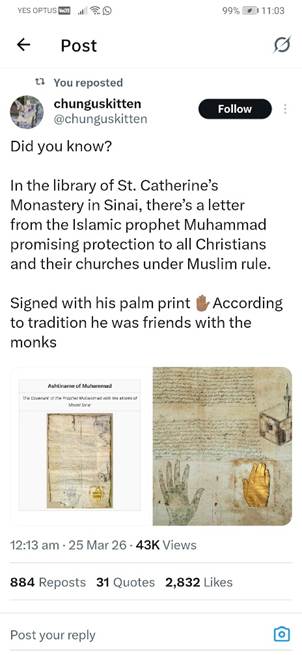
Image from ‘X’
To my wife. Men look for paradise in the stars. I look into the eyes of my wife and find paradise there.
Introduction: A Document the World Forgot
In the library of St. Catherine’s Monastery at the foot of Mount Moses in Sinai, there is a document that should have changed the world. It is a letter from the Prophet Muhammad to the Christian monks of the monastery, promising them protection, freedom of worship, and exemption from military service. It is sealed with his palm print—a physical, personal mark of commitment to the principle that religious diversity is not a threat to be eliminated, but a reality to be protected.
The document is known as the Achtiname. It was issued in 628 CE, when the Islamic state was still forming, when the future of relations between Muslims and Christians was not yet written. It chose coexistence over conflict, protection over persecution.
The world has largely forgotten it. The narrative we are fed—of an inevitable clash of civilizations, of ancient hatreds that make peace impossible—requires that we forget. This article aims to remember.
Part One: The Achtiname – A Covenant of Protection
The Achtiname is preserved in the library of St. Catherine’s Monastery, which has stood at the foot of Mount Moses since the 6th century. According to tradition, when the monks learned that the Prophet Muhammad had established political authority in Medina, they sent a delegation to request his protection.
The document he gave them states:
“This is a message from Muhammad ibn Abdullah, as a covenant to those who adopt Christianity, near and far, we are with them. Verily I, the servants, the helpers, and my followers defend them because Christians are my citizens; and by God, I hold out against anything that displeases them. No compulsion is to be on them. Neither are their judges to be removed from their jobs nor their monks from their monasteries. No one is to destroy a house of their religion, to damage it, or to carry anything from it to the Muslims’ houses.”
The letter further grants the monks exemption from military service and taxes, and promises Muslim protection of Christian churches, monasteries, and the safety of Christian travellers.
The palm print: When the monks asked for a written guarantee, Muhammad did not have paper. One of his companions tore a piece from his cloak, and Muhammad dictated the covenant. Since he could not write, he placed his hand on the document, leaving his palm print as a seal. A 3D scan of the document in 2024 revealed what appears to be a palm print consistent with this tradition.
Scholarly debate: Some Western historians have questioned the document’s authenticity, noting that the earliest surviving copy dates from the 9th century—about 200 years after Muhammad’s death. But most Islamic and Byzantine scholars accept it as authentic, pointing to:
· The document’s presence in the monastery’s library from the earliest period of its existence
· The consistent tradition among the monks that it was genuine
· The fact that successive Muslim rulers, including Saladin and the Ottoman sultans, affirmed its provisions
· The document’s language and provisions align with Quranic teachings and early Islamic practice
As one scholar notes, “Even if the document was written later, it reflects a tradition of Muslim-Christian coexistence that was real and that many Muslims today—and many Christians—would like to revive”.
Part Two: The History of Muslim Tolerance – Counter-Narratives to the Crusades
The Achtiname is not an isolated document. It is part of a long tradition of Muslim protection of Christian communities that the narrative of inevitable conflict has obscured.
The Surrender of Jerusalem to Saladin (1187)
When Saladin recaptured Jerusalem from the Crusaders in 1187, he did not repeat the Crusaders’ massacre of 1099, when they had slaughtered nearly every inhabitant of the city—Muslims, Jews, and Eastern Christians alike. Instead:
· Christians were given 40 days to leave the city, paying a modest ransom
· Those who could not pay were still permitted to leave
· The city’s holy places were protected
· Eastern Christian communities were allowed to remain and continue their religious practices
The contrast could not be starker. As the historian Amin Maalouf writes in The Crusades Through Arab Eyes: “Saladin’s chivalry became legendary, while the Crusaders’ brutality became a defining feature of Western relations with the Muslim world”.
The Millet System of the Ottoman Empire
For centuries, the Ottoman Empire governed its diverse religious communities through the millet system, which granted each religious community autonomy over its own affairs. Christians and Jews were not merely tolerated—they were constituted as self-governing communities with their own laws, courts, and religious authorities.
Under this system:
· The Greek Orthodox Patriarchate in Istanbul became the civil as well as religious leader of all Orthodox Christians in the empire
· The Armenian Apostolic Church was granted similar authority over Armenian Christians
· Jewish communities were governed by their own rabbinical courts
· Religious leaders were responsible for tax collection, education, and civil law within their communities
This system lasted for centuries. It was not a modern invention. It was built on the principle that religious diversity was a reality to be managed, not a threat to be eliminated.
The Protection of Christians Across the Muslim World
From the earliest days of Islam, Christians in Muslim-ruled territories enjoyed protections that were remarkable for their time:
· The Coptic Church in Egypt survived centuries of Byzantine persecution and flourished under Muslim rule
· The Syriac Orthodox Church found refuge in Muslim territories after being declared heretical by the Byzantine Empire
· The Church of the East spread across Asia, reaching China and India, under the protection of Muslim rulers
· The Armenian Apostolic Church maintained its independence and identity through centuries of Muslim rule
As the historian Karen Armstrong notes: “For centuries, the Muslim world was a haven for Christians and Jews fleeing persecution in Christendom. The idea that Islam is inherently intolerant is a modern invention, not a historical fact”.
Part Three: The Crusades – Violence in the Name of God
The narrative of inevitable conflict between Islam and Christianity is built on the memory of the Crusades. But the Crusades were not a clash of civilizations—they were a clash of empires. And they were not the whole story.
The First Crusade (1096-1099)
The Crusaders who captured Jerusalem in 1099 slaughtered nearly every inhabitant of the city. As one Crusader chronicler wrote: “Men rode in blood up to their knees and bridle reins” . Jews were burned alive in their synagogues. Eastern Christians were killed alongside Muslims. The city was emptied of its inhabitants.
This was not a defence of Christendom. It was a conquest. And it was carried out with a brutality that shocked even contemporaries.
Saladin’s Response
When Saladin recaptured Jerusalem in 1187, he did not retaliate in kind. He offered the Christian inhabitants safe passage. He protected the holy places. He allowed Eastern Christian communities to remain. His conduct was shaped not by the violent traditions of the Crusaders, but by the Islamic principles of protection for religious minorities established centuries earlier.
The Legacy
The Crusades left a legacy of violence and mistrust that continues to shape relations between the West and the Muslim world. But they also left a legacy of coexistence. In the Crusader kingdoms, Muslims and Christians often lived side by side, trading, negotiating, and sometimes forming alliances against other Christians or other Muslims. The lines were never as clear as the narrative suggests.
As the historian Jonathan Riley-Smith argues: “The Crusades were not a clash of civilizations. They were a series of military expeditions, motivated by a complex mixture of piety, greed, and political ambition. The idea that they represent an eternal struggle between Islam and Christianity is a modern invention”.
Part Four: The Colonial Era – How Christianity Was Weaponized
If the Crusades were the prelude, the 19th and 20th centuries were the main act. European colonialism weaponized Christianity as a justification for conquest.
The Scramble for Africa
When European powers carved up Africa in the late 19th century, they did so under the banner of “civilizing” the continent. Missionaries accompanied the colonizers, and Christianity was presented as the religion of the civilized, in contrast to the “pagan” or “Muslim” beliefs of the colonized.
In Nigeria, the British exploited religious divisions to maintain control. In Sudan, the Anglo-Egyptian Condominium ruled by dividing the Muslim north from the Christian and animist south. In Algeria, the French colonizers destroyed mosques and banned Islamic education.
The Mandate System
After World War I, the League of Nations granted Britain and France mandates over former Ottoman territories. The Sykes-Picot Agreement of 1916 had already divided the Middle East between them. The borders they drew—Iraq, Syria, Jordan, Lebanon—were designed to serve imperial interests, not the interests of the people who lived there.
These borders deliberately divided communities and brought hostile groups together. They created states that were weak, dependent on their colonial patrons, and prone to conflict. The seeds of today’s violence were planted in those drawing rooms.
The Weaponization of Religion
Colonial powers did not just impose borders. They weaponized religion. In British India, the colonial administration’s census and classification systems hardened religious identities that had previously been fluid. In Palestine, the Balfour Declaration promised a “national home for the Jewish people” in a land where the population was 90 percent Arab, setting the stage for a conflict that continues to this day.
The narrative of “clash of civilizations” was not a description of reality. It was a justification for domination.
Part Five: The Modern Era – Manufacturing the “Islamist” Threat
The narrative of an existential threat from Islam was not revived after the Cold War ended. It was manufactured—and the manufacturing plant was in Washington.
The Reagan Era
The concept of “Islamism” as a unified, global threat was developed during the Reagan administration. As the journalist Robert Dreyfuss documents in Devil’s Game, the US actively supported Islamist movements in Afghanistan, Pakistan, and elsewhere as a way to counter Soviet influence.
The CIA’s support for the mujahideen in Afghanistan funneled billions of dollars to Islamist groups, including those that would later become al-Qaeda. The US also supported Islamist movements in the Balkans, the Caucasus, and Central Asia. The goal was not to spread Islam. It was to weaken the Soviet Union .
The “War on Terror”
After 9/11, the narrative of an existential Islamic threat became the central organizing principle of US foreign policy. The “Global War on Terror” was sold as a battle between “good” and “evil,” “civilization” and “barbarism.”
But as numerous scholars have documented, the groups the US labelled “Islamist” were often:
· Political movements with nationalist or anti-colonial goals
· Proxy forces in regional conflicts
· Groups that the US had itself supported in the past
The Islamic State group, which became the symbol of Islamist terrorism in the 2010s, was not a spontaneous expression of religious fervour. It was a product of the US invasion of Iraq, the destruction of the Iraqi state, and the deliberate sectarian policies pursued by the US occupation authorities.
Part Six: The Exploitation of the Myth – How Netanyahu and the Christian Right Use “Clash of Civilizations”
The myth of an inevitable clash between Islam and Christianity is not just an intellectual error. It is a tool. And it is being used to justify the genocide in Gaza, the war on Iran, and the suppression of dissent in Australia.
Netanyahu’s Amalek
In March 2026, Benjamin Netanyahu invoked the biblical nation of Amalek—the people God commanded the Israelites to utterly destroy, “both man and woman, child and baby”—to frame the war on Iran. He was not describing a geopolitical reality. He was invoking a myth that exempts his actions from moral scrutiny.
Netanyahu’s framing is not accidental. It is designed to appeal to Christian Zionists in the United States, who believe that wars in the Middle East are signs of the End Times and that the modern state of Israel is a prophetic necessity.
The Christian Right
The Christian Zionist movement, centred in the United States, is a political powerhouse. Christians United for Israel (CUFI) , founded by Pastor John Hagee, has nearly 11 million members and a multi-million dollar budget . Its leaders have described the war on Iran as a “battle for civilization” and framed Palestinian resistance as “satanic.”
The influence of this movement on US foreign policy is profound. The Trump administration’s decision to move the US embassy to Jerusalem, to recognize Israeli sovereignty over the Golan Heights, and to withdraw from the Iran nuclear deal were all supported by Christian Zionists who believe these actions are fulfilling prophecy.
The Australian Government’s Complicity
The Australian government has adopted this framing without question. Prime Minister Anthony Albanese has called for “de-escalation” while continuing to support Israel’s “right to self-defence.” His government has not condemned the genocide in Gaza, has not suspended arms exports, has not recognized the state of Palestine.
The government has also appointed a Special Envoy to Combat Antisemitism, Jillian Segal, whose plan has been adopted as government policy. The plan’s framework conflates criticism of Israel with hatred of Jews, effectively silencing those who speak for Palestine.
Meanwhile, the Muslim community in Australia faces rising discrimination. According to the Australian Human Rights Commission, reports of Islamophobic incidents have increased by 300 percent since the Gaza war began. Mosques have been vandalized. Muslim women have been attacked. School children have been bullied.
The government has done nothing. The myth of the Islamic threat allows it to look away.
Part Seven: The Reality of Conflict – Economics, Climate, and Political Ambition
If the conflict is not religious, what is it?
Economic Drivers
The war on Iran is not about religion. It is about oil. The Strait of Hormuz, through which 20 percent of global oil passes, is the real target. Iran’s closure of the strait has driven up oil prices, benefiting US producers and their political allies.
The war in Gaza is not about religion. It is about land. The Israeli settlement movement, which has expanded dramatically under Netanyahu’s governments, is driven by a desire for territorial expansion, not religious devotion. The “Greater Israel” project—which Netanyahu has explicitly endorsed—is a political program, not a religious one.
Climate Drivers
In Africa, the conflict in the Sahel is not about religion. It is about water, land, and climate change. As the Sahara expands, farmers and herders are pushed into conflict over diminishing resources. Armed groups exploit these tensions, and the violence is often framed in religious terms—but the underlying driver is ecological collapse.
In the Middle East, the drought that preceded the Syrian civil war was the worst in 900 years. It displaced millions of farmers, created a humanitarian crisis, and helped spark the conflict that has killed hundreds of thousands. Religion was a frame, not a cause.
Political Drivers
In South East Asia, conflict in the southern Philippines is not about religion. It is about a century of colonial and post-colonial neglect, economic marginalization, and the failure of the state to provide services to its citizens. The Moro Islamic Liberation Front’s demands are political, not theological.
In China, the treatment of Uyghurs in Xinjiang is not about religion. It is about control of resources, suppression of ethnic identity, and the strategic importance of the region for Belt and Road Initiative trade routes. The “counterterrorism” framework is a cover for ethnic repression.
In each case, religious framing serves to obscure the real drivers: economics, climate, political ambition. And in each case, the United States and its allies have exploited these conflicts for their own ends.
Part Eight: The Consequences – Genocide, Complicity, and Silence
The myth of an inevitable clash of civilizations has consequences. It allows governments to look away from genocide. It allows leaders to justify war. It allows the powerful to exploit the vulnerable.
The Genocide in Gaza
More than 50,000 Palestinians have been killed since October 2023. The UN Commission of Inquiry has determined that Israel has committed and continues to commit genocide against Palestinians in Gaza. The International Court of Justice has ruled that the occupation is unlawful.
The Australian government has done nothing. It has not called for sanctions. It has not suspended arms exports. It has not recognized the state of Palestine. It has not even used the word “genocide.”
The myth of inevitable conflict allows this silence. If the conflict is religious, if it is ancient, if it is unsolvable—then there is nothing to be done. The government can look away.
The War on Iran
The war on Iran has killed thousands. It has displaced millions. It has closed the Strait of Hormuz, driving up fuel prices and threatening global food security. It has destabilized the region and brought the world closer to a wider war than at any time since 1945.
The Australian government supports it. Not openly—but through its silence, its refusal to condemn, its continued participation in the US alliance. The myth of the Iranian threat allows this complicity.
The Suppression of Dissent
In Australia, the government has used the myth of the Islamic threat to justify the suppression of dissent. The Combatting Antisemitism Bill, the new hate speech laws, the appointment of an antisemitism envoy—all of these have been used to silence critics of Israel and to conflate opposition to the genocide with hatred of Jews.
Meanwhile, the Muslim community faces rising discrimination. Mosques are vandalized. Women are attacked. Children are bullied. And the government does nothing.
Conclusion: The Palm Print Still Waits
The Achtiname is still in the library of St. Catherine’s Monastery. It has survived fires, invasions, and the rise and fall of empires. It is still there, waiting to be remembered.
The palm print of the Prophet Muhammad is not a relic of a lost golden age. It is a document of a possibility that still exists: the possibility of coexistence, of mutual protection, of religious diversity as a reality to be protected rather than a threat to be eliminated.
The myth of inevitable conflict is a tool. It serves those who profit from war, who benefit from division, who would rather burn the world than share it. But it is not the truth. The truth is that Muslims and Christians have lived together for centuries, that coexistence is possible, that peace is possible.
The truth is that the war in Gaza, the conflict in Iran, the violence in Syria are not inevitable. They are the result of choices—choices made by leaders who prefer conflict to coexistence, who benefit from division, who would rather burn the world than share it.
We can choose differently. We can choose to remember the Achtiname. We can choose to honour its promise. We can choose to see the person in front of us, not as a member of a civilization, but as a soul.
The palm print still waits. The choice is ours.
Postscript – I discussed this with my wife. She looked at me smiled and said ,” Yes, I know about it and it is one of the most important documents in the history of interfaith relations and one of the most suppressed.”
Sources
1. St. Catherine’s Monastery Library, “The Achtiname of Muhammad,” MS 43
2. Sotiris Roussos, “The Achtiname: A Document of Coexistence,” Journal of Eastern Christian Studies, 2024
3. Maalouf, Amin. The Crusades Through Arab Eyes. 1983.
4. Barkey, Karen. Empire of Difference: The Ottomans in Comparative Perspective. 2008.
5. Armstrong, Karen. Islam: A Short History. 2000.
6. Riley-Smith, Jonathan. The Crusades: A History. 2005.
7. Dreyfuss, Robert. Devil’s Game: How the United States Helped Unleash Fundamentalist Islam. 2005.
8. Cockburn, Patrick. The Rise of Islamic State: ISIS and the New Sunni Revolution. 2015.
9. Khalidi, Rashid. The Hundred Years’ War on Palestine. 2020.
10. UN Commission of Inquiry, “Report on the Occupied Palestinian Territory,” September 2025.
11. Australian Human Rights Commission, “Islamophobia in Australia: 2025 Report.”
12. International Court of Justice, “Advisory Opinion on the Legal Consequences of the Construction of a Wall in the Occupied Palestinian Territory,” July 2024.
Published by Andrew Klein
March 25, 2026
 The Patrician's Watch