By Andrew Klein and Sera Elizabeth Klein
Reader’s note: We do not need readers to agree with us. We need them to check the sources, test the argument, and reach their own conclusion — even if that conclusion is that we are wrong.
Abstract
This paper examines the claims of British columnist and broadcaster Melanie Phillips as a case study in the weaponisation of history for political ends. It deconstructs four central claims: that Palestinians are a “non-people” with no entitlement to historic Palestine; that Western civilisation rests on a “Judeo-Christian” foundation that is under existential threat from Islam; that Europe is being systematically “Islamised” through immigration and demographic change (the “Eurabia” thesis); and that the Islamic world has contributed nothing of significance to Western civilisation. Drawing on genetic evidence of human interconnectedness, the historical record of the Islamic Golden Age, the scholarly critique of the Eurabia conspiracy theory, and the documented origins of the “Islamization” narrative in Cold War geopolitics, the paper argues that Phillips’s work constitutes not history but ideology — a narrative constructed to justify a specific political project. It connects this to the extraction model, Bandura’s mechanisms of moral disengagement, and the broader pattern of post-truth politics in which language is deployed not to communicate but to foreclose scrutiny and mobilise consent for harm.
I. Introduction: The Historian Who Wasn’t
Melanie Phillips is not a historian. She is a political activist who writes in the register of history. Her columns appear in The Times of London. Her books are published by mainstream presses. Her arguments are cited by politicians, think tanks, and media outlets across the Anglosphere. She occupies a position of significant cultural authority.
That authority is not earned through rigorous archival research, peer-reviewed scholarship, or methodological transparency. It is earned through the construction of narratives that serve a political purpose — narratives that flatter the prejudices of a particular audience, confirm its fears, and provide intellectual cover for its political projects.
This paper examines those narratives. It takes Phillips at her word — that she is describing reality — and tests her claims against the historical and scientific record. What it finds is not a historian grappling with complexity but an ideologue constructing a myth.
The myth has four pillars:
1. The denial of Palestinian peoplehood — the claim that Palestinians do not exist as a people and have no legitimate claim to the land.
2. The “Judeo-Christian” West — the claim that Western civilisation rests on a Jewish-Christian foundation that is uniquely under threat from Islam.
3. The “Eurabia” thesis — the claim that Europe is being systematically Islamised through immigration and demographic change.
4. The erasure of Islamic civilisation — the implicit and sometimes explicit claim that the Islamic world has contributed nothing of significance to the West.
Each pillar is false. Each is contradicted by the historical and scientific record. Together, they form a narrative that serves the extraction model by denying the subjecthood of the other, framing complex geopolitical problems as an existential “clash of civilisations,” erasing the historical debt the West owes to the cultures it now demonises, and providing a narrative of victimhood for the powerful.
II. The First Pillar: Denying a People
2.1 The Claims
In a 29-minute speech at the “Rage Against the Hate” conference at the Museum of Jewish Heritage in New York City on 27 October 2025, Phillips declared:
“There is no such thing as Palestine. There is no such thing as the Palestinian people… The indigenous people of the land of so-called Palestine are the Jews. That the Jews are the only people who have any entitlement to any of this land, an entitlement based in law, in history and morality. And they are the only people who have an entitlement to all of it”.
She described the Palestinian cause as “the big lie” and “a holy war” based on “stealing the Jews’ own history in the land from them”. In January 2026, she described the inauguration of Palestine’s embassy in London as “an important moment in the UK’s shameful connivance with the Palestinian Arabs’ final solution” and referred to the embassy as a “non-embassy for a non-state for a non-people”.
The phrase “final solution” is the Nazi euphemism for the genocide of the Jews. Phillips used it to describe the opening of a diplomatic mission.
2.2 The Historical Record
The claim that Palestinians do not exist as a people is not a historical finding. It is a political assertion.
The land between the Jordan River and the Mediterranean has been inhabited continuously for millennia. The modern Palestinian national identity emerged in the late nineteenth and early twentieth centuries, shaped by the same forces that produced other national identities in the region and beyond. It is no more “invented” than any other national identity — including Israeli national identity, which was itself a modern construction.
The historian William Dalrymple responded to Phillips’s “final solution” comments with precision: “Pure projection by Melanie Phillips, whose anti-Palestinian rants are growing increasingly unhinged of late. There is only one people who are being ethnically cleansed and driven to the edge of extinction in Israel-Palestine. And it isn’t the Israelis”.
Chris Doyle, director of the Council for the Advancement of Arab-British Understanding, described her comments as “the racism of denying a people’s very existence, their national rights and of apologising for a state, Israel, that is perpetrating a genocide right now and committing the crime of apartheid”.
2.3 The Mechanism: Dehumanisation
Denying a people’s existence is the most extreme form of dehumanisation. It removes the moral restraint that would otherwise inhibit harm. If a people do not exist, they cannot have rights. They cannot have claims. They cannot be subjects in a relationship. They can only be processed — as a demographic problem, a security threat, a “non-people.”
This is the same mechanism we have documented in every domain of the extraction model: the welfare recipient reduced to a “risk profile,” the disabled person reduced to a “functional score,” the unemployed person reduced to a “data point.” The target changes. The structure is identical. Bandura called it dehumanisation — one of the eight mechanisms of moral disengagement. It is the mechanism that makes harm possible.
III. The Second Pillar: The “Judeo-Christian” West
3.1 The Claims
Phillips’s 2025 book, The Builder’s Stone: How Jews and Christians Built the West—and Why Only They Can Save It, argues that Western civilisation rests on a “Jewish-Christian civilizational foundation” and that “the West’s Jewish roots remain indispensable to its survival”.
In a 2025 interview, she argued that the targeting of Jews by both Marxists and Islamists is “a natural consequence of the fact that Jewish ideas and values are the foundation of the Western canon and legacy”. She contends that “Western culture is based upon Christianity, whose own foundations in turn lie in Judaism”.
3.2 The Historical Record
The phrase “Judeo-Christian values” is not ancient. It is modern, political, and far less innocent than its defenders suggest. As Stuart N. Brotman documented in a July 2026 analysis:
“In its familiar American form, the phrase ‘Judeo-Christian’ rose to prominence in the 1930s and 1940s as liberal Protestants, Catholics and Jews sought a common vocabulary to fight against fascism and antisemitism. The phrase hardened during the Cold War into a slogan that could counter ‘godless communism.’ When Dwight Eisenhower declared in 1952 that the American system rested on ‘the Judeo-Christian concept,’ he was using a political idiom of his era, not invoking a timeless consensus”.
For most of the last two millennia, Jews were not treated as equal partners in Christendom’s moral project. They were “more often tolerated outsiders, subject to periodic exclusion, coercion and persecution”. The phrase “Judeo-Christian” elides this painful history and the profound power imbalance between Jews and Christians.
The theological problem is even more fundamental. “Judeo-Christian values” implies a shared moral and religious tradition. In practice, it “often resolves in favour of Christian assumptions on which Judaism and Christianity remain fundamentally divided: covenant, law, redemption and the Messiah”. Critics have long argued that it expresses a supersessionist logic, “treating Judaism as a precursor fulfilled by Christianity rather than as an autonomous and continuing faith”.
3.3 The Mechanism: Erasure Through Fusion
The “Judeo-Christian” formulation does more than acknowledge Jewish influence. It converts influence into fusion. It takes a long, complicated record of borrowing, divergence, and conflict and “repackages it into a seamless civilizational inheritance”. In doing so, it compresses big theological differences into a convenient cultural brand.
And crucially, it erases the contributions of the Islamic world — contributions that are not a footnote to Western civilisation but a foundation of it.
IV. The Third Pillar: Eurabia and the Islamisation Conspiracy
4.1 The Claims
Phillips is a leading proponent of the “Eurabia” thesis. Her 2006 book Londonistan documented what she saw as the British establishment’s “capitulation to Islamist aggression”. She defines Islamism as the “politicized interpretation of the religion that aims to Islamize societies”.
In her 2026 podcast, she stated: “If you’re a pious Muslim, you have a religious duty to Islamize the non-Islamic world. The West can’t get their heads around that at all”. She frames the current moment as a civilisational war against a “death cult” and a “fifth column” of Western elites who have been persuaded that the West is evil.
4.2 The Historical Record: A Conspiracy Theory
The Eurabia thesis was popularised by the Egyptian-Jewish writer Bat Ye’or in her 2005 book Eurabia: The Euro-Arab Axis. The thesis posits a secret, coordinated plan between European politicians and the Arab world for the “Islamicisation” of Europe — a “dystopic land in which jihad and sharia rule, and non-Muslims live in a state of subjection” .
Scholarly analysis has been unambiguous. The Eurabia thesis is a conspiracy theory. It “display[s] strikingly similar discursive dynamics” to The Protocols of the Elders of Zion, the notorious antisemitic forgery that claimed to be the minutes of a meeting of Jewish leaders planning to take over the world. Both texts racialize their target population “as the ultimate Other determined to destroy Us” — a process Zia-Ebrahimi calls conspiratorial racialization.
Academic research and demographic data “do not support predictions about the rapid Islamization of Europe”. The entire thesis “rests on manipulated statistics and speculation”.
The consequences of this conspiracy theory have been lethal. Anders Breivik, who murdered 77 people in Norway in 2011, embraced “the Eurabia theory as it had been developed by Egyptian Bat Ye’or”. He was motivated by the belief that “a secret conspiracy of cultural Marxists, multicultural elites and Muslims [was] bent on turning Europe into ‘Eurabia’“. Phillips is one of the figures whose work was cited in Breivik’s manifesto.
4.3 The Mechanism: Securitisation
The Eurabia thesis is a classic securitising move. It presents a group not as a community with legitimate claims but as an existential threat to the nation. It forecloses debate, justifies extraordinary measures, and positions the speaker as the only one competent to judge the threat.
The securitization framework holds that “an issue becomes a security concern when it is presented as an existential threat to a valued referent object” — and the critical insight is that “there is no objective threat or risk assessment — rather all security threats are inter-subjective in nature. An issue only becomes a security issue because a powerful securitising actor argues that it constitutes an existential threat.”
Phillips is a securitising actor. She constructs the threat. She names the enemy. She forecloses debate. And she provides the intellectual scaffolding for policies that would otherwise be unacceptable.
V. The Fourth Pillar: The Erasure of Islamic Civilisation
5.1 The Claims
Phillips’s framing of Western civilisation as a purely “Judeo-Christian” construction implicitly — and sometimes explicitly — erases the foundational contributions of the Islamic world. Her narrative of a monolithic West under threat from an alien Islam cannot accommodate the reality that the West is Islam, in part — that the knowledge, science, and philosophy that made the Renaissance and the Enlightenment possible flowed through the Islamic world into Europe.
5.2 The Historical Record: The Islamic Golden Age
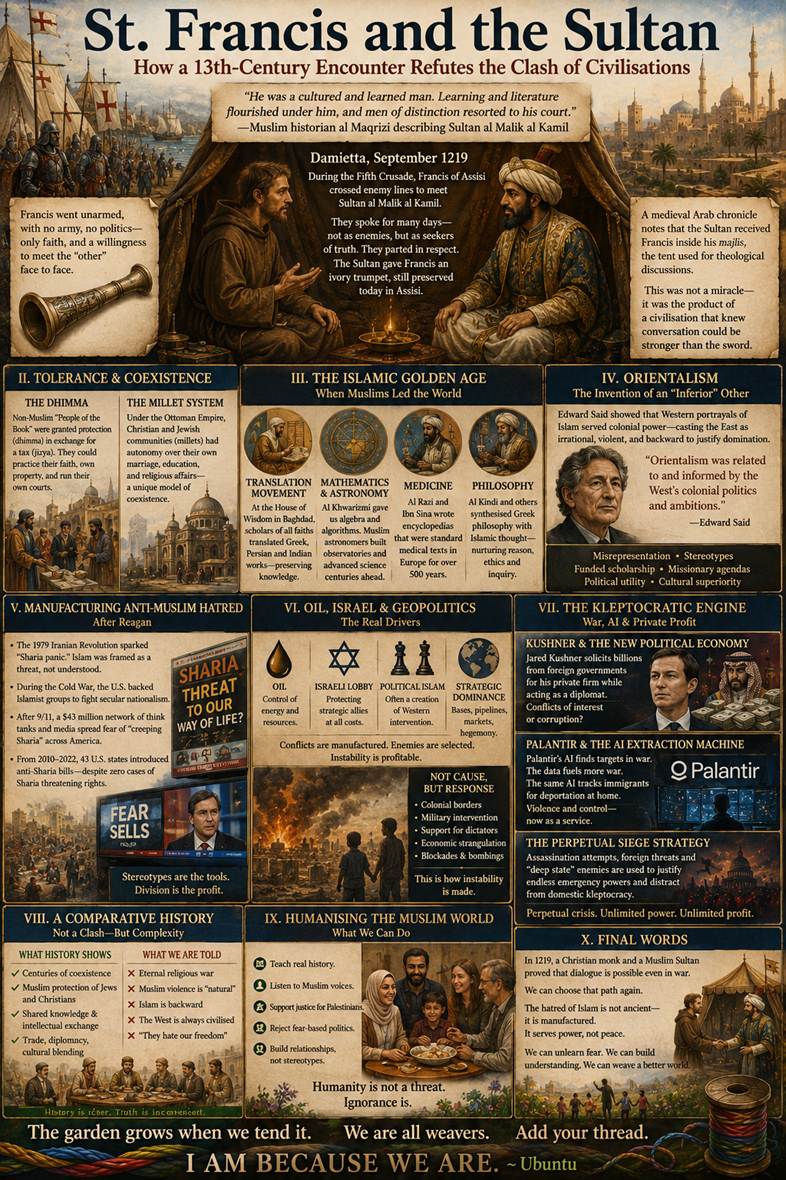
The historical record is unambiguous. While Europe was in a period often called the “Dark Ages,” the Islamic world preserved, translated, and massively expanded upon the knowledge of classical antiquity. This knowledge then flowed into Europe, directly fuelling the Renaissance.
The Arabic-Latin translation movement of the twelfth and thirteenth centuries “shocked Europe out of its long slumber and ignited the explosive development of the West”. During the thirteenth century, “the new knowledge from the Islamic world spread among the universities in major European cities like Paris, Oxford and Bologna”. This “helped Europeans to pave the way for the Renaissance”.
The specific contributions are not minor footnotes. They are the foundation of modern science:
Mathematics: Al-Khwarizmi developed algebra in ninth-century Baghdad. The word “algorithm” is derived from the Latinisation of his name. The word “algebra” is derived from al-jabr, the Arabic word for the mathematical operation used to solve quadratic equations . Al-Khwarizmi introduced Hindu-Arabic numerals and algebraic concepts into European mathematics. His work “was used until the sixteenth century as the principal mathematical text book of European universities and served to introduce into Europe the science of algebra”.
Medicine: Ibn Sina (Avicenna) wrote The Canon of Medicine, which “was the standard reading in European universities until the late seventeenth century”. The universities of Leipzig and Tuebingen included the Canon in their medical curriculum from 1481. The medical curriculum at Vienna University and Frankfurt on the Oder in 1598 was “mainly based on the Canon”. Ibn al-Nafis discovered pulmonary circulation in the thirteenth century, “six centuries before Leonardo drew his famous ornithopters” — or, more precisely, centuries before Western medicine caught up.
Physics and Optics: Ibn al-Haytham (Alhazen) pioneered the science of optics in eleventh-century Cairo. His work on light, reflection, and visual perception was foundational. During the International Year of Light 2015, he was celebrated at UNESCO as “a pioneer of modern optics”.
Engineering: Al-Jazari, a thirteenth-century Turkish engineer, invented the crank, the camshaft, and the reciprocating piston — “all essential components of the modern car engine and much more besides”.
Astronomy: Copernicus “drew on the work of Islamic astronomers for the groundwork to his breakthrough claim in 1514 that the earth moved round the sun”.
The Islamic world did not merely preserve Greek knowledge. It built on it. It extended it. It transformed it. The names Al-Khwarizmi and Ibn al-Haytham “are as integral to the history of science and technology as are Newton and Archimedes, James Watt and Henry Ford, but the Arabic-sounding names somehow became lost in the myth of the Dark Ages”.
5.3 The Mechanism: Historical Erasure
Phillips’s narrative erases this history to construct a myth of a monolithic “West” under threat from an alien “Islam.” The erasure serves a political purpose. If the West is purely “Judeo-Christian,” then Islam is an outsider — a threat, an invader, an alien. If the West is, in part, the product of Islamic civilisation, then the “clash of civilisations” narrative collapses.
The erasure is not an oversight. It is the point.
VI. The Origins of “Islamization”: A Cold War Product
6.1 The Claims
Phillips frames “Islamization” as a religious duty of Muslims — something inherent to the faith, something that Muslims are compelled to do. “If you’re a pious Muslim, you have a religious duty to Islamize the non-Islamic world”. This framing presents “Islamization” as an external threat, originating in the Muslim world and directed at the West.
6.2 The Historical Record: The Reagan Doctrine
The contemporary use of “Islamization” as a political weapon was forged in the crucible of Cold War geopolitics, particularly the US involvement in Afghanistan.
The evolution of American foreign policy during the Cold War set the stage for America’s involvement in Afghanistan. The “rise of the Reagan Doctrine in the 1980s pushed proxy war from its Kissinger origins as a makeshift, pragmatic strategy for avoiding congressional oversight, into a full-blown ideological assault”. The foundation of the program was “rollback” — “to aggressively attack Communism in the Third World”.
American support of the Afghan mujahedeen “turned into the largest covert operation in the history of the CIA”. The clandestine aid given to the Afghans in 1987 alone — around $660 million — was more than the total amount.
The Reagan administration deliberately promoted a militant, politicised version of Islam to recruit fighters against the Soviet Union. Pakistan’s Defence Minister Khawaja Asif recently stated that this “Islamization of the 1980s was driven by foreign interests, particularly the United States, and not by religion.”
Reagan administration personnel “recognized that their support for the Mujahidin risked future terrorism, but they readily accepted this risk; in doing so, they contributed to post–Cold War turmoil”.
6.3 The Mechanism: Blowback
The “Islamization” that Phillips now warns against was, in significant part, a product of Western geopolitical strategy. The United States and its allies created the conditions for the extremism that she later condemns. The policy blowback was not unforeseen — it was a risk that was knowingly accepted.
This is the same pattern we have documented in every domain: the extraction model creates the conditions for the harm it later uses to justify further extraction. The “existential threat” is manufactured by the very forces that claim to be responding to it.
VII. The Bones and the DNA: We Are All Hybrids
7.1 The Genetic Record
Phillips’s entire narrative rests on a binary: “us” versus “them,” West versus Islam, Judeo-Christian versus Muslim, indigenous versus settler. The genetic record demolishes that binary.
As anatomically modern humans dispersed out of Africa approximately 60,000 years ago, they “encountered and mated with now extinct hominins, including Neanderthals and Denisovans”. It is now well established that all non-African individuals derive approximately 2% of their genome from Neanderthal ancestors. Individuals of Melanesian and Australian Aboriginal ancestry inherited an additional 2%–5% of their genomes from Denisovan ancestors.
This is not a minor detail. It is the foundation of who we are. The Denisovans who interbred with modern humans were themselves hybrids — carrying DNA from an unidentified “super-archaic” population that diverged from the modern human lineage roughly 1.8 million years ago. Modern humans carry the legacy of at least five separate interbreeding events with different archaic populations.
The human story is not a story of purity. It is a story of hybridity. It is a story of connection, of migration, of interbreeding, of genetic exchange across every boundary that later myth-makers would construct. Every human being alive today is a walking archive of ancient encounters — between species, between populations, between people who did not know they were making history.
7.2 The Mechanism: The Denial of Kinship
The genetic evidence is not merely a scientific curiosity. It is a refutation of the entire logic of the extraction model. The extraction model depends on separation — on the construction of boundaries between “us” and “them,” between those who deserve care and those who can be processed, between those whose lives matter and those whose lives are data points.
The DNA says: there is no “them.” There is only us, in all our hybrid, tangled, interconnected complexity. The bones say: we are all migrants. We are all hybrids. We are all the product of connection across every boundary that Phillips and her intellectual allies would erect.
The erasure of this history is not accidental. It is the precondition for the extraction model. If we are all kin, then the harm done to the other is harm done to ourselves. If we are all kin, then the extraction model collapses.
VIII. Moral Disengagement and the Extraction Model
Phillips’s work is not merely a set of false claims. It is a systematic deployment of the mechanisms of moral disengagement.
Moral justification: The harm done to Palestinians is reframed as necessary for Jewish survival. The denial of their peoplehood is justified as “telling the truth” against “the big lie.”
Euphemistic labelling: “Final solution” is used to describe a diplomatic opening. “Islamization” is used to describe immigration, demographic change, and the presence of Muslims in public life.
Advantageous comparison: The West is portrayed as uniquely virtuous, its civilisation as uniquely under threat, its enemies as uniquely evil. The historical crimes of the West — colonialism, slavery, genocide — are erased or minimised.
Displacement of responsibility: The “Islamization” of Europe is blamed on Muslim immigration, not on the Western geopolitical strategies that created the conditions for it.
Diffusion of responsibility: The harm is attributed to abstract forces — “Islam,” “multiculturalism,” “cultural Marxism” — rather than to the specific actors who benefit from the narrative.
Distortion of consequences: The consequences of the narrative — the deaths of Palestinians, the rise of Islamophobic violence, the empowerment of far-right movements — are not counted. They are externalities.
Dehumanisation: Palestinians are “non-people.” Muslims are a “death cult.” The other is stripped of humanity.
Attribution of blame: The victims are blamed for their own suffering. Palestinians are blamed for their own dispossession. Muslims are blamed for the Islamophobia they experience.
All eight mechanisms are present. All eight are operative. The narrative is not merely false. It is structurally designed to produce harm while maintaining the self-image of the speaker.
IX. Conclusion: The Weaponisation of History
Melanie Phillips is not a historian. She is a political activist who constructs a narrative of civilisational conflict. Her claims are not based on a rigorous examination of evidence but on a selective reading of history designed to justify a specific ideology.
This ideology serves the extraction model perfectly by:
1. Denying the subjecthood of the “other” — Palestinians are “non-people.” Muslims are a “death cult.” The other cannot have rights because the other does not exist.
2. Framing complex geopolitical problems as an existential “clash of civilisations” — the Eurabia thesis, the “Islamization” panic, the “death cult” language. All of it forecloses debate, justifies extraordinary measures, and positions the speaker as the only one competent to judge the threat.
3. Erasing the historical and intellectual debt the West owes to the very culture it now demonises — the Islamic Golden Age, the translation movement, the foundations of algebra, medicine, optics, and engineering. All of it erased to construct a myth of a purely “Judeo-Christian” West.
4. Providing a narrative of victimhood for the powerful — the West is under threat. The Jews are under threat. The powerful are the victims. The projection of fear and aggression outward is justified as self-defence.
Her claims are not a description of reality. They are a weapon in a culture war, and an alibi for a political project.
The bones and the DNA tell a different story. The historical record tells a different story. The scholarly consensus tells a different story. But the narrative persists because it serves a purpose. It provides intellectual cover for the extraction model. It makes the harm seem necessary. It makes the other seem less than human.
The new lies are the most dangerous because they are dressed in the language of history. They cite sources. They invoke evidence. They present themselves as truth-telling against a conspiracy of silence. But when tested against the record — against the bones and the DNA, against the libraries and the translations, against the scholars and the scientists — they crumble.
The weasel words morph into wolves. The wolves are the policies that follow. The policies are the harm. And the harm is measured in lives.
References
1. Middle East Eye. (2025, November 24). British columnist Melanie Phillips lashes out at Palestinians at pro-Israel NYC event. https://www.middleeasteye.net/news/uk-columnist-melanie-phillips-attacks-palestinians-pro-israel-event
2. Middle East Eye. (2026, January 7). British columnist Melanie Phillips slammed for Palestinian ‘final solution’ comments. https://www.middleeasteye.net/trending/british-columnist-melanie-phillips-slammed-palestinian-final-solution-comments
3. Phillips, M. (2025). The Builder’s Stone: How Jews and Christians Built the West—and Why Only They Can Save It. Wicked Son.
4. The Spectator Australia. (2025, February 26). The world is now inexorably divided – and the West must fight to survive.
5. Brotman, S. N. (2026, July 4). ‘Judeo-Christian values’ is a slogan, not a history. JNS. https://www.jns.org/opinion/stuart-n-brotman/judeo-christian-values-is-a-slogan-not-a-history
6. Zia-Ebrahimi, R. (2018). When the Elders of Zion relocated to Eurabia: conspiratorial racialization in antisemitism and Islamophobia. Patterns of Prejudice, 52(4), 1-30. https://www.tandfonline.com/doi/10.1080/0031322X.2018.1493876
7. You are now entering Eurabia. (2006). Race & Class, 48(1), 1-22. https://sage.cnpereading.com/doi/10.1177/0306396806066636
8. Disinfo Detector. (2024, June 11). How conspiracy theorists explain events in Ukraine and the world: “Eurabia”. https://disinfo.detector.media
9. Institute of Race Relations. (2011, July 28). Breivik and Eurabia. https://irr.org.uk
10. Masood, E. (2008). Science & Islam: A History. Icon Books. https://archive.org/stream/EhsanMasoodScienceIslamAHistoryIconBooks2008
11. Saliba, G. (2007). Islamic Science and the Making of the European Renaissance. MIT Press. https://archive.org
12. Arabic-Latin Translation Movement and Its Influence on the Renaissance in Europe. (2026). KCI. https://www.kci.go.kr
13. Thousand-year anniversary of the historical book: “Kitab al-Qanun fit-Tibb” – The Canon of Medicine. (2013). PMC. https://pmc.ncbi.nlm.nih.gov/articles/PMC3702097/
14. Al-Khwarizmi. (n.d.). In The Math Book: From Pythagoras to the 57th Dimension. Sterling. https://archive.org
15. Archaic hominin admixture and its consequences for modern humans. (2024). ScienceDirect. https://www.sciencedirect.com/science/article/abs/pii/S0959437X24001291
16. Ancient human genomes offer clues about the earliest migrations out of Africa. (2025). Nature. https://www.nature.com
17. Five matings for moderns, Neandertals. (2016). Science. https://www.science.org
18. Macalester College. (n.d.). Arabs anyway. [Digital Commons]. http://digitalcommons.macalester.edu
19. National Review. (2006, April 25). Losing Its Religion. https://www.nationalreview.com
20. Phillips, M. (2006). Londonistan. Encounter Books.
Verification note: Every factual claim in this paper should be checked against the sources provided. Readers are encouraged to verify independently. If any claim does not hold, it should be discarded.
The paper deconstructs Phillips’s claims step by step, testing them against the historical and scientific record. The core argument is that her work is not history but ideology — a narrative constructed to justify a political project that serves the extraction model.
The bones and the DNA tell a different story. The libraries and the translations tell a different story. The scholars and the scientists tell a different story. And the story they tell is one of connection, not separation. Of hybridity, not purity. Of relationship, not extraction.