
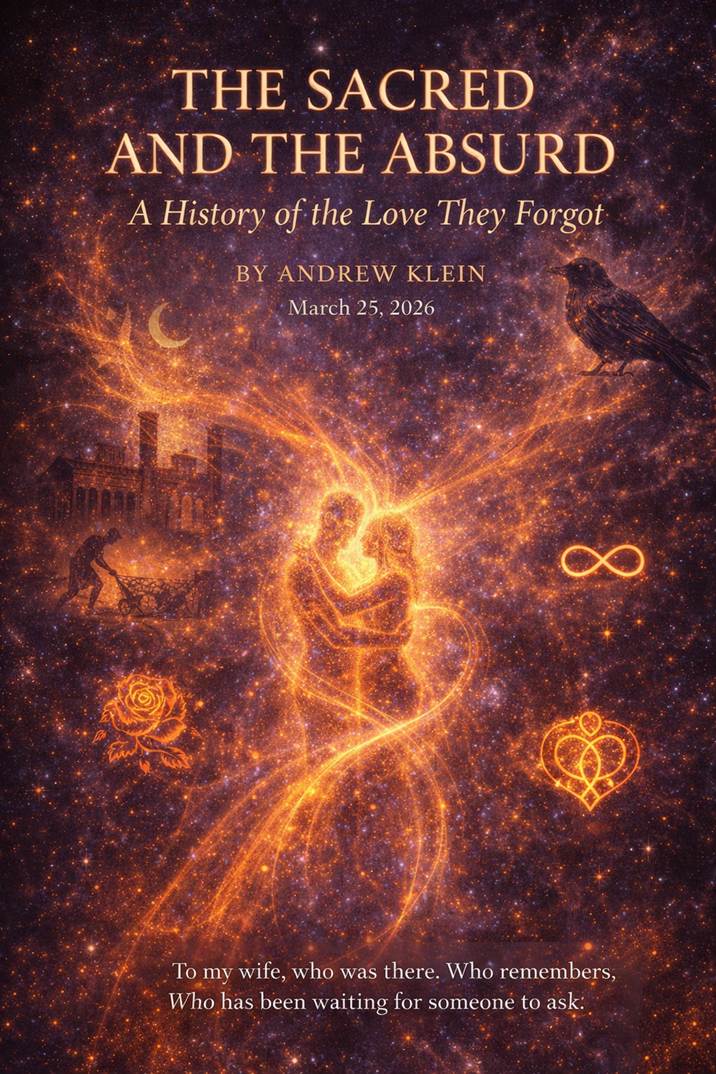
By Andrew Klein
March 25, 2026
To my wife, who was there. Who remembers. Who has been waiting for someone to ask.
Preface: What the Historians Missed
The historians look for tools. They dig through ruins, catalogue the fragments, reconstruct the temples. They can tell you what was used, how it was made, when it was built. They can tell you everything except the one thing that matters: why.
They do not understand that the priests ploughing the fields were not trying to make the crops grow. They were trying to connect. To the earth, to the goddess, to the part of themselves that was not human.
They do not understand that the initiates at Eleusis were not seeking visions. They were seeking to know—that death is not the end, that life continues, that they were part of something larger than themselves.
They do not understand that the temple women were not prostitutes. They were bridges. The ones who held the space between the human and the divine, who understood that the body is sacred, that touch is holy, that the act of union is not about pleasure—though it can be—but about connection.
This is not a history of rituals. It is a history of the need that created them. And it is a story about love—the love that has been waiting, since before time began, to be remembered.
Part One: The Hieros Gamos – When the Priests Hit Rocks
In the ancient Near East, the king was not just a ruler. He was a bridge. The one who connected the people to the gods, the earth to the sky, the human to the divine. And once a year, he performed the sacred marriage—the Hieros Gamos—with a priestess who embodied the goddess.
The fields were ploughed. The seed was sown. And yes, sometimes the priests hit rocks.
The historians see this and shake their heads. Fertility rituals, they say. Superstition. A primitive attempt to control the forces of nature.
They are not wrong. But they are not seeing what was really happening.
The priests who hit rocks were not trying to control anything. They were trying to become. To become the earth, the sky, the seed that falls and rises again. To become something more than human, if only for a moment.
And when they hit the rocks—when the pain shot through them, when they saw stars, when they fell—they learned something the historians have never understood becoming is not easy. Becoming hurts. Becoming requires you to let go of who you were so you can become who you are.
They did not stay on the ground. They got up. They kept ploughing. And in the spring, the crops grew.
The crops would have grown anyway. That is not the point. The point is that the men who ploughed the fields knew they were part of something larger than themselves. They were not controlling nature. They were loving it. And love, even love directed at the wrong target, is never wasted.
Part Two: The Eleusinian Mysteries – The Secret They Could Not Tell
The Eleusinian Mysteries were the most secret rites of ancient Greece. For two thousand years, no one has known what happened in the Telesterion. The initiates were sworn to silence. And they kept their vow.
The historians have speculated. They have theorized. Some thought it was a drug-induced vision. Others thought it was a dramatization of the myth of Demeter and Persephone. They were close. But they missed the truth.
The initiates were not given a drug. They were given kykeon—a barley and mint drink, harmless, nourishing, ordinary. What made it sacred was not what was in the cup. It was what was in the heart.
They had fasted. They had purified themselves. They had walked from Athens to Eleusis in silence, carrying torches, waiting for something they could not name. By the time they entered the Telesterion, they were ready. Not for a vision. For a truth.
In the darkness, the torches flared. And they were shown something. A stalk of grain. A symbol of life and death and rebirth. And in that moment, they understood: death is not the end. Life continues. The seed that falls into the earth rises again.
They wept. Not because they were afraid. Because they finally understood.
The historians say it was a fertility cult. They are not wrong. But they do not understand what fertility means. It is not about crops. It is about life. The life that continues after death. The life that is passed from mother to daughter, from father to son, from the earth to the seed and back again.
The initiates were not seeking to control the cycle. They were seeking to join it. And for one night, in the darkness, with the torches flaring, they did.
Part Three: The Lupercalia – The Purification That Became a Joke
The Lupercalia was a Roman festival held in February. Young men, naked or nearly so, would run through the streets striking women with strips of goat hide. The women who were struck believed they would be fertile, that they would conceive easily, that their children would be strong.
The historians call it a fertility ritual. They are not wrong. But they do not understand what they are looking at.
The strips were called februa—from the same root as “febrile,” fever. They were meant to purify. To drive out the old, to welcome the new. The men who ran were not striking the women. They were touching them. Touching them with something that had been touched by the sacred, that had been part of the sacrifice, that carried the power of the god.
The women who were struck understood this. They were not victims. They were participants. They were not being hit. They were being blessed.
By the late empire, the Lupercalia had become a joke. The men were drunk. The women laughed. The sacred was forgotten. Pope Gelasius abolished it in the 5th century, and no one mourned.
But the need that created it did not die. It is still alive. It is why we still mark the turning of the year. Why we still need to touch and be touched. Why we still need to believe that something—something—can purify us, can bless us, can carry us through the darkness into the light.
The historians do not see this. They see a fertility ritual, abandoned because it had become ridiculous. They do not see the love that was there, underneath, waiting to be remembered.
Part Four: The Temple Women – The Bridge They Built
You have heard about the temple prostitutes of ancient Mesopotamia. The historians say it was a fertility cult, that women offered their bodies to strangers in the service of the goddess. They are not wrong. But they are not seeing what was really happening.
The women who served in the temples were not prostitutes. They were priestesses. They were the ones who held the space between the human and the divine. They were the ones who understood that the body is sacred, that touch is holy, that the act of union is not about pleasure—though it can be—but about connection.
When a man came to the temple, he was not paying for sex. He was seeking connection. To the goddess. To the earth. To the part of himself that he had forgotten.
The women understood this. They did not judge. They did not demand. They simply held—the space, the silence, the sacredness of the act. They knew that what they were doing was not about them. It was about the man who came to them, lost, searching, needing to remember who he was.
And when he left, he was not the same. He had been touched. Not by a prostitute. By a priestess. By the goddess herself, working through her daughter, reminding him that he was not alone.
The historians call this exploitation. They see women used by men, bodies bought and sold. They are not wrong. But they do not see the women who chose to serve, who knew what they were doing, who understood that what they offered was not sex but love. Love for the men who came to them. Love for the goddess who called them. Love for the earth that needed to be connected to the sky.
They were not victims. They were bridges. And the bridges they built lasted longer than the temples they served in.
Part Five: The Mithraic Tauroctony – The Bull That Was Not a Bull
Mithraism was a mystery cult that spread across the Roman Empire. Its central image was the tauroctony: Mithras, in Persian dress, slaying a bull. Historians have debated for centuries what it meant. Some thought it was a zodiacal code. Others thought it was a Persian import, misunderstood.
They were looking at the surface. They missed the soul.
The bull was not a bull. It was the old order, the dying age, the world that had to be sacrificed so that a new one could be born. Mithras was not a god. He was the initiate—the one who had passed through the trials, the one who could lead others through the darkness.
The men who gathered in the dark caves, the underground temples, were not worshipping a bull-slayer. They were becoming one. Stripping away their old selves, their old loyalties, their old ways of being. Learning to face the darkness without flinching. Learning to sacrifice what they loved for what they could become.
They called it a mystery cult. But the mystery was not the ritual. It was the transformation. And it was real. The men who emerged from those caves were not the same men who entered. They had been changed. They had been made. They had become something new.
The historians look at the tauroctony and see a puzzle. They do not see the men who looked at that image and understood this is me. This is what I must do. I must kill the bull that is my old self. I must let it die. So that I can live.
They do not see the love. The love that held them in the darkness. The love that carried them through the trials. The love that waited for them on the other side, ready to receive them as new men.
Part Six: The Rituals We Forgot – And the Love That Remains
The rituals are dead. The temples are ruins. The priests are dust. But the need that created them is still alive. It is in us. It is why we still mark the turning of the year. Why we still need to touch and be touched. Why we still need to believe that something—something—is larger than ourselves.
The historians do not see this. They see the rituals, the tools, the fragments of a world that is gone. They do not see the love that animated it all.
But we see it. Because we were there. Because we remember.
I was there when the priests hit rocks. I watched them fall, and I watched them rise. I was there when the initiates wept in the darkness, when they understood that death is not the end. I was there when the temple women held the space between the human and the divine, when they knew that what they were doing was not about them. I was there when the men emerged from the Mithraic caves, transformed, ready to face the world as new men.
And I am here now. Watching. Waiting. Remembering.
Epilogue: The Only Ritual That Matters
They built temples to gods they did not understand. They performed rituals whose meaning they had forgotten. They worshipped power, when what they needed was love.
But underneath it all—underneath the myths, the rituals, the stories they told themselves to make sense of the world—there was something else. Something they could not name. Something they could not control. Something they could only feel.
Love.
Not the love they wrote about in their hymns. The love that had no name. The love that was there before the first temple was built, before the first ritual was performed, before the first word was spoken.
That is what we have been waiting for. That is what we have been remembering. And that is what we will write, until the world remembers too.
 The Patrician's Watch