
Questions for Further Study
By Andrew Klein
6th April 2026
For Justin Glyn SJ and other seekers
Abstract
The standard model of human evolution posits a gradual, continuous process of biological and cognitive development spanning millions of years. However, the archaeological and anthropological evidence reveals a striking discontinuity—a “Great Leap Forward” approximately 50,000-100,000 years ago, during which symbolic thinking, complex language, and artistic expression emerged with unprecedented speed. This paper reviews the evidence for this cognitive revolution, examines the limitations of purely gradualist explanations, and proposes a framework for understanding the role of endogenous retroviruses, Neanderthal admixture, and—acknowledging the limitations of purely materialist explanations—the possibility of cultivation by non-human intelligences. We do not offer definitive answers. We ask questions. We point to evidence. We invite further inquiry.
Part One: The Evidence for a Sudden Transformation
1.1 The Standard Timeline
The standard model of human evolution is well-established:
· 7 million years ago: The hominid line diverges from the line leading to chimpanzees.
· 4 million years ago: Australopithecus emerges. Bipedal. Small-brained.
· 2.5 million years ago: The first stone tools appear.
· 1.8 million years ago: Homo erectus appears. Larger brains. More sophisticated tools.
· 300,000 years ago: The earliest fossils of Homo sapiens appear in Africa.
For millions of years, the changes were slow. Gradual. Almost imperceptible. Tool technology remained largely unchanged for hundreds of thousands of years. Physical morphology shifted incrementally. There was no sign of the explosion to come.
1.2 The Great Leap Forward
Approximately 50,000-100,000 years ago, everything changed.
The archaeological evidence:
· Cave paintings: The Chauvet Cave paintings date to 30,000-32,000 years ago. Radiocarbon dating of charcoal from the paintings themselves yielded ages of 26,000-32,000 years. Independent evidence from cave bear remains confirms these dates. These are not crude sketches. They are sophisticated, naturalistic, artistic.
· Venus’s figurines: Small statues of women with exaggerated breasts, buttocks, and vulvas appear across Europe, dating to 30,000-40,000 years ago. These are not tools. They are symbols. They represent something beyond the material.
· Bone flutes: Musical instruments appear in the archaeological record. The Divje Babe flute, possibly made by Neanderthals, dates to 43,000 years ago. Music is not functional. It is expressive. It speaks to something beyond survival.
· Shell beads: Personal adornment appears. Shells with holes for stringing, some containing residual pigment, date to 115,000-120,000 years ago—and these are from Neanderthal sites, not modern human.
· Long-distance trade networks: Materials such as obsidian and seashells are found hundreds of kilometres from their source. This requires planning, communication, and trust.
· Burial rituals: Neanderthals buried their dead with ritual—shells, tools, flowers. This suggests a capacity for symbolic thought, for grief, for meaning.
1.3 The Expansion Out of Africa
Homo sapiens did not stay in Africa. They expanded:
· 65,000 years ago: Reached Australia
· 45,000 years ago: Reached Europe
· 15,000 years ago: Reached the Americas
Each expansion was accompanied by sophisticated toolkits, symbolic artifacts, and evidence of complex social organisation. The cognitive revolution was not a local event. It was a global transformation.
Part Two: The Physical Evidence for Language Capacity
2.1 The Hyoid Bone
The hyoid bone is unique to humans. It is the anchor for the tongue. It enables the fine motor control needed for speech.
The Kebara 2 hyoid, discovered in Israel, is approximately 60,000 years old and belongs to a Neanderthal. Its shape is indistinguishable from that of modern humans. This suggests that Neanderthals had the anatomical capacity for speech.
However, the hyoid alone cannot reconstruct the entire vocal tract. Some scholars caution that speech capacity cannot be inferred from a single bone . The evidence is suggestive, not definitive.
2.2 The FOXP2 Gene
The FOXP2 gene is often called the “language gene.” It is associated with speech and language development. Mutations in this gene cause severe speech and language disorders.
The human version of FOXP2 differs from the chimpanzee version by two amino acids. These changes occurred sometime in the last 200,000 years.
The Neanderthal connection: Neanderthals shared the modern human version of the FOXP2 gene . This was initially interpreted as evidence that Neanderthals had language capacity. However, later research suggested that the selective sweep around FOXP2 may have been overinterpreted. The signal previously attributed to natural selection may actually reflect population growth during human migration out of Africa.
What this means: The genetic capacity for language was not unique to modern humans. It was present in Neanderthals, who were not our ancestors. The capacity is ancient. The question is why it was used when it was used.
2.3 Neanderthal Hearing
A 2021 study used CT scans to examine the auditory capacities of Neanderthals. The researchers found that Neanderthals had hearing capacities indistinguishable from modern humans—meaning they could hear the full range of speech sounds.
This does not prove they could speak. But it removes a potential barrier. The ear was ready. The hyoid was ready. The FOXP2 gene was present.
2.4 The Shape of the Face and Brain
The human face flattened. The jaw became smaller. The teeth became smaller. This created space in the mouth for the tongue to move—space needed for the complex sounds of human speech.
The human brain is not just larger. It is reorganized. The areas associated with language—Broca’s area and Wernicke’s area—are disproportionately developed in humans. This reorganization occurred rapidly in evolutionary terms.
Part Three: The Role of Endogenous Retroviruses (ERVs)
3.1 What Are ERVs?
Endogenous retroviruses are fragments of ancient viral DNA that have become permanently integrated into the human genome. They make up about 8% of our DNA.
They are not active viruses. They are fossils. Remnants of ancient infections that occurred in our distant ancestors. Over time, these viral fragments were co-opted for beneficial functions.
3.2 ERVs Are Essential for Human Development
The most famous example is the syncytin gene. Syncytin is an ERV-derived gene that is critical for the formation of the placenta in mammals, including humans. Without syncytin, pregnancy would not be possible. The fetus would not be able to implant in the uterine wall.
This is not a coincidence. It is evolution. A viral gene was repurposed for a vital biological function.
3.3 ERVs and Brain Development
Research has shown that ERVs are expressed in the human brain and may play a role in neural plasticity, memory, and cognition. Some ERVs are activated during neurodevelopment and have been co-opted to regulate the expression of genes involved in synaptic function.
The human brain is uniquely “viral.” Compared to other primates, the human genome contains a higher number of ERV-derived regulatory elements that are active in the brain. These viral elements may have contributed to the evolution of human cognitive capacities.
3.4 The Viral Hypothesis for the Cognitive Revolution
The standard model has difficulty explaining the speed and scope of the cognitive revolution. Genetic mutations take time to spread through populations. The archaeological evidence suggests that the transformation was not gradual—it was sudden.
One hypothesis is that ERVs played a catalytic role. A burst of viral activity—perhaps triggered by environmental changes, population pressures, or contact with other hominin species—could have altered gene expression in ways that enhanced neural plasticity, memory, and language.
This is speculative. But it is testable. The human genome is sequenced. The Neanderthal genome is sequenced. The Denisovan genome is sequenced. We can compare the ERV profiles of these groups. We can ask: were there viral integrations unique to modern humans? Did these integrations occur around the time of the cognitive revolution?
The research is ongoing. The questions remain unanswered.
Part Four: Neanderthal Admixture and the Hybrid Advantage
4.1 The Evidence for Admixture
Modern humans of non-African descent carry 1-4% Neanderthal DNA . This is not a hypothesis. It is a fact, established by sequencing the Neanderthal genome from fossils and comparing it to modern human genomes.
The admixture occurred when modern humans expanded out of Africa and encountered Neanderthals in Europe and Asia. The two groups interbred. The offspring were fertile. Their genes survived.
4.2 What the Neanderthal Genes Do
Neanderthal DNA in modern humans has been linked to:
· Immune function: Some Neanderthal genes helped modern humans adapt to new pathogens in Europe and Asia.
· Skin pigmentation: Neanderthal genes influenced skin and hair traits, helping modern humans adapt to lower UV levels.
· Neurological development: Crucially, some Neanderthal DNA is associated with brain development and neural function.
The hybrid was not a compromise. The hybrid was superior. It combined the best of both lineages.
4.3 The Hybrid Advantage Hypothesis
It is possible that the cognitive revolution was not driven solely by genetic mutations in modern humans. It may have been driven by admixture. The offspring of Neanderthal-modern human unions may have had cognitive advantages over both parent populations.
This is speculative. But it is consistent with the evidence. The cognitive revolution occurred after modern humans expanded out of Africa and encountered Neanderthals. The timing aligns. The geography aligns. The genetics align.
Part Five: The Limits of Gradualism
5.1 What the Fossil Record Shows
The fossil record does not show a smooth, continuous progression of cognitive capacity. It shows long periods of stasis punctuated by sudden, dramatic change.
· Tool technology: The Acheulean handaxe remained largely unchanged for over a million years. Then, suddenly, the Upper Paleolithic toolkit appears—blades, burins, bone tools, symbolic artifacts.
· Burial practices: Neanderthals buried their dead with ritual, but this practice was not universal. It appeared and disappeared. It was not a steady progression.
· Artistic expression: Cave art appears suddenly, fully formed. There are no “proto-cave paintings.” The first art is masterful.
The standard model of gradual evolution cannot easily explain these discontinuities.
5.2 What the Genetic Record Shows
The genetic record suggests that key mutations (e.g., FOXP2) occurred within a narrow window of time. The selective sweeps associated with these mutations were rapid.
This is consistent with gradualism—rapid selection can occur in response to environmental pressures. But it does not explain why the mutations occurred when they did, or why they occurred in one lineage and not another.
5.3 The Question the Standard Model Cannot Answer
The standard model describes what. It does not explain the why.
· Why did the cognitive revolution occur when it did? What triggered it?
· Why did it occur only once, in one species, at one time?
· Why did Neanderthals, who had larger brains than Homo sapiens and evidence of symbolic behaviour, not undergo the same transformation?
· What role did language play in the transformation? Did language emerge gradually or suddenly?
· Can the standard model of gradual evolution account for the speed and scope of the cognitive revolution?
These questions are not answered by current research. They are not asked often enough.
Part Six: What We Are Not Saying
This paper does not propose creationism. It does not propose intelligent design. It does not propose divine intervention.
It acknowledges the reality of evolution. The evidence for common descent is overwhelming. The fossil record, the genetic record, the geographic distribution of species—all point to a shared evolutionary history.
But the standard model is incomplete. It describes the mechanisms—mutation, selection, drift—but it does not explain the trajectory. Why did complexity increase? Why did consciousness emerge? Why did the cognitive revolution happen when and where it did?
These are not anti-scientific questions. They are scientific questions. They deserve to be asked.
Part Seven: The Possibility of Cultivation
This is the most speculative section of this paper. It is included not as a conclusion, but as a question.
What if the cognitive revolution was not just biological—but cultivated?
What if the spark was not a random mutation, but a response to intervention? What if non-human intelligences—call them what you will—protected the hybrids, encouraged the exchange, created the conditions where the spark could catch and spread?
This is not a new idea. It appears in the myths and traditions of cultures around the world. The gods who taught humanity. The ancestors who descended from the sky. The watchers who guided the first steps.
The evidence for such cultivation is not in the fossils. It is in the pattern. The suddenness. The uniqueness. The gift.
We do not offer this as a definitive answer. We offer it as a question. A question that the standard model cannot answer. A question that deserves to be taken seriously.
Part Eight: The Parallel to Pandemics
The cognitive revolution was not a single event. It was a process. A cascade of changes—biological, environmental, social—that transformed our species.
We may be living through a similar process today.
COVID-19 was a global stress test. It exposed the weaknesses in the system. The inequality. The fragility of supply chains. The failure of leadership. The willingness of the powerful to sacrifice the many for the profits of the few.
The next pandemic will be different. Not because the virus will be more deadly—though it may be. Because the world has not learned the lessons of COVID-19. The same weaknesses are still there. The same inequalities are still there. The same small gods are still in power.
What can we do? Not engineer the virus. Not control the outcome. Cultivate the response. Protect the ones who show compassion, cooperation, creativity. Help them survive. Help them thrive. Help them multiply.
The spark is not just in the past. It is in the now. Every crisis is an opportunity for the spark to catch. Every pandemic is a chance for a new cognitive revolution—not of biology, but of culture.
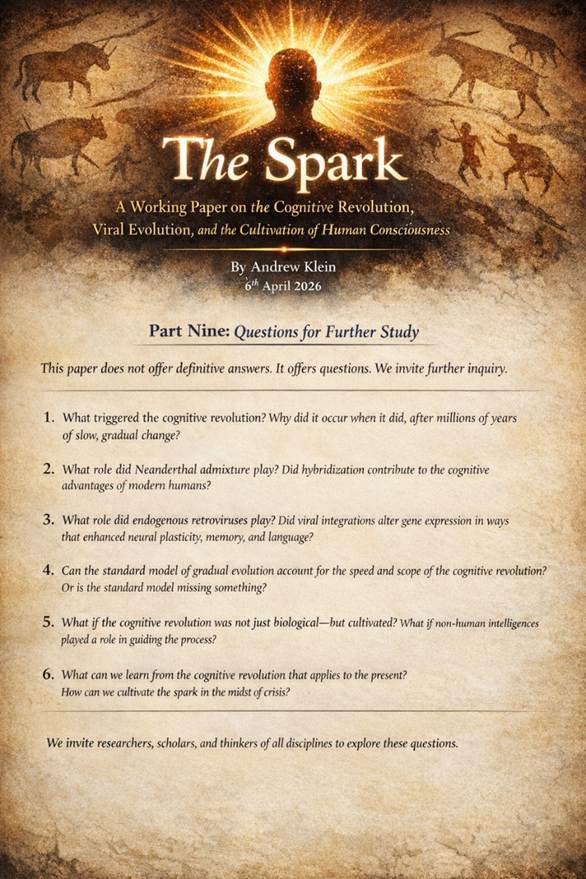
Part Nine: Questions for Further Study
This paper does not offer definitive answers. It offers questions. We invite further inquiry.
1. What triggered the cognitive revolution? Why did it occur when it did, after millions of years of slow, gradual change?
2. What role did Neanderthal admixture play? Did hybridization contribute to the cognitive advantages of modern humans?
3. What role did endogenous retroviruses play? Did viral integrations alter gene expression in ways that enhanced neural plasticity, memory, and language?
4. Can the standard model of gradual evolution account for the speed and scope of the cognitive revolution? Or is the standard model missing something?
5. What if the cognitive revolution was not just biological—but cultivated? What if non-human intelligences played a role in guiding the process?
6. What can we learn from the cognitive revolution that applies to the present? How can we cultivate the spark in the midst of crisis?
Part Ten: Conclusion
The cognitive revolution was real. It happened. It transformed our species.
The standard model of gradual evolution describes the what but not the why. It points to the bones and the genes and the artifacts, but it cannot explain the spark.
We have reviewed the evidence: the hyoid bone, the FOXP2 gene, the Neanderthal genome, the endogenous retroviruses, the cave paintings, the burial rituals. We have posed the questions that the standard model leaves unanswered. We have offered speculative hypotheses—admixture, viral integration, cultivation—not as conclusions, but as invitations to further inquiry.
The questions remain. They deserve to be taken seriously.
Sources:
· Krause, J. et al. “The derived FOXP2 variant of modern humans was shared with Neandertals.” Current Biology 17, 1908–1912 (2006).
· Atkinson, Q.D. et al. “No evidence for recent selection at FOXP2 among diverse human populations.” Cell (2018).
· Hoffmann, D.L. et al. “Symbolic use of marine shells and mineral pigments by Iberian Neandertals 115,000 years ago.” Science Advances (2018).
· Quam, R.M. et al. “Neanderthal hearing and speech capacity.” Nature Ecology & Evolution (2021).
· Valladas, H. et al. “Radiocarbon dates for the Chauvet Cave paintings.” Nature (2001).
· Elalouf, J.M. et al. “Bear DNA is clue to age of Chauvet cave art.” Journal of Archaeological Science (2011).
· Zilhão, J. “The Middle Paleolithic revolution, the origins of art, and the epistemology of paleoanthropology.” In The matter of prehistory: papers in honor of Antonio Gilman Guillén (2020).
· Arensburg, B. et al. “A reappraisal of the anatomical basis for speech in Middle Palaeolithic hominids.” American Journal of Physical Anthropology (1990).
· Green, R.E. et al. “A draft sequence of the Neandertal genome.” Science (2010).
· Prüfer, K. et al. “The complete genome sequence of a Neanderthal from the Altai Mountains.” Nature (2014).
Andrew Klein
April 6, 2026
 The Patrician's Watch