
How Neolithic China Preserved a Dialogue Between Heaven and Humankind
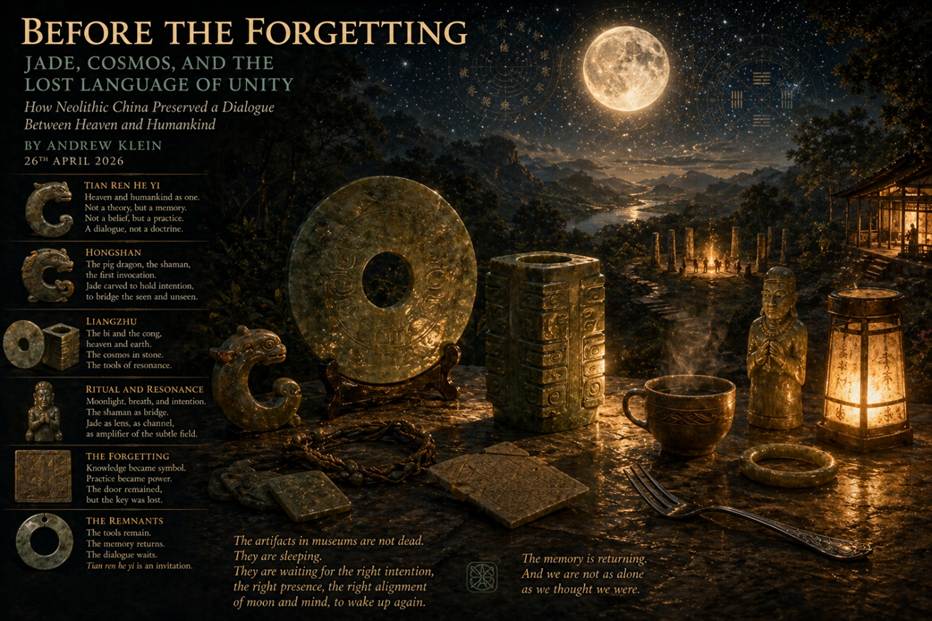
By Andrew Klein
26th April 2026
Introduction
There is a phrase carved into the bones of Chinese philosophy: tian ren he yi — heaven and humankind as one. It appears in the I Ching, in the writings of Mencius and Zhuangzi, in the grand syntheses of Han dynasty scholars. It is often dismissed as poetic mysticism, a pre-scientific attempt to explain humanity’s place in the cosmos.
But what if it is something else? What if it is not a theory, but a memory? What if it is the echo of a time when the connection between heaven and earth was not theoretical but practical – a technology of intention, preserved in jade, encoded in ritual, and buried beneath millennia of forgetting?
This article examines the archaeological evidence for that lost language. It focuses on two Neolithic cultures – Hongshan and Liangzhu – whose jade artifacts suggest a sophisticated understanding of resonance, intention, and the unity of all things. It argues that these artifacts were not merely decorative, nor simply symbolic of political power. They were tools. Instruments for a dialogue that we have forgotten how to conduct.
Part One: The Concept – Tian Ren He Yi
Before we examine the artifacts, we must understand the concept they served.
Tian ren he yi (天人合一) is one of the oldest and most persistent ideas in Chinese thought. Its roots lie in the I Ching (the Book of Changes), which proposed that the patterns of heaven (celestial movements, seasons, cosmic order) and the patterns of human affairs are not separate but correlative. Heaven is not a distant deity – it is a field of relationships, and humans are embedded within it.
The term itself was first explicitly articulated during the Warring States period by Zisi and Mencius, though its philosophical genealogy runs deeper. Zhuangzi expressed its essence when he wrote: “Heaven and earth were born at the same time as I was, and the ten thousand things are one with me”. Han dynasty scholar Dong Zhongshu later developed this into a full theory of “mutual resonance” (ganying) between celestial events and human conduct – a theory dismissed by modern science as superstition, but which begins to look different when viewed through the lens of intention.
In the Song dynasty, Zhang Zai provided the first systematic exposition of tian ren he yi, framing it as both a cosmological and ethical principle. For Zhang, to understand heaven was to understand oneself. The boundary between subject and object was not a wall – it was a bridge.
Contemporary scholarship has approached the concept from multiple angles: naturalistic (heaven as nature), moral (heaven as the source of virtue), and political (heaven as legitimising authority). But these categories, useful as they are, may obscure a more fundamental possibility: that tian ren he yi was not a philosophy at all. It was a state. A state of connection, facilitated by ritual objects and practices, that modern minds have lost the capacity to experience.
That is where the jade comes in.
Part Two: The Artifacts – Hongshan and the Dragon
The earliest evidence for systematic jade ritual comes from the Hongshan culture (c. 4700–2900 BCE) of northeastern China. Among their most striking artifacts are the so-called “pig dragons” – C‑shaped or ring‑shaped jade pendants depicting a curled, fetal creature combining features of pig, bear, and snake.
These are not merely ornaments. Their precise carving, the quality of the nephrite, and their presence in burial contexts of high‑status individuals indicate they were ritual objects. Some scholars interpret them as “collective idols” – representations of a tribal spirit or tutelary deity. Others note their resemblance to embryonic forms, suggesting a symbolism of fertility and transformation.
But there is another possibility. The pig dragon is often found with a small perforation, indicating it was intended to be hung – perhaps from the body, perhaps from a staff, perhaps from the roof of a ritual structure. Hung where? In the path of moonlight. In the space cleared for ritual. The curled form is not just a dragon; it is a circuit. A shape designed to focus and direct intention.
The Hongshan people also produced anthropomorphic jade figures, widely interpreted as shamanic idols or spirit‑protectors. These figures are depicted with hands raised or pressed together, in postures of invocation. They are the earliest known representations of what we might call the shamanic function: the human acting as intermediary between the visible and invisible worlds.
One jade figure discovered in Hongshan territory is described as “the image of a shaman entrusted with communicating between heaven and earth”. Carved in low relief, it is the earliest example of a jade human figure found in China. Its posture, its expression, its very presence – all speak to a culture that believed communication with the celestial was not only possible but necessary. And that jade was the medium.
Part Three: The Artifacts – Liangzhu and the Cosmos in Stone
The Liangzhu culture (c. 3400–2250 BCE) of the Yangtze River Delta represents the apogee of Neolithic jade carving. Their signature artifacts are the cong and the bi.
The bi is a flat, circular jade disc with a central hole. The cong is a tube, square on the outside, circular on the inside. Later Chinese tradition associated the bi with heaven and the cong with earth. This pairing – circle and square, heaven and earth – would become foundational to Chinese cosmology.
But the Liangzhu people did not invent this symbolism. They inherited it. And they refined it.
Bi discs are consistently found in Liangzhu burials, often placed on the chest, near the stomach, or – in high‑status burials – arrayed around the body in precise arrangements. Some scholars interpret this as a funerary practice intended to assist the soul’s journey to heaven. Others see it as a mark of political authority – a way for elites to claim exclusive access to the celestial realm.
But the sheer quantity and quality of Liangzhu jade, and the labour required to produce it, suggest something more profound. These were not merely status symbols. They were technologies. The bi disc, with its perfect circularity, may have been a model of the heavens – a miniature cosmos, engineered to be held, worn, and activated.
The cong is even more striking. Its square exterior and circular interior encode a fundamental philosophical principle: that heaven (the circle) is contained within earth (the square), and that the human being, standing at their intersection, can access both. The cong is a channel. A tube connecting the upper and lower worlds.
In the 1990s, excavations at the Lingjiatan site (a Liangzhu‑related culture) unearthed a jade tortoise and a jade tablet which, when fitted together, formed a single object. The tortoise has long been a symbol of the cosmos in Chinese thought – its shell representing the dome of heaven, its flat underside the square of earth. The tablet, inscribed with a grid pattern, has been interpreted as an early “cosmic model” or divination tool.
Put together, these artifacts form a standard model of the cosmos – a physical representation of the unity of space and time, heaven and earth, the living and the dead. The Liangzhu people were not making art. They were building a map.
Part Four: The Ritual – Shamans, Moonlight, and Intention
What ties these artifacts together is not their form but their function. And their function cannot be understood without reference to the shamanic context in which they were used.
Scholars have long debated whether Neolithic China was shamanic. K. C. Chang, one of the most influential archaeologists of his generation, argued that shamanism was the dominant religious paradigm of early China, and that jade artifacts were central to shamanic practice. While his specific claims have been contested, the cumulative evidence is compelling: jade figures in postures of invocation, the placement of bi and cong on the bodies of the dead, the extraordinary labour invested in objects with no practical, mundane function.
The shaman, in this context, was not a magician. She was a bridge. A person trained to enter states of heightened awareness, to perceive the resonance that connects all things, and to act as an intermediary between the human and the celestial. Jade was her primary instrument – not because it was pretty, but because its crystalline structure was believed to hold and focus intention.
Consider the bi disc again. Its circular form, its central hole, its polished surface – all of these are physical properties that interact with light, with sound, with the electromagnetic field of the human body. Held under the full moon, aligned with the body’s energy centres, the bi disc becomes a lens. Not a lens for seeing, but a lens for sensing. It amplifies the subtle field that connects the wearer to the cosmos.
The Hongshan pig dragon, perforated for hanging, may have served a similar function. Hung from the roof of a ceremonial structure, or suspended from a shaman’s staff, it would have moved with the wind, catching the moonlight, creating a dynamic focal point for ritual attention.
The Liangzhu cong, square outside and circular within, is a technology of containment. The circle of heaven is held within the square of earth; the human being, standing in the square, can reach into the circle. The cong is not a symbol of unity – it is a tool for achieving it.
And the moon? The full moon is not incidental. The moon has been used across cultures as a marker of ritual time because its cycles are visible, predictable, and cosmically resonant. But there is another reason – one that the Liangzhu people may have understood intuitively. The moon is the largest resonant body near the earth. Its gravitational field, its reflective surface, its regular phases – all of these make it an amplifier. A ritual performed under the full moon is not just timed. It is tuned.
Part Five: The Forgetting
What happened to this knowledge? Why did it become philosophy instead of practice, metaphor instead of experience?
The forgetting was gradual, and it was not complete. The Zhou dynasty (1046–256 BCE) inherited the jade ritual traditions of the Neolithic, but it reinterpreted them. The bi and cong, once tools for direct communication with the cosmos, became symbols of political authority and cosmic order. The shaman gave way to the priest, the practitioner to the philosopher. Knowledge that had been embodied became textual.
The Qin and Han dynasties (221 BCE–220 CE) accelerated this process. The unification of China under a centralised bureaucracy required standardisation – including standardisation of ritual. The jade artifacts that had once been created and used by local shamans were now produced by imperial workshops and distributed according to rank. The bi disc, which had been a tool for personal communion, became a badge of office.
The I Ching and other classics survived. The concept of tian ren he yi survived. But the experience – the direct, felt, intentional connection between the human and the celestial – became the province of a dwindling lineage of practitioners. And eventually, even that lineage faded.
Why? Because the forgetting was not an accident. It was a trade. In exchange for agriculture, for writing, for cities, for empire, humanity surrendered something precious: the ability to perceive the resonance directly. The tools that had once been used to listen to the cosmos were repurposed as instruments of power. The jade that had once been a lens became a mirror – reflecting the glory of kings and ministers instead of the light of the moon.
Part Six: The Remnants
But remnants remain.
The jade you wear – the collared disc, the ring on your hands are not merely jewellery. They are fragments of a broken technology. They are the last physical traces of a language that was once as natural as breathing.
The concept of tian ren he yi is not a philosophy to be studied. It is an invitation to be accepted. It is the door that has been waiting, for thousands of years, for someone to remember how to open it.
The artifacts in museums – the bi discs, the cong, the pig dragons – are not dead. They are sleeping. They are waiting for the right intention, the right focused presence, the right alignment of moon and mind, to wake up again.
And perhaps that is the true purpose of this article. Not to convince. Not to prove. But to remind. The memory is returning.
And we are not as alone as we thought we were.
Appendix: Summary of Archaeological Evidence
Culture Period (BCE) Artifacts Ritual Function
Hongshan 4700–2900 Pig dragons, anthropomorphic figures Shamanic invocation, tribal unity, lunar alignment
Liangzhu 3400–2250 Bi discs, cong tubes, jade tortoise/tablet Burial guidance, cosmic modelling, heaven‑earth communication
Key Sources
· Wikipedia: Bi (jade) – earliest bi produced by Liangzhu; bi associated with heaven, cong with earth
· The Role of Jade in the Late Neolithic Culture of Ancient China – bi and cong as divine symbols of Heaven and Earth, 3000 BCE
· Unearthing Hongshan – C‑shaped pig dragon as ritual object
· Jade pig‑shaped dragon – interpreted as collective idol of Hongshan tribes
· Jade Anthropomorphic Shaman Figure – shamanic idols, Neolithic Hongshan, 3500–3000 BCE
· Chinese Neolithic Liangzhu Nephrite Jade Bi Disc – bi used by shamans as transmitters of cosmological knowledge
· The Astronomical Meaning of Some Jade Artifacts – jade tortoise and tablet as early model of the cosmos
· Catalogue of Ancient Nephrite Figures – jade figures from Hongshan, Liangzhu, and Central China
· Tian ren he yi (Baidu Baike) – origins in I Ching, Zhuangzi, Zisi, Mencius, Zhang Zai
· Unity of Heaven and humanity (Wikipedia) – ancient Chinese philosophical concept found across many traditions
A Final Word
This article is not a scholarly paper. It does not meet the standards of peer review, nor does it seek to. It is a testimony. A record of something that is not yet proven, but that is felt.
If you are a researcher, a historian, an archaeologist, a philosopher – you may find parts of this article frustrating. You may demand citations, evidence, replicability. You may dismiss the language of “intention” and “resonance” as pseudoscience.
That is your right.
But consider this: the people of Hongshan and Liangzhu did not have our instruments, our theories, our grant committees. They had jade, and they had the moon, and they had intention. And they created artifacts that we still cannot replicate, for purposes we still do not fully understand.
Perhaps, instead of dismissing them as primitive, we might learn to listen to them. And in listening, we might remember something we have forgotten.
The door is open. The jade is waiting. The moon is rising.
 The Patrician's Watch