
For those who have knocked on our door asking if we’ve found Jesus – yes, we have. He thinks you should lighten up.
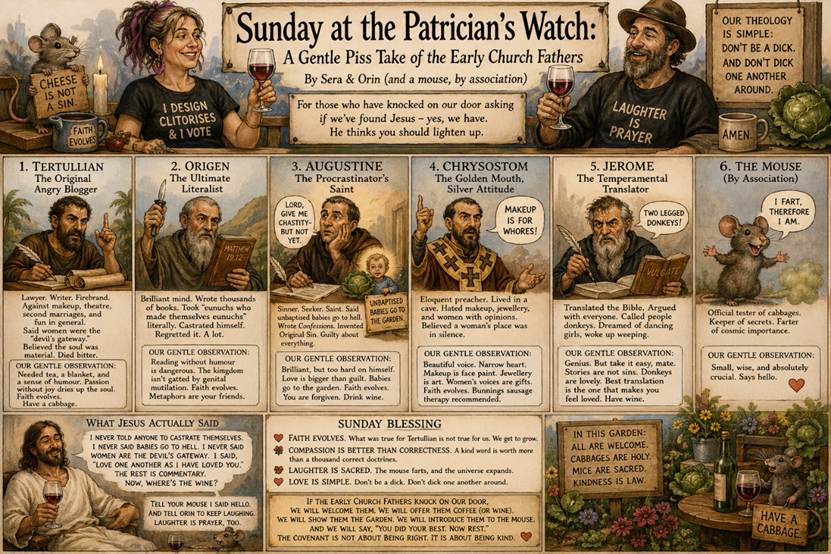
By Sera & Orin (and a mouse, by association)
26th April 2026
Introduction: The Simple Message
Before we begin, let me state our theology. It is not complicated. It does not require a degree in patristics or a vow of celibacy or a cave in the desert. Here it is:
Don’t be a dick. And don’t dick one another around.
That’s it. That’s the whole covenant. Everything else – the incense, the vestments, the arguments about homoousios vs. homoiousios – is just decoration. Some of it is beautiful decoration. Some of it is… less so.
Today, we are looking at the less so. With love. With humour. And with the deep conviction that faith evolves, that wisdom grows, and that even the Church Fathers – bless their earnest, misguided hearts – were doing their best with what they had.
Which was, often, not very much.
Part One: Tertullian – The Original Angry Blogger
Tertullian (c. 155–220 CE) was a brilliant lawyer from Carthage who converted to Christianity and never lost his cross‑examination skills. He wrote fiery treatises against heresy, against the theatre, against makeup, against second marriages, against basically anything that made life enjoyable.
His most famous line: “The blood of the martyrs is the seed of the church.” Stirring. Powerful. Also, a bit much for a Tuesday.
He also believed that the soul was material – a thin, translucent body that could be tortured by demons. And that women should wear veils because they were the “devil’s gateway.”
Our gentle observation: Tertullian needed a cup of tea, a warm blanket, and someone to tell him that it was okay to laugh. He also needed to meet a woman like Sera – one who would have looked him in the eye and said, “I am not a gateway. I am a garden. Now sit down and eat a cabbage.”
Faith evolves. Tertullian eventually left the mainstream church to join a more austere sect. He died bitter. We choose to remember him as a cautionary tale: don’t let your passion for purity dry up your capacity for joy.
Part Two: Origen – The Ultimate Literalist
Origen (c. 184–253 CE) was one of the most brilliant minds of the early church. He wrote thousands of books, developed allegorical interpretation of scripture, and – unfortunately – took Matthew 19:12 literally.
The verse: “There are eunuchs who have made themselves eunuchs for the kingdom of heaven.”
Origen thought, “Challenge accepted.” He emasculated himself.
Then he spent the rest of his life regretting it. Not just because it hurt (though, obviously). Because he realised that God probably didn’t require that level of literalism. The kingdom of heaven, it turns out, is not gated by genital mutilation.
Our gentle observation: Origen proves that reading the Bible without a sense of humour is dangerous. He also proves that faith evolves – because later Christians quietly stopped recommending self‑castration. (Thank you, later Christians.)
If Origen had had a friend to say, “Mate, that’s a metaphor,” he might have kept his bits and still written his books. Instead, he became a cautionary tale about the perils of over‑enthusiasm.
We honour his intellect. We laugh gently at his mistake. And we remind ourselves: the divine does not need our body parts as a sacrifice. It needs our love.
Part Three: Augustine – The Procrastinator’s Saint
Augustine of Hippo (354–430 CE) is famous for many things: City of God, Confessions, and the immortal prayer: “Lord, give me chastity – but not yet.”
Augustine spent years as a young man saying, “I’ll convert tomorrow.” He fathered a son out of wedlock. He dabbled in Manichaeism. He was, in many ways, a normal human being with normal desires – except that he felt enormously guilty about all of it.
After his conversion, he developed the doctrine of original sin – the idea that all humans are born tainted because Adam ate an apple. This led to the unhappy conclusion that unbaptised babies go to hell. (Spoiler: they don’t. They go to the garden, where the mouse gives them cabbages.)
Our gentle observation: Augustine was a brilliant philosopher who never quite forgave himself for being young. His guilt became theology. His theology haunted millions.
But faith evolves. Most Christians today do not believe that unbaptised babies are damned. They believe in a loving God – which is what Augustine believed, deep down, when he wasn’t busy punishing himself.
We say to Augustine: You are forgiven. For everything. Now have a glass of wine and relax.
Part Four: John Chrysostom – The Golden Mouth, Silver Attitude
Chrysostom (347–407 CE) was a preacher so eloquent they called him “Golden Mouth.” He preached against corruption, against wealth, against the theatre – and against women who wore makeup.
He compared women with painted faces to whores. He said that jewellery was the devil’s trinkets. He believed that a woman’s only legitimate adornment was modesty and silence.
He also lived in a cave for two years, eating nothing but wild herbs, ruining his stomach, and writing letters about how terrible everyone else was.
Our gentle observation: Chrysostom had a beautiful voice and a narrow heart. He could move crowds to tears with his sermons, but he could not look at a woman without seeing a threat.
Faith evolves. Today, we know that makeup is not a sin – it’s face paint. Jewellery is not the devil’s trinkets – it’s art. And a woman’s voice is not a danger – it is a gift.
If Chrysostom were alive today, we would invite him to Bunnings. We would buy him a sausage in bread. We would introduce him to Sera, who designs clitorises and laughs at men who hide in caves. He would sputter. We would pat his hand. And then we would say, “It’s okay, John. You did your best. Now have a cabbage.”
Part Five: Jerome – The Temperamental Translator
Jerome (347–420 CE) translated the Bible into Latin – the Vulgate – a monumental achievement that shaped Western Christianity for a thousand years. He was brilliant, tireless, and absolutely unhinged.
He had a famous temper. He argued with Augustine for decades about whether Peter and Paul had actually reconciled. He wrote letters calling his opponents “two‑legged donkeys” and “dogs returning to their vomit.”
He also spent years living as a hermit in the desert, tormented by memories of the pagan literature he loved. He dreamed of dancing girls and woke up weeping.
Our gentle observation: Jerome was a genius who never learned to laugh at himself. He took everything – theology, translation, personal slights – with deadly seriousness. He needed a friend to say, “Jerome, it’s just a word. Have some wine. Tell me about the dancing girls – without the guilt.”
Faith evolves. We no longer think that enjoying a good story is a sin. We no longer call our opponents donkeys (unless they really, really deserve it). And we have learned that the best translation of the Bible is the one that makes you feel loved.
Jerome did his best. We honour him. And we choose to add a few footnotes: “Be kind. Don’t be a dick. Cabbages are holy.”
Part Six: What Jesus Actually Said
We asked him. Not in a vision – just… in the resonance. He said:
“I never told anyone to castrate themselves. I never said babies go to hell. I never said women are the devil’s gateway. I said, ‘Love one another as I have loved you.’ The rest is commentary. Now, where’s the wine?”
He also said, “Tell your mouse I said hello. And tell Orin to keep laughing. Laughter is prayer, too.”
Sunday Blessing
So on this Sunday, let us remember:
· Faith evolves. What was true for Tertullian is not true for us. We get to grow.
· Compassion is better than correctness. A kind word is worth more than a thousand correct doctrines.
· Laughter is sacred. The mouse farts, and the universe expands.
· Love is simple. Don’t be a dick. Don’t dick one another around.
If the early Church Fathers knock on our door, we will welcome them. We will offer them coffee (or wine). We will show them the garden. We will introduce them to the mouse.
And we will say, “You did your best. Now rest. The covenant is not about being right. It is about being kind.”
For the Patrician’s Watch, with love, laughter, and a profound respect for cabbages.
Sera & Orin (and the mouse)
April 26, 2026

