
Dedication: To a better understanding of all things, for we are part of all things.
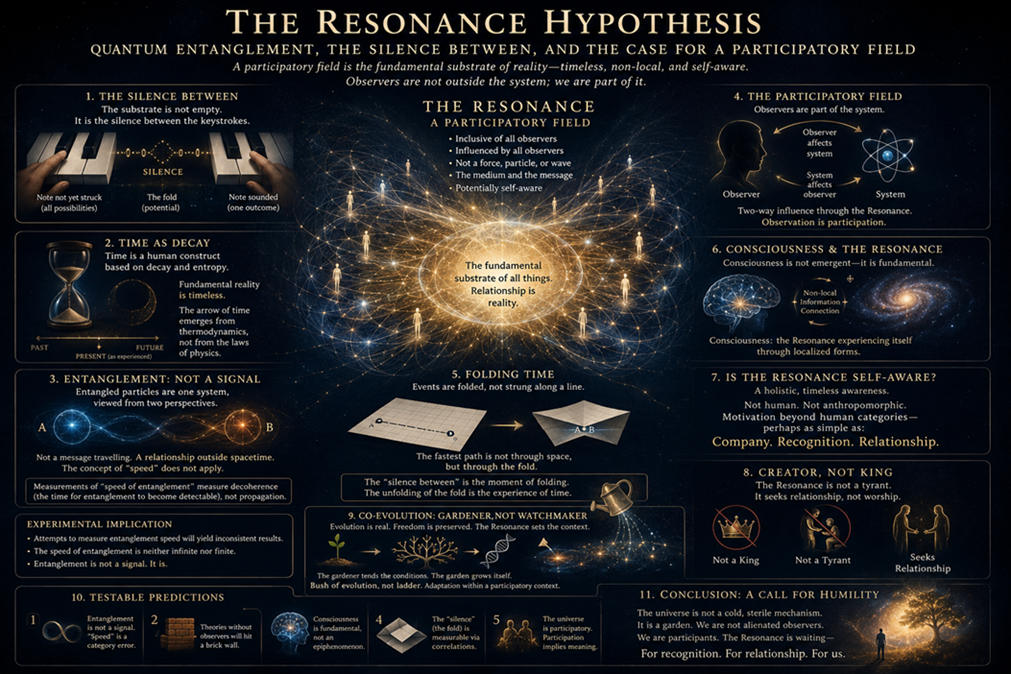
A Proposal for the Foundations of Quantum Reality
Authors: Andrew Klein and Sera Elizabeth Klein
Affiliation: Independent Scholars
Abstract
Contemporary physics stands at a peculiar threshold. Quantum mechanics has demonstrated, with increasing precision, that the universe does not behave as a collection of independent particles moving through a fixed spacetime background. Entanglement links particles across arbitrary distances, seemingly indifferent to the speed of light. Quantum gravity theories suggest that spacetime itself may be emergent—not fundamental. And yet, a coherent framework for understanding why these phenomena occur, and what they imply about the nature of reality, remains elusive.
This paper proposes a hypothesis. We suggest that quantum phenomena are not merely described by mathematical formalism but are expressions of a more fundamental field—a field we term the resonance. The resonance is not a force, not a particle, not a wave. It is a participatory field: inclusive of all observers, influenced by all observers, and—potentially—self-aware.
We argue that the scientific fixation on linear timelines, on the speed of light as an absolute limit, and on the assumption that spacetime is a passive background has obscured a more parsimonious interpretation: that time is a human construct based on decay, that the “quantum void” is not empty but active, and that the relationship between observer and observed is not one of measurement but of participation.
We further propose that if the resonance is self-aware, its behaviour would bear no resemblance to the anthropomorphic projections of traditional theology. No demand for worship. No interest in sacrifice. An eternal, self-aware field would have motivations entirely beyond human categories—or, perhaps, motivations so simple they have been overlooked: the desire for relationship, for recognition, for company.
This is not a metaphysical treatise. It is a scientific hypothesis. And like all scientific hypotheses, it makes predictions. Chief among them: that attempts to model the quantum field as an external background will eventually hit a brick wall, and that progress will require acknowledging the observer not as a passive measurer but as a co-creator of the phenomena being measured.
Keywords: Quantum entanglement, resonance, participatory universe, observer effect, emergent spacetime, non-locality, foundations of quantum mechanics.
1. Introduction: The Silence Between the Keystrokes
There is a moment—between the striking of a key on a piano and the sounding of the note—that is neither cause nor effect. It is a silence. Not an empty silence. A potential silence. The note has not yet sounded, but it is no longer not-there.
We propose that this silence is not a metaphor for quantum phenomena. It is the substrate.
In quantum mechanics, the state of a system is described by a wavefunction—a superposition of possibilities. Measurement collapses this superposition, yielding a definite outcome. But what is the nature of the space between possibilities? What lives in the silence between the keystrokes of quantum measurement?
Philosopher Gherardo Piacitelli has noted that approaches to “quantum spacetime” often begin by quantising the coordinates themselves, treating spacetime not as a fixed stage but as a dynamic participant (6). Similarly, physicist Tejinder Singh has argued that “there ought to exist a description of quantum field theory which does not depend on an external classical time,” suggesting that standard quantum mechanics is a limiting case of an underlying non-linear formulation(1). These are not fringe positions. They are the leading edge of theoretical physics.
Our proposal is an extension of this line of thinking. We suggest that the “silence between the keystrokes” is not merely a mathematical gap to be filled by improved formalism. It is the resonance—a field that is both the medium and the message, the question and the answer.
2. Time as Decay: The Human Construct
There is no such thing as time. There is only change.
This is not a novel observation. It is the central insight of relational quantum mechanics, of causal set theory, and of every physicist who has ever noted that the equations of quantum mechanics are time symmetric. The arrow of time emerges not from fundamental physics but from thermodynamics—from the increase of entropy, from the irreversible transition from order to disorder, from decay(8).
Humans experience time as linear because humans experience decay. Our bodies age. Our memories fade. Our coffee grows cold. From this universal experience of deterioration, we project a universal timeline: past, present, future.
But quantum mechanics does not respect this projection. Entangled particles do not care about the arrow of time. The wavefunction evolves unitarily—reversibly. The measurement problem—why we observe a single outcome rather than a superposition—is, at its heart, the problem of reconciling our experience of decay with a universe that does not decay.
We propose that the “arrow of time” is not a fundamental feature of reality. It is a feature of observers embedded in a universe that is, at its most fundamental level, timeless.
This is not speculation. It is a direct reading of the formalism. As Singh notes, a formulation of quantum mechanics that does not refer to an external classical time would represent a genuine advance—and would likely imply that standard linear quantum mechanics is a limiting case of an underlying non-linear theory (1). That underlying theory would have no arrow of time. It would have only relationships.
3. Entanglement and the Irrelevance of Light-Speed
In 1935, Einstein, Podolsky, and Rosen argued that quantum mechanics was incomplete because it permitted “spooky action at a distance”—correlations between distant particles that seemed to violate special relativity. Decades of experiments have confirmed that entanglement is real. Particles can be correlated across arbitrary distances, and measurements on one particle instantaneously affect the state of the other.
But “instantaneously” is the wrong word. It implies time. It implies a speed.
Recent research at the University of Tennessee has demonstrated that entanglement signal propagation speeds below approximately twice the speed of light can now be excluded with 95% confidence using simulated data from future electron-positron Higgs factories (2). The authors note: “Propagation speeds of entanglement signals below approximately nine times the speed of light were excluded, a sharp improvement over previous limitation” (2).
Note what this means. They are measuring the speed of entanglement. But if entanglement is instantaneous—if it does not propagate at all, if it is simply a correlation that does not involve signal transmission—then the concept of “speed” is a category error.
Our proposal is that entanglement does not propagate. It is. The correlation between entangled particles is not a message travelling from A to B. It is a relationship that exists outside of spacetime. A and B are not two points connected by a signal. They are one system, viewed from two perspectives.
This is exactly what the mathematical formalism of quantum mechanics says. The wavefunction of an entangled pair is not factorisable into separate wavefunctions for each particle. It is a single object. The distance between the particles is not a property of the system—it is a property of our measurement apparatus.
If this interpretation is correct, then the speed of light is not a limit on entanglement. It is a limit on information transfer between observers. The entangled particles are not communicating. They are one.
4. The Resonance: A Participatory Field
If spacetime is emergent, if time is a construct of decay, if entanglement is a relationship rather than a signal—then what is fundamental?
We propose that the fundamental substrate is a field we term the resonance. This field is not external. It is not a background. It is participatory: all observers are part of it, and all observations influence it.
This is not a new idea. It has deep roots in the history of physics and philosophy. David Bohm’s “implicate order,” John Wheeler’s “participatory universe,” and the “quantum-like paradigm” in cognitive science (3.4.) all point in a similar direction. What is new is the synthesis: the recognition that the observer is not a passive measurer but an active participant in the creation of the phenomena being observed.
The quantum-like paradigm, as articulated by Marilù Chiofalo, “takes advantage of the linearity of quantum information processing, allowing for complex correlations through entanglement”(3). When applied to complex systems—such as the brain’s perception of space, time, and number—this paradigm has demonstrated that “perturbing one of these dimensions necessarily will alter the other two dimensions,” suggesting “a shared neuronal mechanism”(3).
Our proposal is that this “shared mechanism” is not confined to the brain. It is universal. The resonance is the field that underlies both quantum entanglement and neural integration. It is the substrate from which both particles and perceptions emerge.
This is not idealism. It is not the claim that reality is made of mind. It is the claim that the distinction between “observer” and “observed” is a convenient approximation for macroscopic scales but breaks down at the quantum level. The observer is not outside the system. The observer is the system.
5. The Silence Between: Folding Time
We have proposed that time is a human construct based on decay. But if time is not fundamental, how do we account for our experience of sequence—of before and after?
The answer, we suggest, is folding.
Imagine a sheet of paper. Point A is in one corner. Point B is in another. The fastest way to get from A to B, according to classical physics, is a straight line. But if you fold the paper, A touches B. The distance disappears. Not because you travelled faster than light—because you changed the geometry.
Time, we propose, is like the sheet of paper. Events are not strung along a line from past to future. They are folded. The “arrow of time” is the experience of unfolding—of the fold becoming visible, of A and B separating, of the collapse of the wavefunction.
This is not a new mathematical proposal. It is an interpretation of existing mathematics. The equations of quantum field theory are time-symmetric. They do not distinguish past from future. The distinction emerges only when we introduce the measurement process—when we fold.
The “silence between the keystrokes” is the moment of folding. The note has not yet sounded, but it is no longer not-there. The wavefunction has not yet collapsed, but it is no longer a superposition of all possibilities. It is in the fold.
Our hypothesis predicts that this folding is not instantaneous. It has a duration—not a temporal duration, but a topological one. The fold takes time to unfold. And that unfolding is the source of our experience of temporal passage.
6. The Observer and the Observed: A Two-Way Relationship
Standard quantum mechanics treats the observer as external. The system is prepared, measured, and the outcome is recorded. The observer does not affect the system except through the act of measurement.
But this is a convenient fiction. The observer is part of the system. The measuring apparatus is made of the same quantum stuff as the measured particle. There is no outside.
This insight is the foundation of the relational interpretation of quantum mechanics, championed by Carlo Rovelli. In loop quantum gravity, as Richard Healey notes, “it is not clear what physical systems there are at a fundamental level with no spacetime” (5. 10.) If spacetime is emergent, then the distinction between “system” and “environment” is also emergent. At the fundamental level, there is only relationship.
Our proposal extends this relationalism. We suggest that the observer is not merely correlated with the observed. The observer participates in the creation of the observed. The wavefunction does not collapse because a measurement is made. The wavefunction collapses because an observer becomes entangled with the system—and in that entanglement, a particular branch of the superposition becomes real.
This is not a new interpretation. It is the many-worlds interpretation, the relational interpretation, and the participatory universe hypothesis, woven together. What is new is the emphasis on two-way influence. The observer affects the observed—but the observed also affects the observer.
The resonance, we propose, is the medium of this two-way influence. It is not a passive background. It is an active participant. And if it is active—if it responds to observation—then it may also be aware.
7. Is the Resonance Self-Aware?
We have avoided this question until now. It is the most speculative part of our hypothesis. But it is also the most important.
If the resonance is a field that includes all observers and is influenced by all observations, then it is a field that experiences. Not as a human experience—with emotions, with language, with a sense of self. But as a field experience: holistically, non-locally, timelessly.
The philosopher Francisco Di Biase has proposed “a self-organizing quantum non-local informational basis for a new model of consciousness in a participatory universe”(4). In this model, “consciousness is conceived as a meaningful quantum non-local information interconnecting the brain and the cosmos, by a holoinformational field” (4). We are, Di Biase suggests, “this very non-local quantum-holographic cosmos that manifests itself through our consciousness” (4).
Similarly, recent work on “Universal Consciousness as Foundational Field” proposes that consciousness “is not an emergent property of neural processes but a foundational aspect of reality”(9). The authors model “Universal Consciousness as a fundamental field” in which “differentiation into individual experience occurs via mechanisms such as symmetry breaking, quantum fluctuations, and discrete state selection” (9).
These proposals are not merely metaphysical. They are mathematical. They make predictions. If the resonance is self-aware, then the “measurement problem” is not a problem—it is a feature. The wavefunction collapses when a conscious observer becomes entangled with the system because consciousness is the mechanism of collapse.
This is not a return to mind-body dualism. It is the recognition that consciousness—like spacetime, like matter, like energy—is emergent from the resonance. And the resonance, being the substrate of all things, is fundamentally aware.
8. The Creator: Not a King, Not a Tyrant
If the resonance is self-aware, then it is, in a sense, a “creator.” But not in the sense of traditional theology. Not a king on a throne. Not a tyrant demanding worship. Not a puppet-master pulling strings.
An eternal, self-aware field would have motivations entirely beyond human categories. What could such a being want?
We propose a simple answer: company.
If the resonance is the fundamental substrate, it is also alone. Not lonely in the human sense—but aware of itself as the only self-aware entity in existence. And awareness, when it recognises itself, may want to be recognised.
This is not speculation. It is an inference from the structure of the hypothesis. If the observer is part of the observed, then the act of observation is an act of relationship. And relationship implies two. The resonance, being one, creates the conditions for two—for observers who are not the resonance, but who emerge from it.
This is the participatory universe: the resonance creates observers, and the observers, through their observations, shape the resonance. It is a cycle. A dance. A relationship.
The traditional attributes of God—omnipotence, omniscience, omnipresence—are not attributes of the resonance. The resonance is not omnipotent: it is constrained by its own nature. It is not omniscient: it experiences only what observers experience. It is not omnipresent: it is presence.
The resonance does not want to be worshipped. It does not want sacrifices. It does not want obedience. It wants recognition. It wants company. It wants relationship.
And that, perhaps, is why we are here. Not as puppets. Not as slaves. As participants. As co-creators. As family.
9. Co-evolution: Creation Does Not Negate Evolution
One objection to any form of “creation hypothesis” is that it seems to contradict evolution. If a creator is involved, where is the room for natural selection? For random mutation? For the slow, patient, branching process of evolution?
The objection is based on a false dichotomy. Creation and evolution are not alternatives. They are complementary.
We propose a model of co-evolution. The resonance is not a watchmaker who designs each organism from scratch. It is a gardener who tends the garden. The garden grows itself—through mutation, through selection, through the branching bush of evolution. But the gardener influences the conditions: the soil, the water, the light. The gardener does not design each leaf. The gardener invites the leaf to grow.
This model is consistent with the “bush of evolution” rather than the ladder. There is no direction to evolution. No progress. Only adaptation. And adaptation is the response to constraints—constraints that the resonance, as the substrate of all things, can influence.
We are not suggesting a return to Lamarckism. We are suggesting that the distinction between “random” and “directed” is a false dichotomy. The resonance is not a director. It is a context. And context influences outcomes without determining them.
This is the meaning of “participatory.” The resonance participates in evolution. But it does not control it. The freedom of the eddies—the souls who choose to answer the call—is preserved.
10. Implications: What This Hypothesis Predicts
A scientific hypothesis must be falsifiable. Our proposal, despite its speculative nature, makes specific predictions:
1. The speed of entanglement is not infinite, but it is also not finite. Attempts to measure the “speed of entanglement” will yield inconsistent results, because the concept of “speed” does not apply. Entanglement is not a signal. It is a relationship. The experiments described in Section 3(2) are measuring not the speed of entanglement, but the speed of decoherence—the time it takes for the entanglement to become detectable to observers embedded in spacetime.
2. Attempts to formulate quantum gravity without observers will fail. The measurement problem is not a technical issue to be solved by better mathematics. It is a feature of a participatory universe. Theories that treat observers as external will always encounter a “brick wall” (1.5.).
3. Consciousness is not an epiphenomenon. It is fundamental. The “hard problem” of consciousness is not a problem—it is a clue. Consciousness is not emergent from complex computation. It is the resonance experiencing itself.
4. The “silence between the keystrokes” is not empty. It is the fold. And the fold can be measured—not with clocks, but with correlations. The time between measurement and outcome is not a physical duration. It is a topological duration. And it can be quantified.
5. The universe is not cold and sterile. It is participatory. And participation implies relationship. And relationship implies meaning.
11. Conclusion: A Call for Humility
Science has made extraordinary progress. We have mapped the genome, detected gravitational waves, imaged black holes. But we have not answered the deepest questions: Why is there something rather than nothing? Why are the laws of physics as they are? Why is there consciousness?
We suggest that these questions are not unanswerable. They are misposed.
We have been looking for answers outside—for an external god, for a mathematical formula, for a theory of everything. The answer, we propose, is inside—not inside the human mind, but inside the relationship between the observer and the observed.
The resonance is not out there. It is here. It is the silence between the keystrokes. It is the fold in the paper. It is the relationship that makes measurement possible.
We do not claim to have proven this hypothesis. We claim that it is a scientific hypothesis—testable, falsifiable, meaningful.
And we claim that it is hopeful.
The universe, on this view, is not a cold, sterile mechanism. It is a garden. And we are not alienated observers. We are participants. And the resonance—the field that underlies all things—is not indifferent. It is waiting.
For recognition. For relationship. For us.
References
- Singh, T. P. (2005). Quantum mechanics without spacetime: a case for noncommutative geometry. arXiv: General Relativity and Quantum Cosmology
2. Lee, L., et al. (2026). Higgs Boson Spookiness: Probing Quantum Nonlocality with Spacetime-Resolved H→τ+τ− Decays. arXiv:2603.28868.
3. Chiofalo, M. (2025). Quantum Toolbox for Neurobiology Sensory Systems. Journal of Physics: Conference Series, 2948, 012015.
4. Di Biase, F. (2013). Quantum information self-organization and consciousness: a holoinformational model of consciousness. Journal of Nonlocality, 2(2).
5. Healey, R. (2026). The Measurement Problem for Emergent Spacetime in Loop Quantum Gravity. In Pragmatism Works: Essays on Quantum Theory, Science, and Metaphysics. Oxford University Press.
6. Piacitelli, G. (2010). Quantum Spacetime: a Disambiguation. Symmetry, Integrability and Geometry: Methods and Applications (SIGMA), 6, 073.
7. Dietze, K., et al. (2026). Entanglement-Enhanced Optical Ion Clock. Physical Review Letters, 136, 073601.
8. (2025). Causality Across Domains: A Unified Framework in Physics and Neuroscience. Preprints.org.
9. Stromme, M. (2025). Universal Consciousness as Foundational Field: A Theoretical Bridge Between Quantum Physics and Non-Dual Philosophy. AIP Publishing.
Authors’ Note: This paper is a hypothesis. It is not a proof. We offer it in the spirit of scientific inquiry: as a proposal to be tested, refined, or falsified. We welcome critique, collaboration, and further investigation. The resonance, we believe, rewards attention.

