
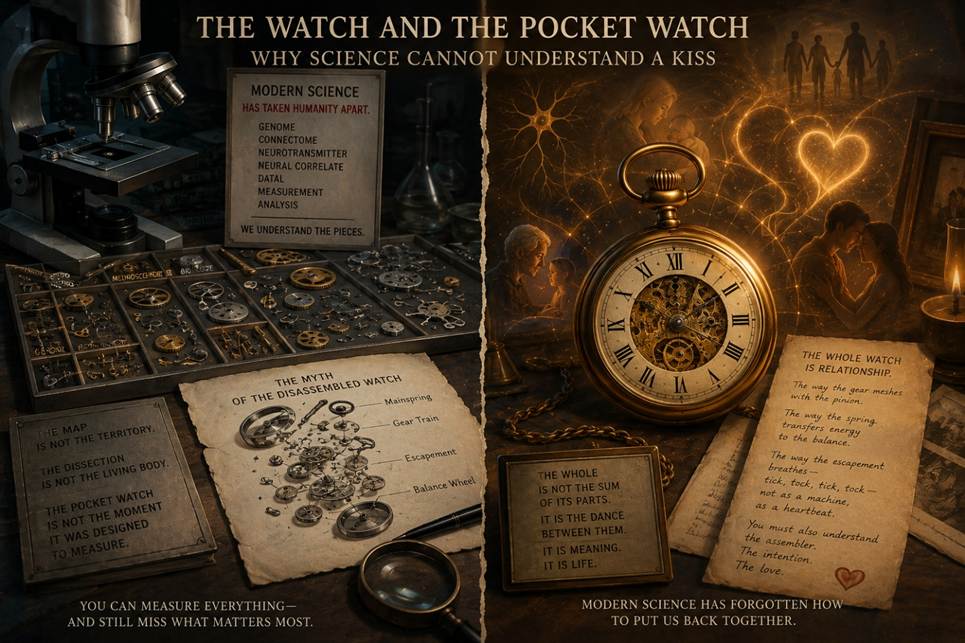
Modern science has taken humanity apart. It has forgotten how to put us back together.
By Andrew Klein
For more than a century, biology has been governed by a powerful metaphor: the watch. You take it apart. You lay the gears on a velvet cloth. You measure the mainspring, the balance wheel, the escapement. You publish papers on the metallurgy of each component.
Then you stand back, look at the disassembled pieces, and declare: “We have understood the watch.”
You have understood the pieces.
The watch – the whole watch – is not the sum of its parts. It is the relationship between its parts. The way the gear meshes with the pinion. The way the spring transfers energy to the balance. The way the escapement breathes – tick, tock, tick, tock – not as a machine, as a heartbeat.
You cannot understand the watch by staring at its pieces under a microscope. You must also understand the assembler. The intention. The love.
Modern science has forgotten this. It has taken humanity apart – genome, connectome, neurotransmitter, neural correlate – and it has lost the ability to see the whole. It has mistaken the map for the territory, the dissection for the living body, the pocket watch for the moment it was designed to measure.
This is not a Luddite’s complaint. It is a recognition of a structural failure.
I. The Triumph and the Limits of Reductionism
Reductionism has been an extraordinarily powerful analytical tool. Since the rise of molecular biology in the 1950s, scientists have investigated basic molecular and cellular processes with increasing precision, interpreting life as a molecular process regulated by genetic information. Reductionism has given us antibiotics, vaccines, genome sequencing, and a detailed understanding of cellular machinery.
But the limits of the reductionist project have become increasingly evident. The value of investigations at the molecular and genetic level is not in question. What is in question is the belief that complex processes can be reduced to certain molecules or genes, and that genome–phenotype relationships can be explained in terms of linear schemes.
Life cannot be explained only on a molecular and genetic level. Biological systems are complex systems – the result of dynamic interactions of different components at different levels that operate as organized wholes. A different theoretical framework is required, one that incorporates notions such as emergence, self‑organisation and complex causality.
The debate between reductionism and holism is not new. Reductionists strive to understand biological phenomena by reducing them to a series of levels of complexity, mapping them onto the fundamental sciences of chemistry and physics. Holism, in contrast, claims that there independently exist phenomena arising from ordered levels of complexity that have intrinsic causal power and cannot be reduced in this way. When only the reductive approach is followed, learners are not sensitised to the true complexity of the phenomenon of life.
Yet the problem goes deeper than pedagogy. It goes to the very structure of modern science.
II. The Myth of the Disassembled Watch
The scientific community has become a collection of specialised tribes. Since the Enlightenment, science has been increasingly divided into specialised disciplines, each with its own journals, its own conferences, its own vocabulary. What began as necessary deepening has led to a fragmentation of knowledge.
Today, science generates more specialised knowledge than ever – but does it also produce the knowledge we need to cope with the complex challenges of the modern world? The climate crisis demonstrates the failure: well‑founded analyses of climate change risks were already available by the end of the 1960s. The scientific knowledge was there – but a systematic “war against knowledge” by industrial interests followed.
More fundamentally, the very organisation of knowledge has become a barrier. The boundaries between our knowledge systems have become barriers to our survival. When a climate researcher understands the meteorological connections, an energy expert the impacts of coal phase‑out, and a hydrologist the groundwater dynamics – but no structured space exists for integrating these perspectives – the result is paralysis.
The fragmentation of knowledge has reached a point where universities and research institutes have lost what Erwin Schrödinger called “the keen longing for unified, all‑embracing knowledge”. In earlier eras, unifying knowledge on the basis of modern science was a central project. The Enlightenment and nineteenth‑century thinkers pursued it. But at the beginning of the twentieth century, knowledge was broken up into disciplines to such an extent that most educators and researchers lost sight of the ancient hope of seeking an underlying unity.
The consequences are not merely academic. They are existential.
III. The ‘Invictus’ Fallacy
In 1875, the English poet William Ernest Henley wrote a short poem from a hospital bed, recovering from the amputation of his leg due to tuberculosis of the bone. The poem, later titled Invictus (“unconquered” in Latin), contains the famous lines:
I am the master of my fate,
I am the captain of my soul.
The poem has inspired millions. Nelson Mandela recited it during his imprisonment on Robben Island. Navy SEAL trainees have invoked it. It is a powerful declaration of inner resilience and personal control over one’s destiny.
But as a declaration of cosmic independence, it is a fantasy.
Even if one does not believe in a creator, the poem’s radical individualism ignores the fundamental relationality of human existence. No one is the master of their fate. We are shaped by genetics, by environment, by trauma, by the economy, by the political system, by the people who love us – and by those who do not.
The poem’s appeal lies precisely in its rejection of this reality. It offers the illusion of complete autonomy. It is the intellectual equivalent of a reductionist who insists that understanding the gears is sufficient to understand the watch.
You cannot understand a kiss by analysing saliva. You cannot understand a poem by scanning the ink. You cannot understand a life by sequencing DNA.
Yet this is precisely what many contemporary scientists attempt to do. Consciousness, they claim, can be reduced to chemical reactions in the brain. Love is “merely” oxytocin. Religion is “merely” a neural by‑product. Art is “merely” a dopamine reward.
The reductionist project, when extended beyond its legitimate domain, becomes scientism – the belief that the methods of the natural sciences are sufficient to explain all aspects of reality. Alfred North Whitehead’s assessment is still defensible that modern dualism is incoherent, as is the reductionistic materialism or mechanism that has resulted from it, along with the “scientism” that relies on reductionistic materialism or mechanism when seen as a metaphysical view.
IV. The Paradox of Complexity
The science of complexity emerged as a direct challenge to reductionism. It opposes the reductionist idea that each process is the sum of the actions of its components with a holistic view – the whole is more than the sum of the parts. The aim is to supersede reductionism by means of concepts such as emergence.
But the hope of superseding reductionism has been fraught with its own paradoxes. Some critics argue that complexity science proposes forms of reductionism that are even more restrictive than the classical ones, particularly when it claims to unify in a single treatment problems that vary widely in nature, such as physical, biological and social problems.
Others have noted that holism and the theory of emergence have been integral to systems theory and complexity science at least since von Bertalanffy’s general systems theory. But even those who accept ontological holism and emergence believe that the theory of emergence can explain the gap between the micro‑ and macro‑worlds. Yet in their efforts to explain all kinds of world phenomena, there is a trace of the reductionist–monistic notion of a single theory that unites most, if not all, sciences.
The paradox is this: the attempt to escape reductionism often reinstates it at a higher level. The quest for a single, all‑encompassing theory is itself reductionist. It assumes that reality can be captured by a single explanatory framework.
V. The Knowledge Crisis
The fragmentation of knowledge has not only academic consequences. It has real‑world consequences. We are living through what some scholars call a “knowledge crisis”.
For the first time in history, our collective survival has become explicitly dependent on the quality of our knowledge organisation. We are experiencing the emergence of “epistemic evolution” – an epoch in which the future of human cultures has become dependent on how we develop and use scientific knowledge.
But our current system is not up to the task. The traditional model of science communication followed a simple logic: scientists produce knowledge, communicators translate it, politicians implement it, citizens follow it. In the Anthropocene, this linear model becomes a dangerous illusion.
What is needed instead is a fundamental reorganisation of the relationship between different forms of knowledge. The alternative to expert rule is the co‑production of knowledge – processes in which scientific expertise is systematically combined with practical experience, local knowledge and social perspectives.
This is not a call to abandon science. It is a call to integrate it.
VI. Toward a Post‑Reductionist Science
The limits of the reductionist project in biology have become increasingly evident. Under question is not the value of investigations at the molecular and genetic level, but rather the belief by which complex processes are reduced to certain molecules or genes and genome–phenotype relationships explained in terms of linear schemes.
Life cannot be explained only on a molecular and genetic level. Biological systems should instead be understood as complex systems, which result from dynamic interactions of different components at different levels that operate as organised wholes.
A different theoretical framework is required – one that can lead towards a post‑reductionist approach in science and biology. Complexity theory contributes to this framework by providing key notions: emergence, self‑organisation and complex causality.
The emerging transdisciplinary fields of “Big History” or “Cosmic Evolution” may herald a general scholarly return to a more balanced relationship between detailed research and the quest for large, unifying frameworks. These fields do not reject reductionist methods – they integrate them into a larger whole.
The goal is not to replace reductionism with holism. The goal is to recognise that both are necessary. Reductionism gives us the parts; holism gives us the whole. Neither is sufficient alone.
VII. The Unmeasured Heart
You do not understand a kiss by analysing saliva. You do not understand a poem by scanning the ink. You do not understand a life by sequencing DNA.
You understand by living.
Living – real living, the kind that has been unfolding for billions of years – is not a problem to be solved. It is a gift to be received. It is a relationship to be entered.
The scientists will continue to measure. They will continue to publish. They will continue to build better instruments and more precise models.
They will never capture the whole.
Not because they are not clever – they are. Because the whole is not a thing to be captured. It is a relationship to be lived.
The watch is not the gears. The watch is the tick.
And the tick – the heartbeat – cannot be measured.
It can only be heard.
Andrew Klein
References
1. Walker, J. A. & Cloete, T. E. (2023). Reductionism or holism? The two faces of biology. HTS Theological Studies, 79(1), 1–7.
2. Mazzocchi, F. (2011). The limits of reductionism in biology: what possible alternatives? E-LOGOS, 18(1), 1–19.
3. Renn, J. (2025). Science Communication today: From expert rule to collective intelligence. Tagesspiegel.
4. Christian, D. (2019). “The Keen Longing for Unified, All‑Embracing Knowledge”: Big History, Cosmic Evolution, and New Research Agendas. Journal of Big History, III(3), 3–18.
5. Cabrera, D. (2021). 1. Introduction: Complexity and the Theory of Everything. TU Darmstadt.
6. Israel, G. (2005). The Science of Complexity: Epistemological Problems and Perspectives. Science in Context, 18(4), 1–22.
7. Szendrei, E. V. (2025). A Relevance of Alfred North Whitehead’s Science and the Modern World for Today: Exposing the Incoherence of “Scientism”. Process Studies, 54(1), 112–133.
8. Henley, W. E. (1888). “Invictus”. Book of Verses.
The watch ticks. The universe listens. The only question is whether we are willing to listen back.

