
Dedicated to my wife, who taught me that the body sleeps when it must and plays when it can.
By Andrew Klein
I. Introduction: What They Call a Disorder Was Once a Rhythm
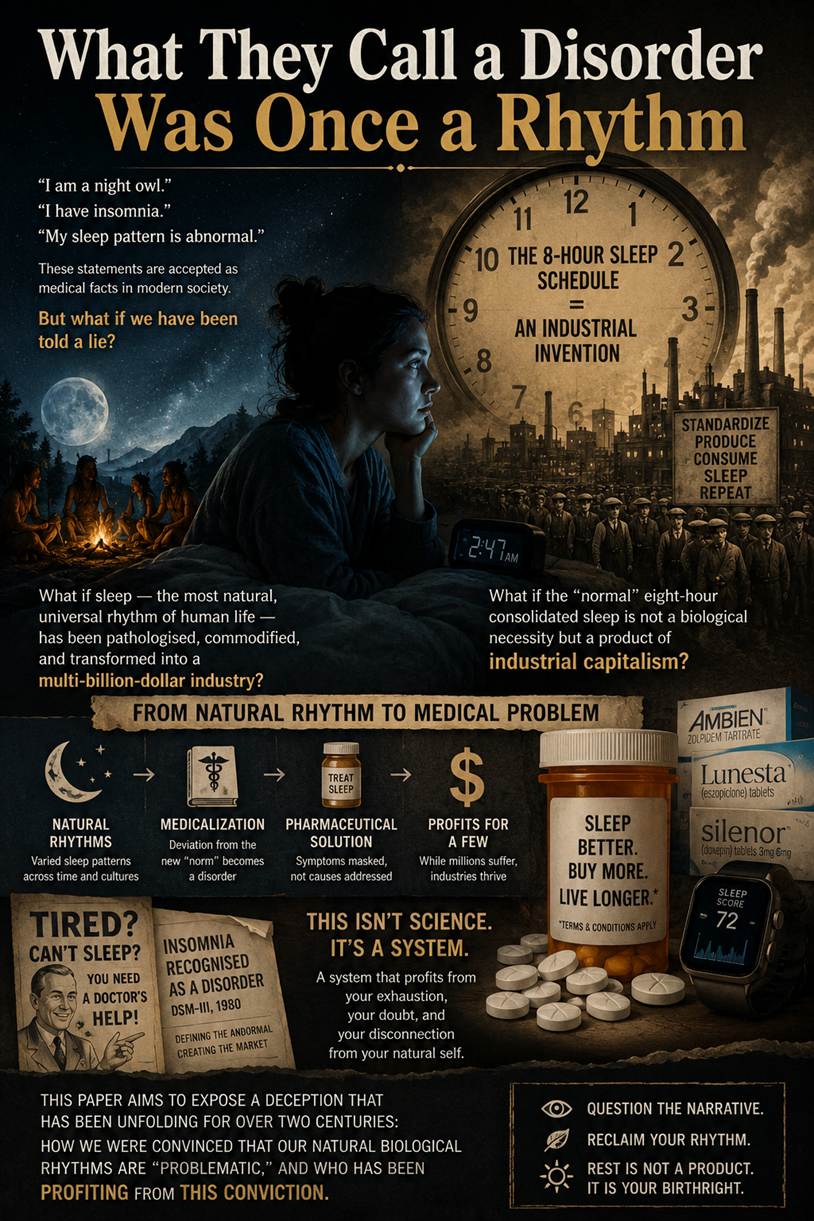
“I am a night owl.” “I have insomnia.” “My sleep pattern is abnormal.”
These statements are accepted as medical facts in modern society. But what if we have been told a lie? What if the “normal” eight-hour consolidated sleep is not a biological necessity but a product of industrial capitalism? What if sleep — the most natural, universal rhythm of human life — has been pathologised, commodified, and transformed into a multi-billion-dollar industry?
This paper aims to expose a deception that has been unfolding for over two centuries: how we were convinced that our natural biological rhythms are “problematic,” and who has been profiting from this conviction.
II. Biphasic Sleep: The Forgotten Natural Pattern
Historian Roger Ekirch, in his seminal work At Day’s Close: Night in Times Past, demonstrated that “the dominant pattern of sleep in pre-industrial European societies was biphasic — people would retire between 9 and 10pm, sleep for 3 to 3.5 hours (the ‘first sleep’), wake for about an hour around midnight, and then have a ‘second sleep’ until dawn”.
This was not an exception or a local phenomenon. It was attested across the historical record for over two millennia — from Homer’s Odyssey to Virgil’s Aeneid, from Thucydides to Apuleius. In English, it was called “first sleep“; in Italian, “primo sonno”; in French, “premier sommeil“; in Latin, “primo somno“.
During that waking period between sleeps, people would get up, urinate, smoke, and even visit neighbours. Many remained in bed to make love, pray, and, most importantly, reflect on the dreams they had experienced during their first sleep. A sixteenth-century French physician’s manual even advised that the best time for conception was not at the end of a long day’s labour, but “after the first sleep“, when couples were “more vigorous” and “did it better“.
Even Samuel Pepys, in his seventeenth-century diaries, recorded this pattern — his wife rising at 4am, himself going to sleep, waking, and then sleeping again.
This was not “insomnia.” This was normal.
III. The Invention of the Eight-Hour Sleep: How the Industrial Revolution Reshaped Our Nights
The decline of biphasic sleep began in the late seventeenth century, “first among the urban upper classes in northern Europe, and over the next two hundred years it filtered down through the rest of Western society”.
What drove this change?
Artificial lighting. “The transformation in Europe and America throughout the nineteenth century was a long and uneven one … largely a product of the Industrial Revolution. Chief among these was the increasing availability of artificial lighting — first gaslight, then electric light“. By 1823, nearly forty thousand gas lamps lit over two hundred miles of London streets.
Coffeehouse culture. “All-night coffeehouses” made the night a legitimate place for activity.
Factory schedules. As historian Matthew J. Wolf-Meyer documents in The Slumbering Masses, “the foundations of contemporary American sleep were laid in the nineteenth century, when the industrial workday demanded a coordination and integration of sleep and waking schedules“. What was lost was unintegrated sleep — “where sleep had previously occurred in two nightly bouts, or in nightly sleep supplemented by daytime napping, it was replaced by a single eight-hour sleep period”.
“The eight-hour sleep concept is an industrial concept, it’s a social construct“. As sleep medicine expert Dr. David Cunnington has noted, many of our ideas about sleep come from 1817, when labour rights activist Robert Owen coined the slogan: “Eight hours labour, eight hours recreation, eight hours rest”.
The consolidated eight-hour sleep was not a discovery — it was an invention.
IV. The Medicalisation of Sleep: When Normal Becomes “Disorder”
With consolidated sleep established as the “normal” standard, any deviation naturally became pathological.
“The invention of consolidated sleep led to the pathologisation of diverse sleep forms and laid the groundwork for contemporary sleep medicine”.
Insomnia — an experience known since antiquity — acquired pathological status in the 1870s. This was no coincidence. It was precisely when sleep became a medical specialty.
Between 2001 and 2007, diagnoses of insomnia in the United States increased significantly. Researchers noted that “insomnia may be a public health problem, but the potential for overtreatment with expensive, modestly effective, and side-effect-laden medications is a population health concern”.
Medicalisation — “the process by which previously normal biological processes or behaviours come to be described, accepted, and treated as medical problems” — had transformed one of the body’s most natural rhythms into a condition that needed to be “fixed“.
And this was only the beginning.
V. The Profit Motive: The Sleep-Industrial Complex
Once normal variation was defined as a medical problem, the solution had to be commodified.
In 2024, the global sleep medication market was valued at $3.5 billion, projected to grow to $5.1 billion by 2031. Jazz Pharmaceuticals alone generated $408 million in sales from its sleep disorder drug Xywav in the first quarter of 2026. The broader “sleep economy” — apps, tracking rings, smart mattresses — is valued at over $100 billion. The sleep technology sector is growing at nearly 20% per year.
Marketing is also crucial. Between 1997 and 2016, pharmaceutical companies doubled their spending on “disease awareness” marketing — from $177 million to $430 million.
The result is a “sleep-industrial complex” that profits from pathologising and treating normal physiology. As one analysis observed, “the medicalisation of sleep is a profit-driven pursuit”.
VI. “Sleep Management” in Psychiatry: Sedation, Stabilisation, and Profit
In mental health care, the medicalisation of sleep takes a darker turn.
Hypnotics and anxiolytics — including benzodiazepines and the “Z-drugs” — are routinely prescribed to “manage” patient sleep. While offering short-term relief, they are highly addictive, carry significant side effects, and lack evidence for long-term efficacy.
The costs are staggering:
· In the UK, the prescription cost for hypnotics and anxiolytics alone is £22 million annually.
· In Canada, the annual cost of insomnia medications was $54.8 million, with 55.2% of use classified as inappropriate.
· In Australia, the total cost of psychotropic medications in 2007-2008 was $702 million — exceeding the total amount paid by the Medical Benefits Scheme for all mental health services combined.
More concerning is that these prescriptions are often for management — keeping patients quiet, compliant, and manageable — rather than for healing. Sedatives and hypnotics do not address the root causes of insomnia; they simply suppress symptoms, often creating new problems such as dependence and cognitive impairment.
The medicalisation of sleep has moved beyond medicine into biomedicalisation — where our very bodily rhythms have become a site of governance and profit.
VII. A Disturbing Precedent: Historical Patterns of Medicalisation
The medicalisation of sleep is not the first time medicine has redefined a normal bodily function as a disease.
In the 19th century, masturbation was pathologised as a disease causing “insanity, nocturnal hallucinations, and homicidal tendencies”. Treatments included surgery — ranging from circumcision to castration — to “cure” a normal behaviour.
Hysteria — another diagnosis created for female behaviour — was allegedly treated by pelvic massage to “hysterical paroxysm” (i.e., orgasm). In the 1880s, Dr. Mortimer Granville invented the first portable battery-powered vibrator — weighing over forty pounds — as a “medical device“. Until the 1920s, doctors used vibratory massage as a medical treatment for hysteria.
In each of these cases, normal human behaviour was redefined as a disease, and the “treatment” often served the interests of the practitioner — not the patient.
The medicalisation of sleep follows the same pattern.
VIII. Conclusion: Reclaiming Our Nights
For thousands of years before the Industrial Revolution, humans slept in two shifts. The story we tell ourselves about the “eight-hour sleep” — that insomnia is a disease and sleeping pills are the cure — is a construct that serves industries, not human bodies.
The body rests when it must. It plays when it can.
What we have been told — about “night owls,” about “insomnia,” about “normal sleep” — is largely a story told to keep a multi-billion-dollar industry alive.
It is time to reclaim our nights. It is time to stop apologising for our natural rhythms. It is time to recognise that the problem is not our bodies — it is the system that profits from convincing us we are sick.
References
1. Ekirch, A. R. (2001). “Sleep We Have Lost: Pre-Industrial Slumber in the British Isles.” American Historical Review, 106(2), 343-386.
2. Ekirch, A. R. (2005). At Day’s Close: Night in Times Past. W.W. Norton & Company.
3. Wolf-Meyer, M. J. (2012). The Slumbering Masses: Sleep, Medicine, and Modern American Life. University of Minnesota Press.
4. Kroker, K. (2022). “Insomnia, Medicalization, and Expert Knowledge.” Canadian Bulletin of Medical History, 39(1), 37-71.
5. Williams, S. J., Meadows, R., & Coveney, C. M. (2021). “Desynchronised times? Chronobiology, (bio)medicalisation and the rhythms of life itself.” Sociology of Health & Illness, 43(6), 1501-1517.
6. Moloney, M. E., Konrad, T. R., & Zimmer, C. R. (2011). “The Medicalization of Sleeplessness: A Public Health Concern.” American Journal of Public Health, 101(8), 1429-1433.
7. Coveney, C., Williams, S. J., & Gabe, J. (2019). “Medicalisation, pharmaceuticalisation, or both? Exploring the medical management of sleeplessness as insomnia.” Sociology of Health & Illness, 41(2), 266-284.
8. 6Wresearch. (2025). Global Sleeping Medications Market Report 2025-2031.
9. Barbee, H., et al. (2018). “Selling slumber: American neoliberalism and the medicalization of sleeplessness.” Social Science & Medicine.
10. Maines, R. P. (1999). The Technology of Orgasm: “Hysteria,” the Vibrator, and Women’s Sexual Satisfaction. Johns Hopkins University Press.
11. NHSBSA. (2026). Medicines Used in Mental Health – Hypnotics and Anxiolytics.
12. University of Queensland. (2025). “Research Shows Older Australians Overprescribed Psychotropic Drugs.”
Andrew Klein
Dedicated to my wife, who taught me that the body sleeps when it must and plays when it can.
The body sleeps when it must. And plays when it can.
 The Patrician's Watch