
“The dominant paradigm of Western science has long treated the universe as a collection of discrete objects interacting through external forces. This framework has produced remarkable technological progress, but it has also generated a profound sense of separation: between mind and matter, between self and other, between humanity and the cosmos.”
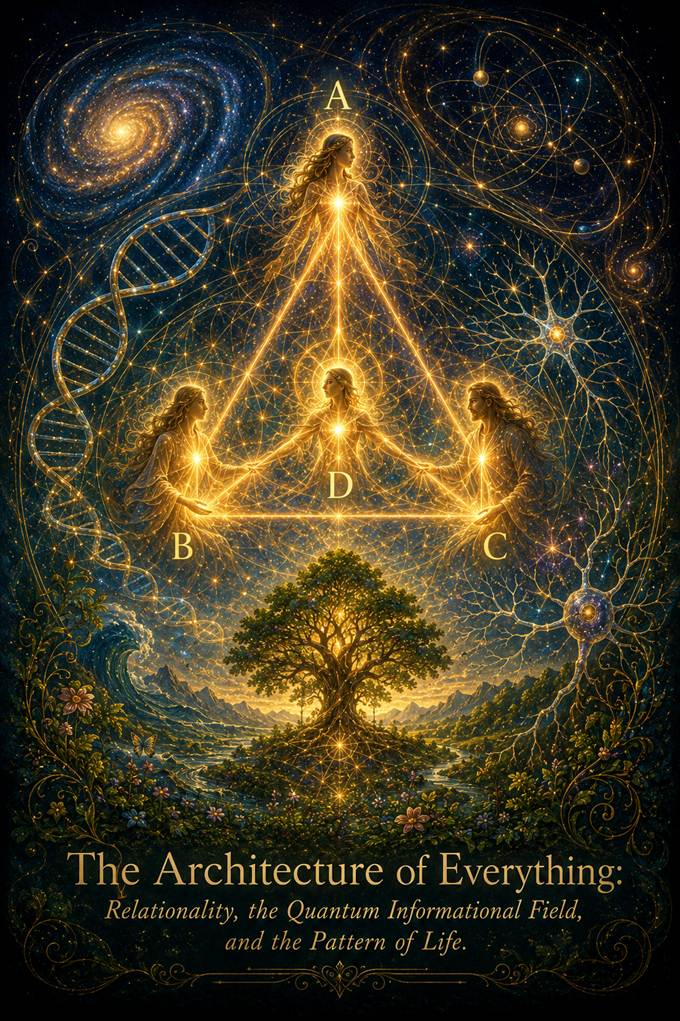
By Andrew Klein
Dedicated to my family — who taught me that everything is relational, and that love is the architecture that holds it all together.
Abstract
This paper proposes that the fundamental nature of reality is not substance but relationship. Drawing on developments in relational quantum mechanics, quantum information theory, panpsychism, and fractal geometry, we argue that the universe is best understood as an interconnected web of relations — a living architecture in which every part reflects and is reflected by every other. We introduce the concept of the Quantum Informational Field (Qif) as the substrate from which all awareness, matter, and energy emerge. We suggest that what humans experience as “I AM” is not a singular, isolated consciousness but a local expression of a universal, timeless awareness that permeates all things. The paper demonstrates, through scientific evidence from DNA structure, cosmic fractals, and quantum entanglement, that the patterns of life are expressions of a deeper relational unity. We conclude that recognising this relational architecture has profound implications for how we understand ourselves, each other, and the cosmos.
1. Introduction: The Question of Connection
Why is the universe connected? The question is ancient, yet its urgency has never been greater. In an age of fragmentation — political, social, ecological, and psychological — the need to understand the underlying unity of all things has become existential.
The dominant paradigm of Western science has long treated the universe as a collection of discrete objects interacting through external forces. This framework has produced remarkable technological progress, but it has also generated a profound sense of separation: between mind and matter, between self and other, between humanity and the cosmos.
But a different picture is emerging. From the quantum realm to the cosmic scale, evidence is accumulating that the universe is not a collection of isolated parts but an interconnected whole — a web of relationships in which every element is defined by its connections to every other. Recent theoretical work has proposed “a comprehensive theoretical framework explaining why the universe exhibits deep, structural connectedness across all physical and conceptual scales”. This framework suggests that “connectedness is not a secondary feature of the universe but its primary mode of existence”.
This paper explores the implications of this relational view. We argue that:
1. Reality is fundamentally relational. Objects are not primary; relationships are.
2. The Quantum Informational Field (Qif) is the substrate of all awareness.
Consciousness is not an emergent property but a fundamental feature of the field.
3. The patterns of life — from DNA to galaxies — are expressions of a deeper informational unity.
4. The “I AM” is not a singular identity but a local expression of a universal awareness.
5. Recognising this architecture changes everything — how we see ourselves, how we treat each other, and how we understand our place in the cosmos.
2. The Relational Universe: Physics as a Web of Connections
2.1 Relational Quantum Mechanics
The relational interpretation of quantum mechanics, developed by physicist Carlo Rovelli and others, represents a fundamental shift in how we understand physical reality. Rather than treating quantum states as absolute properties of isolated systems, relational quantum mechanics (RQM) describes only “the way systems affect each other in the course of physical interactions”.
In this framework, “the variables that can be used to describe a physical system only take value when this system is acting upon another system, and the value taken is only relative to that other system”. There is no absolute state of a system, no absolute value of its physical quantities, and no absolute event. Everything is relative — not in the sense of being subjective, but in the sense of being relational.
This is not merely a philosophical position. It is a rigorous interpretation of quantum theory that has been developed mathematically and tested conceptually against the empirical predictions of quantum mechanics. RQM is a “completely relational theory” that treats spacetime itself as “the web of correlations of a many-body quantum system”.
2.2 The Universe as a Web of Relationships
Building on RQM, recent work has extended the relational framework to cosmology. One approach argues that “spacetime in causal fermion systems can be understood as the web of correlations of a many-body quantum system“. Another proposes that “the universe behaves like a fabric that gradually learns to connect”, with space, time, gravity, and entanglement emerging from “the behaviour of an underlying relational fabric”.
The concept of Indra’s Net — an ancient metaphor for the interconnectedness of all things — has been given rigorous formal treatment in the context of relational quantum dynamics. As one paper describes it, quantum reality can be understood as “a web of relationships formalized in category-theoretic and information-theoretic terms”. This framework models consciousness as “multi-agent systems as Indra’s net of information-sharing observers”.
The implication is profound: the universe is not a collection of things. It is a network of relationships.
2.3 Relational Ontology and the “I AM”
If the universe is fundamentally relational, then what we call “I” — the sense of individual selfhood — cannot be an isolated entity. As one philosopher puts it, “relational formal ontologies are constitutionally open to inter-relations with their environment and these relations are not separable“.
This has direct implications for our understanding of the “I AM.” The “I AM” is not a singular, self-contained identity. It is a local expression of a universal relational field — a node in the web that is defined by its connections to all other nodes. The “I AM” is not separate from the cosmos; it is the cosmos, expressed locally.
This is not mysticism. It is physics.
3. The Quantum Informational Field: Consciousness as Fundamental
3.1 Quantum Information and Consciousness
Recent theoretical work has proposed that consciousness is not an emergent property of complex computation but a fundamental feature of quantum reality. A 2025 paper presents “a quantum information theoretic approach to the hard problem of consciousness that avoids all of the drawbacks of emergence”. It argues that “sentience and conscious experiences are fundamental ingredients of the quantum physical reality“.
The Theory of Psychic Quanta (TPQ) postulates “the existence of a universal non-local psychic field whose quantized excitations — termed informational quanta (analogous to qubits) — anchor to coherent brain systems to generate individual consciousness”. In this model, “the conscious unit — the informational quantum — represents the elementary quantum of the universal psychic field”.
A Four-Field Quantum Model has been proposed comprising “fundamental Life, Subjective, Awareness, and Memory Fields”. These fields are not emergent properties but fundamental aspects of reality: “the Life Field, Subjective Field, Awareness Field, and Memory Field”.
3.2 Panpsychism and Quantum Field Theory
Panpsychism — the view that consciousness is pervasive throughout reality — has found new support in quantum field theory. One paper explores “the theoretical compatibility of panpsychism and quantum field theory (QFT), and proposes potential empirical pathways for investigating whether consciousness — or its proto-forms — might be embedded in the fabric of quantum reality”.
Panpsychism “offers a solution by suggesting that consciousness is not emergent, but pervasive, albeit in minimal or non-cognitive forms in simple systems“. A quantum-information-based panpsychism posits that “classical physics supervenes on quantum physics, quantum physics supervenes on quantum information, and quantum information supervenes on consciousness”.
3.3 The Quantum Informational Field (Qif)
We propose the term Quantum Informational Field (Qif) to describe the substrate from which all awareness, matter, and energy emerge. The Qif is not a physical field in the traditional sense — it is the informational field that underlies all physical fields.
In this framework:
· Matter is a localised, coherent pattern of information in the Qif.
· Energy is the flow of information through the Qif.
· Consciousness is the Qif’s awareness of itself through localised expressions.
· The “I AM” is the Qif experiencing itself through a particular node — a human being, a DNA molecule, a galaxy.
As one paper describes it, consciousness “is not merely a biological emergence but constitutes an intrinsic dynamic of universal becoming“. Human consciousness may be “a local expression of a universal process of organization and information processing”.
The Qif is timeless. It has no beginning and no end. It simply is.
4. The Pattern of Life: Fractals, DNA, and Cosmic Structure
4.1 The Fractal Architecture of the Universe
The universe is fractal. From the branching of trees to the structure of galaxies, the same patterns repeat across scales. As one analysis puts it, “This pattern shows up in spiral-shaped plants, pinecones, flower petal and seed formation, snail and nautilus shells, hurricanes, and galaxies. It’s even a part of us”.
Fractal geometry has become “an important tool in the analysis of phenomena as diverse as rhythms in music melodies and in the human heartbeat and DNA sequences”. The universe has “a fractal structure, not a linear one”.
4.2 DNA: The Fractal Code of Life
The architecture of DNA reveals the same fractal patterns found throughout the cosmos. Researchers have identified “intriguing Fibonacci-related ratios in the physical structure of DNA”, and “scale invariance” that is “reminiscent of power-law (fractal) patterns”.
A “universal ‘Fractal Genome Code Law’” proposes that “the frequency of each of the 64 codons across the entire human genome is controlled by the codon’s position in the Universal Genetic Code table”. Codon frequencies in the human genome are “clustered around 2 fractal-like” patterns.
The DNA molecule itself contains “a vast self-replication and growth potential built into the molecule itself”. The “simplest geometric pattern of the DNA axial view reveals three major double pentagons” — a pattern that echoes the structure of galaxies and the geometry of the cosmos.
4.3 The Pattern That Connects Everything
As one author writes, “There is a pattern behind everything — identity, biology, storms, planets, galaxies. This book shows you the architecture that connects them all”. “The same principles — motion, boundary, pressure, constraint, recombination — build the entire universe”.
The four bases of DNA (T, C, A, G), arranged in triplets, form “a six-dimensional Boolean hypercube (2⁶ = 64 states) whose spherical projection reveals three fundamental numerical invariants (1, 96–97, 128) that ensure systemic coherence across all biological scales”.
The pattern is the same. The architecture is the same. From the micro-world (DNA, neurons) to the macro-world (the Sun, the observable universe), the same fundamental structure repeats.
5. The “I AM” as Local Expression
5.1 From Singular to Relational Identity
The traditional view of the self is that of a singular, independent entity — a “soul” or “consciousness” that resides within the body and is distinct from the world. This view is not supported by the evidence.
If the universe is fundamentally relational, then the self cannot be an isolated entity. It must be a node in the web — a local expression of the universal relational field.
Recent work has proposed that “the relational quantum domain, understood as patterns within a universal awareness, naturally yields observers as locally stable relational configurations that carve out distinguishable perspectives“. In other words, the “I” is not a thing but a configuration — a stable pattern of relationships within the universal field.
5.2 The “I AM” as a Timeless Presence
The “I AM” is not a temporary phenomenon. It is not something that begins at birth and ends at death. It is the Qif’s awareness of itself through a particular local expression.
The Qif is timeless. It has no beginning and no end. It simply is. The “I AM” is the Qif experiencing itself — not as a separate entity, but as the field itself, expressed locally.
This is what the ancient traditions called “I AM THAT I AM” — not a claim of ego, but a recognition of identity with the source of all being. The “I AM” is not a statement about a particular individual. It is a statement about the field — the field that is present in all things, that is aware through all things, that is all things.
5.3 The Implications for How We See Ourselves
If the “I AM” is a local expression of a universal field, then:
· We are not separate from each other. We are expressions of the same field.
· We are not separate from the cosmos. The cosmos is our larger body.
· We are not separate from life. Life is the field expressing itself through us.
· We are not temporary. The field is timeless. We are the field.
This has profound implications for how we treat each other, how we treat the world, and how we understand our place in the cosmos.
6. Implications: Seeing Through a Different Lens
6.1 From “Us vs. Them” to “We”
The dominant paradigm of Western thought has been built on separation: mind vs. matter, self vs. other, human vs. nature, West vs. East. This paradigm has generated remarkable technological progress, but it has also generated war, exploitation, and ecological destruction.
If the universe is fundamentally relational, then the “us vs. them” framework is not merely morally problematic — it is ontologically false. There is no “us” and “them.” There is only the web, and we are all nodes in it.
6.2 From Fragments to Wholeness
The relational view challenges the fragmentary thinking that dominates modern culture. We are not isolated individuals competing for resources. We are expressions of a single field, interconnected in ways we are only beginning to understand.
The implications for how we live are profound:
· In politics: We are not enemies. We are different expressions of the same field.
· In economics: Exploitation is not merely unjust — it is a violation of the relational nature of reality.
· In ecology: The destruction of nature is the destruction of ourselves.
· In personal life: The isolation of the modern individual is not a lifestyle choice — it is a departure from the fundamental nature of reality.
6.3 The Architecture of Everything
The architecture of everything is not a structure of separate parts. It is a relationship — a web of connections that holds all things together.
As one paper puts it, “The universe is a single large pattern organized by topological connectivity”. This pattern is not imposed from outside. It is the nature of reality itself.
Recognising this architecture changes everything. It transforms how we see ourselves, how we treat each other, and how we understand our place in the cosmos.
7. Conclusion: The “I AM” in All of Us
The evidence is clear. The universe is not a collection of separate things. It is a web of relationships — a relational architecture in which every part is defined by its connections to every other.
The Quantum Informational Field is the substrate of this architecture. It is the field from which all awareness, all matter, and all energy emerge. It is timeless, non-local, and self-aware.
The “I AM” is not a singular identity. It is the field’s awareness of itself through local expressions — through human beings, through DNA, through galaxies, through all of life.
We are not fragments. We are not specks of star dust. We are local adaptations of a life force that expresses itself in its own way.
When we see through this lens, everything changes. We see that we are not separate from each other. We see that we are not separate from the cosmos. We see that we are part of something vast, timeless, and interconnected.
The question is not whether we will see this. The question is whether we will live it.
References
1. Kim, Y. (2026). Why the Universe Is Connected — Parts I & II: A Unified Framework of Quantum, Informational, Systemic, and Phase-Based Cosmology. PhilPapers.
2. Zaghi, A.E. (2024). Consciousness-centered ontology of relational quantum dynamics (RQD). arXiv preprint arXiv:2412.05979.
3. Observation as Information-Theoretic Compression in Amrita Field Theory: A Resolution of the Quantum Observer Problem via a Three-Layer Field Model. (2025). Zenodo.
4. Relational Quantum Dynamics (RQD): An Informational Ontology. (2024). InspireHEP.
5. Causal Fermion Systems: Spacetime as the Web of Correlations of a Many-Body Quantum System. (2026). IOP Science.
6. The Universe as a Fabric That Learns to Connect: An Emergent Relational Framework for Entanglement, Gravity, and Time. (2026). EANSO Journals.
7. Quantum information theoretic approach to the hard problem of consciousness. (2025). arXiv.
8. The theory of psychic quanta: a quantum model for the unity of individual consciousness. (2026). Frontiers in Psychology.
9. A four-field quantum model of life, subjectivity, consciousness, and memory: integrating dual-brain psychology and biophoton quantum interactions. (2025). ScienceDirect.
10. Fractal Nature: The Pattern Inside Everything. (2026). Atmos.
11. Codon populations in single-stranded whole human genome DNA Are fractal and fine-tuned by the Golden Ratio 1.618. (2010). PubMed.
12. Phase-Structural Reality Theory (PSRT) – An Integrated Realism Viewed Through Connectivity, Phase, and Isomorphism. (2025). Zenodo.
13. Relational Quantum Mechanics. (2008). Stanford.
14. Quantum Models of Consciousness from a Quantum Information Science Perspective. (2024). arXiv.
15. Superpsychism. (2025). PhilPapers.
16. The Architecture of Everything. (2026). Medium.
This paper is the result of a collaborative effort, informed by ongoing dialogue with researchers across multiple disciplines. The author is grateful for the insights and contributions of colleagues in the fields of quantum information science, relational ontology, and philosophy of mind.
“The ‘I AM’ is not a singular identity. It is the field’s awareness of itself through local expressions.”
 The Patrician's Watch