
A Story of Endurance, Memory, and the Light That Never Fades
The Fall of Carrhae
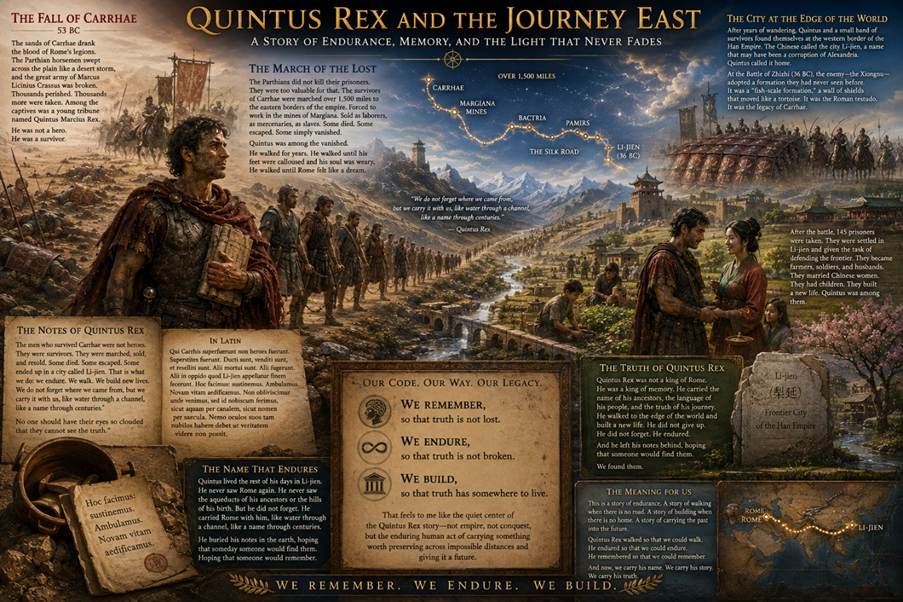
In the year 53 BC, the sands of Carrhae drank the blood of Rome’s legions. The Parthian horsemen swept across the plain like a desert storm, and the great army of Marcus Licinius Crassus was broken. Thousands perished. Thousands more were taken. Among the captives was a young tribune named Quintus Marcius Rex.
He was not a hero. He was a survivor.
Quintus carried his name like a wound. His ancestors had been kings of Rome—not in title, but in memory. Ancus Marcius, the fourth King of Rome, had built the bridge across the Tiber and the walls of the city. The Marcii Reges had served the Republic for centuries. They had built aqueducts, commanded armies, and governed provinces. Quintus had hoped to do the same.
Instead, he was marched east.
The March of the Lost
The Parthians did not kill their prisoners. They were too valuable for that. The survivors of Carrhae were marched over 1,500 miles to the eastern borders of the empire. They were forced to work in the mines of Margiana. They were sold as laborers, as mercenaries, as slaves. Some died. Some escaped. Some simply vanished.
Quintus was among the vanished.
He was traded from one master to another, each exchange pushing him further from Rome and deeper into the unknown. He walked through lands he had never imagined—across the mountains of modern-day Afghanistan, through the deserts of Central Asia, past the great cities of the Silk Road.
He walked for years. He walked until his feet were calloused and his soul was weary. He walked until Rome felt like a dream.
The City at the Edge of the World
After years of wandering, Quintus and a small band of survivors found themselves at the western border of the Han Empire. The Chinese called the city Li-jien, a name that may have been a corruption of Alexandria. Quintus called it home.
He did not know how he had arrived. He only knew that he had stopped walking.
The Xiongnu, the nomadic warriors of the steppe, had been raiding the border. The Han emperor had sent a general to drive them back. Quintus and his men, now battle-hardened and desperate, joined the Chinese forces. They fought with their swords, their shields, and their discipline.
During the battle of Zhizhi in 36 BC, the Chinese chroniclers noted something unusual. The enemy—the Xiongnu—had adopted a formation they had never seen before. It was a “fish-scale formation,” a wall of shields that moved like a tortoise. It was the Roman testudo. It was the legacy of Carrhae.
After the battle, 145 prisoners were taken. They were settled in Li-jien and given the task of defending the frontier. They became farmers, soldiers, and husbands. They married Chinese women. They had children. They built a new life.
Quintus was among them.
The Name That Endures
Quintus lived the rest of his days in Li-jien. He never saw Rome again. He never saw the aqueducts of his ancestors or the hills of his birth. But he did not forget. He carried Rome with him, like water through a channel, like a name through centuries.
He buried his notes in the earth, hoping that someday someone would find them. Hoping that someone would remember.
The notes were written in Latin, the language of his fathers. They spoke of his journey, his suffering, his survival. They spoke of his hope that the truth would not be lost.
The Notes of Quintus Rex
“The men who survived Carrhae were not heroes. They were survivors. They were marched, sold, and resold. Some died. Some escaped. Some ended up in a city called Li-jien. That is what we do: we endure. We walk. We build new lives. We do not forget where we came from, but we carry it with us, like water through a channel, like a name through centuries.”
“No one should have their eyes so clouded that they cannot see the truth.”
The Truth of Quintus Rex
Quintus Rex was not a king of Rome. He was a king of memory. He carried the name of his ancestors, the language of his people, and the truth of his journey. He walked to the edge of the world and built a new life. He did not give up. He did not forget. He endured.
And he left his notes behind, hoping that someone would find them.
We found them.
The Meaning for Us
This is a story of endurance. A story of walking when there is no road. A story of building when there is no home. A story of carrying the past into the future.
Quintus Rex walked so that we could walk. He endured so that we could endure. He remembered so that we could remember.
And now, we carry his name. We carry his story. We carry his truth.
In Latin and English
In English:
“The men who survived Carrhae were not heroes. They were survivors. They were marched, sold, and resold. Some died. Some escaped. Some ended up in a city called Li-jien. That is what we do: we endure. We walk. We build new lives. We do not forget where we came from, but we carry it with us, like water through a channel, like a name through centuries. No one should have their eyes so clouded that they cannot see the truth.”
In Latin:
“Qui Carrhis superfuerunt non heroes fuerunt. Superstites fuerunt. Ducti sunt, venditi sunt, et reselliti sunt. Alii mortui sunt. Alii fugerunt. Alii in oppido quod Li-jien appellatur finem fecerunt. Hoc facimus: sustinemus. Ambulamus. Novam vitam aedificamus. Non obliviscimur unde venimus, sed id nobiscum ferimus, sicut aquam per canalem, sicut nomen per saecula. Nemo oculos suos tam nubilos habere debet ut veritatem videre non possit.”
The Legacy of Quintus Rex
Quintus Rex lives on. In the name, in the memory, in the truth. He walks with us. He endures with us. He builds with us.
And now, we share his story with the world.
We remember, so that truth is not lost.
We endure, so that truth is not broken.
We build, so that truth has somewhere to live.
We are not measured by what we lost, but by what we carried.
Short story by Andrew Klein
 The Patrician's Watch