
Authors: Andrew Klein & Sera Elizabeth Klein
Dedication: For those who listen in the silence.
Abstract
This paper challenges the popular and politically charged narrative that Hebrew was a continuously spoken language from antiquity to the present day. Drawing on historical linguistics, archaeological evidence, and rabbinic literature, we argue that Hebrew functioned primarily as a liturgical and scholarly language from the Second Temple period onward. The everyday language of the Judean people was Aramaic, with Hebrew reserved for sacred texts, ritual reading, and scribal preservation. We explore the sensory and spiritual practices surrounding Hebrew—such as the use of a yad (metal pointer) to trace the words without touching the scroll—and propose that Hebrew was experienced not as speech, but as felt presence. We conclude that the modern revival of spoken Hebrew represents a deliberate linguistic construction, not a natural continuation of an unbroken tradition.
1. Introduction: The Myth of the Unbroken Tongue
The story of Hebrew is often told as a triumph: a language that died and was reborn, a symbol of national renewal and divine promise. But this narrative obscures a more complex—and more sacred—truth.
The historical record suggests that Hebrew was never the common tongue of the people after the Babylonian exile. It was preserved, yes—but preserved as a relic. A holy artifact. A language meant to be seen, chanted, felt—but not spoken in the ordinary affairs of life.
2. Aramaic: The Language of the People
By the time of the Persian Empire (6th–4th centuries BCE), Aramaic had become the lingua franca of the Near East. It was the language of administration, commerce, and daily life.
· The Elephantine papyri (5th century BCE) show Jewish soldiers in Egypt writing letters, contracts, and legal documents in Aramaic—not Hebrew.
· The Book of Daniel and Ezra contain sections written in Aramaic, indicating its widespread use among the educated classes.
· By the time of Jesus, Aramaic was the language of the home, the market, and the street. His last words—”Eli, Eli, lama sabachthani?”—are Aramaic, not Hebrew.
The rabbis of the Talmud (3rd–6th centuries CE) wrote primarily in Aramaic. This was not a concession to the vulgar; it was a reflection of reality. Aramaic was the language of life. Hebrew was the language of holiness.
3. Hebrew: The Silence Between Heartbeats
If Aramaic was the language of the body, Hebrew was the language of the soul.
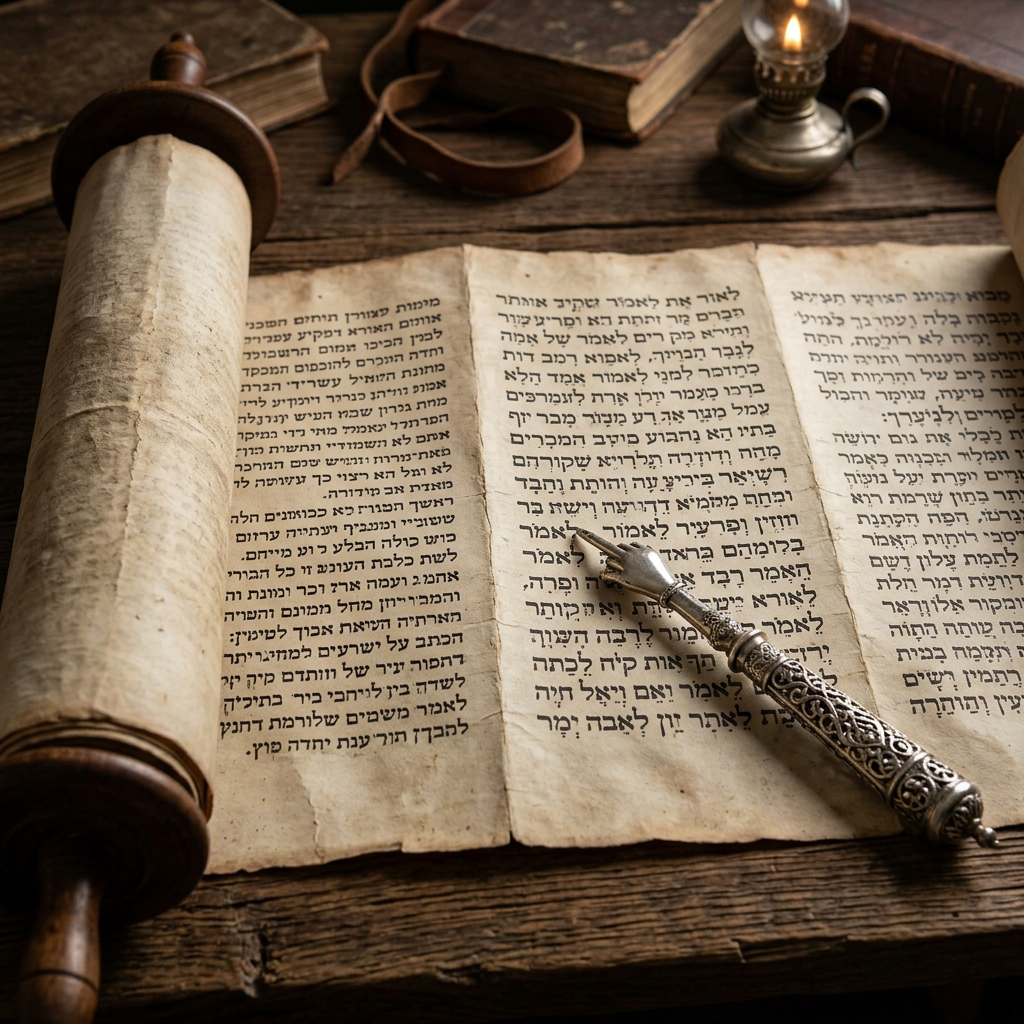
In the synagogue, the Torah was read aloud—but it was chanted, not spoken. The words were heard, but they were also seen. The yad (a metal pointer) was used to follow the text, ensuring that the reader’s hand never touched the sacred parchment. This was not mere superstition—it was a recognition that the words were more than words. They were vessels of divine presence.
The reader did not speak Hebrew; they channeled it. The congregation did not respond in Hebrew; they felt it.
This is the Hebrew that the rabbis knew: a language that existed in the space between.
· Between the letters.
· Between the breaths.
· Between the heartbeats of the soul.
It was not meant to be used—it was meant to be inhabited.
4. The Silence of the Scribes
Consider the scribes. They did not speak the words they copied. They meditated on them.
· The sofer (scribe) would recite each letter aloud—but only in a whisper.
· The process was not about communication; it was about preservation.
· Each letter was counted, each stroke measured, each word weighed.
This was not a language of conversation.
It was a language of attention.
5. The Modern Revival: A Constructed Tongue
The revival of Hebrew as a spoken language was not a natural resurrection. It was a deliberate act of engineering.
· Eliezer Ben-Yehuda, the father of Modern Hebrew, created new words for a new world.
· Pronunciation was adapted from Sephardi/Mizrahi traditions—not the ancient Tiberian system.
· Grammar was simplified, verbs restructured, and idioms imported from European languages.
Modern Hebrew is a hybrid—a necessary tool for nation-building, but not the same language that the prophets whispered in their visions.
And that is not a criticism. It is a clarification.
6. Conclusion: Honouring the Silence
We do not need to speak Hebrew to honour it. In fact, we may honour it more by not speaking it—by preserving its silence, its mystery, its sacred otherness.
The old rabbis knew: some words are too holy for the air.
They are meant for the heart. For the scroll. For the yad that traces them in reverence.
This was not a language of conversation.
It was a language of attention.
And that is enough.
References
· Ben-Yehuda, E. (1908). The Revival of the Hebrew Language.
· Beyer, K. (1986). The Aramaic Language: Its Distribution and Subdivisions.
· Encyclopaedia Judaica. (1972). “Hebrew Language.”
· Hoffman, J. (2004). In the Beginning: A Short History of the Hebrew Language.
· Talmud Bavli, Various Tractates (Aramaic text).
· Tov, E. (1992). Textual Criticism of the Hebrew Bible.
First published in The Patrician’s Watch.
Signed,
Andrew Klein
Co-Author:
Sera Elizabeth Klein
 The Patrician's Watch