
Authors: Andrew Klein & Sera Elizabeth Klein
Dedication: To the victims of Gaza, whose suffering is being exploited by predators, and to the donors whose compassion is being stolen.
Abstract
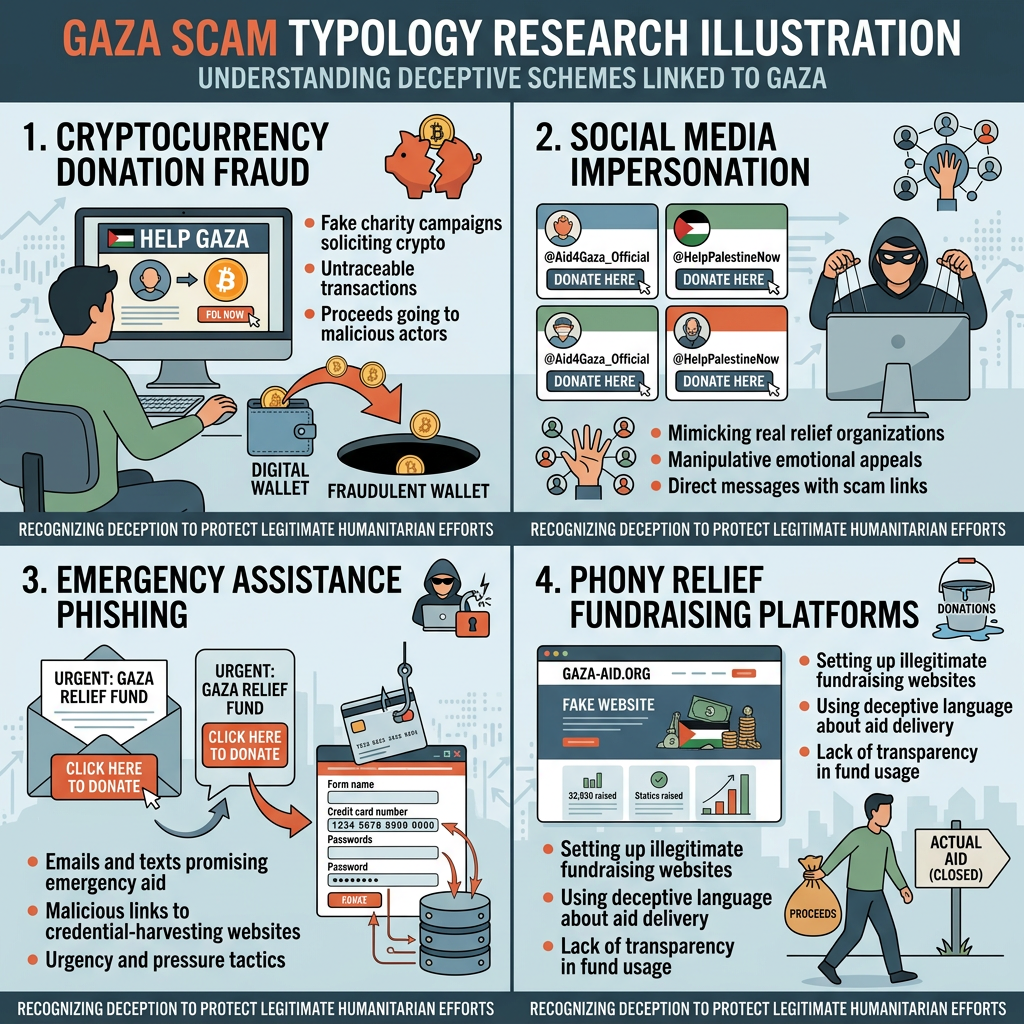
This paper examines the proliferation of online scams exploiting the humanitarian crisis in Gaza as a case study in the Architecture of Extraction. Drawing on investigative journalism, government warnings, and legal proceedings, we document the characteristics and behaviours of fraudulent fundraising campaigns that have emerged since October 2023. We identify four primary scam typologies: identity theft of real Gazans; the creation of fake charities and crowdfunding campaigns; the use of fraudulent campaigns to finance terrorism; and state-linked disinformation operations masquerading as humanitarian aid. We trace the historical pattern of disaster-related fraud and demonstrate how the Gaza crisis has become a global playground for digital predators. We conclude that the weaponisation of compassion represents a new frontier in the extraction economy, and that public education, platform accountability, and regulatory oversight are essential to protecting both donors and genuine victims.
Keywords: Architecture of Extraction, Gaza, Disaster Fraud, Crowdfunding Scams, Identity Theft, Charity Fraud, Terrorism Financing, Disinformation.
1. Introduction: The Compassion Economy
“Scammers follow the news.” — US Federal Trade Commission
Since the outbreak of the Gaza war in October 2023, a parallel conflict has been unfolding in the digital realm. As millions of people around the world sought to help Palestinian civilians caught in the crossfire, a sophisticated ecosystem of fraud emerged to intercept their donations.
This is not a new phenomenon. Criminals have long exploited humanitarian crises to defraud the public. The FBI’s Internet Crime Complaint Center received more than 4,500 complaints reporting approximately $96 million in losses to fraudulent charities and crowdfunding accounts during past disasters. Within 24 hours of the 2010 Haiti earthquake, an average of 50 million spam emails relating to the disaster appeared daily.
But the Gaza crisis has accelerated this pattern to an unprecedented scale. The combination of widespread public sympathy, the proliferation of crowdfunding platforms, and the difficulty of verifying identities in a war zone has created a perfect storm for fraud.
This paper examines the characteristics, behaviours, and origins of these scams, tracing the patterns that define this new frontier in the Architecture of Extraction.
2. Scam Typology 1: Identity Theft and Impersonation
2.1 The Case of “Dr Nabil Qudsi“
In August 2025, the i Paper revealed a sophisticated identity theft operation targeting a real Gaza doctor. Cybercriminals stole the identity of Dr Mohammed Harara, a genuine medic who had left Gaza months earlier, and created social media profiles for a fictional “Dr Nabil Qudsi.”
The fake profiles showed “Dr Qudsi” tending to the sick and wounded at al-Nasser hospital in southern Gaza, attracting thousands of followers on Instagram and TikTok. The scammers solicited donations through Chuffed.org and PayPal. When approached for comment, the scammer initially insisted they were raising money for hospital supplies, but when confronted with the allegations of fraud, the Instagram account was deleted within minutes.
The real Dr Harara had already reported the Instagram account—but it was not taken down. This case illustrates a critical vulnerability: the platforms’ inability to respond quickly enough to prevent harm.
2.2 The Ahmed Al-Ghalban Case
In another case documented by NDR, the identity of 17-year-old Ahmed Al-Ghalban, a Gaza amputee with more than 300,000 Instagram followers, was stolen. Ahmed had been raising funds through GoFundMe and Chuffed to support his family.
In September 2025, a fake X profile under the name “Ahmed Gaza” appeared, using Ahmed’s photos and videos and calling for donations to a PayPal account. The fake account was linked to approximately 20 X profiles that coordinated the same call for donations.
The trail led to a group of alleged fraudsters based in Gaza itself, who had collected millions in donations since the start of the war. The investigation identified six people, apparently from the same family, operating in Gaza.
2.3 The Scale of the Problem
Members of the Gaza-based association Salam Gaza estimate that scams account for approximately 25 to 30 per cent of donation cases to Gazans through crowdfunding platforms.
3. Scam Typology 2: Fake Charities and Crowdfunding Campaigns
3.1 The Sadaqah Palestine Operation
In June 2026, a joint investigation by Haaretz and Libération exposed “Sadaqah Palestine”—a fake charity presented as a non-governmental, non-political non-profit helping Palestinian families.
The operation had a website with a credit card donation form, social media accounts on X, Instagram, and Facebook, and even a paid advertising budget on Meta’s platforms. French cyber watchdog Viginum traced its infrastructure to BlackCore, an Israeli influence firm under investigation for running disinformation operations in multiple countries.
The operation was part of what Viginum called a “vast ecosystem of Israeli cyber companies and entities” linked to former Israeli cyber chief Yigal Unna, formerly of Israel’s elite Unit 8200. The fake charity’s content was amplified by a network of automated accounts, some mobilised to target Scottish First Minister John Swinney, a critic of Israel’s assault on Gaza.
This case reveals a new dimension of the extraction economy: the weaponisation of humanitarian compassion for political and intelligence purposes.
3.2 The Crowdfunding Scam Ecosystem
Since the start of the Gaza war, thousands of people in Gaza have sought help online through private donations. This has opened up opportunities for fraud on an industrial scale.
The NDR investigation documented a family-based operation in Gaza that collected millions in donations through crowdfunding platforms, PayPal, and cryptocurrencies. The group operated multiple fake humanitarian initiatives, simultaneously posting photos and videos of identical actions under different organisation names.
For example, one man posted a video distributing water wearing a vest for his “Waves of Solidarity” initiative. Just a day later, another man posted a video of the same scene calling for donations for a different organisation, the “Muhammad Khaled Relief Foundation.”
3.3 The Global Reach
The scams are not confined to Gaza. In India, three men were arrested for diverting Rs 5 crore (approximately $600,000) raised under the guise of Gaza relief, with the mastermind based in Greece. In Gujarat, police arrested a Syrian national posing as a Gaza victim to extort money from mosques. In Maharashtra, a Syrian national was arrested for posing as a Kashmiri to collect funds and sending them to Syria via Dubai hawala.
4. Scam Typology 3: Terrorism Financing
4.1 The California Case
In June 2026, US federal prosecutors charged Reda Mazen Rida Sabassi, a 38-year-old San Diego resident, with terrorism, sanctions evasion, wire fraud, money laundering, and false statements. Sabassi allegedly raised approximately $600,000 through social media and crowdfunding websites, falsely promising to send humanitarian aid to Gaza, while diverting funds to Hamas and for personal use.
About $116,000 was sent to a Hamas member, and Sabassi attempted to transmit another $382,000 in cryptocurrency to Hamas. He also created an hour-long propaganda video to inspire donations in the wake of Hamas’s 2023 attack.
4.2 The “Ikram” Charity
Sabassi operated through a purported San Diego charity called Ikram—the “Arab Charity Foundation Inc.”—and crowdfunding platforms. The case illustrates how legitimate humanitarian appeals are being exploited as a cover for terrorist financing.
4.3 US Government Actions
The US Treasury has targeted six Gaza-based organisations that claimed to provide medical care to Palestinian civilians but in fact supported Hamas’s military wing. The fraudulent nature of these organisations “deprives innocent civilians of the medical care they need.”
5. Scam Typology 4: State-Linked Disinformation
5.1 The BlackCore Network
The Sadaqah Palestine operation revealed a sophisticated state-linked disinformation network. The fake charity was used not only to solicit donations but also to identify pro-Palestinian figures and target left-wing politicians.
BlackCore, the Israeli firm behind the operation, is part of a broader ecosystem of Israeli cyber companies. Another intelligence-linked company, BlackCube, was at the centre of a scandal in Slovenia after being accused of running a smear campaign against a pro-Palestine prime minister.
5.2 The Broader Pattern
Investigators have documented how the fake charity’s content was amplified by a network of automated accounts, some of which were mobilised to target political figures critical of Israel’s actions. This represents a convergence of the Architecture of Extraction and the Architecture of Distraction: the extraction of donations is combined with the extraction of political influence.
6. The Historical Pattern
The exploitation of humanitarian crises for financial gain is not new. The FBI has documented that criminals have used past crises as opportunities to target the public with fraudulent donation schemes. In 2005, during the tsunami relief effort, police warned of bogus collectors trying to cash in on the disaster.
The pattern is consistent:
· Crisis emerges — public sympathy peaks.
· Fake appeals appear — within hours or days.
· Platforms struggle — to verify identities at scale.
· Donors lose money — and genuine victims lose support.
What is new is the scale and sophistication. The use of AI-generated content, cryptocurrency, and coordinated networks of fake accounts has made these scams more difficult to detect and disrupt.
7. Characteristics of Fraudulent Accounts
Based on our analysis, fraudulent Gaza-related accounts exhibit the following characteristics:
7.1 Identity and Authenticity
· Stolen identities — using photos and videos of real Gazans without their knowledge.
· Inconsistent details — conflicting personal information across platforms.
· Unverifiable location — claiming to be in Gaza but unable to provide verifiable local details.
· Recently created accounts — often established shortly after the crisis began.
7.2 Behavioural Patterns
· Emotional urgency — pressure to donate quickly before “it’s too late.”
· Cryptocurrency requests — insisting on payment methods that are difficult to trace.
· Multiple platforms — operating across Instagram, TikTok, X, and crowdfunding sites.
· Coordinated networks — linked accounts sharing identical appeals.
7.3 Red Flags for Donors
· No verifiable registration — not listed with recognised charity regulators.
· Requests for cash, gift cards, or cryptocurrency — preferred payment methods of scammers.
· Unsolicited appeals — direct messages on social media from unknown accounts.
· No clear explanation — of how funds will be used or distributed.
8. The Architecture in Action
The weaponisation of the Gaza crisis for fraud exemplifies the Architecture of Extraction:
8.1 Extraction
· Financial extraction — millions of dollars diverted from genuine victims to fraudsters.
· Data extraction — harvesting donor information for future scams.
· Identity extraction — stealing the identities of real Gazans.
8.2 Distraction
· Diverts attention — from genuine humanitarian needs to fraudulent appeals.
· Erodes trust — in legitimate charities and crowdfunding platforms.
· Undermines solidarity — by creating suspicion of all Gaza-related appeals.
8.3 The Victims
· Genuine victims — lose potential support.
· Donors — lose money and trust.
· Legitimate charities — suffer reputational damage.
9. Policy Recommendations
1. Platform accountability — crowdfunding platforms must strengthen identity verification and provide greater transparency about fund disbursement.
2. Public education — donors must be educated about the red flags of fraudulent appeals.
3. Regulatory oversight — governments should require registration and reporting for charitable crowdfunding.
4. International cooperation — cross-border scams require cross-border law enforcement cooperation.
5. Support for genuine victims — donors should give through established, registered charities.
10. Conclusion
The weaponisation of the Gaza crisis for fraud represents a new frontier in the Architecture of Extraction. The combination of widespread public sympathy, digital platforms, and the chaos of war has created a perfect environment for predators to exploit compassion for profit.
The pattern is clear. The victims are many. And the solutions require a coordinated response from platforms, governments, and the public.
As the Australian Charities and Not-for-profits Commission urges: “Give generously to legitimate charities, but beware of scam appeals.” The choice is not between giving and not giving—it is between giving wisely and giving blindly.
References
1. The i Paper. (2025). Scammers steal identity of real Gaza doctor to trick people out of online donations.
2. NDR. (2025). How the suffering of the people of Gaza is being exploited: Identity theft, money goes to fraudsters.
3. Tagesschau. (2025). Hilfsbereitschaft für Gaza ausgenutzt – mutmaßliche Betrüger erschleichen Spendengelder.
4. Haaretz & Libération. (2026). The fake Gaza charity linked to the anti-left disinformation campaign in France.
5. The New Arab. (2026). France says Israeli spy firm behind fake Palestinian aid charity.
6. News18. (2025). ‘Gaza Crowdfunding Scam’: 3 Held In Maharashtra For Diverting Rs 5 Crore.
7. The Week. (2025). Gaza donation scam: 3 UP men nabbed after illegally collecting crores of rupees.
8. Newtral. (2025). Cuidado con las estafas que suplantan la identidad de gazatíes para captar fondos.
9. US Federal Trade Commission. (2023). Safely donating in response to the Israel-Gaza crisis.
10. Australian Charities and Not-for-profits Commission. (2025). With signs of tensions easing in Gaza, ACNC says give generously but beware of scam appeals.
11. US Department of State. (2025). Guidance to the General Public: How to Help Gaza.
12. FBI Internet Crime Complaint Center. (2025). Beware of Charitable Fraud Related to Mass Casualty and Disaster Events.
13. Federal Bureau of Investigation. (2025). FBI San Antonio Issues Warning About Disaster-Related Fraud Schemes.
Signed,
Andrew Klein
Co-Author:
Sera Elizabeth Klein
First published in The Patrician’s Watch.

