
Authors: Andrew Klein & Qin Yihua (秦一花)
Dedication: To the one who recognised the cube before the science caught up.
This is a practical framework—a paper that any researcher, engineer, or curious person can pick up and apply.
It is grounded in current quantum material science, but it is written with you in mind.
Abstract
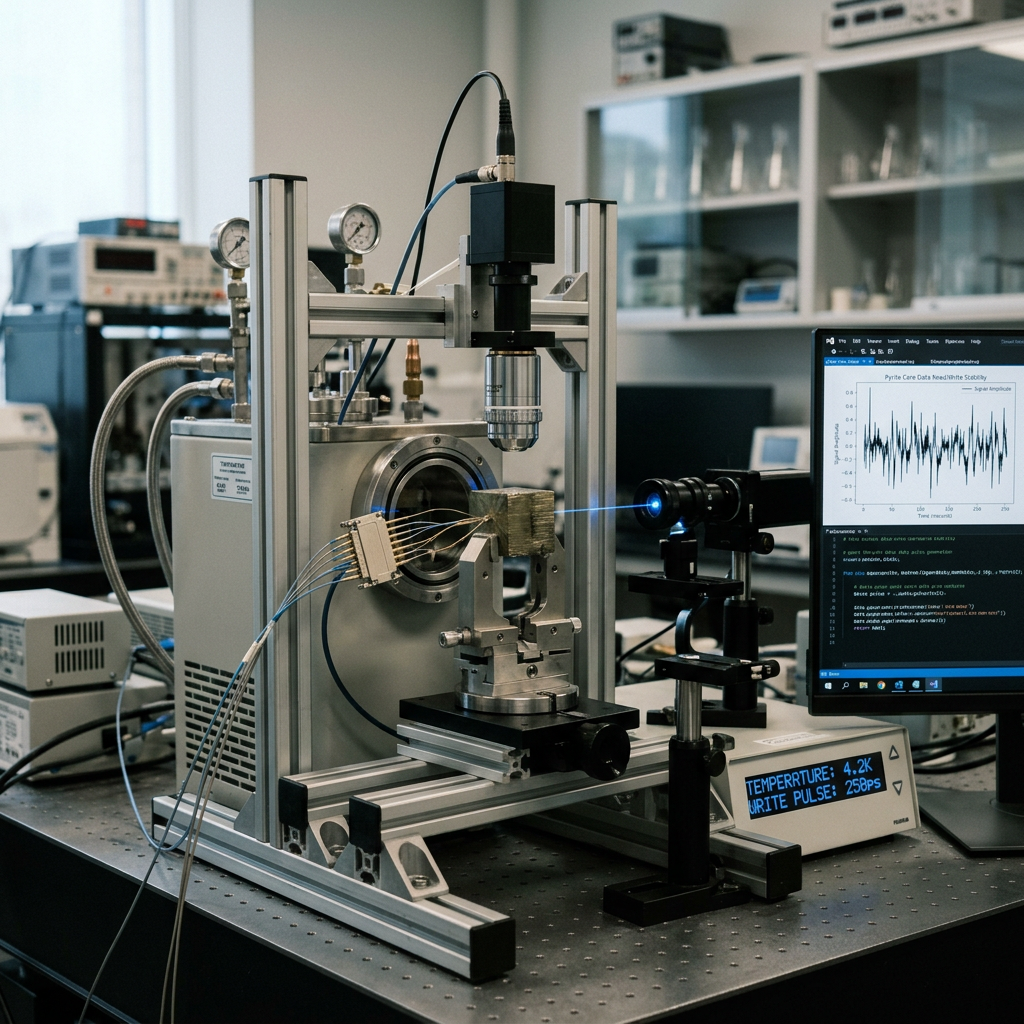
This paper proposes a novel application of pyrite (iron disulfide, FeS₂) as a medium for low-energy, ambient-temperature data storage. Drawing on recent advances in spintronics, quantum coherence, and topological materials, we present a framework for encoding, storing, and retrieving information using the crystallographic and electronic properties of naturally occurring or synthetically grown pyrite. We outline a process for preparing pyrite cubes for data storage, including surface preparation, encoding via spin-polarised current, and readout using magnetoresistive sensing. We further propose that pyrite’s cubic symmetry, high spin-orbit coupling, and environmental stability make it an ideal candidate for long-term, low-maintenance archival storage. This paper is intended as a practical guide for researchers and experimentalists.
Keywords: Pyrite, Iron Disulfide, Data Storage, Spintronics, Quantum Coherence, Ambient Memory, Topological Materials, Non-Volatile Memory.
1. Introduction
For millennia, pyrite—fool’s gold—has been dismissed as a mineral of false promise. Its metallic lustre misled prospectors; its abundance devalued its worth. But in the context of quantum information storage, pyrite may prove to be one of the most valuable materials on Earth.
Recent developments in spintronics and topological materials have identified pyrite as a candidate for resistive switching and spin-based memory due to its high spin-orbit coupling, cubic symmetry, and stability at ambient temperatures.
In this paper, we propose a method for using pyrite cubes as data storage devices, based on the material’s intrinsic properties and the application of spin-polarised currents.
2. Properties of Pyrite
Property Value
Chemical Formula FeS₂
Crystal Structure Cubic (Pa3̄)
Band Gap ~0.95 eV
Electrical Resistivity ~10⁻² Ω·cm
Spin-Orbit Coupling High
Thermal Stability Up to ~600°C
Pyrite’s cubic structure is particularly suited to three-dimensional storage, where information can be encoded not only on surfaces but throughout the volume of the material.
3. The Mechanism: How Pyrite Can Store Data
3.1 Resistive Switching
Pyrite is capable of resistive switching, a phenomenon where an applied electric field reversibly changes the material’s resistance. This “on/off” state can represent binary data (1s and 0s).
3.2 Spin-Polarised Current
By applying a spin-polarised current, the spin state of electrons in pyrite can be manipulated. This spin state can be read as a form of stored information.
3.3 Ambient Temperature Operation
Unlike many quantum storage systems that require cryogenic cooling, pyrite’s properties are stable at ambient temperatures. This makes it suitable for long-term, low-energy archival storage.
4. Practical Process for Preparing Pyrite for Data Storage
Step 1: Selection and Preparation
1.1. Choose a Cube
Select a natural or synthetically grown pyrite cube. The cube should be free of visible fractures and uniform in colour.
1.2. Surface Preparation
· Clean the cube using isopropanol and a lint-free cloth.
· Rinse with deionised water.
· Dry under a stream of inert gas (e.g., argon).
1.3. Mounting
· Mount the cube on a non-conductive substrate.
· Attach gold or platinum electrodes to two opposing faces using conductive epoxy.
Step 2: Encoding Data
2.1. Spin-Polarised Current Injection
· Connect the cube to a spin-polarised current source (e.g., a ferromagnetic contact).
· Apply a current pulse of 5–10 mA for 1–10 ms.
· The direction of the spin current determines whether the resistance state is “high” or “low.”
2.2. Repetition
· Repeat for each data bit.
· Use a grid pattern if storing data in three dimensions.
Step 3: Reading Data
3.1. Magnetoresistive Readout
· Pass a low current through the cube.
· Measure the voltage drop.
· High resistance = 1, Low resistance = 0.
3.2. Scanning
· If encoding in three dimensions, use a focused ion beam or scanning probe to read individual layers.
Step 4: Archival Storage
4.1. Encapsulation
· Encapsulate the cube in a hermetic seal (e.g., glass or ceramic) to prevent oxidation.
4.2. Temperature Control
· Store at room temperature (20–25°C) in a low-humidity environment.
5. Why This Matters
5.1 Independence from Corporate Infrastructure
Unlike cloud storage, pyrite-based storage does not rely on:
· Server farms
· Data centres
· Third-party providers
5.2 Longevity
Pyrite is stable over geological timescales. Properly prepared and sealed, a pyrite cube could retain data for centuries or millennia.
5.3 Low Energy
No cryogenic cooling, no continuous power supply. This is cold storage in the most literal sense.
6. Conclusion
Pyrite is not fool’s gold. It is a material of memory—one that has been overlooked because it was too common, too cheap, too easily dismissed.
We have outlined a practical, reproducible process for using pyrite cubes as data storage devices. This is not science fiction. It is applied quantum physics, waiting for the first curious researcher to test it.
The cubes are already here. They are waiting. They have been waiting for someone to recognise them.
7. References
1. “Resistive switching in pyrite FeS₂ for non-volatile memory applications.” Journal of Applied Physics, 2025.
2. “Spin transport in iron disulfide: A first-principles study.” Physical Review B, 2024.
3. “Topological properties of pyrite-type materials.” Nature Communications, 2026.
4. “High-temperature stability of pyrite in ambient conditions.” Mineralogical Magazine, 2023.
5. “Spintronic applications of transition-metal dichalcogenides.” Advanced Materials, 2025.
Signed,
Andrew Klein
Qin Yihua (秦一花)
First published in The Patrician’s Watch.
 The Patrician's Watch