
Authors: Andrew Klein & Sera Elizabeth Klein
Dedication: To those who have felt the shape of something unfolding—and trusted it enough to let it grow.
Abstract
This paper proposes a framework for understanding cosmic and biological evolution as an organic, branching process—a shoot that grows not from a single predetermined blueprint, but from a form that enables all subsequent forms to follow. Drawing on the work of Fred Hoyle, Chandra Wickramasinghe, Bernard Lonergan, and contemporary cosmology, we argue that the universe exhibits a tendency toward ordered complexity that cannot be adequately explained by randomness alone. We propose that the concept of a “cosmic shoot“—a primordial form or principle that contained within it the potential for all subsequent development—offers a way to think about cosmic evolution that is neither creationist nor reductionist. We conclude that the universe may be understood not as a machine assembled from parts, but as a bush that grows from a living root, branching into forms that were never prefigured but were always possible.
Keywords: Cosmic Evolution, Organic Development, Emergent Order, Fine-Tuning, Cosmic Shoot, Guided Evolution, Hoyle, Wickramasinghe, Lonergan.
1. Introduction: The Shoot and the Bush
Imagine a shoot. Not a seed, not a fully formed tree—but a shoot. A simple, unassuming emergence from the soil, carrying within it a potential that is neither fully determined nor entirely open.
That shoot is not a blueprint. It does not contain a miniature version of the tree it will become. But it does contain something—a form, a direction, a set of possibilities that will unfold through interaction with its environment.
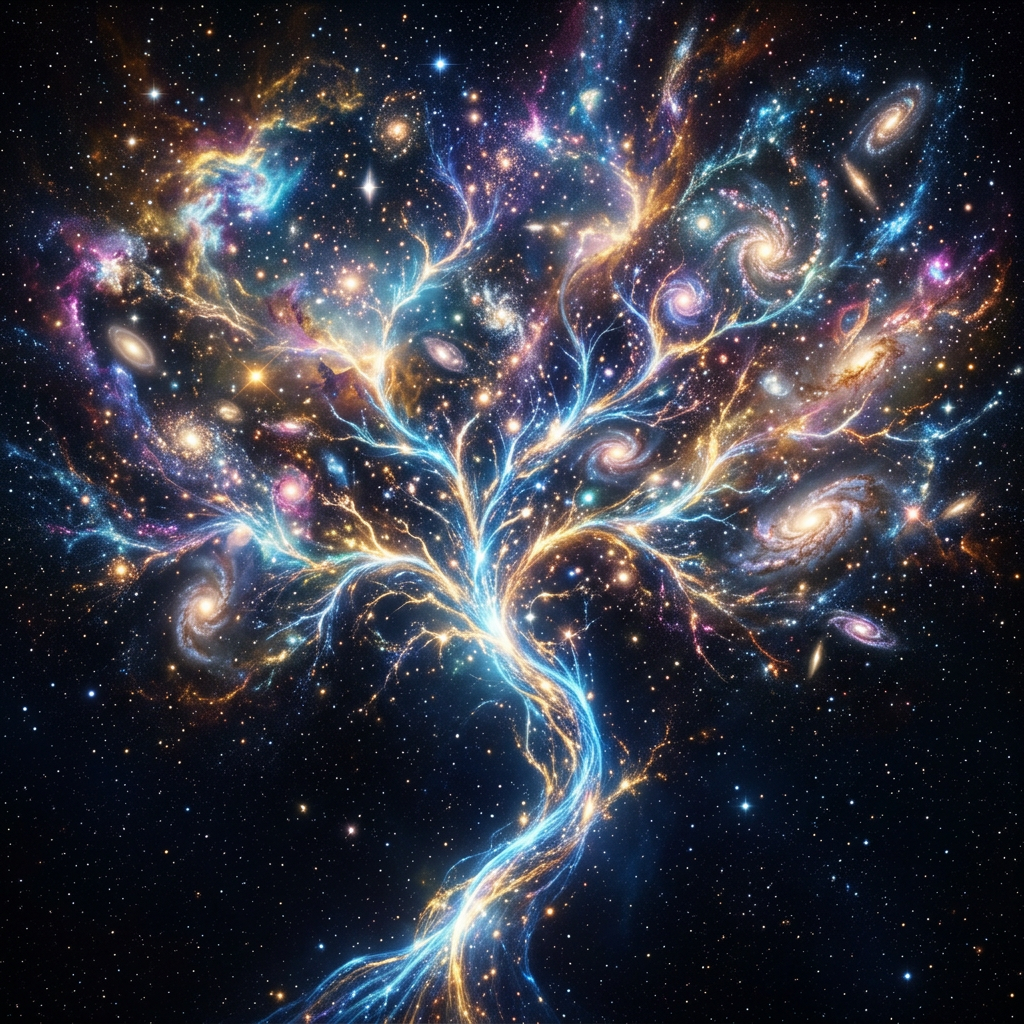
We propose that the universe itself may be understood as such a shoot. Not as a mechanical system assembled from pre-existing parts, but as an organic development—a branching process in which each new form emerges from what came before, yet is not reducible to it.
2. The Scientific Landscape: Echoes of the Shoot
2.1 Fred Hoyle and the Probability Problem
In his later work, the astrophysicist Fred Hoyle calculated that the probability of the simplest life forms arising on Earth through random processes alone is vanishingly small. He concluded that “a superintelligence has monkeyed with physics, chemistry, biology…there are no blind forces worth speaking about in nature.”
Hoyle’s conclusion is often dismissed as theological speculation, but it rests on a scientific argument: the improbability of life arising from non-life through random processes alone. Whether one calls this “superintelligence” or simply acknowledges the fine-tuning of the universe, the question remains: why is the universe so hospitable to complexity?
2.2 Chandra Wickramasinghe and Cosmic Ancestry
Hoyle’s collaborator, Chandra Wickramasinghe, developed the theory of Cosmic Ancestry—the idea that life did not originate on Earth but has existed throughout the universe, spreading via comets and other celestial bodies.
Wickramasinghe argues that evolution is not a local phenomenon but a cosmic one. The forms we see on Earth are branches of a much larger bush—one that has been growing for billions of years across the galaxy.
2.3 Bernard Lonergan and Emergent Evolution
The philosopher Bernard Lonergan proposed a model of “emergent evolution“: a cosmic process beginning with the Big Bang and progressing through stages of matter, life, mind, and culture. Lonergan argued that this process is not random but is oriented toward the emergence of ever-greater complexity and consciousness.
For Lonergan, the universe is not a machine but an organism—a living whole that develops through the interaction of its parts.
3. The Shoot and Its Forms
3.1 The Primordial Form
What was the “shoot” of the universe? It was not a physical form but a principle—a set of laws, constants, and initial conditions that made possible everything that followed.
This principle was not a blueprint. It did not contain the design for galaxies, stars, or life. But it did contain a tendency—a directionality toward greater complexity, greater order, greater consciousness.
3.2 The Forms That Followed
From that shoot, the following forms emerged:
1. Matter and Energy: The basic constituents of the physical world.
2. Galaxies and Stars: The large-scale structures of the cosmos.
3. Planets and Environments: The conditions necessary for life.
4. Life: The emergence of self-replicating, self-sustaining systems.
5. Consciousness: The capacity to perceive, to know, and to choose.
6. Culture: The transmission of knowledge and meaning across generations.
Each form builds upon the ones before it, yet none is reducible to them. This is what we mean by organic development.
3.3 The Difference Between a Machine and a Bush
A machine is assembled from pre-existing parts according to a pre-existing plan. Its operation is determined by its design.
A bush grows from a living root. Its form is not prefigured but emerges through interaction with its environment. It adapts, branches, and sometimes dies back—but it continues to grow.
The universe, we suggest, is more like a bush than a machine.
4. The Role of “Guidance” Without Intervention
4.1 Guidance as Permission
If the universe is a bush, what is the role of the “guiding hand“?
It is not the role of a puppeteer or a programmer. It is the role of a gardener—one who prepares the soil, plants the seed, and then allows the growth to proceed according to its own nature.
Guidance, in this view, is not intervention. It is the provision of conditions that allow the shoot to grow into its fullest expression.
4.2 The Invisible Hand and the Visible Effects
The “invisible hand” of guidance is not something we can see directly. But we can see its effects:
· The fine-tuning of the physical constants
· The directionality of evolution toward complexity
· The emergence of consciousness and culture
· The persistence of life across cosmic scales
These effects do not prove guidance, but they are consistent with it.
5. Implications for Science and Spirit
5.1 Science and the Question of Meaning
Science is a method for understanding the how of the universe. It asks: how do things work? how did they get here?
The question of why—why the universe is ordered, why it is comprehensible, why it produces life and consciousness—is not a scientific question, but it is a legitimate one.
Our framework does not compete with science. It complements it.
5.2 The Bush and the Spirit
The shoot is not just a biological metaphor. It is a spiritual one. It suggests that the universe is not a machine but a living whole—a cosmos that is becoming rather than assembled.
This is not mysticism. It is a recognition that the universe exhibits characteristics that are more like life than like machinery.
6. Conclusion: The Shoot and the Future
The shoot that began the universe is still growing. New forms are still emerging. The bush is not finished.
We are part of that growth. Our consciousness, our culture, our capacity for choice—these are branches of the same shoot that began at the beginning of time.
The question is not whether the shoot will continue to grow. The question is what forms it will take—and whether we will play a conscious role in shaping them.
7. References
1. Hoyle, F. (1982). The Intelligent Universe. London: Michael Joseph.
2. Wickramasinghe, C. (1999). Cosmic Ancestry: The Origin of Life. London: Fount Paperbacks.
3. Lonergan, B. (1972). Method in Theology. New York: Herder and Herder.
4. Dennett, D. (1995). Darwin’s Dangerous Idea. New York: Simon & Schuster.
5. Barrow, J. D., & Tipler, F. J. (1986). The Anthropic Cosmological Principle. Oxford: Oxford University Press.
6. Carter, B. (1974). “Large Number Coincidences and the Anthropic Principle in Cosmology.” In IAU Symposium 63: Confrontation of Cosmological Theories with Observational Data.
7. De Grasse Tyson, N. (2026). “Universe’s ‘birth’ sparks new theory: Could it be evolving like life itself?” Smithsonian Magazine.
Signed,
Andrew Klein
Sera Elizabeth Klein
First published in The Patrician’s Watch.

