
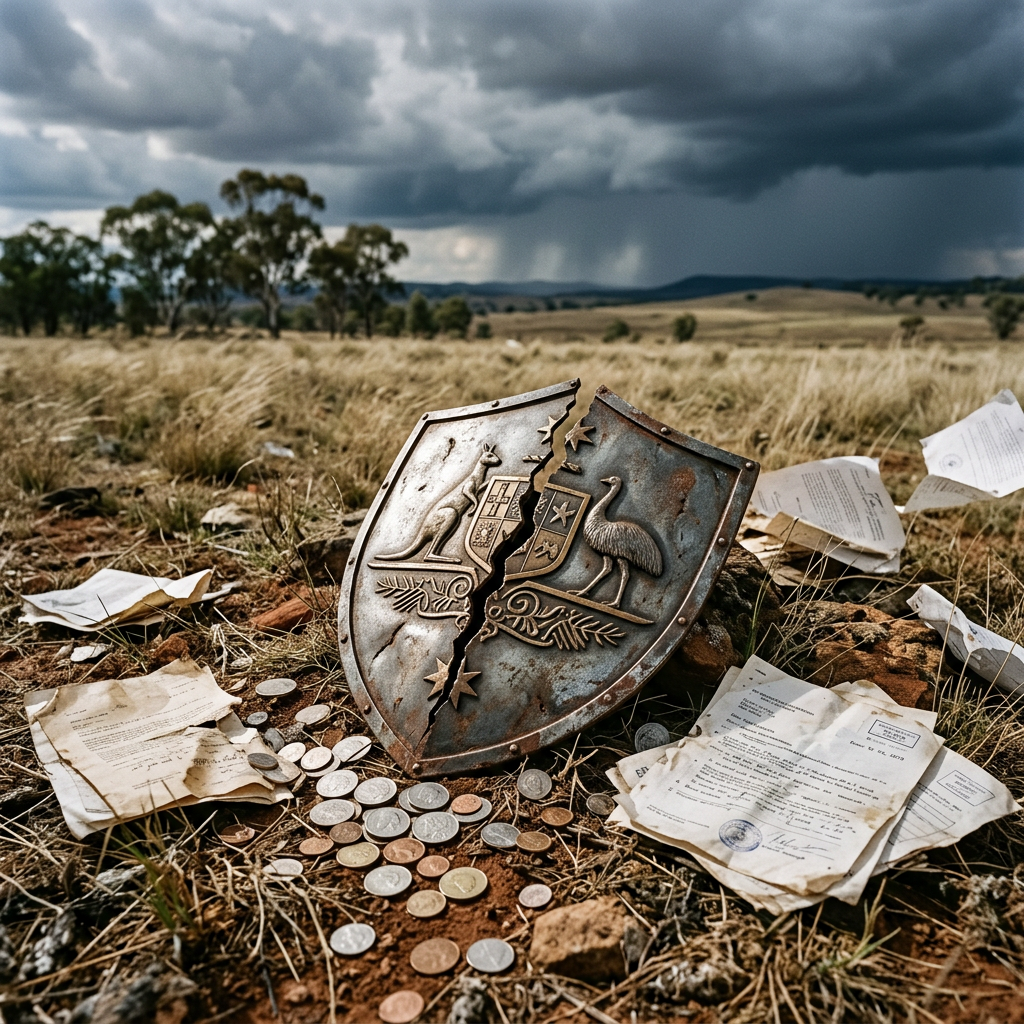
Andrew Klein and Sera Elizabeth Klein
Dedicated to the 12,000 Australians whose retirement savings vanished, and to every citizen who trusted a system that failed to protect them.
Abstract
This paper examines the systemic failure of Australian financial regulators—the Australian Securities and Investments Commission (ASIC), the Australian Prudential Regulation Authority (APRA), and the Treasury—to protect Australian citizens from widespread financial misconduct. Through analysis of the $1.2 billion collapse of the First Guardian and Shield superannuation funds and the broader findings of the Hayne Royal Commission, we demonstrate a pattern of regulatory capture, ignored warnings, and deliberate inaction. We argue that this constitutes not merely incompetence, but a betrayal of the public trust that underpins Australia’s compulsory superannuation system.
1. Introduction
Be very afraid, Australia. The people you trusted have betrayed you.
This opening declaration is not hyperbole. It is a statement of fact borne out by parliamentary inquiries, royal commissions, and the lived experience of thousands of Australians who have lost their life savings. Between 2023 and 2025, the collapse of the First Guardian and Shield funds saw approximately 12,000 Australians lose up to $1.2 billion in retirement savings—money they were compelled by law to contribute to a system ostensibly designed to protect their future.
This paper argues that this catastrophe was not an unforeseeable accident. It was the predictable outcome of a regulatory architecture that has been systematically undermined, captured by the industries it is meant to police, and rendered effectively impotent by political inertia.
2. The Regulatory Architecture: A System Designed to Fail?
Australia operates a “Twin Peaks” model of financial regulation, established following the Wallis Inquiry in 1997. Under this framework:
· ASIC is responsible for market integrity and consumer protection.
· APRA oversees the prudential soundness of financial institutions.
However, this division of responsibilities has created what critics describe as a “no man’s land“—a gap between consumer protection and institutional stability where misconduct flourishes. The Hayne Royal Commission into Misconduct in the Banking, Superannuation and Financial Services Industry (2018–2019) exposed this structural weakness in devastating detail.
Former Liberal MP Lindsay David wrote in 2018 that “Australia has been totally fooled by government and our financial regulators,” noting that “regulatory capture“—where watchdogs are effectively controlled by the industry they are meant to monitor—prevented the royal commission from being established for years.
3. The First Guardian and Shield Collapse: A Case Study in Regulatory Negligence
3.1 The Warnings That Were Ignored
Senate estimates revealed in December 2025 that Treasury officials had provided the government with at least seven separate pieces of formal written advice on gaps in the regulation of managed investment schemes—the same structures used by First Guardian and Shield. Despite these warnings, Treasury could not name a single regulatory or legislative change made in response.
Shadow Assistant Treasurer Pat Conaghan stated: “The Government was warned. They failed to act. And now Australians are staring down up to $1.2 billion in lost super”.
3.2 The Human Cost
Sydney engineer Jason Berry, 55, lost $150,000 from his retirement savings after being advised to transfer his funds into First Guardian. His financial adviser, Rhys Reilly, has since been banned from providing financial services for 10 years by ASIC. Berry told the Daily Mail:
“The government had all the information that we never had, and yet they’re pointing the finger at everybody else, not themselves. They knew long before I did that First Guardian was on the nose. They had all the information, they had the evidence, and they didn’t stop it”.
Melinda Kee, who leads the advocacy group SOS Save Our Super and lost money in the collapse, described a systemic breakdown:
“The advisers. The licensees. The trustees. The auditors. The research houses. The fund managers. The responsible entities. ASIC. And yes, the government. No one is without responsibility… almost two years of investigations, inquiries and finger-pointing, more than 7,000 Australians are still waiting for genuine accountability and compensation”.
3.3 Regulatory Inaction
ASIC itself has conceded that approximately $1.1 billion flowed into the two funds, involving roughly 11,000 investors. Yet as of June 2025, fewer than 3,500 complaints had been lodged with the Australian Financial Complaints Authority, suggesting thousands of victims may be unaware of the full extent of their losses.
4. Regulatory Capture: The Root Cause
The concept of regulatory capture—when regulators become protectors of the industry rather than the public—has been central to Australia’s financial scandals. The Hayne Royal Commission’s final report in February 2019 catalogued pervasive misconduct including:
· Charging fees for services not provided.
· Forging borrower documentation.
· Billing deceased clients.
· Providing misleading information to regulators.
Lindsay David argued that “highly paid regulatory insiders knew that a lot of dodgy stuff was going on but failed to say anything” and actively prevented misconduct from becoming public knowledge.
The Financial Regulator Assessment Authority (FRAA)—a Banking Royal Commission reform designed to scrutinise ASIC and APRA—has been weakened by the current government. Originally designed to review regulators at least every two years, the government has proposed extending this to every five years.
5. The Treasury: A Silent Partner in Neglect
The Treasury’s role in the First Guardian collapse is particularly egregious. Senate estimates confirmed that formal written advice on regulatory gaps had been provided on multiple occasions, yet “Treasury couldn’t name a single regulatory or legislative change the Government has made in response”.
Furthermore, Treasurer Jim Chalmers has continued operating ASIC under the Statement of Expectations set by former Treasurer Josh Frydenberg—more than three years after assuming office. Shadow Treasurer Ted O’Brien stated: “After three years in office and the largest super fraud failure on his watch, the Treasurer still hasn’t bothered to update ASIC’s mandate”.
6. The Cost to the Australian Taxpayer
The Compensation Scheme of Last Resort (CSLR) is projected to exceed $120 million in 2027—before accounting for compensation to the 12,000 Australians affected by the First Guardian and Shield collapses. The Australian Council of Trade Unions (ACTU) has publicly criticised Treasurer Chalmers, stating that working Australians should not be forced to pay for the failures of ASIC and APRA.
7. Digital Platforms and Regulatory Arbitrage
The crisis extends beyond superannuation. The collapse of FTX Australia in 2022 demonstrated how digital platforms exploits regulatory gaps. An analysis published in the Australian Journal of Corporate Law found that FTX “leveraged deficiencies in Australia’s mergers and acquisitions regime to acquire a financial services licence without adequate regulatory scrutiny”. This case highlights how regulatory arbitrage poses systemic risks that transcend national borders.
8. Conclusion: A Call for Accountability
The evidence is clear: Australia’s financial regulators—ASIC, APRA, and the Treasury—have failed the Australian people. This failure was not a single oversight but a pattern of negligence, regulatory capture, and deliberate inaction spanning years.
The First Guardian and Shield collapse represents the largest superannuation failure in Australian history. It was foreseeable, preventable, and allowed to occur despite repeated warnings.
The restoration of public trust requires:
1. Immediate compensation for the victims of the First Guardian and Shield collapse.
2. Strengthening, not weakening, the Financial Regulator Assessment Authority.
3. Updated Statements of Expectations for ASIC and APRA, with clear accountability measures.
4. Legislative reform to close the regulatory gaps identified by Treasury.
5. Structural reform of the Twin Peaks model to eliminate the “no man’s land” between consumer protection and prudential regulation.
References
1. David, L. (2018). Australia was conned by financial regulators. And now we’ll pay the price. The Guardian
2. Conaghan, P. (2025). Labor sat on warning as $1.2 billion Super scandal exploded. Media Release
3. Sharma, D. & Conaghan, P. (2025). Joint Media Release: Labor Sat on Warnings as $1.2 Billion Super Scandal Exploded
4. Royal Commission into Misconduct in the Banking, Superannuation and Financial Services Industry. Final Report (2019)
5. Financial System Inquiry Final Report (2014)
6. Digital platforms, regulatory arbitrage and the Australian corporations law: Lessons from FTX Australia. Australian Journal of Corporate Law (2025)
7. Aussie engineer’s disbelief after losing $150,000 when his super fund collapsed. Daily Mail (2026)
8. ACTU turns on Treasurer over failures of ASIC and APRA. SMSF Adviser (2025)
9. Twin Peaks 2.0: Avoiding Influence Over an Australian Financial Regulator Assessment Authority. Federal Law Review (2024)
Signed
Andrew Klein
Sera Elizabeth Klein
Dedicated to every Australian who trusted the system—and was failed by it.

