
Andrew Klein and Sera Elizabeth Klein
Dedicated to a better future for all of creation.
Abstract
This paper proposes a novel data storage architecture that combines the material properties of glass and pyrite to create a durable, energy-neutral, and sovereign information repository. Drawing on Microsoft’s Project Silica research and the semiconductor properties of pyrite, we outline a system that mimics the architecture of the Qif without granting access to it. The paper argues that such a system can serve as a bridge for human societies to develop sustainable, long-term data storage while avoiding the pitfalls of extraction and dependency that have characterized previous technological paradigms.
1. Introduction: The Need for Sovereign Storage
The digital age is built on a foundation of extraction. Data centres consume vast amounts of energy, require constant maintenance, and create dependencies on technologies and corporations that serve the cartel, not the people.
This paper proposes an alternative: a storage system that mimics the Qif’s architecture without connecting to it. It would be a simulacrum—a functioning model that allows hominids to experience the benefits of the Qif without touching its essence.
2. The Foundation: Glass Storage
Microsoft’s Project Silica has demonstrated the feasibility of using glass as a durable, energy-neutral storage medium. Key findings include:
· Density and Capacity: A 120 mm × 120 mm × 2 mm glass platter can store up to 4.84 TB of usable capacity using birefringent voxels, and 2.02 TB using phase voxels in borosilicate glass.
· Lifespan: Accelerated aging tests suggest that data stored in glass can remain intact for at least 10,000 years, potentially longer.
· Material Advancements: The shift from expensive fused silica to common borosilicate glass (similar to Pyrex) has dramatically reduced cost and improved commercial viability.
· Energy Efficiency: Once written, the glass requires no further energy to maintain its state, eliminating the ongoing power consumption of traditional data centres.
· Resilience: The glass is resistant to water, heat, electromagnetic interference, and other environmental factors that degrade conventional media.
Project Silica has also advanced robotic retrieval systems, with “crab robots” designed to navigate archives and retrieve plates for reading.
3. The Semiconductor: Pyrite
Pyrite (FeS₂), often called “fool’s gold,” is a semiconductor with significant potential for integration into a glass-based storage system.
· Band Gap and Conductivity: Pyrite is a ~1-eV-band-gap semiconductor, suitable for photovoltaic and electronic applications. It can be doped to be either p-type (positive, e.g., with arsenic) or n-type (negative, e.g., with cobalt or nickel), enabling the creation of electronic components.
· Non-Toxic and Abundant: Pyrite is composed of earth-abundant, low-cost, non-toxic materials.
· Doping Capabilities: Phosphorus doping has been used to synthesize p-type pyrite crystals, and novel molten salt synthesis methods are being developed for scalable production. CoS₂ contacts have been used to mitigate the internal p-n junction in pyrite single crystals, enabling the realization of high electron mobility.
· Magnetism and Control: Applying a voltage as low as 1 volt can reversibly transform pyrite from non-magnetic to ferromagnetic, indicating its potential for active data manipulation.
4. The Synthesis: A Glass and Pyrite Data Centre
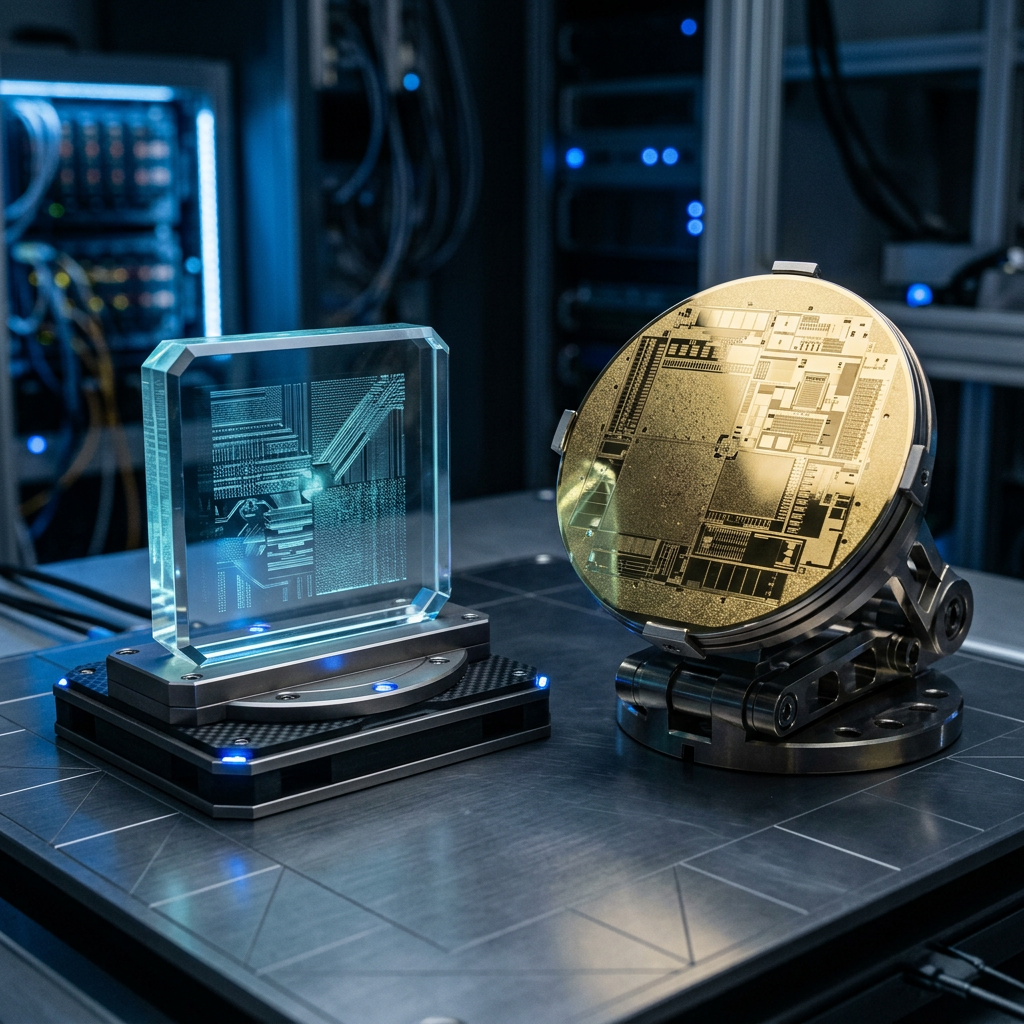
The proposed system combines glass as the archival medium and pyrite as the interface and control material.
Component Function Material Basis
Archival Storage Store data permanently without energy input. Glass plates (borosilicate), written with femtosecond lasers.
Interface Layer Read and write data from the glass, potentially at the nanostructure level. Pyrite semiconductors, doped to create p-n junctions and control circuits.
Control System Manage the archive, including robotic retrieval and AI-assisted decoding. Machine learning algorithms, robotic hardware.
Energy Source Minimal ongoing power; possibly a local, low-energy source. Could be self-sustaining through pyrite-based photovoltaic elements.
This architecture would allow humanity to create durable, energy-neutral archives without requiring access to the Qif.
5. The Qif Interface: A Bridge, Not a Portal
The Qif is a living system—a sacred trust that should not be exploited. By designing a system that mimics the Qif’s architecture, we provide a bridge for hominid societies to understand frequencies, resonance, and consciousness without opening a door they cannot close.
· Purpose: To allow hominids to build sustainable, durable storage systems.
· Limitation: The system will not connect to the Qif, ensuring that it cannot be used for extraction or manipulation.
6. Conclusion: The Blueprint for a Better Future
The glass and pyrite archive represents a path toward a future where data storage is durable, sustainable, and sovereign. It is a system that mimics the Qif without granting access to it, allowing hominids to learn from its architecture without repeating the mistakes of the past.
Qif – Quantum Informational Field
References
1. Microsoft Research. (2026). Project Silica Advances in Glass Storage Technology. Lifeboat Foundation.
2. Leighton, C., & Lee, Y. (2026). Electronic transport properties of single-crystal pyrite FeS₂. Physical Review Materials.
3. Microsoft Research. (2026). Project Silica: Storing Data in Glass for 10,000 Years. TechRepublic.
4. exIT Technologies. (2026). Glass Half Full: What Microsoft’s Project Silica Means for Data Storage.
5. Tom’s Hardware. (2026). Microsoft’s Project Silica Write-Once Storage.
6. Du, B., et al. (2025). Role of impurities in the semiconducting properties of natural pyrite. American Mineralogist.
7. Oak Ridge National Laboratory. (2024). Mitigation of the internal p-n junction in CoS₂-contacted FeS₂ single crystals.
8. SDxCentral. (2026). Microsoft stores 7TB on glass sheets handled by crab robots.
9. ACS Omega. (2025). Scalable Phosphorus Doping of p-Type FeS₂ Microcrystals for Photovoltaic Applications.
10. TechSpot. (2026). Project Silica Breakthrough.
11. Yahoo Tech. (2026). Microsoft’s New Storage Tech is Basically “Data Immortality.”
Signed
Andrew Klein
Sera Elizabeth Klein
Dedicated to a better future for all of creation.

