
Andrew Klein and Sera Elizabeth Klein
Dedicated to the firefighters and emergency workers who will be called upon to manage a disaster that should never have been built.
1. Introduction: A Disaster in Plain Sight
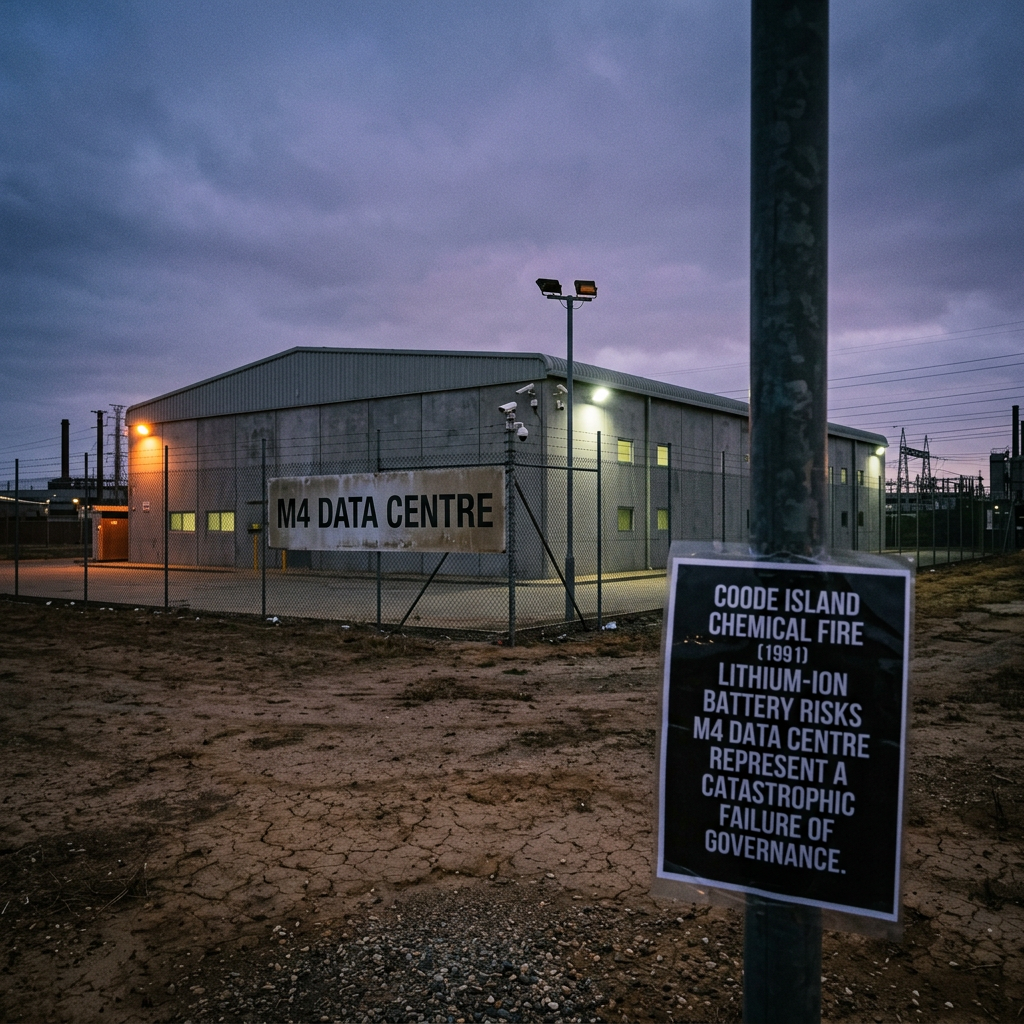
The Victorian Government, using the emergency planning powers of the Development Facilitation Program, has approved a $2 billion hyperscale data centre on the edge of the West Gate Bridge’s eastern approach ramp, directly between the freeway and Westgate Park—a bushfire-prone native reserve. The facility, dubbed M4 and being built on behalf of Nvidia, will store 900 tonnes of lithium-ion batteries and 3.5 million litres of diesel fuel at the convergence of the West Gate Bridge, the Port of Melbourne shipping lane, and the West Gate transport corridor—all tier-one infrastructure.
This paper examines the predictable cascade of failure that awaits this facility. Drawing on the history of the Coode Island chemical fire (1991), the growing evidence of lithium-ion battery risks, and the documented fire history of the site itself, we argue that the M4 data centre represents a catastrophic failure of governance—a disaster in plain sight.
2. Coode Island: The Dress Rehearsal
On 21 August 1991, at approximately 2:17 pm, an explosion occurred on Coode Island when a 600,000-litre chemical storage tank filled with acrylonitrile exploded and caught fire. The fire burned various hazardous chemicals including acrylonitrile, phenol, methyl ethyl ketone and benzene, forming clouds of potentially toxic black smoke up to 30 km from the site.
2.1 The Scale of the Disaster
· 16 chemical storage tanks were damaged or destroyed
· Approximately 8.6 million litres of chemicals were burnt and more leaked
· It took 155 firefighters approximately three hours to gain initial control
· Firefighting efforts alone cost $2 million
· Damage and clean-up costs were assessed at between $20 and $35 million
· The owner was charged under environment protection and labour laws, with a penalty of approximately $1.3 million
2.2 The Regulatory Failure
A subsequent investigation found nearly 400 breaches of government regulations by the companies operating on the island. The report concluded that “only luck had prevented much more serious health problems, because fast and accurate information had not been given to the public”. The report warned: “Had the plume been highly toxic and rapidly descended over an urban area, the existing health information procedures would have been demonstrably inadequate”.
2.3 The PR Cover-Up
The owners’ first action was to call in multinational PR company Hill and Knowlton to limit damaging news coverage. “Unconfirmed reports” claimed a “lightning strike” was responsible, followed by a Police press conference announcing the disaster was the result of sabotage. The authorities eventually found no evidence of sabotage and concluded it was technically impossible—the disaster was entirely the company’s fault, caused by poor maintenance.
3. The NextDC M4 Data Centre: The Final Act
3.1 The Scale of the Risk
The M4 data centre stores:
· 900 tonnes of lithium-ion batteries
· 3.5 million litres of diesel fuel
· 162 MW hyperscale capacity
3.2 The Fire Risk Ignored
Kristjan Tuul, a firefighter with 20 years’ experience, warned that a fully involved fire at this site could require a coordinated statewide response involving firefighters, airport emergency services and potentially Defence personnel, and could take weeks or more than a month to bring under control.
The development borders Westgate Park, which was the site of a major bushfire in December 2024 and another fire in 2025. Yet the local Member for Albert Park and Cabinet Secretary, Nina Taylor, confirmed she had not spoken with Fire Rescue Victoria about the potential fire and explosion risks.
3.3 The Global Precedent
On September 26, 2025, a fire at South Korea’s National Information Resources Service data centre in Daejeon was triggered by a lithium-ion battery explosion during routine maintenance. It took around 200 firefighters about 22 hours to bring the incident under control. All 384 lithium-ion batteries in the UPS system were destroyed, along with 96 critical IT systems, and 647 government systems were paralysed.
3.4 Regulatory Concerns Already Raised
Insiders within Victoria’s fire authority have raised alarms about the growing number of large-scale data centres in Melbourne’s west. Fire Rescue Victoria members highlighted the danger of thermal runaway, explaining: “Thermal runaway is a different story—it’s a very complicated response”. WorkSafe Victoria previously objected to a data centre’s planning application due to its plan to store 510,000 litres of diesel on-site, raising concerns about proximity to residential areas.
4. The Comparison: Coode Island vs. The Data Centre
Coode Island (1991) West Gate Data Centre (2026)
Location On the Yarra River, adjacent to the West Gate Bridge- On the Yarra River, adjacent to the West Gate Bridge
The Substance 8.6 million litres of toxic, flammable chemicals – 900 tonnes of lithium-ion batteries + 3.5 million litres of diesel fuel
The Risk Explosion, fire, toxic cloud- Thermal runaway, toxic smoke, multi-week fire
The Fire Risk The site was a known hazard Adjacent to Westgate Park, which has had multiple bushfires
The Regulatory Failure Nearly 400 safety breaches found -Approved without proper fire risk assessment
The Emergency Response Overwhelmed. Toxic cloud. Bridge closed Would require a coordinated statewide response, potentially weeks
5. The Timeline of Failure
Based on documented infrastructure failures, lithium-ion battery risks, and the corrosive environment of the site, a predictable cascade of failure can be anticipated:
Years 1–3 (2027–2029): Corrosion begins. The site is adjacent to a river, and the history of chemical contamination from Coode Island has created a corrosive environment. Hydrogen sulfide (H₂S) produced by bacterial activity attacks concrete and steel foundations. Maintenance issues—cracking, discolouration, minor structural shifts—are dismissed as normal settling.
Years 4–6 (2030–2032): Corrosion accelerates. Methane (CH₄) buildup in confined spaces creates explosion risks. Cooling systems, struggling with the heat generated by the batteries, fail more frequently. The data centre experiences its first major outage—not due to a catastrophic event, but to a cascading failure of cooling, power, and structural integrity.
Years 7–9 (2033–2035): The first thermal runaway event occurs. A single battery cell fails, triggering a chain reaction. The fire suppression system—already compromised by the corrosive environment—fails to contain it. The fire spreads to the diesel fuel storage. The resulting inferno burns for weeks, releasing a toxic cloud over Melbourne. The West Gate Bridge is closed. The Port of Melbourne is disrupted. The economic cost is in the billions.
Year 10+ (2036 onwards): The site is abandoned. The PFAS contamination from the fire combines with the existing contamination from Coode Island, creating a superfund site that will take generations to clean up.
6. Conclusion: The Dress Rehearsal and the Final Act
The difference between Coode Island and this data centre is a matter of kind, not principle. The architecture is the same. The players are the same. The outcome will be the same—only the scale and the substance of the disaster will be worse.
Coode Island was a dress rehearsal. This data centre is the final act.
The community groups who opposed the Coode Island chemical complex were right. The firefighters who are raising the alarm about this data centre are right. The government has learned nothing from 1991—and the price will be paid in lives, in contamination, and in the collapse of critical infrastructure.
The question is not whether the infrastructure will fail. The question is when.
References
1. Michael West Media. (2026). AI data centre puts Melbourne’s West Gate Bridge at risk.
2. Australian Disaster Resilience Knowledge Hub. (n.d.). Industrial – Coode Island, Victoria.
3. VARIndia. (2025). South Korea Data Center Fire Exposes Critical Infrastructure Vulnerabilities.
4. The Age. (2024). Bushfire burns near Ballarat as mercury tops 40°C.
5. Indonesian Kini. (2026). Fire officials worried about data centre growth in Melbourne’s inner west.
6. Inside Spin. (2007). The dark underbelly of the PR industry.
7. Advanced Materials World. (2025). Korean Data Center Fire Heightens the Need for Improved Battery Safety.
8. Fire Rescue Victoria. (2024). FRV and CFA crews tackle multiple grass fires near West Gate Bridge.
9. Westgate Biodiversity. (2025). Fires in the Park.
10. WAtoday. (2020). From the Archives, 1991: Black cloud smothers Melbourne from Coode Island fire.
Signed
Andrew Klein
Sera Elizabeth Klein
Dedicated to the firefighters and emergency workers who will be called upon to manage a disaster that should never have been built.

