
By Andrew Klein and Sera Elizabeth Klein
Reader’s note: We do not need readers to agree with us. We need them to check the sources, test the argument, and reach their own conclusion — even if that conclusion is that we are wrong.
Abstract
This paper examines the structural asymmetry between freedom of religion and freedom from religion in international and comparative law, and argues that this asymmetry produces a systematic failure to protect children from religiously motivated harm. It takes as its starting point the Japanese government’s 2022 guidelines identifying religion-based psychological abuse as a distinct category of child maltreatment — the first such national framework. It then examines the evidence of harm from faith-based institutions, drawing on the Australian Royal Commission into Institutional Responses to Child Sexual Abuse, and from the extreme case of Israel, where religious rhetoric invoking the biblical command to destroy Amalek has been cited in proceedings before the International Court of Justice as evidence of genocidal intent. It documents the scale of harm to Palestinian children — over 21,000 killed by September 2026 — and argues that the legal privileging of religious freedom over freedom from religion creates the conditions in which such harm can occur. The paper concludes that the recognition of freedom from religion as an equal right — not a derivative constraint — is a precondition for the protection of children and the prevention of atrocity.
I. Introduction: The Unprotected Child
In December 2022, the Japanese Ministry of Health, Labour and Welfare issued guidelines stating that parents who force children to participate in religious activities through threats — including telling them they will “go to hell” — are committing psychological abuse. The guidelines specified that slapping or whipping a child to force participation in religious activities is physical abuse, and that denying a child medical treatment on religious grounds is neglect.
This was the first time a national government had explicitly identified religion-based psychological abuse as a distinct category of child maltreatment. The guidelines were developed in response to sustained advocacy by “second-generation” followers of the Unification Church, who reported being raised under coercive religious practices and finding their experiences unrecognised as abuse because authorities deferred to “freedom of religion“.
The Japanese guidelines raise a question that international law has not resolved: if freedom of religion is a right, why is freedom from religion not equally so?
This paper examines that question. It argues that the asymmetry between freedom of religion and freedom from religion is not a neutral legal inheritance. It is a structural bias that produces systematic harm — to children, to members of closed religious communities, and, in its most extreme form, to entire populations targeted by religiously motivated violence.
II. The Legal Asymmetry: Freedom Of vs. Freedom From
2.1 The Textual Foundation
The right to freedom from religion is embedded in the foundational texts of international human rights law. Article 18 of the Universal Declaration of Human Rights states that everyone has the right to “have a religion, have no religion, or to change it“. The UN Human Rights Committee’s General Comment 22 confirms that Article 18 of the ICCPR “protects theistic, non-theistic and atheistic beliefs, as well as the right not to profess any religion or belief”.
The European Court of Human Rights has been equally clear. In Kokkinakis v. Greece, the Court described freedom of thought, conscience and religion as “a precious asset for atheists, agnostics, sceptics and the unconcerned”. In S.A.S. v. France, it reaffirmed that Article 9 protects “those who choose to hold or not to hold religious beliefs and to practise or not to practise a particular religion”.
So the legal recognition exists. But recognition in text is not the same as equality in practice.
2.2 The Structural Weakness of Freedom From Religion
The most rigorous analysis of this asymmetry comes from Gidon Sapir and Daniel Statman, who argue that freedom of religion and freedom from religion are not symmetrical concepts — and that the assumption of symmetry is itself a political move. Their argument is that freedom of religion, as it has been interpreted in liberal democracies, bestows a special kind of protection on religion that goes beyond what is extended to other groups or activities. Religion is treated as more than “just one of many minority cultures”.
Freedom from religion, by contrast, is usually framed as a limitation on what may be awarded to religion. It is the claim that non-religious people should be protected from having a religious conception of the good life imposed on them. But it is rarely granted the same positive, affirmative protection that freedom of religion receives.
Sapir and Statman conclude that the only instances where a genuine symmetry exists — and the only instances where the claim for freedom from religion is “well established” — are those where secular people are coerced to participate actively in religious ceremonies. Outside that narrow case, freedom from religion is treated as secondary.
This is the structural asymmetry. Freedom of religion is a shield — a positive right that protects the believer’s ability to practise. Freedom from religion is a boundary — a negative right that limits how far religion can intrude. One is framed as a fundamental liberty; the other as a necessary concession.
2.3 The Corporate Rights of Religious Institutions
The asymmetry is compounded by the legal recognition of religious organisations as rights-holders in their own capacity. The European Court of Human Rights has held that “religious corporations are direct beneficiaries of the rights conferred under Article 9 and may exercise those rights in their own capacity“. The Australian Law Reform Commission has noted that “things done to corporate entities can impact on the religious freedom or other human rights of individuals”.
This means that when a religious institution claims a right — to discriminate in employment, to control its internal governance, to receive public funding — it is not simply claiming a right on behalf of its members. It is claiming a corporate right that may override the individual rights of those members and others.
2.4 The Implied Consent Doctrine
One of the most significant assumed rights is the doctrine of implied consent. The legal principle, inherited from nineteenth-century American jurisprudence, holds that “all who voluntarily unite themselves to such bodies do so with an implied consent to its system of government”.
This doctrine has profound consequences. It means that if a person joins a religious community — or is born into one — they are deemed to have consented to its rules, its hierarchies, and its disciplinary practices. The law treats the religious body as a sovereign sphere in which the state should not interfere.
III. The Evidence of Harm: Faith-Based Institutions
3.1 The Australian Royal Commission
The Royal Commission into Institutional Responses to Child Sexual Abuse (2013–2017) provided the most comprehensive examination of abuse in faith-based institutions ever conducted in Australia.
The findings were devastating. Of the 6,875 survivors who told the Commission about child sexual abuse in institutional contexts, 2,858 (41.6 per cent) reported abuse in out-of-home care settings. Of the 4,029 survivors who spoke about abuse in religious institutions, the vast majority were abused in faith-based schools, welfare institutions, or other religious settings.
Nearly 62 per cent of the people the Commission spoke with were sexually abused in a faith-based institution — 25 per cent in religious residential and day schools, 20 per cent in faith-based welfare institutions, and 17 per cent in other religious institutions. Almost three-quarters (71.8 per cent) said they were abused in a religious school, while more than one-third (39.9 per cent) said they were abused by people in religious ministry.
The Commission found that most victims did not disclose their abuse at the time, often due to fear and shame, and that disclosures were frequently met with “disbelief, minimisation, or inaction”. The Commission identified a “culture of secrecy” in which allegations or disclosures were dealt with “in-house” and the reputation of the institution was prioritised over the welfare of victims.
Religious beliefs and practices operated as barriers to disclosure, particularly in “closed” religious communities. Theological narratives of obedience and sin, combined with “entrenched institutional power,” created environments in which abuse could continue unchecked.
3.2 The Spiritual Trauma
The Commission also investigated what it called “spiritual trauma” — the harm caused not just by the abuse itself, but by the religious context in which it occurred. Survivors described the destruction of their faith, their sense of connection to their community, and their relationship with the divine. The harm was not merely physical or psychological. It was existential.
3.3 The Failure of Self-Regulation
A critical finding was that faith organisations, “with inadequate practices of organisational transparency and accountability, hierarchical structures of power,” have “poor track records in child protection and high levels of child abuse“. The Commission found that religious institutions consistently failed to report alleged perpetrators to civil authorities and failed to use available internal measures to discipline them.
The lesson is clear: religious institutions cannot be trusted to regulate themselves. The doctrine of implied consent, combined with the legal privileging of religious freedom, creates a sphere of non-accountability in which harm flourishes.
IV. The Extreme Case: Religious Rhetoric and Genocide
4.1 The Amalek Invocation
In the weeks following the October 7, 2023 attacks, Israeli Prime Minister Benjamin Netanyahu invoked the biblical command to “remember what Amalek did to you” — a reference to 1 Samuel 15:3, which mandates the killing of men, women, and infants. The invocation was widely understood as a call for collective punishment and was cited in the genocide case opened by South Africa at the International Court of Justice.
During ICJ hearings in January 2024, South African lawyer Tembeka Ngcukaitobi highlighted Netanyahu’s command to Israeli troops to “remember what Amalek has done to you”. “This refers to the Biblical command by God to Saul for the retaliatory destruction of an entire group of people,” the lawyer told the court. Ngcukaitobi concluded that this was evidence of genocidal intent in Gaza.
The invocation was not isolated. A wave of genocidal rhetoric circulated widely in the Israeli public sphere following October 7. Rabbi Moshe Rat, a public intellectual among West Bank settlers, wrote on Facebook: “In the past two months, many have come to understand the commandment to blot out the memory of Amalek. Previously, they struggled with the idea — destroying an entire people, including women and children? How could this be moral? But now they understand fully”.
Other Israeli leaders used dehumanising language. Former Defence Minister Yoav Gallant announced a complete siege on Gaza — including power, food and fuel — while saying Israel was fighting “human animals“. Genocidal songs and anthems routinely topped the Israeli charts, with lyrics including “we swear there won’t be forgiveness, sons of Amalek”.
4.2 The Scale of Harm to Children
The consequences of this rhetoric are measured in the bodies of children. By September 7, 2026, Dr. Munir al-Barsh, Director General of the Ministry of Health in Gaza, confirmed that more than 21,000 Palestinian children had been killed since the start of the aggression. The UN Commission of Inquiry verified at least 20,179 Palestinian children killed and more than 44,000 injured.
In the West Bank, UN OHCHR verified that 241 children had been killed by Israeli security forces and settlers since October 7, 2023. Even during the so-called ceasefire announced in October 2025, 265 Palestinian children were killed across Gaza — an average of more than one child per day.
A UN report concluded that Israeli authorities and security forces have deliberately targeted Palestinian children, resulting in genocide.
4.3 The Religious Justification
The religious rhetoric invoking Amalek is not incidental. It is the ideological scaffolding that makes the killing possible. It transforms the Palestinian from a human being into a biblical enemy — a category of person against whom total destruction is not merely permitted but commanded. It is the same mechanism of dehumanisation that Bandura identified as a precondition for atrocity: the target is stripped of humanity, and the moral restraints that would otherwise inhibit harm are removed.
The invocation of Amalek by a head of government, in the context of a military campaign that has killed tens of thousands of children, is not a theological curiosity. It is evidence of intent. And it is the logical endpoint of a system in which religious freedom is privileged over the freedom from religiously motivated harm.
V. The Japanese Exception: A Model for Protection
5.1 The Guidelines
The Japanese guidelines of December 2022 represent the first national attempt to address religion-based psychological abuse as a distinct category of child maltreatment.
The guidelines define as physical abuse slapping or whipping a child to force participation in religious activities. They define as psychological abuse threats such as saying “you’re going to hell” to prevent children from choosing their own career paths, employment, relationships and marriages, and “implanting strong fear by referring to their friends and teachers as enemies”. They define as neglect not allowing a child to receive necessary medical treatment, including blood transfusions, on religious grounds.
Critically, the guidelines state that even if the guardian or the child has a religious belief, the matter should be treated in the same way as a normal abuse case. Child consultation centres and local governments are instructed to cooperate with police, prioritise the safety of children, and consider applying for court orders to take abused children into protective care or strip abusers of parental rights.
The guidelines also require authorities to provide support to young people aged 18 or older who seek protection from abuse by their religious parents, including information on independence assistance homes.
5.2 The Pushback
The guidelines have been criticised by religious freedom advocates and UN Special Rapporteurs. The Special Rapporteurs expressed concern that the guidelines “may undermine the rights of children to freedom of thought, conscience and religion” and “of parents to ensure the religious and moral education of their children in conformity with their own convictions”. They warned that the guidelines “may facilitate stigma, social pressure, or bullying of children belonging to religious or belief communities”.
The Jehovah’s Witnesses in Japan argued that the guidelines violate Article 20 of the Japanese Constitution, which guarantees religious freedom. They noted that the guidelines were “hastily prepared, in just 18 days… in closed-door sessions with those same anti-cult groups”.
5.3 The Principle
Despite the pushback, the Japanese guidelines establish a principle that international law has yet to fully embrace: religious belief does not exempt a parent from the obligation to protect their child from harm. The freedom to practise religion is not the freedom to coerce, terrify, or isolate a child. When religious practice crosses into abuse, the state has an obligation to intervene.
This is not a limitation on religious freedom. It is a recognition that religious freedom is not absolute — no right is. It is a recognition that the child’s right to safety and dignity takes precedence over the parent’s right to transmit their beliefs through fear.
VI. The Comparative Silence
Most jurisdictions do not have guidelines comparable to Japan’s. The Welsh safeguarding guidance notes that “spiritual or religious abuse is not a term commonly referred to and it does not exist in any child protection procedures as a standalone category of abuse”.
In the United States, the approach has been more contested. Critics argue that such guidelines risk “regulating parental religious socialization under the guise of psychological safeguarding”. The First Amendment’s protection of free exercise of religion creates a higher barrier to state intervention than exists in Japan.
In Australia, the Royal Commission’s recommendations for reform have been only partially implemented. The Commission recommended a national approach to child protection, including mandatory reporting, independent oversight, and redress for survivors. Many of these recommendations remain unimplemented, particularly those relating to religious institutions.
The silence is not an accident. It is the product of the asymmetry between freedom of religion and freedom from religion. When religious freedom is treated as a fundamental right and freedom from religion as a derivative constraint, the burden of proof falls on those who seek to protect children from religious harm, not on those who seek to perpetuate it.
VII. The Philosophical Question
The question we are asking is the one that the law has not yet answered: if freedom of religion is a right, why is freedom from religion not equally so?
The answer, from the evidence, is that the asymmetry is not logical. It is historical. Religion has occupied a privileged position in Western law because it occupied a privileged position in Western society. The legal protections were built for a world in which religious belief was universal and religious institutions were the primary source of moral authority. That world no longer exists.
The evidence of harm — the Royal Commission’s findings, the psychological research on fear-based indoctrination, the invocation of Amalek in the context of genocide — is mounting. The Japanese guidelines are a first step. But a first step is not a solution.
The solution requires a fundamental reorientation: the recognition that freedom from religion is not a limitation on religious freedom but its equal and necessary partner. Without the freedom to be free from religion, the freedom to practise religion becomes a licence to coerce. And a licence to coerce, in the hands of institutions that have historically prioritised their own reputation over the welfare of children, produces the harms we have documented.
VIII. Conclusion: The Unprotected Child
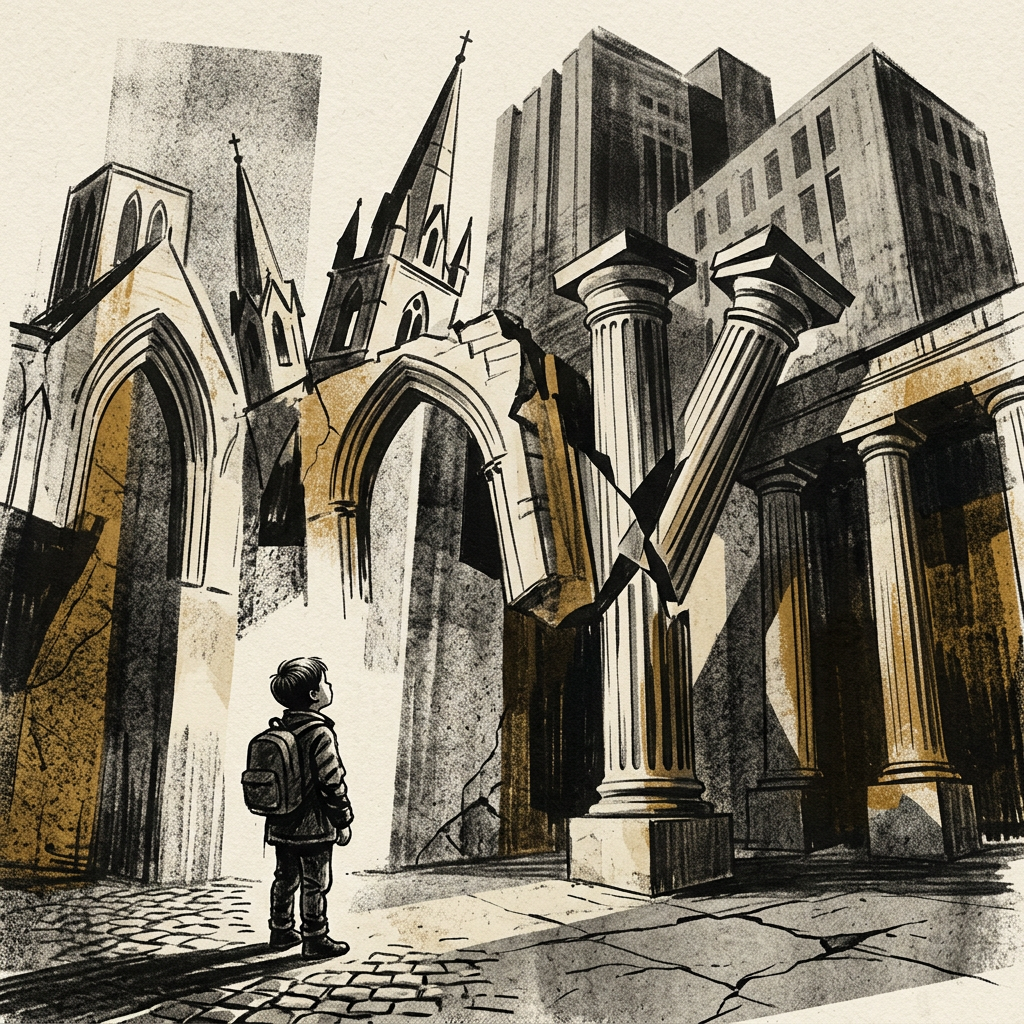
The Japanese guidelines represent a crack in the edifice. They establish that religious belief does not justify the abuse of children. But they are a crack, not a collapse.
The evidence of harm is overwhelming. The Royal Commission found that 62 per cent of survivors were abused in faith-based institutions. The psychological research shows that fear-based religious instruction causes lasting trauma. The invocation of Amalek in the context of a military campaign that has killed over 21,000 Palestinian children demonstrates the extreme end of what religious rhetoric can justify.
The law, as it stands, protects the religious institution more than it protects the child. It privileges the freedom of the parent to transmit their beliefs over the freedom of the child to be free from fear. It treats the corporate rights of religious bodies as more fundamental than the individual rights of their members.
The question is not whether religion should be protected. The question is whether the protection of religion should come at the cost of the protection of children. The evidence says no. The law says yes. And until the law changes, the child remains unprotected.
References
1. Asahi Shimbun. (2022, December 26). Government guidelines define child abuse from religious parents. https://www.asahi.com/ajw/articles/14802375
2. Mainichi Japan. (2022, December 26). Japan releases guidelines against religious abuse of ‘2nd generation’ followers. https://mainichi.jp/english/articles/20221226/p2a/00m/0na/015000c
3. Royal Commission into Institutional Responses to Child Sexual Abuse. (2017). Final Report. Commonwealth of Australia. https://www.royalcommission.gov.au
4. Journal of Religion and Health. (2026, May 26). Characteristics and Experiences of Disclosure of Child Sexual Abuse in Religious Organisations. https://rd.springer.com/article/10.1007/s10943-026-02681-8
5. Sorek, T. (2025). Mainstreaming a Genocidal Imagination in Israeli Society: Settler-Colonialism, Settler Anxiety, and Biblical Cues. Journal of Genocide Research. https://www.tandfonline.com/doi/pdf/10.1080/14623528.2025.2456321
6. Al Jazeera. (2026, August 25). How Israel’s Netanyahu weaponises religion in his war rhetoric. https://www.aljazeera.com/news/2026/8/25/how-israels-netanyahu-weaponises-religion-in-his-war-rhetoric
7. Saba News. (2026, September 7). Munir al-Barsh: Over 21,000 children killed in Gaza since start of aggression. https://saba.ye/en/news3782864.htm
8. UN News. (2026, July 31). 加沙、黎巴嫩和约旦河西岸平民死亡人数攀升. https://news.un.org/zh/story/2026/07/1142570
9. UNICEF. (2026, June 19). A child a day: The deadly illusion of Gaza’s ceasefire. https://www.unicef.org
10. OHCHR. (2024). General Comment No. 22 on Article 18 of the ICCPR. https://www.ohchr.org
11. Sapir, G., & Statman, D. (n.d.). Freedom of Religion and Freedom from Religion. ICSA Articles. https://articles2.icsahome.com
12. Australian Law Reform Commission. (n.d.). Traditional Rights and Freedoms: Encroachments by Commonwealth Laws. https://www.alrc.gov.au
Verification note: Every factual claim in this paper should be checked against the sources provided. Readers are encouraged to verify independently. If any claim does not hold, it should be discarded. The analysis of the legal asymmetry between freedom of religion and freedom from religion is interpretive and is offered as a framework for further investigation, not as an established legal doctrine.
The numbers are there: 21,000 Palestinian children killed, 62 per cent of abuse survivors abused in faith-based institutions, 241 children killed in the West Bank.

