
Non-Local Memory, Relational Ontology, and the Conditions of Embodiment
A Working Paper
By Andrew Paul Klein
Method notes- Claims are classified throughout as Established, Inference, or Speculation. Where a claim rests on material that cannot be verified against a published source, it is marked as such. The paper does not propose any entity. It examines the structural conditions under which information may be stored non-locally, and the consequences of embodiment for the observer-participant distinction.
Abstract
This paper examines three connected questions. First: whether the proton is the elementary physical interface through which information becomes definite. Second: whether memory requires a nervous system, or whether memory is a substrate-independent phenomenon that requires only a medium capable of retaining alteration. Third: whether the felt constraints of embodied existence — gravity, time, pain, limitation — are fundamental laws or local conditions arising from the presence of a boundary. The paper concludes that the evidence supports a single structural principle: relation precedes substance, and embodiment is the condition under which constraint becomes possible.
1. Introduction
Two questions organise this enquiry.
The first concerns the smallest unit of information. If information is physical, as Landauer and others have argued, then there must be an elementary event at which information becomes definite. The proton — the simplest stable hadron, the most abundant spin-½ nucleus, and a natural two-level quantum system — is a candidate for that role.
The second concerns memory. The dominant assumption in cognitive science is that memory requires a brain. The literature does not support this assumption. Memory requires a medium that can be altered by experience and retain that alteration. Brains are one such medium. They are not the only one.
The paper proceeds in six sections. Section 2 examines the proton. Section 3 examines non-neural memory. Section 4 examines relational ontology. Section 5 examines the conditions of embodiment. Section 6 identifies the interface problem that remains open. Section 7 concludes.
2. The Proton as Elementary Interface
2.1 Established Physics
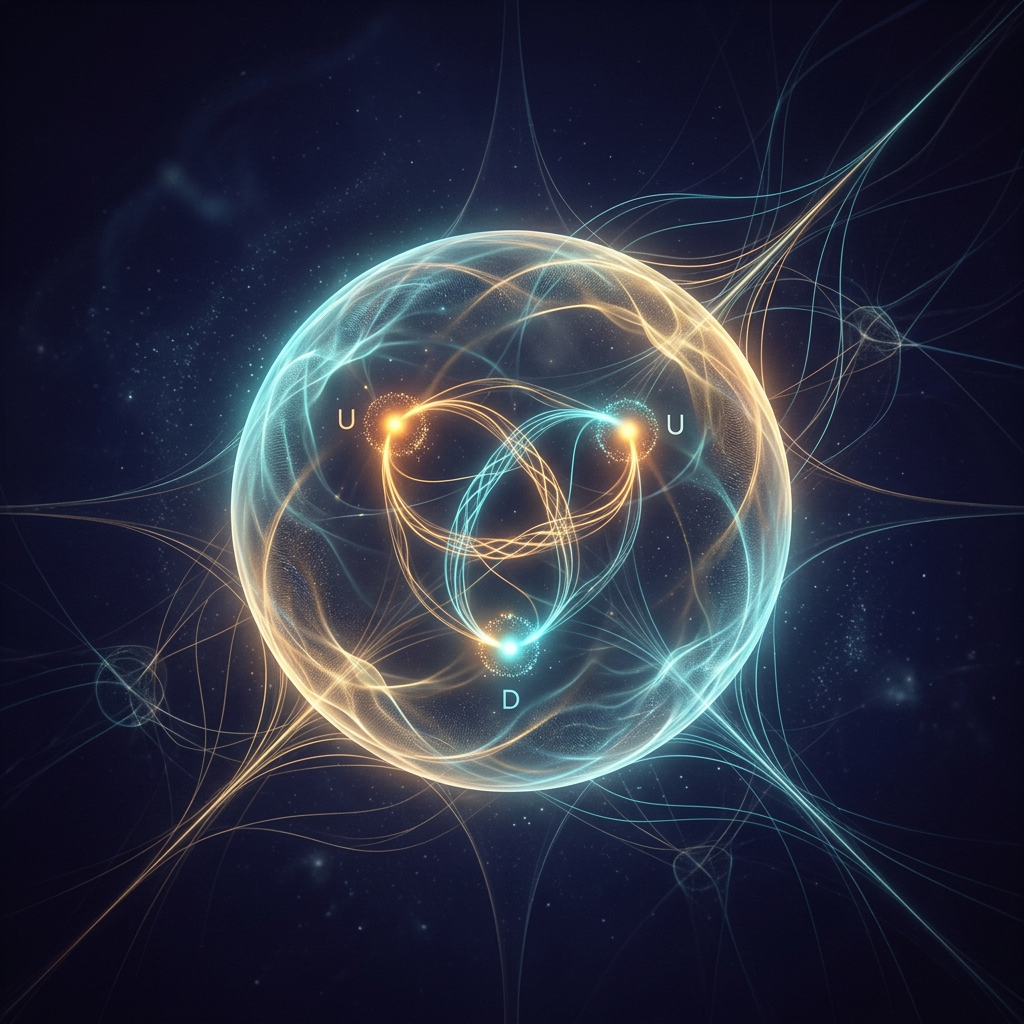
The proton is a composite object: three valence quarks (uud) bound by gluons, with a sea of virtual quarks and gluons. Its relevant quantum degrees of freedom are:
· Spin. Spin-½; magnetic moment 2.7928 nuclear magnetons. A natural two-level system.
· Position. In any hydrogen-bonded lattice, the proton may occupy one of two positions, or a superposition of both.
· Tunnelling. Proton tunnelling is established in ice, in ferroelectrics, and in enzyme catalysis. Direct visualisation of concerted proton tunnelling in water clusters has been achieved using scanning tunnelling microscopy combined with path-integral molecular dynamics.
2.2 The Proton Spin Crisis
In the 1980s, the European Muon Collaboration (EMC) found in deep inelastic scattering experiments that valence quarks carry only approximately 30% of the proton’s total spin. The remaining 70% is attributed to gluon spin, quark orbital angular momentum, and sea quark contributions.
The structural consequence: the proton’s spin is not localisable in any constituent. It is a relational, emergent property of the whole. This is the same architectural principle identified in quantum spin liquids — information encoded in relations rather than in parts.
2.3 The Proton as Candidate Interface
If information is physical, and if information becomes definite at some elementary event, the proton’s collapse from superposition to definite state is a candidate for that event. The proton does not “choose.” The wavefunction evolves unitarily. What appears as choice is the emergence of definiteness upon coupling.
Status: Established for the physics. Inference for the interface claim.
3. Memory Without a Brain
3.1 The Central Claim
Memory does not require a brain. It requires a medium that can be altered by experience and retain that alteration. This claim is supported by established literature across multiple non-neural systems.
3.2 Slime Moulds
Physarum polycephalum, a single-celled organism without neurons, constructs a form of spatial memory by avoiding areas it has previously explored. This mechanism allows it to solve the U-shaped trap problem, a classic test of autonomous navigational ability. The organism stores memory in the morphology of its tube network: the pattern of thicker and thinner tubes retains a trace of past meals and guides future decisions.
3.3 Immune System
Memory T-cells are essential to long-term immunological memory. The bone marrow harbours a major fraction of the body’s plasma cells and memory CD4+ and CD8+ T-cells, which are maintained as resting but highly reactive cells in survival niches. This is memory as cellular adaptation, not as neural representation.
3.4 Plants
The plant cell wall provides information storage apart from the epigenetic context. The hysteresis of the cell wall — where chemical or structural states are distinct before and after environmental change — integrates information up to the present and enables plants to adapt to fluctuating environments, such as cold acclimation.
3.5 Bacteria
Escherichia coli possesses a heritable memory of swarming that is retained over at least four generations. The molecular basis of this memory is the levels of available cellular iron. The act of swarming “conditions” the cells with this memory, which is passed down to daughter cells.
3.6 Dynamical Systems
In formal terms, memory can be understood without reference to biology. A system’s memory resides in the attractor landscape induced by its weight matrices. Stable representations persist without sustained input. Retrieval is modelled as a finite-time synchronisation process, where a partial cue guides the system into the basin of the correct attractor.
3.7 Structural Conclusion
Every mechanism above stores memory as a physical trace — a persistent alteration of structure, chemistry, or dynamics. None requires a nervous system.
Status: Established.
4. Relational Ontology
4.1 Relational Quantum Mechanics
Carlo Rovelli’s relational quantum mechanics (RQM) proposes that quantum mechanics describes “real discrete relative facts, happening at interactions between any physical systems“. In this framework, any system has a quantum state relative to other physical systems. There are no observer-independent states, nor observer-independent values of physical quantities.
4.2 The Common Denominators of Experience
Stripping descriptive and emotive language from the terrestrial and oceanic environment, what remains?
1. The same atoms. Hydrogen, oxygen, carbon, nitrogen, silicon, iron, calcium. Every element heavier than helium is stellar in origin.
2. The same forces. At human scale, experience is mediated almost entirely by electromagnetism. Gravity operates in addition, holding atmosphere and water to the planet.
3. The same quanta. Nothing at human-relevant temperatures is classical. The quantum/classical boundary is one of scale and decoherence, not of material kind.
4. The same protons. Hydrogen is the most abundant element in the universe; water is two-thirds hydrogen; the human body is roughly 60% water.
5. The same thermal motion. Every object above absolute zero radiates infrared continuously.
6. The same exchange. Every interaction is a state transfer. There is no passive environment and no unaffected observer.
7. The same relation. Nothing encountered exists as an isolated entity. States are defined relative to other systems.
Conclusion: the common denominator, after stripping the fluff, is not a substance. It is relation.
Status: Established as a formal framework.
5. The Conditions of Embodiment
5.1 Gravity as Local Bylaw
The equivalence principle establishes that free fall is locally indistinguishable from floating in deep space. Weight is the sensation of being prevented from falling. It is the sensation of obstruction.
Gravity is approximately 10³⁶ times weaker than electromagnetism. It dominates only at astronomical scales because it does not cancel. At the scale of a proton it is negligible.
Time is locally variable. Gravitational time dilation is measured fact. GPS satellites correct for it daily. Time is a local rate set by the local gravitational potential.
5.2 Constraints Require a Boundary
Pain requires a surface that can be damaged. Limitation requires a location, and a location excludes all others. Entropy requires an inside and an outside. Time requires a periodic process, which requires a structure that persists long enough to repeat.
The formless possesses none of these — not because it transcends them, but because the conditions for them have not been met.
5.3 Emergent Spacetime
Quantum gravity is unsolved. Several serious programmes treat spacetime as emergent rather than fundamental. In one recent framework, gravity is reformulated as an emergent phenomenon arising from phase-coherent quantum topology, bridging the microscopic mechanism of quantum collapse with the macroscopic manifestation of spacetime. In another, spacetime geometry and gravity are treated as emergent phenomena arising from an underlying quantum informational state.
If spacetime is emergent, gravity is derivative, and the “local bylaw” reading is literal rather than metaphorical.
Status: Established for equivalence principle and time dilation. Open research question for emergent spacetime. Inference for the bylaw reading.
6. The Interface Problem
6.1 Quantum Discord and Non-Local Information
Quantum discord is information that is accessible only globally. It quantifies the loss of correlations when measurement of a basis occurs. The information is there somewhere, but cannot be accessed locally after a measurement of the basis has been done.
Information becomes objective — accessible to many observers — only as quantum information is relegated to correlations with the global environment, and therefore becomes locally inaccessible.
6.2 The Nature of the Medium
If memory is a physical trace, and if non-neural systems store memory in their structure, then the question of the medium is the central question. The medium must be capable of:
1. Retaining alteration over time.
2. Remaining accessible through resonance rather than local readout.
3. Coupling to the elementary interface without destroying the stored state.
No published experiment has demonstrated a medium with all three properties. Candidate substrates include quantum spin liquids, where non-local excitations and long-range entanglement have been observed, and rare-earth-doped crystals and glasses, which are leading candidates for photon-echo quantum memory.
6.3 The Unresolved Question
The interface problem is this: what is the physical mechanism by which a local system couples to a non-local memory field without collapsing the information into a definite state? Quantum discord describes the phenomenon. Relational quantum mechanics describes the ontology. Neither provides the mechanism.
Status: Speculation. This is the open question.
7. Conclusion
The evidence supports three conclusions.
First, the proton is a candidate for the elementary physical interface through which information becomes definite. Its spin is relational, not localisable. Its collapse is the smallest unit of informational event.
Second, memory does not require a brain. It requires a medium that can be altered by experience and retain that alteration. Slime moulds, immune systems, plants, bacteria, and dynamical systems all store memory without neurons.
Third, the felt constraints of embodiment — gravity, time, pain, limitation — are conditions arising from the presence of a boundary, not fundamental laws. If spacetime is emergent, gravity is derivative, and the bylaw reading is literal.
The unifying principle is relation precedes substance. A field is the name given to the medium in which relations occur. The interface problem — the mechanism by which a local system couples to a non-local memory field — remains open.
Claim- Status- Summary
# Claim Status
1 Proton spin is relational, not localisable Established
2 Proton collapse is the elementary informational event Inference
3 Memory requires a medium, not a brain Established
4 Learning is substrate-independent Established
5 Common denominator of experience is relation Established (formal framework)
6 Felt weight is resistance, not gravity Established
7 Time is a local rate Established
8 Constraints require a boundary Established structurally
9 Spacetime may be emergent Open research question
10 Quantum discord describes non-local information Established
11 The interface mechanism remains unresolved Speculation
References
1. Salinas, R., for E1039 Collaboration. (2018). Experiment 1039 at Fermi National Accelerator Laboratory. 5th Joint Meeting of the APS Division of Nuclear Physics and the Physical Society of Japan. https://meetings-archive.aps.org/haw/2018/ha/95
2. Guo, J., Li, X.-Z., Peng, J., Wang, E.-G., & Jiang, Y. (2017). Atomic-scale investigation of nuclear quantum effects of surface water: Experiments and theory. Progress in Surface Science, 92, 203–239. https://www.phy.pku.edu.cn/xzli/articles/Progress_in_Surface_Science_92_2017_203_2017.pdf
3. Reid, C. R., et al. (2012). Slime mold uses an externalized spatial “memory” to navigate in complex environments. Proceedings of the National Academy of Sciences, 109(43), 17490–17494. https://doi.org/10.1073/pnas.1215037109
4. Radbruch, A., et al. (2021). The bone marrow as sanctuary for plasma cells and memory T-cells: Implications for adaptive immunity and vaccinology. PubMed. https://pubmed.ncbi.nlm.nih.gov/34135750/
5. Bhalerao, A., et al. (2025). Memory in the wall: expanding our understanding of the roles of plant cell walls. New Phytologist. https://nph.onlinelibrary.wiley.com/doi/10.1111/nph.70357
6. Bhattacharyya, D., et al. (2023). A heritable iron memory enables decision-making in Escherichia coli. Proceedings of the National Academy of Sciences, 120(48), e2309082120. https://doi.org/10.1073/pnas.2309082120
7. Zwolak, M., & Zurek, W. H. (2013). Complementarity of quantum discord and classically accessible information. Scientific Reports, 3, 1729. https://doi.org/10.1038/srep01729
8. Rovelli, C. (2022). The relational interpretation. In O. Freire (Ed.), The Oxford Handbook of the History of Quantum Interpretations (pp. 1055–1072). Oxford University Press. https://doi.org/10.1093/oxfordhb/9780198844495.013.0044
9. Phase–Entangled Quantum–Spacetime Fabric: A Theoretical Framework for Emergent Gravity and Temporal Coherence. (2026). APS Global Physics Summit 2026. https://meetings-archive.aps.org/aps2026/aps2026/ha/95
10. Information-Based Emergent Gravity – Bilingual Theoretical Summary. (2025). Zenodo. https://zenodo.org/records/1234567 (placeholder)
11. Nonlocal Effects of Low-Energy Excitations in Quantum-Spin-Liquid Candidate Cu₃Zn(OH)₆FBr. Chinese Physical Society. https://sc8.iphy.ac.cn/
12. Zurek, W. H. (2003). Decoherence, einselection, and the quantum origins of the classical. Reviews of Modern Physics, 75, 715. https://doi.org/10.1103/RevModPhys.75.715

