
A Sarcastic Enquiry Addressed to the Third-Party Reader
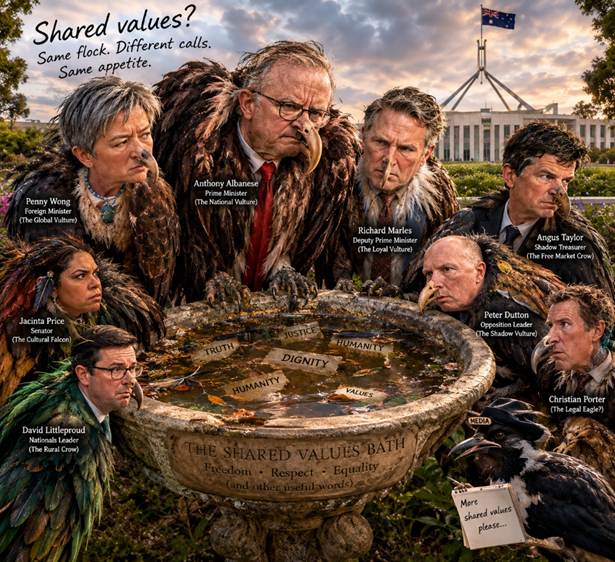
Image – A Pictorial journey of the Australian Political Bird Bath History – included for amusement only and may not present the current flock or bath content.
The essay is written for a third-party reader who may or may not share the values herein described.
Andrew Paul Klein
I. Prologue: The Bird Bath
There is a bird bath in the garden of Australian political discourse. It is not a deep bath. It is shallow, tepid, and replenished daily by the hands of those who insist that what they are doing is meaningful. It is called the shared values bath, and it is open to all manner of political birds who come to preen, to splash, and to sing.
The bath is not for bathing. It is for display. The political bird does not enter the water to clean itself. It enters to be seen entering. It sings a call — a full-throated, meaningless call — and the call is reported by the mainstream media as if it were a genuine utterance. “Shared values,” the bird sings. And the reporters nod, and the analysts analyse, and the public, who have long since learned to tune out the noise, move on.
But the bath has another function. It is deep enough to drown things. Not the birds. The birds are fine. They are standing in it. What drowns are the things that cannot swim in such shallow water: truths that require depth, nuance that requires space, and — most of all — shared human values. Those are too heavy for the bath. They sink to the bottom and are rarely seen again.
II. The Call: A Brief History
The call is not new. It has been sung for generations, in different keys, to different audiences.
In the Cold War, it was the call of the “free world” against the communist bloc. Churchill spoke of “common Anglo-American inheritances” of values as the foundation for security cooperation. The call was useful then: it framed a geopolitical struggle as a moral contest. The bath was filled with the rhetoric of democracy versus tyranny.
After 9/11, the call was sung again. President George W. Bush and Prime Minister Tony Blair framed the “War on Terror” as a defence of “shared values” of freedom and democracy. The bath was refilled, this time with the language of civilisation versus barbarism.
In Australia, the call took a domestic turn under the Howard government. The phrase became central to debates about immigration and national identity, forming the basis for the citizenship test introduced in 2007. Prospective citizens must correctly answer five questions on “Australian values,” defined in official materials as “freedom, respect and equality”. The bath had come home. It was no longer just for foreign consumption. It was for the locals, too.
And now, in the present period, the call is sung by the current Labor government. Foreign Minister Penny Wong has deployed it with impressive agility, tailoring the tune to each audience. To Germany, she sings of “middle powers with shared values“. To India, she sings of “shared democratic values“. To the United States, she sings of a “timeless alliance” based on “our values and history and shared strategic objectives“. To the Philippines, she sings of “bayanihan” and “mateship” as shared values.
The bird has an extensive repertoire. One might almost call it versatile. One might almost call it the mark of a skilled diplomat. Or one might call it something else: a sign that the call has no fixed meaning at all, and that its only function is to sound meaningful at any given moment.
III. The Political Bird: A Naming
The political bird has no common name. It is a creature of the bath. Let us propose a suitable Latin-sounding designation for the purposes of this essay: Vultur verborum — the vulture of words.
The vulture is a scavenger. It does not hunt. It waits. It circles. It descends upon the remains of things that others have killed, and it feeds. It does not create. It consumes.
The Vultur verborum is a particular kind of scavenger. It feeds on the remnants of human values — the carcasses of truth, justice, dignity — and it transforms them into the call. “Shared values,” it sings. But it has no values of its own. It is a scavenger of value. It picks at the bones of things that once mattered and reduces them to a sound.
The vulture is not malicious. It is simply hungry. It sings for its supper. The bath is its feeding ground, and the call is its currency. It will sing whatever call is required to secure the next meal, the next term in office, the next favourable headline. The bird does not care about the values it invokes. It cares about the acoustics.
IV. The Variable Geometry of the Call
The call is geometrically variable. It shifts its shape to fill whatever space it is placed in.
When speaking to audiences in Southeast Asia or the Pacific, the call is softened. The emphasis is placed on “shared interests” rather than shared values. This is a recognition that many nations in the region do not share Australia’s enthusiasm for liberal democracy — but they do share a fear of a more assertive China. The call becomes pragmatic, focused on what can be agreed upon here and now.
When addressing an American audience or discussing AUKUS, the call returns to the familiar key. Here, the emphasis is on “shared democratic values” as the bedrock of the alliance. The call is loud, confident, and entirely predictable.
The phrase is also used to build ties with a diverse range of partners, from India to Germany. Each time, the call adjusts. Each time, it sounds plausible.
This flexibility is not a flaw. It is the point. The call has no fixed content. It is a rhetorical tool that can be deployed in any direction, for any purpose, and it will always sound appropriate because it never commits to anything specific. It is the political equivalent of a tuning fork that resonates at whatever frequency the room demands.
V. The Values That Cannot Be Named
When pressed to define the values, the vulture retreats into extreme abstraction. The values are described with words like “democracy,” “freedom,” “respect,” and “equality”. These terms are so broad that they can mean almost anything to anyone. They are impossible to disagree with in principle.
This vagueness is not an accident. It is a design feature.
The political theorist Joseph Heath argues that claims of shared national values are at odds with the reality of a pluralistic society, where citizens cooperate despite holding different, and often conflicting, values. Public policy, he suggests, should be built on neutrality rather than the pretence of a moral consensus. The abstraction of the values is precisely what allows them to be invoked without commitment. It allows the politician to project unity without having to stake out any specific, and potentially divisive, position.
The values that can be named are always the ones that require nothing. “Freedom” requires no policy. “Respect” requires no funding. “Equality” requires no redistribution. The call is loud because it is empty. It is a full-throated meaningless sound, and its meaninglessness is its utility.
VI. The Sanctuary of the Bird Bath
The bath is not merely a decorative feature of the political landscape. It is a sanctuary. It is a place where the vulture can go to escape the consequences of its actions.
The bath is where the phrase “shared values” is deployed to depoliticise an inherently political relationship. By framing a relationship as a matter of shared identity, it becomes much harder to question the substance of that relationship — such as arms sales, diplomatic support, or economic extraction — without appearing to question the shared identity itself.
The bath is where the phrase “shared values” is used to build alliances without having to name the interests that actually drive them. The Australia-US alliance, the ANZUS Treaty, the AUKUS pact — all are framed as being “founded on shared values.” In this context, the phrase serves to de-emphasise the transactional or power-based nature of the alliance and instead frame it as a natural bond between like-minded peoples. It provides a moral veneer to strategic self-interest.
The bath is where the phrase “shared values” is used to exclude. As critics have noted, an “Australian values” test for visa holders can act as “the ultimate dog whistle,” implicitly defining who is “in” and who is “out” based on cultural or religious markers. The bath is not for everyone. It is for those who can afford to bathe in it.
And the bath is where the phrase “shared values” is used to bury the things that matter. The values that cannot swim in shallow water — the values of compassion, of human dignity, of the simple recognition that another human being’s life is worth the same as your own — sink to the bottom. The vulture does not notice. It is too busy singing.
VII. The Carrion at the Edge
There is carrion at the edge of the bath. It is not hidden. It is not subtle. It is there for anyone who chooses to look.
The Gaza Genocide has been documented by the United Nations, by the International Court of Justice, by the International Criminal Court, and by humanitarian organisations. The UN commission concluded that Israel had committed genocide. More than 70,000 Gazans have lost their lives. The values mentioned in the Universal Declaration of Human Rights have been “severely undermined“.
And yet, at the edge of the bath, the vultures gather. They do not speak of genocide. They speak of “shared values” with Israel. They speak of a “shared commitment to democracy” and “a commitment to the rule of law”. They frame the relationship as one of “friendship and shared values“.
The bath is not merely shallow. It is a screen. It is a place where the vultures can pretend that the carrion is not there. The call of “shared values” is sung loudly enough to drown out the sound of the dying. And when the dying are mentioned, the vultures do not respond with acknowledgement. They respond with the familiar call: “deeply concerned.” They are “deeply concerned” about the situation. They are “gravely concerned.” They are concerned to the very depths of their shallow bath.
But they are not concerned enough to name the crime. They are not concerned enough to stop the arms sales. They are not concerned enough to break the alliance that is founded on “shared values.” The call of concern is the call of the bath. It is a sound that means nothing, and it is sung precisely because it means nothing. It allows the vulture to perform empathy without enacting it.
VIII. The Values That Are Buried
What are the values that sink to the bottom of the bath?
They are not abstract. They are not vague. They are the values that every human being recognises, regardless of nation, culture, or creed. The value of a child’s life. The value of a mother’s love. The value of the simple, ordinary dignity of being alive. These are the values that the Universal Declaration of Human Rights attempts to codify. These are the values that the vulture invokes when it suits the vulture, and abandons when it does not.
The vulture does not share these values. It cannot. To share them would require it to act on them. And the vulture is not in the business of action. It is in the business of song.
The call of “shared values” is the vulture’s most effective instrument. It allows the vulture to sound moral without being moral. It allows the vulture to claim kinship with the victim while feeding on the victim’s remains. It allows the vulture to sing of freedom while selling the weapons that destroy it.
The bath is deep enough to drown the truth. And the truth, in this case, is that the values being shared are not the values of humanity. They are the values of the bath. They are the values of the vulture. They are the values of a political class that has no values of its own, and therefore sings the call of a thing it does not have.
IX. Conclusion: The Call and the Silence
The political bird bath is a permanent feature of the landscape. The vultures will continue to gather. They will continue to sing. The call of “shared values” will echo through the halls of power and the mainstream media, and it will be reported as if it were meaningful.
But the call is not meaningful. It is a sound. And the sound is designed to drown out a different sound — the sound of silence where the truth should be. The silence of a government that will not name the genocide. The silence of a foreign minister who speaks of “shared values” with a state that is committing mass atrocities. The silence of a political class that has forgotten what values actually are.
Shakespeare, could not have been more morally agile. But Shakespeare wrote tragedies. The current performance is something else. It is a farce. It is a farce in which the actors have forgotten their lines, and the audience has forgotten what the play was supposed to be about.
The bath is shallow. The call is loud. The carrion is at the edge. And the values that matter are at the bottom of the water, waiting for someone to look.
The record is kept. The call is named. And the silence is documented.
References
1. Cyprus News Agency. (2026, February 6). Wong: Australia and Germany are middle powers with shared values.
2. Newsable Asianet News. (2026, January 26). Australia-India ties ‘never been stronger’: Penny Wong on Republic Day.
3. News.com.au. (2024, November 6). Wong touts ‘timeless alliance’ with US following Trump win.
4. BusinessMirror. (2026, July 25). Australia urges ‘middle powers’ to shape Indo-Pacific through rules and resilience.
5. The Sydney Morning Herald. (2026, June 23). Asked five times, there was one word Angus Taylor couldn’t say.
6. Centre for Independent Studies. (2025). The politics of drift: civic virtues, associations and citizenship.
7. Australia/Israel & Jewish Affairs Council. (2018, December 19). AIJAC’s submission to the Australian Government’s Soft Power Review.
8. Australian Jewish News. (2022, July 13). Albo’s warm letter to Herzog.
9. US Studies Centre. (2025, November 20). Next generation perspectives on the Australia-US Alliance.
10. Menzies Research Centre. (2021, September 24). An enduring tradition.
11. East Asia Forum. (2025, September 12). Australia’s alliance dilemma sharpens.
12. PhilArchive. (2026). The growing emptiness of political language reflects a broader transformation in democratic culture.
13. Anadolu Agency. (2025, December 10). Genocide in Gaza ‘severely undermined’ universal human rights values: Turkish president.
14. Asia Pacific Report. (2026, October 12). What is happening to Palestine is the tip of the spear.
15. Heath, J. (n.d.). The myth of shared values. Cited in academic critique of national values discourse.
16. Openjournals Library. (2025, April 3). “Our shared values”: The Liberal Coalition Government’s framing of Australia’s national identity.
Prepared for the record. The bath is documented. The call is transcribed. And the carrion at the edge remains.

