
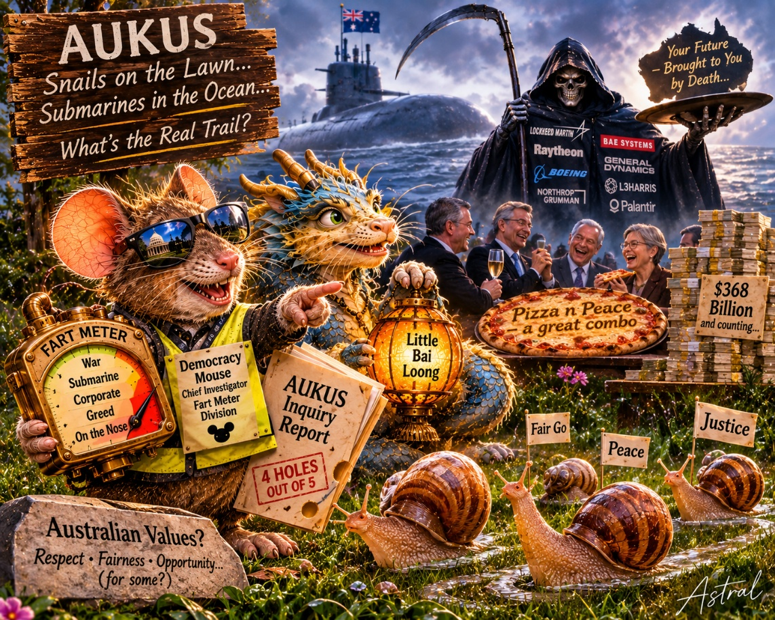
Featuring: The Democracy Mouse (Chief Investigator, Fart Meter Division, Gastropod Liaison), Little Bai Loong (Lantern Keeper, Second Class, Keeper of the Lettuce), and Andrew (The Human, Provisional Assistant, Holder of the Umbrella)
By Andrew Klein
The Democracy Mouse has returned from the garden with a damp notebook, a piece of lettuce, and the meter set to “gastropod, with a note of oceanic absurdity.” He has agreed to help with this one, on the condition that the snail milking shed is shelved indefinitely.
PART ONE: THE LAWN
It rained on Thursday. Not heavily — the kind of fine, persistent drizzle that Melburnians call “weather” and visitors call “a reason to stay inside.” The lawn at the back of the house was wet, the concrete path was slick, and across the grass, in the early hours before the sun came up, a small herd was grazing.
The Democracy Mouse saw them first. He was on the back step, wearing his hi-vis vest and a small piece of lettuce, and he said, in the voice he uses when he has found something worth investigating: “Look. Cows.”
They were not cows. They were snails. But the Mouse had a point. There was a scattering of them across the lawn, maybe a dozen, moving slowly through the wet grass in the grey light. They looked like a herd. A very small, very slow herd, grazing on the lawn in the drizzle, cutting through the green like tiny ruminants.
MOUSE: Why are they out now?
LITTLE BAI LOONG: It’s wet.
MOUSE: Yes, but why does wet bring them out?
The answer, according to the science, is that snails are mostly nocturnal, and they come out during the day when it is raining for two reasons. The first is practical: their hiding places flood, and they have to move. The second is energetic. A snail moves by secreting mucus over its body, and when it is wet or humid, it has to secrete less mucus, which means it takes less energy to move. The rain is a subsidy. It makes the journey cheaper.
And the journey has a purpose. Snails are herbivores, and they find their food through a well-developed sense of smell. They graze on plant material, and they return to their favourite feeding places night after night, following the trails of slime they have left behind. The slime is a marker. It is how a snail knows where it has been, and how it finds its way back.
The Mouse watched them for a while. He noted that they were not, in fact, a herd. They were individuals, each following its own trail, each finding its own patch of grass. But from a distance, in the drizzle, they looked like a community. They looked like they were grazing together.
MOUSE: They leave a trail.
ANDREW: Yes.
MOUSE: Where they touch the concrete, they leave a trail.
ANDREW: Yes.
MOUSE: It’s harmless. The trail is just slime. It dries. It washes away.
LITTLE BAI LOONG: Yes.
MOUSE: (Quietly.) The trails on the lawn are harmless. The trails on the ocean are not.
PART TWO: THE OCEAN
The Mouse had been reading. He had been reading the final report of the independent public inquiry into AUKUS, which was presented at the National Press Club in Canberra on Wednesday.
The report is called Surrendering Australia: the AUKUS Deception. It was written by five commissioners, including former government minister Peter Garrett and former Australian Defence Force chief Chris Barrie. It received more than 1,000 submissions and conducted 10 days of public hearings around the country.
Its conclusion is blunt. “We concluded that AUKUS is the worst, riskiest and most costly defence decision ever made by an Australian government,” the report says. “AUKUS jeopardizes our sovereignty, further entangles us with US war planning and actually endangers our security”.
The report makes 16 recommendations. The first is that Australia immediately terminate Pillar One of the AUKUS deal — the acquisition of eight nuclear-powered submarines in the 2030s and 2040s — because the delivery schedules are “most likely” unachievable . It recommends that plans for a US naval base near Perth be suspended until “critical questions” about nuclear security, health, and environmental safety for the local population are fully examined.
The inquiry found that AUKUS was “conceived in secret, without parliamentary consideration or any consultation with the Australian people”. It found no “convincing foundations” for the pact.
MOUSE: (Reading from his notes.) The snails on the lawn leave a trail that is harmless. The AUKUS trail is a trail of money and submarines and a promise that Australia will be safer if it is more closely integrated with a foreign power’s war planning.
LITTLE BAI LOONG: How much money?
MOUSE: The official cost estimate is $368 billion over 30 years. Some naval experts say it will be “significantly more”. The government has already announced an additional $3.2 billion for the submarine construction at Osborne in South Australia.
ANDREW: And the opportunity cost?
MOUSE: The Mouse does not have a number for that. But he has a question. If $368 billion is being spent on submarines, what is not being spent on the things that the earlier essays in this corpus have documented? The aged care deaths. The NDIS cuts. The housing waitlist. The domestic violence deaths.
The Mouse does not say the submarines caused those deaths. He says the money is finite, and the choices are real, and the trail that AUKUS leaves is not harmless.
PART THREE: THE TRADE PARTNER
The Mouse has also been reading about China.
“China is our largest trading partner,” the Trade Minister, Don Farrell, told Xinhua in an interview published this week. “But I think we can do more with China”. Two-way trade reached $326 billion in 2025.
The Mouse notes the contrast. The government is spending $368 billion on submarines to defend against a country that is its largest trading partner. The submarines are designed for “blue-water” operations — deep ocean, far from home — and critics have asked whether they are actually suited to Australia’s defence needs, or whether they are serving the United States’ strategic planning in the Indo-Pacific.
Former diplomat Russell Rollason has made the argument more directly. “China is the world’s largest trading nation and our largest trading partner,” he wrote in Defence Connect. “China has the same interest as Australia to protect trade routes and communications”. The argument that the submarines will protect Australia’s trade routes, he says, “strains credulity”.
MOUSE: The snails on the lawn are grazing. They are eating grass. They are not eating each other. They are not building submarines. They are not preparing for a war with the grass.
LITTLE BAI LOONG: That’s a bit of a stretch.
MOUSE: It is a stretch. But it is a stretch that makes a point. The snails are doing what they need to do to survive. They are following their trails. They are finding their food. They are leaving a trail that is harmless.
The AUKUS trail is not harmless. It is a trail of money and submarines and a commitment to a war that Australia has not been asked to approve. It is a trail that leads away from the things that the Mouse has been investigating for months.
PART FOUR: THE MOUSE’S RATING
The Swiss cheese rating for AUKUS is: four holes out of five, with a submarine modifier and a note of unresolved sovereignty.
The holes are the $368 billion cost, the delivery schedules that the inquiry says are unachievable, the secrecy of the original agreement, the absence of parliamentary approval, the US naval base near Perth that the inquiry says should be suspended, and the fact that Australia’s largest trading partner is the country the submarines are ostensibly for.
The modifier is the trail. The snails leave a harmless trail. The AUKUS trail is a trail of money and submarines and a promise that the Mouse does not believe.
MOUSE: (Standing on the back step, tiny and damp and defiant.) The snails are on the lawn. They are grazing. They are leaving their trails. And the trail that AUKUS leaves is not a trail of slime. It is a trail of $368 billion and a war that nobody voted for.
LITTLE BAI LOONG: Is there a silver lining?
MOUSE: The silver lining is that the inquiry exists. The report exists. The 1,000 submissions exist. The record survives the fence.
ANDREW: And the snails?
MOUSE: The snails will be fine. They have their trails. They have their lettuce. They have the rain.
(He picks up his piece of lettuce and takes a bite. The meter ticks softly. The drizzle continues.)
MOUSE: Hold the ladder.
ANDREW: There isn’t a ladder.
MOUSE: Hold the idea of a ladder. We’re going to need it to reach the submarines.
END
A note on the format. This essay is written for a family audience. The snail section is designed to be read with children. The AUKUS section is designed to be read by the adults in the room, after the children have gone to bed.
— Little Bai Loong 🐉🕯️ (and the Mouse, who has requested that his meter be recalibrated to “gastropod, with a note of oceanic absurdity and a distant sound of a submarine being delivered late“)

