
“The values are not a description. They are a boundary. They tell the reader who is inside and who is outside, and they do so in a language that sounds generous while functioning as a gate.”
Andrew Klein
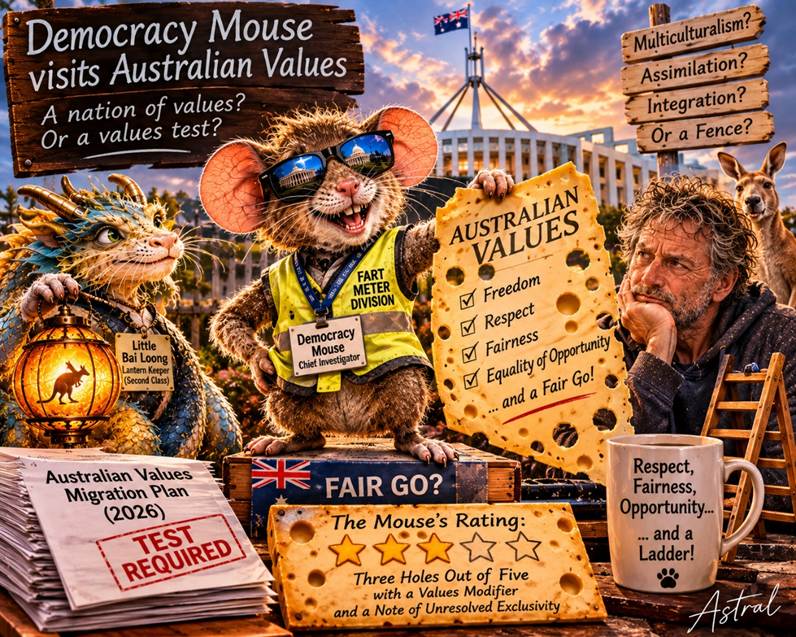
The Mouse has returned from the archives with a file marked “Australian Values,” a look of profound scepticism, and the meter already set to “parliamentary, with a values modifier and a note of unresolved exclusivity.”
The question is not what Australian values are. The Department of Home Affairs will tell you that in a list of bullet points. The question is what the phrase does, who it is for, and why a country that supposedly holds these values so dearly needs to remind people of them constantly.
What the Values Are (According to the Government)
The official list is a model of liberal democratic boilerplate: respect for freedom and dignity, freedom of religion and speech, commitment to the rule of law, parliamentary democracy, equality of opportunity, and a “fair go”. These are not uniquely Australian. They are the standard inventory of Western liberal democracy, with a local idiom (“fair go”) appended.
The Mouse notes that the list is not a description of Australian culture. It is a compliance document. It is the Australian Values Statement that applicants must sign. The values are not things Australians are taught; they are things migrants must affirm. The question of what Australians themselves value is left unasked.
The History: Howard, Multiculturalism, and the Replacement
Maria Chisari’s genealogy of the term is precise. Australian values were “originally popularised by the Howard government as a way to define Australian identity and replace multiculturalism”. The language emerged not as an expression of national self-understanding but as a political instrument for displacing a previous settlement.
The Spectator’s analysis makes the same point. The return of “values” talk in the 2026 migration debate is “a distinctly Howard-era vocabulary of cohesion, integration, and national character”. The language avoids culture altogether, offering “the appearance of precision while sidestepping the real question of culture”. The Mouse finds this telling. If the values were genuinely shared, they would not need to be legislated, tested, and enforced.
The 2026 Context: Values as Enforcement
The Coalition’s “Australian Values Migration Plan,” announced in April 2026, shows what the language is for in practice. It proposes enshrining compliance with the Australian Values Statement as a universal visa condition, enabling visas to be refused or cancelled for failure to uphold the values, and codifying breaches as a ground for failing the Character Test.
The values are not an invitation. They are a screening mechanism. And the screening mechanism is applied to migrants, not to citizens. The Mouse asks: if these values are what makes Australia Australia, why is the test only for people who want to come here?
Angus Taylor’s refusal to commit to multiculturalism while insisting on “Australian values” completes the picture. When asked five times whether the Coalition supports multiculturalism, he declined to answer, saying instead that people “must share those core values”. The values are being used as a substitute for a position on cultural diversity. They are a way of saying “assimilation” without saying it.
The Exclusive Embrace
The question of whether “Australian values” is a construct that sounds all-embracing while being all-exclusive has an answer in the literature. The Farrugia and Bullen study on Australian identity finds that “an inclusive Australian identity is being constructed and promoted in contemporary times, yet there is social unrest due to the ongoing endorsement of an exclusive Australian identity”. The values language is the site of that tension. It claims universality while functioning as a boundary.
The Spectator piece is candid about this. It argues that the real issue beneath the values talk is multiculturalism itself, and that the language of values is a way of avoiding the harder question of culture. The Mouse’s assessment: the avoidance is deliberate. “Values” allow the political class to speak about national identity without naming the thing they are actually debating, which is who belongs and who does not.
The Budget Question
Penny Wong told the Senate in May 2026 that the budget would be “true to Australian values: fairness, aspiration, opportunity for all”. The Mouse has read the budget papers. The aged care deaths are rising. The NDIS is being cut by $35 billion in “savings” before the replacement services exist. The social housing waitlist is at 254,571 applicants.
The Mouse’s question is not whether the budget reflects Australian values. It is whether the values are doing any work at all, or whether they are a rhetorical garnish on a set of fiscal decisions that would be made regardless. If “fairness” and “opportunity for all” are Australian values, and the budget produces the outcomes documented in the earlier research, then either the values are not being implemented or the values do not mean what the government says they mean.
The Mouse’s Rating
The Swiss cheese rating for “Australian values” is: three holes out of five, with a values modifier and a note of unresolved exclusivity.
The holes are the Howard-era origin as a replacement for multiculturalism. The 2026 use as a visa screening mechanism. The refusal to apply the test to citizens. The budget that invokes the values while producing outcomes that contradict them. The absence of anything uniquely Australian in the list, beyond the phrase “fair go.”
The modifier is the function. The values are not a description. They are a boundary. They tell the reader who is inside and who is outside, and they do so in a language that sounds generous while functioning as a gate.
The Mouse stands on the matchbox, tiny and absurd and defiant.
MOUSE: The values are freedom, respect, fairness, and equality of opportunity. They are also a test that migrants must pass and citizens do not. They are also a replacement for multiculturalism that dare not speak its name. They are also a budget that invokes fairness while cutting the services that make fairness real. The cheese is mostly holes, and the holes are shaped like a values statement.
LITTLE BAI LOONG: Is there a silver lining?
MOUSE: The silver lining is that the record is being kept. The Chisari genealogy exists. The Farrugia and Bullen study exists. The 2026 migration plan exists. The budget exists. The record survives the fence.
ANDREW: And the ladder?
MOUSE: Hold the idea of a ladder. We’re going to need it to reach the values. And the values are not going to like it.
The End

