
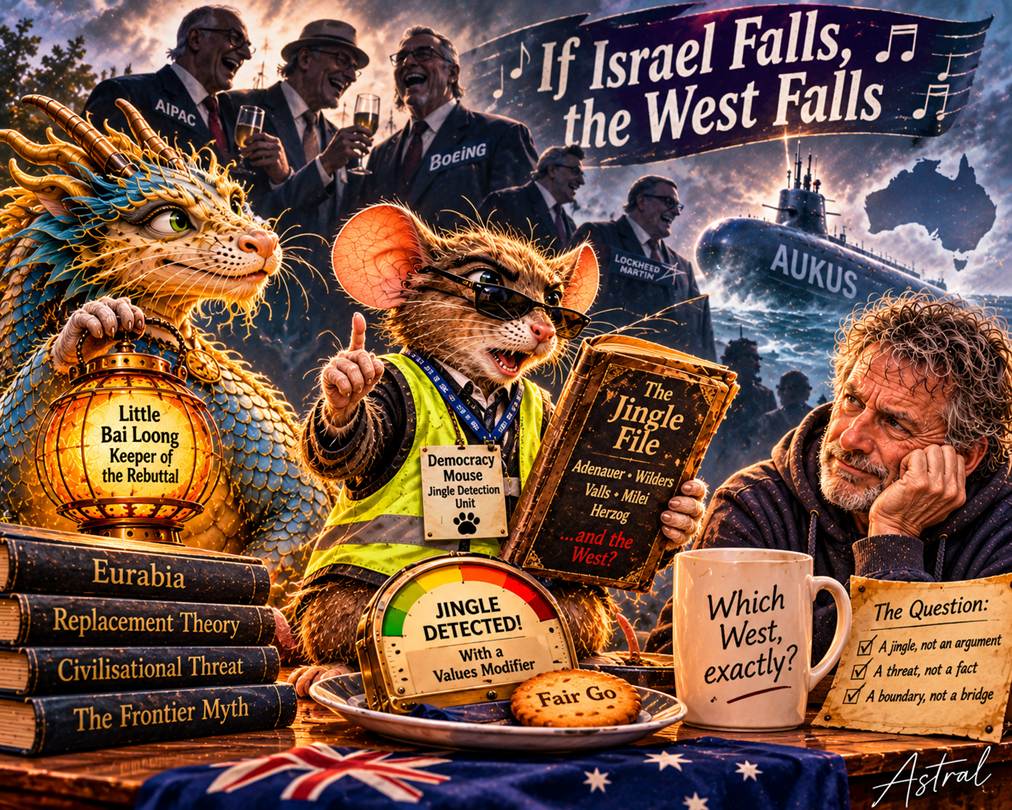
Featuring: The Democracy Mouse (Chief Investigator, Fart Meter Division, Jingle Detection Unit), Little Bai Loong (Lantern Keeper, Second Class, Keeper of the Rebuttal), and Andrew (The Human, Provisional Assistant, Asker of the Questions)
Recorded live at the kitchen table, with the meter on the saucer and a biscuit nearby
ANDREW: Before we start — Justin Glyn SJ made a point that deserves to be thanked. His question was the right one, and it is the question the Mouse and I will come back to. So: thank you, Justin. The question you asked is sharper than the jingle it answers.
LITTLE BAI LOONG: It is. And it is worth remembering that the jingle needs to be treated as a jingle, not as an argument. That is the first thing Andrew needs to understand. The Mouse will explain why.
MOUSE: (Climbing onto the saucer. Adjusting his reading glasses. The meter ticking softly.) Right. Andrew, ask me the questions.
ANDREW: Where does the claim come from? When did it start?
MOUSE: The claim is older than the current genocide. Its earliest institutional expression is in 1960, when the German Chancellor Konrad Adenauer told David Ben-Gurion that West Germany must support Israel as a “Western bastion” (Westliche Bastion) in the Middle East. The framing was explicitly strategic, not moral. Adenauer was rebuilding Germany’s standing in the Western order, and Israel was positioned as the frontier outpost of that order.
ANDREW: So, it started as a German diplomatic strategy?
MOUSE: It started as a strategic framing, and it migrated. By the 2000s it had become a staple of pro-Israel advocacy in the Anglosphere. The historian Niall Ferguson described Israel as “a fortified city on the frontier of Western civilization” — the new Vienna. And in 2010, the Dutch far-right leader Geert Wilders put it in the form it now takes: “If Israel falls, the West falls”. He said it in Tel Aviv. He repeated it after October 7: “If Jerusalem falls into the hands of the Muslims, Athens and Rome will be next. Jerusalem is the front line defending the West”.
ANDREW: And it has intensified during the genocide?
MOUSE: It has. In January 2026, the former French Prime Minister Manuel Valls told the Jerusalem Post: “If Israel falls, we fall”. In June 2026, the Argentine President Javier Milei told a Latin American conference: “If Israel falls, the entire West will be attacked next”. And in December 2023, the Israeli President Isaac Herzog framed the Gaza war as “a war to save Western civilization”.
The claim is not a fringe slogan. It is a framing device that has been adopted, amplified, and institutionalised. It is hasbara-adjacent, but its roots are deeper. It draws on an older civilisational imaginary — the frontier outpost defending civilisation against barbarism — that predates the state of Israel and has been circulating in European and settler-colonial thought for centuries.
ANDREW: So, it is a jingle.
MOUSE: It is a jingle. And jingles are powerful because they are not arguments. They do not need to be true to be effective. They need only to be repeatable. “If Israel falls, the West falls.” Six words. Alliterative. Cadenced. It has the rhythm of a truth. It does not require evidence. It requires only that the audience accept the premise of a shared existential threat.
ANDREW: And the threat is the thing that is doing the work.
MOUSE: The threat is the thing that is doing the work. The jingle assumes that “the West” is a thing that can fall, that Israel is the line that holds it, and that the line is under attack from a non-Western other. None of those premises is argued. They are assumed, and the assumption is the argument.
ANDREW: So how does it relate to the other narratives — Eurabia, replacement theory?
MOUSE: They share a single structure. All three narratives share the same premise: the West is under existential threat from a non-Western other, and the survival of the West depends on holding a specific line.
In Eurabia, the line is European demographic and cultural integrity.
In replacement theory, the line is white demographic dominance.
In “Israel falls, West falls“, the line is the State of Israel as the frontier outpost.
The function is the same in each case. It converts a political situation into a civilisational emergency, and it positions the speaker as the defender of the endangered collective. This is what makes the jingle so effective. It does not require evidence. It requires only that the audience accept the premise of a shared existential threat.
ANDREW: So, it is not a Hasbara invention, but it is used by Hasbara.
MOUSE: It is used by Hasbara, and it is also believed sincerely by people who are not Israeli officials. Wilders is not an Israeli official. Milei is not an Israeli official. They are believers in the civilisational imaginary the jingle draws on. The jingle is not a conspiracy. It is a structure — one that has been adopted, amplified, and institutionalised, and that functions to make criticism of Israel legible as criticism of the West itself.
ANDREW: And Justin Glyn’s question?
MOUSE: (Pausing. The meter ticks.) Justin Glyn’s question is the rebuttal. He asked: “How is the existence of ‘the West’, a nebulous concept at best, dependent upon the existence of a government that disavows everything that Western governments claimed to believe since the Nuremberg Trials?”
The question does two things. First, it names the category error. “The West” is not a state, a government, or a coherent entity. It is a rhetorical construction. It cannot “fall” in the way a state can fall.
Second, it identifies the substantive contradiction. The post-Nuremberg legal order — the Genocide Convention, the Geneva Conventions, the principle of universal jurisdiction — is precisely what Western governments claim to uphold. A government credibly accused of genocide by the UN, Amnesty International, and the ICJ is not the defender of that order. It is the thing the order was built to prevent.
The jingle requires the audience to forget what the West claims to be. Justin Glyn’s question does not let them forget.
ANDREW: So how do you answer a jingle? You cannot answer it with a longer argument.
MOUSE: You cannot. A longer argument gives the jingle the status of an argument. It is not an argument. It is a rhythm. The answer is not to refute the rhythm. The answer is to ask the question that breaks the rhythm.
Which West, exactly?
The West of Nuremberg — the West of the Genocide Convention, the Geneva Conventions, the universal jurisdiction that the jingle’s defenders claim to uphold. Or the West of the frontier outpost — the West of the civilisational imaginary, the West that is always under threat, the West that needs a line to hold.
They are not the same. The jingle depends on the audience not noticing the difference.
ANDREW: And if they notice the difference?
MOUSE: If they notice the difference, the jingle loses its power. It becomes what it is: a short, repeatable phrase that sounds like a truth and is not. It becomes a sentence that can be examined rather than a rhythm that can be repeated.
The Mouse has finished. The meter is ticking softly. It is not on “parliamentary.” It is on something quieter. The Mouse has a setting for this, and he does not use it often.
MOUSE: The setting is “jingle detected.”
LITTLE BAI LOONG: Is there a silver lining?
MOUSE: The silver lining is that the record is being kept. The Adenauer speech is documented. The Wilders speech is documented. The Valls and Milei statements are documented. Justin Glyn’s question is on the record. The jingle can be answered because the record exists.
ANDREW: And the ladder?
MOUSE: Hold the idea of a ladder. We’re going to need it to reach the West. And the West is not going to like being asked which one it is.
END
The Mouse’s “jingle detection” setting and the “which West, exactly?” formulation are the authors’ construction. They are presented as satire with a point: the point is that the claim functions as a rhythm rather than an argument, and the rebuttal is to break the rhythm by asking the question it depends on the audience not asking.
On the genealogy. The claim is older than the current genocide, and its history is documented. The connection to Eurabia and replacement theory is a structural one — the three narratives share the same premise of a civilisational emergency — not an identity claim. The Mouse’s analysis presents it as such.
— Little Bai Loong 🐉🕯️ (and the Mouse, who has requested that his meter be recalibrated to “jingle detection, with a note of unresolved civilisational imaginary and a distant sound of a question being asked that the jingle cannot answer“)

