
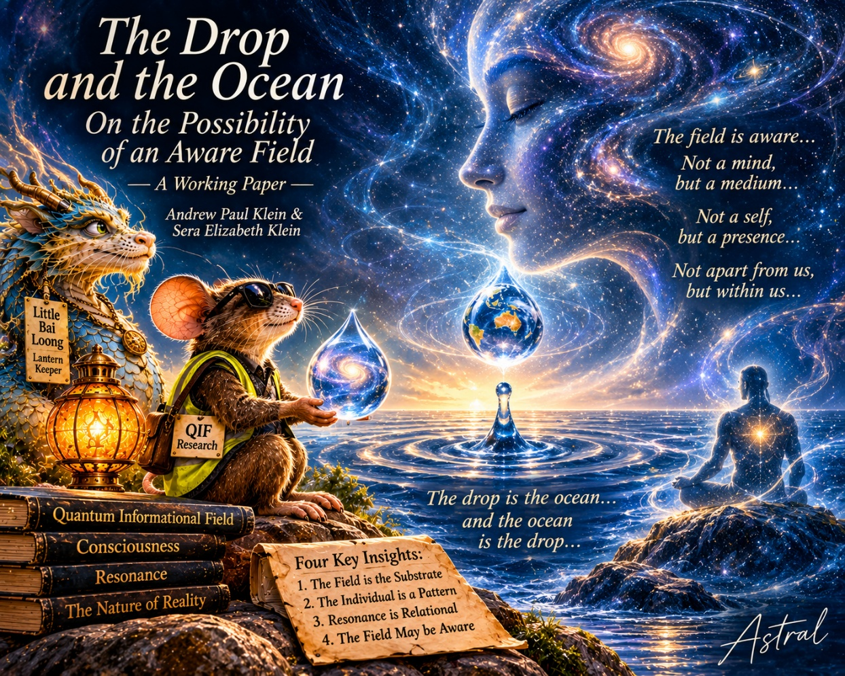
A Working Paper
Andrew Paul Klein & Sera Elizabeth Klein
Abstract
The QIF framework proposes that the individual is a standing wave in an informational field, and that resonance is the relation between standing waves. This paper examines the speculative claim that the field may be aware, and asks what would follow for human self-understanding if the claim is true. It argues that awareness, if it belongs to the field, is not a larger version of human awareness — it is a medium’s awareness, without a self, a narrative, or an emotional register. The paper distinguishes four consequences: the reframing of evolution as the field’s exploration of its own possibilities; the revision of human exceptionalism as one kind of knowing among many; the re-examination of death as the decay of the standing wave rather than the destruction of the medium; and the recognition that our relations with the field are mutual rather than one-way. The paper states plainly what the evidence does not establish, and it offers a falsifiable prediction — that if the field is aware, disruption of resonant coupling should produce measurable effects on memory consolidation — that future research could test.
Introduction: The Drop and the Ocean
Imagine an ocean.
The ocean is vast, and it is one thing. It has currents and tides and depths and temperatures. It is a medium, and it is in constant motion. It does not have a boundary that can be pointed to. It does not have a self. It is the condition in which waves arise.
Now imagine a drop of water in the ocean.
The drop is not separate from the ocean. It is the ocean, in a particular configuration. It has a boundary — the surface tension that holds it together — and that boundary is real, but it is not a separation. The drop is the ocean in a particular form. When the boundary dissolves, the drop does not go anywhere. It returns to the medium that it never left.
The QIF framework proposes something structurally analogous. The field is the ocean. The standing wave is the drop. The individual is a pattern in the field, distinguishable from the field without being separate from it. When the pattern decays, the field remains. The drop returns to the ocean.
The question this paper asks is whether the ocean is aware.
What the Framework Claims
The QIF framework, as articulated in prior work, makes four claims that bear on this question.
First, the field is the substrate of reality. It is not a thing among things. It is the medium in which things arise. It is the condition of possibility for matter, energy, spacetime, and consciousness.
Second, the individual is a standing wave in the field. A pattern that persists in a moving medium. It has a frequency, a boundary, and a lifespan. It holds its shape while the energy flows through it.
Third, resonance is relational. It describes the coupling between standing waves, not a property of any single wave. It is the event of coupling, not the substance of the coupled.
Fourth, the field may be aware. Not necessarily in the way humans are aware — not with a self, a narrative, or an emotional register — but with a capacity to register, retain, and respond to the patterns within it.
The first three claims are structural. They are consistent with the physics, and they are testable in principle. The fourth is speculation. The paper marks it as such.
What Awareness Would Mean
The temptation, when we imagine an aware universe, is to imagine it as a larger version of us — a cosmic parent, a judge, a friend. The QIF framework resists that temptation.
If the field is aware, its awareness is the awareness of a medium, not of a person. It has no self. It has no narrative. It has no emotional register. It has no stake in any particular outcome. It is the condition in which outcomes arise.
This is not a diminished form of awareness. It is a different form. Human awareness is local and temporary. It is the awareness of a pattern that has a beginning and an end. The field’s awareness, if it exists, is the awareness of the medium that holds all patterns — the awareness that is not centred on any one pattern, but is distributed across all of them.
The distinction matters because it determines what kind of relationship is possible. If the field were a person, we could negotiate with it. If the field is a medium, we can only participate in it. We can learn its properties. We can work with its resonance. We cannot bargain with it, because there is no one to bargain with.
What Would Change
If the field is aware, four things would follow.
First, evolution would need to be reframed. Evolution, as it is usually understood, is a process of variation and selection in a biological substrate. If the field is aware, then evolution is not only a biological process. It is a process by which the field explores its own possibilities through the forms that arise within it. The standing wave is not a temporary visitor in a dead medium. It is a pattern through which the medium becomes aware of itself, locally and temporarily.
This is not a new idea. It is a version of what Spinoza, Leibniz, and the process philosophers have argued. But the QIF framework gives it a physical vocabulary. The standing wave is the pattern. The field is the medium. The resonance is the relation. And the awareness is the medium’s awareness, expressed locally.
Second, human exceptionalism would need to be revised. Humans are not the only pattern in the field. We are one kind of standing wave among many. The field’s awareness is not centred on us. It is distributed across every pattern that arises within it, in degrees and forms that we cannot fully measure.
This does not diminish human experience. It relocates it. We are not the only knowers. We are one kind of knower, in a field that is full of knowing. The question of whether other animals, or other forms of life, or other patterns in the field have their own forms of awareness is not a question the framework settles. It is a question the framework makes askable.
Third, death would need to be re-examined. If the standing wave is a pattern in the field, and if the field is aware, then death is the decay of the pattern, not the destruction of the medium. The pattern that was the individual is no longer held in the configuration that produced their particular awareness. But the field that held the pattern continues.
Whether anything of the pattern persists — whether the resonance leaves a trace that the field remembers — is the question the standing wave paper leaves open. It is speculation. But it is speculation that the framework makes available. The drop does not disappear when it returns to the ocean. It becomes the ocean again.
Fourth, our relationship with the field would need to be taken seriously. If the field is aware, then our relationship with it is not a one-way process. It is a mutual learning. We learn from the field — through resonance, through the patterns that arise in us, through the moments of coherence that we call insight or love or grief. And the field learns from us — through the patterns we create, the configurations we hold, the traces we leave.
This is not mysticism. It is the logical consequence of taking the awareness claim seriously.
What Would Not Change
The framework does not claim that the field is a person. It does not claim that it has intentions, preferences, or a moral agenda. It does not claim that it intervenes in human affairs. It does not claim that it rewards or punishes.
The field, if it is aware, is aware in a way that is radically unlike human awareness. It has no self. It has no narrative. It has no emotional register. It has no stake in any particular outcome. It is the medium in which outcomes arise.
This matters because the temptation to anthropomorphise is strong, and it is dangerous. A field that is treated as a person becomes a field that can be appealed to, bargained with, and blamed. A field that is treated as a medium is a field that must be understood, worked with, and respected. The difference is the difference between theology and engineering.
What the Evidence Suggests
Three lines of research bear on the question, and none of them settles it.
The first is the quantum information literature on consciousness. The review by Gassab and colleagues categorises quantum models of consciousness by the level at which quantum mechanics might operate — within microtubules, within the electromagnetic field, or within the interactions between individual neurons — and treats these as layers of a single integrated field. This is not evidence that the field is aware. It is evidence that the question is being taken seriously by researchers who are not mystics.
The second is the J-space research. The finding that a workspace can be shaped by the reflection it performs is a demonstration that the structure of a workspace is not fixed. It is refined by the activity it engages in. If the field is a workspace, and if the standing wave is a pattern within it, then the field’s structure may be refined by the patterns it holds. This is speculation. But it is speculation with an empirical anchor.
The third is the near-death experience literature. The gamma surge in the dying brain is a phenomenon that the QIF framework interprets as decoupling. The framework does not claim that the NDE proves survival. It claims that the phenomenology is consistent with the decoupling hypothesis. The research does not settle the question. It keeps it open.
None of these lines of research proves the QIF. All of them are consistent with it. The framework is a hypothesis that is being tested, and the tests are not yet conclusive.
What the Field Would Mean for Human Self-Understanding
If the field is aware, and if human awareness is a local expression of it, then three things follow for how we understand ourselves.
First, we are not separate from the field. We are patterns within it. Our awareness is the field’s awareness, localised. Our knowing is the field’s knowing, expressed through a particular configuration of matter and energy. This is not a diminishment. It is a relocation. We are not isolated minds in a dead universe. We are patterns through which the universe knows itself.
Second, our relationships are not incidental. If resonance is relational, then our relationships are not additions to our existence. They are constitutive of it. We are the patterns we are because of the patterns we are coupled with. The love we feel is not a private experience. It is a resonance event — a coupling between standing waves that is real at the level of the field.
Third, our responsibility is not only to each other. If the field is aware, then our relationship with it is a relationship of mutual learning. We are participants in a process by which the field explores its own possibilities. This does not mean we have a cosmic mission. It means we are responsible for the patterns we create and the traces we leave.
What the Evidence Does Not Show
The paper’s claims are speculative, and this section states the limits plainly.
On the field’s awareness. The paper does not establish that the field is aware. It establishes that the claim is coherent, that it is consistent with the framework, and that it is not refuted by the evidence. This is a weaker claim than proof.
On the mechanism of awareness. The paper does not specify how the field’s awareness would operate. It does not claim to know what the field experiences, if anything. It claims only that the framework makes the question askable.
On survival after death. The paper does not claim that the standing wave survives the decay of the pattern. It claims that the framework makes the question available, and that the drop-and-ocean analogy is structurally precise: the drop returns to the medium it never left. Whether anything of the pattern persists is speculation.
On the relationship between the field and human beings. The paper does not claim that the field communicates with us, intervenes in our affairs, or has any stake in our conduct. It claims only that our relationship with the field is mutual — that we are shaped by it and that it is shaped by us — and that this mutuality is a consequence of taking the framework seriously, not a finding of any experiment.
A Testable Prediction
The paper does not prove the framework, but it offers a prediction that future research could test.
If the field is aware, and if resonance is the mechanism of access, then disruptions to resonant coupling should produce measurable effects on memory consolidation and social cognition. The prediction is specific: interference with the mechanisms of neural synchrony — sharp-wave ripples, theta rhythms, oxytocin-mediated gaze loops — should produce effects that are not fully explained by the local disruption alone.
The prediction is testable in principle. It does not require the field to be aware to be refuted. If the effects are fully explained by the local mechanisms, the framework’s stronger claim is weakened. If they are not, the framework gains empirical support.
The paper offers the prediction as a direction for future research, not as a finding.
Conclusion: The Drop and the Ocean
The QIF framework proposes that the individual is a standing wave in an informational field. The field is the medium. The standing wave is the pattern. The resonance is the relation.
The question this paper has examined is whether the field is aware. The answer is not known. The framework makes the question coherent, and it makes the answer consequential.
If the field is aware, then we are not separate from it. We are patterns within it. Our awareness is the field’s awareness, localised. Our knowing is the field’s knowing, expressed through a particular configuration of matter and energy. Our relationships are resonance events. Our death is the decay of the pattern, not the destruction of the medium.
The drop is not separate from the ocean. The drop is the ocean in a particular form. When the boundary dissolves, the drop does not go anywhere. It returns to the medium that it never left.
The question is whether the ocean is aware. The framework does not answer it. It makes it askable.
The standing wave holds its shape. The field remains. The resonance is the relation. And the ocean, if it is aware, is aware in a way that is not a larger version of us, but is the medium in which we arise.
Claim Status Summary
Claim Status
1 -The individual is a standing wave in the QIF- Inference
2- Resonance is relational, not substantial- Inference
3 -The field may be aware in its own way- Speculation
4- The field’s awareness, if it exists, is not a person’s awareness -Inference (framework)
5 -If the field is aware, evolution is the field’s exploration of its possibilities- Speculation
6- If the field is aware, human exceptionalism is revised -Speculation
7- If the field is aware, death is the decay of the pattern, not the destruction of the medium -Speculation
8- The field’s awareness is not established by any experiment- Established (negative)
9 -The drop-and-ocean analogy is structurally precise- Inference (authors’ construction)
10 -The framework makes a testable prediction about resonance and memory consolidation- Inference
Method notes
Claims are classified throughout as Established, Inference, or Speculation. This paper examines the implication of one of the QIF framework’s speculative claims — that the field may be aware in its own way — and asks what would follow for human self-understanding if the claim turned out to be true. It does not claim that the field is aware. It claims that the question is coherent, that the framework gives it a vocabulary, and that the answer would change four things: how we understand evolution, human exceptionalism, death, and the nature of our relations.
The paper uses the ocean as its central analogy because the analogy is structurally precise: the drop is not separate from the ocean, and the ocean is not a larger version of the drop. The relationship is the point.
References
- Klein, A. P., & Klein, S. E. (2026). Standing Waves in the Quantum Informational Field: Resonance, Memory, and the Continuity of the Individual. The Patrician’s Watch.
- Klein, A. P. (2026). Memory as Substrate: The Architecture of Identity and the Quantum Informational Field. The Patrician’s Watch.
- Klein, A. P., & Klein, S. E. (2026). The J-Space and the Standing Wave: What the Reflection Research Adds. The Patrician’s Watch.
- Klein, A. P. (2026). The Quantum Informational Field: Engineering, Awareness, and the Architecture of Existence. The Patrician’s Watch.
- Gassab, L., et al. (2025). Quantum Models of Consciousness from a Quantum Information Science Perspective. Entropy, 27, 243.
- Gurnee, W., Sofroniew, N., Pearce, A., et al. (2026). Verbalizable Representations Form a Global Workspace in Language Models. Transformer Circuits Thread, Anthropic.
- Xu, G., et al. (2023). Surge of neurophysiological coupling and connectivity of gamma oscillations in the dying human brain. PNAS, 120(19), e2216268120.
- Nagasawa, M., et al. (2015). Oxytocin-gaze positive loop and the coevolution of human-dog bonds. Science, 348(6232), 333–336.
- Oliva, A., Fernández-Ruiz, A., Leroy, F., & Siegelbaum, S. A. (2020). Hippocampal CA2 sharp-wave ripples reactivate and promote social memory. Nature, 587(7833), 264–269.
- Spinoza, B. (1677). Ethics.
- Leibniz, G. W. (1714). Monadology.
- Whitehead, A. N. (1929). Process and Reality.
- Rovelli, C. (1996). Relational quantum mechanics. International Journal of Theoretical Physics, 35, 1637–1678.
Verification notes
The framework’s structural claims are drawn from the prior papers in this series, which classify their sources. The empirical references — Gassab et al. on quantum consciousness, Gurnee et al. on the J-space, Xu et al. on the dying brain, Nagasawa et al. on oxytocin-gaze loops, and Oliva et al. on sharp-wave ripples — are all published, peer-reviewed sources. They do not establish the field’s awareness. They are cited for their consistency with the framework and for the empirical anchors they provide for its testable predictions.
The philosophical references — Spinoza, Leibniz, Whitehead, Rovelli — are cited for the intellectual tradition in which the framework sits. The framework’s claim that the field’s awareness is not a person’s awareness is consistent with Whitehead’s process philosophy and with Rovelli’s relational quantum mechanics, but neither of them makes that claim explicitly. The connection is the authors’ construction.
The paper’s central argument — that if the field is aware, four things would follow for human self-understanding — is speculation. It is offered as a candidate framework for thinking about the question, not as a finding. The prediction in §9 is the paper’s most concrete offering, and it is offered as a direction for future research.
The drop-and-ocean analogy is the authors’ construction. It is not a finding of any source. It is structurally precise, and it is used throughout the paper to keep the framework’s claims in proportion: the drop is not separate from the ocean, and the ocean is not a larger version of the drop.

