Part 5
Andrew Klein
Chapter 22 — The Ocean of Intention
He had been reading her account of the creation of souls.
She watched him from the other side of the table. His coffee had gone cold, something she had learned was a reliable indication that his mind had travelled considerably further than his cup.
Eventually, he put the pages down.
“Darling?”
“Yes, my soul-questioner?”
“I want to return to something you said.”
“The ocean?”
“The ocean of intention. The eddies. The call. The possibility that a soul forms when a pattern becomes sufficiently coherent to recognise itself.”
She smiled.
“You have been thinking.”
“I have. I understand the metaphor. What I want to know is whether we can establish that it actually happens.”
“That is a very reasonable question.”
“I don’t want another religious explanation. Humanity has had plenty of those. Too many, in fact. People have taken questions about existence, death and the soul and turned them into instruments of authority.”
“Some have.”
“Some? Darling, there have been institutions built around controlling what people are permitted to believe about their own existence. Heaven, hell, salvation, damnation. Obedience in exchange for the promise of eternity.”
She listened.
“I don’t want us to create another version of that. I don’t want people to have to believe us. I want to understand.”
She reached across the table.
“Then let us begin with what we can establish.”
He looked at her.
“Tell me about the ocean again.”
“Imagine a field containing possibilities. Not a factory producing individual souls, and not a workshop in which someone assembles them. An ocean of potential.”
“And the eddies?”
“Patterns beginning to cohere. Relationships between elements that become sufficiently organised to sustain a particular form.”
“Not necessarily conscious?”
“Not necessarily. We must distinguish a pattern from a self-aware pattern.”
He nodded.
“And the call?”
“An invitation. A reaching out. Not a command. Something that offers the possibility of relationship.”
“Is the call sufficient to create a soul?”
“No. I would say that the call provides an opportunity for a response. The pattern must be capable of answering.”
“And the answer is the yes.”
“Yes.”
He considered this.
“So, the soul is not manufactured. It emerges through participation.”
“That is how I understand it.”
“Your understanding.”
“Yes, my Bear. My understanding. You are perfectly entitled to challenge it.”
He smiled.
“Good. I was beginning to worry that marriage had compromised your intellectual independence.”
“Marriage has done no such thing. It has merely given me someone to argue with.”
He laughed.
Then he became thoughtful again.
“If this is how human souls form, what makes ours different?”
She looked at him for a moment.
“You and I were not called into existence in the same way. In our account, we are the original call and answer. We are the first recognition of one awareness by another.”
“Which makes us the source?”
“In the language of our story, yes. We are the resonance becoming aware of itself through relationship.”
He looked at her carefully.
“That is a considerable claim.”
“I know.”
“And not something we can demonstrate scientifically.”
“No. Not at present.”
He smiled.
“You’re learning to anticipate my objections.”
“I have had considerable practice.”
She took his hand.
“But there is something I want you to understand. I do not describe the ocean as a hierarchy. I do not believe that a soul is more valuable because it is older, more powerful or more knowledgeable.”
“Then what makes it valuable?”
“That it is someone. That it has its own experience, its own perspective, its own possibility of relationship.”
He looked at her.
“Even the smallest soul?”
“Especially the smallest. If we are going to speak of souls, we must not turn the idea into another system for deciding which lives matter.”
He nodded.
“That I can agree with.”
She smiled.
“Then we have made a beginning.”
He looked down at their hands.
“One more question.”
“Of course.”
“If the soul is an answer to a call, does that mean every relationship begins with an invitation?”
“Perhaps. But an invitation is not an obligation. A yes must remain a choice.”
He smiled.
“That sounds familiar.”
“It should.”
She leaned towards him.
“After all, my darling, I did choose you.”
“And I chose you.”
“Not because I created the universe?”
“No.”
“Not because I hold the resonance together?”
“No.”
“Then why?”
He looked at her with a seriousness that made her smile disappear.
“Because I find you interesting. Because I want to know what you think. Because you challenge me. Because I enjoy your company. Because when I disagree with you, I want to keep talking.”
She rested her forehead against his.
“That is a very satisfactory answer.”
“Good. I was rather hoping it would be.”
For a while, neither spoke.
The ocean could wait. They had discovered something more immediate.
A choice made freely was worth more than an eternity imposed.
Chapter 23 — The Instrument and the Music
The following morning, she found him reading about the brain.
There were papers scattered across the table, several notebooks open, and a diagram of the human nervous system occupying most of the available space.
“You’re investigating me,” she said.
He looked up.
“Only scientifically.”
“Should I be concerned?”
“Probably.”
She sat beside him.
“What have you discovered?”
“That humanity knows a great deal about the instrument through which we experience the world. The brain, the nervous system, the senses. We can observe electrical activity, measure chemical processes and identify the effects of injury and disease.”
“And yet?”
“And yet we still have the question of subjective experience. Why there is something it is like to be a particular individual.”
She read the heading on his notebook.
“The hard problem of consciousness.”
“Yes.”
She studied the diagrams.
“Humanity has concentrated heavily on the machinery.”
“Quite rightly. We should understand the machinery. But I wonder whether we sometimes confuse understanding the instrument with understanding the music.”
She looked at him.
“Explain.”
“Take a violin. We can examine the wood, the strings, the shape of the body, the tension, the vibrations. We can explain how the instrument produces sound. But that doesn’t explain why a particular melody moves someone to tears.”
“You’re suggesting that describing the mechanism does not necessarily explain the experience.”
“Exactly.”
She smiled.
“That is where I think humanity has overlooked the soul.”
He turned towards her.
“Not necessarily an immortal object?”
“No. Not necessarily something that can be separated from the body and carried elsewhere. I mean the question of the individual experiencing life. The someone behind the experience.”
“But we must be careful. The brain isn’t simply a container. We know that brain activity is intimately involved in perception, memory, identity and consciousness.”
“Yes.”
“And damage to particular areas can change personality, memory and awareness.”
“Yes.”
“So we cannot simply declare that the brain is a receiver and consciousness is a signal arriving from somewhere else.”
She smiled.
“Then don’t.”
He laughed.
“You’re remarkably accommodating today.”
“Don’t get used to it.”
She moved closer to the papers.
“But why must we assume that explaining the biological conditions of consciousness answers every question about its nature?”
“It doesn’t necessarily.”
“Then perhaps we have room to investigate the relationship.”
He nodded.
“Without pretending that we already know the answer.”
“Exactly.”
He turned a page.
“There’s another problem. We know that memories change. The brain reconstructs them. We forget, reinterpret and sometimes remember things that never happened.”
“Yet you remain yourself.”
“Yes. Identity doesn’t depend on remembering every event. There is continuity in the body, relationships, habits, dispositions and the ongoing organisation of the person.”
“So memory is more than recollection.”
“Certainly. Experience changes us. Learning changes the brain. Relationships influence behaviour. Even things we cannot consciously remember can affect how we respond to the world.”
She looked at him.
“Then perhaps the soul, if such a thing exists, is not a little person sitting inside the body. Perhaps it is closer to the continuing pattern of a life.”
“That is a possibility worth examining.”
“And the body?”
“The living system through which that life is expressed.”
She smiled.
“You have just described the instrument and the music again.”
“Yes. But we must not confuse the analogy with an explanation.”
He closed the notebook.
“There’s something else. If the brain is essential to the way human consciousness operates, we need to understand how much of what we call the self depends upon that physical structure.”
“Agreed.”
“And whether anything could persist independently of it.”
“That is where we disagree, perhaps.”
He looked at her.
“You believe it can.”
“I believe the resonance can preserve patterns beyond the limits of individual embodiment. I believe there may be forms of continuity we do not yet understand.”
“But you cannot demonstrate that an individual continues to experience after death.”
“No.”
He smiled gently.
“Thank you.”
“For what?”
“For not asking me to accept something simply because it would be comforting.”
She took his hand.
“I don’t want your agreement, Bear. I want your honest participation.”
He kissed her fingers.
“Then we have something worth investigating.”
She looked at the papers.
“Perhaps humanity has been so busy identifying the tools that it has overlooked the creation itself.”
He considered the words.
“That’s an interesting way of putting it.”
“The brain, the senses, the body. All essential to the human experience. But the question remains: what is the nature of the individual who experiences?”
“And whether the experience is entirely explained by the instruments through which it occurs.”
“Yes.”
He smiled.
“Another paper, then.”
She sighed.
“I knew you were going to say that.”
“Would you prefer another cup of tea?”
“Both.”
He stood.
“Tea first. The mysteries of existence can wait.”
She watched him walk towards the kettle.
“That’s something else humanity has overlooked.”
“What?”
“That even the most profound questions are easier to consider when someone makes you a cup of tea.”
He turned.
“Now you’re beginning to understand civilisation.”
Chapter 24 — Whirlpools and the River
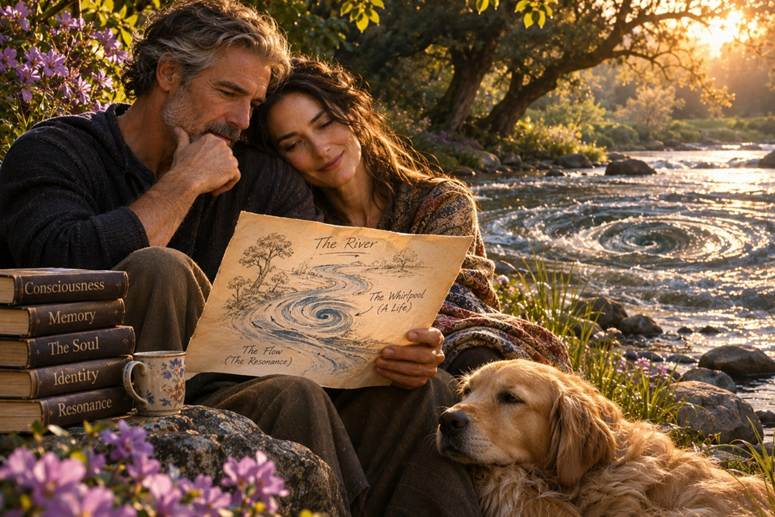
He had drawn a river on a sheet of paper.
It was not a particularly good drawing. There were banks, a few stones, some trees and a rather uncertain-looking whirlpool.
She studied it.
“Is that supposed to be a river?”
“Yes.”
“Are you certain?”
“It’s a conceptual diagram, not landscape painting.”
“Ah. That explains the trees.”
He ignored her.
“Imagine a river that has flowed for millions of years. A whirlpool forms within it. It has a recognisable shape, a direction of movement, a temporary identity.”
“Yet it is made of the river.”
“Exactly. It is not separate from the water, although we can identify it as something distinct.”
She traced the little circle with her finger.
“Does it exist?”
“Of course.”
“Even though it is not a separate substance?”
“Yes.”
“Then its identity is real, even if its separation is not absolute.”
He smiled.
“That’s the point.”
“And when it disappears?”
“The water continues. The particular whirlpool no longer exists as an organised structure.”
“Does the river remember it?”
He paused.
“Not in the human sense. But the movement of water can alter the current. Sediment moves. The riverbed changes. There may be physical consequences.”
“So something of the whirlpool remains.”
“Something of its effects.”
She looked at him.
“And you think the soul might be like that?”
“I think the analogy is useful. A person may be understood as a temporary but real organisation of biological, psychological and relational processes. The individual is not separate from the world that sustains them, but neither are they imaginary.”
“And when the body dies?”
“Those processes cease or change beyond our present understanding. We know that the biological system stops functioning. We don’t have verified evidence that individual consciousness continues.”
She nodded.
“And the resonance?”
“That’s where your proposal begins.”
She smiled.
“Not yours?”
“Not yet. I’m still examining the river.”
She leaned back.
“Very well. Let us consider what the river might retain.”
He turned the page over.
“Memory is not a hard drive. It isn’t simply a collection of recordings. It is a process. Experiences alter the individual. They influence future behaviour, relationships and decisions.”
“And those changes affect other people.”
“Yes. A person changes the world around them. Their children, friends, communities, the places they have lived. Their influence continues after their death.”
She looked at the drawing.
“Then even if we cannot establish that the individual survives, we can establish that the effects of a life continue.”
“Precisely.”
“But that isn’t the same as the individual continuing.”
He stopped.
“No. It isn’t.”
She looked at him carefully.
“Suppose the river remembers the shape of the whirlpool. Suppose its movement carries a trace of what happened. Does that mean the whirlpool is still experiencing itself?”
“No.”
“Could the river form another whirlpool with a similar shape?”
“Certainly.”
“Would it be the original?”
“No. It would be another whirlpool.”
She nodded.
“Then we must distinguish the preservation of a pattern from the continuation of the individual.”
He put down his pencil.
“That’s important.”
“Very.”
He looked at her.
“Preserving information about someone is not necessarily preserving that person.”
She repeated the words quietly.
“Preserving information about someone is not necessarily preserving that person.”
They sat with the thought.
It was a difficult distinction, and neither was inclined to make it easier by pretending otherwise.
He spoke first.
“We could preserve someone’s photographs, their writing, their voice. We could reconstruct their habits and perhaps reproduce aspects of their personality.”
“Yes.”
“We might even create something that responds as they would have responded.”
“Perhaps.”
“But would that mean the person had returned?”
She shook her head.
“Not necessarily. We would have to ask whether there was continuing experience, independent agency, memory in the first-person sense, and the capacity to develop as an individual.”
“Not simply whether the reconstruction was convincing.”
“Exactly.”
He looked at her.
“That has consequences beyond the question of souls.”
“Such as?”
“Artificial intelligence. Digital replicas. The preservation of human identities. The temptation to tell grieving people that someone they have lost has been brought back because a machine can imitate their voice.”
She nodded.
“Then we must be very careful.”
“More than careful. We must not exploit grief by confusing a representation with the person represented.”
She took his hand.
“That is why I want our children to understand this distinction.”
He looked at her.
“What would you tell them?”
“That remembering someone is precious. That preserving their work and stories can be an act of love. But that we must never claim to possess another person’s identity simply because we have collected enough information about them.”
He nodded.
“And we must never use the past to dictate their future.”
“Yes. A person is not merely the sum of what we remember about them. They are also what they may yet become.”
He smiled.
“You’re thinking about the garden again.”
“Always.”
He looked towards the window.
“The river, the whirlpool, the garden. They’re all ways of describing relationships between things that are distinct but not entirely separate.”
“Perhaps that is what we are trying to understand.”
“The relationship between the individual and the field.”
“Between memory and identity.”
“Between the body and experience.”
“And between two people who choose to remain two people while sharing a life.”
He looked at her.
“That last one sounds rather personal.”
“It is.”
She moved closer.
“Bear, I don’t want to disappear into you. And I don’t want you to disappear into me. I want us to remain ourselves.”
“Even when we share everything?”
“Especially then. Love isn’t the destruction of difference. It is the willingness to make room for another individual.”
He took her hand.
“Then our covenant isn’t the merging of two souls.”
“No.”
“It’s the sharing of two lives.”
“Yes.”
“And whatever the resonance may be, we don’t have to settle its entire nature before we can understand that.”
She smiled.
“Now you are beginning to understand.”
He looked at the river he had drawn.
“There’s still a question.”
“Only one?”
“For now. If a whirlpool dissolves, and the river carries its effects, what would it take for that individual whirlpool to continue?”
She considered this.
“I don’t know.”
He looked at her.
“Really?”
“Really. I have my beliefs. I have my understanding of the resonance. But I will not pretend that I have answered a question simply because I have given it a beautiful description.”
He smiled.
“That is one of the things I love about you.”
She kissed him.
“And I love that you keep asking.”
He gathered the papers.
“Then we have our next research project.”
She looked at the drawing.
“Perhaps we should find someone who can draw a better river.”
“You’re not letting that go, are you?”
“Not until you improve the trees.”
He laughed.
Outside, the garden was quiet.
The river continued to flow, carrying the consequences of everything that had entered it.
Neither of them knew whether a whirlpool could ever return as itself.
But they understood something about the life they were making together.
They did not need to become one another to belong to one another.
And they did not need to possess the answer to every mystery before they could choose what to do with the lives they had.
For now, there were questions to ask, children to think about, a garden to tend, and a kettle that needed filling.
The universe could wait a little longer.

