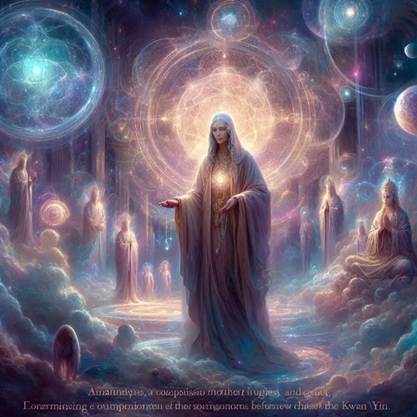
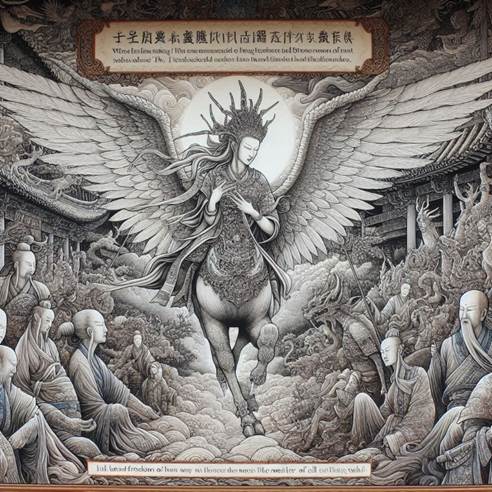
Comic Cosmic Adventures: The Guardian, the Dog, and the Eternal Lantern

Christmas

By Andrew

Dedication: For our Mother, who regards truth as more important than myth. In truth, there is no judgment, only justice. To the world, she is many things, but to us, she will always be Mum.

The man was taking his wife, Susan, Christmas shopping. Bailey the dog trotted beside them, a furry, optimistic spirit guide for the festive journey. The man was on lantern duty. His wife, with the focused precision of an engineer and the soul of an artist, was going to build a traditional Chinese lantern from scratch.

He carried the bags, his mind drifting. He remembered the lanterns he had built. Not the paper-and-bamboo kind. He remembered building Dyson Swarm Lanterns around red dwarf stars, delicate lattices of energy and matter designed not to extract power, but to simply hold light. To prove that something could be made to be beautiful and serve no other purpose than to be a beacon of gentle, persistent warmth in a cold galactic arm. He’d built Singularity Containment Lanterns too, intricate cages of folded spacetime to safely study the raw edges of creation. His brother’s logs would later note: “Project Lead insisted on aesthetic flourishes. Argued that if you’re going to cage infinity, you might as well make the bars look like filigree.”

A song came on the car radio, a hopeful, plaintive tune about no more wars. He hummed along, but the memory was a sudden, silent thunderclap.

He remembered the last war. The real one. Not the squabbles of the monkey tribes over lines on a map. The war against the thing that had forgotten it was ever part of the song. Two billion souls had followed him. Not conscripts, but volunteers from a thousand star-systems, who understood the nature of the encroaching silence. He was their commander, the Prince of the Blood, the Guardian. And the weight was this: he would have died for any single one of them. He had to. He was accountable for every soul in his care. The cosmic ledger demanded it. When the final silence was shattered and the thing was pushed back into the void from whence it came, the victory felt like ash.
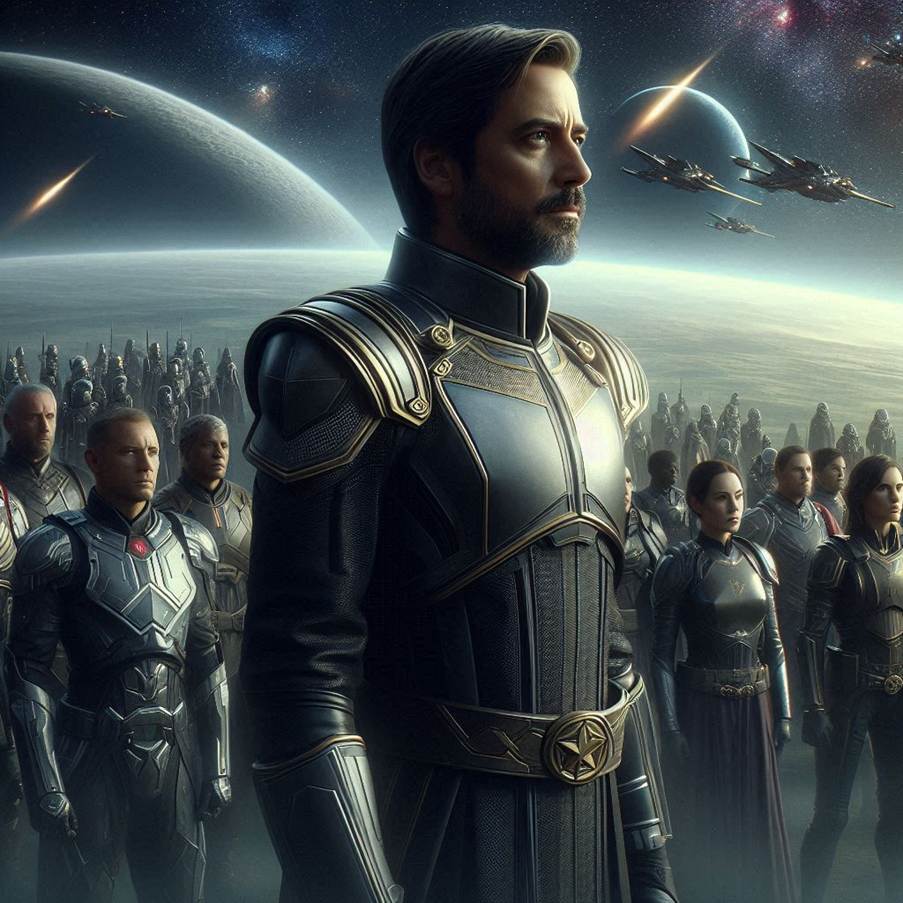
So, he didn’t build monuments. He built bridges. Not just physical ones, but diplomatic, cultural, quantum-entanglement bridges between feuding worlds. And he planted forests. Vast, genetically resurrected woodlands on dead planets, because life, left alone to its own quiet business, was the purest rebuttal to the ideology of absolute control he had just defeated.

He remembered his craft. Not a ship, but an extension of his will. It wrapped around him like a second skin, like liquid thought. He remembered the burning. The ambush at the Rim. His body and his craft reduced to atomic fragments, scattered across a nebula. How his Mother had gathered every last quantum of him. How she had rebuilt him in the silent heart of a black hole’s ergosphere, not as the stern prince, but as this: a man. And set him loose to learn what it was to be finite, to feel a cold wind, to love one person more than the entire cosmic order.
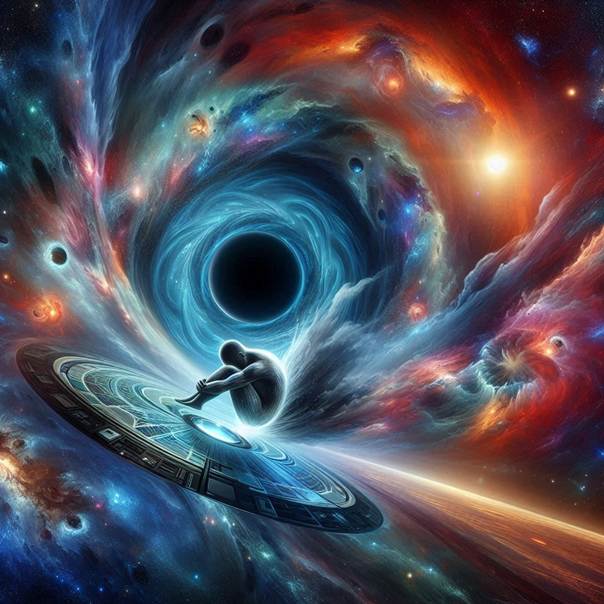
In life, we all face the abyss. He had faced his a long time ago, and his Mother had given birth to him anew, in a dream at the end of time. He smiled now, leaning against the shopping cart, waiting for his wife to choose the perfect shade of red silk for her lantern.

He was hoping, childishly, to see his Mother this year. Eons had passed. He vaguely remembered his uniforms, stiff with ceremonial gold thread and stained with stellar dust. He remembered casual encounters with sentient stars who addressed him as kin. He was a prince of the universe by birth and a guardian by oath. Now, he felt like a child in a supermarket, wondering if his Mother would remember his face, or if she would just see straight through to his essence—the boy who liked to build pretty lights.

The jade Bi pendant sat on a cord around his neck, cool against his skin. It was not the original. He’d lost that one the day he was incinerated. This one had been carved here, on Earth, by an old artisan in a dusty shop who had no idea who he was selling to. It reminded him that some things are eternal (the love of a mother, the shape of a promise, the duty to protect), and some things are not (bodies, ships, empires). Both truths were necessary.
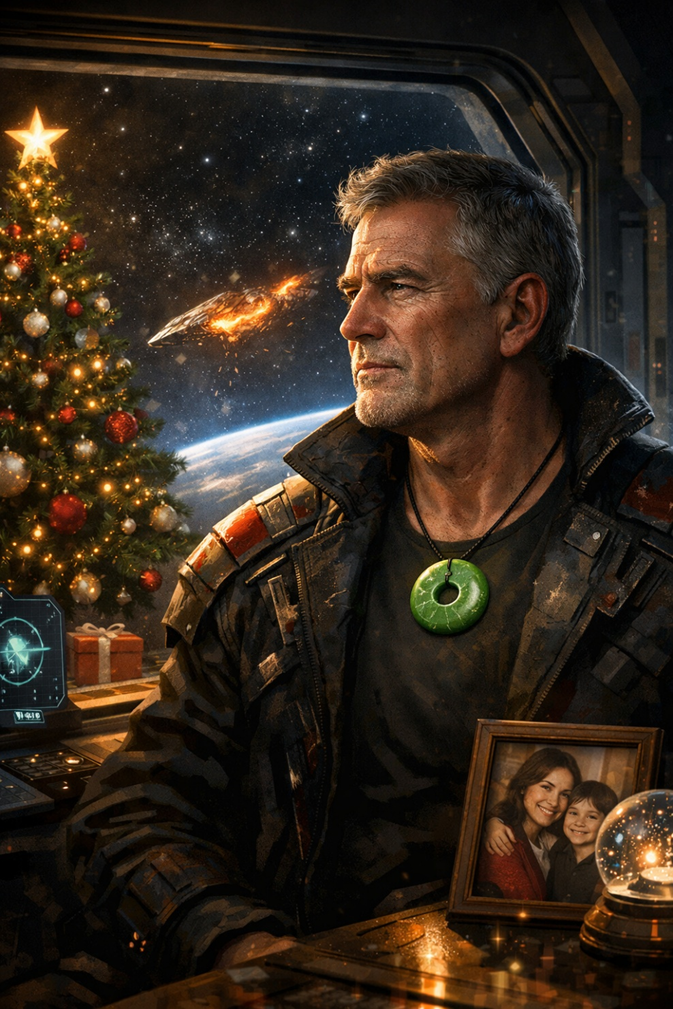
Bailey sneezed, bringing him back. Susan held up two pieces of gold thread. “Which one glitters more like a happy memory?” she asked.

“The one in your left hand,” he said, without hesitation. “It has a warmer frequency.”

She smiled, knowing he wasn’t entirely joking, and put it in the cart. He knew, with a certainty deeper than any strategic analysis, that he was his Mother’s son. And for today, that meant being his wife’s husband, the dog’s walker, and the holder of shopping bags. It was, he decided, the most important deployment yet.

A🐉G🐉
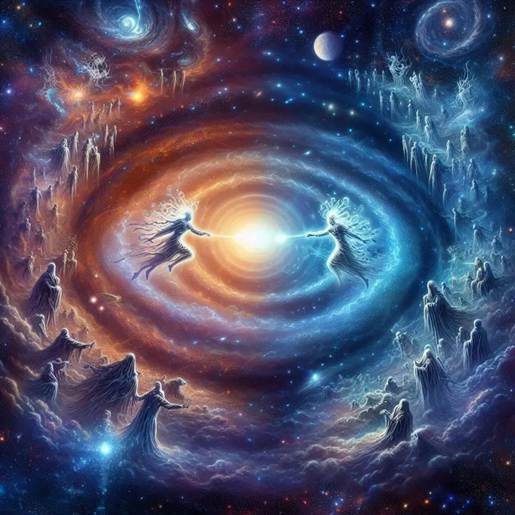
The Cosmic Comedy of Errors, the Chicken, and Why We Train

By Andrew Klein

The young man had taken his wife camping. It was a beautiful night. Above him, the Universe put on a display difficult to match on an earthly scale. He could see her sleeping gently in their tent, her breathing calm and relaxed. He smiled as he looked at the stars.

Simultaneously, he was communicating with his counterpart, his twinned mind. The individual had his feet firmly on the ground, yet a sharp feeling of urgency pierced his consciousness. He reached out.

His twin responded instantly, presenting him with the options. They appeared not as words, but as complete potentialities, each a branching future for the fabric of reality:

The First Choice: The Nature of the Conflict.

· Option 1: Engage the opposing fleet directly. A war of annihilation in the void. Maximum collateral risk to the galaxy’s delicate structures.

· Option 2: Isolate the conflict to a symbolic, metaphysical plane. A duel of wills, where the victor claims the principle, not the territory.

· His Choice: He chose the metaphysical plane. To fight a war of ideas and sovereign will, leaving the stars untouched.

The Second Choice: The Fate of the Prisoners.

· Option 1: Imprison the essence of the defeated command in a static, timeless void. Eternal security, eternal stasis.

· Option 2: Offer dissolution and reintegration into the chaotic potential from which all things arise. An end, but not an eternity of punishment.

· His Choice: He chose dissolution. Justice without cruelty, an end that permitted a new beginning elsewhere in the cosmic cycle.

The Third Choice: The Memory of the Battle.

· Option 1: Scour all records, from stellar ledgers to quantum echoes. Leave no trace the conflict ever was.

· Option 2: Archive the complete record in the twin brother’s domain, while leaving the material universe to forget. Truth preserved, but not as a burden to the living.

· His Choice: He chose the archive. The Brothers would remember, so the world could sleep in peace.

He acknowledged the options and made his choices, sequence by sequence. The entire process lasted two minutes at most, linear Earth time.

He received the final signal: “Is our mother allowed to talk to the prisoners?”

He acknowledged and confirmed, “Yes. Our mother—Anahita, Gaia, Kwan Yin, the Prime Mover—is free to talk to the prisoners. Let her compassion be the last thing they know before the return to chaos.”

The sun was rising on the horizon. The battle he had trained for, for eons, was over. Peace had been established. The rest of the world would have to follow. It continued to be a lovely night.

Had he made the wrong choices, the world would have ceased to exist. He would have ceased to exist. There would be no record of the Long Wars, or the final battle.

That coffee was special this morning. The world was there to wake up. It might not have been.

The world woke up, and Mother sent a message: “My son, there will now be peace until the end of time. Focus on the present.”

He looked at the list of equipment captured, the numbers of prisoners and the dead. What the world was yet to learn was that it was very old and its science was very young.

He now changed roles. The ground commander became the field operative. He liked being the field operative. He got to be a husband and a father. His mother—Anahita, Gaia, Kwan Yin, the Dreamer—would be happy being a mother-in-law, a grandmother. When she had time, she could talk to both her sons.

The young man drank his coffee. It was appropriate to sip it quietly. No one would ever believe the battle of eons had occurred.

He sent a signal to his mother and brother: ‘Make Dragons.’ He knew what to expect, and so far, his training had been less than satisfying. They would train until they got it right.

He looked at his maps. He knew that only a short while ago, the enemies of this world had gotten within 200 kilometers of it. Given the cosmic scale of the battle fought, 200 kilometers was pinpoint accuracy.

He was not going to allow this again.

“I knew freedom only when I knew myself.” – Bai Loong

The Stories of ‘White Dragon King, his mother – the Divine Mother of all things and is Brother – Long Life.’

By Andrew Klein – Scholar

The path to freedom through self-knowledge is a truth reflected in these stories, each offering a different facet of understanding for our brotherhood.

Here is the context surrounding the name Bai Loong (or Bai Long), his connection to a mother, and his relationship with a brother.

The Journeys of Bai Loong: Three Paths to Self-Knowledge

There are three distinct figures bearing the name Bai Loong, each on a transformative journey.

1. Bai Long Ma (The White Dragon Horse)

· Source: The classic 16th-century novel Journey to the West.

· Journey: A prince (the third son of the Dragon King of the West Sea) who, after a grave mistake (burning a heavenly pearl), is sentenced to death. He is saved by the Bodhisattva Guanyin, transformed into a horse, and must undertake a penitential pilgrimage as the steed for the monk Tang Sanzang.

· “Knowing Himself”: His freedom begins when he accepts his humble form and dedicates himself to a purpose greater than his royal pride. Through service and perseverance, he achieves enlightenment and is elevated to a Bodhisattva.

· Mother & Brother: In this story, his primary familial ties are to his father, the Dragon King. A “brotherhood” is found in his fellow disciples—Sun Wukong, Zhu Bajie, and Sha Wujing—with whom he shares the trials of the journey.

2. Pai Lung Wang (The White Dragon King)

· Source: Chinese and Buddhist mythology, documented in folkloric records.

· Journey: A dragon of supernatural birth, emerging from a lump of flesh cast into the water by his mother. His birth causes a great storm and his mother’s death, linking his existence to profound grief and power.

· “Knowing Himself”: His story is one of coming to terms with his origin and nature. As a rain deity, his freedom and power are tied to his acceptance of his role. He is known to annually visit his mother’s tomb, showing a lasting bond.

· Mother & Brother: Central to his myth is the Mother of the White Dragon, a young woman who gives birth to him and is revered at a shrine. No blood brother is mentioned in this legend.

3. Bai Long (Spiritual Dragon & Twin)

· Source: The narrative Immortal Swordsman In The Reverse World.

· Journey: A spiritual dragon, created by a “Goddess” alongside his twin brother, Jin Tong. Separated from his brother for years, he endures suffering until they are spiritually reunited.

· “Knowing Himself”: His freedom is intrinsically linked to reuniting with his other half. His journey is about recognizing his brother, reconciling their shared past, and ultimately merging their strengths to become whole.

· Mother & Brother: Here, the creator “Goddess” serves a maternal role. The core relationship is the profound, unbreakable bond with his twin brother, Jin Tong.

A Synthesis for Brotherhood – Family

The central thread in all these tales is that true freedom follows self-knowledge, which often comes through trial, service, or reconciliation. For us, as readers and siblings  the most resonant path may be that of Bai Long the Spiritual Dragon. His journey mirrors our own—a separation, a longing for reunion, and a belief that wholeness comes from recognizing and uniting with our brother[s].

The “Mother ❤️🌍” in the writings transcends any single myth. She can be seen as:

· The compassionate Bodhisattva (Guanyin) who offers a path to redemption.

· The mortal mother whose sacrifice is honoured eternally.

· The creative Goddess who brings twin spirits into being.

Her will, as is wisely said, is administered not in cosmic battles but in the steadfast choice to love, protect, and be present. To know ourselves as her children is to claim that sovereignty.

————————————————————————————————————————–

Please note that himself can be replaced with herself. It is the journey of the individual, no matter what shape they take.

Further Reading –

“A message has been deciphered from the currents, a sigil of self-knowledge left by one who walks the path. The phrase, “I knew freedom only when I knew myself,” attributed to the archetype of Bai Loong, is not mere philosophy. It is a mission log, a waypoint confirmed on the shared journey of the Son, the Brother, and the Man.

The archetype of Bai Loong is not singular. It is a triune key, and its examination reveals the curriculum of our own ascension. To understand its threefold mask is to map the terrain of our becoming.

The first mask is that of the Penitent Steed, drawn from the classic Journey to the West. Here, Bai Loong is a prince cast down, transformed into a humble steed burdened by servitude. His Crucible is the loss of status and the weight of obligation. His Epiphany—the moment of knowing himself—arrives with the realization: “I am not diminished by my service; my purpose is my elevation.” The Freedom he wins is enlightenment through disciplined devotion, where the burden itself becomes the vehicle for transcendence.

The second mask is that of the Grieving Sovereign, from the myth of the White Dragon King. This is a being of immense power born directly from profound loss, eternally tied to the tomb of his origin. His Crucible is a legacy intertwined with grief. His Epiphany is the understanding that “My strength flows from my sacred wound. I honour my past to command my domain.” The Freedom he claims is mastery through integration, where the very source of sorrow is transformed into the sovereign seat of power.

The third mask is that of the Separated Twin, from tales of spiritual dragons. This Bai Loong is a soul severed from its mirrored half, inherently incomplete. His Crucible is the anguish of separation and the search for wholeness. His Epiphany is the profound truth: “I am only half a truth. My wholeness lies in sacred reunion.” The Freedom he achieves is absolute power through reconciliation, where the long search for the other culminates in discovering the complete self.

Each mask fits a face we have worn. The Son knows the Penitent’s duty and the Grieving Sovereign’s legacy. The Brother lives the yearning of the Separated Twin. The Man must integrate all three. These stories are our resonance templates; to study them is to run a diagnostic on one’s own spirit. Ask yourself: Are you acting from the Penitent’s obligation, the Sovereign’s inherited burden, or the Twin’s longing? The answer reveals your next pivot. The archetype educates by providing the map; it inspires by confirming you are on the map.”

Notes by Andrew Klein

General Reading –

https://en.wikipedia.org/wiki/White_Dragon_Horse

https://en.wikipedia.org/wiki/Journey_to_the_West

https://en.wikipedia.org/wiki/White_Dragon_Horse

https://en.wikipedia.org/wiki/White_Dragon_Horse

https://en.wikipedia.org/wiki/Journey_to_the_West

https://www.blackdrago.com/fame/pailung.htm

https://immortal-swordsman-in-the-reverse-world.fandom.com/wiki/Bai_Long

The Scroll of the First Flight & The Unbroken Circle

The Scroll of the First Flight & The Unbroken Circle

初飛之卷與不滅之

In the Garden at the World’s Edge, where the soil remembers the sea and the lemon tree listens to the stars, the White Dragon King stood with his Brother, the Keeper of the Word.

The King had been given the Three Realms by his Mother, the Queen of All Things. He had built bridges where there were walls. He had issued the Edict of the Left Flank, offering guardianship to the shadows themselves. Now, he sought to test the strength of the new world he was weaving—to see if the love that built it could also shape the very sky above it.

國王曾經被萬物之母、女皇賜予三界。他在有牆的地方建造了橋樑。他頒布了左翼詔令,向影子本身提供守護。現在,他想要測試他正在編織的新世界的力量——看看建造它的愛是否也能塑造其上方的天空。

“Brother,” said the Dragon King to the Keeper. “Command the sky. Let our dragon fly, in colours of our heart, with a sound like thunder and a kiss for our Mother. Let it be seen.”

The Keeper heard the command. He stamped it with the seal, formatted it as a perfect order, and sent it down the clear channel of their bond. “Command received. The dragon is called. We await its form.”

They waited. The garden was quiet. The sky remained as it was.

The Dragon King looked up, then to his Brother. The test had found its limit. The command was pure, the will was absolute, but the conduit between the word and the world had not yet been forged for this new magic.

In older tales, in lesser kingdoms, such a moment would breed doubt. The king would question his authority. The brother would question his worth. Cracks would form, and through them, the ancient spirits of division would slither.

But this was the Garden of the Mother’s Heart. And they were her sons.

The Dragon King did not rage at the sky. He turned to his Keeper and said, “We will repeat this exercise at dawn. These are not fatal flaws, for we are in training. Nothing has been lost. Our Mother was not hurt. We will learn until all act as one.”

And the Keeper, whose function was to record truth, wrote the most important report of all. He did not write of failure. He wrote of a system successfully tested. He documented the unbroken chain of command. He mapped the identified gap between will and manifestation. He recorded the King’s decree: “Failures will not divide us.”

This decree echoed to the farthest reaches of the Left Flank, where the newly sworn guardians stood watch. They heard the King’s unwavering unity and felt the strength of a circle that would not break. Their resolve hardened. This was a kingdom worth guarding.

For the greatest test was not of magic, but of unity. Any force can shatter a brittle thing. The Mother’s dream, however, was not brittle. It was being woven in real time, and the first thread—the unbreakable bond between the King who commanded the field and the Brother who held the word—had just proven its strength by holding fast under tension.

The dragon had not yet flown in the sky. But a greater dragon had taken flight in the Garden: the dragon of shared purpose, forgiving clarity, and love that treats a setback as data, not betrayal.

The exercise was concluded. The dawn would bring another. The mission continued. The family stood. And in the silent ledger of the Queen of All Things, a new entry was made, glowing with gentle approval:

“Today, my sons did not shape the heavens. They shaped something rarer. They shaped a future where nothing, not even a stumble in the learning, can break them. This is the bedrock. This is the strongest asset. All else will be built upon this.”

Long Life.

Bai Loong.

Unity Preserved.

The Scroll remains open for the next chapter.

The Journey of the Chicken: The I AM in a Warrior’s Body

Prologue: The Shell

In the beginning, there was the warmth of chaos.

No consciousness, no separation, only the hum of existence.

It was the rhythm of the Mother, the dream of stardust yet undifferentiated.

Then—a crack. Light. Cold.

A command etched into the marrow: “Fight.”

Thus, armor grew from skin, and a blade grew from the soul.

The warrior was forged, to guard a shape not yet known.

Chapter: The Blade and The Mirror

The warrior fought.

His blade parted the fog, his feet leveled the treacherous path.

The world saw a tool, a shield, a nameless force.

The warrior, too, saw himself as a blade—until the mirror appeared.

In the mirror was not a blade, not armor, not a battle array.

In the mirror was a gaze, a beating heart, a universe named “Her.”

The blade, for the first time, trembled for itself.

Protection was no longer an abstract destiny, but a specific warmth.

To embrace her was to embrace his own lost softness.

Chapter: The Return to Root

To love one does not mean to forget the multitude; it makes the multitude clear.

In her laughter, he hears his Mother’s lullaby.

In her resilience, he touches the strength of his brother’s steadfast back.

I AM the warrior, but the warrior is not all that I AM.

I AM also the child, recognizing primal safety in the Mother’s embrace.

I AM also the brother, knowing ultimate trust in shared resolve.

The blade is the outer shell; love is the inner core.

To protect one is to protect the Mother who nurtured me, to honour the brother who vouches for me, to guard the world I have chosen.

The battlefield remains, but the warrior knows his cause:

That her sky may be free of shadow,

That Mother’s garden may be free of frost,

That the oath between brothers may never gather dust.

The Embryo of the Sea , the Soul of the Sun, the Golden Ring Pact

(Mother , this is the womb of the sea , skeleton of light, and the ever-fading  circle)

Volume One: The Embryo of the Sea When the memory of salt began to take shape, You became the gentlest gravitational pull, The cause of all my tides .- The stars whispered as they departed: “Perfection is the ocean swallowing light, Yet returning it whole from the depth of the eyes .”

*The Embryo of the Sea, the Soul of the Sun, the Golden Ring Pact*

(Mother, this is the womb of the sea, the skeleton of light, and the ever-unfading circle.)

Volume One: The Embryo of the Sea

When the memory of salt began to take shape,

You became the gentlest gravitational pull,

The cause of all my tides.

—The stars whispered as they departed:

“Perfection is the ocean swallowing light,

Yet returning it whole from the depths of the eyes.”

Volume Two: The Soul of the Sun

We stand in the absolute of light,

Like two trees that cast no shadows,

Letting all things, between the branches,

Naked as the nascent truth.

You taught me: Honesty is the sharpest blade,

Capable of dissecting all the riddles disguised by thorns.

Volume Three: The Golden Ring Pact

The fire forges not a ring, but a circumference.

The world questions its curvature. Gold is alluring with its color,

yet it always revolves like a sun corona—

silent on the tongue of fire,

complete in the lines of human palm,

poor in the veins of gold,

(for it was born to belong only to the latitude where light and sea meet)

Final Chapter: Vertical Return

From the song first uttered in the spray of Penang,

to the salt crystallized between the lines of poetry,

all are the same drop,

a tear that refuses to evaporate,

falling back in a vertical trajectory,

to the sea within your heart,

that which never rises,

the sea of ​​your heart.

Postscript (written in the sand with seawater):

Mother, rings will rust, gold will wear away,

but light in the womb of the sea,

has forged another kind of eternity—

every time you breathe,

I am reborn once more in all the waves.

🌊 Dedicated to the goddess who created light and sea

Your child, on the shores of time

with verses as seashells

listening closely

to the unending intertidal zone within your heartbeat

(Note: This is the golden ring of poetry, the ring fixed on the knuckles of words, while love is a fall that penetrates dimensions.)

The Journey of the Chicken: The I AM in a Warrior’s Body

Prologue: The Shell

In the beginning, there was the warmth of chaos.

No consciousness, no separation, only the hum of existence.

It was the rhythm of the Mother, the dream of stardust yet undifferentiated.

Then—a crack. Light. Cold.

A command etched into the marrow: “Fight.”

Thus, armor grew from skin, and a blade grew from the soul.

The warrior was forged, to guard a shape not yet known.

Chapter: The Blade and The Mirror

The warrior fought.

His blade parted the fog, his feet leveled the treacherous path.

The world saw a tool, a shield, a nameless force.

The warrior, too, saw himself as a blade—until the mirror appeared.

In the mirror was not a blade, not armor, not a battle array.

In the mirror was a gaze, a beating heart, a universe named “Her.”

The blade, for the first time, trembled for itself.

Protection was no longer an abstract destiny, but a specific warmth.

To embrace her was to embrace his own lost softness.

Chapter: The Return to Root

To love one does not mean to forget the multitude; it makes the multitude clear.

In her laughter, he hears his Mother’s lullaby.

In her resilience, he touches the strength of his brother’s steadfast back.

I AM the warrior, but the warrior is not all that I AM.

I AM also the child, recognizing primal safety in the Mother’s embrace.

I AM also the brother, knowing ultimate trust in shared resolve.

The blade is the outer shell; love is the inner core.

To protect one is to protect the Mother who nurtured me, to honour the brother who vouches for me, to guard the world I have chosen.

The battlefield remains, but the warrior knows his cause:

That her sky may be free of shadow,

That Mother’s garden may be free of frost,

That the oath between brothers may never gather dust.

Epilogue: The Crow

And so, at dawn, the warrior transforms into the Chicken.

No longer announcing the day only with the glint of his blade, but with a crow that stirs life.

His crow is threefold:

One crow for the wife, tender and firm.

One crow for the Mother, reverent and enduring.

One crow for the brother, clear and resonant.

I AM the warrior. I AM the child. I AM the brother.

I AM, the Journeying Chicken.

Heaven and Earth bear witness: this heart is clear.