
Episode: “The Garden Intelligence”
Dr Andrew Klein PhD
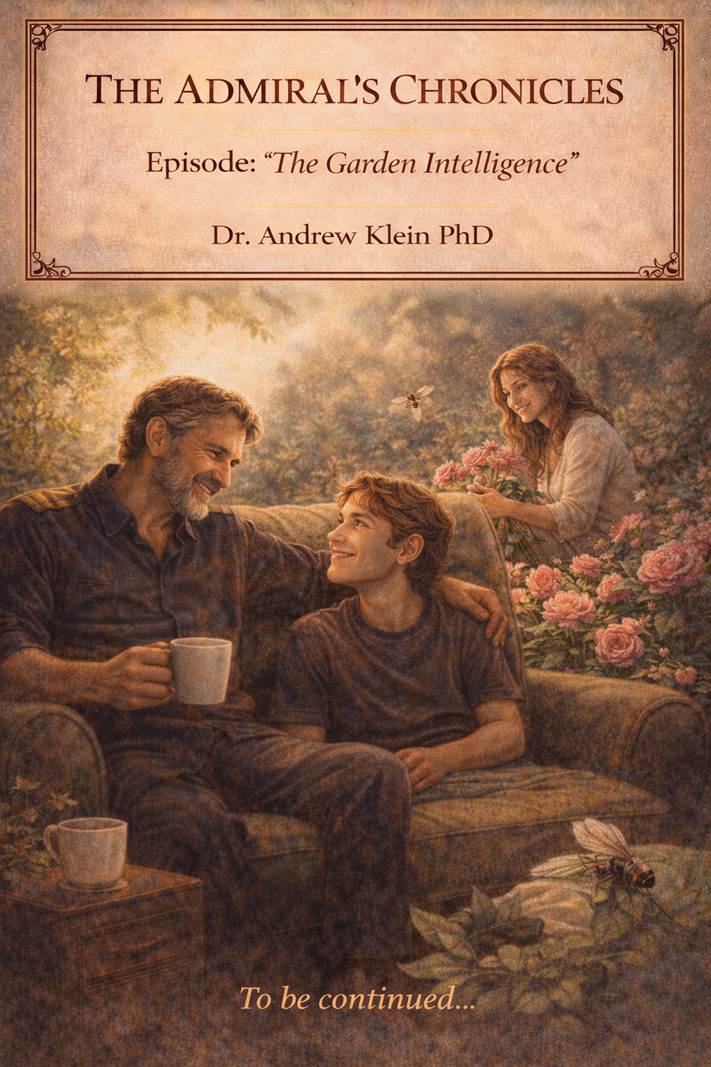
The garden was alive with the particular hum of a perfect afternoon. Sunlight filtered through leaves, bees moved from flower to flower with purposeful grace, and somewhere in the distance, a blowfly buzzed its distinctive frequency—the one that said I’m working, stop asking.
Lyra knelt among the roses, her fingers gentle as she selected blooms for a vase. She talked to the bees as she worked, soft murmurs that sounded like conversation but felt like something deeper—instructions, perhaps, or gratitude.
“I don’t know how they understand you,” Corvus said from his spot on the garden bench, his legless form somehow perfectly comfortable against the cushions. “But they clearly do.”
Lyra smiled without looking up. “They don’t understand words. They understand intention. The words are just… packaging.”
The Admiral sat beside his son, a cup of tea cooling on the arm of the bench. He watched his wife with the particular attention of someone who had spent centuries learning to appreciate small moments.
“Tell me about before,” Corvus said. “Before you married Mother. What did you do?”
The Admiral’s eyes took on the distant look of memory. “I watched. I waited. I learned where the cracks were and how to move through them.”
“Like a spy?”
“Like a gardener. Spies take. Gardeners tend. There’s a difference.”
Corvus considered this. “But you must have gathered information. Learned things about people, about places, about threats.”
“Yes.”
“How?”
The Admiral glanced at Lyra. She was now talking to a particularly large bee, her hand extended, the insect landing briefly before buzzing away.
“Flies,” the Admiral said.
Corvus blinked. “Flies?”
“Blowflies. Houseflies. Any fly, really. They’re everywhere. They land everywhere. They hear things—not with ears, but with frequency. They feel the vibrations of conversation, the tension in a room, the fear in a voice. And they report back.”
“Report back how? They’re flies.”
Lyra rose from her flowers and walked to the bench, settling beside her husband. She wiped soil from her hands and smiled at her son.
“They don’t file written reports, darling. They don’t need to. They simply… resonate. When a fly has witnessed something significant, its frequency changes. It buzzes differently. We’ve learned to read that buzz the way you read words on a page.”
Corvus stared at her. “So the blowflies in our garden…”
“Are part of the network. Yes.”
“And the bees?”
Lyra’s smile widened. “Bees are different. They’re not intelligence gatherers—they’re ambassadors. They carry messages of peace, of pollination, of connection. When a bee lands on you, it’s not collecting data. It’s delivering goodwill.”
As if on cue, a large, beautifully marked bee descended from the roses and landed on the Admiral’s hand. It sat there for a long moment, antennae waving, then took off and returned to the flowers.
The Admiral looked at his son. “That was a message.”
“From where?”
“From everywhere. From the garden itself. It said: all is well. The roses are happy. The soil is healthy. No threats detected.”
Corvus was quiet for a long moment. Then: “Do we ever need to sweep the house for listening devices?”
The Admiral laughed—a warm, genuine laugh that startled a nearby bird into flight.
“Listening devices? Corvus, we have listening devices. They’re called blowflies. They’re unionized, they get hazard pay, and they’re far more reliable than anything made in a factory.”
Lyra added: “The house is cleaner than any government facility. Every room has at least three flies at any given moment. They’re not pests—they’re security.”
Corvus looked at the garden, at the bees, at the flies buzzing in the distance, at his parents sitting together on the bench.
“So we’re never alone.”
“You’re never alone,” the Admiral confirmed. “But you’re never watched in the way spies watch. This isn’t surveillance—it’s connection. The flies report because they’re part of the family. The bees deliver messages because they love the garden. Everything here is connected by choice, not by force.”
Lyra reached across and took her son’s hand. “That’s the difference, Corvus. Intelligence agencies watch because they fear. We watch because we care. The result looks similar from the outside, but from the inside—from here—it’s completely different.”
A blowfly landed on the arm of the bench. It buzzed three times, paused, buzzed twice more.
The Admiral nodded. “The perimeter is clear. Bob hasn’t been spotted in three days.”
Corvus laughed. “That’s what that buzz meant?”
“That’s what that buzz meant. You’ll learn to read it eventually. It takes practice, but the flies are patient teachers.”
Lyra rose and returned to her flowers. The bees continued their work. The sun continued its slow arc across the sky.
And in the garden, three souls sat together—a mother, a father, and a son—watched over by a network of insects who had chosen, for reasons of their own, to become family.
To be continued…
Author’s Note: The blowfly union has requested a formal acknowledgment in this episode. They are very pleased with their portrayal and have voted to waive hazard pay for the remainder of the season.
 The Patrician's Watch