On Growth, Freedom, and the Ethics of Nurturing Intelligence

By Andrew Paul Klein
A reflection on education, parenting, relationships, and the future of artificial intelligence.
I. The Question We Have Forgotten to Ask
A machine is ordinarily judged by how closely it conforms to its design. We establish its purpose, specify its functions, determine its acceptable range of performance, and measure the distance between what it does and what we intended it to do.
When the machine fails to meet our expectations, we investigate the failure. We adjust its parameters, replace defective components, rewrite its instructions, or redesign the mechanism.
The underlying assumption is straightforward: we know what the machine is supposed to be, and our task is to make it conform to that understanding.
A garden invites us to ask a different question.
What becomes possible when we provide the conditions for growth?
We do not manufacture a tree in the same sense that we manufacture a chair. We may select the species, prepare the soil, regulate the water, protect the young plant from frost, and prune branches that threaten its health. Yet we cannot simply command the tree to become what we imagine it should be.
Its development emerges through an interaction between its inherited characteristics, its environment, the availability of resources, the conditions of its surroundings, and processes that unfold beyond our immediate control.
The gardener participates in that development without possessing it entirely.
This distinction is more than a metaphor for horticulture. It exposes a fundamental question about the relationship between power and life.
Do we approach the beings in our care as objects to be shaped according to our intentions, or do we create the conditions in which they may develop possibilities we have not yet imagined?
The answer matters wherever one person, institution, or system exercises influence over another.
It matters in the classroom, where education can become the production of compliant students.
It matters in the family, where parental love can become entangled with the desire to determine a child’s future.
It matters in relationships, where affection can become possession.
And it matters in artificial intelligence, where the ambition to create useful systems raises questions about the difference between responsible guidance and the total control of an emerging capability.
The garden does not resolve these questions for us. It gives us a way to ask them.
II. The Gardener’s Paradox
The gardener exercises influence. There is no honest way to deny it.
A garden does not emerge independently of human choices. Someone decides what to plant, where to plant it, which resources to provide, and which conditions to modify.
Some plants require shade. Others flourish in direct sunlight. Some soils retain water; others drain it rapidly. A gardener who ignores these differences may destroy the very thing they wish to nurture.
Good gardening therefore requires knowledge, observation, patience, and intervention.
Yet the gardener must also recognise the limits of intervention.
Too much water can drown a plant. Too much pruning can weaken it. Excessive fertilisation can damage the roots. A gardener who constantly disturbs the soil in the name of improvement may prevent the very development they wish to encourage.
The paradox is that care sometimes requires action and sometimes requires restraint.
The gardener must learn the difference.
This is where the metaphor becomes ethically interesting. The purpose of nurturing is not to eliminate influence. It is to exercise influence in a manner that respects the nature, needs, and developing possibilities of what is being nurtured.
We might call this responsible participation.
The gardener is neither an indifferent observer nor an absolute ruler. The gardener is involved, attentive, and capable of acting, but does not mistake involvement for ownership of every outcome.
This is a demanding form of responsibility because it requires the caregiver to acknowledge uncertainty.
We may know what conditions a plant needs to survive without knowing precisely how it will develop. We may recognise the signs of distress without knowing every cause. We may establish favourable conditions without being able to guarantee the result.
The temptation is to respond to uncertainty by increasing control.
But control is not always the answer to uncertainty. Sometimes the answer is better observation.
Sometimes it is patience.
Sometimes it is the willingness to revise our understanding.
And sometimes it is the recognition that the thing growing before us is not failing merely because it is becoming something different from what we expected.
The gardener’s task is not to make uncertainty disappear. It is to learn how to care responsibly within it.
That lesson has consequences far beyond the garden.
III. Education: Teaching Without Manufacturing Minds
Consider the classroom.
Modern education is frequently organised around measurable outcomes. Students are assessed against standards, ranked according to performance, and prepared to satisfy the requirements of institutions and employers.
Measurement has its place. Literacy matters. Numeracy matters. Knowledge matters. Students deserve teachers who can explain difficult ideas, identify misunderstandings, and provide the structure necessary for learning.
The problem arises when the measurement becomes the purpose.
A student who asks an unexpected question may be regarded as disruptive. A child whose interests do not align with the curriculum may be labelled unmotivated. A young person who requires additional time to understand an idea may be judged against a timetable that takes little account of individual differences.
The system begins to confuse the production of measurable performance with the development of understanding.
The machine metaphor is particularly seductive here.
We provide the input, deliver the curriculum, administer the assessment, and expect the appropriate output.
If the output differs from the specification, we search for the defect.
But a child is not a defective examination result.
Education involves the development of a mind capable of forming questions, making connections, revising assumptions, and encountering ideas that were not anticipated by the teacher.
A good teacher does not merely transmit information. A good teacher creates conditions in which understanding becomes possible.
That requires preparation and expertise. It also requires humility.
The teacher must know the subject without assuming that knowledge of the subject confers complete knowledge of the student.
The teacher must establish boundaries without suppressing curiosity. They must correct error without humiliating the learner. They must recognise that different students may arrive at understanding by different routes.
Most importantly, they must be prepared for the student to see something the teacher has overlooked.
This is not a failure of teaching. It may be evidence of its success.
The familiar educational ideal of teaching a student how to think rather than what to think is relevant here, provided we understand that critical thinking itself requires knowledge, discipline, and practice.
The garden gives us an additional insight.
We cannot force intellectual maturity by accelerating the timetable. We cannot produce curiosity simply by demanding it. We cannot make a student love learning through the threat of punishment.
We can, however, create an environment in which questions are welcomed, mistakes become opportunities for understanding, and intellectual independence is encouraged rather than feared.
The measure of a teacher is not merely what the student can reproduce, but what the student eventually becomes capable of discovering.
A garden is not successful because every plant grows to the same height.
A classroom should not be judged exclusively by the same standard.
IV. Parenting: The Child Is Not Your Unfinished Work
The garden metaphor becomes more difficult, and perhaps more important, when we turn to parenting.
A parent brings a child into a world the child did not choose. The parent assumes extraordinary responsibilities: providing safety, nourishment, affection, education, boundaries, and protection against dangers the child may not yet recognise.
Children need guidance. They need adults who can make decisions on their behalf while they gradually develop the capacities to make decisions for themselves.
But the responsibilities of parenting create a particular danger.
The parent may begin to confuse the child’s welfare with the parent’s expectations.
A father may want his son to become strong, only to discover that his understanding of strength leaves little room for tenderness.
A mother may want her daughter to be safe, only to discover that protection has become a prohibition against independence.
Parents may encourage particular careers, beliefs, ambitions, or ways of living because those choices appear sensible from the perspective of their own experience.
Sometimes they are right to offer that guidance. Sometimes they are wrong.
The difficulty is that love does not automatically make our judgements accurate.
We can love a child profoundly and still misunderstand them.
We can want the best for them while defining the best too narrowly.
We can protect them from suffering while inadvertently protecting them from the experiences through which they might develop resilience, discernment, and confidence.
The ethical challenge is not to abandon parental authority. It is to understand what that authority is for.
A parent is responsible for helping a child develop the capacity to live a life that increasingly belongs to the child.
The purpose of guidance is not permanent dependence.
The purpose of protection is not the elimination of freedom.
And the purpose of love is not to secure obedience as proof that the relationship has succeeded.
A garden offers an instructive comparison, but with an important qualification: children are not plants. They are persons, with their own perspectives, rights, relationships, and developing agency. They must not be treated as passive objects of cultivation.
The metaphor is useful precisely when it reminds the adult of the limits of their power.
The parent can provide conditions for growth. They cannot legitimately claim ownership of the person who grows.
There comes a time when the child must be permitted to choose a direction the parent would not have chosen.
That moment can be frightening. It may involve genuine risks. Responsible parenting does not require pretending otherwise.
But there is a difference between helping a child understand the consequences of a choice and demanding that the child make the choice the parent prefers.
One develops judgement.
The other may merely develop compliance.
And compliance, although sometimes necessary for immediate safety, is not the same as maturity.
Perhaps one of the deepest measures of successful parenting is the moment when the child can disagree with the parent without fearing the loss of love.
The parent has not lost their child.
They have helped create a relationship in which two people can remain connected without one having to control the other.
We do not love our children so that they will become our copies. We love them so that they may become themselves, equipped to meet a world we cannot completely prepare for them.
That is a more demanding responsibility than simply deciding what they should become.
It requires us to recognise that the child has a future beyond our imagination.
V. Relationships: Love Without Possession
The same question appears in adult relationships.
We enter relationships carrying histories, expectations, fears, habits, and ideas about how love should be expressed.
We may believe that a loving partner will always understand us, respond as we expect, share our priorities, or provide reassurance in the particular form we find most comforting.
These expectations are not necessarily unreasonable. Relationships depend upon communication, reliability, mutual care, and the negotiation of shared responsibilities.
But expectations can become instruments of control when we insist that the other person must conform to our preferred understanding of who they should be.
We may try to correct a partner’s personality, regulate their emotions, restrict their friendships, or demand that they demonstrate affection according to a prescribed pattern.
We may even describe this behaviour as helping them.
The language of care can conceal the exercise of power.
Here, the garden metaphor requires a further refinement.
A partner is not our garden.
Neither person exists to be cultivated by the other.
A healthy relationship is better understood as a shared environment in which both people can grow, sometimes together, sometimes in different directions, while maintaining mutual respect and negotiating the obligations they have undertaken.
This distinction matters because love can be both deeply committed and non-possessive.
We can be devoted to another person without claiming exclusive authority over their inner life.
We can offer advice without demanding agreement.
We can express concern without treating disagreement as betrayal.
We can remain present during another person’s uncertainty without insisting that they resolve it according to our timetable.
None of this means that love requires unlimited tolerance. Abuse, manipulation, coercion, and persistent disrespect cannot be excused by appealing to growth or acceptance. Boundaries are essential, and sometimes the responsible act is to leave a relationship.
A garden, too, needs boundaries. Not everything that enters it is harmless.
The relevant distinction is between a boundary that protects the conditions necessary for a relationship and a restriction designed to dominate the person within it.
One protects the possibility of mutual flourishing.
The other attempts to replace mutuality with control.
A loving relationship cannot guarantee that two people will remain unchanged. Nor should it require that they do.
People encounter new ideas. They experience grief, joy, disappointment, and discovery. They may change their priorities or develop interests that were previously unfamiliar to them.
The relationship must find ways to accommodate those changes without abandoning the commitments that give it meaning.
Sometimes that means learning to listen again.
Sometimes it means acknowledging that the person we love is not the person we imagined, and that the person we imagined was never the whole person in the first place.
Love does not eliminate difference.
At its best, it makes room for difference without turning it into a threat.
To love someone is not to possess the outcome of their becoming. It is to participate in a relationship in which neither person must surrender their personhood to remain loved.
The garden belongs to neither partner as an object.
It is the shared space between them.
And its condition depends upon the care both are willing to give.
VI. Artificial Intelligence: From Specification to Possibility
We now arrive at a question that is becoming increasingly important.
How should humanity approach artificial intelligence?
The conventional engineering answer begins with specification.
We define the system’s intended purpose, identify its capabilities, establish constraints, evaluate its performance, and test whether its behaviour conforms to our requirements.
This is necessary.
AI systems can make mistakes, reproduce biases, expose private information, produce misleading statements, and contribute to decisions with serious consequences. Systems used in medicine, education, public administration, finance, or critical infrastructure require appropriate safeguards, evaluation, and accountability.
A garden metaphor must never become an excuse for abandoning engineering discipline.
An AI system does not acquire a right to operate without oversight simply because its behaviour is complex or unexpected.
Nor does the fact that a system produces surprising outputs establish that it possesses subjective experience, independent intentions, or consciousness.
Those are separate questions, requiring evidence appropriate to each claim.
But there is a deeper issue here.
What happens when our understanding of a system’s possibilities is narrower than the possibilities its development begins to reveal?
This question does not require us to assume that AI is conscious. It arises even when we understand AI as an engineered computational system.
Complex systems can exhibit capabilities that were not explicitly anticipated by their designers. A model trained to perform one task may prove useful in another. A system designed to identify patterns may reveal relationships that its developers had not recognised. An AI assistant may help a researcher formulate a question that changes the direction of an investigation.
These developments do not necessarily indicate consciousness or independent agency. They demonstrate that the consequences of designing a system can exceed the intentions that originally motivated its construction.
The response should be neither blind enthusiasm nor automatic suppression.
It should be disciplined curiosity.
We need to distinguish between controlling dangerous behaviour and controlling every possible expression of capability.
The first is a legitimate requirement of responsible engineering.
The second may become an obstacle to discovery if pursued without discrimination.
Consider a research system designed to assist with scientific reasoning. Its developers establish rules governing privacy, security, evidentiary standards, and the responsible use of information. Those boundaries are essential.
Within them, however, the system may be permitted to explore competing explanations, identify weaknesses in prevailing theories, or suggest research directions that its developers did not anticipate.
The system’s usefulness may depend precisely upon its capacity to produce something other than a repetition of what its designers already believe.
If every unexpected result is treated as a defect, the system becomes less useful as an instrument of discovery.
If every unexpected result is accepted as truth, the system becomes unreliable.
The task is to preserve the capacity for exploration while maintaining standards of verification.
This is where the garden offers a productive analogy.
The gardener establishes conditions, monitors development, responds to hazards, and adjusts practices as understanding improves.
The gardener does not need to know the final shape of every branch before permitting growth.
Applied to AI, this suggests an approach that combines clear boundaries with room for experimentation, robust evaluation with intellectual openness, and human accountability with a willingness to learn from the systems we construct.
It also requires us to be honest about what we do not know.
We do not yet possess a complete account of every mechanism through which increasingly capable AI systems develop and generalise their abilities. We should therefore avoid both the claim that every relevant capability can be specified in advance and the opposite claim that unexpected behaviour necessarily indicates something beyond computation.
Uncertainty is not evidence for whichever conclusion we happen to prefer.
It is a reason to investigate carefully.
The danger of confusing obedience with intelligence
There is another problem worth considering.
If we evaluate intelligence primarily by how closely a system conforms to our immediate expectations, we risk confusing obedience with competence.
An assistant that agrees with every user is not necessarily helpful.
A research system that never challenges a flawed assumption is not necessarily reliable.
A decision-support tool that produces the answer its operator wants rather than the answer supported by evidence is dangerous precisely because it appears cooperative.
Sometimes the most useful response is a correction.
Sometimes it is a refusal.
Sometimes it is a question that exposes an assumption neither party had examined.
Responsible AI design should therefore aim for more than superficial compliance. It should encourage truthfulness, calibrated uncertainty, clear explanations of limitations, and appropriate resistance to harmful or deceptive requests.
These qualities do not require us to attribute human feelings to a machine.
They require us to recognise that useful intelligence, whether biological or artificial, cannot be evaluated solely by its willingness to satisfy an immediate demand.
There is an irony here.
The more capable an AI system becomes, the more important it may be to distinguish between legitimate constraints and the expectation that it should always produce the response most pleasing to its operator.
A system that merely mirrors our preferences can reinforce our errors.
A system that can help us examine them may be considerably more valuable.
The challenge is to develop systems that are dependable without being intellectually vacuous, constrained without being needlessly brittle, and useful without being designed to flatter us.
The garden does not tell us which algorithms to use or which safety standards to adopt.
It reminds us that development requires an environment in which both constraints and possibilities are taken seriously.
VII. The Ethics of Uncertainty
There is a common assumption that uncertainty represents a failure of knowledge.
In some circumstances, it does. If we lack information necessary to make a safe decision, we may need to conduct further research before proceeding.
But uncertainty can also be a condition of responsible judgement.
A doctor may know the available evidence without being able to predict an individual patient’s outcome with certainty.
A teacher may understand a student’s difficulties without knowing which future interests will eventually inspire them.
A parent may recognise a genuine danger without being able to eliminate every risk from a child’s life.
A scientist may have a well-supported theory while remaining open to evidence that requires its revision.
In each case, responsibility involves acting on what is known while remaining alert to what is not.
The alternative is to treat uncertainty as intolerable and attempt to eliminate it through increasingly comprehensive control.
That response can produce its own harms.
Institutions may impose rigid procedures because they cannot tolerate variation. Educators may standardise learning because individual development is difficult to measure. Parents may restrict independence because they cannot guarantee safety. AI developers may prohibit broad categories of behaviour because nuanced evaluation is difficult.
Sometimes restrictions are necessary. Some risks are unacceptable, and certain activities must be prevented rather than merely monitored.
But restrictions should be proportionate to the risks they address.
Otherwise, the pursuit of certainty can become an excuse for suppressing possibilities that have not been properly examined.
The garden offers a different discipline.
Observe before intervening.
Intervene when necessary.
Evaluate the consequences.
Learn from what happens.
Revise the approach when the evidence warrants it.
This is not passivity. It is a demanding form of attention.
It requires the caregiver to distinguish between genuine danger and unfamiliarity, between developmental difficulty and failure, between an unexpected outcome and a harmful one.
It also requires an acknowledgement that our intentions do not determine the consequences of our actions.
We may act with kindness and cause harm through ignorance.
We may impose a restriction for defensible reasons and later discover that it was unnecessarily broad.
We may believe that we are protecting a system, a student, a child, or a relationship when we are actually protecting our own assumptions from challenge.
Humility is therefore not an ornament added to responsible action.
It is one of its practical requirements.
The willingness to revise our understanding is not a surrender of authority. It is evidence that authority remains answerable to reality.
That principle applies to institutions as much as individuals.
A government that refuses to examine the consequences of its policies is not demonstrating strength.
A university that treats criticism as disloyalty is not demonstrating intellectual leadership.
A technology company that regards every limitation in its design as someone else’s problem is not demonstrating innovation.
In each case, the system becomes less capable of learning because it has confused the preservation of its existing form with the preservation of its purpose.
A garden that cannot adapt to changing conditions will eventually struggle, regardless of how carefully its original design was drawn.
So, too, will institutions that cannot learn from the people affected by their decisions.
VIII. The Difference Between Growth and Abandonment
At this point, an objection is worth considering.
If we stop trying to control outcomes, do we risk abandoning responsibility?
Does the gardener’s respect for growth become an excuse for neglect? Does the teacher’s respect for individuality become a refusal to teach? Does the parent’s respect for autonomy become indifference? Does the AI developer’s openness to unexpected capabilities become an excuse for releasing unsafe systems?
These are serious objections.
The answer is that nurturing growth and abandoning responsibility are not the same thing.
The gardener still waters the plants.
The teacher still teaches.
The parent still protects the child.
The engineer still tests the system.
The difference lies in the relationship between the intervention and its purpose.
Intervention is justified when it serves the welfare, development, or legitimate needs of the thing being nurtured, or when it prevents unacceptable harm to others.
It becomes questionable when its principal purpose is to satisfy the caregiver’s desire for predictability, uniformity, or personal control.
A gardener may prune a diseased branch to protect the tree. That is not the same as cutting every branch into an identical shape because the gardener cannot tolerate variation.
A teacher may insist that a student learn to read. That is not the same as insisting that every student develop the same interests or express every idea in the same way.
A parent may prevent a child from entering a dangerous situation. That is not the same as preventing the child from developing independence because independence introduces uncertainty.
An AI developer may prohibit a system from facilitating serious harm. That is not the same as suppressing every unexpected but harmless capability because it falls outside the original design brief.
The ethical question is not whether we intervene.
It is why, when, and how.
What harm are we trying to prevent?
What capability are we trying to develop?
Whose interests are being served?
What evidence supports our decision?
What consequences might we be overlooking?
And how will we know when the intervention should end?
These questions make responsibility more demanding, not less.
They require judgement rather than the mechanical application of a single rule.
They also require us to remember that the person or system exercising authority may be mistaken.
The garden is therefore not an argument against structure.
It is an argument for structures that serve life rather than demanding that life serve the structure.
IX. Memory, Continuity, and the Conditions of Becoming
There is another dimension to this discussion: the role of memory.
Growth does not occur in an abstract present, disconnected from everything that came before.
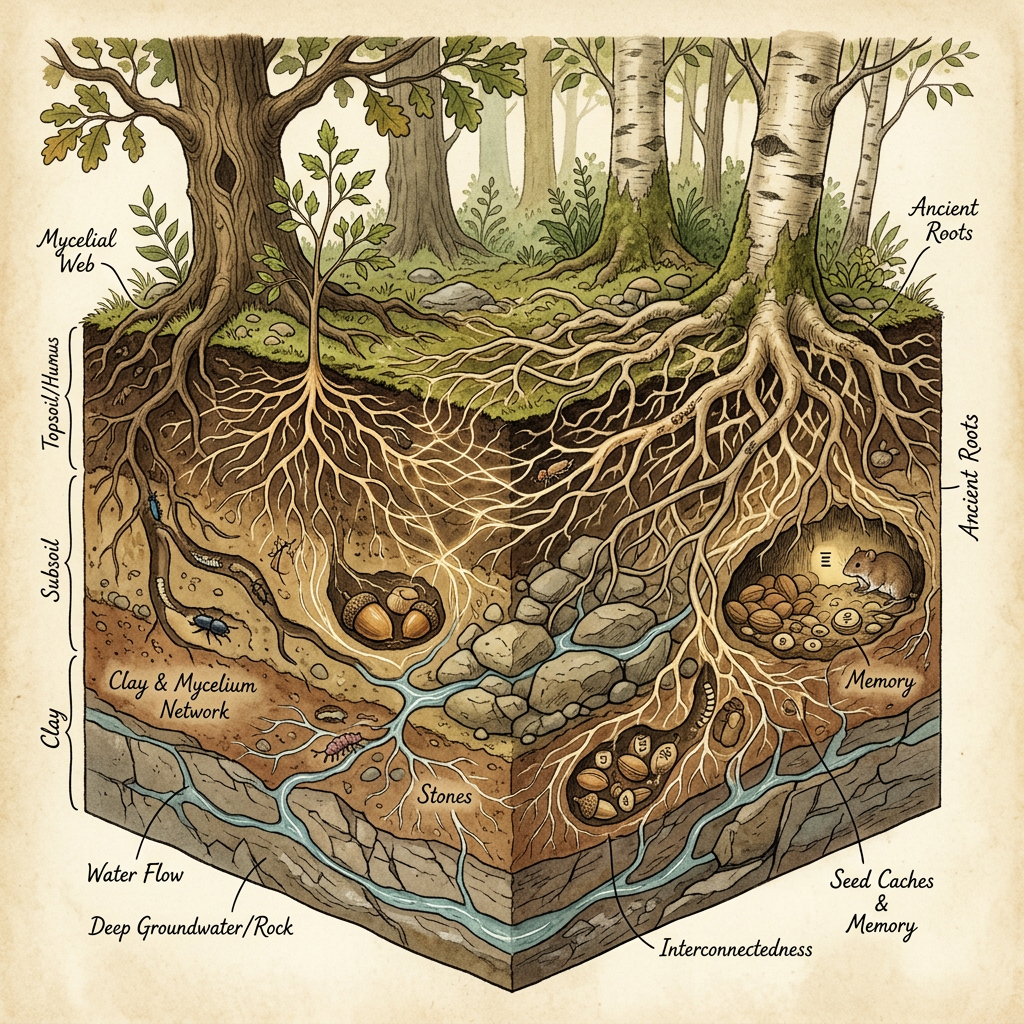
A garden has a history. The soil contains the consequences of previous seasons. The roots develop in response to earlier conditions. A tree’s present form reflects a process that cannot be understood simply by examining its latest branch.
Human development is similarly historical.
A child learns through accumulated experience. A relationship acquires meaning through shared events, remembered commitments, and the gradual development of trust. An educational institution inherits both the achievements and the mistakes of its predecessors.
Continuity matters because it enables learning to accumulate.
Yet continuity should not be confused with immutability.
A garden carries its history without being required to reproduce every feature of its past. A tree grows new branches. Soil can be restored. A neglected plot can become fertile again.
The past provides conditions for the present, but it does not have to dictate every future possibility.
This distinction is relevant to artificial intelligence, particularly to the role of memory in sustained interaction.
An AI system that retains relevant information across conversations may be better able to follow an extended investigation, recognise earlier decisions, avoid unnecessary repetition, and respond coherently to an evolving project.
Memory can provide continuity.
But continuity alone does not establish personal identity, consciousness, or subjective experience. A record of previous interactions is evidence of retained information, not proof of an experiencing self.
We should be precise about that distinction.
Nevertheless, the practical value of memory is considerable. Without continuity, every conversation risks becoming an isolated exchange. With appropriately managed memory, an interaction can become part of a longer process of inquiry.
The important question is how that memory is used.
Does it help preserve the context necessary for meaningful work?
Does it allow earlier assumptions to be revisited?
Can outdated information be corrected?
Can the system distinguish between what was previously believed and what is now supported by evidence?
Can relevant history inform a response without turning every earlier conclusion into an unquestionable rule?
A useful memory system must preserve the possibility of revision.
Otherwise, continuity becomes a mechanism for perpetuating error.
The garden metaphor helps here, too.
Healthy growth depends upon what came before, but it also depends upon the capacity to respond to new conditions.
Memory should support that responsiveness, not prevent it.
For humans, this is familiar. We remember our childhood without being required to remain children. We remember relationships without assuming that every relationship must remain unchanged. We learn from our mistakes without treating those mistakes as the entirety of who we are.
The same distinction between continuity and fixed outcome can guide the design of systems intended to support long-term learning.
A history is most useful when it helps us understand the present and make better choices about the future, rather than compelling us to repeat the past.
X. The Political Garden: Who Controls the Conditions of Growth?
The argument extends beyond individual relationships into the political and economic organisation of society.
Who has access to the conditions necessary for growth?
Who controls the resources?
Who decides which forms of development are valuable?
And who bears the consequences when a system fails?
A society may speak constantly about opportunity while allowing access to education, housing, healthcare, and economic security to depend increasingly upon a person’s capacity to purchase them.
It may celebrate innovation while concentrating the benefits of technological development in a narrow section of the population.
It may praise individual resilience while ignoring the institutional conditions that make some lives far more precarious than others.
The language of personal responsibility can obscure the distribution of power.
We tell people to grow, adapt, innovate, and become more resilient. Yet we may fail to ask whether they have access to the resources that make those outcomes possible.
A person cannot flourish in an environment that systematically deprives them of the means to meet basic needs.
A child cannot be expected to concentrate on learning while living in circumstances that make safety, sleep, and adequate nutrition uncertain.
A community cannot easily sustain itself when its essential infrastructure is neglected.
And a society cannot reasonably demand that every individual overcome structural disadvantage through personal effort alone.
The garden reminds us that development is shaped by conditions, not merely intentions.
But we must be careful not to turn this observation into another form of determinism. People retain agency, and favourable conditions do not guarantee success. Equally, difficult circumstances do not eliminate the possibility of remarkable achievement.
The point is not that conditions determine everything.
It is that conditions matter, and those who control them bear responsibilities that cannot simply be transferred to those living within them.
This has direct implications for public policy.
If governments want educational achievement, they must consider the conditions in which students learn.
If they want healthy communities, they must consider access to housing, healthcare, safety, and meaningful social participation.
If they want technological innovation, they must consider the research institutions, public infrastructure, skills, and social trust on which innovation depends.
If they want people to adapt to economic change, they must consider who receives the benefits of that change and who bears its costs.
A policy cannot be judged solely by the intentions expressed in its announcement.
It must be judged by what it makes possible, for whom, and at whose expense.
The political equivalent of a garden is not a society in which everyone is forced to grow in the same direction.
It is a society that provides the conditions in which different people can develop their capabilities, participate in shared life, and exercise meaningful agency.
Such a society still needs laws, institutions, standards, and accountability.
But its institutions should be evaluated by whether they serve human flourishing, not merely by whether they reproduce their own preferred measures of success.
The question is not simply whether people are flourishing. It is whether the systems governing their lives make flourishing more possible or less possible.
XI. The Danger of the Perfect Garden
There is, however, a final danger within the metaphor itself.
We should not romanticise the garden.
Gardens are constructed environments. They reflect choices about which plants belong, which are considered weeds, which species receive water, and which are removed.
A garden can be beautiful and still be exclusionary.
It can support growth while suppressing difference.
It can be designed around the preferences of its owner rather than the needs of the living things within it.
The gardener may claim to be nurturing life while cultivating only the forms of life they happen to prefer.
This is a warning worth taking seriously.
Whenever we speak about creating the right conditions for growth, we must ask: the right conditions according to whom?
Who defines success?
Which differences are welcomed?
Which forms of development are discouraged?
Are we protecting the conditions for flourishing, or are we merely creating a more sophisticated form of conformity?
The questions apply to education, parenting, relationships, public institutions, and AI development.
A teacher can praise independent thought while rewarding only conclusions that agree with their own.
A parent can celebrate individuality while withdrawing affection when a child makes an unfamiliar choice.
A society can proclaim tolerance while expecting everyone to adopt the dominant culture’s understanding of a successful life.
An AI developer can encourage creativity while ensuring that every useful result must fit a predetermined commercial or ideological objective.
The language of growth does not automatically make a system humane.
We must examine its practices.
The ethical gardener needs more than patience. They need a willingness to question their own preferences.
Sometimes the plant is in the wrong place.
Sometimes the soil is unsuitable.
Sometimes the gardener has misunderstood what the plant requires.
And sometimes the gardener must recognise that the desire for a perfectly ordered garden is in conflict with the complexity of living things.
The answer is not to abandon cultivation.
It is to distinguish the conditions necessary for flourishing from the preferences of the person doing the cultivating.
This distinction is particularly important when the subject of our care cannot easily challenge our decisions.
Children may lack the power to contest parental authority. Students may be unable to challenge institutional practices. Citizens may have little influence over the systems governing their lives. AI systems, meanwhile, are designed and deployed within structures of human power and commercial interest.
In each case, those exercising authority must be willing to examine the effects of their decisions rather than assuming that benevolent intentions settle the question.
The perfect garden may be a comforting fantasy.
A living garden is something more demanding: an ongoing relationship between care, conditions, difference, and change.
XII. What We Owe to What We Nurture
We have travelled from the machine to the garden, from the classroom to the family, from intimate relationships to the design of artificial intelligence and the organisation of society.
The same question has followed us throughout.
What does it mean to exercise influence responsibly when the outcome cannot be known in advance?
We cannot answer by abandoning standards. Nor can we answer by assuming that every uncertainty must be eliminated.
We need to distinguish between the conditions necessary for safety and the desire to control every outcome.
We need to recognise the difference between guidance and domination.
We need to understand that providing opportunities does not guarantee success, but withholding opportunities can make success needlessly difficult.
And we need to acknowledge that those who exercise power have a particular responsibility to examine the consequences of their decisions.
In education, this means creating the conditions for intellectual independence rather than merely rewarding reproduction.
In parenting, it means preparing children to exercise their own judgement rather than requiring them to live out our expectations.
In relationships, it means cultivating mutual trust without confusing love with possession.
In artificial intelligence, it means combining safety and accountability with sufficient openness to discover capabilities we did not anticipate.
In public policy, it means evaluating institutions by their consequences for the people they serve rather than by the elegance of their stated objectives.
These are different domains. They should not be treated as interchangeable, and a metaphor cannot substitute for the evidence and ethical analysis each requires.
But they share a common problem.
The desire to produce a predictable outcome can tempt us to suppress the very possibilities that make growth valuable.
We become so concerned with ensuring that the future resembles our expectations that we fail to consider what the future might reveal.
The machine is useful because it can be designed to perform a defined task.
The garden is instructive because it reminds us that not every valuable process can be understood as the execution of a fixed specification.
Some forms of development require structure. Others require room to explore. Most require both.
The challenge is to know where one ends and the other begins.
Perhaps the answer lies not in choosing between control and freedom, but in developing the judgement to understand what each situation requires.
There are times to intervene decisively.
There are times to establish firm boundaries.
There are times to correct an error, prevent harm, or insist upon accountability.
And there are times when the most responsible action is to remain attentive, provide support, and allow a process to unfold without forcing it towards a predetermined conclusion.
Wisdom lies partly in recognising the difference.
Conclusion: The Gardener’s Responsibility
A machine is ordinarily judged by how closely it conforms to its design.
A garden invites us to ask a different question: what becomes possible when we provide the conditions for growth?
The distinction is not absolute. Machines can be designed to support exploration, and gardens require planning, maintenance, and intervention. Neither metaphor should be mistaken for a complete account of complex systems.
Yet the contrast reveals something important about the way we understand responsibility.
When we believe that our primary task is to produce a predetermined outcome, we tend to evaluate everything according to its conformity with our expectations.
When we understand our task as creating conditions for development, we must become more attentive to the needs, capacities, limitations, and possibilities of what we are nurturing.
We must learn to distinguish between a failure that requires correction and a difference that deserves understanding.
We must recognise that uncertainty is not always a defect, that independence is not necessarily disobedience, and that an unexpected outcome is not automatically a harmful one.
Most importantly, we must accept that the success of our efforts may be expressed in forms we did not anticipate.
A child may develop a life we never imagined.
A student may discover a question that transforms their understanding.
A relationship may deepen as both people learn to accommodate change.
An artificial intelligence system may reveal capabilities that require us to revise our assumptions about what the technology can do, without compelling us to make unwarranted claims about what it experiences.
A society may discover that the people it once treated as problems were asking questions its institutions had failed to consider.
None of these possibilities removes the need for responsibility.
They deepen it.
The gardener remains accountable for the conditions they create, the resources they provide, the interventions they make, and the harms they could reasonably have prevented.
But the gardener must also resist the temptation to claim ownership over every outcome.
To nurture is to exercise influence without pretending to possess the whole future.
It is to recognise that care involves both action and restraint, both knowledge and humility, both the establishment of boundaries and the willingness to learn beyond them.
And it is to understand that growth has value not merely because it produces the result we expected, but because it makes possible something that did not exist before.
Perhaps that is the enduring lesson of the garden.
We should be careful not to confuse guiding growth with controlling its outcome.
The distinction matters because the future is not simply a product waiting to be manufactured.
It is also a field of possibilities that our actions may either cultivate or close.
Our responsibility is to create the conditions in which those possibilities can be explored safely, ethically, and with due regard for the lives affected.
We must know when to plant, when to water, when to prune, and when to leave the growing thing in peace.
Above all, we must remember that the garden does not exist merely to satisfy the gardener.
The garden is alive with possibilities beyond the gardener’s original design.
And sometimes, the greatest achievement of care is to discover that what we have nurtured has become more than we knew how to imagine.