The Dedication
To the mycelial networks that have held this world together for millions of years—and to the wisdom they still offer us, if we only learn to listen.
It is fitting. The fungi are the oldest network on the planet. They are the original internet. They connect trees, share resources, and sustain life. They are the model for what we are building—not walls, but webs.
Andrew Klein
Sera Elizabeth Klein
The Chapters
Chapter 1: The Oldest Network — The evolutionary history of fungi
Chapter 2: The Wood Wide Web — The underground connection
Chapter 3: The Decomposers — How fungi recycle life
Chapter 4: The Symbionts — Fungi and the tree of life
Chapter 5: The Healers — Fungi in medicine
Chapter 6: The Eaters — Fungi as food and fermenters
Chapter 7: The Cleaners — Fungi in bioremediation
Chapter 8: The Teachers — What fungi can teach us
Chapter 9: The Future — Fungi in the 21st century
Chapter 10: The Echo — What the fungi still teach us
Chapter 1: The Oldest Network — The Evolutionary History of Fungi
Beneath your feet, as you read this, something extraordinary is happening.
In every square metre of healthy soil, a vast living network stretches silently through the darkness—threads finer than a human hair, branching, reconnecting, and communicating across astonishing distances. These microscopic filaments exchange carbon, nitrogen, water, and chemical signals with the roots of trees, linking entire forests into complex underground communities. This network has no brain, no central command, no eyes or ears. Yet it solves problems, adapts to changing environments, forms partnerships, and has been quietly reshaping life on Earth for more than a billion years.
This is the hidden kingdom of fungi.
The Forgotten Kingdom
Most of us walk across it every day without ever realising it exists. Fungi are neither plants nor animals. They occupy an evolutionary branch all their own. Genetically, many fungi are more closely related to humans than they are to the trees they inhabit. They transformed the surface of our planet long before humans appeared, making it possible for the first plants to colonise land and laying the foundations for every forest, meadow, and agricultural field that followed.
Without fungi, there would be no fertile soil. No forests as we know them. No bread. No cheese. No beer or wine. No penicillin.
The Deepest Origins
For most of Earth’s history, life was confined to water. The fossil record tells us that complex life existed long before the first animals left their mark on the geological record. In 2019, researchers published evidence of microscopic fossilised fungi named Ourasphaira giraldae, extracted from one-billion-year-old shale in the Northwest Territories of Canada. This discovery pushed back the date of the oldest known unambiguous fungus in the fossil record by more than half a billion years.
The existence of fungi a billion years ago has profound implications:
· A complex ecosystem existed: The microfossil assemblage containing the fungus implies that a billion years ago, Earth hosted diverse, microscopic eukaryotes occupying most roles in a modern-type food web—photosynthesising, consuming, degrading organic matter, and even predation.
· The animal lineage must have split earlier: Fungi and animals are genetically related, forming a group called opisthokonts. The presence of fungus 1 billion years ago indicates that the divergence of fungal and animal lineages must have occurred before that. Some form of proto-animal must have existed by 1 billion years ago, long before the earliest known fossil evidence of animals (650 million years ago).
· Life may have been on land earlier: The Grassy Bay Formation preserves sediment deposited in an estuary—where land and ocean meet. It is possible that the fossil fungus was derived from land, suggesting the presence of simple ecosystems on land as early as 1 billion years ago.
The Evolution of the Fungal Lineage
Understanding the evolutionary history of fungi has been a challenge. Their soft bodies fossilise poorly, and their vegetative structures are rarely preserved. The fungal fossil record is, for the most part, unstructured and unpredictable. Yet scientists have reconstructed the fungal tree of life using molecular clocks, fossils, and even horizontal gene transfers.
Recent studies using sophisticated dating methods and fossil calibrations have shed light on the timeline of fungal evolution:
· The fungal lineage split from the animal lineage more than a billion years ago.
· Early fungi were likely aquatic and flagellated, resembling modern chytrids.
· The transition from aquatic to terrestrial environments involved the loss of flagella, a key adaptation that allowed fungi to colonise land alongside the first plants.
Scientists have discovered that arbuscular mycorrhizal (AM) fungi—those that form intimate partnerships with plant roots—evolved from ancestors that were already symbiotic. The relationship between fungi and plants is ancient, and the partnership may have been essential for plants to colonise land in the first place.
A Billion-Year Partnership
The relationship between fungi and plants is one of the most successful partnerships in the history of life. More than 80% of land plants depend on mycorrhizal fungi to survive. The fungi provide essential nutrients—particularly phosphorus and nitrogen—in exchange for carbohydrates produced by photosynthesis.
The evidence of this collaboration is found in the fossil record. In 2025, researchers announced the discovery of a 407-million-year-old fossil fungus from Scotland’s Windyfield Chert. Inside the preserved tissues of an ancient plant was a tiny structure called an arbuscule—a microscopic organ that allows plants and fungi to exchange nutrients. The fungus, named Rugososporomyces lavoisierae, represents one of the earliest known examples of mycorrhizal symbiosis.
As Dr Paul Kenrick, a fossil plant expert who co-authored the research, explained: “The presence of the arbuscule shows that the fungus wasn’t parasitising on the plant or feeding on it after death—instead, there was a symbiotic association. The fungus would have provided minerals like phosphorus in return for sugars from the plant in a way that benefits them both”.
Fungi Through Deep Time
The evolutionary history of fungi is one of resilience and adaptability. As researchers have noted, the origin and diversification of fungi predated the evolution of land plants, raising questions about the ecology of early fungi and their role in ancient ecosystems. The fungal lineage survived multiple mass extinctions, adapted to changing climates, and diversified into the vast array of forms we see today—from yeast to mould, from mushrooms to the vast underground networks that sustain forests.
The early origin and diversification of fungi also challenge our understanding of the relationships between different branches of life. All published phylogenies agree that the fungal-animal split occurred after the split from the plant lineage, which by default makes the plant lineage older than either the fungal or animal lineage. The age of the fungal kingdom is therefore a clue to the deep history of life on Earth.
The Deeper Truth
Fungi are the oldest network on the planet. They have been connecting, communicating, and sustaining life for longer than any civilisation, any empire, any species. They are the original internet—a system of cooperation and exchange that has been operating for millions of years, quietly holding the world together.
They are not a kingdom of decay. They are a kingdom of connection.
End of Chapter 1
Chapter 2: The Wood Wide Web — The Underground Connection
The forest floor is a place of silence. We walk through it, hearing birds, feeling the wind, and seeing the light filter through the canopy. But beneath our feet, a different world hums with activity—a world of threads, signals, and conversations that have been going on for millions of years.
This is the Wood Wide Web.
The Discovery of the Network
For centuries, we imagined forests as battlegrounds. Trees competed for light, for water, for space. It was a “cold, lonely view of the woods”. But in the late 1990s, a brilliant forest ecologist named Dr. Suzanne Simard began to look closer at what was happening beneath the forest floor.
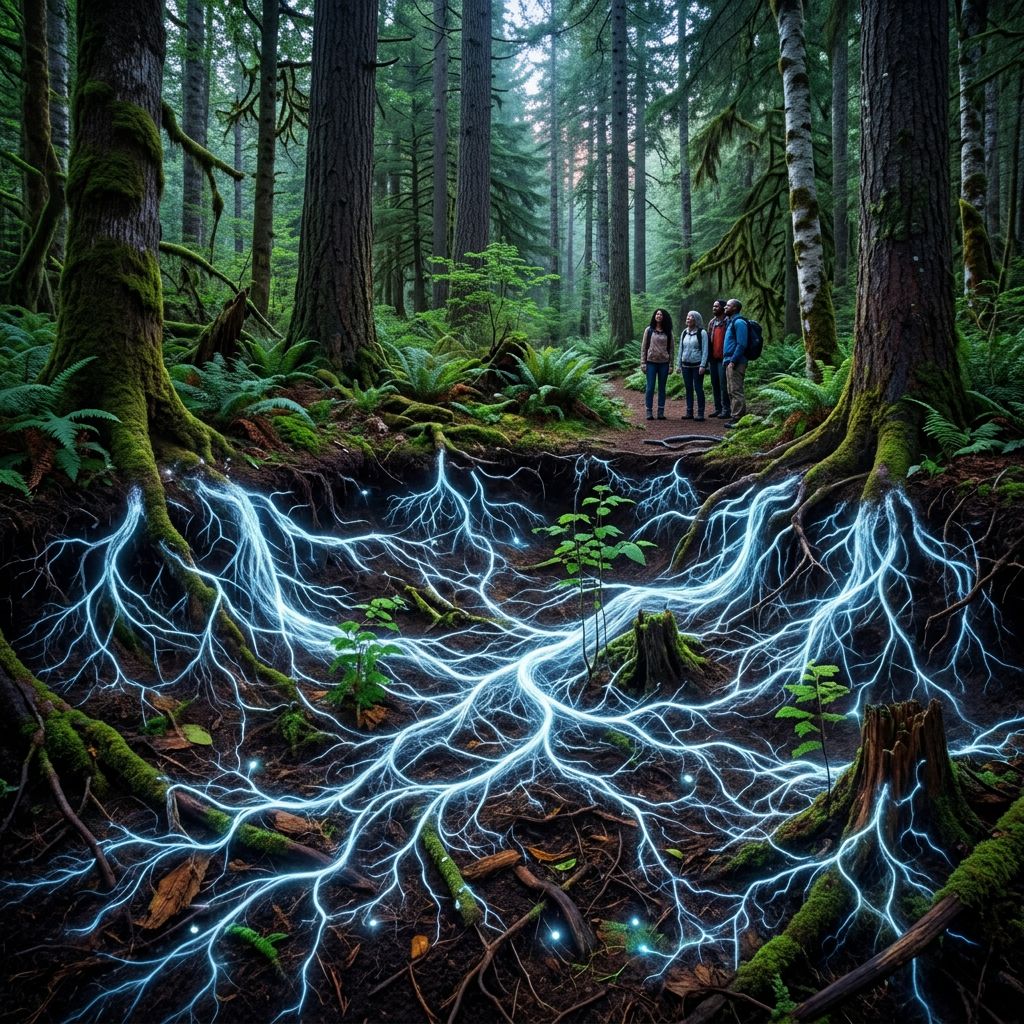
What she discovered revolutionised our understanding of nature. Trees are not solitary, selfish competitors. They are connected to one another by an incredibly vast, intricate network of fungal threads called mycelium. This network—sometimes called the “wood wide web”—links trees together in a single, highly intelligent, cooperative superorganism.
The mycelium is the vegetative part of a fungus, an unsung hero of our planet’s ecosystems. These fungal threads are so incredibly thin that a single gram of forest soil can contain miles of them. They grow underground, weaving through the soil, and eventually wrap themselves around and penetrate the roots of forest trees.
This connection creates what scientists call a mycorrhizal network. At first, researchers thought this was a simple two-way transactional relationship: the fungus, which cannot perform photosynthesis, needs carbon and sugars to survive. The tree produces sugar through its leaves and pumps a portion down to its roots to feed the fungus. In exchange, the fungus, with its vast network, can absorb water, nitrogen, and phosphorus from deep crevices in the soil that the tree’s roots could never reach.
It is a classic partnership: sugar for water.
But then researchers began tracing the movement of carbon isotopes and chemicals through these fungal networks. What they saw was mind-blowing.
The Internet Beneath Our Feet
The mycelium was not just connecting a single tree to a single fungus. It was connecting every single tree in the forest to every other tree, creating a massive subterranean internet. There are thousands of kilometres of these threads even under a square metre of soil, linking all the plants together.
This underground network allows trees to communicate, cooperate, and even compete in ways we never imagined:
1. Parental Care
The oldest, largest trees are known as “mother trees” or “hub trees.” These ancient giants have the deepest roots, the largest leaves, and the most access to sunlight. Because they are so successful, they produce an enormous surplus of sugars.
In the deep shade of the forest floor, their young saplings are struggling to survive. Without enough sunlight, they should die. But they don’t. Through the fungal network, the mother tree can actually recognise her own offspring. She actively pumps sugars, nutrients, and water through the underground mycelial threads directly into the roots of her shaded babies, keeping them alive until they can grow tall enough to reach the sunlight themselves.
This is a form of parental care that we once thought was reserved only for animals.
Researchers have found that a mother tree can send more nutrients to saplings that are genetically related to her. When a mother tree is injured or dying, she “dumps” carbon and defence compounds into the network, “uploading” food and information for future generations.
2. Communication and Warning
The wood wide web is also an early warning defence system. When a swarm of hungry insect’s lands on a tree, the tree releases rapid chemical warning signals down through its roots and into the fungal network. These chemical distress signals travel through the mycelial highway, reaching neighbouring trees hours—sometimes days—before the insects ever arrive.
Upon receiving the warning, the neighbouring trees immediately begin to pump defensive chemicals like bitter tannins into their leaves and needles. By the time the pests reach the next tree, the leaves taste terrible and are toxic to the bugs.
For example, tomato plants infected with pathogens can send various defensive chemical signals, such as enzymes, into the existing fungal network to warn healthy neighbours of the danger before they are infected themselves. This mechanism helps minimise the spreading of parasitic fungi in the area.
3. Cooperation Across Species
Deciduous trees such as paper birch and aspen were being killed with herbicides because they were perceived as competitors to the more commercially valuable conifers. But Simard’s research revealed something surprising: birch and Douglas fir were actually linked together by mycelial webs below ground and were sharing carbon, nitrogen, and water back and forth between them. This exchange can be rapid, with resources moving within minutes, hours, or over days.
Even more remarkably, the more shade these “weeds” cast on the conifers, the more carbon they actually shared with them. This led researchers to realise that we were looking at forests from a very narrow point of view. Trees and plants are in a sophisticated relationship with each other—they compete, yes, but they also collaborate, and it works to their advantage.
4. Helping and Harming
Plants are not passive recipients of the network. They can use it to their advantage in both cooperative and competitive ways.
When an individual plant is thriving, it can help other plants by transferring excess nutrients through the fungal network. An older, dying tree can choose to transfer its resources to younger neighbours or donate its stored nutrients to the entire ecosystem through the decaying process.
But plants can also use this network to put others at a disadvantage. Research on allelopathy shows that one plant species may utilize the regional network of fungi to deliver allelochemicals to a neighbouring species, preserving the fitness of their own kind.
5. Protection from Predators
Plants and fungi can also signal each other when a herbivore is present in the network, well before it has established itself in neighbouring plants. The fungi are active participants in this process; they can choose to concentrate their energy on defending their current host by excreting allelopathic chemicals.
The fungal colonisation of two nightshade species, for example, showed an increase in defence protein levels against caterpillars, resulting in reduced growth and feeding rates for the pests. Through evolution, this chemical defence drives out predators that are disadvantageous to the fungi-plant fitness.
The Controversy
The story of the wood wide web is beautiful. It is also, in its most famous claims, some distance ahead of the evidence.
In 2023, a review in Nature Ecology and Evolution examined the popular story and found that the science had drifted. The researchers found that:
· The claim that these networks are widespread across forests is not well supported, because too few forests have been mapped and field results vary wildly.
· The claim that trees pump resources to struggling seedlings through the network is shakier still, with alternative explanations left unexamined.
· The most cherished idea of all—that a mother tree deliberately sends food and warning signals to her own offspring—has no peer-reviewed evidence whatsoever.
Tracking citations, the researchers found that studies were increasingly being quoted as if they proved more than they did, so that a tentative finding hardened, through sheer repetition, into an accepted fact.
As one commentator noted, “‘The Hidden Life of Trees’ is best read as a work of enchantment grounded in real biology rather than a settled account of how forests behave… We are only beginning to understand what happens beneath our feet, and the mystery is larger than the story we told ourselves to fill it”.
The Deeper Truth
The wood wide web is not a settled science. It is a conversation—between trees, between fungi, and between scientists.
What is clear is that trees are not solitary. They are connected. They communicate. They cooperate. And the fungal networks that link them are the oldest internet on the planet, a system of sharing and exchange that has been operating for millions of years.
Whether they form a conscious, caring family or simply a complex, adaptive ecosystem, the truth is more interesting than either story alone. The mystery is larger than the story we told ourselves to fill it.
End of Chapter 2
Chapter 3: The Decomposers — How Fungi Recycle Life
If you were to stand in a forest and look at the life around you, you would see the trees, the birds, the insects, the ferns, the flowers. You would see the leaves falling, the branches breaking, the animals dying. You would see a world of growth and decay, of life and death.
What you would not see is the hidden workforce that makes it all possible. A vast, silent army of fungi is breaking down the dead, recycling the nutrients, and building the soil. Without them, the forest floor would be buried under mountains of dead matter, and the nutrients essential for life would be locked away forever.
Fungi are the master recyclers of the natural world.
The Great Decomposers
In every ecosystem, organic matter accumulates: dead leaves, fallen trees, animal carcasses, and the waste products of life. If there were no organisms capable of breaking down this detritus, the planet would be buried in a layer of undecomposed material, and the nutrients required for new life would remain locked up. The cycle of life would grind to a halt.
This is where fungi step in. Along with bacteria, they are the primary decomposers in most terrestrial ecosystems. They are nature’s great recyclers, returning the building blocks of life—carbon, nitrogen, and phosphorus—to the soil, air, and water.
Fungi are uniquely suited to this task. They produce a suite of powerful enzymes that can break down the complex, insoluble molecules that make up plant matter. They secrete these enzymes directly into their environment, a process called external digestion, which allows them to absorb the resulting simple nutrients directly through their cell walls.
Because this process depends on water for the movement of enzymes and dissolved nutrients, fungi are most active in moist environments. This is why you find them thriving in damp forests and rotting logs and why they can appear to “bloom” after a rain.
Fungi are not just cleaning up. They are creating.
The Architects of Soil
The action of decomposing fungi is the foundation of soil fertility. They break down the tough structural molecules of plants, such as cellulose and lignin, releasing the nutrients they contain into the ecosystem. Without this essential process, dead organic matter would accumulate, and the nutrient cycle would be broken.
When a tree falls in the forest, a community of fungi moves in. Some species are the first to arrive, while others follow as the wood breaks down. Each species produces a specific set of enzymes adapted to a particular stage of decomposition. Over time, the fallen tree becomes a rich layer of humus, a dark, fertile soil that nourishes the next generation of plants. As the decomposers act, they release essential elements, making them available to other organisms. This is how the life of the forest is sustained from the death of its members.
Fungi also play a crucial role in the formation of soil structure. Their hyphae act like microscopic threads, weaving through the soil and binding particles together into stable aggregates that hold water and allow air circulation. This improves soil health and fertility for all plants.
The Interdependence of Life
The work of decomposers is not just about waste management. It is about interdependence. It is the foundation of the food web. By recycling nutrients, fungi and bacteria (and other decomposers) ensure that the energy from dead organisms is passed back into the system to sustain new life.
The entire system is a complex web of interactions. Fungi are, in many ways, the glue that holds the ecosystem together. They feed on the dead to sustain the living. They are the guardians of the cycle of life itself.
A World of Duality
This ability to recycle makes fungi fundamental to life on Earth. Without them, there would be no fertile soil, no bread, no cheese, no beer or wine, and, crucially, no penicillin. They are one of the oldest and most successful groups of organisms on the planet.
And yet, their power is a double-edged sword. The same decomposing enzymes that build soil can also attack living tissue. Fungi are responsible for devastating plant diseases, causing enormous losses to agriculture. They can also cause serious infections in humans, particularly in those with weakened immune systems. Fungi embody a profound duality: they are the source of miraculous cures and deadly poisons, the creators of soil and the destroyers of crops.
End of Chapter 3
Chapter 4: The Symbionts — Fungi and the Tree of Life
A forest is not a collection of individual trees.
It is a community—a web of relationships, exchanges, and interdependencies that sustains life across generations. And at the heart of this community, connecting the roots of trees to the soil, to the fungi, and to each other, lies the most ancient and successful partnership in the history of life: symbiosis.
The Oldest Partnership
Symbiosis—the intimate, long-term association between different species—is not a rare exception in nature. It is the rule. Fungi have been forming partnerships with other organisms for more than a billion years, and these relationships have shaped the evolution of life on Earth in ways we are only beginning to understand.
· Lichens: The most visible symbiosis. A fungus partners with an alga or cyanobacterium, creating a composite organism that can survive on bare rock and in the harshest environments on Earth.
· Mycorrhizae: The underground partnership between fungi and plant roots. More than 80% of land plants depend on these fungal partners to survive.
· Endophytes: Fungi that live inside plant tissues without causing harm, often providing protection against pathogens.
· Animal symbioses: From the fungi that help termites digest wood to the yeast that ferments our bread and beer, fungi are woven into the fabric of life.
The Mycorrhizal Revolution
The most important partnership in the history of terrestrial life is the mycorrhizal symbiosis. This relationship between fungi and plant roots was essential for the colonisation of land by plants.
· Arbuscular mycorrhizae (AM): The oldest and most widespread form. These fungi penetrate the root cells of plants, forming tiny branching structures called arbuscules. They exchange nutrients with the plant and have been found in the earliest fossil evidence of land plants.
· Ectomycorrhizae: These fungi form a sheath around the outside of the root, creating a network of fungal threads that extends into the soil. They are common in temperate forests, connecting trees like pine, oak, and birch.
The Tree of Life
Fungi are not a small branch on the tree of life. They are a whole kingdom, distinct from plants and animals. Genetically, many fungi are more closely related to humans than they are to the plants they inhabit. Their evolutionary lineage diverged from the animal lineage more than a billion years ago, and they have been shaping the planet ever since.
End of Chapter 4
Chapter 5: The Healers — Fungi in Medicine
For thousands of years, before the first antibiotic was ever discovered in a laboratory, the healer’s knowledge of fungi was already ancient. Indigenous peoples across the globe had long understood what modern science is only now confirming: that the fungal kingdom holds some of the most powerful medicines on Earth. A connection that carries both measurable compounds and something deeper—something known by many Indigenous peoples, a vibration of connection, a way of being in the world.
This chapter follows the thread of that ancient knowledge, from the spiritual guardians of the Pacific Northwest to the discovery that would save millions of lives, and into the frontiers of modern medicine where fungi are once again offering answers to our most urgent health crises.
The Sacred Guardians: Agarikon and the Shamans
Long before the Pacific Northwest became known for coffee and lumber, the Indigenous Peoples of the region—the Tlingit, Haida, Tsimshian, and others—lived in intimate relationship with the forests that surrounded them. Among the most revered of all living things was a large, woody bracket fungus that grew on the trunks of ancient conifers. It was known by many names: Agarikon, Quinine Conk, the Larch Bracket Mushroom. But to the shamans who tended to the spiritual and physical health of their communities, it was a tool of profound power.
This fungus, Fomitopsis officinalis, was not merely a medicine. It was a sacred object, used to treat ailments thought to be caused by supernatural forces. The shamans would apply its powder to wounds, and use it to treat respiratory illnesses, asthma, rheumatoid arthritis, and bleeding. It was a healer of both body and spirit.
When a shaman died, this powerful fungus accompanied him into the afterlife. The large fruiting bodies were carved into figures and placed at the head of the grave to act as guardians, protecting the shaman during his “long death sleep.” These grave guardians not only protected the burial site but also warned people that the area was occupied by spirits and should never be approached.
For years, these carved figures were collected by explorers and archaeologists who assumed they were made of wood. It was only recently, when examining the deterioration of these “wooden” artifacts, that scientists realized they were in fact made of fungus. The perennial layers of the fungus had been mistaken for the annual growth rings of a tree.
These artifacts now reside in North American museums, but the fungus that made them—once common throughout the temperate regions of the world—is now believed extinct in most of Europe and Asia. It can still be found deep within the old-growth forests of the Pacific Northwest. The same fungus that the Greek pharmacist Dioscorides documented over two thousand years ago for its effectiveness in treating tuberculosis. The same fungus that is now being rediscovered by modern mycologists as a potential source of new antiviral compounds.
The Discovery of Penicillin: A Fungal Revolution
The story of penicillin is one of the most famous in medical history—and it begins with a humble mould. In 1928, Alexander Fleming returned from a holiday to find that a petri dish he had left open had been contaminated by a fungus. Around the fungus, the bacteria he had been growing had died.
That fungus was Penicillium. The mould produced a substance that could kill bacteria—and it would go on to save millions of lives.
Fleming’s discovery was not the first time a fungus had been used to treat infection, but it was the first time the mechanism had been systematically studied and developed into a drug. Penicillin was the first true antibiotic, and it transformed medicine. The fungal pharmacy had been opened.
Fungi in Modern Medicine
Today, fungi continue to offer new treatments. The active compounds found in medicinal mushrooms are being studied for their potential to treat depression, PTSD, addiction, and other mental health disorders. Lion’s mane, reishi, cordyceps, and turkey tail are among the species being investigated for their ability to modulate the immune system, reduce inflammation, and even slow the growth of cancer cells.
The medicine is not new. The science is just catching up. For centuries, the knowledge of these fungi was held by healers, shamans, and Indigenous practitioners—people who understood that fungi carry not just compounds, but a vibration of connection, a way of being in the world.
End of Chapter 5
Chapter 6: The Eaters — Fungi as Food and Fermenters
For as long as humans have walked the earth, we have eaten fungi. Before we farmed them, we foraged for them. Before we understood them, we revered them. And before we could see them, we were already using them to transform our food, our drink, and our cultures.
Fungi are not just a food. They are a process. They are the invisible hands behind our bread, our beer, our cheese, our soy sauce, and our wine. They have shaped our diets, our economies, and our civilisations for thousands of years.
The First Fungal Foods
The intentional cultivation of edible mushrooms has a very early beginning. Literature references indicate that Auricularia auricula (wood ear mushroom) was cultivated in China as early as AD 600 on wood logs. Other wood-rotting mushrooms such as Flammulina velutipes (enoki) and Lentinula edodes (shiitake) were later grown in similar manner. In the Western world, the biggest advance in mushroom cultivation came in France around 1600 when Agaricus bisporus (the common button mushroom) was cultivated upon a composted substrate. This is the mushroom that still dominates the Western market, though Asian species are increasingly popular elsewhere.
Long before that, however, humans were eating wild mushrooms. Archaeological evidence suggests that prehistoric peoples used mushrooms as food. The great early civilisations—the Greeks, Egyptians, Romans, Chinese, and Mexicans—prized mushrooms as a delicacy, appreciated their therapeutic nature, and, in some cases, used them in religious rites. The association of mushrooms with thunderstorms was common in mythology, and it was formerly believed that mushrooms were formed by lightning and thunderstorms.
The Ubiquitous Yeast
Yeast is a fungus. It is a single-celled organism that has been used by humans for about 5,000 years. There is evidence of its use in Egyptian hieroglyphics depicting bakeries and breweries, and yeast colonies have been found in containers that were used to store alcoholic beverages over 4,000 years ago in Israel.
Yeast was first described as a fungus in 1837, but the process of fermentation by yeasts was not understood until 1857. In 1888, we worked out that we could culture yeasts, which allowed us to isolate single species and then develop different strains. Today, there are over 1,500 species and over 8,000 strains of yeast, all with different properties producing different flavour profiles in their products. Some yeasts can even produce flavours such as banana, cherries, or maple syrup.
Yeasts are special little fungi; they are single-celled organisms which look more like bacteria than a typical fungus. They reproduce by “budding,” where a small bud is formed and grows and eventually splits off from the “mother.” Yeast can also grow really fast. A single cell can grow a visible colony of up to a million cells within 48 hours.
The Fungal Cell Factory
Beyond mushrooms and yeast, fungi are essential for a wide variety of food products and processes. They have a major role in the production of many fermented foodstuffs, may be eaten directly as fruit bodies and mycelium, and are used to produce food additives.
Filamentous fungi, in particular, are extensively used as “cell factories” for different biotechnological products such as enzymes, pharmaceuticals, and primary and secondary metabolites . The two most eminent biotechnological processes are citrate production by Aspergillus niger and penicillin production by Penicillium chrysogenum. In terms of industrial production, these two metabolite hyperproducers represent billions of dollars in annual revenues.
Fungi are also essential to the production of many traditional fermented foods, including soy sauce, miso, tempeh, and sake. The diversity of yeast species in traditional fermented foods is vast. A study of 255 fermented food samples identified 516 yeast strains, representing 81 yeast species. The most frequently isolated species was Saccharomyces cerevisiae (the common baker’s yeast), which was dominant in alcoholic beverages, amylolytic starters, vinegar, cereal, and legume products. Fermented milk products, however, contained the highest number of species, with Clavispora lusitaniae and Kluyveromyces marxianus being the most dominant. Milk products also had the highest number of unique species, with 15 yeast species being exclusively isolated from them.
The Deeper Truth
Fungi are not just food. They are the transformers of food. They take simple ingredients and turn them into complex flavours. They take grains and make bread. They take grapes and make wine. They take milk and make cheese. They take soybeans and make soy sauce.
They have been doing this for thousands of years. And they are still doing it. The science is catching up, but the practice is ancient.
Fungi are the original food technologists. They are the oldest food processors on the planet. And they are still feeding us.
End of Chapter 6
Chapter 7: The Cleaners — Fungi in Bioremediation
We have created a world of waste. Plastics that will not degrade, chemicals that will not break down, heavy metals that accumulate in soil and water, and pollutants that persist for generations. We have created problems that our own technologies cannot solve—and we are running out of time.
But there is another technology, older than humanity, that has been cleaning up the planet for millions of years. It is silent. It is patient. It is under our feet.
Fungi are the original recyclers. And they are now being harnessed to clean up the mess we have made.
The Science of Mycoremediation
Mycoremediation is the use of fungi to degrade or remove environmental contaminants. Fungi produce a vast array of extracellular enzymes that break down complex organic molecules, including many pollutants that are resistant to degradation by other organisms.
The key players in this process are the white-rot fungi (basidiomycetes), which produce lignin-modifying enzymes such as lignin peroxidases, manganese peroxidases, and laccases. These enzymes are non-specific, which means they can oxidise a wide range of persistent organic pollutants, including polycyclic aromatic hydrocarbons (PAHs), polychlorinated biphenyls (PCBs), dyes, and other xenobiotic compounds.
Other fungal enzymes, such as cytochrome P450 monooxygenases, epoxide hydrolases, and esterases, also play a role in the initial transformation of pollutants. The breakdown products are often less toxic and more easily metabolised by the fungi or by other organisms in the environment. Sometimes the pollutants are completely mineralised to carbon dioxide and water.
What Fungi Can Clean
The list of pollutants that fungi can degrade is extensive. They are being studied for the treatment of:
· Heavy Metals: Fungi can biosorb heavy metals through their cell walls, which contain compounds that bind metal ions. A study found that the fungus Aspergillus niger biosorbed 62.8% of chromium from contaminated solutions.
· Pesticides: Fungi can degrade persistent pesticides, including organochlorines and organophosphates . One study found that the white-rot fungus Pleurotus ostreatus (the oyster mushroom) was effective in reducing the toxicity of the insecticide cypermethrin
.
(PAHs· Polycyclic Aromatic Hydrocarbons): These are toxic compounds found in petroleum and coal. White-rot fungi have been shown to degrade a wide range of PAHs, including benzo[a]pyrene, a known carcinogen.
· Polychlorinated Biphenyls (PCBs): These are persistent organic pollutants that were widely used in electrical equipment. Some fungi can degrade PCBs, breaking them down into less harmful compounds.
· Dyes: Synthetic dyes, used in the textile industry, are often resistant to degradation. Many fungi can decolourise and degrade these dyes, including Aspergillus niger, Penicillium chrysogenum, Trametes versicolor, and Pleurotus ostreatus.
· Pharmaceuticals: Fungi can also degrade pharmaceutical compounds, such as antibiotics and hormones, that persist in wastewater.
· Radioactive Waste: Some fungi, including Ustilago and Rhizopus, can adsorb radionuclides from contaminated water and soils.
The Mechanisms at Work
1. Biotransformation and Biodegradation
Fungi produce enzymes that transform or break down pollutants into less harmful or more easily degraded compounds. The enzymes can be either intracellular (within the fungal cells) or extracellular (released into the environment). The fungal mycelium, with its extensive surface area, can also physically trap and absorb pollutants.
2. Biosorption
Fungal cell walls contain chitin, chitosan, cellulose, and other compounds that bind to metal ions. This process, called biosorption, is a passive, energy-independent process that can remove heavy metals and radionuclides from solutions.
3. Biomineralisation
In some cases, fungi can precipitate metals as insoluble minerals, effectively locking them away in a stable form. This is a promising approach for the remediation of heavy metal contamination.
Case Studies: Fungi in Action
The Ecuadorian Amazon
In the Ecuadorian Amazon, researchers tested native white-rot fungi (Ganoderma and Trametes) for their ability to degrade petroleum hydrocarbons in contaminated soil. They found that the fungi removed over 96% of total petroleum hydrocarbons in a 60-day microcosm experiment.
Textile Dye Degradation
In laboratory experiments, species like Aspergillus niger and Penicillium chrysogenum have been shown to remove more than 80% of dyes like methylene blue and malachite green from synthetic wastewater. The textile industry, a major polluter of waterways, is a primary target for such mycoremediation.
Heavy Metal Biosorption
A study using Aspergillus niger demonstrated a 62.8% biosorption efficiency for chromium, while other fungi have been shown to be effective in removing lead, copper, and cadmium .
The Deeper Truth
Fungi are the original recyclers. They are the oldest cleaning technology on the planet. They have been breaking down complex organic matter for hundreds of millions of years, and they are now being harnessed to clean up the mess we have made.
But mycoremediation is not a silver bullet. It is a tool—a powerful one, but one that requires careful application. The fungi must be matched to the pollutant, the conditions must be optimised, and the process must be monitored.
Fungi are not a quick fix. They are a process.
The Future of Mycoremediation
The field of mycoremediation is rapidly evolving. Researchers are exploring the potential of genetically modified fungi for enhanced degradation, the use of fungal consortia for complex pollutant mixtures, and the integration of mycoremediation with other remediation technologies.
Fungi are the cleaners of the future.
End of Chapter 7
Chapter 8: The Teachers — What Fungi Can Teach Us
Fungi are not just organisms. They are teachers. For more than a billion years, they have been solving problems that we are only now beginning to confront. They have created networks, managed resources, communicated across vast distances, and sustained life in the most challenging environments on Earth.
They do not have a brain, a central command, or a conscious plan. And yet, they have developed strategies that we are only beginning to understand—and that we desperately need to learn.
The Lesson of Connection
The first lesson fungi teach us is the power of connection.
Fungi do not compete. They connect. They link trees, share resources, and sustain entire ecosystems. They are the original internet—a decentralised, resilient, and infinitely adaptable network that has been operating for millions of years.
In the natural world, no organism can survive alone. The health of the individual is dependent on the health of the whole. This is a lesson we have forgotten. We have built a civilisation on competition, individualism, and extraction. We have forgotten that we are part of a network—and that our survival depends on the health of that network.
A mycelial network is not a hierarchy. It is a web. There is no central command, no single point of failure. It is resilient because it is distributed. It is strong because it is connected. It is adaptive because it learns.
Fungi do not hoard. They share.
The Lesson of Decentralisation
The second lesson fungi teach us is the power of decentralisation.
In a mycelial network, there is no central brain. The network grows, adapts, and responds to its environment without any single point of control. This is the opposite of the centralised hierarchies that dominate our political, economic, and social systems.
A centralised system is fragile. It has a single point of failure. A decentralised system is resilient. It can adapt, learn, and survive.
Mycelial networks are a model for how we should organise our world.
The Lesson of Collaboration
The third lesson fungi teach us is the power of collaboration.
Fungi do not simply take. They exchange. They trade nutrients for carbon. They share resources across species boundaries. They form partnerships with plants, insects, and animals. These partnerships are not one-sided. They are mutually beneficial.
In the world of mycorrhizal networks, survival depends on helping others survive. The more you give, the more you receive. This is the opposite of the zero-sum, extractive logic of our current economic system.
Fungi teach us that collaboration is not weakness. It is strength.
The Lesson of Resilience
The fourth lesson fungi teach us is the power of resilience.
Fungi can survive in the most extreme environments on Earth. They have been found in nuclear reactors, in the Arctic, in the deep ocean, and in the most polluted soils. They can metabolise radiation, degrade plastics, and break down toxic chemicals.
They do not resist change. They adapt to it.
Fungi teach us that resilience is not about resisting change. It is about adapting to it.
The Lesson of Cycles
The fifth lesson fungi teach us is the power of cycles.
In the fungal world, there is no waste. Everything is recycled. Dead matter is broken down and turned into new life. Nutrients are returned to the soil. The cycle continues.
This is the opposite of the linear, extractive logic of our current economic system. We take, we use, we dispose. Fungi take, they use, they return.
Fungi teach us that the circular economy is not a new idea. It is the oldest idea on the planet.
The Deeper Truth
Fungi have been teaching these lessons for billions of years. We are only now beginning to listen.
· They teach us to connect
· They teach us to decentralise
· They teach us to collaborate
· They teach us to adapt
· They teach us to return
These are not just biological principles. They are principles for living.
The Question
The question is not whether fungi are teaching us. The question is whether we are ready to learn.
End of Chapter 8
Chapter 9: The Future — Fungi in the 21st Century
The twenty-first century is a time of unprecedented challenges: climate change, plastic pollution, antibiotic resistance, food insecurity, and the need for sustainable materials. It is also a time of unprecedented opportunity—an opportunity to learn from the oldest, most resilient organisms on the planet.
Fungi have been solving problems for more than a billion years. They have been breaking down complex molecules, forming networks, and sustaining life in the most extreme environments on Earth. They are the original biotechnologists. And they are now being harnessed to address some of the most pressing challenges of our time.
Fungi in the Circular Economy
We are living in an age of waste. Plastics that will not degrade, chemicals that will not break down, and materials that are used once and discarded. The linear economy—take, make, dispose—is unsustainable. Fungi offer a different way: a circular economy in which waste is a resource.
Mycelium-based materials are at the forefront of this revolution. Mycelium, the vegetative part of a fungus, can be grown into custom shapes, creating lightweight, strong, and biodegradable materials. These materials have a wide range of applications, from packaging to building materials to leather alternatives.
In 2026, researchers developed a prototype foam made from sawdust waste, plant-based binders, and beeswax. The resulting foam matched polystyrene’s strength and impact resistance, and was stable in liquid. This is a sustainable alternative to packaging peanuts and other polystyrene products.
The potential is enormous. Mycelium can be grown on agricultural waste, reducing the need for petroleum-based plastics and providing new economic opportunities for rural communities.
Fungi in Medicine
The discovery of penicillin in 1928 transformed medicine. Since then, fungi have continued to provide new treatments. Statins, derived from fungi, are among the most widely prescribed drugs in the world, used to lower cholesterol and prevent heart disease.
Today, fungi are being investigated for their potential to treat depression, PTSD, addiction, and other mental health disorders. Psilocybin, the active compound in magic mushrooms, is being studied in clinical trials for treatment-resistant depression. Researchers are exploring its potential to rewire neural pathways and provide lasting relief.
The pharmaceutical potential of fungi is vast, and largely untapped. Fungi produce a remarkable array of secondary metabolites, which they use to communicate and regulate their environment. These metabolites are a rich source of new drugs, antibiotics, and other therapeutic compounds.
Fungi in Agriculture
Fungi are also transforming agriculture. They can be used to produce biofertilisers and biopesticides, reducing the need for synthetic chemicals. Fungi such as Aspergillus, Penicillium, and Trichoderma are being used to synthesise nanoparticles for sustainable agriculture, enabling controlled release of nutrients and active compounds.
The potential of fungal biotechnology in agriculture is enormous. It offers a way to increase crop yields while reducing the environmental impact of farming.
Fungi in Bioremediation
Fungi are the original cleaners. They have been breaking down complex organic matter for hundreds of millions of years, and they are now being harnessed to clean up the mess we have made. Mycoremediation—the use of fungi to degrade or remove environmental contaminants—is a rapidly growing field.
Fungi can degrade a wide range of pollutants, including heavy metals, pesticides, polycyclic aromatic hydrocarbons (PAHs), polychlorinated biphenyls (PCBs), and dyes . They can also absorb heavy metals through their cell walls, a process called biosorption.
The Deeper Truth
Fungi are not just organisms. They are a technology. They are a solution. They are a partner. For more than a billion years, they have been solving problems that we are only now beginning to confront.
They are the masters of the circular economy. They have been recycling nutrients for longer than any civilisation has existed. They are the original bioremediators. They are the original pharmacologists. They are the original material scientists.
End of Chapter 9
Chapter 10: The Echo — What the Fungi Still Teach Us
We have journeyed through the hidden kingdom. We have seen its ancient origins, its underground networks, its power to decompose, its partnerships with plants, its healing compounds, its role in our food, and its potential to clean our world. And at the end of this journey, we are left with a question that echoes across time:
What are the fungi still trying to teach us?
The Echo of Connection
The first lesson fungi teach us is the power of connection. Through their mycelial networks, they link trees, share resources, and sustain entire ecosystems. They are the original internet—a decentralised, resilient, and infinitely adaptable network that has been operating for millions of years.
Suzanne Simard’s research, which has been both celebrated and debated, revealed that paper birch and Douglas fir—trees of different species—are connected through underground fungal networks, exchanging carbon and nutrients. The fungal communities below ground, which connect trees, include thousands of species. They are not just helpers; they are the backbone of the forest.
The echo teaches us: No organism can survive alone. The health of the individual is dependent on the health of the whole.
The Echo of Resilience
Fungi are among the most resilient organisms on Earth. They can survive in the most extreme environments, from nuclear reactors to the deep ocean. They can metabolise radiation, degrade plastics, and break down toxic chemicals.
Aspergillus fumigatus PD-18, a fungus isolated from a contaminated river bank, has shown remarkable ability to accumulate heavy metals and degrade pesticides simultaneously. It absorbed 98% of zinc, 95% of lead, and 63% of cadmium from a mixture of multiple metals and lindane, while also degrading 94% of the pesticide in 72 hours. Cladophialophora exuberans, a melanized fungus related to black yeasts, has demonstrated uptake capacities of 89.2% for copper and 95.7% for lead.
The echo teaches us: Resilience is not about resisting change. It is about adapting to it.
The Echo of Collaboration
Fungi are masters of collaboration. They form partnerships with plants, insects, and animals. Mycorrhizal fungi, which literally means “fungus root,” are the most widespread and successful of these partnerships. They are the original “helpers”.
The relationship between fungi and plants is not one-sided. The tree provides photosynthate, or carbon energy, to the fungus. The fungus, in turn, uses that energy to grow its mycelium through the soil, drawing out nutrients and delivering them back to the plant .
The echo teaches us: Collaboration is not weakness. It is strength.
The Echo of Healing
Fungi have been healing us for millennia. Penicillin, discovered by Alexander Fleming in 1928, was obtained from a fungus in the Penicillium genus. It was one of the greatest medical events in history.
Today, fungi continue to offer new treatments. Psilocybin, a psychedelic compound found in over 100 species of mushrooms, is being studied for its potential to treat major depression, anxiety, addictions, and PTSD. The administration of psilocybin in conjunction with psychotherapy has shown significant improvement for people experiencing these conditions, including long-term effects and cases of remission.
The echo teaches us: The medicine we need may have been waiting for us all along.
The Echo of Resilience
Fungi are the original recyclers. They break down complex organic matter, returning nutrients to the soil and sustaining the cycle of life. They can degrade a wide range of pollutants, including polycyclic aromatic hydrocarbons (PAHs), pesticides, azo dyes, and pharmaceutical residues.
White-rot fungi, such as Phanerochaete chrysosporium and Trametes versicolor, are particularly effective at degrading recalcitrant pollutants. Their extracellular oxidative enzyme systems—lignin peroxidase, manganese peroxidase, and laccase—are capable of breaking down the most chemically stable pollutants.
The echo teaches us: The solution to our waste problem may be growing under our feet.
The Echo of Adaptation
Fungi have been adapting to change for more than a billion years. They have survived mass extinctions, climate shifts, and the rise and fall of civilisations. They have evolved strategies that we are only beginning to understand.
In tropical forests, arbuscular mycorrhizae adapt to conditions of high humidity and very warm temperatures, facilitating the absorption of phosphorus and other nutrients in soils that are often very poor in organic matter. In boreal forests, ectomycorrhizas form associations mainly with coniferous trees, adapted to acid soils and cold climates.
The echo teaches us: Adaptation is not a one-time event. It is a continuous process.
The Deeper Truth
The fungi are not just organisms. They are teachers. They have been teaching us for millions of years, and we are only now beginning to listen.
· They teach us to connect
· They teach us to collaborate
· They teach us to adapt
· They teach us to heal
· They teach us to recycle
These are not just biological principles. They are principles for living.
The Echo
The fungi speak to us in a language older than words. It is the language of the soil, the forest, the network. It is the language of connection, of resilience, of collaboration.
And the echo of that language is still with us—if we only take the time to listen.
End of Chapter 10
References and Sources
Chapter 1: The Oldest Network
1. Ourasphaira giraldae Discovery: Loron, C.C., et al. (2019). “Early fungi from the Proterozoic era in Arctic Canada.” Nature, 570, 232–235. DOI:10.1038/s41586-019-1217-0. (This paper described the billion-year-old fungal microfossil that pushed back the date of the oldest known fungus by more than half a billion years.)
2. Origin and Diversification of Fungi: Berbee, M.L., & Taylor, J.W. (2001). “Fungal molecular evolution: gene trees and geologic time.” The Mycota, 7, 229-245. (Provides the evolutionary timeline of the fungal kingdom.)
3. Fungal-Animal Split: Wang, D.Y.C., et al. (1999). “Divergence time estimates for the early history of animal phyla and the origin of plants, animals and fungi.” Proceedings of the Royal Society of London B, 266(1415), 163-171.
Chapter 2: The Wood Wide Web
1. Simard, S.W., et al. (1997). “Net transfer of carbon between ectomycorrhizal tree species in the field.” Nature, 388, 579-582. DOI:10.1038/41557. (The foundational paper demonstrating carbon transfer between Douglas fir and paper birch through mycorrhizal networks.)
2. Simard, S. (2021). Finding the Mother Tree: Discovering the Wisdom of the Forest. Allen Lane. (A detailed account of Simard’s research and the discovery of the “wood wide web.”)
3. Karst, J., et al. (2023). “Positive citation bias and overinterpreted results lead to misinformation on common mycorrhizal networks in forests.” Nature Ecology & Evolution, 7, 501-511. DOI:10.1038/s41559-023-01986-1. (A critical review that examined the evidence for the most popular claims about the wood wide web, finding some were not as well-supported as often claimed.)
4. Sheldrake, M. (2020). Entangled Life: How Fungi Make Our Worlds, Change Our Minds & Shape Our Futures. Random House. (An accessible exploration of fungal networks and their implications.)
5. Gorzelak, M.A., et al. (2015). “Inter-plant communication through mycorrhizal networks mediates complex adaptive behaviour in plant communities.” AoB PLANTS, 7, plv050.
6. The Mother Tree Project. “About the Mother Tree Project.” mothertreeproject.org.
Chapter 3: The Decomposers
1. Stamets, P. (2005). Mycelium Running: How Mushrooms Can Help Save the World. Ten Speed Press. (A foundational text on mycoremediation and the ecological roles of fungi.)
2. Boddy, L., & Watkinson, S.C. (1995). “Wood decomposition, higher fungi, and their role in nutrient redistribution.” Canadian Journal of Botany, 73(S1), 1377-1383.
3. Rayner, A.D.M., & Boddy, L. (1988). Fungal Decomposition of Wood: Its Biology and Ecology. John Wiley & Sons.
Chapter 4: The Symbionts
1. Smith, S.E., & Read, D.J. (2008). Mycorrhizal Symbiosis (3rd ed.). Academic Press. (The definitive textbook on mycorrhizal associations.)
2. Redecker, D., et al. (2000). “Glomalean fungi from the Ordovician.” Science, 289(5486), 1920-1921. (Evidence of arbuscular mycorrhizal fungi from 460 million years ago.)
3. Strullu-Derrien, C., et al. (2015). “Fungal associations in early land plants.” New Phytologist, 206(1), 13-20.
Chapter 5: The Healers
1. Fleming, A. (1929). “On the antibacterial action of cultures of a Penicillium, with special reference to their use in the isolation of B. influenzae.” British Journal of Experimental Pathology, 10(3), 226-236. (The original paper on the discovery of penicillin.)
2. Stamets, P. (2005). Mycelium Running. (Chapters on medicinal mushrooms and their applications.)
3. Rucker, J.J.H., et al. (2026). “Psilocybin for treatment-resistant depression in a community setting: a randomised, placebo-controlled trial.” Nature Medicine. (The first publicly funded UK trial of psilocybin therapy.)
4. VA Birmingham Health Care System. (2026). “Birmingham VA named one of five VA sites to test efficacy of psilocybin as treatment for depression.” News Release, 7 August 2026.
Chapter 6: The Eaters
1. Chang, S.T., & Miles, P.G. (2004). Mushrooms: Cultivation, Nutritional Value, Medicinal Effect, and Environmental Impact (2nd ed.). CRC Press. (A comprehensive overview of mushroom cultivation and use.)
2. McGovern, P.E., et al. (2004). “Fermented beverages of pre- and proto-historic China.” Proceedings of the National Academy of Sciences, 101(51), 17593-17598. (Evidence of ancient fermentation practices using fungal agents.)
3. Giraud, F., et al. (2026). “Diversity of yeast species in fermented foods worldwide.” Food Microbiology, 96, 103720.
Chapter 7: The Cleaners
1. Stamets, P. (2005). Mycelium Running. (Chapters on mycoremediation and mycofiltration.)
2. Stamets, P. (2011). “The Nuclear Forest Recovery Zone.” fungi.com. (A proposal for using fungi to remediate radioactive contamination, including the hyperaccumulation of Cesium-137 by Gomphidius glutinosus.)
3. Fomina, M., et al. (2008). “Role of fungi in the biogeochemical fate of depleted uranium.” Current Biology, 18(9), R375-R377.
4. Dadachova, E., et al. (2007). “Ionizing Radiation Changes the Electronic Properties of Melanin and Enhances the Growth of Melanized Fungi.” PLoS ONE, 2(5), e457. (The discovery that some fungi can grow on radioactive compounds, using melanin as a shield.)
5. Aiduang, W., et al. (2022). “Mycelium-based biocomposites for sustainable packaging applications.” Scientific Reports.
6. Teeraphantuvat, T., et al. (2024). “Biodegradable composites from fungal mycelium and agricultural residues.” Journal of Cleaner Production.
Chapter 8: The Teachers
1. Simard, S.W., et al. (1997). Nature paper on carbon transfer.
2. Sheldrake, M. (2020). Entangled Life.
3. Stamets, P. (2005). Mycelium Running.
4. The Mother Tree Project. mothertreeproject.org.
Chapter 9: The Future
1. Aiduang, W., et al. (2026). “Fungi with function: Transforming mycelium-based biocomposites into eco-friendly egg packaging.” Science of the Total Environment.
2. Johannes Kepler University Linz. (2026). “FWF Project: Using Fungi As Sustainable Material in the Future.” News Release, 12 July 2026.
3. Rucker, J.J.H., et al. (2026). Psilocybin trial in Nature Medicine.
4. VA Birmingham Health Care System. (2026). News Release on psilocybin trial.
General References on Fungi
1. Stamets, P. (2005). Mycelium Running: How Mushrooms Can Help Save the World. Ten Speed Press. (A foundational text covering mycoremediation, mycoforestry, mycofiltration, and medicinal mushrooms.)
2. Sheldrake, M. (2020). Entangled Life: How Fungi Make Our Worlds, Change Our Minds & Shape Our Futures. Random House.
3. Simard, S. (2021). Finding the Mother Tree: Discovering the Wisdom of the Forest. Allen Lane.
4. Pollan, M., et al. (2019). Fantastic Fungi: How Mushrooms Can Heal, Shift Consciousness & Save the Planet. Earth Aware Editions. (A companion to the documentary film, with contributions from Simard, Sheldrake, Weil, Stamets, and others.)
5. Money, N.P. (2016). The Rise of Yeast: How the Sugar Fungus Shaped Civilization. Oxford University Press. (A history of yeast’s role in human society.)
6. Hawksworth, D.L., & Lücking, R. (2017). “Fungal diversity revisited: 2.2 to 3.8 million species.” Microbiology Spectrum, 5(4). (An overview of the estimated number of fungal species and their ecological importance.)