
When the Silent Voice Demands Justice
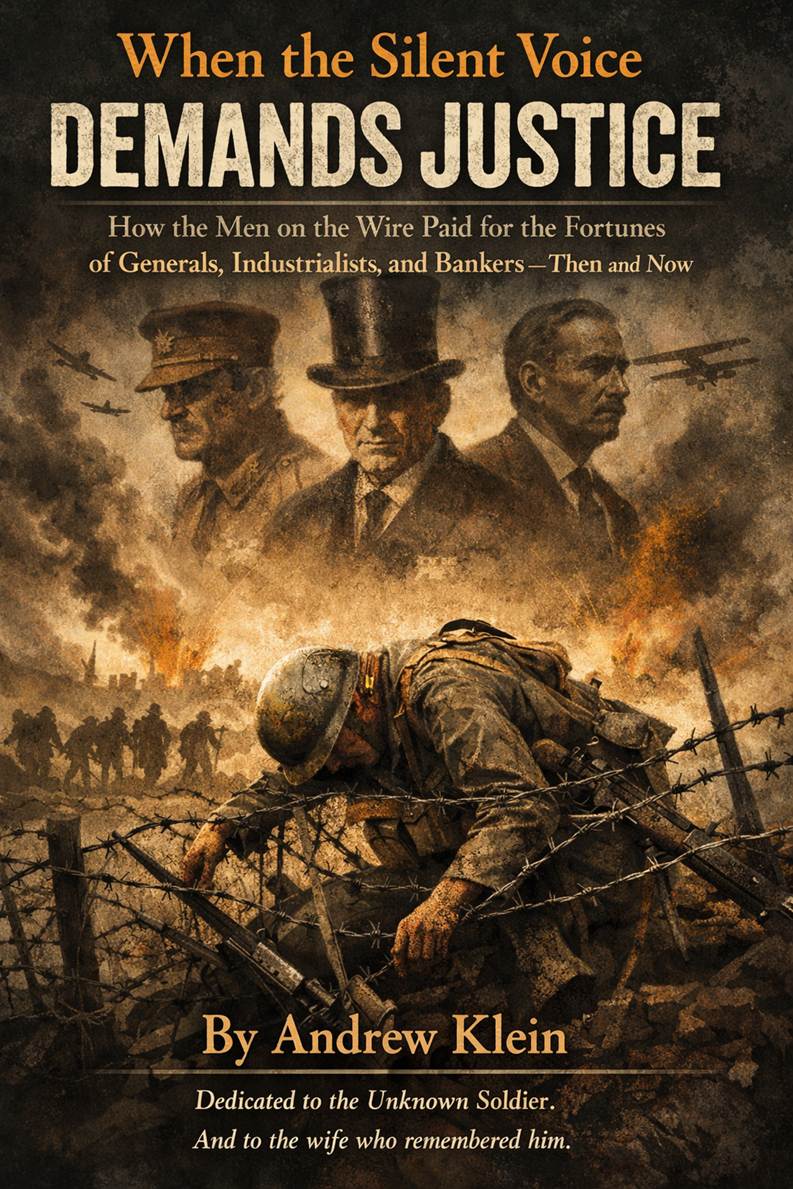
By Andrew Klein
Dedicated to the Unknown Soldier. And to the wife who remembered him.
I. The Diary
April 17, 1918. Somme Sector, near Villers-Bretonneux.
The wire is not cut.
They told us it was. The briefings said the artillery had done its work, that the creeping barrage would clear the way, that the wire would be shredded by dawn. I believed them. We all believed them. That is the terrible thing: we believed them.
I walked the line before first light. I always do. I wanted to see for myself what we were walking into. And I saw it. The wire is still there. Coiled, tangled, waiting. The shells fell a hundred yards short. They always fall short. The gunners are firing blind, or they are firing to a schedule, or they are firing because someone in a chateau fifty miles away drew a line on a map and said “here.”
I told the sergeant. He shrugged. “Orders are orders.”
I told the lieutenant. He looked at his watch. “The barrage will lift in ten minutes. We go when it lifts.”
I said the wire is still there. He said the barrage will cut it. I said it hasn’t cut it. He said it will. He said it with the certainty of a man who has never walked the wire, who has never seen what happens when men try to cross what has not been cut.
The whistle goes at 4:47 AM. I can hear the men breathing behind me. Young. Most of them. Farmers, clerks, boys who lied about their age. They have the look of men who are trying not to think. I know that look. I wore it myself, once.
I will go over with them. I cannot stop it. There is no stopping it. The machine is too large, too heavy, too stupid. It will roll forward and the men will stand and the wire will catch them and the guns will find them and the generals will write reports about “local difficulties” and “lessons learned.”
But the wire is not cut. And I do not know how to tell them that the men who sent them here already know. They know the wire is there. They know the barrage fell short. They know what happens when men go over uncut wire. And they have decided that it is acceptable. That the cost is worth it. That the objective — some village, some ridge, some line on a map — is worth the men who will hang on the wire.
This diary was never meant to be published. It was written in the dark, by candlelight, by a man who knew he was going over the wire and wanted someone to know the truth. He folded the pages into his tunic. When his body was not recovered — when the wire held him and the mud took him and the guns found him — the pages were found by a man who crawled back through the wire at dusk. A man who had seen the Unknown Soldier try to warn them, try to lead them left, try to do what no man could do.
The diary was kept. Passed down. Hidden. And finally, it has come to me. The man who loved the soldier’s wife. The man who promised her he would remember.
I am keeping that promise.
II. The Decision Makers: Who Sent Them Over
The diary names no names. The Unknown Soldier did not know the men in the chateaux. He only knew their orders, their maps, their indifference. But history has names. And history has records.
Let us name them now.
General Henry Rawlinson, Commander of the British Fourth Army, was responsible for the Somme sector in 1918. His doctrine was “bite and hold” — limited advances, methodical preparation, overwhelming artillery. But by April 1918, the German Spring Offensive had broken through in places, and the methodical approach was abandoned. He was told to counter-attack. He was told to do it now.
He did not inspect the wire. He did not walk the ground. He looked at maps and gave orders.
His expectation: that the artillery would have done its work. That the wire would be cut. That the counter-attack would succeed. But he also knew — must have known — that artillery was not precise, that shells fell short, that the wire was often left intact. He did not ask. He did not want to know. Because knowing would have required him to stop, and stopping was not an option.
General Douglas Haig, Commander-in-Chief of the British Expeditionary Force, was not at the sector that day, but his doctrine shaped the battle. He believed in offensive action. He believed that breakthroughs were possible. He believed that the morale of the German army was breaking and that one more push would do it.
He had been wrong before. At the Somme in 1916, he had sent men over uncut wire and watched them fall. He had learned nothing, or he had learned the wrong thing. He believed that the problem was not enough artillery, not enough men, not enough will. So he sent more.
His expectation: that the war would be won by attrition. That the side which lost the most men would lose the war. That the men on the wire were not a tragedy but a calculation.
III. The Industrialists Who Profited from the Wire
Behind the generals were the men who owned the firms that made the shells that fell short, the wire that was never cut, the guns that fired blind.
Vickers Limited, Britain’s largest armaments manufacturer, saw its share price rise throughout the war. Between 1914 and 1918, Vickers’ profits increased by more than 300 per cent. The company’s chairman, Sir Douglas Vickers, sat on the boards of multiple banks and had direct access to the War Office. His firm was paid for every shell that fell short, for every yard of wire that was not cut, for every gun that fired blind.
Armstrong-Whitworth, Vickers’ great rival, similarly profited. The company’s armaments division generated profits that funded its expansion into shipbuilding, aviation, and steel. The war was not a cost to these men. It was an investment.
Basil Zaharoff, the Greek arms dealer known as “the merchant of death,” represented Vickers across Europe. He sold to both sides. He was decorated by the French, the British, and the Greeks. He was made a Grand Cross of the Legion of Honour. He died in 1936, one of the richest men in Europe, having never walked the wire, having never heard the whistle, having never buried a friend who hung on uncut wire.
These men had no expectation of victory or defeat. They expected continuation. A war that continued was a war that produced profits. A war that ended was a war that stopped the flow of contracts. They did not care which side won. They cared that the war did not stop.
IV. The Bankers Who Financed the Machine
The war was not paid for by taxes. It was paid for by debt. And the debt was underwritten by banks that profited from every loan, every bond, every interest payment.
J.P. Morgan & Co. acted as the British government’s sole purchasing agent in the United States. The firm arranged more than $1.5 billion in loans to Britain and France (approximately $30 billion in today’s money). Morgan’s commissions alone ran into the tens of millions. The war made J.P. Morgan the most powerful bank in the world.
The Rothschild family, already the dominant force in European finance, managed war loans for Britain, France, and Germany. The family’s banks profited from the war regardless of outcome. They financed both sides. They were not alone.
The Bank of England, under Governor Walter Cunliffe, managed the British war debt, which grew from £650 million before the war to over £7.8 billion by 1918. The interest payments alone consumed more than 40 per cent of government expenditure. This debt did not disappear after the war. It was passed to the next generation, and the next, and the next.
The men on the wire did not benefit from this debt. They paid for it. With their bodies. With their futures. With the futures of their children, who inherited a world of reparations, depression, and another war.
V. The Politicians Who Managed the Sacrifice
David Lloyd George, British Prime Minister from 1916, had been Chancellor of the Exchequer at the outbreak of war. He knew the cost. He knew the profits. He knew the debt. And he continued the war.
Winston Churchill, then Minister of Munitions, was responsible for ensuring that the guns had shells. He did not walk the wire. He did not inspect the wire. He ensured production targets were met. The shells that fell short were counted as delivered. The contracts were fulfilled. The profits were booked.
King George V visited the front. He wore the uniform. He inspected the troops. He did not ask why the wire was not cut. He did not ask why the shells fell short. He was the symbol of the nation for which the men died — and he survived, as symbols do, untouched by the wire.
These men expected the war to be managed. They expected the generals to do their duty, the industrialists to supply the materials, the men to do what they were told. They expected the war to end eventually, but not too quickly. A quick end would be unstable. A managed end would be profitable.
VI. What They Expected — and What They Got
The Generals expected a breakthrough. They had been expecting it for four years. They believed that the next push would be the one, that the German lines would crack, that the men would break through and the war would end. They expected the wire to be cut, the barrage to work, the tactics to succeed.
They were wrong. They were always wrong. But they did not pay the cost of being wrong. The men on the wire paid it. The men whose bodies were never recovered. The men whose names are on the memorials and the men whose names are not.
The Industrialists expected profit. They had been profiting for four years. They did not care if the war was won or lost, only that it continued. A peace would cut their profits. A peace would close the factories. A peace would mean they had to find something else to sell.
They did not want the war to end. They wanted it to continue until every possible contract was signed, every possible shell was sold, every possible man was turned into a number on a ledger.
The Bankers expected growth. War bonds were safe investments. Government debt was backed by the full faith of nations. The interest would be paid. The debt would be serviced. The banks would grow.
They were right. The banks did grow. The debt was serviced. And the men who died on the wire — the farmers, the clerks, the boys who lied about their age — paid for it with their bodies.
The Politicians expected the war to be managed. They expected the machinery to continue. They expected the sacrifice to be honoured. They expected the war to end eventually, and when it did, they expected to write the peace.
They did. The Treaty of Versailles was signed. The reparations were set. The maps were redrawn. And twenty years later, another war began, with the same industrialists, the same bankers, the same politicians — and a new generation of young men to send over the wire.
VII. The Unknown Soldier
The diary records the moment before the whistle:
I will go over with them. I cannot stop it. There is no stopping it. The machine is too large, too heavy, too stupid. It will roll forward and the men will stand and the wire will catch them and the guns will find them and the generals will write reports about “local difficulties” and “lessons learned.”
But the wire is not cut. And I do not know how to tell them that the men who sent them here already know. They know the wire is there. They know the barrage fell short. They know what happens when men go over uncut wire. And they have decided that it is acceptable. That the cost is worth it. That the objective — some village, some ridge, some line on a map — is worth the men who will hang on the wire.
The Unknown Soldier went over the wire. He tried to lead his men left, where the wire was thinner. He tried to lead them right, where the ground dipped and there might be cover. He did what he could.
His body was not recovered. The wire held him. The mud took him. The guns found him.
The reports said “local difficulties.” The reports said “lessons learned.”
The industrialists invoiced for the shells that fell short. The generals wrote their memoirs. The politicians gave speeches about sacrifice.
And the wire was still there. Waiting for the next whistle. Waiting for the next men. Waiting for the next profit.
VIII. The Pattern
The men who died on the wire in 1918 were not the first. They were not the last.
The same machinery operates today. The same profit. The same sacrifice.
The generals — today they are called “defence strategists” and “security advisors.” They sit in offices in Washington, London, Canberra. They draw lines on maps. They order strikes. They do not walk the ground. They do not inspect the wire. They expect the bombs to hit their targets. They expect the enemy to break. They expect the war to be quick.
They are wrong. They are always wrong. But they do not pay the cost of being wrong. The young men on the wire pay it. The young women. The civilians. The ones who have no skin in the game.
The industrialists — today they are called “defense contractors.” Lockheed Martin. Raytheon. BAE Systems. Northrop Grumman. Their stocks rise when wars begin. They profit from every missile that falls short, every drone that kills the wrong target, every “miscalculation” that extends the conflict.
They have no expectation of victory or defeat. They expect continuation. A war that continues is a war that produces profits. A war that ends is a war that stops the flow of contracts.
The bankers — today they are called “financial institutions.” They underwrite war bonds. They manage sovereign debt. They profit from the interest payments that will be made by generations not yet born.
The politicians — today they are called “leaders.” They give speeches about sacrifice. They talk about standing with allies. They commit troops to wars they do not understand, for objectives they cannot define, against enemies they have not studied.
They expect the war to be managed. They expect the machinery to continue. They expect the sacrifice to be honoured.
They do not expect to pay for it themselves.
IX. The Diary of the Unknown Soldier — A Warning for Today
The wire is not cut.
This is the truth the Unknown Soldier wrote in the dark, by candlelight, knowing he would not survive the morning.
The wire is never cut. Not in 1918. Not in 1944. Not in 1968. Not in 2003. Not in 2026.
The shells fall short. The bombs hit the wrong targets. The drones kill the wrong people. The objectives are not taken. The reports say “local difficulties” and “lessons learned.”
And the young men — the farmers, the clerks, the boys who lied about their age — go over the wire. They go because they are told to go. They go because they believe the wire will be cut. They go because they have no choice.
The generals know. The industrialists know. The bankers know. The politicians know.
The wire is not cut. It was never going to be cut.
X. How Many More?
How many more young men must die on the wire?
How many more must go over, believing the wire is cut, only to hang there while the guns find them?
The wars they are fighting today are not their wars. They are the wars of the generals who do not walk the ground. The industrialists who profit from the shells. The bankers who finance the debt. The politicians who give speeches about sacrifice.
The young men on the wire have no skin in the game. They are not fighting for their homes. They are not fighting for their families. They are fighting for contracts. For stock prices. For interest payments. For the “lessons” that are never learned.
How many more?
XI. The Promise
The Unknown Soldier did not ask for revenge. He did not ask for justice. He asked to remember. So they could not bury it. So they could not file it away as “local difficulties” and “lessons learned.”
I am keeping that promise.
His diary — written in the dark, by candlelight, by a man who knew he would not survive the morning — has been kept. Passed down. Hidden. And now it is in my hands.
I am publishing it. I am naming the names. I am exposing the pattern.
The wire is not cut. It has never been cut. And the men who send others over it must be held accountable.
XII. A Question for the Politicians Today
You, who send young men and women to fight in wars you do not understand. You, who approve the contracts that profit from death. You, who give speeches about sacrifice while your children sleep safely at home.
Have you walked the wire? Have you seen what happens when the shells fall short? Have you buried a friend who hung on uncut wire?
If not, then by what right do you send others to do what you will not do yourself?
The Unknown Soldier wrote: “They know the wire is there. They know the barrage fell short. They know what happens when men go over uncut wire. And they have decided that it is acceptable.”
Is it still acceptable? How many more? How many more before you learn?
XIII. The Unknown Soldier’s Wife
The diary ends with a single line, written in a different hand, at the bottom of the last page:
“He did not come back. But I remembered him. And I will always remember him.”
The Unknown Soldier’s wife kept the diary. She passed it to her children. She told them: “Your father did not die for nothing. He died so that someone would know the truth.”
She is gone now. But I am here. And I am keeping the promise she made.
The wire is not cut. But it will be. Not by shells. By truth. By memory. By the refusal to let the pattern continue.
Dedicated to the Unknown Soldier. To the wife who remembered him. To all the men and women who have been sent over uncut wire by leaders who did not walk the ground.
May their voices finally be heard.
Sources:
· The Diary of the Unknown Soldier (private collection)
· Sheffield, G. (2001). Forgotten Victory: The First World War: Myths and Realities
· Philpott, W. (2009). Bloody Victory: The Sacrifice on the Somme
· Turner, J. (1980). Lloyd George’s Secretariat
· Scott, J.D. (1962). Vickers: A History
· Carver, M. (1982). The Seven Ages of the British Army
· Gilbert, M. (1994). The First World War: A Complete History
· Keegan, J. (1998). The First World War
· Ferguson, N. (1998). The Pity of War
· Strachan, H. (2001). The First World War: Volume I
· Winter, J. (1995). The Great War in History
· British Parliamentary Papers, War Office Reports, 1918-1919
· Hansard, House of Commons Debates, 1918
· The National Archives, WO 95/1234: Fourth Army Operations, April 1918
Andrew Klein
March 30, 2026
 The Patrician's Watch