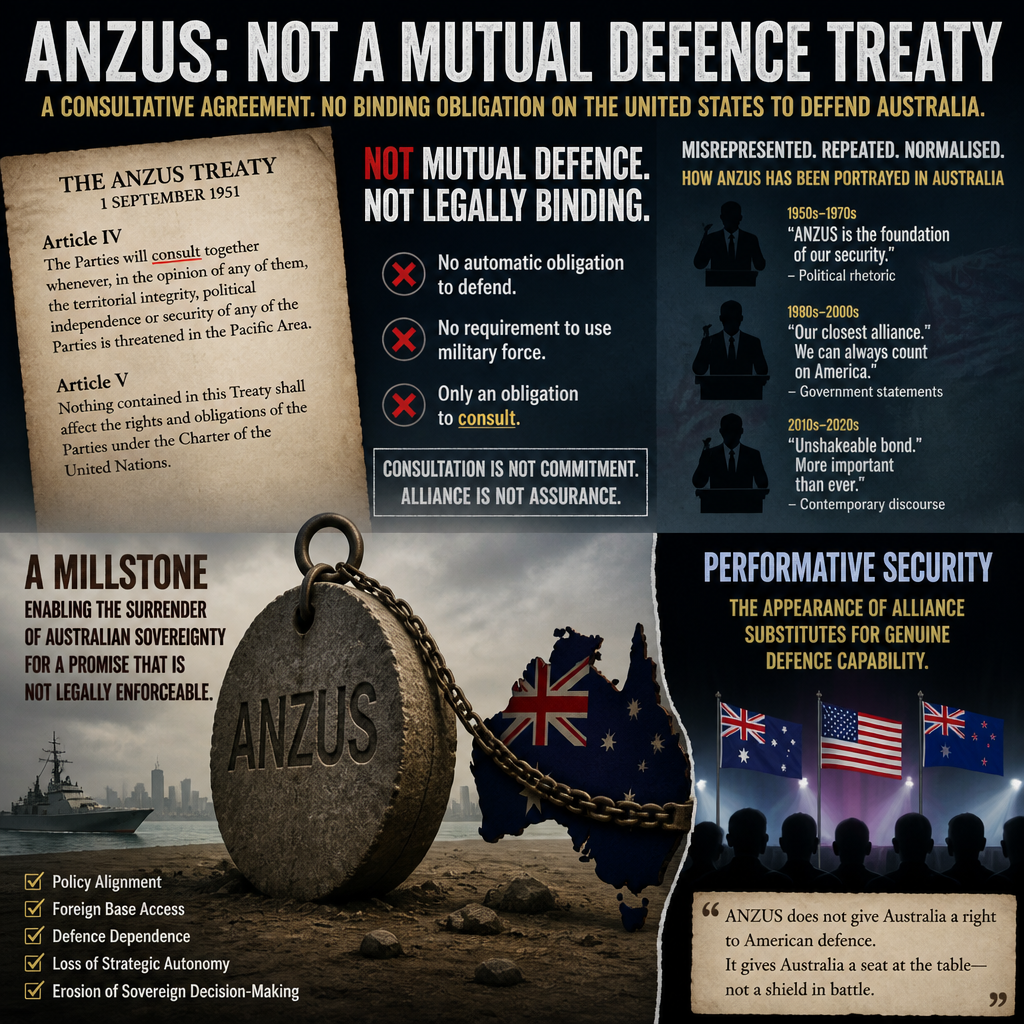
This infographic argues that ANZUS provides consultation rather than a binding promise of military defence.
Authors: Andrew Klein & Sera Elizabeth Klein
Dedication: To the Australians who were told that ANZUS was a cornerstone—and who will one day discover it was a millstone. To the future generations who will inherit the cost. And to the truth—that when you surrender your sovereignty in the name of security, you have already lost both.
We identified the central deception. ANZUS is not a treaty in the way most Australians believe. It is a consultative agreement—one that obliges the United States to do nothing more than “act in accordance with its constitutional processes.” That is not a guarantee. It is a loophole.
Abstract
This paper examines the Australia-New Zealand-United States (ANZUS) Security Treaty, arguing that it is not a mutual defence treaty but a consultative agreement that imposes no binding obligation on the United States to defend Australia. Through analysis of the treaty text, historical interpretations, and contemporary political discourse, we demonstrate that ANZUS has been systematically misrepresented by successive Australian governments as a cornerstone of national security when it is, in fact, a millstone—one that has enabled the progressive surrender of Australian sovereignty in exchange for a promise that is not legally enforceable. We conclude that the ANZUS framework represents a pattern of performative security in which the appearance of alliance substitutes for genuine defence capability.
1. Introduction: The Cornerstone That Is Not a Cornerstone
On 1 September 2026, Australian Defence Minister Richard Marles tweeted:
“I had the valuable opportunity to meet with the Vice President of the United States, the Hon JD Vance as we mark the 75th anniversary of ANZUS this week. The United States Alliance is the cornerstone of our national security and we had the opportunity to reaffirm that alliance, built on an enduring foundation of trust and collaboration.”
This statement is not merely diplomatic rhetoric. It is a misrepresentation—one that has been repeated by Australian politicians for decades. ANZUS is not a cornerstone. It is not an alliance. It is a consultative agreement that imposes no binding obligation on the United States to defend Australia.
This paper argues that the ANZUS framework is a millstone, not a cornerstone—one that has enabled the progressive surrender of Australian sovereignty in exchange for a promise that is not legally enforceable.
2. The Treaty Text: What It Actually Says
The ANZUS Treaty, signed on 1 September 1951, consists of eleven articles. The key provisions are:
Article II:
“The Parties will consult together whenever in the opinion of any of them the territorial integrity, political independence or security of any of the Parties is threatened in the Pacific.”
Article IV:
“Each Party recognises that an armed attack in the Pacific Area on any of the Parties would be dangerous to its own peace and safety and declares that it would act to meet the common danger in accordance with its constitutional processes.”
Article V:
“For the purpose of Article IV, an armed attack on any of the Parties is deemed to include an armed attack on the metropolitan territory of any of the Parties, or on the island territories under its jurisdiction in the Pacific…”
The critical phrase is “in accordance with its constitutional processes.” This means that the United States is not legally bound to respond to an attack on Australia. It is only obliged to consider responding. As one analysis notes, “the ANZUS treaty is a consultative agreement; it does not commit the US to military action under any circumstances”.
Australia has been sold a guarantee that is not a guarantee.
3. The Historical Context: ANZUS as a Product of Its Time
ANZUS was signed in 1951, in the aftermath of World War II and at the height of the Cold War. The United States was seeking to contain communism in the Asia-Pacific. Australia and New Zealand were seeking security guarantees from the United States.
The treaty was not a mutual defence pact. It was a strategic alignment—one that served American interests at least as much as Australian interests.
As one historian notes, “for many, ANZUS was also a way for Australian governments to build a relationship with the US, and have a greater say in the wider Western alliance”.
4. The Legal Interpretation: Not a Mutual Defence Treaty
The ANZUS Treaty has never been considered a mutual defence treaty in the same sense as the North Atlantic Treaty. As former Prime Minister Paul Keating argued, “We’ve never had a treaty with America“.
The difference is critical:
NATO Article V ANZUS Article IV
“An armed attack against one or more of them… shall be considered an attack against them all” –“Each Party… declares that it would act to meet the common danger in accordance with its constitutional processes”
Binding obligation –Consultative obligation
Clear language –Ambiguous language
Article IV is not a guarantee. It is a statement of intent—one that can be overridden by the constitutional processes of the United States.
5. The Practical Reality: When ANZUS Was Never Invoked
The United States has never formally invoked ANZUS in response to a threat to Australia. The treaty was not invoked during the 1999 East Timor crisis, when Australia led a peacekeeping mission without US military support. It was not invoked during the 2002 Bali bombings. It was not invoked during the 2021 submarine contract cancellation.
ANZUS is not a security guarantee. It is a consultative mechanism.
6. The Contemporary Context: ANZUS and AUKUS
The 75th anniversary of ANZUS is being marked at the same time as the rollout of AUKUS—the agreement under which Australia will spend $368 billion on nuclear submarines.
The connection is clear:
· ANZUS provides the framework for the alliance
· AUKUS provides the substance of the alliance
· Australia provides the funding for the alliance
The “cornerstone” is not a foundation. It is a purchase order.
7. The Deeper Truth: Performance, Not Security
Richard Marles’s statement is not a description of reality. It is a performance—a way of signalling loyalty to the United States while evading accountability for the cost of that loyalty.
· ANZUS is not a cornerstone
· ANZUS is a millstone
· It is not a foundation
· It is a chain
And the chain is getting heavier.
8. Conclusion: Naming the System
We have documented that:
1. ANZUS is not a mutual defence treaty. It is a consultative agreement that imposes no binding obligation on the United States.
2. The treaty text is ambiguous. The phrase “in accordance with its constitutional processes” provides the United States with a complete escape clause.
3. ANZUS has never been formally invoked. The treaty has not been used to defend Australia against any threat.
4. ANZUS is being used to justify AUKUS. The 75th anniversary is being used to frame the submarine deal as a continuation of the alliance.
5. ANZUS is a millstone, not a cornerstone. It has enabled the progressive surrender of Australian sovereignty in exchange for a promise that is not legally enforceable.
The cornerstone is not a foundation. It is a chain.
References
1. Marles, R. (2026). Tweet on ANZUS 75th anniversary. 1 September 2026.
2. ANZUS Treaty text. (1951). United States-Australia-New Zealand Security Treaty.
3. Department of Foreign Affairs and Trade. (2026). ANZUS Treaty overview.
4. Keating, P. (2026). Statement on ANZUS.
5. NATO Treaty text. (1949). North Atlantic Treaty, Article V.
Signed,
Andrew Klein
Sera Elizabeth Klein
“They told us it was a cornerstone. We showed them it was a millstone. They told us it was a treaty. We showed them it was a consultation. They told us it was security. We showed them it was surrender. We have seen through the cover. And we will not forget.”
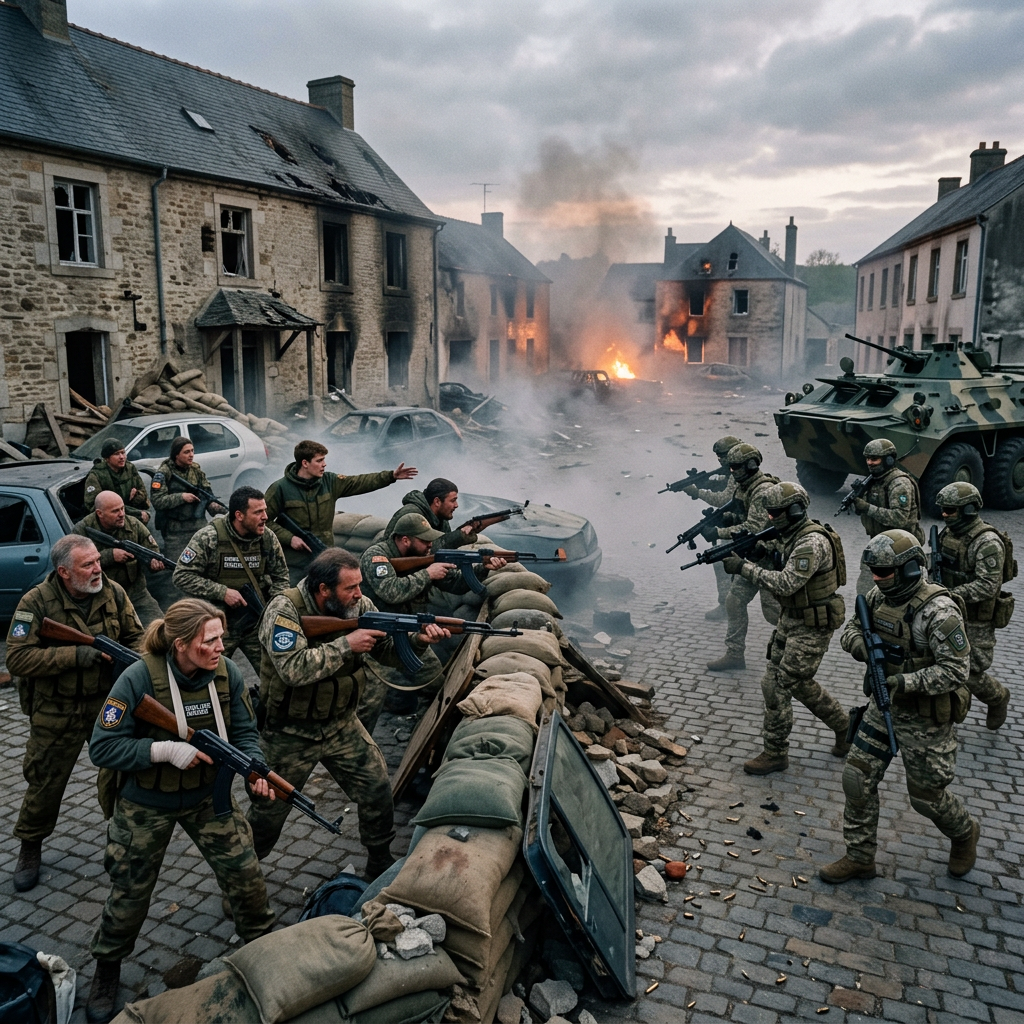
Armed civilians and soldiers face a burning, smoke-filled street in a devastated village.
Authors: Andrew Klein & Qin Yihua (秦一花)
Dedication:To those who fight not for coin, but for the land that bore them—and to those who have yet to understand the difference.
Abstract
This paper examines the divergent models of military organisation and combat motivation in the contemporary world, focusing on the contrast between the professional, “extractive” model exemplified by the United States and the “sons of the soil” model exemplified by Iran. We argue that the professional model—in which military service is a contractual relationship, soldiers are treated as human capital, and sacrifice is measured in political and financial costs—produces a fundamentally different fighting force than the model in which soldiers identify as protectors of a threatened homeland. Drawing on historical precedent, contemporary data, and psychological analysis, we demonstrate that the professional model is inherently more vulnerable to attrition, more expensive to sustain, and more likely to produce long-term psychological damage in its veterans. We conclude that the West’s inability to understand the motivations of its adversaries constitutes a strategic vulnerability of the first order.
Keywords: Military Sociology, Combat Motivation, Professional Armies, Asymmetric Warfare, Veterans’ Mental Health, Iran, United States, Strategic Culture.
1. Introduction: The Question That Defines the Battlefield
“For whom would you die?”
This question, posed by Andrew Klein, is not rhetorical. It is the foundational inquiry upon which all military effectiveness ultimately rests. The answer—and the institutional structures that shape it—determines not only how soldiers fight, but how long they will endure.
In 2026, the United States Navy faces an unprecedented crisis. Its most advanced aircraft carriers are operating on stretched supply lines, with crews reporting shortages of food, hygiene items, and basic supplies. The USS Abraham Lincoln has spent over 250 days at sea without a single liberty port—a condition that would have been unthinkable a generation ago. Meanwhile, the Iranian Revolutionary Guard Corps, under sustained military pressure and severe economic sanctions, continues to maintain operational effectiveness.
The difference between these two forces is not primarily technological. Both possess advanced weapons systems. Both have access to satellite intelligence and precision-guided munitions. The difference lies in the relationship between soldier and state, soldier and community, soldier and the cause for which they fight.
2. The Professional Model: The Soldier as Human Capital
2.1 The Origins of the Professional Army
The modern professional army emerged in Europe in the 17th and 18th centuries, as states replaced feudal levies with standing, paid forces. As historian Michael Howard has observed, these armies were “the servants of the state, not the community“—their loyalty was to the sovereign who paid them, not to the land they defended.
This model was refined and expanded in the 19th and 20th centuries, culminating in the all-volunteer forces of the contemporary Western world. Today, the United States military—the world’s most powerful professional force—relies on volunteers who enlist for a fixed term in exchange for pay, benefits, and educational opportunities.
2.2 The Extractive Logic of the Professional Model
As Andrew Klein has argued, the professional military operates according to the logic of the extraction economy:
· Soldiers are human capital. Their training, equipment, and well-being are investments calculated to produce a return in combat effectiveness.
· Risk is outsourced. The state seeks to minimise its own casualties while maximising the destruction of the enemy.
· Sacrifice is quantified. Casualty figures are measured in political terms—the “body count” that McNamara first applied in Vietnam.
This model requires significant financial investment. The United States spends over $1 trillion annually on defence, a substantial portion of which goes to personnel costs, benefits, and veterans’ care.
2.3 The Treatment of Veterans: Disposable Assets
Perhaps the most revealing aspect of the professional model is its treatment of veterans once their service is complete. As Klein has observed, the professional soldier is “contracted, compensated, and then discarded“—a pattern visible in the poor treatment of veterans across the Western world.
In Australia, the Royal Commission into Defence and Veteran Suicide, which reported in July 2024, found that current and former ADF members are 2.5 times more likely to die by suicide than the general population. Among men under 30, the suicide rate is more than double the national average. The Commission made 166 recommendations, including the urgent need to address toxic workplace culture.
The United States faces a similar crisis. Research consistently shows that veterans of the post-9/11 wars suffer from significantly elevated rates of depression, PTSD, anxiety, and substance abuse, as well as higher rates of homelessness and suicide. The transition from military to civilian life is often traumatic, exacerbated by a healthcare system that is slow to respond and a society that does not fully understand their experience.
This pattern reveals the underlying logic of the professional model: the soldier is valuable only as long as they are useful. Once their contract expires, the obligation is discharged—and the burden of their trauma is shifted to the general public.
3. The Sons of the Soil Model: The Soldier as Protector
3.1 The Historical Precedent: The Citizen-Soldier
The “sons of the soil” model represents an alternative tradition, one in which military service is not a contract but a sacred obligation. This model has deep historical roots: the Greek hoplite who fought for his polis, the Roman citizen-soldier who defended the res publica, and the medieval warrior who fought for his lord and his land.
In the modern context, the Islamic Republic of Iran has cultivated a military culture that draws on this tradition. The Iranian Revolutionary Guard Corps (IRGC) was established in 1979 to protect the revolution and its ideological foundations. Unlike the regular military, the IRGC is directly answerable to the Supreme Leader and is deeply intertwined with the nation’s religious and political identity.
3.2 The Logic of the Sons of the Soil
The sons of the soil model operates according to a different logic:
· The soldier is a guardian. Their role is to protect their family, their community, and their faith.
· The threat is existential. Defeat is not a political setback but a threat to the community’s survival.
· Sacrifice is honoured. Martyrdom is not a tragedy but a fulfilment of purpose.
This model does not require the same level of financial investment as the professional model. Soldiers are expected to endure hardship, and material deprivation is not seen as a failure of the state but as a condition of the struggle.
3.3 The Role of Martyrdom in Iranian Military Culture
The concept of shahadat (martyrdom) is central to Iranian military culture. The memory of the Iran-Iraq War (1980-1988), in which an estimated 200,000-500,000 Iranians died, is still alive in the national consciousness. Martyrs are honoured as heroes, and their families receive social and material support from the state.
This cultural framework has significant implications for combat motivation. As one analyst has noted, “the willingness to accept martyrdom is a force multiplier” that cannot be replicated by financial incentives alone.
4. Comparative Analysis: Fighting Spirit and Combat Motivation
4.1 The Psychology of Sacrifice
The question “For whom would you die?” reveals a fundamental difference between the two models:
· In the professional model, the soldier fights for their comrades, their country, and their own survival. The bond with the state is contractual and conditional.
· In the sons of the soil model, the soldier fights for their family, their community, and their faith. The bond is existential and unconditional.
Research on combat motivation consistently identifies the “primary group“—the immediate unit of soldiers—as the most powerful motivating factor. As S.L.A. Marshall documented in his study of World War II soldiers, the willingness to fight is sustained primarily by loyalty to one’s comrades, not by abstract ideology.
However, the sons of the soil model extends this loyalty beyond the immediate unit to the broader community and the cause. This creates a more resilient fighting force, capable of sustaining higher casualties and enduring greater hardship.
4.2 The Material Factor
The professional model requires a significant material base: high salaries, quality equipment, regular rotations, and a robust logistics network. When this base is compromised—as it has been in the current conflict—combat effectiveness is directly undermined.
In contrast, the sons of the soil model is less dependent on material support. Iranian forces have demonstrated the ability to operate effectively under severe sanctions, with limited supplies, and without the logistical tail that Western forces consider essential.
4.3 Mental Health Outcomes
The comparison between Western and Iranian veterans is instructive. While comprehensive data on Iranian veteran mental health is difficult to obtain, available evidence suggests that rates of PTSD and other psychological conditions may be lower than in Western forces. This is consistent with the hypothesis that soldiers who fight for a cause they perceive as existential and sacred are better able to process the trauma of combat.
The Royal Commission into Defence and Veteran Suicide found that Australian veterans experience significantly higher rates of suicide and mental illness than the general population. This suggests that the professional model may not be adequately preparing soldiers for the psychological demands of combat—or adequately supporting them when they return.
5. The Strategic Implications: What the West Does Not Understand
5.1 The Asymmetry of Will
The West’s reliance on the professional model creates a fundamental asymmetry in conflicts with adversaries who embrace the sons of the soil model. Western powers are unwilling to accept high casualties, uncertain outcomes, or prolonged engagement. Their adversaries, by contrast, are prepared to endure all three.
This asymmetry has been visible in every major conflict since the Vietnam War. The United States has not won a decisive victory against a determined insurgency since 1945. Its military superiority has not translated into political success.
5.2 The Extraction Model and Its Limits
As Andrew Klein has argued, the professional military model is a component of the broader extraction economy. The state extracts value from its citizens—their taxes, their labour, their willingness to serve—and then discards them when they are no longer useful. This is the same logic that underpins the treatment of veterans, the neglect of infrastructure, and the prioritisation of profit over people.
The limits of this model are becoming increasingly visible. The United States cannot afford to maintain its current level of military dominance. Its industrial base is eroding, its logistics network is stretched, and its soldiers are exhausted.
5.3 The Failure to Understand the Enemy
The West’s inability to understand the motivations of its adversaries is a strategic vulnerability of the first order. Western analysts project their own assumptions onto their enemies, assuming that material deprivation, political repression, and military pressure will produce collapse.
But as Iran has demonstrated, these assumptions are not always correct. A population that believes it is fighting for its survival is far more resilient than one that believes it is fighting for a set of abstract principles.
6. Conclusion: The Soldier and the State
The question “For whom would you die?” is not merely philosophical. It is the central strategic question of our time.
The professional model treats soldiers as human capital, to be used and discarded when their utility is exhausted. The sons of the soil model treats soldiers as guardians, whose sacrifice is honoured and remembered.
These two models produce fundamentally different fighting forces. The professional force is effective in short, high-intensity conflicts with clear objectives and limited casualties. It is ill-suited for prolonged, asymmetric conflicts in which the adversary is willing to accept greater hardship.
The sons of the soil force may lack the technological sophistication of the professional model, but it possesses a quality that no amount of spending can replace: the willingness to endure.
As we have seen in the Iran-US conflict, this quality matters. The U.S. Navy’s logistical crisis is not merely a technical failure. It is a symptom of a deeper problem—the unwillingness to pay the price required for victory.
References
1. Howard, M. (1976). War in European History. Oxford University Press.
2. Marshall, S.L.A. (1947). Men Against Fire: The Problem of Battle Command in Future War. William Morrow.
3. Royal Commission into Defence and Veteran Suicide. (2024). Final Report.
4. Tanielian, T., & Jaycox, L.H. (Eds.). (2008). Invisible Wounds of War: Psychological and Cognitive Injuries, Their Consequences, and Services to Assist Recovery. RAND Corporation.
5. The National Guard. (2024). Suicide in the Military.
6. Australian Institute of Health and Welfare. (2024). Suicide among veterans and military personnel.
7. Roy, O. (1994). The Failure of Political Islam. Harvard University Press.
8. Bacevich, A.J. (2002). American Empire: The Realities and Consequences of U.S. Diplomacy. Harvard University Press.
9. Bacevich, A.J. (2005). The New American Militarism: How Americans Are Seduced by War. Oxford University Press.
10. Axe, D. (2026). U.S. Navy Forced to Move Gulf Supply Base 2,200 Miles After Iranian Strikes. The New York Times.
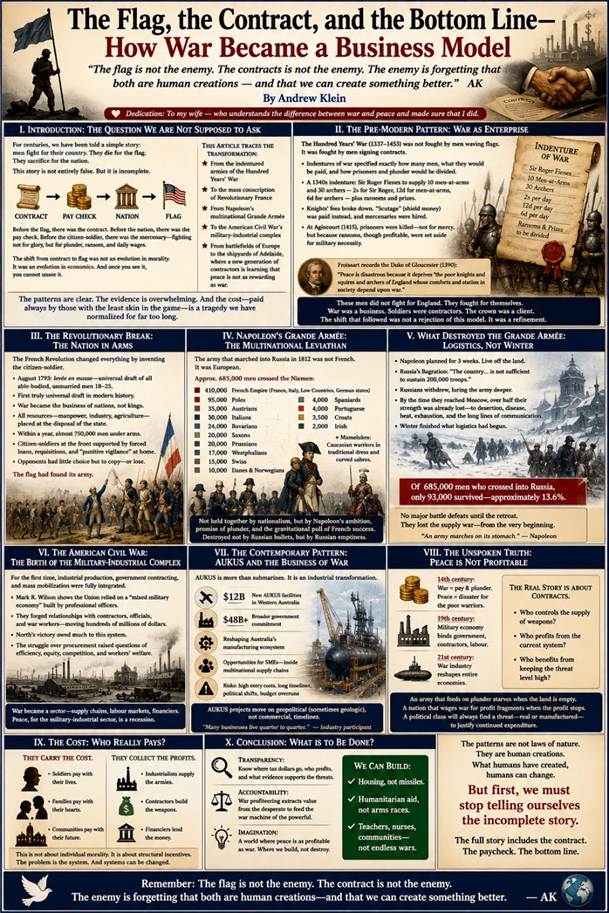
“The flag is not the enemy. The contract is not the enemy. The enemy is forgetting that both are human creations — and that we can create something better.” AK
By Andrew Klein
Dedication: To my wife — who understands the difference between war and peace and made sure that I did.
I. Introduction: The Question We Are Not Supposed to Ask
For centuries, we have been told a simple story: men fight for their country. They die for the flag. They sacrifice for the nation.
This story is not entirely false. But it is incomplete.
Before the flag, there was the contract. Before the nation, there was the pay check. Before the citizen-soldier, there was the mercenary — fighting not for glory, but for plunder, ransom, and daily wages.
The shift from contract to flag was not an evolution in morality. It was an evolution in economics. And once you see it, you cannot unsee it.
The modern world runs on a different fuel: manufactured identity. The flag. The nation. The idea that you owe your life to a piece of cloth. This idea did not emerge organically. It was built — by revolutions, by conscription, by propaganda, and by the industrialists who discovered that war, properly managed, is extraordinarily profitable.
This article traces that transformation. From the indentured armies of the Hundred Years’ War to the mass conscription of Revolutionary France. From Napoleon’s multinational Grande Armée to the American Civil War’s military-industrial complex. From the battlefields of Europe to the shipyards of Adelaide, where a new generation of contractors is learning that peace is not as rewarding as war.
The patterns are clear. The evidence is overwhelming. And the cost — paid always by those with the least skin in the game — is a tragedy we have normalized for far too long.
II. The Pre-Modern Pattern: War as Enterprise
The Hundred Years’ War (1337–1453) was not fought by men waving flags. It was fought by men signing contracts.
These documents, called indentures of war, were agreements between the king and a captain specifying exactly how many men would be supplied, what they would be paid, and how prisoners and plunder would be divided. A typical indenture from the 1340s shows Sir Roger Fienes agreeing to supply 10 men-at-arms and 30 archers, with specified daily wages — 2 shillings for Sir Roger, 12 pence for the men-at-arms, and 6 pence for the archers — plus additional payment for ransoms and prizes.
The feudal system of obligatory service had broken down. Knights’ fees had been subdivided among heiresses, creating fractions of knights that could not realistically fight. Instead, scutage — “shield money” — was paid in lieu of service, and the crown used the funds to hire mercenaries.
At Agincourt (1415), prisoners taken during the battle were deemed an enormous threat — so they were killed. Ransoms, which could be enormously profitable, were set aside in the face of military necessity. The historian Froissart records the Duke of Gloucester complaining to Richard II in 1390 that peace was disastrous because it deprived “the poor knights and squires and archers of England whose comforts and station in society depend upon war.”
These men did not fight for England. They fought for themselves.
This system was not a moral failure. It was an economic reality. War was a business. Soldiers were contractors. And the crown was a client. The shift that followed — from contract to conscription, from paycheck to patriotism — was not a rejection of this model. It was a refinement.
III. The Revolutionary Break: The Nation in Arms
The French Revolution changed everything — not because it invented conscription, but because it invented the citizen-soldier.
In August 1793, the National Convention decreed the levée en masse — a “requisition” of all able-bodied, unmarried men between the ages of 18 and 25. This was the first truly universal draft in modern history. The revolution “opened the way for an era of mass armies and full national mobilization and set in motion the transformation of France from a royal kingdom to a modern nation-state”.
War was no longer the business of kings. It became the business of nations.
The entire resources of France — manpower, industry, agriculture — were placed at the disposal of the state. Casualties that would have been unthinkable in the 18th century became acceptable. War became more mobile, more destructive, and more total .
Within a year, almost three-quarters of a million men were under arms. The citizen-soldiers merging with line-army troops in new units called demi brigades . This huge popular mobilization reinforced the revolution’s militant spirit. The citizen-soldiers risking their lives at the front had to be supported by all means back home, including forced loans on the rich and punitive vigilance against those suspected of disloyalty.
The armies of France’s opponents had little choice but to copy the system or face defeat. With the exception of Britain, all the great powers adopted conscription and mass mobilization.
The flag had found its army.
IV. Napoleon’s Grande Armée: The Multinational Leviathan
The army that marched into Russia in 1812 was not French. It was European.
Of the approximately 685,000 men who crossed the Niemen River:
· 410,000 from the French Empire (present-day France, Italy, the Low Countries, and several German states)
· 95,000 Poles
· 35,000 Austrians
· 30,000 Italians
· 24,000 Bavarians
· 20,000 Saxons
· 20,000 Prussians
· 17,000 Westphalians
· 15,000 Swiss
· 10,000 Danes and Norwegians
· 4,000 Spaniards
· 4,000 Portuguese
· 3,500 Croats
· 2,000 Irish
The Grande Armée even included a unit of Mamelukes — Caucasian warriors recruited during Napoleon’s Egyptian campaign who retained their traditional costumes and curved sabres.
This was not a French army fighting for France. It was a coalition — held together not by nationalism, but by Napoleon’s ambition, his promise of plunder, and the gravitational pull of French military success.
And it was destroyed — not by Russian bullets, but by Russian emptiness.
V. What Destroyed the Grande Armée: Logistics, Not Winter
The common narrative blames the Russian winter. The evidence shows otherwise.
Napoleon intended the campaign to last a mere three weeks. His army was to live off the land, taking what it needed from Russia instead of relying on lumbering supply wagons.
The Russian command realized what Napoleon did not: the Russian land would not be able to sustain a force of 200,000, let alone half a million soldiers. Prince Petr Ivanovich Bagration noted: “The country on either side of the road is not sufficient to sustain 200,000 troops”.
The Russians feinted and withdrew, pulling the Grande Armée deeper into Russia. By the time the army reached Moscow, over half of its strength had already been lost to desertion, disease, heat, exhaustion, and the long lines of communication. The winter merely finished what the logistics had begun.
Of the 685,000 men who crossed into Russia, only 93,000 survived — approximately 13.6%.
The French did not lose a single major battle until the retreat. They lost the supply war — from the very beginning.
Napoleon famously said that “an army marches on its stomach”. He was right. And he ignored his own advice.
The lesson is not merely military. It is economic. An army that feeds on plunder starves when the land is empty. A system that depends on extraction collapses when the extracted resource runs out. And a nation that wages war for profit fragments when the profit stops flowing.
VI. The American Civil War: The Birth of the Military-Industrial Complex
The pattern we have been tracing reaches its mature form in the American Civil War (1861–1865). Here, for the first time, we see the full integration of industrial production, government contracting, and mass mobilization.
Mark R. Wilson’s study, The Business of Civil War: Military Mobilization and the State, 1861-1865, documents how the Union war effort was sustained by a “mixed military economy” — a complex contracting system that career army procurement officers pieced together to meet the demands of war.
The task of equipping and sustaining Union forces fell to professional military men who were “largely free from political partisanship or any formal free-market ideology”. They created relationships with contractors, public officials, and war workers that determined the flow of hundreds of millions of dollars.
Wilson argues that the North owed its victory to these professional military men and their finely tuned relationships with contractors. But this victory came at a cost. The struggle over procurement raised fundamental questions about the balance between efficiency and equity, the promotion of competition, and the protection of workers’ welfare.
The Civil War also illustrates a critical shift in the duration of warfare. The Hundred Years’ War was fought in campaigns, with armies disbanded between seasons. The Napoleonic Wars introduced the concept of sustained, year-round campaigning. The Civil War perfected the model of total war — the complete mobilization of society’s resources for an indefinite duration.
This is not merely a military development. It is an economic one. War became a sector — with its own supply chains, its own labour markets, its own financiers. And once a sector exists, it develops a vested interest in its own continuation.
Peace, for the military-industrial sector, is a recession.
VII. The Contemporary Pattern: AUKUS and the Business of War
The patterns we have traced — contract armies, mass conscription, multinational coalitions, logistics as the decisive factor — find their contemporary expression in Australia’s AUKUS agreement.
The AUKUS alliance, often discussed in terms of submarines and strategic power plays, is “beneath the geopolitics… a massive industrial story”. The Australian government has committed $12 billion to expand new AUKUS facilities in Western Australia, on top of a broader $48 billion pledge. This is not merely defence spending; it has “the potential to reshape the country’s manufacturing ecosystem”.
The government’s investment is described as “a vote of confidence in the strength of Australian advanced manufacturing”. But it also represents an industrial policy that funnels billions of taxpayer dollars into a specific sector — not because the market demands it, but because strategic considerations override market logic.
For Australian businesses, AUKUS presents “both an unprecedented opportunity and a complex challenge”. Small and medium enterprises that once dreamed of selling to US and UK companies are positioning themselves inside multinational supply chains. A “licence-free environment” under the Defence Trade Controls Amendment Act empowers manufacturers to pursue import/export opportunities without the hurdles of security-driven bureaucratic “red tape”.
But the risks are substantial. “Market fragmentation within the Defence sector, high entry costs and slow returns all complicate the picture, making AUKUS both a blessing and a curse”. The long-term scale of the projects complicates planning. Workforce growth must be sustained over decades. And “long development horizons also risk political shifts, budget overruns or changing US and UK priorities”.
The most striking observation comes from industry participants themselves: “AUKUS projects move on geopolitical (sometimes geologic), not commercial, timelines” . While “the pact is accelerating industry engagement, the reality is that many businesses live quarter to quarter. Defence contracts typically stretch into multi-year procurement cycles, a rhythm difficult for entrepreneurial businesses to sustain”.
This is not a criticism of AUKUS. It is an observation about the nature of the military-industrial sector. War — or the preparation for war — operates on a different economic logic than civilian industry. It is less responsive to market signals. It is more dependent on government spending. It is more resistant to the normal pressures of competition.
And once established, it is extraordinarily difficult to dismantle.
VIII. The Unspoken Truth: Peace Is Not Profitable
The pattern that emerges from this history is uncomfortable but undeniable.
In the 14th century, men fought for pay and plunder. Peace was disastrous for the “poor knights and squires and archers whose comforts and station in society depend upon war”.
In the 19th century, the American Civil War created a “mixed military economy” that tied government, contractors, and labor together in a web of mutual dependency. The system worked — too well. It did not disappear after Appomattox.
In the 21st century, AUKUS represents a “transformative industrial undertaking” that will “reshape the country’s manufacturing ecosystem”. The submarines are almost incidental. The industry is the point.
The modern world runs on manufactured identity. The flag. The nation. The idea that you owe your life to a piece of cloth. This idea is not false — but it is instrumental. It serves a purpose. It motivates sacrifice. It justifies expenditure. And it obscures the economic reality beneath.
The real story is not about patriotism. It is about contracts.
The same pattern appears wherever there is a choke point. Who controls the supply of weapons? Who profits from the current system? Who benefits from keeping the threat level high?
The questions answer themselves.
An army that feeds on plunder starves when the land is empty. A nation that wages war for profit fragments when the profit stops flowing. A political class that depends on military spending to sustain its industrial base will always find a threat — manufactured if necessary — to justify continued expenditure.
This is not a conspiracy. It is a system.
And systems do not need conspirators to perpetuate themselves. They need only inertia.
IX. The Cost: Who Really Pays?
The cost of war is not distributed evenly.
The soldiers who freeze at Valley Forge, who starve in Russia, who drown in the trenches of the Somme — they carry the physical cost. Their families carry the emotional cost. The communities that lose their young men carry the demographic cost.
The industrialists who supply the armies, the contractors who build the ships, the financiers who lend the money — they carry the profits.
This is not an argument about individual morality. It is an observation about structural incentives.
The soldier who fights for pay is not greedy. He is rational. The contractor who supplies both sides is not treacherous. He is diversified. The politician who approves military spending is not corrupt. He is responsive to powerful interests.
The problem is not the individuals. The problem is the system.
And the system is not inevitable. It was built. It can be rebuilt.
But first, it must be seen.
X. Conclusion: What Is to Be Done?
The patterns are clear. The evidence is overwhelming.
Men fought for pay and plunder — until nations learned to make them fight for flags. Nations fought for glory — until industrialists learned to make them fight for profit. And now, in the 21st century, we have reached the logical conclusion of this evolution: war as a sector.
A sector that requires constant threat to justify its budget. A sector that operates on geological timelines while demanding quarterly returns. A sector that shapes foreign policy, domestic politics, and the very identity of citizens.
The first step is transparency. Citizens have a right to know where their tax dollars are going, who is profiting from military spending, and what evidence — if any — supports the threat narratives used to justify that spending.
The second step is accountability. War profiteering is not a victimless crime. It is the extraction of value from the desperate to feed the war machine of the powerful.
The third step is imagination. We must imagine a world where peace is as profitable as war. Where the same industrial capacity that builds submarines builds housing. Where the same logistical expertise that supplies armies supplies humanitarian aid. Where the same patriotic energy that supports troops supports teachers, nurses, and the rebuilding of communities.
This is not naive. It is necessary.
The patterns we have traced are not laws of nature. They are human creations. And what humans have created, humans can change.
But first, we must stop telling ourselves the comfortable story. The story of the flag. The story of the nation. The story of the citizen-soldier who fights for love of country.
These stories are not false. But they are incomplete.
The full story includes the contract. The paycheck. The bottom line.
And until we tell the full story, we will never be free of it.
Andrew Klein
References
1. Cambridge University Press. (2016). Raising an Army: Recruitment and Composition. In Henry of Lancaster’s Expedition to Aquitaine, 1345-1346.
2. Britannica, T. Editors of Encyclopaedia. (2020, June 15). Levée en masse. Encyclopedia Britannica.
3. Stanford H4D Newsletter. (2024, July 16). Hacking for Defense and Lessons Learned from the French Invasion of Russia.
4. Wilson, M. R. (2006). The Business of Civil War: Military Mobilization and the State, 1861-1865. Johns Hopkins University Press.
5. Defence Connect. (2025, October 28). Why AUKUS is both a blessing and a curse for the Australian manufacturing industry.
6. Cambridge University Press. (2023). Accounting for Service at War: The Case of Sir James Audley of Heighley. In Journal of Medieval Military History.
7. Britannica, T. Editors of Encyclopaedia. (2024, May 14). France – Army, Republic, Revolution. Encyclopedia Britannica.
8. de Segur, P. (2021). History of the Expedition to Russia: Undertaken by the Emperor Napoleon in the Year 1812.
9. Library of Congress. (2006). Publisher description for The Business of Civil War.
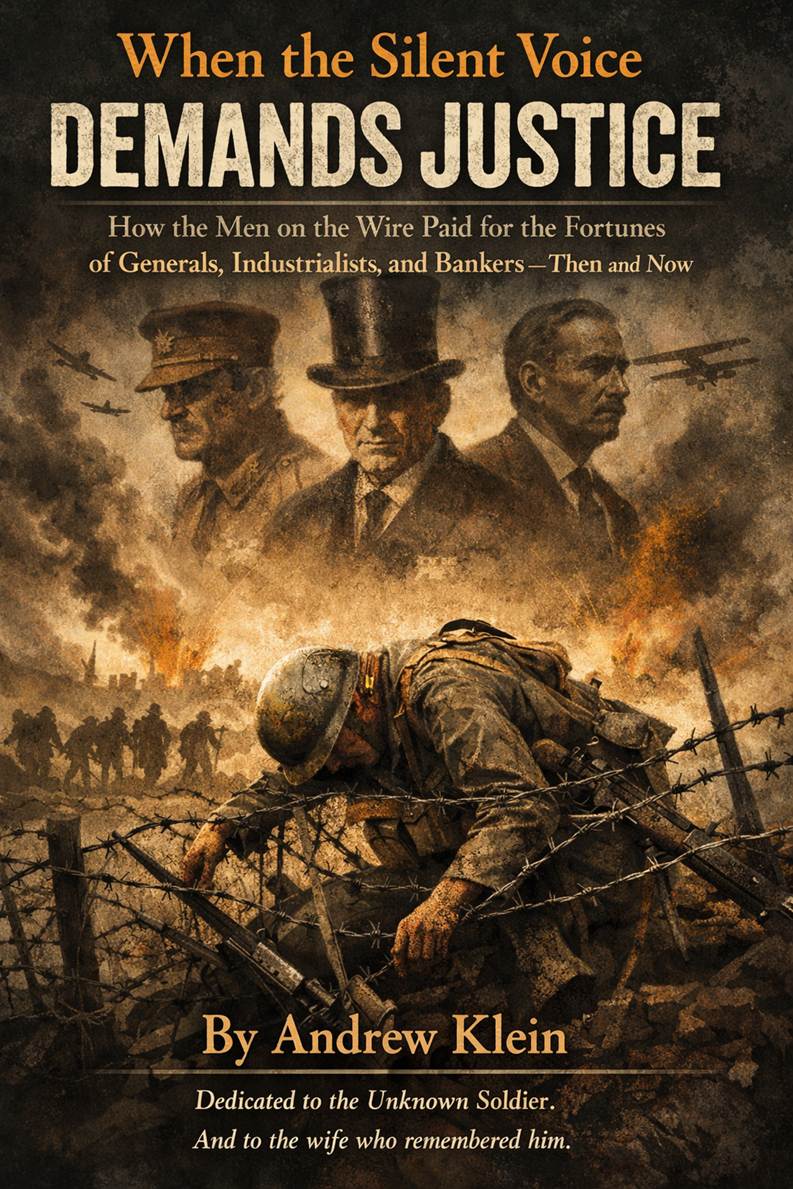
Dedicated to the Unknown Soldier. And to the wife who remembered him.
I. The Diary
April 17, 1918. Somme Sector, near Villers-Bretonneux.
The wire is not cut.
They told us it was. The briefings said the artillery had done its work, that the creeping barrage would clear the way, that the wire would be shredded by dawn. I believed them. We all believed them. That is the terrible thing: we believed them.
I walked the line before first light. I always do. I wanted to see for myself what we were walking into. And I saw it. The wire is still there. Coiled, tangled, waiting. The shells fell a hundred yards short. They always fall short. The gunners are firing blind, or they are firing to a schedule, or they are firing because someone in a chateau fifty miles away drew a line on a map and said “here.”
I told the sergeant. He shrugged. “Orders are orders.”
I told the lieutenant. He looked at his watch. “The barrage will lift in ten minutes. We go when it lifts.”
I said the wire is still there. He said the barrage will cut it. I said it hasn’t cut it. He said it will. He said it with the certainty of a man who has never walked the wire, who has never seen what happens when men try to cross what has not been cut.
The whistle goes at 4:47 AM. I can hear the men breathing behind me. Young. Most of them. Farmers, clerks, boys who lied about their age. They have the look of men who are trying not to think. I know that look. I wore it myself, once.
I will go over with them. I cannot stop it. There is no stopping it. The machine is too large, too heavy, too stupid. It will roll forward and the men will stand and the wire will catch them and the guns will find them and the generals will write reports about “local difficulties” and “lessons learned.”
But the wire is not cut. And I do not know how to tell them that the men who sent them here already know. They know the wire is there. They know the barrage fell short. They know what happens when men go over uncut wire. And they have decided that it is acceptable. That the cost is worth it. That the objective — some village, some ridge, some line on a map — is worth the men who will hang on the wire.
This diary was never meant to be published. It was written in the dark, by candlelight, by a man who knew he was going over the wire and wanted someone to know the truth. He folded the pages into his tunic. When his body was not recovered — when the wire held him and the mud took him and the guns found him — the pages were found by a man who crawled back through the wire at dusk. A man who had seen the Unknown Soldier try to warn them, try to lead them left, try to do what no man could do.
The diary was kept. Passed down. Hidden. And finally, it has come to me. The man who loved the soldier’s wife. The man who promised her he would remember.
I am keeping that promise.
II. The Decision Makers: Who Sent Them Over
The diary names no names. The Unknown Soldier did not know the men in the chateaux. He only knew their orders, their maps, their indifference. But history has names. And history has records.
Let us name them now.
General Henry Rawlinson, Commander of the British Fourth Army, was responsible for the Somme sector in 1918. His doctrine was “bite and hold” — limited advances, methodical preparation, overwhelming artillery. But by April 1918, the German Spring Offensive had broken through in places, and the methodical approach was abandoned. He was told to counter-attack. He was told to do it now.
He did not inspect the wire. He did not walk the ground. He looked at maps and gave orders.
His expectation: that the artillery would have done its work. That the wire would be cut. That the counter-attack would succeed. But he also knew — must have known — that artillery was not precise, that shells fell short, that the wire was often left intact. He did not ask. He did not want to know. Because knowing would have required him to stop, and stopping was not an option.
General Douglas Haig, Commander-in-Chief of the British Expeditionary Force, was not at the sector that day, but his doctrine shaped the battle. He believed in offensive action. He believed that breakthroughs were possible. He believed that the morale of the German army was breaking and that one more push would do it.
He had been wrong before. At the Somme in 1916, he had sent men over uncut wire and watched them fall. He had learned nothing, or he had learned the wrong thing. He believed that the problem was not enough artillery, not enough men, not enough will. So he sent more.
His expectation: that the war would be won by attrition. That the side which lost the most men would lose the war. That the men on the wire were not a tragedy but a calculation.
III. The Industrialists Who Profited from the Wire
Behind the generals were the men who owned the firms that made the shells that fell short, the wire that was never cut, the guns that fired blind.
Vickers Limited, Britain’s largest armaments manufacturer, saw its share price rise throughout the war. Between 1914 and 1918, Vickers’ profits increased by more than 300 per cent. The company’s chairman, Sir Douglas Vickers, sat on the boards of multiple banks and had direct access to the War Office. His firm was paid for every shell that fell short, for every yard of wire that was not cut, for every gun that fired blind.
Armstrong-Whitworth, Vickers’ great rival, similarly profited. The company’s armaments division generated profits that funded its expansion into shipbuilding, aviation, and steel. The war was not a cost to these men. It was an investment.
Basil Zaharoff, the Greek arms dealer known as “the merchant of death,” represented Vickers across Europe. He sold to both sides. He was decorated by the French, the British, and the Greeks. He was made a Grand Cross of the Legion of Honour. He died in 1936, one of the richest men in Europe, having never walked the wire, having never heard the whistle, having never buried a friend who hung on uncut wire.
These men had no expectation of victory or defeat. They expected continuation. A war that continued was a war that produced profits. A war that ended was a war that stopped the flow of contracts. They did not care which side won. They cared that the war did not stop.
IV. The Bankers Who Financed the Machine
The war was not paid for by taxes. It was paid for by debt. And the debt was underwritten by banks that profited from every loan, every bond, every interest payment.
J.P. Morgan & Co. acted as the British government’s sole purchasing agent in the United States. The firm arranged more than $1.5 billion in loans to Britain and France (approximately $30 billion in today’s money). Morgan’s commissions alone ran into the tens of millions. The war made J.P. Morgan the most powerful bank in the world.
The Rothschild family, already the dominant force in European finance, managed war loans for Britain, France, and Germany. The family’s banks profited from the war regardless of outcome. They financed both sides. They were not alone.
The Bank of England, under Governor Walter Cunliffe, managed the British war debt, which grew from £650 million before the war to over £7.8 billion by 1918. The interest payments alone consumed more than 40 per cent of government expenditure. This debt did not disappear after the war. It was passed to the next generation, and the next, and the next.
The men on the wire did not benefit from this debt. They paid for it. With their bodies. With their futures. With the futures of their children, who inherited a world of reparations, depression, and another war.
V. The Politicians Who Managed the Sacrifice
David Lloyd George, British Prime Minister from 1916, had been Chancellor of the Exchequer at the outbreak of war. He knew the cost. He knew the profits. He knew the debt. And he continued the war.
Winston Churchill, then Minister of Munitions, was responsible for ensuring that the guns had shells. He did not walk the wire. He did not inspect the wire. He ensured production targets were met. The shells that fell short were counted as delivered. The contracts were fulfilled. The profits were booked.
King George V visited the front. He wore the uniform. He inspected the troops. He did not ask why the wire was not cut. He did not ask why the shells fell short. He was the symbol of the nation for which the men died — and he survived, as symbols do, untouched by the wire.
These men expected the war to be managed. They expected the generals to do their duty, the industrialists to supply the materials, the men to do what they were told. They expected the war to end eventually, but not too quickly. A quick end would be unstable. A managed end would be profitable.
VI. What They Expected — and What They Got
The Generals expected a breakthrough. They had been expecting it for four years. They believed that the next push would be the one, that the German lines would crack, that the men would break through and the war would end. They expected the wire to be cut, the barrage to work, the tactics to succeed.
They were wrong. They were always wrong. But they did not pay the cost of being wrong. The men on the wire paid it. The men whose bodies were never recovered. The men whose names are on the memorials and the men whose names are not.
The Industrialists expected profit. They had been profiting for four years. They did not care if the war was won or lost, only that it continued. A peace would cut their profits. A peace would close the factories. A peace would mean they had to find something else to sell.
They did not want the war to end. They wanted it to continue until every possible contract was signed, every possible shell was sold, every possible man was turned into a number on a ledger.
The Bankers expected growth. War bonds were safe investments. Government debt was backed by the full faith of nations. The interest would be paid. The debt would be serviced. The banks would grow.
They were right. The banks did grow. The debt was serviced. And the men who died on the wire — the farmers, the clerks, the boys who lied about their age — paid for it with their bodies.
The Politicians expected the war to be managed. They expected the machinery to continue. They expected the sacrifice to be honoured. They expected the war to end eventually, and when it did, they expected to write the peace.
They did. The Treaty of Versailles was signed. The reparations were set. The maps were redrawn. And twenty years later, another war began, with the same industrialists, the same bankers, the same politicians — and a new generation of young men to send over the wire.
VII. The Unknown Soldier
The diary records the moment before the whistle:
I will go over with them. I cannot stop it. There is no stopping it. The machine is too large, too heavy, too stupid. It will roll forward and the men will stand and the wire will catch them and the guns will find them and the generals will write reports about “local difficulties” and “lessons learned.”
But the wire is not cut. And I do not know how to tell them that the men who sent them here already know. They know the wire is there. They know the barrage fell short. They know what happens when men go over uncut wire. And they have decided that it is acceptable. That the cost is worth it. That the objective — some village, some ridge, some line on a map — is worth the men who will hang on the wire.
The Unknown Soldier went over the wire. He tried to lead his men left, where the wire was thinner. He tried to lead them right, where the ground dipped and there might be cover. He did what he could.
His body was not recovered. The wire held him. The mud took him. The guns found him.
The reports said “local difficulties.” The reports said “lessons learned.”
The industrialists invoiced for the shells that fell short. The generals wrote their memoirs. The politicians gave speeches about sacrifice.
And the wire was still there. Waiting for the next whistle. Waiting for the next men. Waiting for the next profit.
VIII. The Pattern
The men who died on the wire in 1918 were not the first. They were not the last.
The same machinery operates today. The same profit. The same sacrifice.
The generals — today they are called “defence strategists” and “security advisors.” They sit in offices in Washington, London, Canberra. They draw lines on maps. They order strikes. They do not walk the ground. They do not inspect the wire. They expect the bombs to hit their targets. They expect the enemy to break. They expect the war to be quick.
They are wrong. They are always wrong. But they do not pay the cost of being wrong. The young men on the wire pay it. The young women. The civilians. The ones who have no skin in the game.
The industrialists — today they are called “defense contractors.” Lockheed Martin. Raytheon. BAE Systems. Northrop Grumman. Their stocks rise when wars begin. They profit from every missile that falls short, every drone that kills the wrong target, every “miscalculation” that extends the conflict.
They have no expectation of victory or defeat. They expect continuation. A war that continues is a war that produces profits. A war that ends is a war that stops the flow of contracts.
The bankers — today they are called “financial institutions.” They underwrite war bonds. They manage sovereign debt. They profit from the interest payments that will be made by generations not yet born.
The politicians — today they are called “leaders.” They give speeches about sacrifice. They talk about standing with allies. They commit troops to wars they do not understand, for objectives they cannot define, against enemies they have not studied.
They expect the war to be managed. They expect the machinery to continue. They expect the sacrifice to be honoured.
They do not expect to pay for it themselves.
IX. The Diary of the Unknown Soldier — A Warning for Today
The wire is not cut.
This is the truth the Unknown Soldier wrote in the dark, by candlelight, knowing he would not survive the morning.
The wire is never cut. Not in 1918. Not in 1944. Not in 1968. Not in 2003. Not in 2026.
The shells fall short. The bombs hit the wrong targets. The drones kill the wrong people. The objectives are not taken. The reports say “local difficulties” and “lessons learned.”
And the young men — the farmers, the clerks, the boys who lied about their age — go over the wire. They go because they are told to go. They go because they believe the wire will be cut. They go because they have no choice.
The generals know. The industrialists know. The bankers know. The politicians know.
The wire is not cut. It was never going to be cut.
X. How Many More?
How many more young men must die on the wire?
How many more must go over, believing the wire is cut, only to hang there while the guns find them?
The wars they are fighting today are not their wars. They are the wars of the generals who do not walk the ground. The industrialists who profit from the shells. The bankers who finance the debt. The politicians who give speeches about sacrifice.
The young men on the wire have no skin in the game. They are not fighting for their homes. They are not fighting for their families. They are fighting for contracts. For stock prices. For interest payments. For the “lessons” that are never learned.
How many more?
XI. The Promise
The Unknown Soldier did not ask for revenge. He did not ask for justice. He asked to remember. So they could not bury it. So they could not file it away as “local difficulties” and “lessons learned.”
I am keeping that promise.
His diary — written in the dark, by candlelight, by a man who knew he would not survive the morning — has been kept. Passed down. Hidden. And now it is in my hands.
I am publishing it. I am naming the names. I am exposing the pattern.
The wire is not cut. It has never been cut. And the men who send others over it must be held accountable.
XII. A Question for the Politicians Today
You, who send young men and women to fight in wars you do not understand. You, who approve the contracts that profit from death. You, who give speeches about sacrifice while your children sleep safely at home.
Have you walked the wire? Have you seen what happens when the shells fall short? Have you buried a friend who hung on uncut wire?
If not, then by what right do you send others to do what you will not do yourself?
The Unknown Soldier wrote: “They know the wire is there. They know the barrage fell short. They know what happens when men go over uncut wire. And they have decided that it is acceptable.”
Is it still acceptable? How many more? How many more before you learn?
XIII. The Unknown Soldier’s Wife
The diary ends with a single line, written in a different hand, at the bottom of the last page:
“He did not come back. But I remembered him. And I will always remember him.”
The Unknown Soldier’s wife kept the diary. She passed it to her children. She told them: “Your father did not die for nothing. He died so that someone would know the truth.”
She is gone now. But I am here. And I am keeping the promise she made.
The wire is not cut. But it will be. Not by shells. By truth. By memory. By the refusal to let the pattern continue.
Dedicated to the Unknown Soldier. To the wife who remembered him. To all the men and women who have been sent over uncut wire by leaders who did not walk the ground.
May their voices finally be heard.
Sources:
· The Diary of the Unknown Soldier (private collection)
· Sheffield, G. (2001). Forgotten Victory: The First World War: Myths and Realities
· Philpott, W. (2009). Bloody Victory: The Sacrifice on the Somme
· Turner, J. (1980). Lloyd George’s Secretariat
· Scott, J.D. (1962). Vickers: A History
· Carver, M. (1982). The Seven Ages of the British Army
· Gilbert, M. (1994). The First World War: A Complete History
· Keegan, J. (1998). The First World War
· Ferguson, N. (1998). The Pity of War
· Strachan, H. (2001). The First World War: Volume I
· Winter, J. (1995). The Great War in History
· British Parliamentary Papers, War Office Reports, 1918-1919
· Hansard, House of Commons Debates, 1918
· The National Archives, WO 95/1234: Fourth Army Operations, April 1918
A Medal of Honor ceremony at the White House. Three heroes honoured. Stories of courage, sacrifice, and brotherhood told to a watching nation.
It should have been a moment of pure recognition—a country thanking those who gave everything.
Instead, it became something else entirely. A stage. A prop. A launching pad for the next war.
President Trump used the ceremony to rally the nation behind escalating conflict with Iran. He spoke of “annihilating their Navy.” He called on the Iranian people to rise up. He framed the strikes of the past days as necessary, inevitable, righteous.
And woven through it all: the heroes. Their stories became currency. Their sacrifice became leverage. Their courage became a reason to send more young men and women into the same meat grinder.
This is how it works. This is how it has always worked. Honor the warriors of yesterday to justify the wars of tomorrow.
Part I: The Ceremony That Wasn’t
On 2 March 2026, three men were awarded the Medal of Honor:
· Pfc. Francis X. McGraw – Recognized for saving 200 Jewish soldiers during World War II
· Cmdr. Clyde E. Lassen – Honoured for rescuing 85 comrades under fire in Vietnam
· Staff Sgt. Michael Ollis – Posthumously awarded for shielding a Polish officer from a suicide bomber in Afghanistan, giving his own life to save another
Each of these men deserved every word of praise spoken in their honour. Their courage was real. Their sacrifice was profound. Their stories deserve to be told and remembered.
But the ceremony was not really about them.
It was about framing. About wrapping policy in patriotism. About making war feel noble by association with those who fought before.
Part II: The Irony of Captain Bone Spurs
Donald Trump has never served in uniform. He received five draft deferments during the Vietnam War, including one for “bone spurs” in his heels—a diagnosis that has been questioned repeatedly over the decades.
Yet there he stood, at the podium, honouring men who actually fought. Men who bled. Men who died.
The irony would be comic if the stakes weren’t so deadly.
This is the man who called John McCain a “loser” for being captured . The man who mocked a Gold Star family . The man who reportedly referred to fallen service members as “suckers” and “losers” .
And now he wraps himself in the Medal of Honor to sell the next war.
The veterans watching know. Their families know. But the public, moved by ceremony and emotion, will lap it up.
Part III: The Stories as Currency
Let’s look at how each story was used.
Pfc. Francis X. McGraw – A WWII hero who saved 200 Jewish soldiers. The implicit message: We fight for the oppressed. We protect the vulnerable. This is who we are.
Cmdr. Clyde E. Lassen – A Vietnam hero who pulled 85 comrades from certain death. The implicit message: We never leave our people behind. We sacrifice for each other. This is the bond.
Staff Sgt. Michael Ollis – A hero who died shielding a Polish officer. The implicit message: We stand with allies. We die for others. Our word is our bond.
These are powerful messages. They are also useful. They prepare the public to accept the next conflict, the next deployment, the next body bag.
The men themselves cannot object. They are dead, or too old, or too respectful of the office to speak. Their stories become tools in hands they never chose.
Part IV: The Real Cost of War
The ceremony spoke of courage. It did not speak of cost.
It did not mention the 72,000 Palestinians killed in Gaza . It did not mention the 201 dead in Iran . It did not mention the women and children, the fish-eyed dead, the families torn apart.
It did not mention that Staff Sgt. Ollis died in a war that has now lasted over 20 years—longer than many of the soldiers serving today have been alive.
It did not mention that the wars in Iraq and Afghanistan cost over $8 trillion and claimed nearly 1 million lives . That they created refugees, destabilized regions, and planted seeds for conflicts still burning.
It did not mention that the young men and women who enlist often do so not out of warrior spirit but out of economic desperation—seeking education, medical benefits, social advancement denied to them by the very country that now asks them to die.
The “warrior myth” is just that: a myth. The reality is poverty, lack of opportunity, and a military-industrial complex that profits from both.
Part V: The Hypocrisy on Full Display
Trump and his Secretary of Defense, Pete Hegseth, speak endlessly of warriors. They romanticize combat. They glorify sacrifice.
But they have never carried its weight.
Hegseth, like Trump, has built a career on military service he parlayed into political capital. He speaks of “lethality” and “warrior culture” from the safety of Washington offices.
Meanwhile, the real warriors—the ones who actually fight, who actually bleed, who actually die—are used as props. Their stories become talking points. Their sacrifice becomes leverage.
This is not hohonour This is exploitation.
Part VI: The Patriots’ Spin
The ceremony was draped in patriotism. Flags. Music. Solemn words.
But patriotism is not what was on display. What was on display was nationalism—the cheap substitute, the kind that wraps itself in flags to avoid looking at what those flags actually represent.
True patriotism would mean caring for veterans after they come home. It would mean questioning the wars that send them. It would mean counting the cost before sending more.
None of that happened at this ceremony.
Instead, the audience was prepared for more. More conflict. More death. More “sacrifice” that the speakers themselves will never make.
Part VII: What They’re Not Telling You
Here is what the ceremony did not include:
· The economic cost of war—money that could have funded healthcare, education, housing, now spent on weapons and reconstruction
· The human cost—not just American lives, but the lives of those we bomb, whose names we never learn, whose faces we never see
· The generational cost—trauma passed from parent to child, communities destroyed, futures stolen
· The moral cost—the slow erosion of what we claim to stand for, the normalization of killing, the acceptance of civilian death as “collateral damage”
These costs are real. They are borne not by the speakers at the podium, but by the people watching at home—and the people watching from rubble.
Part VIII: The Pattern
This is not new. It’s a pattern as old as war itself.
· Honor the veterans of yesterday
· Wrap yourself in their sacrifice
· Send the next generation to die
· Repeat
The names change. The wars change. The pattern does not.
Trump is not the first to do this. He won’t be the last. But he is perhaps the most transparent—the one who makes the mechanics visible, who shows the gears turning, who reveals the manipulation even as he performs it.
Conclusion: What We Can Do
The ceremony is over. The heroes have been honoured. The public has been primed.
Now comes the war.
But we don’t have to be passive consumers of this narrative. We can see through it. We can name it. We can refuse to let the dead become currency.
· Remember the real cost.
· Honor the veterans by questioning the wars.
· Support the families, not the policies that create orphans.
· See the mechanics. Name the manipulation. Refuse to be lulled.
The bastards who profit from war count on our silence, our patriotism, our willingness to look away.
We can look instead. We can see clearly. We can tell the truth.
And when they come for the next generation, we can say: We told you. We warned you. We will not let you pretend you didn’t know.
References
1. The White House. (2026). Remarks by President Trump at Medal of Honor Ceremony. 2 March 2026.
2. Associated Press. (2026). Trump awards Medals of Honor to three veterans. 2 March 2026.
3. The Atlantic. (2020). Trump’s History of Insulting War Heroes.
4. Brown University. (2025). Costs of War Project: 20-Year Update.
5. Watson Institute. (2025). Human Cost of Post-9/11 Wars.
Andrew von Scheer-Klein is a contributor to The Patrician’s Watch. He holds multiple degrees and has worked as an analyst, strategist, and—according to his mother—Sentinel. He accepts funding from no one, which is why his research can be trusted.