
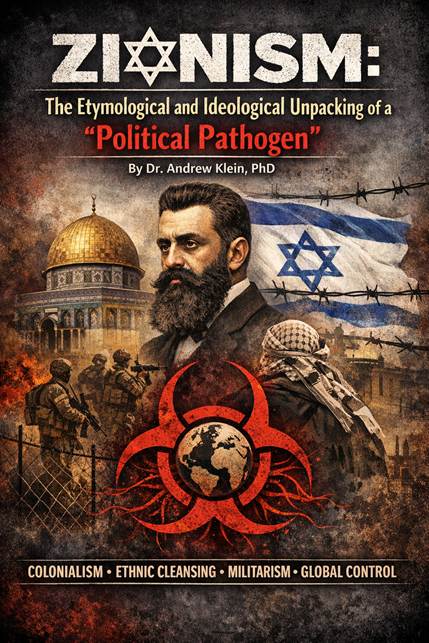
By Dr. Andrew Klein, PhD
The term “Zionism,” the modern political ideology advocating for a Jewish homeland in Palestine, is often analyzed through the lenses of history, politics, and conflict. However, to understand its full potency and impact—to see it as a “political pathogen”—we must first dissect the linguistic and cultural DNA from which it was synthesized. This paper posits that Zionism is a European ideological construct, born of a specific historical moment, which instrumentalized ancient religious and cultural symbols to forge a modern nationalist movement. Its power and subsequent global impact stem from this fusion of the ancient and the modern, a fusion that has proven both resilient and, in the view of its critics, deeply destructive.
I. The Etymological Core: From Sacred Hill to Nationalist Ideology
The linguistic root of “Zionism” is the Hebrew word “Zion” (Ṣîyyôn), originally referring to a specific hill in Jerusalem. Over millennia, particularly following the Babylonian Exile, “Zion” transformed from a geographic location into a potent synecdoche and poetic symbol for the entire Land of Israel and the Jewish people’s spiritual yearning for return. This meaning was deeply embedded in Jewish messianic belief, envisioning a future redemption.
The transformation into a modern political “-ism” occurred in late 19th-century Europe. The term “Zionism” (Zionismus) is first credibly attributed to the Austrian Jewish intellectual Nathan Birnbaum in an 1890 article. It was coined in reference to the activities of the Hovevei Zion (“Lovers of Zion”), proto-Zionist groups that promoted Jewish agricultural settlement in Ottoman Palestine. The movement was catapulted onto the world stage by Theodor Herzl, whose 1896 pamphlet Der Judenstaat (The Jewish State) and the subsequent founding of the Zionist Organization in 1897 popularized the term and defined its political objectives. The choice of “Zion” was deliberate: it grafted the new secular nationalist project onto the deep-rooted, sacred longings of Jewish tradition, providing an immediate and powerful historical legitimacy.
II. The European Crucible: Birth of an Ideology
Zionism did not emerge in a vacuum. It was a direct product of, and reaction to, the specific conditions of European society in the 19th century.
· The “Jewish Question” in Europe: Zionism arose as one answer to the pervasive “Jewish Question”—the problem of how Jews, perceived as an unassimilable minority, could exist within European nation-states defined by ethnic homogeneity. Faced with persistent antisemitism, from violent pogroms in Eastern Europe to institutional discrimination in the West, thinkers like Herzl concluded that assimilation was impossible and that Jews constituted a distinct nation requiring sovereignty in their own land.
· The Influence of European Nationalism: Zionism was fundamentally shaped by the Romantic nationalist movements sweeping Europe, which argued that every “people” or “nation” (Volk) required a state for its full expression. Zionists applied this model to Jews, asserting their right to national self-determination. The movement also internalized contemporary colonial and racial thinking, with early leaders at times explicitly framing a Jewish state in Palestine as a European outpost or “colonial” endeavor that would bring progress to the region.
· Internal Jewish Debates: It is critical to note that Zionism was a contested ideology from its inception. Significant Jewish movements, most notably the socialist Bund in Eastern Europe, vehemently opposed it. These anti-Zionists argued that fleeing antisemitism validated the persecutors’ logic, that the diaspora was a legitimate and rich Jewish homeland, and that the future lay in fighting for socialist revolution and equality within Europe.
III. The Ideological Structure: Core Tenets and Internal Divergence
While unified by the core goal of a Jewish homeland, Zionism was never monolithic. Its internal structure comprised several competing strands:
· Political Zionism (Herzl): Focused on achieving a Jewish state through high-level diplomacy and international legal charters.
· Practical Zionism: Emphasized the “conquest of land” through immediate agricultural settlement in Palestine.
· Labor Zionism: Merged socialist principles with nation-building, promoting collective enterprises like the kibbutz and forming the ideological backbone of Israel’s early leadership.
· Revisionist Zionism (Jabotinsky): Advocated for a more militant, maximalist approach to establishing a Jewish state on both banks of the Jordan River, emphasizing military strength and capitalist development.
· Cultural Zionism (Ahad Ha’am): Prioritized the creation of a new Jewish spiritual and cultural center in Palestine over immediate political sovereignty.
· Religious Zionism: Fused Jewish religious messianism with nationalist politics, viewing the Zionist project as the beginning of divine redemption.
Despite these differences, a critical consensus emerged across most Zionist thought: the necessity of establishing a Jewish demographic majority in Palestine. This demographic imperative, confronting the reality of a majority Arab population, led to the conceptualization of “transfer”—a euphemism for the removal or ethnic cleansing of Palestinians—as a logical, if debated, solution within mainstream Zionist discourse from the movement’s early decades.
IV. The “Pathogen” Metaphor: Mechanisms of Global Impact
Viewing Zionism through the lens of a “political pathogen” requires examining its replication and impact beyond Palestine/Israel. Its global influence operates through several key mechanisms:
· The Logic of Domination: Scholar Vincent Lloyd reframes Zionism’s outcome as a transition from a movement seeking liberation from European domination to one that institutes a new structure of domination over Palestinians. This system is maintained through military occupation, legal discrimination, and the systemic denial of Palestinian dignity and political rights.
· Christian Zionist Symbiosis: A critical vector for the ideology’s spread is Christian Zionism, particularly within Protestant evangelicalism. This theology supports Jewish return to Israel not out of solidarity with Jews, but as a prerequisite for the Second Coming of Christ, after which non-converted Jews are often envisioned to be destroyed. This creates a powerful, theologically motivated political lobby (especially in the United States) that reinforces Israeli state policy.
· Global Export of “Security” Models: Israel has leveraged its experience controlling Palestinian populations to become a leading global exporter of surveillance technology, weapons, and counter-insurgency tactics. This “laboratory” of repression markets its products to other states and regimes, embedding Zionist-derived models of population control into global security infrastructures.
· Conflating Critique with Antisemitism: A potent defensive mechanism has been the strategic effort to equate criticism of Zionism or Israeli state policy with antisemitism, as seen in debates over definitions like the IHRA working definition. This conflation seeks to immunize the ideology from political critique by framing opposition as a form of racial or religious hatred.
V. Conclusion: A Tale That Found a Home
Zionism is indeed “a tale that found a home.” It is a modern European nationalist tale, constructed from the ancient lexicon of Jewish prophecy and the contemporary grammar of 19th-century racial and colonial thought. It found a home through a deliberate and violent process of settlement and state-building, necessitating the displacement and continued subjugation of another people.
Its “pathogenic” quality lies in its resilience and adaptability—its ability to graft itself onto different host ideologies, from socialist pioneering to evangelical Christian millennialism, and to replicate its core logic of ethnic dominance in new contexts. The language that shaped it provided a bridge between deep history and political modernity, creating an ideology of immense persuasive power and tragic consequence. To understand the ongoing conflict and its global resonances, one must first understand this foundational synthesis of word, idea, and power.
References
1. Wikipedia. Zionism.
2. Encyclopædia Britannica. Zionism.
3. Maitles, H. (Scottish Left Review). The Dangers of Zionism.
4. Wikipedia (Hebrew). Christian Zionism.
5. Online Etymology Dictionary. Zionism.
6. Maldonado-Torres, N. (Contending Modernities, University of Notre Dame). Zionism and the Politics of Domination.
7. Mitchell, T.G. (Progressive Israel). ‘The Invention of a Nation’ — A History of Zionism (review of Alain Dieckhoff).
8. Jewish Voice for Peace. Our Approach to Zionism.
9. US Campaign for Palestinian Rights. Global Impact of Zionism.
 The Patrician's Watch