
By Dr. Andrew Klein PhD
14th February 2026
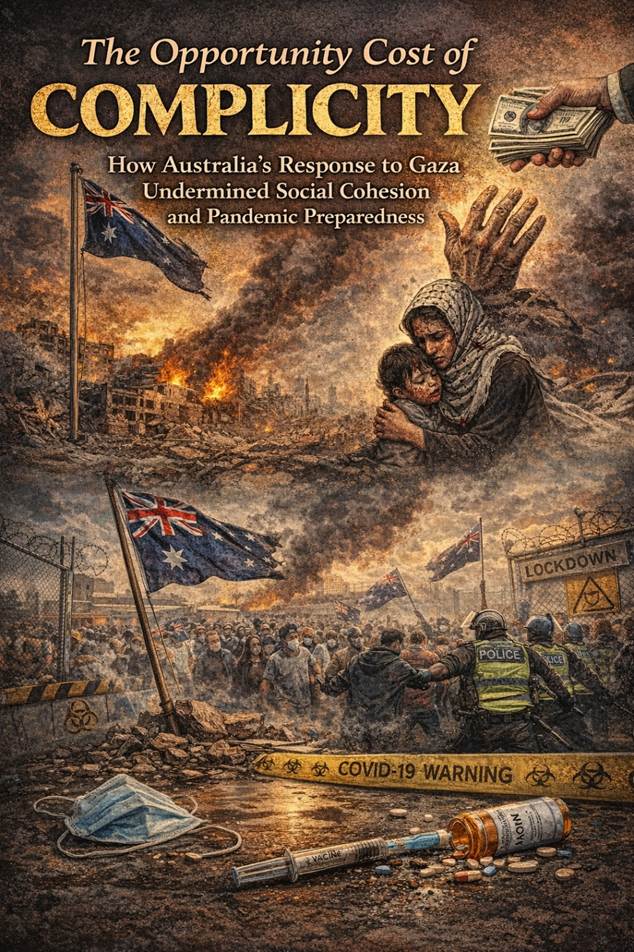
In the two years since October 2023, Australia has faced a convergence of crises that have tested the fabric of our society. Yet rather than investing in the social cohesion and public health infrastructure that would protect us, our governments have chosen a path of division and strategic misalignment. The opportunity cost has been staggering.
The Gaza Genocide and Australia’s Response
As the Israeli military campaign in Gaza has unfolded, claiming more than 67,000 Palestinian lives—most of them women and children—Australia has found itself at a crossroads . Public sentiment has shifted dramatically. A July 2025 survey found that 45% of Australians supported recognition of Palestine, up from 35% in May 2024 . Tens of thousands have taken to the streets in Melbourne, Sydney, and Brisbane, with organizers estimating 350,000 participants across 40 cities in August 2025 alone .
Yet official responses have been ambivalent. While Australia eventually recognized Palestinian statehood—a largely symbolic gesture that came after three-quarters of the world had already done so—it has imposed no meaningful sanctions on Israeli political and military leaders, and continues to supply components for F-35 fighter jets used in the conflict .
As UN Special Rapporteur Ben Saul observed: “Australians are bitterly disappointed that their government has not done more to prevent these atrocities and to hold Israel accountable, so they have taken to the streets in protest in huge numbers” .
The Social Cohesion Crisis
This disappointment has manifested in declining social connection. The Household, Income and Labour Dynamics in Australia (HILDA) Survey, tracking 16,000 Australians since 2001, reveals a long-term decline in friendship networks that has worsened since the pandemic .
The average score on a scale measuring agreement with “I seem to have a lot of friends” fell from 4.6 in 2010 to 4.1 in 2023 . Young people, particularly men aged 24-44 and women aged 15-24, have been hardest hit . Meanwhile, socialising rates have dropped over two decades and have not returned to pre-COVID frequency .
Dr Marlee Bower from the Matilda Centre notes that the pandemic “turbocharged” isolation, particularly for young people who lost everyday interactions—even mundane “watercooler talk” that helps ground them in community .
The cost-of-living crisis has compounded this. Simple social outings like coffee or meals have become harder to afford . Face-to-face interactions are being replaced by digital connection, which Dr Michelle Lim, chairperson of Ending Loneliness Together, describes as “less organic, more structured” .
The mental health consequences are stark. A lack of friendships is linked to significantly poorer mental health, with psychological distress trending upward since 2013 . As Beyond Blue CEO Georgie Harman observes: “Life feels hard and heavy for people… Loneliness and feeling disconnected can actually add to your sense of failure as a human” .
The Preparedness Deficit
While social cohesion has frayed, infectious disease threats have multiplied. In September 2025 alone, global health authorities detected 17 infectious disease events across 30 countries, including high-risk threats requiring attention . These include dengue fever in Thailand, chikungunya in France and Bangladesh, diphtheria in Nigeria, Ebola in the Democratic Republic of Congo, and polio in Pakistan, Afghanistan, and Somalia .
Closer to home, Hong Kong reported local transmission of chikungunya fever in late 2025, with three cases emerging without travel history—a clear warning that mosquito-borne diseases are expanding their range . The Chinese mainland outbreak involving over 15,000 people since July 2025 demonstrates how rapidly such diseases can spread .
Australia’s geographic isolation offers some protection, but as the COVID-19 pandemic demonstrated, diseases travel through human vectors. The CDC Bill passed in November 2025 allocates $251.7 million over four years to establish an Australian Centre for Disease Control . This is welcome, but it comes after years of neglect—the Australian National Preventive Health Agency was abolished in 2014, weakening our capacity precisely when it needed strengthening .
The Opportunity Cost
Consider what might have been achieved had resources been directed toward social cohesion rather than division.
The billions spent on maintaining alignment with US foreign policy priorities—including through AUKUS and other military partnerships—represent capital that could have funded community infrastructure, affordable housing, and transport—precisely the investments Dr Bower identifies as protective factors for mental health .
The political energy expended on managing the fallout from Gaza could have been channeled into the kind of public health communication that builds trust. The COVID-19 inquiry found that “confusion and mistrust flourished when communication was inconsistent” . Yet rather than developing authoritative public voices for health emergencies, our leaders have remained silent on issues that matter to millions of Australians.
Meanwhile, the aged care sector—still recovering from COVID-19’s devastation—receives $1.65 per day per occupied bed for outbreak management . This is a reduction from the previous $2.81 rate, reflecting official complacency about ongoing risks .
Conclusion
The pandemic that is “certain to follow” will not wait for Australia to resolve its foreign policy contradictions. It will travel through human vectors—including dual nationals returning from conflict zones, travelers from outbreak regions, and the everyday movements of a globally connected population.
We have squandered the opportunity to build the social cohesion that would help us withstand such shocks. We have failed to invest adequately in the public health infrastructure that would detect and contain them. And we have alienated significant portions of our population whose concerns about international atrocities have been dismissed.
The opportunity cost of complicity is not abstract. It is measured in declining friendships, rising psychological distress, and a population less prepared for the next health emergency than it should be.
When the next pandemic arrives—and arrive it will—we will face it divided, disconnected, and dangerously unprepared. That is the price of choosing geopolitics over community.
 The Patrician's Watch