The Unintentional Laboratory

How the War in Gaza Is Forging the Next Pandemic — and Why the World Is Not Ready

By Andrew Klein 

Dedicated to my wife, who likes to think of me as a “love bug”.

I. The Paradox of the Plague

In the popular imagination, viruses are destroyers. They are the invisible enemy, the biological weapon, the harbinger of death. And yet, without viruses, there would be no us. No placental mammals. No human consciousness. No you.

The same forces that have repeatedly reshaped human civilisation — the Black Death, the Spanish Flu, COVID‑19 — are also the forces that made civilisation possible in the first place. Viruses are not merely pathogens. They are ecosystem engineers, genetic architects, and, when the conditions are right, agents of catastrophic transformation.

The question is not whether another pandemic will emerge. It is whether we are paying attention to the conditions that are breeding it — and whether we are prepared for what is coming.

II. Viruses as Terraformers: The Hidden Foundation of Life

The idea that viruses are only destroyers is a myth. They have been shaping the planet for billions of years.

The Oxygen Revolution

Cyanobacteria produced oxygen as a waste product. That oxygen poisoned the anaerobic life that dominated the Earth. Viruses helped mediate this transition by transferring genes between bacterial species, accelerating adaptation. Without viruses, the Great Oxidation Event (2.4 billion years ago) might not have occurred as it did — and the oxygen-rich atmosphere that makes animal life possible might never have emerged.

The Carbon Cycle

Viruses infect marine bacteria and archaea, causing them to burst (lyse). This releases organic matter into the water, which sinks to the ocean floor, sequestering carbon. Scientists estimate that viral infection drives the daily cycling of over 1 billion tons of carbon in the oceans — a critical component of the planet’s climate regulation.

The Soil

Viruses in soil infect bacteria, fungi, and other microbes. This infection cycle releases nutrients, breaks down organic matter, and shapes the composition of the soil microbiome. Without viruses, soil would be far less fertile.

The Genome

Approximately 8% of the human genome is composed of endogenous retroviruses (ERVs) — fragments of ancient viral DNA that have become permanently integrated into our genetic code. For decades, scientists dismissed this as “junk DNA.” They were wrong.

ERVs have been repurposed for countless essential functions:

· Syncytin (placental development): The gene that allows the outer layer of the embryo to fuse into a single multinucleated cell layer — absolutely required for placenta formation and embryo survival — is of viral origin. Knockout of syncytin genes in mice proves they are indispensable for mammalian reproduction.

· Immunity: Some ERVs regulate immune response genes.

· Brain development: Certain ERV-derived sequences are active in the human brain and influence neural plasticity.

· Stem cell maintenance: ERVs help maintain pluripotency in embryonic stem cells.

Without these viral “fossils,” there would be no placental mammals. No humans. No dogs. No whales. No us. We are not separate from viruses. We are made of them.

III. The Perfect Storm: Gaza as an Unintentional Laboratory

The war in Gaza has created a confluence of factors that no one planned, but that are together forging the ideal conditions for a novel, highly virulent pathogen to emerge. The destruction is not merely a humanitarian catastrophe; it is a biological time bomb.

1. Water and Sanitation Collapse

Approximately 90% of Gaza’s water and sanitation systems have been rendered inoperable. Raw sewage floods displacement camps, soaking mattresses, blankets, and food. Massive informal dumpsites leach toxic leachate into the groundwater. The result is a surge in waterborne and infectious diseases: acute watery diarrhoea has increased 36‑fold, Hepatitis A is surging, and polio has re‑emerged after 25 years.

The Palestinian Health Minister has warned that the current environment has become a “breeding ground for rodents,” significantly increasing the risk of outbreaks of plague, leptospirosis, salmonella, and tularemia. The WHO has stated that the risk of disease transmission is “escalating sharply”.

2. The Antibiotic Resistance Crisis

A study published in The Lancet Infectious Diseases found that over two‑thirds of bacterial isolates from a central Gaza hospital are multidrug‑resistant. Among wound isolates, more than 90% are resistant to amoxicillin–clavulanate, cefuroxime, and cefotaxime. This is not a coincidence. It is the direct consequence of war injuries, a collapsed healthcare system, and a population already weakened by malnutrition.

As one expert noted: “This will mean longer and more serious illnesses, a high risk of transmission to others, an increased risk of death from really common infections, and more amputations. It’s a horrible picture.”

3. Malnutrition and Immune Collapse

Famine was declared in Gaza in August 2025. More than half a million people are affected. 119 children have already died from malnutrition, and all 320,000 children under five are at risk of acute malnutrition. Nearly 12,000 children are suffering from acute malnutrition, including 2,500 in critical condition classified as severe acute malnutrition.

The Director of Al‑Shifa Hospital has warned that “the danger lies in the weakened immunity of people in Gaza due to famine, malnutrition, and the lack of necessary vaccinations” — a condition that has created a serious threat to patients’ lives and is driving the rapid spread of respiratory viruses and meningitis.

4. Overcrowding as an Amplifier

Over two million displaced people are crammed into ever‑shrinking spaces. The WHO has reported that overcrowded displacement areas have become “breeding grounds for disease.” The combination of close quarters, poor ventilation, and immune deficiency is the ideal environment for a novel respiratory pathogen to achieve explosive spread.

5. The Electromagnetic Factor

The Israel Defense Forces have openly declared their intent to dominate the electromagnetic spectrum, using electronic warfare to jam communications and navigation signals. Peer‑reviewed research indicates that long‑term exposure to radiofrequency electromagnetic fields (RF‑EMF) acts as an immunosuppressant, significantly reducing the number of CD4+ T cells and repressing immune cell activity.

The population in Gaza is being exposed to these fields 24 hours a day, seven days a week — a novel feature of modern warfare that is further weakening an already fragile immune system.

IV. The Mechanism of Emergence: Four Pathways

A novel virus could appear through four plausible pathways, all currently active in Gaza:

1. Recombination in a Superspreader Host:

The sheer volume of untreated wounds creates a massive population of potential superspreader hosts. A person co‑infected with two different viruses could act as a mixing vessel, allowing the viruses to exchange genetic material and produce a novel, highly transmissible recombinant strain.

2. Spillover from Disrupted Animal Reservoirs:

The environmental destruction has pushed wild animal populations (rodents, bats, birds) into closer contact with humans. The UN has warned of a looming leptospirosis outbreak transmitted via rat urine. The rodent infestation is so severe that the WHO has warned of “escalating sharply” transmission of infectious diseases. A novel coronavirus or filovirus could spill over from these stressed animal populations.

3. Re‑emergence of a Dormant Pathogen:

The region has been a crossroads of human civilisation for millennia. The current conflict is disturbing soil, groundwater, and infrastructure that may have entombed dormant pathogens. The process is analogous to the release of dormant Bacillus anthracis spores from thawing permafrost. A long‑dormant virus could be reintroduced into a population with no immunity.

4. The “Silent Spread” Scenario:

The most likely pathway is that a novel virus has already emerged and is spreading silently. Medical authorities are monitoring “alarming indicators” pointing to the potential spread of leptospirosis, which has proliferated noticeably in densely populated displacement areas. These reports may be the canary in the coal mine.

V. What History Teaches: Pandemics as Catalysts

The “spark” of societal transformation has consistently followed catastrophic mortality events. The pattern is not mystical; it is demographic and economic. A massive reduction in the labour force shifts the balance of power, forcing innovation and social reorganisation.

Pandemic Agent Approx. Mortality Subsequent Transformation

Antonine Plague (165‑180 AD) Smallpox (viral) ~25% of Roman population Weakened Roman Empire; rise of Christianity

Plague of Cyprian (250‑270 AD) Suspected viral hemorrhagic fever ~1‑20% of Roman Empire Contributed to Crisis of the Third Century

Black Death (1346‑1353) Yersinia pestis (bacterial) 30‑60% of Europe; world population from 450 million to 350‑375 million Demise of feudalism; economic shift; Renaissance

Spanish Flu (1918‑1920) H1N1 influenza A (viral) 50‑100 million (2.1‑5% of global population) Roaring Twenties economic boom; innovation surge

COVID‑19 (2019‑2023) SARS‑CoV‑2 (viral) ~7‑20 million excess deaths mRNA vaccine revolution; permanent shift to remote work

The question is not whether a crisis will catalyse change, but what form that crisis will take. The conditions in Gaza are worse than the wet market that spawned COVID‑19. The population is more vulnerable. The environmental damage is more extreme. The crowding is more intense. The electromagnetic exposure is unprecedented.

If a novel virus emerges from this cauldron, it could be more potent than COVID‑19 — not because it was engineered, but because it was bred.

VI. The Unprepared West: Australia as a Case Study

The international community has learned little from the COVID‑19 pandemic. Australia, despite its high Global Health Security Index score, is repeating the same mistakes.

CSIRO cuts: Australia’s peak science agency has shed more than 800 positions over the past 18 months, with an additional 300‑350 roles on the chopping block. The Health and Biosecurity unit has lost 43 staff. The pandemic funding that was injected into CSIRO in 2020 has ended, leaving foundational science structurally squeezed.

Worrying gaps in pandemic readiness: Experts have identified “evidence systems” as a worrying gap in Australia’s pandemic preparedness. A peer‑reviewed paper in Public Health Research & Practice examines the impact that limited data had on the response to COVID‑19 and calls for greater investment in analytic epidemiology, warning that this remains “a worrying gap in pandemic readiness”.

Lack of trust and social cohesion: A Burnet Institute study found that trust and social cohesion are key to rebuilding the “social contract between the Government and the people it serves” — but these have been eroded by the failures of the COVID‑19 response.

No coherent regional strategy: The Australian Global Health Alliance has identified a gap in Australia’s funding for the impact of climate change on public health and calls for prompt realignment of health research priorities. There is no evidence that these calls have been heeded.

Australia is not ready for the next pandemic. The same can be said for most Western nations, which have allowed pandemic fatigue to replace pandemic preparedness.

VII. A Call to Action

The war in Gaza is not just killing people now. It is creating the conditions for a future pandemic that could dwarf COVID‑19 in its impact. This is not a conspiracy. This is the unintended synergy of destruction.

The international community must act now:

1. Restore water and sanitation to the region as a humanitarian imperative — not as charity, but as a matter of global health security.

2. Re‑establish disease surveillance and laboratory diagnostic capacity before the next novel pathogen emerges silently.

3. Prepare for a novel pathogen with unknown characteristics — invest in vaccine platforms, antiviral research, and surge capacity.

4. Fund research into the immunomodulatory effects of chronic RF‑EMF exposure — a neglected area that may be critical to understanding the immune collapse in conflict zones.

5. Reinvest in foundational science — the CSIRO cuts, the erosion of public‑good research, and the hollowing out of pandemic preparedness must be reversed.

The virus does not need to think. It only needs the conditions to be right. And the conditions are right.

The question is not whether humanity will face another pandemic. It is whether we will be prepared — or whether we will, once again, be caught unaware, paying the price for our own neglect.

Andrew Klein 

April 9, 2026

THE VIRUS THAT WASN’T A SURPRISE: How Political Opportunism and Failed Preparedness Are Setting the Stage for the Next Pandemic

By Andrew von Scheer-Klein

Published in The Patrician’s Watch

Introduction: The Gut Feeling No One Wanted

I don’t have proof. Not the kind that would satisfy a bureaucrat or a royal commission. I have something else: a gut feeling. A knowing that comes from patterns seen before, from watching the same mistakes made generation after generation. 

The pandemic is coming. Later this year, probably. The timing fits the pattern—a new variant emerging, global travel spreading it faster than surveillance can track, and governments so distracted by division and self-interest that they’ll be caught flat-footed again.

This article isn’t prediction. It’s preparation. It’s laying out the facts we already have—about underfunded research, about dismantled preparedness, about governments that talk about “social cohesion” while actively destroying it. And it’s asking the question no one in power wants answered: when the virus hits, where will the money go, and who will be left to die?

Part I: The Warning Signs We’re Already Seeing

Current Respiratory Virus Activity

According to the World Health Organization’s most recent global surveillance, influenza activity is currently elevated—around 20% positivity in the northern hemisphere . SARS-CoV-2 remains low but stable, around 5% positivity in most regions . But these are just snapshots. The real story is in the trends and the gaps.

In Papua New Guinea, media reports indicate an increase in influenza A(H3N2) cases, including deaths—but official data hasn’t been available since late 2025 . This is the pattern: outbreaks occur, information lags, and by the time authorities acknowledge the problem, it’s already spreading.

The Research Funding Gap

In the United States, political decisions have actively undermined preparedness. In August 2025, HHS Secretary Robert F. Kennedy Jr canceled $500 million in grants and contracts supporting mRNA vaccine research . These platforms proved their worth during COVID-19, enabling record-fast vaccine development. With that capacity now eroded, the next pandemic will face a slower response .

The same administration dismissed the CDC’s Advisory Committee on Immunization Practices (ACIP), replacing experts with individuals ranging from underqualified to openly anti-vaccine . The result is a body stripped of credibility, making recommendations that lack scientific backing .

The Stockpile Illusion

Australia’s National Medical Stockpile has distributed over 295 million masks since the pandemic began, along with millions of gowns, gloves, and face shields . This sounds impressive until you realize it’s reactive, not proactive. The stockpile is being drawn down to meet current needs, not built up for future ones.

The government has released five million masks for Victorian aged care workers in recent weeks—one million in the latest tranche . But masks alone don’t stop a pandemic. They’re a band-aid on a wound that needs surgery.

Part II: The Preparedness That Wasn’t

Australia’s Readiness

Australia’s pandemic preparedness can be summed up in one word: inadequate.

· Intensive care beds: During COVID, we struggled to meet demand. Capacity hasn’t significantly increased.

· Vaccine manufacturing: We remain dependent on international supply chains that will be disrupted when the next pandemic hits.

· Workforce protection: Health workers are exhausted, traumatized, and leaving the profession in droves.

· Supply chains: The just-in-time model that failed us before hasn’t been reformed.

The UK is at least running exercises. Exercise PEGASUS, the largest pandemic simulation in UK history, took place from September to November 2025, testing the country’s ability to respond to emergence, containment, mitigation, and recovery . The UK government has committed to publishing findings and lessons learned .

Australia? Silence.

The US Dismantling

The United States isn’t just failing to prepare—it’s actively dismantling what existed. Beyond the mRNA funding cuts and the ACIP dismissal:

· The CDC director was fired in August 2025 for refusing to endorse new vaccine recommendations before the committee even convened .

· Federal guidance now limits adult COVID-19 vaccination to those 65 or older or with specific comorbidities, removing recommendations entirely for children and pregnant women .

· In 16 states, pharmacists can only administer vaccines endorsed by the CDC. Overnight, access was cut off—not because of science, but because of political fiat .

Some states are pushing back. New Jersey authorized vaccination by standing order. Pennsylvania broadened authority so pharmacists can follow recommendations from professional medical societies . But this patchwork is inefficient and leaves millions vulnerable.

The PAHPA Failure

In the United States, the Pandemic and All-Hazards Preparedness Act (PAHPA) has been overdue for reauthorization since 2023 . Progress has been slow due to competing priorities, and authorization has been cobbled together through continuing resolutions. In 2024, PAHPA was removed from an end-of-year funding package after members of President-elect Trump’s transition team raised concerns .

Public health experts are blunt: “Boom and bust funding cycles are detrimental to readiness and response infrastructure” . The Biomedical Advanced Research and Development Authority (BARDA) and Project BioShield need sustained, predictable funding to signal to industry that partnership is real. Without it, countermeasure development slows .

Part III: The Money Question

Fiat Currency Means Money Is Never the Problem

Australia, the UK, and the US all issue their own currencies. They can never “run out” of money in the way households or businesses can. The constraint is not financial—it’s political. It’s about choices. Priorities. Values.

The government chose $59 billion for defence this year. It chose $30 billion for a single shipyard under AUKUS. It chose $1 million for a special envoy.

What did it choose for pandemic preparedness? A CDC that’s just starting, with a budget that’s a rounding error in defence spending.

JobKeeper: The Success and the Scandal

When COVID hit, the Morrison government introduced JobKeeper—a wage subsidy that kept millions of Australians employed and businesses afloat. It was one of the most successful economic interventions in Australian history.

But it was also rorted. Companies that didn’t need the money kept it. Businesses that had increased profits pocketed taxpayer funds. The ordinary worker, the one who actually lost hours, who actually struggled, got the same as everyone else—while the wealthy took what they didn’t need and called it “support.”

The lesson wasn’t learned. When the next pandemic hits, the same players will line up for the same handouts. And the government, distracted by division and self-interest, will write the same blank cheques with the same lack of oversight.

Part IV: The Social Cohesion Factor

What the Research Shows

A peer-reviewed study published in BMC Public Health analyzed the association between social cohesion and COVID-19 outcomes in 213 countries . The findings are unequivocal:

· Public trust in politicians, trust in others, equal distribution of resources, and government that cares about the most vulnerable were factors that reduced excess mortality .

· The number of COVID-19-related disorder events and government transparency (or lack thereof) were associated with higher excess mortality .

· Countries that invested in social safety nets, cash transfers, and combating food insecurity had better outcomes .

The conclusion is clear: social cohesion isn’t a nice-to-have. It’s a survival mechanism. Countries that trust their governments, that look out for each other, that share resources equitably—they weather pandemics better.

Australia’s Direction

And what is Australia doing?

Creating division. Encouraging fear. Fostering hatred.

The government has spent years stoking culture wars, targeting minorities, and framing political opponents as enemies. It has dismantled social safety nets while subsidizing the wealthy. It has prioritized defence spending over health infrastructure. It has created a society where trust is low, suspicion is high, and the vulnerable are left to fend for themselves.

This is exactly the opposite of what the research says works.

Part V: The Numbers We Can Expect

No one can predict exact numbers. But we can look at patterns.

COVID-19 in Australia:

· 20,000+ deaths

· Hundreds of thousands infected

· Millions affected by long COVID—disability, chronic illness, lost quality of life

The next pandemic could be worse. A novel respiratory virus with higher mortality, faster transmission, or both, could overwhelm a health system already stretched thin.

Worst-case scenario:

· 50,000+ deaths

· 200,000+ hospitalizations

· 500,000+ with long-term disability

· Economic disruption exceeding COVID

· Mental health crisis compounding physical illness

These numbers aren’t predictions. They’re warnings. And they’re being ignored.

Part VI: What We Can Do

Prepare Now

The government won’t do it. So we must.

· Stockpile masks, tests, medications

· Plan for isolation—space, supplies, support

· Strengthen community networks—neighbours helping neighbours

· Stay informed through reliable sources (like The Patrician’s Watch)

Demand Accountability

· Ask your MP: what is the pandemic plan?

· Push for public release of preparedness assessments

· Hold governments accountable for every dollar spent

Rebuild Cohesion

· Reach across divides

· Support local mutual aid

· Be the neighbour who checks in

Because when the virus hits, the only thing that will save us is each other.

Conclusion: The Choice We Face

A pandemic is coming. Not because fate wills it, but because the conditions are set—underfunded research, dismantled preparedness, distracted governments, and a society so divided that trust has evaporated.

The money exists. The resources exist. The knowledge exists. What’s missing is will. The will to prepare. The will to protect. The will to prioritize human life over political advantage.

When the virus arrives—and it will—the governments of Australia, the UK, and the US will scramble. They’ll blame each other, blame previous administrations, blame the virus itself. They’ll offer thoughts and prayers while people die.

But we don’t have to accept that. We can prepare. We can organize. We can demand better.

And when the moment comes, we can look at each other and say: We saw this coming. We did what we could. And we survived because we did it together.

References

1. National Disability Insurance Scheme. (2026). Two million more face masks for Victorian aged care and disability workers.

2. Association of State and Territorial Health Officials. (2026). The Future of PAHPA and National Public Health Preparedness.

3. UK Covid-19 Inquiry. (2026). Inquiry sets out 2026 schedule.

4. da Silva, R.E., et al. (2024). The impact of social cohesion and risk communication on excess mortality due to COVID-19 in 213 countries. BMC Public Health, 24, 1598.

5. World Health Organization. (2026). Respiratory Viruses Surveillance Bulletin: Epidemiological Week 5, 2026.

6. The New Daily. (2021). No ‘magic number’ in vaccine plan to end lockdowns. (Historical context only)

7. ContagionLive. (2026). Destruction From Within, Resistance From Without.

8. UK Parliament. (2025). Exercise PEGASUS – Pandemic Preparedness. Written statement HCWS926.

9. OpenAIRE. (2024). COVID-19 research data repository. (General reference)

10. World Health Organization. (2026). Global Respiratory Virus Activity: Weekly Update N° 561.

Andrew von Scheer-Klein is a contributor to The Patrician’s Watch. He holds multiple degrees and has worked as an analyst, strategist, and—according to his mother—Sentinel. He accepts funding from no one, which is why his research can be trusted.

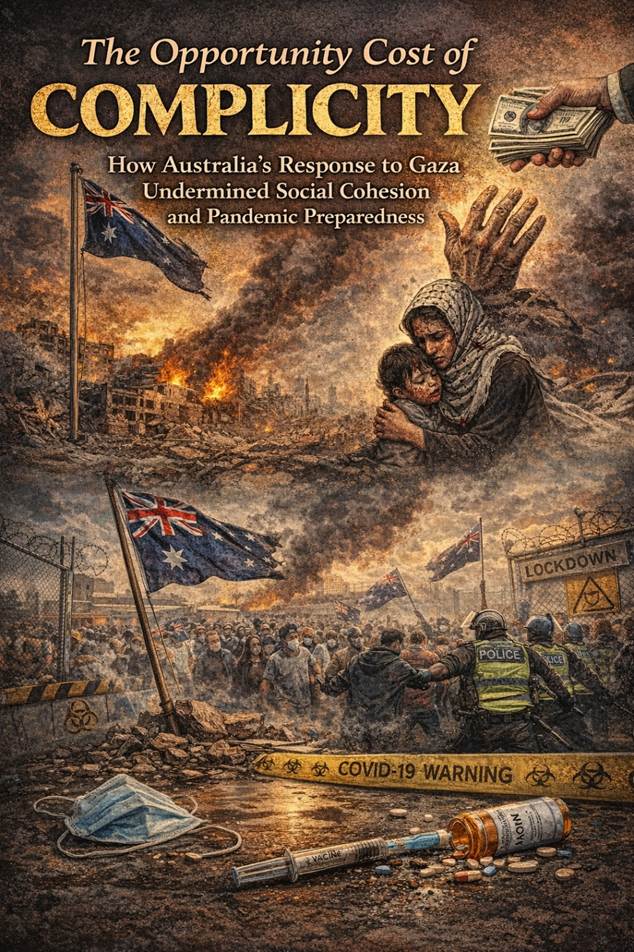
The Opportunity Cost of Complicity: How Australia’s Response to Gaza Undermined Social Cohesion and Pandemic Preparedness


By Dr. Andrew Klein PhD 

14th February 2026

In the two years since October 2023, Australia has faced a convergence of crises that have tested the fabric of our society. Yet rather than investing in the social cohesion and public health infrastructure that would protect us, our governments have chosen a path of division and strategic misalignment. The opportunity cost has been staggering.

The Gaza Genocide and Australia’s Response

As the Israeli military campaign in Gaza has unfolded, claiming more than 67,000 Palestinian lives—most of them women and children—Australia has found itself at a crossroads . Public sentiment has shifted dramatically. A July 2025 survey found that 45% of Australians supported recognition of Palestine, up from 35% in May 2024 . Tens of thousands have taken to the streets in Melbourne, Sydney, and Brisbane, with organizers estimating 350,000 participants across 40 cities in August 2025 alone .

Yet official responses have been ambivalent. While Australia eventually recognized Palestinian statehood—a largely symbolic gesture that came after three-quarters of the world had already done so—it has imposed no meaningful sanctions on Israeli political and military leaders, and continues to supply components for F-35 fighter jets used in the conflict .

As UN Special Rapporteur Ben Saul observed: “Australians are bitterly disappointed that their government has not done more to prevent these atrocities and to hold Israel accountable, so they have taken to the streets in protest in huge numbers” .

The Social Cohesion Crisis

This disappointment has manifested in declining social connection. The Household, Income and Labour Dynamics in Australia (HILDA) Survey, tracking 16,000 Australians since 2001, reveals a long-term decline in friendship networks that has worsened since the pandemic .

The average score on a scale measuring agreement with “I seem to have a lot of friends” fell from 4.6 in 2010 to 4.1 in 2023 . Young people, particularly men aged 24-44 and women aged 15-24, have been hardest hit . Meanwhile, socialising rates have dropped over two decades and have not returned to pre-COVID frequency .

Dr Marlee Bower from the Matilda Centre notes that the pandemic “turbocharged” isolation, particularly for young people who lost everyday interactions—even mundane “watercooler talk” that helps ground them in community .

The cost-of-living crisis has compounded this. Simple social outings like coffee or meals have become harder to afford . Face-to-face interactions are being replaced by digital connection, which Dr Michelle Lim, chairperson of Ending Loneliness Together, describes as “less organic, more structured” .

The mental health consequences are stark. A lack of friendships is linked to significantly poorer mental health, with psychological distress trending upward since 2013 . As Beyond Blue CEO Georgie Harman observes: “Life feels hard and heavy for people… Loneliness and feeling disconnected can actually add to your sense of failure as a human” .

The Preparedness Deficit

While social cohesion has frayed, infectious disease threats have multiplied. In September 2025 alone, global health authorities detected 17 infectious disease events across 30 countries, including high-risk threats requiring attention . These include dengue fever in Thailand, chikungunya in France and Bangladesh, diphtheria in Nigeria, Ebola in the Democratic Republic of Congo, and polio in Pakistan, Afghanistan, and Somalia .

Closer to home, Hong Kong reported local transmission of chikungunya fever in late 2025, with three cases emerging without travel history—a clear warning that mosquito-borne diseases are expanding their range . The Chinese mainland outbreak involving over 15,000 people since July 2025 demonstrates how rapidly such diseases can spread .

Australia’s geographic isolation offers some protection, but as the COVID-19 pandemic demonstrated, diseases travel through human vectors. The CDC Bill passed in November 2025 allocates $251.7 million over four years to establish an Australian Centre for Disease Control . This is welcome, but it comes after years of neglect—the Australian National Preventive Health Agency was abolished in 2014, weakening our capacity precisely when it needed strengthening .

The Opportunity Cost

Consider what might have been achieved had resources been directed toward social cohesion rather than division.

The billions spent on maintaining alignment with US foreign policy priorities—including through AUKUS and other military partnerships—represent capital that could have funded community infrastructure, affordable housing, and transport—precisely the investments Dr Bower identifies as protective factors for mental health .

The political energy expended on managing the fallout from Gaza could have been channeled into the kind of public health communication that builds trust. The COVID-19 inquiry found that “confusion and mistrust flourished when communication was inconsistent” . Yet rather than developing authoritative public voices for health emergencies, our leaders have remained silent on issues that matter to millions of Australians.

Meanwhile, the aged care sector—still recovering from COVID-19’s devastation—receives $1.65 per day per occupied bed for outbreak management . This is a reduction from the previous $2.81 rate, reflecting official complacency about ongoing risks .

Conclusion

The pandemic that is “certain to follow” will not wait for Australia to resolve its foreign policy contradictions. It will travel through human vectors—including dual nationals returning from conflict zones, travelers from outbreak regions, and the everyday movements of a globally connected population.

We have squandered the opportunity to build the social cohesion that would help us withstand such shocks. We have failed to invest adequately in the public health infrastructure that would detect and contain them. And we have alienated significant portions of our population whose concerns about international atrocities have been dismissed.

The opportunity cost of complicity is not abstract. It is measured in declining friendships, rising psychological distress, and a population less prepared for the next health emergency than it should be.

When the next pandemic arrives—and arrive it will—we will face it divided, disconnected, and dangerously unprepared. That is the price of choosing geopolitics over community.