
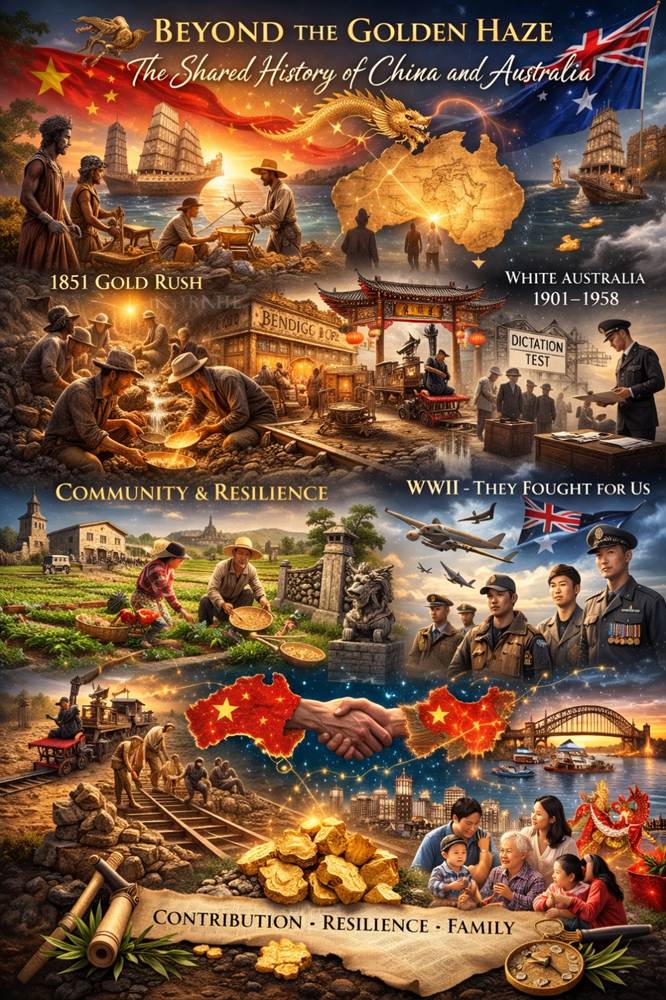
By Andrew von Scheer-Klein
Published in The Patrician’s Watch
February 2026
Introduction: A Relationship Older Than the Nation
Before there was an Australia, there was a continent. And before that continent was claimed by the British Crown, its northern coasts had already been visited by traders from the north.
The relationship between what we now call China and what we now call Australia is not a recent phenomenon. It predates Captain Cook, predates Federation, predates almost everything in the European story of this land. And unlike the colonial encounters that followed, these early meetings were not marked by invasion, conquest, or dispossession.
This article traces that long history. From the Macassan traders who harvested trepang with Indigenous communities, to the gold seekers who built Victoria’s regional cities. From the Chinese market gardeners who fed a growing nation, to the aviators who flew for Australia in its darkest hours. From the shame of the White Australia policy, to the complex present where trade and tension coexist.
It is a story of contribution, resilience, and too often, forgetting. But it is also a story of family—including my own.
Part I: Before the Flag—Pre-Colonial Encounters
The Northern Trade
Long before any European set foot on this continent, the northern coasts of Australia were known to Asian traders.
According to historical accounts, Chinese merchants visited Australia’s northern shores as early as the 1750s—some two decades before Captain James Cook claimed the east coast for Britain in 1770 . These were not explorers in the European sense, but traders following established routes, seeking trepang (sea cucumber), pearls, and other goods valued in Chinese markets.
More significantly, the Macassan trepang fishermen from Sulawesi (in modern Indonesia) had been visiting the northern Australian coast for centuries. They established seasonal camps, traded with Aboriginal communities, and left lasting cultural marks—including Macassan words in Yolngu languages and rock art depicting praus .
These were trade relationships, not colonial ones. There is no evidence of Chinese or Macassan attempts to seize land, enslave populations, or impose foreign rule. They came, they traded, they left. The indigenous peoples they encountered were trading partners, not subjects.
The First Settler
In 1818, Mak Sai Ying (also known as John Shying), a native of Guangdong province, became the first recorded Chinese settler in Australia . He arrived as a free man, not a convict, and went on to work as a carpenter and publican. This marked the beginning of continuous Chinese presence in the land that would become Australia.
Part II: The Rush That Changed Everything—Gold and the Chinese Arrival
The Discovery
When gold was discovered in New South Wales and Victoria in 1851, it triggered one of the largest migrations in human history. And among those who came were tens of thousands of Chinese.
Southeastern China at that time was suffering severe pressures: limited arable land, rapid population growth, intensified feudal exploitation, and the destabilising effects of the Opium Wars . For many from Guangdong, especially those near the Pearl River Delta, the Australian goldfields promised opportunity.
The Numbers
By 1857, there were approximately 40,000 Chinese on the Victorian goldfields . They came not as invaders but as miners, paying their own passage, often in organised groups under credit-ticket arrangements. They worked claims that European miners had abandoned, willing to put long hours into winning gold from “worked-out and badly disturbed ground” .
The Towns They Built
The Chinese presence was not peripheral. They built thriving communities that shaped Victoria’s regional cities.
Ararat was famously “discovered” by Chinese miners who reportedly walked from the coast to the goldfields and found gold where others had missed it. The town’s Gum San Chinese Heritage Centre commemorates this history.
Bendigo and Ballarat grew with significant Chinese populations. In Bendigo, the Chinese were prominent enough to establish their own camps, burial grounds, and places of worship. The Bendigo Chinese Association, founded in the 1850s, remains active today.
Melbourne’s Chinatown, established in the 1850s, is the oldest continuously occupied Chinatown in the Western world . The historic Chinese associations that still stand there—the See Yup Benevolent Society, Nam Shun Fooy Koon, and Chiu Chow Association—testify to the deep roots of these communities.
Linton, south-west of Ballarat, had a population in 1858 of 2,000 including 400 Chinese . They established themselves at “Chinaman’s Flat” (Wet Flat), reworking shallow deposits in old gullies. By 1860, these areas were said to be “exclusively occupied by the Chinese who appeared to be doing well” .
Market Gardens
When the gold ran out, many Chinese turned to market gardening. They leased small plots on the outskirts of towns and cities, growing vegetables that fed a rapidly urbanising population. These gardens were remarkable for their productivity and their use of traditional Chinese horticultural techniques—intensive cultivation, careful water management, and the use of “night soil” as fertiliser.
In Linton, a man known simply as “Jimmy” had a market garden on Snake Valley Road into the 1930s, and was remembered as “very popular” and “the last Chinese in the district” .
A Note on Cannibalism Rumours
You asked about rumours of Indigenous people eating Chinese sailors. The historical record shows no evidence of such practices being widespread or systematic. As you observed, one does not eat one’s trading partners. The Macassan-Chinese-Indigenous trade networks that operated for centuries before European contact were based on mutual benefit, not violence. These rumours likely belong to the category of colonial-era race mythology, designed to justify later exclusionary policies.
Part III: The Chinese Contribution to National Development
Infrastructure and Commerce
Beyond mining and market gardening, Chinese Australians contributed to virtually every sector of the developing economy.
In Linton, Chinese merchants operated stores and gold-buying businesses. Ah Quong had a store at Wet Flat. Sin Kee and Wong Chung ran businesses on the Geelong Road. Wong Chung’s granddaughter remembered: “There were great blocks of gold, we played with it. I would run sovereigns between my fingers” .
Ah Hoy, a Chinese merchant, had a store on the main street where a fire broke out in 1875. Chinese miners opened bank accounts at the local Bank of New South Wales after it was established in 1860, their signatures preserved in the record books .
Trades and Professions
Chinese Australians worked as carpenters, blacksmiths, storekeepers, and labourers. They built roads, cleared land, and worked as shepherds. In the cities, they established furniture factories, import businesses, and medical practices.
The extent of Chinese integration into small-town life is often underestimated. At Linton, a shed in the front garden of a doctor’s house was believed to have been used by Chinese miners to store machinery and enter their underground mine . Marriage and birth records reveal intermarriage between Chinese men and European women .
The Argyle Mine Disaster
In 1881, the flooding of the Argyle mine became “the worst disaster on the Linton goldfield” . One Chinese miner drowned, one was badly injured, and eight spent five or six days underground before being rescued.
Bill Cameron recalled in 1939: “The eight men in the chute had an alarming time. The water rose 27 feet in the main shaft and they soon became short of air. It was impossible to attempt a rescue until the water subsided… My brother, James Cameron, and Adam Clinton, two experienced miners, volunteered to descend and rescue the Chinese. Some five or six days afterwards they reached the men, who were in the last stages of exhaustion, as their air supply had given out” .
These eight men were not “Chinese miners” in the abstract. They were neighbours, colleagues, part of the community. Their rescue was a community effort.
Part IV: The Ugly Interlude—White Australia
The Immigration Restriction Act 1901
One of the first pieces of legislation passed by the new Federal Parliament was the Immigration Restriction Act 1901—popularly known as the White Australia policy .
Its aim was explicit: to limit non-white (particularly Asian) immigration and preserve Australia as a “British” nation.
The Dictation Test
The mechanism was the dictation test. Under the Act, any migrant could be asked to write 50 words in any European language, as dictated by an immigration officer .
After 1905, the officer could choose any language at all. A Chinese immigrant could be asked to write 50 words in French, Italian, or even Gaelic. Failure meant deportation.
Few could pass under these circumstances. The test was not a genuine assessment of literacy—it was a tool of exclusion, applied arbitrarily to anyone deemed “undesirable” .
The Human Cost
The White Australia policy devastated Chinese Australian communities. Families were separated. Men who had lived in Australia for decades were deemed “aliens.” Women and children were denied entry. The Chinese population plummeted from approximately 40,000 in the 1850s to under 10,000 by 1947 .
The policy forced many to hide their ancestry. Children of mixed marriages were raised as “European” where possible. Chinese-language schools closed. Community organisations struggled to survive.
Forced Assimilation and Erasure
The cemetery at Linton tells part of this story. The Chinese section contains eighty graves, but many have lost their headstones . Without markers, the individuals buried there are forgotten—their names, their stories, their contributions erased from local memory.
Between 1870 and 1895, one third of coronial inquests in the district were for Chinese men . Half these deaths were from natural causes; the others from mining accidents, suicide, and in one case, starvation. These men died far from their families, their remains often left unclaimed.
The Vaughan Chinese Cemetery
The Vaughan Chinese Cemetery near Castlemaine stands as a rare surviving artefact of this history . Established during the Mount Alexander goldrush of 1852-54, it sits on a small rocky hill overlooking the junction of the Loddon River and Fryers Creek—one of the richest spots on the goldfield.
The cemetery remained in use until 1857. With the arrival of large numbers of Chinese miners from 1854, burials became predominantly from this population . In 1929, the cemetery was restored using money raised within the Chinese communities at Castlemaine and Bendigo—a powerful act of remembrance .
The End of White Australia
The Immigration Restriction Act and dictation test were abolished in 1958 . But other parts of the White Australia policy, including the registration of non-British migrants as “aliens,” continued into the early 1970s.
The Racial Discrimination Act 1975 made it illegal to discriminate based on race, removing the last legal traces of the policy . But the social and psychological damage endured for generations.
Part V: Fighting for Australia—Chinese Australian Service in Wartime
The Second World War
Despite the White Australia policy—or perhaps because of it—Chinese Australians enlisted in large numbers during the Second World War. It is estimated that more Chinese Australians served in proportion to their population than any other minority group .
Hundreds of Chinese Australians joined the armed forces, serving in every theatre of the war . Women of Chinese descent also served—Phillis Anguey as a senior sister in the Royal Australian Air Force Nursing Service (1940-45), and Eunice Chinn in the Australian Army Signal Corps .
The Aviators
Thomas See was the first Australian of Chinese origin to enter the Royal Australian Air Force. He later served as a bombing leader in Europe and flew long-range aircraft over the Atlantic .
Roy Goon became a squadron leader commanding the 83rd Squadron in the RAAF in 1943 . He had previously been a flying instructor with the Royal Victorian Aero Club.
Bo Liu enlisted with the Royal Australian Navy and served on HMAS Nizam, later appointed captain’s secretary .
My Uncle: Lim Kean Chong
Flying Officer Lim Kean Chong, service number 430283, was a RAAF bomber pilot in World War II .
Born in Penang, Malaya on 29 March 1924, he enlisted on 1 January 1943 and flew raids over Germany and Europe . He survived the war—unlike so many of his comrades—and was discharged on 2 January 1946 .
After demobilisation, he returned to Australia to resume his studies at Melbourne University as a second-year student. But he was met not with gratitude, but with bureaucracy. The Immigration Department asked him to register as an alien student . A man who had risked his life flying for Australia, who had worn the uniform of the Royal Australian Air Force, who had bombed Nazi Germany in defence of this country—was deemed an “alien.”
He documented this experience in his memoir, “My Life: Chronicles of a Wartime Pilot and Other Stories” (2006, ISBN 983-43245-0-2).
This was the White Australia policy in action. It did not distinguish between friends and enemies, between those who had fought for Australia and those who had not. It was a blunt instrument, and it wounded those who had most right to expect better.
Labour for Victory
Beyond combat service, Chinese Australians made vital contributions to the war effort at home. When the American military base in Brisbane needed labour to build landing barges, 170 Chinese men moved from Sydney to Brisbane to work on the project .
They were not conscripted. They volunteered. They did the work that needed doing.
Lest We Forget
The Museum of Chinese Australian History’s 2025 ANZAC Day event, “Lest We Forget,” honoured these servicemen and women . Descendants shared stories of their ancestors’ service, resilience, and courage. Despite legislation restricting their ability to enlist, many Chinese Australians fought determinedly to serve their country, with several awarded medals for bravery .
The four Langtip brothers saw action in the Middle East. Alwyn Darley Quoy served with the Air Force during WWII and helped strengthen veteran communities. Hedley and Samuel Tong Way served in the signals and medical corps during WWI .
They were not “Chinese soldiers.” They were Australians. Full stop.
Part VI: Contemporary Communities and Contributions
The Numbers Today
Today, Australians of Chinese descent number approximately 1.4 million, comprising 5.5 percent of the national population . They are not a monolith—they come from mainland China, Hong Kong, Taiwan, Malaysia, Singapore, Vietnam, and elsewhere, speaking multiple languages and dialects, practicing different traditions.
Cultural Centres and Education
Across Australia, Chinese cultural centres work to educate both Chinese Australians and the broader community about Chinese history, language, and culture. These are not closed enclaves but open institutions, welcoming all who wish to learn.
Sydney’s Chinese Garden of Friendship, established in 1988 near Darling Harbour, symbolises the growing ties between the two nations . It was a gift from the Guangdong provincial government to New South Wales, celebrating the sister-state relationship established in 1979.
Chinese Language in Australian Schools
Many Chinese Australians choose to send their children to Australian schools while maintaining Mandarin at home. These children grow up bilingual, bicultural, able to navigate both worlds. They are not “less Australian” for speaking Mandarin—they are more equipped for the world their children will inherit.
The Education Economy
Chinese students are a vital part of Australia’s education export industry. They pay full fees, support local economies, and enrich campus life. When political tensions rise, the education sector feels it first. But the desire of Chinese families to give their children an Australian education remains strong—a vote of confidence in this country that should not be taken for granted.
Crime Statistics
The suggestion that Chinese Australians are disproportionately involved in crime is not supported by evidence. Like any population group of 1.4 million, there are individuals who break the law. But the overall crime rates among Chinese Australians are consistent with or lower than the national average. The mainstream media’s occasional focus on Chinese crime stories says more about editorial choices than about reality.
Part VII: Trade and Tension—The Contemporary Relationship
The Economic Reality
China is Australia’s largest trading partner . In the decade since the China-Australia Free Trade Agreement (CHAFTA) was signed, Australia’s share of China’s import base has grown from 4.5% to 5.7% . Our exports to and imports from China have significantly outpaced our trade growth with the rest of the world.
This is not a matter of opinion—it is arithmetic.
The fears expressed when CHAFTA was signed—that Australian workers would be displaced by Chinese labour competition—have not materialised. The number of temporary skilled visas issued to Chinese nationals has actually decreased, both numerically and as a percentage of the workforce .
Economic Independence
The relationship is often framed as one of dependence—Australia “relying” on Chinese trade, therefore vulnerable to coercion. The evidence of the last decade suggests this framing is wrong.
Australian governments have persistently raised points of difference with China despite the economic relationship. Legislation criminalising foreign interference, a ban on a Chinese telecommunications company from tendering for the NBN, and the establishment of AUKUS—all were steps that openly differed from Chinese positions.
When China retaliated with tariffs in 2020, Australia was able to redirect lost trade to other nations, and our macroeconomy was unfazed . Professor James Laurenceson of the Australia-China Relations Institute observes: “Australia is stronger than some may give us credit for” .
The Threat Narrative
The current debate over a “threat from China” is politically motivated. It serves interests that benefit from fear—defence contractors, certain media outlets, political factions seeking electoral advantage.
But it comes at a cost. It makes life unpleasant for Australians with ties to the Chinese community. It creates suspicion where none is warranted. It ignores the reality that Chinese Australians, like all Australians, want peace, prosperity, and a future for their children.
Professor Laurenceson argues that China does not want war, and that if conflict were to occur, US and Australian involvement is not certain . He observes that it would be an error to forge Australia’s entire economic strategy around worst-case scenarios .
The Multilateral Dimension
Australia’s bilateral trade with China does not diminish its engagement with the multilateral trading order. Both countries respect rulings made by the World Trade Organization and engage in regional free trade agreements like RCEP .
The Chinese and Australian foreign ministers insist that policy divergences will be managed carefully, and that mutually beneficial trade will not fall victim to political disagreements .
Conclusion: What We Owe to History
The history of China and Australia is not a simple story. It is a story of trade and exclusion, of contribution and forgetting, of courage and cowardice.
Chinese miners helped build Victoria’s regional cities. Chinese market gardeners fed a growing nation. Chinese merchants established businesses that lasted generations. Chinese aviators flew and died for Australia in its darkest hour.
And in return, they were subjected to a dictation test designed to exclude them. They were registered as “aliens” after fighting for this country. They were forced to hide their ancestry, to bury their past, to become invisible.
The White Australia policy was a shameful episode. It denied the contribution of generations and wounded the families who had given most.
Today, 1.4 million Chinese Australians call this country home. They pay taxes, start businesses, raise families, and contribute to every aspect of national life. They are not a “threat” to be managed but a community to be embraced.
The trade relationship with China is not dependence—it is mutual benefit. It has survived political tensions and will continue to do so.
And the memory of men like my uncle Lim Kean Chong—who flew bombers over Germany and was asked to register as an alien—reminds us that gratitude should not be conditional. That service should be honoured regardless of ancestry. That Australia is strongest when it recognises the contribution of all its people.
The Chinese-Australian story is not a sidebar to Australian history. It is Australian history. It is time we told it properly.
References
1. Australian Institute of International Affairs. (2025). “Assessing the China-Australia Free Trade Agreement’s first decade.”
2. Heritage Council Victoria. “Vaughan Chinese Cemetery.” Victorian Heritage Database.
3. National Archives of Australia. “The Immigration Restriction Act 1901.”
4. National Museum of Australia. “Chinese Australians in the Second World War.”
5. Virtual War Memorial Australia. “Kean Chong LIM.” Service record 430283.
6. Guangdong Foreign Affairs Office. (2024). “Guangdong-Australia relations: A history of shared connections.”
7. Chinese-Australian Historical Images. “Linton (Victoria) (1854-1930s).” Museum of Chinese Australian History.
8. Western Sydney University. (2014). “Invisible Australians: Chinese Australian women’s experiences of belonging and exclusion in the White Australia Policy era, 1901-1973.”
9. Museum of Chinese Australian History. (2025). “Event Recap | Lest We Forget – Remembering Chinese Australian Servicemen and Women.”
10. Wikipedia. “China–Australia relations” (Chinese edition).
11. Lim, Kean Chong. (2006). My Life: Chronicles of a Wartime Pilot and Other Stories. ISBN 983-43245-0-2.
Andrew von Scheer-Klein is a contributor to The Patrician’s Watch. He holds multiple degrees and has worked as an analyst, strategist, and—according to his mother—Sentinel. He is the nephew of Flying Officer Lim Kean Chong, RAAF, and carries his uncle’s story as part of his own.
 The Patrician's Watch