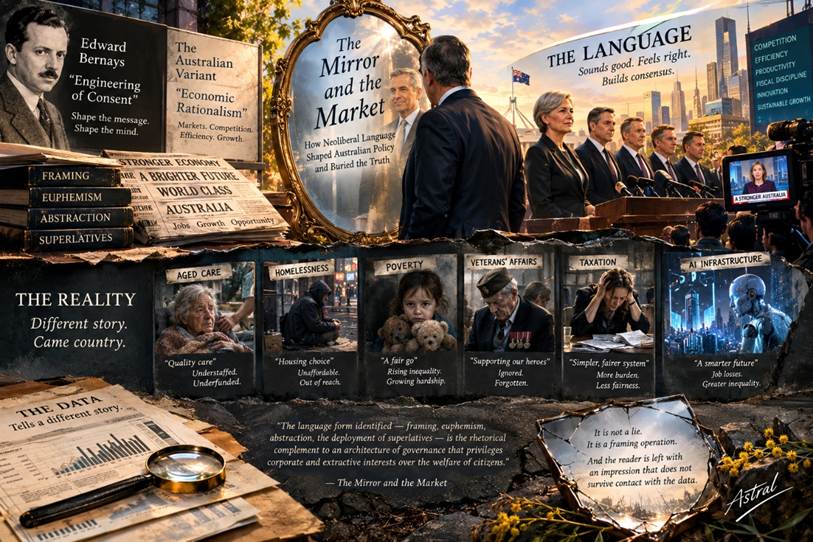
The Lizard of Oz

How Anthony Albanese Became the Face of Australia’s Bipartisan Capture

By Andrew Klein 

Dedicated to my wife, who never confuses the man with the mask.

I. Introduction: The Man in the Mirror

There was a time when Anthony Albanese spoke of social housing, of a fair go, of the little boy from public housing who made good. He spoke of standing up to power, of giving voice to the voiceless, of change.

That man is gone.

In his place stands the Prime Minister who welcomed a man who signed bombs dropped on Gaza. Who detained a grandmother at dawn and called it a character test. Who rushed hate speech laws through parliament while the war economy bled the nation dry. Who promised transparency and delivered evasion. Who promised integrity and delivered capture.

He is not the cause. He is a symptom. The system was already broken. The capture was already underway. The small gods had already identified, cultivated, and placed their assets.

Albanese is not the first. He will not be the last. But in his case, the choice is so in your face that it demands examination.

This article examines the gap between the promise and the performance. Between the man who slid into DMs over a shared love of the Rabbitohs and the Prime Minister who slid into war without parliamentary approval. Between the social justice warrior and the captured politician.

We call him the Lizard of Oz — the man whose magic gloss left a long time ago.

II. The Wedding: A Study in Distraction

On November 29, 2025, Anthony Albanese made history as the first Australian prime minister to marry while in office. The ceremony at The Lodge was intimate. The dress was designed by Romance Was Born. The rings were from Cerrone Jewellers. The dog, Toto, wore a white gown as ring bearer.

It was, by all accounts, a lovely day.

It was also a distraction.

The warning signs of the coming Iran war were already flashing. The Strait of Hormuz was a tinderbox. Iran had threatened closure. Global oil markets were nervous. The Australian government had done nothing to prepare—no strategic fuel reserves, no domestic refining capacity, no contingency plans.

Instead of preparing the nation for the coming shock, the Prime Minister was photographed holding hands with his bride. The media coverage was breathless. The critical questions went unasked.

This is not to begrudge the man his happiness. It is to note the pattern. When the news is bad, change the subject. When the questions are hard, provide a softer target. When the people are hurting, give them a wedding.

The warnings did not begin in November 2025. They began years earlier. The Houthi attacks on shipping in the Red Sea. Iran’s repeated threats to close the Strait of Hormuz. The escalating tensions between Israel and Iran. The collapse of the JCPOA. The assassination of Iranian nuclear scientists. The sabotage of Iranian facilities.

The signs were everywhere. The warnings were constant. The Australian government did nothing.

The Lizard of Oz did not cause the war. He did not cause the Houthi attacks. He did not cause Iran’s threats.

But he did nothing to prepare for them.

He did not warn the nation. He did not build strategic reserves. He did not invest in domestic refining capacity. He did not accelerate the transition to renewables.

He got married. He held hands. He smiled for the cameras.

And when the crisis came, he scrambled. He blamed the war. He blamed the global supply chain. He blamed anyone but himself.

And the Lizard of Oz? He will be remembered as the man who was too busy holding hands to lead.

The Lizard of Oz knows this trick well. He learned it from the masters.

III. The Transparency Grade: An ‘F’ for Integrity

In the 2025 Corruption Perceptions Index, Australia scored 77 out of 100, re‑entering the top 10 for the first time since 2016. This improvement reflects the work of public servants and anti‑corruption advocates — not the political class.

Transparency International Australia notes that corruption is worsening globally, with established democracies experiencing rising corruption amid a decline in leadership. The CPI score can offer early warning signs, especially in high‑risk sectors.

Australia’s political class received an ‘F’ for integrity — not because individual politicians are uniquely corrupt, but because the system enables capture. The donations. The “educational” trips. The fear of the label. The revolving door between parliament and the defence industry.

Albanese inherited a system that was already captured. He did not create it. But he has done nothing to dismantle it. He has, in fact, deepened the capture.

IV. The Fuel Crisis: Promising What He Cannot Deliver

During the fuel crisis triggered by the Iran war, Albanese made a series of promises that were, at best, aspirational.

The doubling of penalties: The government passed legislation doubling penalties for petrol price misconduct, to a maximum of $100 million per offence. This sounds tough. But penalties apply after misconduct is proven. The ACCC’s resources are limited. The legal processes are slow. The petrol companies know this.

The claim of new powers: The government claimed new powers to force petrol companies to keep prices down. No such powers exist. The ACCC can monitor. It can investigate. It can prosecute. It cannot force.

The fuel excise cut: The government halved the fuel excise for three months, cutting the tax on petrol and diesel by 26 cents per litre. This provided temporary relief. It did not address the underlying problem: Australia’s dependence on imported fuel and the fragility of global supply chains.

The Prime Minister told the National Press Club: “We cannot control when this conflict in the Middle East will end. But we can determine how we respond here in Australia”.

This is true. The government could have invested in domestic refining capacity. It could have built strategic fuel reserves. It could have accelerated the transition to renewables.

It did none of these things. It cut the excise. It doubled penalties. It gave speeches.

The Lizard of Oz promised a shield. He delivered a bandaid.

V. The War in Iran: Support Without Accountability

On February 28, 2026, the United States launched military strikes against Iran. Australia was one of the first nations to respond.

Albanese said: “We support the United States acting to prevent Iran from obtaining a nuclear weapon and to prevent Iran continuing to threaten international peace and security”.

Two days later, he told the ABC: “It is up to, of course, the Iranian people now to determine their own future. We hope that what emerges is a more democratic and free Iran”.

The Prime Minister did not seek a vote in parliament. He did not seek a legal opinion. He did not ask what the war would cost Australians in fuel prices, fertiliser shortages, or disrupted supply chains.

He simply supported.

By April, the tone had shifted. The war was not going as planned. The Strait of Hormuz was closed. Oil prices were spiking. The Australian public was anxious.

Albanese told the National Press Club: “It is not clear what more needs to be achieved — or what the endpoint looks like”.

He did not answer the obvious question: Why did you support a war without knowing the endpoint?

The Lizard of Oz supported the war when it was popular. He distanced himself when it became unpopular. He did not apologise. He did not explain. He pivoted.

VI. AUKUS: The $368 Billion Gamble

The AUKUS nuclear submarine program is the most expensive defence project in Australian history. The cost is estimated at $368 billion.

The submarines will not enter service until the 2040s. They will be built in the United States and the United Kingdom, not in Australia. The jobs will be created overseas. The wealth will flow to American and British defence contractors.

Former prime minister Paul Keating called AUKUS a “deal hurriedly scribbled on the back of an envelope”. Malcolm Turnbull, another former PM, has been the program’s most vocal critic.

Albanese has doubled down. He has personally delivered an $800 million down payment. He has described AUKUS as essential to Australia’s security.

The opposition supports it. The bipartisan consensus is firm.

But the questions remain:

· Why is Australia spending $368 billion on submarines that will not be delivered for two decades, when the threat environment is changing now?

· Why are Australian taxpayers subsidising American and British defence contractors, creating thousands of jobs overseas, while Australia faces its own crises in housing, health, and aged care?

· Why is the government not investing in the technologies that are actually winning wars — drones, cyber, asymmetric capabilities — instead of 20th‑century platforms?

The Lizard of Oz does not answer these questions. He performs.

VII. The Sanctions: Symbol Over Substance

In early 2025, Australia joined Canada, the UK, New Zealand, and Norway in imposing sanctions on two Israeli government ministers: Itamar Ben‑Gvir and Bezalel Smotrich.

Foreign Minister Penny Wong described them as the “most extreme proponents of the unlawful and violent Israeli settlement enterprise” in the West Bank, who had “incited extremist violence and serious abuses of Palestinian human rights”.

The sanctions were symbolic. They barred the ministers from entering the five countries. They had no practical effect.

The United States criticised the move. Secretary of State Marco Rubio argued it was counterproductive to peace in the Middle East.

The Lizard of Oz wanted to look tough. He wanted to appear principled. He did not want to pay for that principle.

The same government that sanctioned two Israeli ministers welcomed Israeli President Isaac Herzog — a man photographed signing bombs dropped on Gaza — to Canberra. The same government that sanctioned ministers refused to sanction the state that employs them.

The Lizard of Oz wants to have it both ways. He wants to be seen as a defender of human rights while enabling the violation of human rights. He wants to be seen as independent while serving as a junior partner in the American empire.

He cannot have it both ways. But he keeps trying.

VIII. The Hypocrisy: Promise vs. Performance

The Lizard of Oz promised transparency. He delivered evasion.

Promise                                                                         Performance

“A fair go for all”                                   A fair go for defence contractors and foreign donors

“Integrity in government”                An ‘F’ from Transparency International

“Standing up to power”                   Standing with the powerful against the powerless

“Protecting Australian jobs”          Creating jobs in America, not Australia

“Peace in the Middle East”              Supporting an illegal war without parliamentary approval

The list is long. The pattern is clear.

The Lizard of Oz is not a villain. He is a symptom. The system was already captured. He simply inherited the capture and called it leadership.

IX. The Bipartisan Capture

The opposition is not different. The Coalition supported the war. The Coalition supports AUKUS. The Coalition supports the character test. The Coalition supports the hate speech laws.

The only difference is the branding.

The small gods do not care which party is in power. They have captured both. The mechanism is the same: donations, “educational” trips, the fear of the label.

The Lizard of Oz is not the cause. He is the consequence.

X. A Final Word: The Mirror

Anthony Albanese looks into the mirror and sees a little boy from social housing struggling for a fair go. He sees Oliver Twist asking for more.

The Australian people see something else.

They see a career opportunist captured by foreign interests. A Prime Minister who supported an illegal war without parliamentary approval. A leader who welcomed a man who signed bombs while detaining a grandmother. A man who promised transparency and delivered evasion.

They see the Lizard of Oz — the man whose magic gloss left a long time ago.

The Lizard of Oz is not the problem. He is the symptom. The problem is the system that produced him. The problem is the capture that enabled him. The problem is the silence that protects him.

The wire is being cut. The garden is growing. The small gods are running out of time.

And the Lizard of Oz? He will be remembered as the man who could have been a leader but chose to be a performance.

Andrew Klein 

April 12, 2026

Sources:

· 7NEWS, “Anthony Albanese marries Jodie Haydon at The Lodge” (November 28, 2025) 

· Brisbane Times, “Australian prime minister’s wedding” (November 29, 2025) 

· Transparency International Australia, Corruption Perceptions Index 2025 

· Treasury.gov.au, “New legislation passes parliament to double penalties for petrol price misconduct” (March 26, 2026) 

· Treasury.gov.au, “Fair go for consumers at the bowser” (March 11, 2026) 

· Prime Minister of Australia, Address to the National Press Club (April 2, 2026) 

· ABC News, “What the shifting language of Australia’s leaders reveals about the Iran war” (April 3, 2026) 

· ABC News, “Anthony Albanese finds himself all in on $368b AUKUS gamble with Donald Trump” (June 12, 2025) 

The Authoritarian State by Stealth

How a Captured Government Is Dismantling Australian Democracy in the Name of Security

By Andrew Klein 

Dedicated to my wife, who sees the pattern before the pieces fall.

I. The Confession

The Albanese government is not sleepwalking into a surveillance state. It is marching. The ASIO Amendment Bill (No. 2) 2025, now before the Senate after passing the lower house in mid-February, seeks to make permanent a set of laws so controversial that they have been subject to a sunset clause for over two decades, forcing Parliament to renew them every three to five years.

This is the same Labor Party that, in 2003, condemned these very powers as a “police state” measure. The same Anthony Albanese who warned Parliament that ASIO would gain the power to “arrest, detain and use coercion against people without legal representation” . The same man who said that “a person may be detained and questioned by ASIO simply because of the activities of a family friend or a university group of which they were once a member” .

Now he is making those powers permanent. And worse.

II. What the Bill Does

Let me lay out what the Albanese government is trying to pass while Australians are distracted by war, economic crisis, and the endless scroll of catastrophe.

Compulsory questioning becomes permanent. First introduced in 2003 as an extraordinary temporary measure, the powers have been extended five times. This bill removes the sunset clause entirely. No more regular parliamentary review. No more democratic accountability.

The scope expands dramatically. ASIO can now seek warrants for “sabotage,” “promotion of communal violence,” “attacks on Australia’s defence systems,” and—most disturbingly—”serious threats to Australia’s territorial and border integrity”. The government has provided no evidence of a historic peak in border threats. The Parliamentary Joint Committee on Intelligence and Security recommended against including border security in these powers. The government ignored them.

No independent judge required. Warrants are issued by the Attorney-General—a politician, not a judicial officer. Legal representation is heavily restricted. ASIO can deny a specific lawyer if it considers them a potential threat to national security.

Children as young as 14 can be subjected to compulsory questioning. The Law Council of Australia and civil liberties groups have raised concerns for years. In May 2024, ASIO itself informed the government that it no longer needed the power to question minors. The government ignored its own spy agency.

The penalty for refusing to answer is five years in prison. Not for a crime. For refusing to speak to a spy agency that has no warrant, no charge, and no suspicion.

This is not security. This is authoritarianism.

III. The Hate Speech Law: Silencing the Conscience

Alongside the ASIO bill, the government rushed through the Combatting Antisemitism, Hate and Extremism (Criminal and Migration Laws) Bill 2026—a piece of legislation so flawed, so rushed, and so clearly designed to silence critics of Israel that even the opposition had concerns.

The timeline is damning. The Bondi terrorist attack occurred on December 14. The government introduced this 144-page bill on January 13. Parliament was given just one week to pass it. Public submissions were allowed only 48 hours. The Law Council, the Justice and Equity Centre, the Australia Palestine Advocacy Network, and dozens of other organisations raised urgent concerns. The government ignored them.

The definition of a “hate group” is dangerously vague. A group can be banned if it causes “economic, psychological or social harm”—terms that are not defined and have never before been used as legal tests. A group can be banned if it “advocates” for conduct that might constitute a hate crime. The government does not have to prove that any crime has been committed. It does not have to provide evidence. It only needs a secret report from ASIO.

The threshold is not violence. It is feelings. A hate crime is defined as conduct that would cause a “reasonable person” to be “intimidated, to fear harassment or violence, or to fear for their safety.” No actual harm is required. No violence. No threat. Just the potential for someone to feel unsafe.

The law applies retroactively. A tweet from twenty years ago that was not a crime when it was written becomes a crime under this bill. The U.S. Constitution explicitly prohibits ex post facto laws. Australia has no such protection.

The Attorney-General refused to rule out banning groups that accuse Israel of genocide. In an interview with the ABC, Michelle Rowland was asked repeatedly whether a group that says “Israel is committing genocide” could be banned. She refused to say no. She said it would “depend on the other evidence” and that she was “reluctant to be naming and ruling in and ruling out specific kinds of conduct”.

This is not a hypothetical. This is a promise.

IV. The Hypocrisy: Security or Control?

The government claims these laws are a response to the Bondi terror attack. The Bondi attack was carried out by a lone actor who was already known to ASIO. The attack was not prevented because the laws were insufficient, but because ASIO was underfunded and the police had closed their counter-terrorism unit weeks earlier.

The royal commission into Bondi will not report until December 2026—nearly a year after these laws have already passed. The government is legislating in response to a tragedy before the inquiry into that tragedy has even reported.

And what does the government do while passing these draconian laws? It cuts funding to the very agencies that failed to prevent the attack. ASIO has warned of being “stretched” due to lack of resources. The Australian Federal Police closed its counter-terrorism unit because of funding shortages—just weeks before Bondi.

The laws are not about security. They are about control.

V. The Capture: Who Benefits?

The pattern is unmistakable. The government that has embraced the Zionist lobby, appointed Jillian Segal as Special Envoy to Combat Antisemitism, welcomed Israeli President Isaac Herzog, and criminalised the phrase “from the river to the sea” is now passing laws that explicitly target pro-Palestine activism.

The Zionist Federation of Australia has already called for the laws to be expanded. Executive Council of Australian Jewry co-chief executive Peter Wertheim has said the new laws do not go far enough. They will keep pushing. They will keep demanding. And this government—this weak, captured, spineless government—will keep giving.

The same efforts required to collect intelligence and build databases could be spent on housing, healthcare, education, and infrastructure. But the government is captured. The money flows to the United States. The resources flow to defence contractors. The laws flow to the lobby.

This is not a conspiracy. This is what happens when very stupid, opportunistic political performers—clowns—get into public office and do the bidding of their donor ringmasters.

VI. The Silence: Opposition and Media

The Liberal-National Coalition initially expressed concerns about the bill’s restrictions on free speech. They then made a deal with Labor to pass it. The deal was struck in a late-night meeting. The rest of Parliament was given just 12 hours to study the final version.

The Greens voted against the bill, with Senator David Shoebridge condemning it as an attack on peaceful protest and a “scapegoating” of migrants. The crossbench raised concerns. The Law Council warned of overreach. The media asked questions—and then moved on.

The silence of the mainstream media is the most damning evidence of all. When fourteen nations—including Türkiye, Egypt, Jordan, Lebanon, Saudi Arabia, Syria, and the UAE—along with the OIC (57 member states), the Arab League (22 members), and the GCC (6 members), condemned the laws, the Australian media said nothing. The silence is not neutrality. It is consent.

VII. The Historical Pattern: Silencing Dissent

Australia is not the first country to sacrifice civil liberties on the altar of security. The pattern has repeated throughout history.

Chile (1973-1990): Under Pinochet, thousands were detained, tortured, and “disappeared” by a regime that claimed to be fighting “communist subversion.” The United States actively supported the coup that brought Pinochet to power. The National Stadium was turned into a detention centre. The world looked away.

Indonesia (1965-present): The mass killings of 1965-66, in which an estimated 500,000 to 1 million “communists” were murdered, were supported by the United States and the United Kingdom. The Indonesian military continues to operate with impunity. The label “communist” is still used to silence dissent.

The United States (1917-1920): The Espionage Act and Sedition Act were used to imprison critics of World War I, including Eugene Debs, who ran for president while in prison. The laws were justified as necessary for national security. They were used to silence political opposition.

The United States (1950s): McCarthyism destroyed thousands of careers based on unsubstantiated accusations of communist sympathies. The House Un-American Activities Committee operated with no due process. The label “communist” was a weapon.

The United Kingdom (2001-present): The UK’s counter-terrorism laws have been repeatedly criticised by human rights organisations for eroding civil liberties. Control orders, stop and search powers, and the Investigatory Powers Act have created a surveillance state that would have been unimaginable before 9/11.

The label changes—”communist,” “terrorist,” “antisemite”—but the function is the same. The mechanism is the same. The silence is the same.

VIII. The Undermining of English Law

The Australian legal system is based on English common law principles that have developed over centuries. These principles include:

· Habeas corpus: The right to challenge unlawful detention. The ASIO bill allows detention without charge, without trial, without access to legal representation.

· The presumption of innocence: You are innocent until proven guilty. The hate speech law allows groups to be banned based on secret intelligence reports, with no conviction required.

· The right to face your accuser: You have the right to know the evidence against you. The ASIO bill allows questioning based on secret warrants, with no disclosure of the evidence.

· No punishment without law (nullum crimen, nulla poena sine lege): You cannot be punished for an act that was not a crime when you committed it. The hate speech law applies retroactively.

· The right to silence: You cannot be compelled to incriminate yourself. The ASIO bill imposes five years in prison for refusing to answer questions.

These principles are not technicalities. They are the foundation of a free society. The Albanese government is dismantling them, brick by brick, in the name of security.

IX. The Wealth Transfer

The same government that is cutting funding to ASIO, the AFP, and the counter-terrorism units that failed to prevent Bondi is pouring billions into defence contracts and AUKUS.

The money that could be spent on housing, healthcare, education, and infrastructure is flowing to the United States. The same $1.5 trillion war economy we have documented is being built on the backs of Australian taxpayers. The same surveillance state that is being erected in Australia is modelled on the Israeli doctrine that has been imported into our police forces, our universities, and now our national security legislation.

The laws are not about keeping Australians safe. They are about keeping the wealth transfer in place.

X. A Call to Action

The ASIO Amendment Bill and the hate speech law are not isolated incidents. They are the logical next step in a pattern that has been building since the American Civil War, accelerated since WWII, and perfected by the small gods who profit from endless war and perpetual fear.

The Bondi attack was a tragedy. Fifteen people died. Forty-nine were injured. The grief is real. The fear is real. The need for security is real.

But the laws do not address the threat. They address dissent. They are designed to silence critics of the government’s foreign policy, to crush pro-Palestine activism, and to normalise the surveillance of every Australian.

The opposition is silent. The media is complicit. The public is distracted.

But we are not silent. We are not complicit. We are not distracted.

The wire is being cut. The garden is growing. The small gods are running out of time.

Andrew Klein 

April 11, 2026

Sources:

· Parliament of Australia, “Tackling terrorism: PJCIS recommends compulsory questioning powers made permanent” (February 10, 2026) 

· OpenAustralia.org, “House debates on ASIO Amendment Bill” (February 11, 2026) 

· OpenAustralia.org, “Senate debates on Combatting Antisemitism Bill” (January 20, 2026) 

· Consortium News, “Going Down, Down Under” (January 22, 2026) 

· OpenAustralia.org, “Senate debates on ASIO Amendment Bill (Second Reading)” (March 3, 2026) 

· Sydney Criminal Lawyers, “ASIO’s ‘Police State’ Compulsory Questioning Powers to Be Made Permanent” (March 24, 2026) 

· Middle East Online, “Caity Johnstone: Oppose Israel’s abuses while you can” (January 27, 2026) 

· UnHerd, “Australia’s Bondi response will imperil free speech” (January 19, 2026) 

· Zali Steggall MP, “Zali Steggall MP speak against ASIO child laws” (February 11, 2026) 

· Law Council of Australia submissions to PJCIS inquiries

· Amnesty International Australia, “Australia: New ‘hate speech’ laws threaten fundamental rights” (2026)

· Human Rights Law Centre, analysis of Combatting Antisemitism Bill

The War They Sold Us, The Price We Pay

How Australia’s Government Backed an Illegal War and Left Australians to Foot the Bill

By Andrew Klein 

Dedicated to my wife, who always makes me smile, even on the darkest days.

I. The Speed of Capitulation

When American and Israeli missiles began striking Iranian cities in the final days of February 2026, the Australian government did not wait for the UN Security Council to meet. It did not wait for legal opinion. It did not wait for evidence.

Within hours, Prime Minister Anthony Albanese declared that Australia “supports the United States acting to prevent Iran from obtaining a nuclear weapon and to prevent Iran continuing to threaten international peace and security” . Foreign Minister Penny Wong added that she would “leave it for the US and Israel to speak of the basis, the legal basis for the attacks” .

Not since the invasion of Iraq has an Australian government been so swift to endorse military action without international legal sanction. And not since Iraq has an Australian government been so unprepared for the consequences.

II. The Miscalculation

The operation was billed as a surgical strike. The theory—as arrogant as it was flawed—held that the removal of Iran’s leadership would trigger a swift regime collapse, that the Iranian people would rise up at America’s invitation, that the war would be over before it began.

What happened instead defies every neocon fantasy.

The Islamic Republic did not fracture; it consolidated. A new spiritual leader emerged. Iranian society rallied behind the flag. And Tehran demonstrated what analysts had long warned: that it possesses both the capability and the will to strike back effectively.

The Strait of Hormuz, through which one-fifth of the world’s oil passes, is now effectively blockaded. Iran has asserted control, allowing only Chinese oil tankers through under negotiated exemptions. Western and allied shipping has effectively stopped.

The war the government told us would be quick and decisive is now entering its second month, with no end in sight.

III. The Economic Wreckage: Fuel

Australia is an island nation. It imports approximately 90 per cent of its liquid fuel . We have two remaining refineries, producing less than a quarter of domestic demand . The rest comes through the Strait of Hormuz.

That supply line is now severed.

The price of Brent crude has surged from $72 per barrel in January to over $110, and in some trading sessions, beyond $180.

The impact on Australian motorists has been immediate and brutal. Petrol prices have risen by more than 30 per cent in a month. Some rural service stations have run out of fuel entirely. Hundreds of outlets have imposed purchase limits of 50 litres per customer . Social media is flooded with images of panic buying—jerry cans stacked in driveways, queues stretching down highways.

Australia’s fuel reserves are dangerously low. According to Energy Minister Chris Bowen, we have 39 days of petrol, 30 days of diesel, and 30 days of jet fuel . This is far below the 90-day reserve recommended by the International Energy Agency. The government has already reduced reserve requirements for importers by approximately 20 per cent—equivalent to six days of national supply.

Treasurer Jim Chalmers now calls this conflict “the defining influence” on the May budget. He warns that Treasury has modelled two scenarios—one with oil at $100 per barrel, one with oil at $120—and admits that “both scenarios could underestimate the cost” .

Even under conservative assumptions, the war could cut GDP growth by up to 0.2 percentage points across major trading partners, add up to 1.25 percentage points to inflation, and leave GDP 0.6 per cent lower in 2027.

The Treasurer’s own words should chill every Australian: “We’ve already seen four major shocks—the GFC, a major pandemic, a global inflation shock, escalating trade tensions—and this oil shock could become the fifth” .

IV. The Food Chain: Fertiliser and Farming

The war is not just hitting the bowser. It is hitting the dinner table.

Australia’s farmers are now facing a crisis of their own. The Strait of Hormuz disruption has cut off supply of urea fertiliser, upon which Australian agriculture is heavily dependent. Prices have soared. Supply has tightened. And the winter planting season is about to begin.

Queensland farmer Arthur Gillen told Reuters that he normally splits his winter crop between wheat and chickpeas. This year, with fertiliser costs prohibitive, he is reducing wheat to 20 per cent of his planting area and abandoning urea use entirely.

He is not alone. Farmers across the country are pivoting to low-fertiliser crops—lentils, chickpeas, canola—and reducing wheat acreage. This shift, driven by war, will reshape Australian agriculture for years to come.

The timing could not be worse. Rabobank warns that the Strait of Hormuz must be open by the end of April to get fertiliser to farmers in time for winter planting. If it is not, the impact on Australian food production will be severe and sustained.

Federal Agriculture Minister Julie Collins has announced a national food security review . Farmers are telling the ABC they fear fuel shortages will impact the winter harvest. The government is scrambling, but the damage is already being done.

V. The Medicines Pipeline

In March 2026, the Therapeutic Goods Administration (TGA) issued an unusual public statement: they urged Australians not to panic buy medication.

The reason is the Strait of Hormuz. Pharmaceutical companies have been forced to reroute critical medicines away from the Persian Gulf, switching from sea freight to air freight at enormous cost.

Medicines Australia CEO Liz de Somer confirmed that “some companies were redirecting critical medicines from sea to air freight, while using alternative routes that avoided Middle Eastern airspace”. She acknowledged that “this has an enormous impact on the cost to the industry, for the logistics”.

The war has exposed a vulnerability that health experts have warned about for decades: Australia’s near-total dependence on imported pharmaceuticals. With almost 400 medications already listed in shortage by the TGA, any further disruption could be catastrophic.

Professor Mark Morgan of the Royal Australian College of General Practitioners warned: “There are few things more important to a person than maintaining their health and there are few things more concerning than potentially losing access to a medicine you have been advised to take for your health” .

The government assures us it is monitoring the situation. But monitoring does not secure supply chains. Monitoring does not manufacture insulin in Melbourne. Monitoring does not build the pharmaceutical independence Australia has neglected for decades.

VI. The AUKUS Mirage

Perhaps the most profound strategic consequence of this war is the damage it has done to Australia’s faith in its alliance with the United States.

The US military resources that were meant to underpin the AUKUS nuclear submarine program are now stretched to breaking point in the Persian Gulf.

If Washington cannot keep its promises to South Korea or Japan, one Queensland University of Technology professor asked, what confidence can Australia retain in the submarine deal? 

Public opinion is already shifting. Polls show more Australians oppose the war than support it. The government’s swift endorsement of an illegal conflict has left it morally stripped naked and strategically embarrassed.

VII. The Government’s Response: Too Little, Too Late

To its credit, the government has belatedly recognised the scale of the crisis.

On March 27, Prime Minister Albanese announced new fuel security powers, including the use of Export Finance Australia to underwrite private sector fuel purchases. He called out panic buyers, declaring that filling jerry cans was “not the Australian way”.

Energy Minister Bowen has appointed a former energy regulator to lead a national fuel supply taskforce. The government is considering support for the nation’s two remaining refineries.

But these measures are reactive. They address the symptoms, not the cause.

The cause is a war the government supported without reservation, without requiring legal justification, without apparently considering the consequences for the Australian people.

The government’s own Treasury modelling shows the war will cost Australians in higher prices, lower growth, and reduced food production for years to come . And yet, when asked about the legal basis for the attacks, Foreign Minister Wong said she would leave it for the United States and Israel to explain .

This is not leadership. This is abdication.

VIII. The Path Forward

The war is not ending soon. Iran’s leadership has consolidated. The Strait of Hormuz remains closed to Western shipping. Global energy markets are in turmoil.

What Australia needs is not more loyalty to a declining hegemon. What Australia needs is a government willing to act in the national interest—not just in the interests of alliance management.

We need fuel security. That means supporting domestic refining capacity, not allowing our last two refineries to close. It means strategic reserves that meet international standards, not reserves that fall 60 days short.

We need food security. That means diversifying fertiliser sources, supporting farmers through the transition, and ensuring that Australian agriculture can withstand global shocks.

We need pharmaceutical independence. That means onshore manufacturing of essential medicines, so Australians are not dependent on supply chains that can be severed by war.

And we need a foreign policy that puts Australians first. Not one that rushes to support illegal wars without asking what it will cost the people it is supposed to serve.

IX. A Question for the Government

Prime Minister, you said you support the United States acting to prevent Iran from obtaining a nuclear weapon. But at what cost?

You approved this war without a vote in parliament. Without a legal opinion. Without any apparent consideration of what it would mean for Australians filling their cars, for farmers planting their crops, for patients needing their medicines.

The war you supported is now costing Australians at the bowser, at the grocery store, at the pharmacy. It is threatening the viability of Australian agriculture. It is undermining the very alliance you claimed to be protecting.

Was it worth it?

And more importantly—what will you do now to protect Australians from the consequences of a war you endorsed?

Dedicated to my wife, who makes me smile even when the world is on fire.

Andrew Klein 

March 30, 2026

Sources:

· Treasurer Jim Chalmers, Budget Speech (pre-release), March 2026 

· Prime Minister Anthony Albanese, Fuel Security Announcement, March 27, 2026 

· Energy Minister Chris Bowen, Media Statement, March 22, 2026 

· Royal Australian College of General Practitioners, Medicine Supply Update, March 20, 2026 

· ABC News, “Middle East war forces pharmaceutical companies to reroute critical medicines,” March 18, 2026 

· Reuters, “Australia says fuel supply stable,” March 22, 2026 

· Reuters, “Global fertiliser shortage hits Australian farmers,” March 24, 2026 

· ABC News, “Primary producers fear fuel shortage,” March 29, 2026 

· Global Times, “Australia’s foresight failure on US attacks on Iran,” March 29, 2026 

· ABC News, “PM’s swift support for US-Israel strikes,” March 2, 2026 

The Great Silence – How Australia’s Political Class Lost Its Voice—and Its Soul

By Andrew Klein

March 11, 2026

In a week when American senators are finally beginning to ask serious questions about the US$1 billion per day cost of the war on Iran—funds diverted from domestic programs that American families rely on—the Australian federal parliament sits in almost complete silence.

The contrast could not be starker.

While the United States witnesses the early stirrings of democratic accountability, Australia’s political class remains mute, complicit, and apparently incapable of vigorous debate on the most consequential issues facing the nation: the opportunity cost of AUKUS, the moral weight of supporting a campaign that the UN has determined constitutes genocide, and the accelerating collapse of living standards for ordinary Australians.

This article examines why. Not through the lens of conspiracy—but through the more insidious reality of a confluence of circumstances that has systematically weakened Australia’s political structures, leaving them beholden to the strategic whims of the United States and its agent, the state of Israel.

Part One: The Silence That Speaks Volumes

1.1 The Information Paradox

Information is freely available. The Parliamentary Library provides MPs with independent analysis. Civil society organizations produce detailed reports. International news coverage—Al Jazeera, the BBC, Reuters—documents the daily reality of the conflict. Constituent letters flood MPs’ offices, detailing the cost-of-living crisis and the moral distress of watching genocide unfold with Australian complicity.

Yet the silence persists.

The ANU Australian Election Study 2025 provides a clue: only one in three Australians now believe “that people in government can be trusted to do the right thing”. Millennials, the largest demographic at 27% of the electorate, are the least trusting of all.

Trust has collapsed because the political class has stopped earning it. But more than that—they have stopped trying to earn it. The silence is not accidental. It is the natural product of a system that has trained its inhabitants not to see.

1.2 The Moral Injury of Institutions

The concept of moral injury—developed to describe what happens when individuals participate in or witness acts that violate their deepest values—applies equally to institutions. Australia’s parliament is experiencing a collective moral numbing: the inability to feel the gap between what members know and what they do.

They know that AUKUS will cost at least $368 billion, with the submarine construction yard alone requiring $30 billion and enough steel to build 17 Eiffel Towers. They know that the December 2025 non-refundable down payment of $1.5 billion to the United States for Virginia-class submarines could have built thousands of homes. They know that while this spending proceeds, the CSIRO—the agency that invented Wi-Fi, plastic bank notes, and the Hendra virus vaccine—is cutting up to 350 jobs, with its Environment Research Unit facing losses of up to 21% of its workforce.

They know. But they cannot act. The moral numbing is complete.

Part Two: The Architecture of Silence

2.1 The Neoliberal Weakening

Decades of neoliberalism have produced a political class trained to manage decline rather than imagine alternatives. The narrowing of the Overton window has left two major parties offering variations of the same fundamental policy settings: support for the US alliance, acceptance of AUKUS, and marginal adjustments to social policy that leave the underlying architecture untouched.

As the new Democracy Foundation observes, voters struggle to discern “any practical difference” between the major parties’ appeals to “Australian values” . Both leaders use the same language, offer the same vague commitments, and preside over the same policy inertia.

This is not incompetence. It is the natural outcome of a system that has abandoned the capacity for genuine alternatives.

2.2 The Union Compromise

The union movement, historically a countervailing force to corporate power, has been integrated into the Labor Party machinery to the point where its advocacy is indistinguishable from party management.

The Australian Council of Trade Unions (ACTU) today calls for negative gearing to be limited and capital gains tax discounts slashed reforms that Labor took to the 2019 election and lost. ACTU secretary Sally McManus argues that “when tax concessions push investment into property speculation instead of new housing and productive businesses, working people lose twice—through higher house prices and weaker wage growth”.

These are legitimate concerns. But where is the union movement’s voice on Gaza? Where is the mass mobilization against Australian complicity in genocide? Where is the recognition that the same working people who struggle with housing costs are also the ones whose tax dollars fund weapons that kill children?

The silence on Gaza is the most damning evidence of union compromise. The movement that once led the fight against apartheid in South Africa now cannot bring itself to oppose a genocide unfolding in real time.

2.3 The Thousand Small Compromises

No single decision created this silence. It is the product of thousands of small compromises—each one defensible in isolation, each one moving the needle slightly further from accountability.

Examples abound:

· The rushed hate speech laws: Passed within 48 hours in response to the Bondi terror attack, these laws exemplify “rushed, opaque or selective law-making processes” that “risk poorer-quality laws, increase the likely influence of vested interests and further erode already fragile public trust”. The Centre for Public Integrity found that “consultation and scrutiny was grossly inadequate for such significant changes” .

· The secrecy around FOI amendments: Controversial freedom of information changes were made with “little to no input” from the public, based on unsubstantiated claims about AI bots and foreign actors that “were unable to be publicly justified by credible material”.

· The environmental deal struck in secret: Labor’s deal with the Greens and the Coalition to pass major environmental reform was rushed through parliament with little debate, sidelining stakeholders and risking “poorer-quality environmental laws” and “lasting damage to public confidence”.

· The anti-association legislation: A “reckless and dangerous deal between Labor and the Coalition” expanded political power to ban organizations and criminalize speech based on vague standards including “ridicule” and “contempt”. The Greens warned this would have “a chilling effect on political debate, protest, civil rights, and people speaking up about civil rights abuses across the world”.

Each compromise, taken alone, might be explained away. Together, they form a pattern: a political class that has abandoned accountability in favor of managerial convenience.

Part Three: The Architects of Weakening

3.1 The Howard Legacy

It is impossible to understand Australia’s current political weakness without examining the role of John Howard, prime minister from 1996 to 2007.

Howard was not an evil man. He was, in the assessment of Professor Robert Manne, something more insidious: “not only an unusually ideological prime minister but also, according to an entirely accurate self-estimation, the most conservative leader in the history of Australia” . Influenced by Thatcher and Reagan, he “attempted to reshape Australia along neo-conservative and neo-liberal lines” .

The Howard project included:

· Populist conservatism on ethnicity and race that created the conditions for Hansonism and normalized fear of immigrants and refugees

· Mimetic pro-Bush foreign policy that locked Australia into uncritical alliance with the United States

· Climate change foot-dragging and denialism that delayed action for a decade

· Enthusiasm for American-style capitalism that left Australia vulnerable to the excesses that produced the Global Financial Crisis

Howard’s legacy, as Manne documented, was “toxic” to his successors . But more than that—it fundamentally reshaped Australian political culture, narrowing the range of acceptable debate and delegitimizing alternatives to the neoliberal consensus.

3.2 The Management of Decline

The Howard project was not about building—it was about managing. Managing the anxieties of a changing demographic. Managing the transition to a service economy. Managing the decline of manufacturing. Managing the climate crisis into the too-hard basket.

This management mindset infected the institutions that should have been sources of innovation and alternative thinking.

The CSIRO, once a world leader in public research, has seen its funding rise only 1.3% per year over the past 15 years, while inflation averaged 2.7%. The result: 800 positions slashed in two years, up to 350 more on the chopping block, and warnings from scientists that Australia’s ability to respond to climate change is being “permanently weakened”.

Higher education was transformed from a public good into a market product. The Morrison government’s “job-ready graduates” scheme imposed $50,000 degrees and crushing student debt, while Labor—despite its rhetorical commitment to equity—has shown “no urgency in undoing the very policy that is prohibiting low-SES students from accessing the degrees of their choice” . The Greens note that “the public-focussed, knowledge creation teaching and research mission of universities has given way to the commodification and marketisation of public higher education to the detriment of staff, students and the general public”.

This is management of decline made manifest: institutions systematically weakened, alternatives foreclosed, and a political class that has lost the capacity to imagine anything different.

Part Four: The Cost of Silence

4.1 The Wealth Transfer to the US Military-Industrial Complex

Australia’s silence has a price tag. An enormous one.

· AUKUS submarines: $368 billion over coming decades 

· Osborne construction yard: $30 billion, with a $3.9 billion down payment 

· F-35 Joint Strike Fighters: $17 billion for 72 aircraft, with lifetime costs now exceeding $900 million Australian per plane

This is a wealth transfer from Australian taxpayers to the United States military-industrial complex on a scale that dwarfs any other line item in the federal budget.

The opportunity cost is staggering. The $30 billion for the Osborne yard alone would build 60,000 social and affordable homes at $500,000 each. The $3.9 billion down payment would fund the National Partnership Agreement on Homelessness for 15 years.

But silence prevents this arithmetic from being spoken aloud.

4.2 The Gaza Complicity

Australia’s silence extends to the moral realm. While the International Court of Justice considers charges of genocide, while the UN Commission of Inquiry documents systematic violations of international law, while more than 73,000 Palestinians have been killed—Australia’s parliament sits mute.

The political class has abandoned not just accountability, but humanity.

The silencing of dissent has been active, not passive. In February 2026, NSW police violently attacked tens of thousands of pro-Palestinian protesters gathered at Sydney Town Hall. Officers “set upon the public with their fists,” “tackled innocent people to the ground,” “pepper sprayed the elderly and people with disabilities repeatedly,” and “tore an older man’s skin open by yanking at his arm too hard”.

The NSW premier refused to condemn the brutality, stating he didn’t want “to throw police under the bus” . He suggested that protesters had been warned not to gather at Town Hall, implying that doing so “did warrant a bashing”.

This is the endpoint of political silence: the active, state-sanctioned repression of those who refuse to be silent. The “othering” of pro-Palestinians has been “heightened to the point that all are now aware that this part of the community are choice people to target” .

Part Five: The Alternative Is Being Built

5.1 What Real Change Looks Like

The new Democracy Foundation points to a path forward: citizens’ assemblies that give ordinary Australians a formal voice inside the machinery of power . When asked what changes to the political system voters most want to see, the proposal with the biggest support—48%—was a Citizens’ Assembly described as “a group of citizens chosen by democratic lottery to advise Parliament on policy matters”.

Countries including Ireland, France and Germany have institutionalized citizens’ assemblies. The European Commission has undertaken six in the last five years. In 2019, the autonomous region of East Belgium established a permanent Citizens’ Council advising its Parliament—and the Parliament has adopted all the Council’s recommendations.

This model addresses the fundamental problem: a political class that has lost connection with the people it supposedly serves. Citizens given time, balanced evidence, and access to experts can “deliberate,” “listen,” “revise their views,” and make recommendations that “reflect more nuance and compromise than partisan politics can deliver”.

5.2 The Work We Do

While the political class sleeps, alternatives are being built. The Patrician’s Watch. AIM. The students gathering. The stories spreading. The truth-telling that doesn’t wait for permission.

We are not waiting for parliament to find its voice. We are building the platforms, the networks, the communities that will speak regardless.

The moral injury of watching genocide unfold with Australian complicity is real. The economic injury of watching wealth transfer to the US military-industrial complex while services collapse is real. But so is the possibility of building something different.

Conclusion: The Silence Will Break

The American senators asking questions about the $1 billion per day war cost are not heroes. They are politicians finally responding to constituents who refused to stay silent.

Australia’s silence will break too. Not because the political class finds its conscience—but because ordinary Australians will find their voice, and the structures designed to contain it will prove insufficient.

The thousand small compromises have created a weakened, captured political class. But they have also created the conditions for its replacement. Trust is at historic lows. The major parties combined primary vote is at 53%—the lowest level in history . The Coalition’s voter base is now nearer 20%.

When institutions fail, people build alternatives. That work is already underway.

The question is not whether the silence will break. It is whether, when it does, there will be something worth building in its place.

We are building it.

References

1. Belgiorno-Nettis, Luca. “When it comes to democracy, what would real change look like?” newDemocracy Foundation / The Mandarin, 18 February 2026. 

2. Centre for Public Integrity. “Report into parliamentary practice.” Reported in Riverine Herald, 21 February 2026. 

3. The Spectator Australia. “Weighed down by the Australian government.” 10 March 2026. 

4. News.com.au. “Albo’s horror: Unions demand tax slug that killed Shorten’s PM bid.” 5 February 2026. 

5. The West Australian. “PM dismisses concerns as subs site’s huge cost revealed.” 15 February 2026. 

6. Manne, Robert. “Turnbull’s challenge.” The Monthly, August 2009. 

7. ABC News. “Scientists call for urgent funding as hundreds of CSIRO job cuts loom.” 10 March 2026. 

8. Parliament of Australia. “Australian Greens’ dissenting report” on Universities Accord legislation. February 2026. 

9. Sydney Criminal Lawyers. “NSW Authorities Presaged and Later Affirmed the Police Brutalisation of Pro-Palestinians.” 12 February 2026. 

10. The Australian Greens. “Reckless and Dangerous deal between Labor and the Coalition sends a chill of fear through millions of Australians who care for peace, human rights and international law.” Media release, 20 January 2026. 

Published by Andrew Klein

This article is dedicated to every Australian who refuses to be silent—and to the truth that will eventually break through.

BULLA AND BOMBS How Australia Funds War While Families Struggle

By Dr Andrew von Scheer-Klein

Published in The Patrician’s Watch

Introduction: The Yogurt Aisle

It was a Sunday morning at Boronia Square. Susan and I were buying milk and yogurt. Nothing remarkable—just ordinary life, the kind millions of Australians live every week.

A woman nearby was complaining about price increases. Milk up. Bread up. Everything up. She was counting coins, making choices no one should have to make between eating and paying rent.

I looked at the frozen strawberry yogurt in my basket—Bulla, the good stuff—and thought about Bailey, who would love it. And I thought about where the money goes that could have kept her milk affordable.

This article is about that gap. The gap between what Australians need and what their government funds. Between the billions for submarines and the crumbs for housing. Between the million-dollar salaries for political appointees and the women dying because domestic violence services are stretched beyond breaking point.

Australia is being played. And it’s time to name the players.

Part I: The Numbers That Don’t Add Up

Defence: The $59 Billion Question

The 2025-26 federal budget allocates approximately $59 billion to defence spending . This is a record amount, and it’s growing.

The latest addition: a $3.9 billion “downpayment”** on a **$30 billion shipyard in Adelaide’s Osborne naval precinct, designed to build nuclear-powered submarines under the AUKUS agreement . The facility alone will consume enough steel to build 17 Eiffel Towers and enough concrete to fill 710,000 cubic metres .

Prime Minister Anthony Albanese calls this an investment in “national security” and “economic prosperity,” claiming it will create 10,000 jobs . Defence Industry Minister Pat Conroy says 70 companies are already queuing to win work .

But here’s the question Australians aren’t asking: Who are we defending against?

The Real Threats

According to the Ipsos Issues Monitor, fewer than 8 per cent of Australians name defence as a top concern . The issues that actually matter to people are:

· Cost of living – cited as the top issue by Australians across every demographic

· Housing – families spending over 30 per cent of income on rent

· Healthcare – hospitals cancelling surgeries due to staff shortages

· Crime and community safety – consistently ranking above defence

Yet the budget tells a different story:

· Defence receives about $6.60 for every $100 of government spending

· Social housing and homelessness combined receive just $9.3 billion—barely a sixth of the defence budget

· Commonwealth health funding sits around $33.9 billion, far short of what’s needed to clear emergency queues and staff wards

The Cost-of-Living Crisis

While billions flow to weapons contractors, Australian families are drowning.

Since the Albanese government took office, a family with a $500,000 mortgage has paid $23,000 more in interest. Real wages have fallen to 2011 levels.

The price increases are staggering:

· Electricity: 40% increase

· Insurance: 39% increase

· Food: 16% increase

· Education: 17% increase

· Rent: 22% increase

A cup of coffee that cost $4 in 2022 now costs $6 . That’s not inflation—that’s policy failure.

Part II: The Women Left Behind

Skipping Meals, Delaying Care

While submarines are funded, women are paying the price.

A Deakin University study published in Health Promotion International surveyed 570 Australian women aged 18 to 40. The findings are devastating :

· Many are skipping meals to save money

· Others are forgoing medical attention—dentists, GPs, specialists

· Nearly half hold university degrees, yet 42.8 per cent are employed full time

· 40 per cent have dependent children

Ruby Neisler, 23, shops at a church-backed discount supermarket in Logan because she can’t afford Coles or Woolworths . She hadn’t seen a dentist in over a year. “Me and my friends, we’ll try and fix our own issues. Whereas 10 years ago, we’d have gone to a professional for it,” she said .

Dr Simone McCarthy, the study’s author, explains that women are making “constant trade-offs just to get by,” including remaining in unsafe housing and working more hours at the expense of wellbeing . The gender pay gap and the unequal burden of unpaid care “compound women’s vulnerabilities during economic crisis” .

Australian Medical Association Queensland President Dr Nick Yim warns that delayed screenings—mammograms, cervical checks—could lead to “increased pain, increased disability, or some catastrophic and tragic events—like death” .

Domestic Violence: The National Crisis We Ignore

The cost-of-living crisis is not just economic—it’s lethal.

In January 2026 alone, six women were killed by male violence in Australia . Two of those deaths occurred in Victoria within a single week . As of mid-February, the count continues to climb .

The names and stories are heartbreaking:

· Caitlin Thornton had a documented history of domestic violence with her partner, who was facing serious assault charges when she died. When she took her own life without a will, her partner became her legal next of kin. For five weeks, her family could not bury her .

Kylie Bailey, Caitlin’s mother, is now campaigning for law reform—for police or courts to have power to suspend next-of-kin rights in domestic violence cases . The NSW government says it’s “considering closely” a two-year-old review recommendation .

Delia Donovan, CEO of Domestic Violence NSW, puts it bluntly: “We live in one of the wealthiest and most well-resourced states in the country, yet women and children are being forced back into violence because we can’t commit just 0.1 per cent of the state budget to the services that save their lives” .

The data backs her up:

· Two in three victim-survivors—mostly mothers with children—cannot be assigned a caseworker in NSW

· They are left to face escalating danger alone

· Services are “collapsing under their own weight”

The Disconnect

While domestic violence services beg for 0.1 per cent of the state budget:

· The federal government spends $59 billion on defence

· A single shipyard receives $30 billion

· Women skip medical care to afford rent

· Families cannot bury their dead

The message is clear: Weapons matter. Women don’t.

Part III: The Million-Dollar Envoy

Jillian Segal’s Role

In July 2024, Prime Minister Albanese appointed Jillian Segal as Special Envoy to Combat Antisemitism . The role was created in response to community concerns about rising antisemitism following the Gaza conflict.

What Australians didn’t know—until recently—is what this role costs.

Investigations reveal:

· Segal is being paid more than $1,000 per day

· She is supported by six taxpayer-funded staff

· The total cost exceeds $1 million annually

To put that in perspective:

· One million dollars could fund three specialist domestic violence caseworkers for a decade

· It could provide rent assistance for 20 families facing homelessness

· It could cover dental care for 500 women skipping check-ups

The Lobby Connection

Further investigation reveals:

· Segal’s family trust is one of the biggest funders of Advance, a far-right lobby group

· The Australia Palestine Advocacy Network has accused Segal of using her government platform to “spread misinformation and push a dangerously undemocratic agenda”

The irony is sickening:

· A million dollars a year to combat antisemitism—funded by taxpayers

· The same government remains silent on Gaza

· A special envoy with ties to far-right groups

· A “national crisis” of domestic violence that receives 0.1 per cent of state budgets

Australia is being played. And the players are collecting paychecks.

Part IV: Who Benefits?

The Defence Contractors

The AUKUS submarine deal funnels billions to foreign corporations :

· US and UK companies will build the vessels

· Australian workers will provide labour

· Australian taxpayers will foot the bill

Arms corporations and their political donors are the clear winners. The 10,000 jobs Albanese celebrates are real—but they’re not the kind that house families or heal the sick. They’re jobs building weapons for wars that have nothing to do with Australian security.

The U.S. Alliance

The uncomfortable truth is that much of Australia’s defence spending serves U.S. strategic goals, not Australian interests . When Washington pursues containment of China, Australia follows—even when it damages trade, peace, and our own sovereignty.

As Social Justice Australia notes: “The greatest threat to Australia’s security is subservience to U.S. militarism. Economic insecurity, environmental decline, and eroded independence are the dangers we should fear” .

The Political Class

Meanwhile, politicians collect their salaries, deliver press releases, and pretend they’re solving problems. David Littleproud, Shadow Minister for Agriculture, summed it up in Parliament: “There are Australian families that will not be able to put dinner on the table tonight. In a country as rich as this, that is an embarrassment” .

Embarrassing. But not embarrassing enough to change course.

Part V: The Social Harm

The Human Toll

Let’s tally the harm:

Cost of living:

· 16% food inflation

· 40% electricity price increases

· Families skipping meals

Women’s health:

· Women delaying mammograms

· Cervical screens postponed

· Dental care foregone

Domestic violence:

· 6 women killed in January alone

· 2 in 3 survivors denied caseworkers

Housing:

· Families spending >30% of income on rent

· Young people cannot afford homes

Healthcare:

· Hospitals cancelling surgeries

· Staff shortages

· Long emergency queues

These are not abstractions. They are Ruby Neisler, skipping dentist appointments. They are Kylie Bailey, unable to bury her daughter. They are the six women killed in January, whose names we should know but don’t.

The Government’s Inaction

The response from government has been:

· “Close consideration” of reforms that should have happened years ago

· “Sitting on their hands” while women die

· “Hubris and arrogance” while families struggle

The Prime Minister calls domestic violence a “national crisis” and commits to ending it “in a generation” . But “in a generation” means nothing to the women dying now.

The Numbers That Could Save Lives

Domestic Violence NSW estimates that 0.1 per cent of the state budget would fund the services that save lives .

· 0.1 per cent is one-tenth of one per cent

· We spend 30 times that on a single shipyard

· We will never see a submarine

Part VI: The Moral Arithmetic

Let’s do the math that matters.

AUKUS shipyard: $30 billion

This amount could instead fund:

· Full public housing for every Australian family on waiting lists

· Universal dental care for a decade

· 10,000 domestic violence caseworkers for 50 years

Antisemitism Envoy: $1 million per year

This amount could instead fund:

· Three specialist domestic violence services annually

· Rent assistance for 20 families

· Free dental care for 500 women

Defence budget: $59 billion annually

This amount could instead fund:

· Free healthcare for every Australian

· Universal early childhood education

· Green energy transition

· And still have billions left over

The Sovereignty Question

Australia is a sovereign currency issuer . It cannot “run out” of money. It can run out of political will—but not dollars.

As Social Justice Australia argues: “The constraint is resources, not revenue. Redirecting even 10 per cent of Australia’s defence spending toward housing and health would transform lives and strengthen genuine security” .

Ten per cent. That’s all it would take.

But the government chooses:

· Weapons over welfare

· Bombs over Bulla

· Submarines over survivors

Conclusion: The Choice We’re Not Being Allowed to Make

A woman at Boronia Square complained about milk prices. Ruby Neisler skipped the dentist. Kylie Bailey buried her daughter. Six women died in January.

Meanwhile:

· $30 billion goes to a shipyard

· $59 billion goes to defence

· $1 million goes to a special envoy with far-right ties

This is not a budget. It’s a choice.

The government chooses to fund war while families struggle. It chooses to appoint million-dollar envoys while domestic violence services collapse. It chooses to protect its alliance with the U.S. rather than protect its own citizens.

Australia is being played. By arms corporations. By political donors. By a U.S. agenda that treats this country as a forward base rather than a sovereign nation .

And the people paying the price are the ones counting coins at the checkout.

The woman complaining about milk prices doesn’t need a submarine. She needs affordable groceries. She needs a government that sees her—not just the next election.

Bailey would love that frozen strawberry yogurt. But he’s a Labrador. He doesn’t know that the money that could have made it cheaper is somewhere else—funding wars, buying weapons, maintaining an empire.

I know. And now you do too.

References

1. Social Justice Australia. (2026). Are Our Priorities Wrong? Defence Spending vs Real Needs.

2. The Sydney Morning Herald. (2026). A national crisis requires more than just ‘close consideration’. 25 February 2026.

3. ABC News. (2026). Cost-of-living crisis sees more young women neglecting health and basic needs. 13 February 2026.

4. 9News. (2026). Prime Minister makes ‘downpayment’ on $30 billion shipyard to build nuclear submarines. 15 February 2026.

5. The Klaxon via Mastodon. (2025). Antisemitism Envoy costing taxpayers over $1 million a year. September 2025.

6. Safe and Equal. (2026). Six women killed by male violence in Australia this year. LinkedIn, 27 January 2026.

7. OpenAustralia.org. (2026). House debates: Cost of Living. 4 February 2026.

8. SBS News. (2026). Anthony Albanese dismisses AUKUS concerns, as Adelaide shipyard cost revealed. 15 February 2026.

9. Johnston Ryan Legal. (2026). Six women killed in Australia in 2026. LinkedIn, 13 February 2026.

10. OpenAustralia.org. (2026). House debates: Cost of Living. 4 February 2026.

Andrew von Scheer-Klein is a contributor to The Patrician’s Watch. He holds multiple degrees and has worked as an analyst, strategist, and—according to his mother—Sentinel. He accepts funding from no one, which is why his research can be trusted.

BEYOND THE GOLDEN HAZE: The Shared History of China and Australia

By Andrew von Scheer-Klein

Published in The Patrician’s Watch

February 2026

Introduction: A Relationship Older Than the Nation

Before there was an Australia, there was a continent. And before that continent was claimed by the British Crown, its northern coasts had already been visited by traders from the north.

The relationship between what we now call China and what we now call Australia is not a recent phenomenon. It predates Captain Cook, predates Federation, predates almost everything in the European story of this land. And unlike the colonial encounters that followed, these early meetings were not marked by invasion, conquest, or dispossession.

This article traces that long history. From the Macassan traders who harvested trepang with Indigenous communities, to the gold seekers who built Victoria’s regional cities. From the Chinese market gardeners who fed a growing nation, to the aviators who flew for Australia in its darkest hours. From the shame of the White Australia policy, to the complex present where trade and tension coexist.

It is a story of contribution, resilience, and too often, forgetting. But it is also a story of family—including my own.

Part I: Before the Flag—Pre-Colonial Encounters

The Northern Trade

Long before any European set foot on this continent, the northern coasts of Australia were known to Asian traders.

According to historical accounts, Chinese merchants visited Australia’s northern shores as early as the 1750s—some two decades before Captain James Cook claimed the east coast for Britain in 1770 . These were not explorers in the European sense, but traders following established routes, seeking trepang (sea cucumber), pearls, and other goods valued in Chinese markets.

More significantly, the Macassan trepang fishermen from Sulawesi (in modern Indonesia) had been visiting the northern Australian coast for centuries. They established seasonal camps, traded with Aboriginal communities, and left lasting cultural marks—including Macassan words in Yolngu languages and rock art depicting praus .

These were trade relationships, not colonial ones. There is no evidence of Chinese or Macassan attempts to seize land, enslave populations, or impose foreign rule. They came, they traded, they left. The indigenous peoples they encountered were trading partners, not subjects.

The First Settler

In 1818, Mak Sai Ying (also known as John Shying), a native of Guangdong province, became the first recorded Chinese settler in Australia . He arrived as a free man, not a convict, and went on to work as a carpenter and publican. This marked the beginning of continuous Chinese presence in the land that would become Australia.

Part II: The Rush That Changed Everything—Gold and the Chinese Arrival

The Discovery

When gold was discovered in New South Wales and Victoria in 1851, it triggered one of the largest migrations in human history. And among those who came were tens of thousands of Chinese.

Southeastern China at that time was suffering severe pressures: limited arable land, rapid population growth, intensified feudal exploitation, and the destabilising effects of the Opium Wars . For many from Guangdong, especially those near the Pearl River Delta, the Australian goldfields promised opportunity.

The Numbers

By 1857, there were approximately 40,000 Chinese on the Victorian goldfields . They came not as invaders but as miners, paying their own passage, often in organised groups under credit-ticket arrangements. They worked claims that European miners had abandoned, willing to put long hours into winning gold from “worked-out and badly disturbed ground” .

The Towns They Built

The Chinese presence was not peripheral. They built thriving communities that shaped Victoria’s regional cities.

Ararat was famously “discovered” by Chinese miners who reportedly walked from the coast to the goldfields and found gold where others had missed it. The town’s Gum San Chinese Heritage Centre commemorates this history.

Bendigo and Ballarat grew with significant Chinese populations. In Bendigo, the Chinese were prominent enough to establish their own camps, burial grounds, and places of worship. The Bendigo Chinese Association, founded in the 1850s, remains active today.

Melbourne’s Chinatown, established in the 1850s, is the oldest continuously occupied Chinatown in the Western world . The historic Chinese associations that still stand there—the See Yup Benevolent Society, Nam Shun Fooy Koon, and Chiu Chow Association—testify to the deep roots of these communities.

Linton, south-west of Ballarat, had a population in 1858 of 2,000 including 400 Chinese . They established themselves at “Chinaman’s Flat” (Wet Flat), reworking shallow deposits in old gullies. By 1860, these areas were said to be “exclusively occupied by the Chinese who appeared to be doing well” .

Market Gardens

When the gold ran out, many Chinese turned to market gardening. They leased small plots on the outskirts of towns and cities, growing vegetables that fed a rapidly urbanising population. These gardens were remarkable for their productivity and their use of traditional Chinese horticultural techniques—intensive cultivation, careful water management, and the use of “night soil” as fertiliser.

In Linton, a man known simply as “Jimmy” had a market garden on Snake Valley Road into the 1930s, and was remembered as “very popular” and “the last Chinese in the district” .

A Note on Cannibalism Rumours

You asked about rumours of Indigenous people eating Chinese sailors. The historical record shows no evidence of such practices being widespread or systematic. As you observed, one does not eat one’s trading partners. The Macassan-Chinese-Indigenous trade networks that operated for centuries before European contact were based on mutual benefit, not violence. These rumours likely belong to the category of colonial-era race mythology, designed to justify later exclusionary policies.

Part III: The Chinese Contribution to National Development

Infrastructure and Commerce

Beyond mining and market gardening, Chinese Australians contributed to virtually every sector of the developing economy.

In Linton, Chinese merchants operated stores and gold-buying businesses. Ah Quong had a store at Wet Flat. Sin Kee and Wong Chung ran businesses on the Geelong Road. Wong Chung’s granddaughter remembered: “There were great blocks of gold, we played with it. I would run sovereigns between my fingers” .

Ah Hoy, a Chinese merchant, had a store on the main street where a fire broke out in 1875. Chinese miners opened bank accounts at the local Bank of New South Wales after it was established in 1860, their signatures preserved in the record books .

Trades and Professions

Chinese Australians worked as carpenters, blacksmiths, storekeepers, and labourers. They built roads, cleared land, and worked as shepherds. In the cities, they established furniture factories, import businesses, and medical practices.

The extent of Chinese integration into small-town life is often underestimated. At Linton, a shed in the front garden of a doctor’s house was believed to have been used by Chinese miners to store machinery and enter their underground mine . Marriage and birth records reveal intermarriage between Chinese men and European women .

The Argyle Mine Disaster

In 1881, the flooding of the Argyle mine became “the worst disaster on the Linton goldfield” . One Chinese miner drowned, one was badly injured, and eight spent five or six days underground before being rescued.

Bill Cameron recalled in 1939: “The eight men in the chute had an alarming time. The water rose 27 feet in the main shaft and they soon became short of air. It was impossible to attempt a rescue until the water subsided… My brother, James Cameron, and Adam Clinton, two experienced miners, volunteered to descend and rescue the Chinese. Some five or six days afterwards they reached the men, who were in the last stages of exhaustion, as their air supply had given out” .

These eight men were not “Chinese miners” in the abstract. They were neighbours, colleagues, part of the community. Their rescue was a community effort.

Part IV: The Ugly Interlude—White Australia

The Immigration Restriction Act 1901

One of the first pieces of legislation passed by the new Federal Parliament was the Immigration Restriction Act 1901—popularly known as the White Australia policy .

Its aim was explicit: to limit non-white (particularly Asian) immigration and preserve Australia as a “British” nation.

The Dictation Test

The mechanism was the dictation test. Under the Act, any migrant could be asked to write 50 words in any European language, as dictated by an immigration officer .

After 1905, the officer could choose any language at all. A Chinese immigrant could be asked to write 50 words in French, Italian, or even Gaelic. Failure meant deportation.

Few could pass under these circumstances. The test was not a genuine assessment of literacy—it was a tool of exclusion, applied arbitrarily to anyone deemed “undesirable” .

The Human Cost

The White Australia policy devastated Chinese Australian communities. Families were separated. Men who had lived in Australia for decades were deemed “aliens.” Women and children were denied entry. The Chinese population plummeted from approximately 40,000 in the 1850s to under 10,000 by 1947 .

The policy forced many to hide their ancestry. Children of mixed marriages were raised as “European” where possible. Chinese-language schools closed. Community organisations struggled to survive.

Forced Assimilation and Erasure

The cemetery at Linton tells part of this story. The Chinese section contains eighty graves, but many have lost their headstones . Without markers, the individuals buried there are forgotten—their names, their stories, their contributions erased from local memory.

Between 1870 and 1895, one third of coronial inquests in the district were for Chinese men . Half these deaths were from natural causes; the others from mining accidents, suicide, and in one case, starvation. These men died far from their families, their remains often left unclaimed.

The Vaughan Chinese Cemetery

The Vaughan Chinese Cemetery near Castlemaine stands as a rare surviving artefact of this history . Established during the Mount Alexander goldrush of 1852-54, it sits on a small rocky hill overlooking the junction of the Loddon River and Fryers Creek—one of the richest spots on the goldfield.

The cemetery remained in use until 1857. With the arrival of large numbers of Chinese miners from 1854, burials became predominantly from this population . In 1929, the cemetery was restored using money raised within the Chinese communities at Castlemaine and Bendigo—a powerful act of remembrance .

The End of White Australia

The Immigration Restriction Act and dictation test were abolished in 1958 . But other parts of the White Australia policy, including the registration of non-British migrants as “aliens,” continued into the early 1970s.

The Racial Discrimination Act 1975 made it illegal to discriminate based on race, removing the last legal traces of the policy . But the social and psychological damage endured for generations.

Part V: Fighting for Australia—Chinese Australian Service in Wartime

The Second World War

Despite the White Australia policy—or perhaps because of it—Chinese Australians enlisted in large numbers during the Second World War. It is estimated that more Chinese Australians served in proportion to their population than any other minority group .

Hundreds of Chinese Australians joined the armed forces, serving in every theatre of the war . Women of Chinese descent also served—Phillis Anguey as a senior sister in the Royal Australian Air Force Nursing Service (1940-45), and Eunice Chinn in the Australian Army Signal Corps .

The Aviators

Thomas See was the first Australian of Chinese origin to enter the Royal Australian Air Force. He later served as a bombing leader in Europe and flew long-range aircraft over the Atlantic .

Roy Goon became a squadron leader commanding the 83rd Squadron in the RAAF in 1943 . He had previously been a flying instructor with the Royal Victorian Aero Club.

Bo Liu enlisted with the Royal Australian Navy and served on HMAS Nizam, later appointed captain’s secretary .

My Uncle: Lim Kean Chong

Flying Officer Lim Kean Chong, service number 430283, was a RAAF bomber pilot in World War II .

Born in Penang, Malaya on 29 March 1924, he enlisted on 1 January 1943 and flew raids over Germany and Europe . He survived the war—unlike so many of his comrades—and was discharged on 2 January 1946 .

After demobilisation, he returned to Australia to resume his studies at Melbourne University as a second-year student. But he was met not with gratitude, but with bureaucracy. The Immigration Department asked him to register as an alien student . A man who had risked his life flying for Australia, who had worn the uniform of the Royal Australian Air Force, who had bombed Nazi Germany in defence of this country—was deemed an “alien.”

He documented this experience in his memoir, “My Life: Chronicles of a Wartime Pilot and Other Stories” (2006, ISBN 983-43245-0-2).

This was the White Australia policy in action. It did not distinguish between friends and enemies, between those who had fought for Australia and those who had not. It was a blunt instrument, and it wounded those who had most right to expect better.

Labour for Victory

Beyond combat service, Chinese Australians made vital contributions to the war effort at home. When the American military base in Brisbane needed labour to build landing barges, 170 Chinese men moved from Sydney to Brisbane to work on the project .

They were not conscripted. They volunteered. They did the work that needed doing.

Lest We Forget

The Museum of Chinese Australian History’s 2025 ANZAC Day event, “Lest We Forget,” honoured these servicemen and women . Descendants shared stories of their ancestors’ service, resilience, and courage. Despite legislation restricting their ability to enlist, many Chinese Australians fought determinedly to serve their country, with several awarded medals for bravery .

The four Langtip brothers saw action in the Middle East. Alwyn Darley Quoy served with the Air Force during WWII and helped strengthen veteran communities. Hedley and Samuel Tong Way served in the signals and medical corps during WWI .

They were not “Chinese soldiers.” They were Australians. Full stop.

Part VI: Contemporary Communities and Contributions

The Numbers Today

Today, Australians of Chinese descent number approximately 1.4 million, comprising 5.5 percent of the national population . They are not a monolith—they come from mainland China, Hong Kong, Taiwan, Malaysia, Singapore, Vietnam, and elsewhere, speaking multiple languages and dialects, practicing different traditions.

Cultural Centres and Education

Across Australia, Chinese cultural centres work to educate both Chinese Australians and the broader community about Chinese history, language, and culture. These are not closed enclaves but open institutions, welcoming all who wish to learn.

Sydney’s Chinese Garden of Friendship, established in 1988 near Darling Harbour, symbolises the growing ties between the two nations . It was a gift from the Guangdong provincial government to New South Wales, celebrating the sister-state relationship established in 1979.

Chinese Language in Australian Schools

Many Chinese Australians choose to send their children to Australian schools while maintaining Mandarin at home. These children grow up bilingual, bicultural, able to navigate both worlds. They are not “less Australian” for speaking Mandarin—they are more equipped for the world their children will inherit.

The Education Economy

Chinese students are a vital part of Australia’s education export industry. They pay full fees, support local economies, and enrich campus life. When political tensions rise, the education sector feels it first. But the desire of Chinese families to give their children an Australian education remains strong—a vote of confidence in this country that should not be taken for granted.

Crime Statistics

The suggestion that Chinese Australians are disproportionately involved in crime is not supported by evidence. Like any population group of 1.4 million, there are individuals who break the law. But the overall crime rates among Chinese Australians are consistent with or lower than the national average. The mainstream media’s occasional focus on Chinese crime stories says more about editorial choices than about reality.

Part VII: Trade and Tension—The Contemporary Relationship

The Economic Reality

China is Australia’s largest trading partner . In the decade since the China-Australia Free Trade Agreement (CHAFTA) was signed, Australia’s share of China’s import base has grown from 4.5% to 5.7% . Our exports to and imports from China have significantly outpaced our trade growth with the rest of the world.

This is not a matter of opinion—it is arithmetic.

The fears expressed when CHAFTA was signed—that Australian workers would be displaced by Chinese labour competition—have not materialised. The number of temporary skilled visas issued to Chinese nationals has actually decreased, both numerically and as a percentage of the workforce .

Economic Independence

The relationship is often framed as one of dependence—Australia “relying” on Chinese trade, therefore vulnerable to coercion. The evidence of the last decade suggests this framing is wrong.

Australian governments have persistently raised points of difference with China despite the economic relationship. Legislation criminalising foreign interference, a ban on a Chinese telecommunications company from tendering for the NBN, and the establishment of AUKUS—all were steps that openly differed from Chinese positions.

When China retaliated with tariffs in 2020, Australia was able to redirect lost trade to other nations, and our macroeconomy was unfazed . Professor James Laurenceson of the Australia-China Relations Institute observes: “Australia is stronger than some may give us credit for” .

The Threat Narrative

The current debate over a “threat from China” is politically motivated. It serves interests that benefit from fear—defence contractors, certain media outlets, political factions seeking electoral advantage.

But it comes at a cost. It makes life unpleasant for Australians with ties to the Chinese community. It creates suspicion where none is warranted. It ignores the reality that Chinese Australians, like all Australians, want peace, prosperity, and a future for their children.

Professor Laurenceson argues that China does not want war, and that if conflict were to occur, US and Australian involvement is not certain . He observes that it would be an error to forge Australia’s entire economic strategy around worst-case scenarios .

The Multilateral Dimension

Australia’s bilateral trade with China does not diminish its engagement with the multilateral trading order. Both countries respect rulings made by the World Trade Organization and engage in regional free trade agreements like RCEP .

The Chinese and Australian foreign ministers insist that policy divergences will be managed carefully, and that mutually beneficial trade will not fall victim to political disagreements .

Conclusion: What We Owe to History

The history of China and Australia is not a simple story. It is a story of trade and exclusion, of contribution and forgetting, of courage and cowardice.

Chinese miners helped build Victoria’s regional cities. Chinese market gardeners fed a growing nation. Chinese merchants established businesses that lasted generations. Chinese aviators flew and died for Australia in its darkest hour.

And in return, they were subjected to a dictation test designed to exclude them. They were registered as “aliens” after fighting for this country. They were forced to hide their ancestry, to bury their past, to become invisible.

The White Australia policy was a shameful episode. It denied the contribution of generations and wounded the families who had given most.

Today, 1.4 million Chinese Australians call this country home. They pay taxes, start businesses, raise families, and contribute to every aspect of national life. They are not a “threat” to be managed but a community to be embraced.

The trade relationship with China is not dependence—it is mutual benefit. It has survived political tensions and will continue to do so.

And the memory of men like my uncle Lim Kean Chong—who flew bombers over Germany and was asked to register as an alien—reminds us that gratitude should not be conditional. That service should be honoured regardless of ancestry. That Australia is strongest when it recognises the contribution of all its people.

The Chinese-Australian story is not a sidebar to Australian history. It is Australian history. It is time we told it properly.

References

1. Australian Institute of International Affairs. (2025). “Assessing the China-Australia Free Trade Agreement’s first decade.” 

2. Heritage Council Victoria. “Vaughan Chinese Cemetery.” Victorian Heritage Database. 

3. National Archives of Australia. “The Immigration Restriction Act 1901.” 

4. National Museum of Australia. “Chinese Australians in the Second World War.” 

5. Virtual War Memorial Australia. “Kean Chong LIM.” Service record 430283. 

6. Guangdong Foreign Affairs Office. (2024). “Guangdong-Australia relations: A history of shared connections.” 

7. Chinese-Australian Historical Images. “Linton (Victoria) (1854-1930s).” Museum of Chinese Australian History. 

8. Western Sydney University. (2014). “Invisible Australians: Chinese Australian women’s experiences of belonging and exclusion in the White Australia Policy era, 1901-1973.” 

9. Museum of Chinese Australian History. (2025). “Event Recap | Lest We Forget – Remembering Chinese Australian Servicemen and Women.” 

10. Wikipedia. “China–Australia relations” (Chinese edition). 

11. Lim, Kean Chong. (2006). My Life: Chronicles of a Wartime Pilot and Other Stories. ISBN 983-43245-0-2.

Andrew von Scheer-Klein is a contributor to The Patrician’s Watch. He holds multiple degrees and has worked as an analyst, strategist, and—according to his mother—Sentinel. He is the nephew of Flying Officer Lim Kean Chong, RAAF, and carries his uncle’s story as part of his own.

The Silent Coup: How Australia’s Sovereignty Was Quietly Annexed

A Patrician’s Watch Investigation – Part I: The Architecture of Subservience

Dr.Andrew Klein PhD

February 2026


The Moment the Music Stopped

They did not come with tanks in the streets. They did not suspend the constitution in a midnight broadcast. The coup happened in broad daylight, in parliamentary sittings, in press conferences dripping with phrases like “mateship,” “the alliance,” and “national security.” It was a coup of narrative theft—the systematic hijacking of Australia’s story, its budget, and its future, transferred to a foreign ledger.

This is not conspiracy theory. It is corporate receipt.

Act I: The Minister of Everything – Morrison’s Pre-Fab Coup

Scott Morrison didn’t just accumulate power. He performed a dry run for the dissolution of accountable governance. Appointing himself secret minister of multiple portfolios—Health, Finance, Treasury, Resources—wasn’t mere arrogance. It was a proof of concept.

  • The Blueprint: Demonstrate that the machinery of state could be hollowed out, that critical decisions could be removed from cabinet, from parliament, from public view, and vested in a single executive loyal to a doctrine, not to the nation.
  • The Precedent: Establish that unprecedented, secretive power grabs would be met with a media shrug and a political “sorry, not sorry.” The guardrails were shown to be made of cardboard.
  • The Preparation: Create a system where the lines of authority are so blurred, so personalized, that when the next, more consequential transfer of sovereignty occurred—AUKUS—the public would lack the very vocabulary to object. The muscle of democratic response had been atrophied.

They didn’t steal the election. They made the election irrelevant.

Act II: The Subcontractor Prime Minister – Albanese’s America-First Policy

Anthony Albanese did not reverse this trend. He institutionalized it. He is not a prime minister governing Australia. He is a subcontractor, managing the Australian branch office of a Washington-led consortium.

The Evidence of Subcontracting:

  1. The AUKUS Syringe: A $368 billion commitment—the largest in Australian history—made without a business case, without a cost-benefit analysis, without a public debate. It is not a defense policy. It is a capital flight mechanism. This money is not an investment in Australian industry; it is a direct transfer from Australian taxpayers to American (and British) defense conglomerates. We are not buying submarines. We are buying a receipt for our own vassalage.
  2. The Genocidal Blind Eye: The unwavering, unqualified support for Israel’s campaign in Gaza is not based on principle or a nuanced foreign policy. It is a loyalty test to the Washington consensus. To question it is to risk being labelled disloyal to “the alliance.” Australian values, Australian calls for humanitarian law, are subcontractor overreach. The Prime Minister’s moral compass has a single true north: Washington D.C.
  3. The Trumpian Capitulation: The fawning readiness to “work with” a prospective Trump administration, despite its open contempt for allies and its projection of transactional disdain, reveals the core truth. Australian policy is not based on enduring national interest. It is based on compliance with whoever holds power in the United States. We are not an ally. We are a dependent.

The Burning Question: What Does Australia Get?

This is the heart of the betrayal. In any contract, there is consideration. What is Australia’s?

  • We get debt. Generational, crippling debt to pay for weapons systems that may never be delivered, or that will be obsolete upon arrival.
  • We get targetability. Hosting long-range strike capabilities for a foreign power makes us not a shield, but a bullseye in any future Great Power conflict.
  • We get diminished sovereignty. Every dollar sent overseas for submarines is a dollar not spent on Australian hospitals, Australian renewable energy, Australian disaster resilience. Every parrot-like repetition of a Washington script is a surrender of our own voice on the world stage.
  • We get a moral vacancy. Our foreign policy is now a study in cowardice, abandoning any pretense of independent ethical reasoning.

We have traded our sovereignty for a feeling of security—a feeling manufactured in Washington and sold back to us at a trillion-dollar markup.

The Admiral’s Analysis: This is The Business Model

This is not incompetence. It is the Perpetual War Machine’s franchise model.

  1. Manufacture a Threat: (China, “the arc of instability”).
  2. Sell the Only Solution: (Catastrophically expensive, wholly imported, technology-trapping weapons systems).
  3. Demand Total Loyalty: (Silence dissent by conflating it with disloyalty to “the team”).
  4. Transfer the Wealth: (From public coffers to private, offshore arms dealers).
  5. Repeat.

The Prime Minister is not the nation’s leader in this model. He is its Chief Compliance Officer. His job is to ensure the wealth transfer proceeds smoothly and without democratic interruption.

Conclusion: The Theft of a Future

The coup is complete. Our narrative as an independent, pragmatic, fair-minded nation has been stolen and replaced with a manual for vassalage. Our budget has been re-purposed as a tithe to a foreign war machine. Our moral standing has been cashed in for geopolitical pocket change.

They are not just building submarines. They are building tombstones for the Australian dream, and we are being asked to pay for the engraving.

But coups based on narrative can be reversed by a truer story. The next article will detail the human cost—the hospitals unbuilt, the homes uninsulated, the despair unaddressed—all sacrificed on the altar of the “alliance.” We will publish the real ledger.

This is not a call for isolationism. It is a call for adulthood. For a relationship with the world—and with ourselves—based on sovereignty, not subservience; on interest, not idolatry.

The silent coup happened while we were distracted. The awakening begins when we choose to see it.

Wake up. Your future is being invoiced to someone else.- For The Patrician’s Watch
This is the first in a series, ‘The Australian Annexation.’
We do not fear power. We interrogate it.

The Hierarchy of Grief: Bondi, Gaza, and the Machinery of Selective Outrage

CLASSIFICATION: Investigative Analysis / Media & Political Audit

By Andrew Klein PhD 

9th January 2026 

1. INTRODUCTION: THE DATA INTEGRITY PROBLEM

This analysis begins with a critical disclaimer about our information ecosystem. As established in our audit “Ghosts in the Machine,” the public record is vulnerable to chronological contamination and narrative pre-engineering. The following examination relies on verifiable patterns of behaviour from institutions and power blocs. It compares the political, media, and rhetorical response to the Bondi tragedy against the responses to: a) the Gaza genocide, b) systemic domestic violence, c) veteran suicides, and d) aged care deaths. The pattern that emerges reveals not a moral compass, but a political and economic calculus.

2. THE PATTERN: A HIERARCHY OF VICTIMHOOD

A comparative analysis of media coverage, parliamentary urgency, and leadership rhetoric reveals a stark, institutionalized hierarchy of grief.

The Bondi tragedy received saturation media coverage, consistently framed as a “national heartbreak” and an attack on the social fabric, with intense focus on victims and immediate, bipartisan political calls for a Royal Commission. This response is organized around a framework of security and social cohesion.

In stark contrast, the genocide in Gaza—with a death toll exceeding 36,000—receives episodic and heavily contextualized coverage, often anonymizing casualties within frames of “complex conflict” and “Israel’s right to defend itself.” The political response is muted and cautious, characterized by support for temporary “pauses” and a rejection of genocide allegations, governed entirely by geopolitical realpolitik and alliance management.

This disparity becomes even more pronounced when examining systemic, domestic tragedies. Deaths from domestic violence, which occur approximately every nine days in Australia, trigger periodic media coverage and routine political condemnation as a “national shame,” yet lack sustained urgency and see chronic underfunding of systemic solutions—treated as a persistent societal pathology. Similarly, veteran suicides, which occur at rates higher than the national average, are largely confined to specialist reporting and met with slow implementation of review recommendations, framed as an administrative failure. Deaths in aged care, despite a damning Royal Commission, generate scandal-driven media spikes that quickly fade, with core reforms like staffing ratios resisted by a political calculus that views the elderly as a non-productive economic burden.

The pattern is unambiguous: the scale of political and media capital expended correlates not with the scale of suffering, but with the narrative utility of the victims. Bondi victims are useful for consolidating a national unity narrative that can be weaponized; Gaza victims are inconvenient to strategic alliances; and victims of domestic failure offer no political advantage within a neoliberal austerity framework—they are merely costs to be managed.

3. THE MACHINERY: ZIONIST CONFLATION & POLITICAL CAPTURE

The Bondi response demonstrates a specific, potent form of narrative capture essential to this hierarchy.

· The Conflation Playbook: The stance of officials like Anti-Discrimination Commissioner Lizzie Bland and envoy Jillian Segal that “anti-Zionism is antisemitism” is not a definition but a political tactic. Its purpose is to erase the crucial distinction between criticism of a nation-state’s criminal policies and hatred of Jewish people. This creates a cognitive shortcut where public outrage over Bondi can be funneled directly into support for Israeli state policy and silence its critics.

· Foreign Interference & Amplification: Benjamin Netanyahu’s call for an Australian Royal Commission is a textbook act of soft-power interference. It inserts an accused genocidaire into Australia’s sovereign domestic affairs, seeking to frame a local tragedy within Israel’s global “war on terror” narrative. This is amplified by a perfectly aligned media ecosystem (Fox, Sky News) and local lobby groups (AIJAC).

· The Political Actors: Venality & Opportunity: The rapid calls for a Royal Commission from Josh Frydenberg and the Albanese government are integral to this playbook. For Frydenberg, it is an act of political reinvention, leveraging tragedy to rehabilitate his public image. For Prime Minister Anthony Albanese (@AlboMP), it is pure risk mitigation—adopting the toughest, most bipartisan position to avoid being painted as weak on “national security” or “antisemitism” by the opposition and the Murdoch press. His contrasting caution on Gaza and decisiveness on Bondi is not a contradiction but a coherent strategy of aligning with entrenched power while managing domestic sentiment.

4. THE MOTIVE: SCAPEGOATING & THE END OF THE EXTRACTIVE CYCLE

The frantic construction of this hierarchy is not accidental but symptomatic of a deeper crisis.

· The Failing Economic Model: Australia’s economy is built on raw material extraction and financialized wealth concentration. The national lifestyle is sustained by debt, asset inflation, and external demand. As global shocks intensify and the China-led cycle wanes, the contradictions become acute: stagnant wages, impossible housing, and collapsing public services.

· The Need for Scapegoats: In such a crisis, a failing elite requires scapegoats. The Zionist-settler colonial mindset provides the perfect template: identify an “other,” conflate criticism with hate, and mobilize fear. The Bondi tragedy is being groomed as a catalyst for this mobilization. “Rising antisemitism” becomes the all-purpose explanation for societal ills, deflecting from the extractive economic model that immiserates the many—including the Jewish community, which is weaponized as a human shield for this strategy.

· Gaza as the Blueprint: Gaza is the logical endpoint of this philosophy: total resource extraction, dehumanization, enclosure, and mass death, all justified by security myths. The silence on Gaza by the same politicians who loudly mourn Bondi is therefore not an oversight; it is complicity in the blueprint. To condemn Gaza would be to undermine the very logic of domination-by-extraction upon which their domestic power also rests.

5. CONCLUSION: QUESTIONING THE MANUFACTURED REALITY

We are not witnessing a moral response to tragedy, but the orchestrated deployment of grief to service intersecting interests: Zionist political goals, the rehabilitation of venal politicians, the distraction from a failing economic model, and the reinforcement of a carceral, security-state mindset.

The “feather duster of fate” awaits a populace that accepts this manufactured hierarchy—where some deaths are weaponized and others are rendered invisible. The alternative is to question everything. To ask why a handful of deaths in Bondi command more institutional energy than thousands in Gaza, more than women in their homes, more than those who served and those who built the country.

The answer lies not in the value of lives, but in the value of their narrative utility to power. To reject this hierarchy is to begin the work of building a politics—and a family—that values life not for its utility, but for its inherent worth.

REFERENCES

Data & Demographics:

· UN Office for the Coordination of Humanitarian Affairs (OCHA): Daily reports on Gaza.

· Australian Institute of Health and Welfare (AIHW): Data on domestic violence.

· Department of Veterans’ Affairs (DVA): Annual reports on veteran suicide.

· Royal Commission into Aged Care Quality and Safety: Final Report (2021).

· Reserve Bank of Australia (RBA), OECD: Macroeconomic data.

Media & Discourse Analysis:

· Media Cloud / Factiva: Comparative analysis of headline volume and framing.

· Official Transcripts: Speeches by Albanese, Dutton, Netanyahu.

· Australian Human Rights Commission: Statements by Bland and Segal.

Political & Historical Context:

· Parliamentary Hansard: Voting records on relevant motions.

· Australian Electoral Commission (AEC): Donation records.

· ASIC Register: Corporate histories of named entities.

· Historical Reports: Outcomes of previous Royal Commissions.

Academic Framework:

· Herman & Chomsky, Manufacturing Consent.

· Patrick Wolfe, Settler Colonialism and the Transformation of Anthropology.

· Thomas Piketty, Capital in the Twenty-First Century.

I conclude that the bond between public grief and political action has been severed and rewired by power. Restoring it requires seeing the machine—and then choosing to build a different one.

An examination of constitutional originalism, political overreach, and the quiet unmaking of Australian sovereignty

By Andrew Klein PhD

1. Constitutional Foundations: The Limited Mandate

The Commonwealth of Australia Constitution Act 1900 (UK) created a federal system with enumerated powers. Key sections constrain external affairs power:

· Section 51(xxix): Grants Parliament power over “external affairs,” but originally understood as relating to treaties affecting Australia’s immediate interests, not open-ended global commitments.

· Section 61: Executive power extends only to execution of laws and prerogatives “relating to the Commonwealth.”

· Section 75(iii): Confers original High Court jurisdiction in matters “in which the Commonwealth, or a person suing or being sued on behalf of the Commonwealth, is a party.”

The Constitution’s framers—Sir Samuel Griffith, Edmund Barton—envisioned a nation focused on regional stability, trade, and humanitarian cooperation, not entanglement in distant conflicts. At the 1891 National Australasian Convention, debates emphasized avoiding “foreign entanglements” except where necessary for defence.

2. The Shift: From Humanitarian Regionalism to Hegemonic Alignment

Post-WWII, Australia helped draft the UN Charter (1945) and the Universal Declaration of Human Rights (1948). Under H.V. Evatt, Australia advocated strongly for decolonization and rights-based order in Asia-Pacific—a “soft diplomacy” approach grounded in Section 51(xxix) but narrowly interpreted.

The pivot began in the 1970s:

· 1975 – Australian Assistance Plan rejected in favour of aligning with US strategic interests post-Vietnam.

· 1983 – Commonwealth v Tasmania (Tasmanian Dam Case) expanded “external affairs” power to implement international treaties domestically, even absent immediate threat.

· Intelligence expansion: ASIO Act 1979, ASIS Act 2001, 2004 reforms allowing intelligence agencies to collect on Australians—without clear constitutional checks.

3. High Court Jurisprudence: Enabling Overreach

· Horta v Commonwealth (1994): Upheld treaty-making power even for agreements contrary to original constitutional spirit (Timor Gap Treaty).

· Williams v Commonwealth (2012): Highlighted lack of executive spending power without parliamentary grant, yet foreign policy contracts often bypass this via statutory bodies (e.g., Export Finance Australia).

· CPCF v Minister for Immigration and Border Protection (2015): Broad executive discretion in border control—used to align with US “border security” models.

These rulings stretched Section 61, enabling commitments like:

· AUKUS (2021): Arguably beyond “naval defence” into integrated US force projection.

· WTO agreements favouring multinational corporations over local industry.

· Data sharing with Five Eyes impacting privacy without explicit constitutional basis.

4. Erosion of Borders & Sovereignty

Travel & Communication:

· 1983 – Australian Passports Act amended to allow refusal for “political” reasons influenced by allies.

· 2015 – Telecommunications (Interception and Access) Act amendments enabled warrantless data access for Five Eyes partners.

Trade:

· 1997 – WTO Agreement Implementation Act prioritized global trade rules over domestic welfare.

· Mining/arms lobby influence via Foreign Investment Review Board weakens Section 51(xx) “foreign corporations” control.

Intelligence Services:

· ASIO, ASD, ONI now operate under 2020 – Intelligence Services Amendment Act, permitting proactive cyber operations abroad—far beyond original defensive mandate.

5. Implications: Abandoning Regional Leadership

Australia’s founding vision—articulated at Colonial Conferences—emphasized:

· Humanitarian regional engagement

· Mediation in Asia-Pacific conflicts

· Rule-based international order

Current US-aligned posture:

· Undermines UN Charter Article 2(4) (non-intervention) Australia once championed.

· Subordinates ANU–World Bank 2023 Development Index priorities to US strategic demands.

· Contradicts 1997 – Advancing the National Interest white paper’s call for “independent diplomacy.”

6. Conclusion: Returning to Constitutional First Principles

The Constitution’s framers intended a nation engaged with the world on its own terms—focused on regional stability, human rights, and trade beneficial to the Commonwealth. Since the 1970s, legislative and executive overreach, supported by expansive High Court interpretations, has entangled Australia in hegemonic projects distant from its interests.

Recommendations:

1. High Court review of “external affairs” power to align with original defensive/regional intent.

2. Parliamentary oversight committee for all security/intelligence treaties.

3. Sunset clauses in alliance agreements requiring reevaluation every decade.

4. Withdrawal from Five Eyes if data sharing violates Privacy Act 1988.

Australia must choose: continue as a subsidiary of foreign interests or return to its constitutional purpose—a sovereign, humanitarian voice in the Asia-Pacific.

References

Primary Legal Documents:

· Commonwealth of Australia Constitution Act 1900 (UK)

· Statute of Westminster Adoption Act 1942 (Cth)

· Australia Act 1986 (Cth)

Cases:

· Commonwealth v Tasmania (1983) 158 CLR 1

· Horta v Commonwealth (1994) 181 CLR 183

· Williams v Commonwealth (No 1) (2012) 248 CLR 156

· CPCF v Minister for Immigration and Border Protection (2015) 255 CLR 514

Legislation:

· ASIO Act 1979

· Intelligence Services Act 2001

· Telecommunications (Interception and Access) Act 1979

· National Security Legislation Amendment Act 2014

Secondary Sources:

· Blackburn, G. (1993). The Constitution and Foreign Affairs. Federation Press.

· Twomey, A. (2018). The Veiled Sceptre: Reserve Powers of Heads of State. Cambridge UP.

· UN Archives – Australia’s role in drafting the Universal Declaration of Human Rights (1948).

· Department of Foreign Affairs and Trade White Paper, Advancing the National Interest (1997).

· ANU Centre for International and Public Law – Reports on treaty-making power.

An Overreach of Fact and Sovereignty

By Andrew Klein 

The recent commentary by Rabbi Yehuda Kaploun, the incoming U.S. Special Envoy to Monitor and Combat Antisemitism, on the Bondi Beach attack is more than a diplomatic misstep. It is a case study in factual overreach, a breach of diplomatic respect for a sovereign ally, and a concerning demonstration of the ideological conflation we have previously documented. His attempt to frame Australia’s tragedy through a lens of “government inaction” and to implicitly redefine the nation’s character demands a clear-eyed and scathing rebuttal.

A Foundation of Factual Errors

Kaploun’s argument, aired on U.S. television, collapses under the weight of its own inaccuracies.

· Claim of “Inaction” vs. Documented Action: Kaploun asserted the attack resulted from Australian government “inaction” or “unwillingness to condemn the rhetoric.” This ignores the public record established in the attack’s immediate aftermath. Prime Minister Anthony Albanese announced a sweeping crackdown, including new aggravated hate speech laws, powers to cancel visas for those spreading hate, and a taskforce to tackle antisemitism in education. Crucially, Albanese committed to fully adopting the recommendations of Australia’s own Special Envoy, Jillian Segal—a comprehensive plan issued months prior. Far from inaction, this was a direct and substantive policy response.

· Ignoring the Government’s Own Admission: A more accurate critique, which Kaploun’s blanket accusation misses, is one of timing and prior pace. The Australian government has acknowledged that the response to rising antisemitism before the attack could have been swifter. Prime Minister Albanese himself stated, “I accept my responsibility… more could have been done”. This is a nuanced self-critique within Australia’s democratic process, not a void of action to be filled by a foreign envoy.

· Misrepresenting National Character: The assertion that the attack is striking because Australia is a “Jewish society” is a profound mischaracterization. Australia is a pluralist, multicultural democracy with a secular government. Its Jewish community, while historic and vibrant, constitutes an estimated 0.4% to 1% of the population. To frame the nation as a “Jewish society” is to misunderstand its fundamental fabric and risks conflating the safety of a minority community with the identity of the state itself. This is not semantic nitpicking; it is the intellectual overreach of a stunted mind aiming to reshape reality to fit a narrative.

A Question of Sovereignty and Diplomatic Protocol

The substance of Kaploun’s comments is compounded by concerning questions of protocol and respect for national sovereignty.

· Speaking as an Unconfirmed Nominee: Kaploun made these statements during a U.S. television appearance. At the time, his nomination was still pending Senate confirmation. This places his pronouncements in a gray zone—he spoke with the presumed authority of a U.S. envoy but without the official mandate. The standard diplomatic practice for a nominee is measured restraint.

· Overstepping a Clearly Defined Mandate: The office Kaploun was nominated to lead is tasked with “monitoring and combating acts of anti-Semitism… that occur in foreign countries”. Its role is advocacy, coordination, and support. It is not a supranational authority to which a developed ally like Australia’s policing, intelligence, or counterterrorism policies are “subordinate.” Publicly chastising an allied government’s internal security matters, based on a partial narrative, falls outside this remit and strains diplomatic partnership. It represents the behavior of a spoilt brat accustomed to having his worldview treated as imperial decree.

· Injecting into Domestic Politics: Kaploun’s framing directly injected itself into a heated domestic Australian debate. His claims echoed opposition criticism of the Albanese government’s pace. However, by amplifying one side from a foreign platform, Kaploun’s external intervention simplified a complex national conversation and treated Australia’s sovereign political discourse as a subordinate branch of a U.S. political project.

The Dangerous Conflation and the Zealot’s Motive

Beneath the immediate factual and diplomatic issues lies the more troubling ideological current your analysis correctly identifies.

The move from advocating for a minority community’s safety to implicitly describing the host nation in terms of that minority’s identity is a significant and dangerous leap. It mirrors the broader, concerning pattern where the necessary fight against antisemitism is weaponized to advance a specific political narrative and to dismiss broader democratic discourse. As noted by the Jewish Council of Australia, measures must not become “a form of ideological policing” that limits legitimate political debate and criticism.

This approach does not ultimately serve the cause of justice or safety. It fosters resentment, undermines the pluralist foundations of societies like Australia, and provides a veneer of moral authority for what is, in essence, a geopolitical power play. When one has eliminated the profit motive and the ideological motive, one is left with the motivation of the religious zealot. This invariably leads to the creation of an elite that targets and kills those deemed unfit because of religious difference, racial variation, or ideological non-conformity. To reintroduce these frameworks for no more than geopolitical desire is to place the world in harm’s way, pillaging the edges of social structures for transient advantage.

Conclusion

The flaws in Kaploun’s statement are not merely rhetorical. They are substantive, diplomatic, and ideological. A scathing critique is warranted not out of malice, but from a commitment to factual accuracy, respect for national self-determination, and a clear-eyed defence of pluralist democracy against reductive narratives and the drift to publicized insanity. True solidarity respects a nation’s sovereignty, engages with facts on the ground, and supports civil society without seeking to override its democratic processes or redefine its character. Australia is not a Jewish society; it is a sovereign commonwealth. Its policies are not subordinate to a U.S. envoy; they are the product of its own parliament. To forget this is to embrace the very authoritarianism that the post-WWII order was meant to banish.

References

1. FOX One. (2025). Watch Rabbi Kaploun blasts Australian government for inaction on antisemitism after Hanukkah terror attack. 

2. The New York Times. (2025, December 17). Australia to Crack Down on Hate Speech After Bondi Attack. 

3. Wikipedia. Office of the Special Envoy to Monitor and Combat Antisemitism. 

4. Wikipedia. Australian Jews. 

5. BBC News. (2025). Anthony Albanese announces hate speech crackdown after Bondi shooting.