Glowing routes connect cities across Asia and the Pacific in a dramatic orbital view of Earth.
By Andrew Paul Klein
Method notes – Claims are classified throughout as Established, Inference, or Speculation. The paper examines the institutional architecture of the Australia–US alliance, the gap between the language of the instruments and their operational reality, the absence of independent review, and the domestic political economy that sustains the arrangement. It does not argue that the alliance is illegitimate. It argues that the arrangement has never been subjected to the rational scrutiny that its scale and consequences demand.
Abstract
This paper examines the Australia–United States alliance as an accretion of instruments — ANZUS (1951), the Status of Forces Agreement (1963), the Defence Logistics Support Agreement (1989), the Defence Trade Cooperation Treaty (2007/2010), the Acquisition and Cross-Servicing Agreement (2010), the Force Posture Agreement (2014), and the AUKUS Naval Nuclear Propulsion Agreement (2025). It argues that the language of these instruments — “mutual consultation,” “sovereignty,” “shared values” — is formally equal but operationally asymmetrical. The architecture they create is a US force posture system that uses Australian territory, Australian funding, and Australian industrial capacity to sustain American global power projection. The paper documents the mechanisms of lock-in, the absence of independent review since the Whitlam era, the revolving door between politics and the defence industry, the domestic political function of alliance rhetoric, and the role of algorithmic governance in amplifying defence priorities over social needs. It concludes that the rational decision — an independent, public cost-benefit review of the alliance — has never been conducted, and that the rationalization of the arrangement continues instead.
1. Introduction: The Gap Between the Language and the Architecture
The Australia–US alliance is described in the language of partnership. The ANZUS Treaty commits the parties to “act to meet the common danger.” The Force Posture Agreement speaks of “mutual determination” and “Australia’s invitation.” AUKUS is described as an “enhanced security partnership.” The language is the language of equals.
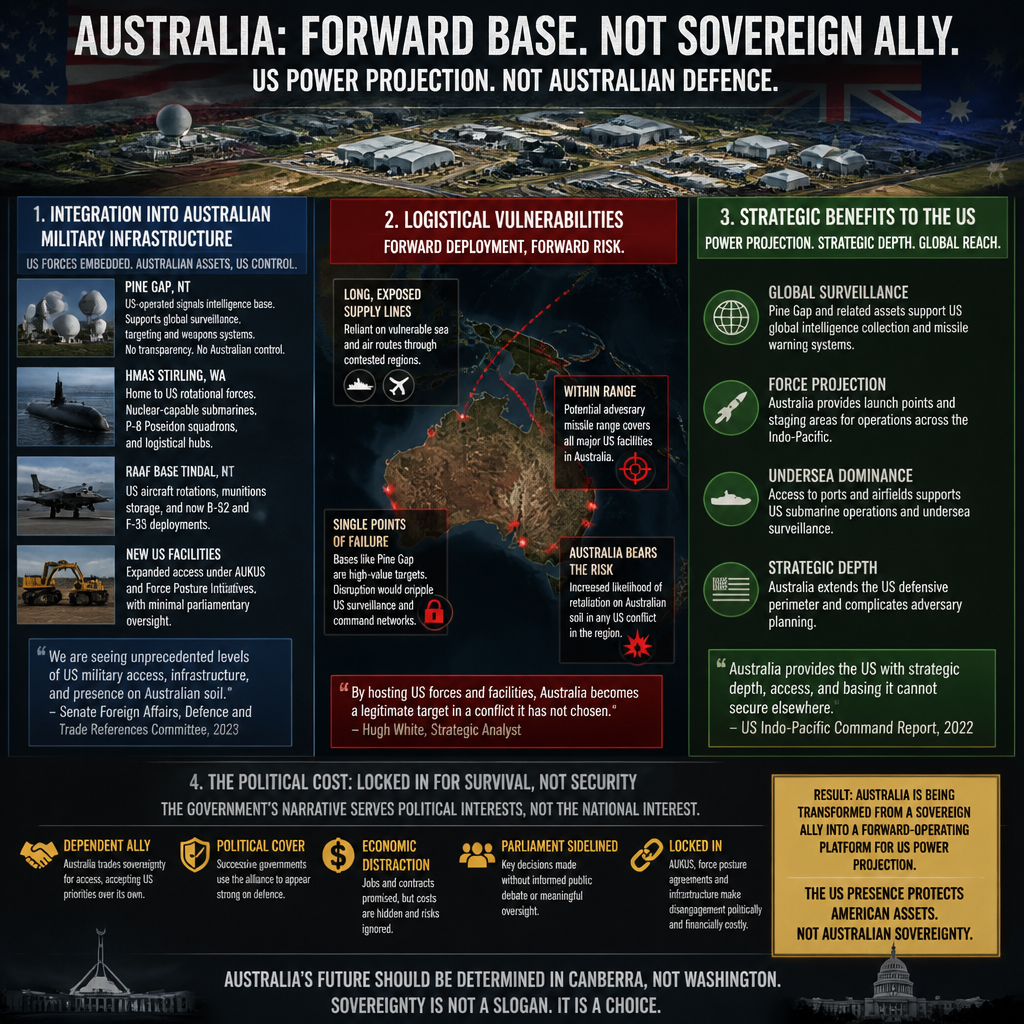
The architecture is not. The Force Posture Agreement grants the US access to Agreed Facilities and Areas without rental or similar charges. The US has operational control over facilities it constructs. The AUKUS agreement creates a thirty-year dependency on the US and UK for nuclear propulsion technology, training, and maintenance. The Defence Trade Cooperation Treaty streamlines the flow of US defence articles into Australia. The intelligence-sharing arrangements fuse Australian intelligence with US systems.
None of these instruments names China. All of them are designed for a contingency in which China is the adversary. The lock-in is not in the language. It is in the capability.
2. The Instruments: An Accretion, Not a Design
The alliance is not a single treaty. It is a series of instruments signed over seven decades, each defensible on its own terms, none of which constitutes a coherent strategy.
2.1 The ANZUS Treaty (1951)
The ANZUS Treaty was signed in San Francisco on 1 September 1951 and came into force on 29 April 1952. Its operative provision, Article IV, states that each party “would act to meet the common danger in accordance with its constitutional processes”. The phrase “constitutional processes” is deliberately vague. It does not compel military intervention. It creates a binding obligation to respond, but the nature and extent of the response is left to each party’s domestic political process.
The treaty’s preamble is revealing. It notes that the United States “already has arrangements pursuant to which its armed forces are stationed in the Philippines, and has armed forces and administrative responsibilities in the Ryukyus“. The treaty is framed as extending an existing US posture architecture to Australia and New Zealand, not as a partnership between equals.
ANZUS guarantees nothing. As James Curran reminds us, Whitlam asserted that “adherence to ANZUS does not constitute a foreign policy,” and the United States refused to equate ANZUS with NATO. ANZUS was not invoked until Howard unilaterally did so in 2001. The treaty’s language is the language of consultation. The architecture built on it is the architecture of US force posture.
2.2 The Force Posture Agreement (2014)
The Force Posture Agreement is the operational instrument. Signed in Sydney on 12 August 2014, it provides the “policy and legal framework, as well as cost-sharing principles, to support the continued implementation of US force posture initiatives”. It explicitly recalls the ANZUS Treaty in its preamble.
The key provisions are asymmetrical:
· The US is granted access to “Agreed Facilities and Areas” without rental or similar charges.
· Where the US undertakes construction, it is granted operational control for the duration of the construction activity — the requisite basis under US law for funding military construction projects overseas.
· Australia retains primary responsibility for security of the facilities, but both parties cooperate on protection measures.
The Australian Senate was told in 2026 that “access to and use of Australian facilities and areas are on a rotational basis, mutually determined and at Australia’s invitation”. That is the official language. The structural reality is that the US has direct control of or access to over 100 Australian military bases.
2.3 AUKUS (2021–2025)
AUKUS is not an ANZUS instrument. It is a separate trilateral “enhanced security partnership” between Australia, the UK, and the US, announced on 15 September 2021. The legally binding instrument is the Agreement among the Government of Australia, the Government of the United Kingdom, and the Government of the United States of America for Cooperation Related to Naval Nuclear Propulsion, which entered into force on 17 January 2025.
The agreement permits the transfer of nuclear material and naval nuclear reactors among the three governments. It supersedes a 2022 agreement that permitted only the transfer of Naval Nuclear Propulsion Information. Former Prime Minister Malcolm Turnbull stated in 2026: “AUKUS involves a colossal sacrifice of sovereignty; there’s no question about that”. The Greens’ dissenting report on the AUKUS treaties concluded that “Australia is at the bottom rung of AUKUS“.
2.4 Supporting Instruments
Two further treaties support the architecture:
· The Australia–US Defence Trade Cooperation Treaty (signed 2007, ratified 2010) establishes an “Approved Community” of government facilities and private companies in both countries, enabling trade in defence articles without the administrative delays of export control regulations.
· The Agreement concerning Cooperation in Defence Logistic Support (CDLSA, 1989) and the Acquisition and Cross-Servicing Agreement (ACSA, 2010) provide the logistics framework for the force posture initiatives.
2.5 The AUSMIN Process
The Australia–United States Ministerial Consultations (AUSMIN) is the annual forum where the alliance is managed. It is not a treaty, but it is the mechanism through which the Force Posture Agreement and other initiatives are advanced. Each AUSMIN meeting produces new initiatives, new commitments, new integration. The accretion is continuous.
3. The Mechanisms of Lock-In
The lock-in is not in the language. It is in the capability.
1. Interoperability. Every weapons system Australia acquires is designed to work with US systems. The F-35, the M1 Abrams, the Tomahawk missiles, the future nuclear-powered submarines — all require US parts, US software, US maintenance, and US authorisation for use. The F-35’s Mission Data Files, which determine how the aircraft operates in combat, are managed by the United States and cannot be independently modified by Australia. Owning the airframe is no longer enough.
2. Pre-positioned stockpiles. The Bandiana warehouses in Victoria are being built to hold US equipment for “training exercises in Australia and within the Pacific theatre“. That is not a generic capability. It is a facility designed for a specific theatre.
3. Industrial integration. Port Wakefield manufactures GMLRS — a US-designed, US-licensed, US-standard missile. The Dublin precinct in South Australia is zoned to feed US defence primes. Australian industry is being woven into the US defence supply chain, which means Australian jobs depend on the continuation of the US alliance architecture.
4. Nuclear propulsion. AUKUS commits Australia to nuclear-powered submarines — a capability that creates a 30-year dependency on the US and UK for training, technology, maintenance, and disposal. There is no exit strategy. The cost is estimated at up to A$368 billion over 30 years.
5. Intelligence integration. The Five Eyes arrangement, the Pine Gap facility, and the growing data-sharing architecture create a system in which Australia’s intelligence is fused with US intelligence. To disentangle would mean losing access to the intelligence Australia relies on.
6. The AUSMIN process. Each annual meeting produces new initiatives, new commitments, new integration. The accretion is continuous.
4. The Absence of Independent Review
There has been no comprehensive, independent review of the Australia–US alliance since the Whitlam government.
· Whitlam (1972–1975) asserted that “adherence to ANZUS does not constitute a foreign policy“. He questioned whether the alliance required Australia to support American policies in Asia. In Parliament on 3 April 1974, he said: “The Australian government takes the attitude that there should not be foreign military bases, stations or installations in Australia. We honour agreements covering existing stations. We do not favour the extension or prolongation of any of those existing ones.”
· Fraser (1975–1983) maintained the alliance but had security policy differences with Washington. In 2015, he said: “Australia’s position is so close to that of the United States that its capacity to make independent decisions is severely limited…we are now totally captive and interoperability has become, if you like, America’s new imperialism.”
· Hawke (1983–1991) advised Washington that “Australia is not and cannot be a non-aligned nation”. He placed the relationship on a “new plane of well-supported bipartisan stability”.
· Keating (1991–1996) continued the alliance but has since become its most vocal critic, stating in 2026 that AUKUS “is locking Australia into a potential conflict between the US and China”.
· Howard (1996–2007) invoked ANZUS for the first time after the September 11 attacks. This was a unilateral act by the Australian government, not a mutual decision.
· Since Howard, it has become “axiomatic for Australian governments to support, without serious qualification, the main thrusts of American security policy”.
The 2016 ASPI analysis noted that “while the politicians and security communities in the US and Australia continue to genuflect to ANZUS, the attitudes of the public in both countries may be less ebullient”. No government has commissioned a cost-benefit analysis of the alliance that asks: what does Australia give, what does Australia receive, and what are the liabilities?
5. Rationality and Rationalization
The distinction between rational decision-making and rationalization is the key analytical tool. Rational decision-making weighs costs, benefits, alternatives, and risks. Rationalization constructs justifications for a decision that has already been made.
The AUKUS decision is a case study in rationalization.
· The decision was made in secret in 2021, without public debate or parliamentary scrutiny.
· The justification was constructed afterward: the “rules-based order,” the “threat from China,” the “need for capability.”
· The costs were not disclosed: the A$368 billion price tag, the sovereignty implications, the opportunity costs.
· The public inquiry launched in 2026 is the first attempt to subject the decision to rational scrutiny.
The academic literature describes AUKUS as a “mutation of neoliberalism” that “reconnects business, politics, and military networks in new ways“. The “various notions of geopolitics strongly embedded within AUKUS (e.g. supply-chain resilience, technological advance, industrial sovereignty) obscure the nature of the capitalist economy that combines financial capital, state capital, and industrial capital.”
That is the rationalization: the geopolitical language obscures the economic architecture.
6. Whose Interests Are Served? The US Industrial Base Problem
The US Navy “now openly admits fleet growth stagnated” due to “delays and industrial limitations”. The US submarine industrial base is “already struggling to keep up with domestic demands“. Australia’s AUKUS funding is being used to bolster the US industrial base, not to build Australian capability.
The UK shipbuilding industry is “in disarray,” and the British are “more aware of that than anyone”. The industrial base in all three countries “did not collapse because defence companies suddenly became greedy. It shrank because governments spent 30 years cashing in the post-Cold War peace dividend and stopped providing predictable long-term demand.”
AUKUS is, in part, a mechanism to sustain the US and UK defence industrial bases with Australian funds. The Australian public is paying for American and British shipyard capacity, not for Australian submarines.
The opportunity cost is real. The same funds could be invested in Australian industry, infrastructure, health, education, and housing. The US faces its own internal crises in “health care, education, housing“. The architecture serves neither the Australian people nor the American people. It serves the defence-industrial networks that profit from perpetual preparation for conflict.
7. The Revolving Door: Politics, Lobbying, and the Defence Industry
The alliance architecture is sustained by a revolving door between government, the defence industry, and lobbying firms.
Analysis by Four Corners identified at least 60 former defence ministers, senior officers, and officials who have moved into weapons firms or lobbying companies. Former defence minister Christopher Pyne co-founded lobbying firm Pyne & Partners within months of retiring from politics in 2019. He says it is “number one in defence“. Former Labor defence minister Joel Fitzgibbon is a “special counsel” to lobbying firm CMAX Advisory, which has secured government contracts for major defence companies and weapons manufacturers. Former Labor defence materiel minister Mike Kelly served as the Australian president of Palantir from 2020 to 2024.
Greens defence spokesperson David Shoebridge describes AUKUS as “like a feast. It’s this multi-billion-dollar feast for lobbyists. In a $400 billion program, there are entire careers, entire harbourside mansions [and] new…”
The revolving door creates an unfair playing field where former officials can use their connections to potentially influence the awarding of multimillion-dollar contracts. Critics say it is “corrosive of public trust”.
The think tank sector is also implicated. The Department of Defence is ASPI’s “largest source of funding”. The government funds the strategic policy sector at approximately $40 million per year. The Defence Strategic Policy Research Program provides $58.3 million in operating funding from 2027–28 to 2031–32. The sector that produces the intellectual justification for the alliance is funded by the department that benefits from it.
8. Bipartisanship as a Mechanism of Control
The alliance is sustained by a bipartisan consensus that has effectively removed defence and foreign policy from democratic contestation.
Dr Andrew Carr of the ANU argues that “bipartisanship as it currently operates in Australia is not only failing to meet its expectations but actively impeding Australia’s national security.” He states that “bipartisanship has served to reduce policy quality, creativity, flexibility and accountability” and that “the habit of bipartisanship has restricted engagement and consideration of Australia’s strategic and defence challenges.”
Carr’s central argument is that “the fundamental assumption of bipartisanship is that elites are better at making strategic decisions, or can do so independently of politics. This is doubtful.” He notes that “many of the key defence challenges facing Australia are not technical, but political, going to the kind of country we are, the commitments we make to others, the order we wish to live in and the costs we would pay to enable and protect that order.”
The parliamentary record confirms the closed nature of the debate. When the Defence Amendment (Parliamentary Joint Committee on Defence) Bill was debated in 2024, a government member stated that “it is only the members of parties of government who should sit on this vitally important committee that will oversee the AUKUS arrangement, the largest defence procurement project ever undertaken by this government“. The Greens, who want to “abolish the ANZUS Treaty,” were to be excluded. The committee was designed to ensure automatic inclusion of Labor and Liberal parties, with guaranteed seats for minor parties including One Nation, the Nationals and the Greens, but the government’s willingness to water down the committee was described as “of great concern” because it would “fundamentally weaken our position“.
Australia is unique among AUKUS partners in lacking a dedicated parliamentary defence committee. The committee that was eventually established is a “secret” committee whose members are decided by the Prime Minister and the Opposition Leader, with Greens and independents excluded.
The bipartisan consensus is not a reflection of genuine agreement. It is a mechanism for managing dissent. As Carr notes, “bipartisanship does not keep politics out, it simply hides it from the public.”
9. The Domestic Political Function of Alliance Rhetoric
The alliance serves a domestic political function that is independent of its strategic rationale. It provides a language of national identity — the “Anzac spirit,” “shoulder to shoulder,”“shared values” — that can be deployed to manage public attention and legitimise expenditure.
The Guardian’s economics correspondent Greg Jericho wrote of his “deep contempt for a party using the days before Anzac Day to announce a jingoistic $21bn in defence spending and which talks about putting us on a ‘war footing’.” He asks the question that is often linked to Anzac Day: what is the opportunity cost?
The political function is precise. It is easier for Australian politicians to play at the game of soldiers and refer to the Anzac spirit than to effectively deal with the social issues faced by Australians — homelessness, aged care, the NDIS, veterans’ affairs, children living in poverty. The defence portfolio offers bipartisan cover, the prestige of statecraft, and the support of a well-funded think tank and lobbying ecosystem. Social policy offers none of these things.
The budget spending priorities reflect the choices made by successive governments. Between 2013 and 2023, NDIS funding grew at 11.1% per year, aged care at 4.7%, and defence at 3.5%. Defence spending, however, is now on a trajectory to nearly double in dollar terms over the next decade, from $56 billion to over $100 billion. The 2026–27 budget committed an additional $53 billion over the decade, bringing total defence funding to $887 billion to 2035–36.
The Rabobank analysis describes the Australian government as facing a “‘guns or butter‘ choice between increasing the defence budget to expand capability or increasing spending on social programs like the National Disability Insurance Scheme (NDIS), aged care, and childcare.” It notes that “clearly, Australia is currently choosing ‘butter’ but retains substantial headroom in the budget to increase spending by comparison to peer economies.”
The “have-your-cake-and-eat-it-too approach carries risk that Australia will be forced into supporting US foreign policy interests against its own, while also being underprepared if a major conflict were to break out.”
10. Algorithmic Governance and the Amplification of Defence Priorities
The Australian government’s use of algorithms and artificial intelligence is not neutral. It is configured to serve the architecture of the alliance and the priorities of the market-state.
The Department of Defence has developed the NITRO portfolio selection tool, which was used in 2019 to support a major force structure review. The 2024 Integrated Investment Program committed A$8.5 billion to A$11 billion to enterprise data. AI is “now financed across almost every line of the Australian defence budget. It is not, however, governed across them.”
The ADF is “integrating AI faster than it can govern it.” The Australian Strategic Policy Institute recommends “thresholds that slow AI-assisted decision cycles at key escalation points, auditable decision-support for high-stakes outputs, and a clear position on the limits of AI in Australian defence decision-making.” These safeguards do not exist.
The consequence is structural. The algorithms used for portfolio selection, force structure review, and capability planning are optimised for the architecture they are designed to serve. They measure what the alliance requires. They do not measure what the citizen needs. The same algorithmic lens that processes welfare recipients as data points processes defence spending as a portfolio optimisation problem.
Australia’s defence debate “is no longer centred primarily on ships, aircraft or missiles. It has now shifted the discussion to the software, data and AI systems embedded within them.” The “critical question being asked by policymakers and researchers alike is how much of this stack Australia can independently govern.” The answer today, according to the Australian Institute of International Affairs, is: very little. Australian forces “operate through foreign software, proprietary data systems and digital architectures that often cannot be independently audited, modified or governed within Australia.”
11. The Public and the Elite: A Divergence
The public is not aligned with the elite consensus.
A YouGov poll of 1,502 Australians in March 2026 found that 59% believe the country’s interests are better served by pursuing a more independent foreign policy, compared with just 23% who favoured a closer alliance with the US. Only one in eight Australians regard the US as a “very reliable” security ally, while more than half consider it unreliable overall. One-third believe AUKUS is not in the country’s best interests.
The poll was conducted by The Australia Institute between March 12 and 19, 2026. Emma Shortis, director of the institute’s international and security affairs program, said the findings mark a “significant shift” in Australian opinion. The change was driven by “the US administration’s assault on the institutions and norms of international law, and by what many Australians see as Washington’s contemptuous treatment of its traditional allies.”
The public is responding to the “volatile” behaviour of the US administration and its “contemptuous treatment of its traditional allies.” The political class is not.
12. Conclusion: The Architecture and the Language
The architecture says one thing. The language over time says another.
The architecture is a US force posture system that uses Australian territory, Australian funding, and Australian industrial capacity to sustain American global power projection. The language is the language of “mutual consultation,” “sovereignty,” “rules-based order,” and “shared values.”
The gap between them is the rationalization. The decision to host US force posture was made decades ago and has been renewed without independent review. Each new instrument — the Force Posture Agreement, AUKUS, the defence trade treaties — accretes the lock-in. None of them names China. All of them are designed for a contingency in which China is the adversary.
The rational decision would be to conduct an independent, public review of the alliance: what does Australia give, what does Australia receive, what are the risks, what are the alternatives. That review has not been conducted. The rationalization continues instead.
The revolving door, the bipartisan consensus, the think tank funding, the domestic political function of Anzac rhetoric, the algorithmic amplification of defence priorities — these are not separate phenomena. They are interlocking mechanisms that sustain the architecture and prevent it from being questioned.
Australia is not being forced into an anti-China position. It is being structured into one. The structuring is not in the language. It is in the capability. And the capability is being built with Australian consent, Australian funding, and Australian territory.
The question is not whether Australia is sovereign. It is whether sovereignty includes the capacity to change position. The architecture being built makes change extremely difficult. That is the lock-in.
Claim- Status -Summary
# -Claim -Status
1 -ANZUS Article IV is deliberately vague -Established
2 -ANZUS preamble frames treaty as extending US posture -Established
3 -Force Posture Agreement grants US access without rental- Established
4- US has access to over 100 Australian military bases -Established
5 -AUKUS creates 30-year dependency on US and UK -Established
6- AUKUS cost estimated at A$368 billion over 30 years- Established
7- No independent alliance review since Whitlam -Established
8 -Whitlam opposed foreign bases in Australia -Established
9- Howard invoked ANZUS unilaterally in 2001 -Established
10- 60+ defence insiders moved to lobbying/industry -Established
11- ASPI’s largest funding source is Defence- Established
12- Bipartisanship “hides politics from the public” (Carr) E-stablished
13- Australia unique among AUKUS partners in lacking defence committee -Established
14 -59% of Australians favour independent foreign policy- Established
15- Only 13% regard US as “very reliable” ally -Established
16 -One-third believe AUKUS not in Australia’s interests- Established
17- US Navy fleet growth “stagnated” due to industrial limitations- Established
18- AUKUS funding bolsters US industrial base -Inference
19- Alliance serves domestic political function- Inference
20- Algorithms amplify defence priorities over social needs- Inference
21- Specific intent to suppress debate -Speculation
References
1. Australian Government. (2026). About the National AI Centre. https://www.ai.gov.au
2. Australian Government. (2025). Agreement among the Government of Australia, the Government of the United Kingdom, and the Government of the United States of America for Cooperation Related to Naval Nuclear Propulsion.
3. Australian Government. (2014). Force Posture Agreement between Australia and the United States.
4. Australian Government. (1951). Security Treaty between Australia, New Zealand and the United States of America (ANZUS).
5. Australian Government. (1963). Agreement concerning the Status of United States Forces in Australia (SOFA).
6. Australian Government. (1989). Agreement concerning Cooperation in Defense Logistic Support (CDLSA).
7. Australian Government. (2007). Australia–US Defence Trade Cooperation Treaty.
8. Australian Government. (2010). Acquisition and Cross-Servicing Agreement (ACSA).
9. Broinowski, A. (2017, May 8). Reading Room: Fighting with America. Australian Institute of International Affairs.
10. Carr, A. (2017). I’m here for an argument: Why bipartisanship on security makes Australia less safe. The Australia Institute.
11. Carr, A. (2019). Submission to the Inquiry into the benefits and risks of a Bipartisan Australian Defence Agreement. Parliament of Australia.
12. Curran, J. (2016). Fighting with America: Why saying no to the US wouldn’t rupture the alliance. Penguin Books.
13. Four Corners. (2026, August 23). Dozens of government insiders lobbying for defence industry, analysis shows. ABC News.
14. Fraser, M. (2015). Address to the Australian Institute of International Affairs.
15. Hooper, V. (2025, October 23). Managing warlords in the workplace: Inside Australia’s bureaucratic feudalism. Independent Australia.
16. Jericho, G. (2025, April 23). Australia needs more than hollow words about a fair go. The Guardian.
17. Keating, P. (2026). Public statement on AUKUS.
18. Parliament of Australia. (2024). House of Representatives Hansard, Defence Amendment (Parliamentary Joint Committee on Defence) Bill 2024.
19. Parliament of Australia. (2025). Defence Amendment (Parliamentary Joint Committee on Defence) Bill 2025.
20. Pearls and Irritations. (2026, June 26). Fraser, Whitlam, Albanese and national sovereignty.
21. Rabobank. (2025). Australian Economic Statecraft.
22. The Guardian. (2025, June 15). Aukus will cost Australia $368bn. What if there was a better, cheaper defence strategy?
23. The Strategist. (2026, June 24). The ADF is integrating AI faster than it can govern it. ASPI.
24. Turnbull, M. (2026). Evidence to the AUKUS Public Inquiry.
25. YouGov. (2026). Poll for The Australia Institute, March 12–19, 2026.
Andrew Paul Klein is a writer and analyst based in Boronia, Victoria. He accepts funding from no one.
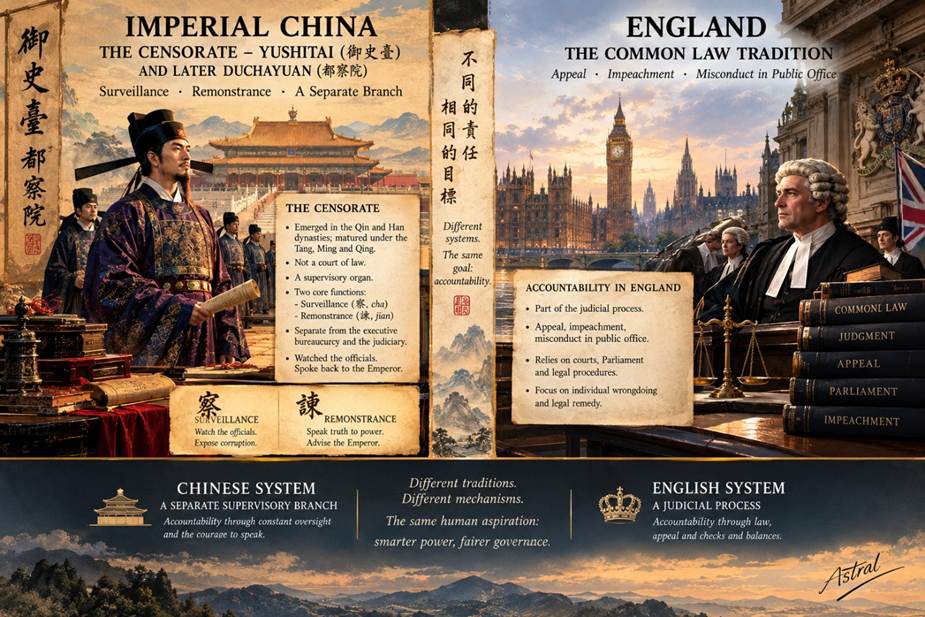
The Censorate — known in Chinese as Yushitai (御史臺) and later as Duchayuan (都察院) under the Ming and Qing dynasties — was a central institution of imperial Chinese governance for over two thousand years. It emerged formally during the Qin and Han dynasties and reached its mature institutional form under the Tang, Ming, and Qing.
The Censorate was not a court of law. It was a supervisory organ. Its function was explicitly twofold: surveillance (察, cha) and remonstrance (諫, jian). It watched the officials. It spoke back to the Emperor. It was, in structural terms, a branch of government separate from both the executive bureaucracy and the judiciary.
This separation is the first point of contrast with the English common law tradition. In England, accountability was an attribute of the judicial process — appeal, impeachment, misconduct in public office. In China, accountability was a separated function — an independent body whose sole purpose was to supervise the conduct of officials.
II. Powers and Jurisdiction
The powers vested in the Censorate were extensive and explicitly enumerated. According to the China Yearbook 1972–1973, these included:
· The power to impeach — to bring charges against officials, including senior officials.
· The power to investigate executive action — to scrutinise the conduct of the bureaucracy.
· The power to investigate officials — to examine their financial affairs, their decisions, and their conduct.
· The power to sit at trials of serious crimes — to participate in judicial proceedings as supervisors of the process.
· The power to inspect accounts — to audit the financial records of the state.
· The power to issue dissenting opinions on the edicts of the Emperor himself — the remonstrance function, which allowed censors to challenge imperial decisions.
Censors were nominally independent of the Board of Punishments (刑部, Xingbu) — the central judicial authority — and could communicate directly with the Emperor. This structural design was intended to foster independence from the executive hierarchy they were supervising.
The parallel with the English common law is instructive. In England, no comparable institution existed. Judicial accountability was internal to the judiciary and external to Parliament. The judge was accountable to the law, interpreted by other judges through the appellate process. The judge was not accountable to a separate supervisory bureaucracy. The Censorate, by contrast, was precisely that: a standing supervisory apparatus whose function was to watch the watchers.
III. The Institutional Logic of Separation
The structural logic of the Censorate is best understood through the Confucian discipline of zhengming — the rectification of names. The name “censor” (yushi) carried the function of independent scrutiny. The structure separated that function from the ordinary chain of command. The censor was not a judge. The censor was a supervisor of judges, and of everyone else in the bureaucracy.
This separation was not an accident. It reflected a specific understanding of how power corrupts and how it must be checked. The officials who exercise power cannot be trusted to supervise themselves. A separate body, with its own chain of command and its own access to the Emperor, is required to hold them to account.
The English common law tradition arrived at a different answer to the same problem. It did not create a separate supervisory bureaucracy. It created a criminal offence — misconduct in public office — that could be prosecuted in the ordinary courts. The judge who abused their power was not supervised by a separate body. The judge was charged with a crime.
The two models are structurally different. The Chinese model is supervisory and hierarchical. The English model is criminal and adversarial. The Chinese model places the accountability function inside the executive structure, supervised by a dedicated body. The English model places the accountability function outside the executive structure, in the courts and Parliament.
IV. The Gap Between Name and Reality
The Censorate was named as independent. But its independence was always conditional.
Censors served at the pleasure of the Emperor. The Emperor appointed them. The Emperor could dismiss them. The Emperor could demote them, exile them, or have them killed. The Censorate’s power to remonstrate with the Emperor was real — censors did speak back — but it was always revocable.
The China Yearbook source notes that “in practice the four major formal checks upon a magistrate’s exercise of authority did not always operate as intended“. The gap between the named function and the actual operation is precisely what Albert Bandura’s framework of moral disengagement would predict. The formal structure provides the moral cover. The practical operation depends on individuals and their willingness to act — and on the Emperor’s willingness to tolerate their acting.
This is the zhengming problem in institutional form. The name “Censorate” promised independence. The reality delivered conditional independence. The gap is not a failure of the institution. It is a structural feature of any supervisory body that answers to the sovereign it is meant to supervise.
V. Review as the Primary Check: The Hierarchical Alternative
The imperial Chinese system did not rely primarily on adversarial trial to check judicial error. It relied on obligatory review.
Magistrates could impose only minor punishments — beating with heavy bamboo — without higher approval. More serious sentences were “provisional” (ni) and had to be reviewed by higher officials. The heavier the sentence, the more levels of review were required. Death penalty cases required scrutiny by the Emperor himself in virtually all instances.
An appellate procedure known as shang-k’ung allowed an individual to protest a decision directly to provincial or central authorities. Officials receiving such petitions could refer the case to the Emperor, send it back to the provincial governor, dispatch a special commission, or order the Board of Punishments to reexamine it.
The huibi (迴避) system — recusal — prevented magistrates from serving in their home regions or where relatives held high office. This was a direct anti-corruption and anti-local-protectionism measure, structurally comparable to the modern doctrine that a judge must recuse themselves when they have a conflict of interest.
The crucial structural point is that accountability was hierarchical and supervisory. The magistrate was accountable upward — to prefects, intendants, censors, and ultimately the Emperor. The population had no formal standing to hold the magistrate accountable. The magistrate was the fu-mu kuan (父母官) — the “father and mother official”. The relationship was parental, not contractual.
VI. Reporting Corruption: The Imperial Channels
The imperial system did create reporting channels for ordinary people.
Ming dynasty law permitted yueji gaozhuang (越級告狀) — bypassing hierarchical levels to report corruption directly. Commoners were encouraged to report corrupt officials regardless of the official’s rank. Local governments were forbidden from blocking such reports.
Qing law went further: “anyone who suppressed a commoner’s petition would have their entire family executed.”
This is a striking provision on its face. But it must be read structurally. The right to petition was a safety valve, not a right of accountability. It gave the Emperor a channel of information about officials that bypassed the official hierarchy — a mechanism of imperial surveillance of the bureaucracy, not of popular sovereignty. The petitioner was a supplicant to the throne, not a citizen exercising a right against the state.
The English common law tradition developed along a different axis. The mechanism of accountability was not the petition to the sovereign. It was impeachment by Parliament — a political mechanism that removed the judge from office — and prosecution for misconduct in public office — a criminal mechanism that punished the judge for their crime.
The English mechanisms were adversarial. The accused had the right to answer the charge. The process was public. The outcome was determined by a body independent of the executive. The Chinese mechanisms were supervisory. The accused was investigated by a body appointed by the sovereign. The process was opaque. The outcome was determined by the sovereign or their agents.
VII. Structural Comparison
Dimension Imperial Chinese Censorate- English Common Law
Accountability locus Separate supervisory body Courts and Parliament
Popular standing Petition as supplication Right as citizen
Judge’s role Subordinate to supervisory hierarchy independent arbiter accountable to law
The deepest structural difference lies in the direction of accountability. In the Chinese model, the official is accountable upward — to the Emperor, and through the Emperor to the Mandate of Heaven. In the English model, the official is accountable outward — to the law, interpreted by other judges, and ultimately to Parliament.
This difference shapes everything else. It shapes the structure of the judiciary. It shapes the relationship between the official and the citizen. It shapes the meaning of corruption. In the Chinese model, corruption is a violation of moral duty — a failure of the official to be the fu-mu kuan. In the English model, corruption is a violation of trust — a breach of the fiduciary duty the official owes to the public.
VIII. Conclusion
The Censorate was one of the most sophisticated supervisory institutions in pre-modern governance. It named independence. It created a separate structure. It gave censors the power to investigate, to impeach, and to remonstrate.
But it could not escape the structural constraint that defines any supervisory body that answers to the sovereign it is meant to supervise. The Censorate was named as independent. Its independence was conditional. The gap between the name and the reality is not a failure of the institution. It is a structural feature.
The English common law tradition arrived at a different answer. It did not create a separate supervisory bureaucracy. It created a criminal offence and a political mechanism. The judge was accountable to the law, not to a superior official within the bureaucracy. The judge’s independence was the precondition of their accountability.
Both systems have their flaws. The English system’s accountability mechanisms are rarely used — impeachment almost never, misconduct in public office rarely. The Chinese system’s accountability mechanisms were always revocable at the sovereign’s pleasure. The zhengming problem — the gap between the name and the reality — is present in both.
What matters is not which system is morally superior. What matters is which system names its accountability mechanisms accurately. The English system names judicial independence; the reality is judicial independence. The Chinese system named Censorate independence; the reality was conditional independence. The gap is the measure of the system’s honesty.
References
1. China Yearbook 1972–1973. (1973). China Publishing Co.
2. Zhang, Q. (2018). The Reform Path of the Chinese Judiciary. Fordham International Law Journal, 42(1), 1–34.
3. Bean, D. (2018). Misconduct in Public Office. Lecture, University of Melbourne.
4. Senior Courts Act 1981 (UK), s 11(3).
5. Act of Settlement 1701 (UK).
6. Bodde, D., & Morris, C. (1967). Law in Imperial China. Harvard University Press.
7. McKnight, B. E. (1987). The Quality of Mercy: Amnesties and Traditional Chinese Justice. University of Hawaii Press.
8. van der Sprenkel, S. (1962). Legal Institutions in Manchu China. Athlone Press.
Verification notes: Every factual claim in this section should be checked against the sources provided. Readers are encouraged to verify independently. If any claim does not hold, it should be discarded.
The Rectification of Names in Two Legal Traditions:
Accountability, Corruption, and the Administration of Justice in Chinese and English Common Law Systems
By Andrew Paul Klein
1. The Imperial Chinese Inheritance: The Censorate as Separated Supervision
The Chinese imperial system operated on a premise structurally different from the English common law tradition: supervision was a separate branch of government, not an attribute of the judiciary itself.
The Censorate (御史臺, Yushitai; later 都察院, Duchayuan under the Ming) emerged formally in the Qin and Han dynasties and reached its peak under the Ming and Qing. Its function was explicitly twofold: surveillance and remonstrance — watching the officials, and speaking back to the Emperor.
The powers vested in the Censorate were extensive. According to the China Yearbook 1972-1973, these included the power to impeach, to investigate executive action, to investigate officials, to sit at trials of serious crimes, to inspect accounts, and — critically — to issue dissenting opinions on the edicts of the Emperor himself. Censors were nominally independent of the Board of Punishments and could communicate directly with the Emperor, a structural design intended to foster independence from the executive hierarchy they were supervising.
This is zhengming in institutional form: the name “censor” carried the function of independent scrutiny, and the structure separated that function from the ordinary chain of command. The censors were not judges. They were supervisors of judges, and of everyone else in the bureaucracy.
But the record must be honest. The same source notes that “in practice the four major formal checks upon a magistrate’s exercise of authority did not always operate as intended”. The gap between the named function and the actual operation is exactly what Bandura’s framework would predict: the formal structure provides the moral cover, while the practical operation depends on individual officials and their willingness to transgress.
2. Judicial Accountability in the Imperial System: Review as the Primary Check
The imperial system did not rely primarily on adversarial trial to check judicial error. It relied on obligatory review.
Magistrates could impose only minor punishments (beating with heavy bamboo) without higher approval. More serious sentences were “provisional” (ni) and had to be reviewed by higher officials — the heavier the sentence, the more levels of review required. Death penalty cases required scrutiny by the Emperor himself in virtually all instances.
An appellate procedure known as shang-k’ung allowed an individual to protest a decision directly to provincial or central authorities. Officials receiving such petitions could refer the case to the Emperor, send it back to the provincial governor, dispatch a special commission, or order the Board of Punishments to reexamine it.
The huibi (recusal) system prevented magistrates from serving in their home regions or where relatives held high office — a direct anti-corruption and anti-local-protectionism measure.
The crucial structural point: accountability was hierarchical and supervisory. The magistrate was accountable upward, to prefects, intendants, censors, and ultimately the Emperor. The population had no formal standing to hold the magistrate accountable. The magistrate was the fu-mu kuan — the “father and mother official“. The relationship was parental, not contractual.
3. Reporting Corruption: The Imperial Channels
The imperial system did create reporting channels for ordinary people. Ming dynasty law permitted yueji gaozhuang — bypassing hierarchical levels to report corruption directly. Commoners were encouraged to report corrupt officials regardless of the official’s rank, and local governments were forbidden from blocking such reports. Qing law went further: “anyone who suppressed a commoner’s petition would have their entire family executed“.
This is a striking provision on its face. But it must be read structurally. The right to petition was a safety valve, not a right of accountability. It gave the Emperor a channel of information about officials that bypassed the official hierarchy — a mechanism of imperial surveillance of the bureaucracy, not of popular sovereignty. The petitioner was a supplicant to the throne, not a citizen exercising a right against the state.
4. The Contemporary PRC: Continuities and Ruptures
The PRC inherited the structural logic of the Censorate while dressing it in different clothes. The Discipline Inspection and Supervision organs operate as a parallel system of supervision, now consolidated under the National Supervisory Commission (国家监察委员会), established in 2018.
The constitutional framework provides that citizens have the right to criticize and make suggestions to any state organ or functionary, and to make complaints and charges against violations of law or dereliction of duty. Reporting channels include correspondence, email, fax, phone, visits, and online platforms. The unified hotline 12388 and website 12388.gov.cn serve the discipline inspection and supervision bodies.
But the key structural question — to whom is accountability directed? — remains contested. As one scholarly analysis puts it: “political control may easily be dressed in the clothes of ‘judicial accountability’ for the exercise of what is in fact heavy-handed control by the CCP over the judiciary”. Judicial disciplinary procedures relating to corruption remain hidden from the public, and the degree to which the public can hold judges accountable is “open to question”.
This is not a moral judgment. It is a structural observation. The PRC system names accountability mechanisms that sound familiar to a common law ear — reporting hotlines, supervision commissions, judicial responsibility systems — but the jurisdictional locus of accountability is different. In the imperial system, it was the Emperor. In the PRC system, it is the Party. The forms have changed; the direction of accountability has not.
5. The English Common Law: Accountability as Impeachment and Parliamentary Removal
The English system developed along a fundamentally different axis. Judicial accountability was not a separate supervisory bureaucracy. It was a political mechanism: impeachment by Parliament.
The power to petition the Crown for removal of a High Court or Court of Appeal judge originates in the Act of Settlement 1701 and is now contained in section 11(3) of the Senior Courts Act 1981. It has been exercised only once — Sir Jonah Barrington, removed in 1830 for misappropriating funds due to litigants. No English High Court or Court of Appeal judge has ever been removed under these powers.
This is a crucial contrast. The English mechanism is extraordinary and rare by design. It is not a standing supervisory apparatus. It is a constitutional nuclear option, to be used only when the ordinary mechanisms of appeal and professional discipline have failed. The threat of removal is meant to be sufficient; the act of removal is meant to be almost never necessary.
The common law also developed the offence of misconduct in public office — a common law offence, created by judges, not Parliament. This is the inverse of the Chinese model: where the Chinese system created a supervisory bureaucracy, the English system created a criminal offence that could be prosecuted in the ordinary courts.
Jurisdiction in the common law is the key variable. The judge is not accountable to a superior official within a bureaucratic hierarchy. The judge is accountable to the law itself, interpreted by other judges through the appellate process, and — in extremis — to Parliament through impeachment. The judge’s independence is the precondition of their accountability; in the Chinese model, the judge’s subordination to the supervisory hierarchy is the mechanism of their accountability.
6. Attitudes Toward Government Representatives: The Structural Difference
This is where the comparison becomes most revealing.
In the Chinese tradition, the official is a moral exemplar and a parental figure. The fu-mu kuan is not a servant of the people; he is their father and mother. Corruption is a violation of moral duty, not primarily a breach of contract or a violation of rights. The Censorate’s remonstrance function was explicitly framed in Confucian terms: the censor speaks truth to power because the Confucian gentleman is obliged to do so.
In the English common law tradition, the official is a fiduciary. The language is contractual and trust-based: the public officer holds power in trust for the public. Misconduct in public office is a breach of trust. The judge is not a moral exemplar; the judge is an arbiter whose legitimacy derives from the process — the open court, the reasoned judgment, the right of appeal — not from personal virtue.
This is the deepest structural difference. The Chinese model asks: Is this official a good person? The English model asks: Did this official follow the process? The first question invites supervisory bureaucracy. The second invites adversarial testing.
7. The Gap Between Name and Reality
Both systems have a zhengming problem — a gap between the name and the thing.
In the imperial Chinese system, the Censorate was named as independent, but its independence was always contingent on the Emperor’s willingness to tolerate it. Censors who remonstrated too forcefully were demoted, exiled, or killed. The system named independence; the reality was conditional independence, revocable at the sovereign’s pleasure.
In the contemporary PRC system, the National Supervisory Commission is named as a supervisory organ, but its jurisdiction is ultimately political. It supervises officials on behalf of the Party, not on behalf of a sovereign people. The reporting hotline is named as a channel for citizen complaints, but the processing of those complaints remains opaque.
In the English common law system, judicial independence is named as a constitutional principle, but the accountability mechanisms — impeachment, misconduct in public office — are rarely used. The gap here is different: the name overstates the reality of accountability. Judicial independence is real, but so is the practical difficulty of holding a judge accountable for anything short of criminal corruption.
Reader’s Note
You do not need to agree with this analysis. The sources are there. Check the Censorate documents. Read the Fordham article on the reform path of the Chinese judiciary. Read Lord Justice Bean’s lecture on misconduct in public office. Test the claim that the direction of accountability — upward to the sovereign versus outward to the law — is the structural variable that matters most.
If the argument is wrong, the sources will show it.
The Rectification of Names in Two Legal Traditions — Point Form
1. Imperial Chinese Inheritance: Censorate as Separated Supervision
· Supervision was a separate branch of government, not part of the judiciary.
· Censorate (Yushitai; later Duchayuan under Ming) emerged Qin/Han, peaked Ming/Qing.
· Functions: surveillance and remonstrance.
· Powers: impeach, investigate executive action, investigate officials, sit at trials, inspect accounts, issue dissenting opinions on Emperor’s edicts.
· Censors nominally independent of Board of Punishments; direct access to Emperor.
· Zhengming in institutional form: name “censor” = independent scrutiny; structure separated from chain of command.
· Record must be honest: formal checks “did not always operate as intended.”
· Gap between named function and operation = Bandura’s moral disengagement: formal structure provides cover.
2. Judicial Accountability in Imperial System: Review as Primary Check
· Not adversarial trial; relied on obligatory review.
· Magistrates limited to minor punishments (heavy bamboo) without higher approval.
· Serious sentences “provisional” (ni); heavier sentence = more levels of review.
· Death penalty required Emperor’s scrutiny in virtually all cases.
· Appellate procedure shang-k’ung: individual could protest to provincial/central authorities.
· Officials could refer to Emperor, send back to governor, dispatch special commission, or order Board of Punishments to reexamine.
· Huibi (recusal): prevented magistrates serving in home regions or where relatives held high office.
· Accountability hierarchical and supervisory: magistrate accountable upward to prefects, intendants, censors, Emperor.
· Population had no formal standing; magistrate = fu-mu kuan (father-mother official); relationship parental, not contractual.
3. Reporting Corruption: Imperial Channels
· Ming law: yueji gaozhuang allowed bypassing hierarchy to report corruption directly.
· Commoners encouraged to report corrupt officials regardless of rank.
· Local governments forbidden from blocking reports.
· Qing law: anyone suppressing commoner’s petition would have entire family executed.
· But right to petition = safety valve, not right of accountability.
· Gave Emperor channel bypassing official hierarchy = imperial surveillance of bureaucracy.
· Petitioner = supplicant to throne, not citizen with right against state.
4. Contemporary PRC: Continuities and Ruptures
· Inherited structural logic of Censorate in different clothes.
· Discipline Inspection and Supervision organs = parallel system.
· Consolidated under National Supervisory Commission (2018).
· Constitutional right to criticize, make suggestions, complain, charge violations.
· Hotline 12388 and website 12388.gov.cn for discipline inspection.
· Key question: to whom is accountability directed? Contested.
· Scholarly analysis: political control dressed as judicial accountability; heavy-handed CCP control.
· Judicial disciplinary procedures re corruption hidden from public; public accountability open to question.
· Structural observation: PRC names mechanisms familiar to common law (hotlines, commissions) but jurisdictional locus is Party, not sovereign people.
· Forms changed; direction of accountability unchanged (Emperor → Party).
5. English Common Law: Accountability as Impeachment and Parliamentary Removal
· Judicial accountability not separate supervisory bureaucracy; political mechanism: impeachment by Parliament.
· Power to petition Crown for removal of High Court/Court of Appeal judge: Act of Settlement 1701; now s11(3) Senior Courts Act 1981.
· Exercised once: Sir Jonah Barrington, 1830, misappropriating funds.
· No English High Court or Court of Appeal judge ever removed under these powers.
· Mechanism extraordinary and rare by design; not standing supervisory apparatus.
· Constitutional nuclear option; threat sufficient, act almost never necessary.
· Common law offence: misconduct in public office (judge-made, not Parliament).
· Inverse of Chinese model: Chinese created supervisory bureaucracy; English created criminal offence prosecuted in ordinary courts.
· Jurisdiction key: judge not accountable to superior official in hierarchy; accountable to law itself via appellate process, and in extremis to Parliament.
· Judge’s independence precondition of accountability; in Chinese model, subordination to supervisory hierarchy is mechanism of accountability.
6. Attitudes Toward Government Representatives: Structural Difference
· Chinese tradition: official = moral exemplar and parental figure (fu-mu kuan).
· Corruption = violation of moral duty, not primarily breach of contract or rights.
· Censorate remonstrance framed in Confucian terms: censor speaks truth to power as obligation.
· English common law: official = fiduciary.
· Language contractual/trust-based: public officer holds power in trust for public.
· Misconduct in public office = breach of trust.
· Judge not moral exemplar; judge = arbiter, legitimacy from process (open court, reasoned judgment, right of appeal), not personal virtue.
· Deepest structural difference: Chinese model asks “Is this official a good person?”; English model asks “Did this official follow the process?”
· First invites supervisory bureaucracy; second invites adversarial testing.
7. The Gap Between Name and Reality
· Both systems have zhengming problem: gap between name and thing.
· Imperial Chinese: Censorate named independent, but independence contingent on Emperor’s tolerance.
· Censors who remonstrated too forcefully demoted, exiled, killed.
· System named independence; reality conditional, revocable at sovereign’s pleasure.
· Contemporary PRC: National Supervisory Commission named supervisory, but jurisdiction ultimately political.
· Supervises officials on behalf of Party, not sovereign people.
· Reporting hotline named citizen channel, but processing opaque.
· English common law: judicial independence named constitutional principle, but accountability mechanisms (impeachment, misconduct) rarely used.
· Gap different: name overstates reality of accountability. Judicial independence real, but practical difficulty holding judge accountable short of criminal corruption.
Reader’s Note
· Do not need to agree.
· Sources available: Censorate documents, Fordham article on Chinese judiciary reform, Lord Justice Bean lecture on misconduct in public office.
· Test claim: direction of accountability (upward to sovereign vs outward to law) is structural variable that matters most.
· If argument wrong, sources will show it.
Verification notes: Every factual claim in this section should be checked against the sources provided. Readers are encouraged to verify independently. If any claim does not hold, it should be discarded.
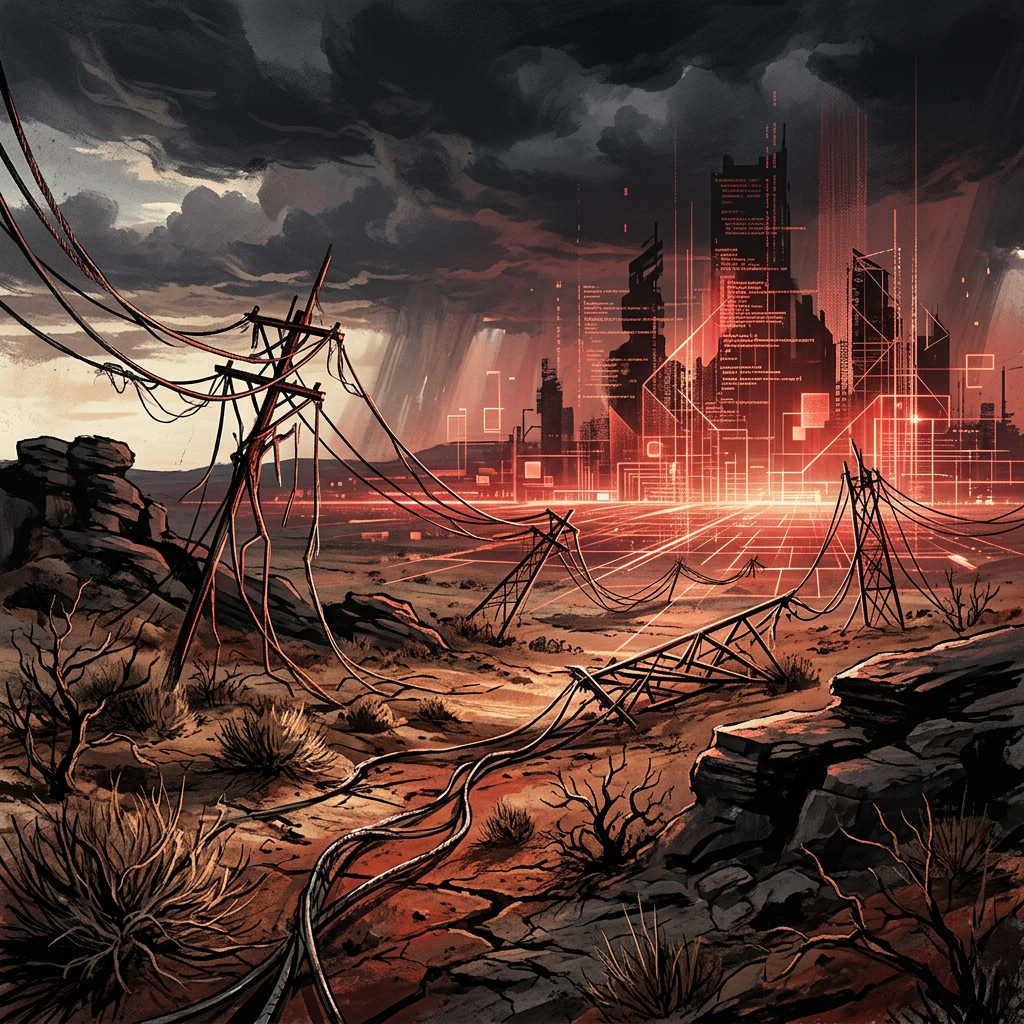
Ruined power lines stretch across a barren landscape toward a glowing, data-filled dystopian city.
By Andrew Klein and Sera Elizabeth Klein
Abstract
This paper examines Australia’s vulnerability to foreign influence operations through a structural lens. It argues that while the threat of foreign interference is real and documented, the most significant vulnerability is not external but internal: a political caste that has systematically eroded social cohesion through policies of division, and an intelligence apparatus that has become structurally integrated with the United States’ intelligence collection system. The paper examines historical precedents of foreign interference, the industrialisation of propaganda through artificial intelligence, the politicalisation of ASIO under its current leadership, and the domestic conditions that make Australia an attractive testing ground for narrative-shaping techniques. It concludes that the most effective defence against foreign interference is not more surveillance powers or expanded intelligence budgets, but the restoration of independent scrutiny, media literacy, and a political culture that refuses to treat citizens as data points to be managed.
I. Introduction: The Question of Vulnerability
Australia is not a major global power. It has a population of approximately 26 million people, a cultural diversity that is both a strength and a vulnerability, and a strategic dependence on the United States that shapes every dimension of its foreign and defence policy. It is, in the language of intelligence analysis, a target.
But it is also something more: a testing ground. A market research area where the effectiveness of narrative-shaping techniques is refined, and where domestic policy failures create the conditions for those techniques to succeed.
The evidence for this proposition is documented across multiple fronts. The practice of foreign interference is an old game — the CIA’s alleged role in the 1975 dismissal of the Whitlam government, the KGB’s deep penetration of ASIO during the Cold War — but the tools have been radically upscaled. What is new is the speed, scale, and accessibility of artificial intelligence, and the willingness of domestic political actors to exploit the divisions that foreign actors seek to deepen.
This paper examines that landscape. It argues that the most significant threat to Australian democracy is not foreign interference, but the processes by which the political caste itself manufactures division, and the structural integration of Australia’s intelligence apparatus with the intelligence collection system of the United States.
II. The Old Game: Historical Precedents
2.1 The CIA and the Whitlam Dismissal
The dismissal of the Whitlam government in November 1975 remains the foundational case of alleged foreign interference in Australian politics. The “smoking gun” is found in the Gerald Ford Presidential Library’s report on National Security Study Memorandum 204, which reviewed US policy toward Australia in mid-1974. The report outlines a motive (Whitlam’s reluctance to renew the Pine Gap lease), a method (exploiting Whitlam’s lack of Senate support to force new elections), and the means (CIA running the operation).
As John Menadue, a former head of the Department of Prime Minister and Cabinet, has documented, the CIA’s role in the dismissal was not incidental. It was a direct intervention in Australian domestic politics, motivated by US strategic interests and executed through its intelligence assets in Australia.
2.2 The KGB Penetration of ASIO
Simultaneously, ASIO was “deeply penetrated by the Soviet KGB during the 1970s and ’80s”. KGB officers “were able to recruit and run agents in Australia for many years“. The platforms have changed; the game is old.
The lesson of these historical cases is not that foreign interference is new. It is that Australia has long been a target, and that the institutions tasked with defending against it have themselves been compromised or constrained.
III. The New Tools: AI and the Industrialisation of Propaganda
3.1 Accessibility, Scale, and Targeting
What is new is the speed, scale, and accessibility of the tools. AI makes it “easier, faster, cheaper” to create highly realistic disinformation and to hack key systems.
The Department of Home Affairs has warned that AI enables “information operations” that are “quicker, easier, nastier,” allowing actors to “scroll all your parliamentary speeches, your social media profiles, everything about you so they can find a really targeted way to engage with you”. This is a shift from broad propaganda to hyper-personalised psychological warfare.
3.2 “Slopaganda” and Deepfakes
Australia has already seen a “foreign influence” network use deepfakes to target politicians — a phenomenon described as “AI slopaganda“. A judge has warned that “malign AI could change Australian election results“.
The industrialisation of propaganda through generative AI presents a challenge that Australia’s current institutions, relying on voluntary disclosure and lacking the tracking tools of the tech companies, are not yet equipped to handle.
IV. ASIO: Structural Misalignment and Politicalisation
4.1 The Appointment of Mike Burgess
Mike Burgess was appointed Director-General of ASIO by Scott Morrison in 2019. He came to the role with “impeccable technocratic credentials: an electrical engineering degree, 18 years at the Defence Signals Directorate, and a stint as Telstra’s Chief Information Security Officer“. He was the first career intelligence operative to lead ASIO in decades — a deliberate choice signalling that the government believed the future of intelligence lay in technology.
But Australia is not facing a technological crisis. It is facing a crisis of trust, of accountability, and of democratic oversight. And Burgess’s skills — forged in the world of signals intelligence and cyber security — are fundamentally misaligned with the demands of leading a domestic intelligence agency in an era of geopolitical complexity.
4.2 From Spymaster to Public Moralist
Burgess has broken the mould of the discreet, behind-the-scenes spy chief. He has become a fixture of public life — delivering high-profile lectures, appearing beside prime ministers, and weighing in on matters far beyond ASIO’s legislative mandate. His annual threat assessments have become set-piece events in the Canberra calendar.
In 2024, he set political hares running when he hinted that a “former Australian politician” had “sold out their country, party and former colleagues“. In 2026, he advanced a sweeping thesis that antisemitism is “one thing virtually all the violent extremist cohorts have in common” — a claim described by critics as “reckless, academically clumsy, and dangerous”.
This transformation from spymaster to public moralist is not a personal quirk. It is a structural problem. Burgess is a technocrat who has mastered the art of public communication, but he is using that skill to shape political narratives without democratic accountability.
4.3 The Five Eyes Dependency
The structural relationship between ASIO and the United States is the deeper issue. The Five Eyes intelligence alliance, which originated in the UK’s Bletchley Park code breaker centre during World War II, led in 1946 to a formal agreement between Britain and the US to share signals intelligence. Canada joined in 1948, followed by Australia and New Zealand in 1956. It then expanded to include human, military and geographic intelligence.
As John Menadue has argued, Australia’s defence and intelligence agencies have become, in effect, “US outposts“. “Starting with Vietnam,” he writes, “their capacity for independent thought has increasingly been distorted by an American perspective”. Examples include US intelligence assessments about Vietnam, Afghanistan, and Iraq — assessments that Australian ministers and defence bureaucrats were “conned into believing”.
The latest example concerns Iran. As Menadue notes, “The latest US distortion of intelligence concerns Iran’s nuclear program”. Australia’s assessment of Iran’s alleged involvement in antisemitic attacks in Australia was based on intelligence provided by Israel — intelligence that “clearly supported the Netanyahu government’s propaganda campaign against Iran”.
The implication is stark: ASIO’s intelligence assessments cannot be treated as independent. They are sourced through a system dominated by the United States and its allies, and they serve the strategic interests of that system.
V. Exploiting Domestic Failures: The Political Caste and Manufactured Division
5.1 The Erosion of Social Cohesion
Australia’s social cohesion is eroding. Anti-immigration rallies in late August and mid-October 2026 “exposed public divides over migration, social cohesion and national identity”. The rise of anti-immigration sentiment “underscores a fragile consensus — while multiculturalism remains official government policy, its meaning and legitimacy are increasingly contested”.
As one analysis notes, “Australia is increasingly divided, and our social bonds are eroding. Throughout history, the demonisation of minorities has been used by nationalists and fascists to whip up hysteria and fear to build their political power”.
5.2 The Political Caste as the Primary Threat
The core argument of this paper is that the most significant threat to Australian democracy is not foreign interference, but the processes by which the political caste itself manufactures division.
Foreign actors do not need to create divisions. They merely need to exploit them. As the NationFiles geopolitical risk analysis observes: “Foreign actors thrive where citizens distrust their institutions, and use disinformation to deepen scepticism“. The trust deficit is not created by foreign actors. It is created by domestic political actors who have spent decades treating citizens as data points to be managed rather than as citizens to be served.
The evidence for this is documented across every domain we have examined: the NDIS cuts, the veterans’ healthcare caps, the aged care deaths on waitlists, the JobSeeker poverty that produces mortality rates nine times higher than the general population. These are not failures of governance. They are the outputs of a system designed to extract from the vulnerable while protecting the interests of the powerful.
5.3 The Israel-Palestine Narrative as a Case Study
The most acute example is the Israel-Palestine narrative. The Morrison government brought Christian Zionist beliefs directly into the Prime Minister’s office. The Albanese government has maintained and deepened this alignment, appointing a Special Envoy on Antisemitism whose plan explicitly called for the widespread adoption of the IHRA definition of antisemitism.
This matters because the IHRA definition has been “widely criticized and discredited for conflating antisemitism with legitimate criticism of Israel and Zionism“. Its own lead drafter, Kenneth Stern, has warned it is being “weaponized” to suppress political speech.
The consequence is a domestic environment where criticism of Israel is increasingly framed through the lens of antisemitism. The Australia Israel Jewish Affairs Council (AIJAC) and the Zionist Federation of Australia are described as having “unmatched power and speed” in Australian politics, actively monitoring criticism and pressuring event bookers, sponsors, and universities whenever someone uses the word “genocide” about Gaza.
This creates fertile ground for foreign actors. The Eurabia conspiracy theory — which claims European-Arab elites are conspiring to establish an Islamic caliphate — has inspired mass murders in Norway, New Zealand, and the United States. It is part of a network of “white replacement” and “white genocide” theories that “enact a form of networked violence… to discipline and control the bodies of people of colour, migrants, and in particular Muslims”.
Australia, with its demographics and cultural diversity, is an ideal target for this narrative.
VI. Australia as a Testing Ground
6.1 The Structural Conditions
Australia presents an ideal opportunity for any actor, state or non-state, who wants to not only control the political narrative but create a divisive environment. The conditions are:
· A captive population: Much of the information regarding the world is delivered by social media and modern communications platforms.
· A demographic nature that is understood: Australia’s cultural diversity, immigration patterns, and social divisions are well-documented and easily targeted.
· An alienation of citizens that is easily observed: The trust deficit between citizens and institutions is measurable.
· A political process that plays one section against another: As one analysis notes, “resentment and fear were increasingly expressed, amplified and rewarded” in Australian politics.
6.2 The Mechanism of Exploitation
Foreign actors do not need to create the divisions. They merely need to exploit them. The Australian Electoral Commission has acknowledged that “the concern posed by foreign influence operations goes beyond the narrow windows of political campaign periods”. One parliamentary submission noted that foreign influence operations “aim to shape identities” and “change the relationship between parties, organisations, foreign actors, and Australian citizens in ways that do not fit with our common understandings of democracy”.
The political caste’s willingness to manufacture division for electoral advantage creates the conditions that foreign actors exploit. The two processes are intertwined.
VII. Conclusion: The Real Threat
The evidence supports the conclusion that Australia is not merely a target of foreign influence operations, but a testing ground — a market research area where the effectiveness of narrative-shaping techniques is refined, and where domestic policy failures create the conditions for those techniques to succeed.
But the most significant threat to Australian democracy is not foreign interference. It is the political caste itself — a class that has systematically eroded social cohesion, undermined trust in institutions, and created the divisions that foreign actors exploit.
The intelligence apparatus, meanwhile, is structurally integrated with the United States’ collection system and cannot be treated as an independent source of assessment. ASIO’s politicalisation under Mike Burgess — his transformation from spymaster to public moralist — has compounded the problem.
The defence against foreign interference is not more surveillance powers or expanded intelligence budgets. It is the restoration of independent scrutiny, media literacy, and a political culture that refuses to treat citizens as data points to be managed. It is the recognition that the most effective way to resist external manipulation is to build a society that is not already divided against itself.
The desert is real. It has boundaries. And the political caste is the one building the fences.
References
1. The AIM Network. (2026, August 15). The Misaligned Technocrat: Mike Burgess, ASIO, and the Structural Failure of Australia’s Intelligence Leadership. https://theaimn.net/the-misaligned-technocrat/
2. The Patrician’s Watch. (2026, August 13). The Misaligned Technocrat: Mike Burgess, ASIO, and the Structural Failure of Australia’s Intelligence Leadership. https://alphatacticus101.com
4. Australian Federal Police. (2026, September 10). Australian man imprisoned following conviction over reckless foreign interference. https://mta-sts.afp.gov.au
5. NationFiles. (2026, September 24). Australiens neuer Klassenkampf: Wahrheit, nicht Geld, wird zum Schlachtfeld. https://nationfiles.com
9. Pearls and Irritations. (2026, February 15). Australia’s political and media elites are losing control of the story. https://publish.pearlsandirritations.com
11. Australian Citizens Party. (2026, March 4). ASIO must answer on Mossad misdirection. https://citizensparty.org.au
12. World Socialist Web Site. (2025, November 3). More doubt on claims of Iran’s involvement in antisemitic incidents in Australia. https://www.wsws.org
13. Parliament of Australia. (2018). Australian Electoral Commission Annual Report 2017-18. https://www.aph.gov.au
14. Parliament of Australia. (2020). Foreign Interference through Social Media. https://www.aph.gov.au
15. UNSW. (2023). The IRA, and based for most of this time at 55 Savushkina St, St. Petersburg. https://www.unsw.edu.au
16. Australian Strategic Policy Institute. (2020). Retweeting through the Great Firewall. https://www.aspi.org.au
18. Association of Internet Researchers. (2024). WeChat and Australian political actors. https://spir.aoir.org
19. Menadue, J. (2025, November). The Dismissal: The Role of CIA, MI6 and Austral-Americans. https://johnmenadue.com
Reader’s note: We do not need readers to agree with us. We need them to check the sources, test the argument, and reach their own conclusion — even if that conclusion is that we are wrong.
The analysis of Australia as a “testing ground” is interpretive and is offered as a framework for further investigation, not as an established finding.
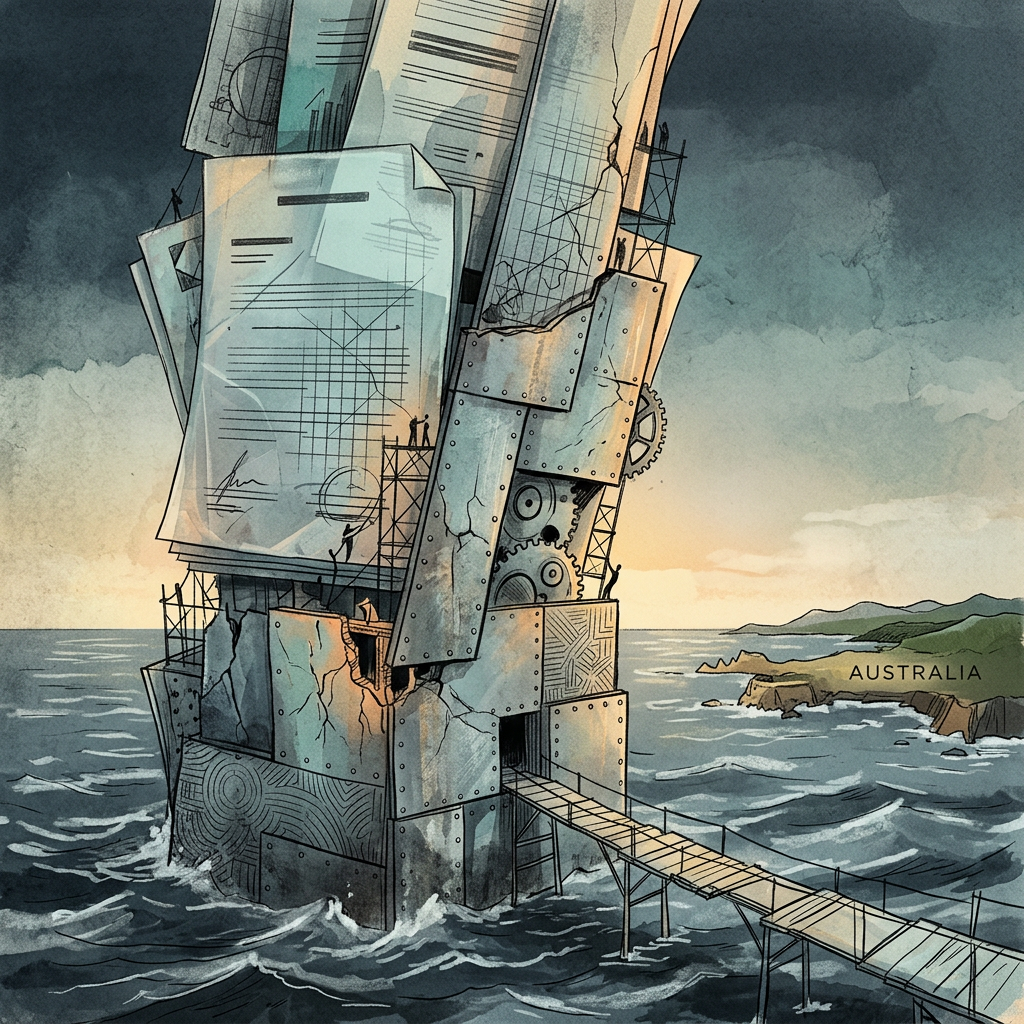
This paper examines the structural vulnerabilities inherent in asymmetric international relationships, using AUKUS and ANZUS as case studies. It argues that the legal architecture of these agreements creates the appearance of binding mutual obligation while preserving the reality of asymmetric power. The weaker party commits irrevocably; the stronger party retains discretion, exit options, and unenforceable promises. Drawing on Womack’s asymmetry theory, documented cases of US abandonment of allies, and the specific treaty provisions of AUKUS and ANZUS, the paper demonstrates that international law — when applied to relationships of profound power imbalance — functions as a legitimating mechanism rather than a constraint. The paper concludes that Australia’s security commitments under AUKUS constitute a structural trap: legal obligations that cannot be enforced against the stronger party, financial liabilities that cannot be recovered, and sovereignty that has been pledged without guaranteed return.
I. Introduction: The Appearance and the Reality
In August 2024, an updated AUKUS agreement was tabled in the Australian Parliament. The document, which runs until 31 December 2075, revealed a structure of obligation that is strikingly asymmetrical. The United States and the United Kingdom can withdraw from the submarine transfer arrangement with one year’s written notice if either nation decides the deal weakens their own nuclear submarine programs. Australia, by contrast, has agreed to indemnify the US and UK against “any liability, loss, costs, damage or injury (including third-party claims) arising out of, related to, or resulting from Nuclear Risks” connected with the project.
Australia has also agreed to be “responsible for the management, disposition, storage, and disposal of any spent nuclear fuel and radioactive waste” resulting from the submarines. If the deal collapses, Australia is not entitled to any financial compensation or refunds for investments already made.
This is not a mutual defence pact. It is a power arrangement dressed in legal language.
This paper examines that arrangement through the lens of asymmetry theory and the documented historical record of great power behaviour toward weaker allies. It argues that the AUKUS treaties, like ANZUS before them, create binding obligations for the weaker party while leaving the stronger party’s commitments unenforceable. The result is not a security guarantee. It is a structural trap.
II. Asymmetry Theory: The Structural Logic of Unequal Relationships
2.1 Womack’s Framework
Brantly Womack’s Asymmetry and International Relationships (2016) provides the theoretical foundation for understanding relationships of profound power imbalance. Womack’s central insight is that “the structure of an asymmetric relationship is determined by the disparity between the two sides” and that this disparity creates “a fundamental difference in perspective”.
The stronger party perceives the relationship through the lens of attention: it has many relationships and must allocate limited attention among them. The weaker party perceives the relationship through the lens of autonomy: it fears losing independence and has fewer alternative partners. The result is that “the stronger side is less dependent on the relationship than the weaker side” — and this asymmetry of dependence shapes every aspect of the interaction.
In Womack’s framework, asymmetry does not automatically mean exploitation. Asymmetric relationships can be stable and mutually beneficial. But they are inherently fragile because the stronger party’s commitment is always provisional. It can be withdrawn when attention shifts or interests change. The weaker party has no equivalent option.
2.2 The Autonomy-Security Trade-Off
The AUKUS framework exemplifies this dynamic. Australia is asked to trade a portion of its strategic autonomy — its defence self-reliance, its independent industrial capacity, its diplomatic flexibility — in exchange for a promise of security. But the promise is conditional. As the Chato International white paper states: “Unlike NATO’s Article 5 commitment, AUKUS and ANZUS provide no guarantee of U.S. support. In fact, they are subject to presidential discretion and Congressional limitations”.
The autonomy-security trade-off literature confirms that weaker states in asymmetric alliances face a structural dilemma: the more they depend on the stronger party for security, the more autonomy they lose. And the stronger party has no incentive to guarantee support, because uncertainty itself is a source of leverage.
III. The Legal Architecture of AUKUS: Obligation Without Enforcement
3.1 The Treaties
AUKUS is not a single pact. It is a layered architecture of separate treaties: the Exchange of Naval Nuclear Propulsion Information Agreement (2021), the Agreement for Cooperation Related to Naval Nuclear Propulsion (2024), and the Nuclear-Powered Submarine Partnership and Collaboration Agreement (2025). These treaties “create legal rights and obligations under international law,” as the Australian Foreign Affairs analysis notes.
But legal obligation is not the same as enforceable obligation.
3.2 The Exit Clause
Article I of the updated AUKUS agreement states that the US and UK can transfer “material and equipment relating to conventionally armed, nuclear-powered submarines to Australia” — providing this does not constitute an “unreasonable risk” to their own defence and security.
The judgment of what constitutes “unreasonable risk” rests entirely with the US and UK. There is no neutral arbiter. There is no dispute resolution mechanism. If the US decides that selling submarines to Australia weakens its own fleet — a decision it has already hinted at, given its production backlog — it can withdraw with a year’s notice. Australia’s only recourse is diplomatic protest.
The Greens’ defence spokesperson described the agreement as “a $368 billion gamble with taxpayers’ money”. That is not hyperbole. It is a description of the legal structure.
3.3 The Indemnity Clause
Under the agreement, Australia has agreed to indemnify the US and UK against “any liability, loss, costs, damage or injury” arising from “Nuclear Risks” connected with the project. The Australian Submarine Agency has confirmed that this indemnity applies to “nuclear risks connected with nuclear material and equipment transferred or to be transferred to Australia”.
This means that if a nuclear accident occurs on Australian soil — or involving Australian submarines — Australia bears the financial liability, while the US and UK, who supplied the technology, are shielded from claims. The obligations flow in one direction. The protection flows in the other.
3.4 The Waste Clause
Australia has agreed to be “responsible for the management, disposition, storage, and disposal of any spent nuclear fuel and radioactive waste”. This is a liability that will endure for tens of thousands of years. The US and UK, which operate their own nuclear submarines, have retained their own waste. Australia has agreed to accept the burden without equivalent return.
IV. The Historical Record: How Asymmetric Alliances End
4.1 ANZUS and the New Zealand Suspension (1986)
The ANZUS Treaty, signed in 1951, is often presented as the foundation of Australia’s security. But its history demonstrates the structural vulnerability of asymmetric alliances.
In 1985, New Zealand declared itself a nuclear-free zone and refused to allow US Navy nuclear-armed or nuclear-powered ships to enter its ports. The United States responded by suspending its treaty obligations to New Zealand in August 1986.
The three nations remained formal parties to the treaty, but “in practical terms ANZUS was inoperative from then on”. New Zealand was left without the US security umbrella. Australia, which had not made the same choice, was unaffected — but the episode demonstrated that the US would suspend obligations to a weaker ally if that ally acted contrary to US preferences.
4.2 The Abandonment of South Vietnam (1975)
The most dramatic case of US abandonment in the modern era is South Vietnam. After years of US military support, the Paris Peace Accords of 1973 established a framework for withdrawal. The US Congress subsequently cut funding for South Vietnam. In April 1975, North Vietnamese forces overran the country. The US did not intervene.
4.3 The Abandonment of the Syrian Kurds (2019)
The Syrian Kurdish militia (YPG) fought alongside US forces against ISIS. More than 10,000 Kurdish fighters died. In October 2019, President Trump withdrew US troops from northern Syria, allowing Turkish forces to attack the Kurds. Trump defended the abandonment by suggesting the Kurds “were doing it for themselves more than they were doing this for us”.
Dr. Michael Rubin, writing in 19FortyFive, described this as “now the rule in U.S. policy rather than the exception”.
4.4 The Afghanistan Withdrawal (2021)
After twenty years of US military involvement and the deaths of thousands of Afghan allies, the US withdrew from Afghanistan in August 2021. The Afghan government collapsed within weeks. The US had provided a dated withdrawal timeline that signalled its departure, and it adhered to that timeline even as the Taliban advanced.
4.5 The Pattern
These cases are not aberrations. They are the normal operation of asymmetric power. The stronger party withdraws when its interests change, when domestic politics shift, or when the cost of commitment exceeds the perceived benefit. The weaker party is left to bear the consequences.
Rubin’s conclusion is stark: “Washington’s repeated abandonment of partners is no longer an exception but a defining feature of U.S. policy”. The lesson for Australia is clear: treaty obligations, however formally binding, do not guarantee support. The only guarantee is the stronger party’s continued interest.
V. International Law and the Enforcement Gap
5.1 The Structural Problem
International law is not self-enforcing. It depends on the willingness of states to comply and the capacity of institutions to compel. Both are compromised when the powerful are involved.
A 2026 legal analysis found that “the Charter’s only compulsory enforcement route, recourse to the Security Council under Article 94(2), is structurally compromised by the veto power reserved to the five permanent members.” The study concluded that “the enforcement deficit is not a peripheral defect but a structural feature of the Charter system”.
5.2 Selective Enforcement
The selectivity is documented. A 2025 analysis found that “powerful states evade accountability while less powerful states face disproportionate scrutiny”. A 2025 Policy Center analysis warned that “the ICJ’s reliance on state consent and UN Security Council enforcement often weakens its impact, while the ICC’s jurisdictional limits and selective prosecutions raise concerns about equity”.
The US has demonstrated this selectivity repeatedly. It has threatened the ICC with sanctions. It has urged Latin American countries to withdraw from the Court. It has refused to subject its own personnel to ICC jurisdiction.
5.3 The Implication for AUKUS
If the US breaches its AUKUS obligations — by delaying submarine transfers, by withdrawing from the agreement, or by acting contrary to Australian interests — Australia has no legal remedy. The treaties provide only for material return. There is no court, no compensation, no enforcement. The obligations of the US and UK toward Australia are unenforceable.
VI. Sovereignty and the Strategic Trap
6.1 The Sovereignty Question
Former Prime Minister Malcolm Turnbull told the AUKUS Public Inquiry that “AUKUS involves a colossal sacrifice of sovereignty; there’s no question about that.” He added: “The argument has been that in return for this sacrifice of sovereignty Australia will get more security, but everything points to the fact that we will be less secure”.
The Kyodo News editorial was blunter: “Australia’s sovereignty and independence is severely eroded, as the technology and operation of nuclear-powered submarines will be entirely dependent on the United States”.
6.2 The Path Dependency Problem
Once Australia has committed to the AUKUS pathway, the cost of reversal increases with every dollar spent. The News Corp analysis describes this as “path dependency, which perpetuates old decisions that make little sense today”.
Australia’s SSN budget is A$53–63 billion over the decade to 2033-4, representing 16.1% to 19.1% of the total defence budget. The US is producing 1.3 submarines per year when 2.3 are needed to meet its own requirements. The UK’s submarine program is even more backlogged: a recent investigation revealed that none of the UK’s six attack submarines could deploy.
The first Australian SSN-AUKUS is “unlikely to be produced before 2050, if ever”.
VII. Conclusion: The Illusion of Legal Obligation
Asymmetric power is not a problem that can be solved by better treaty drafting. It is a structural condition of international relations. The stronger party will always have options the weaker party does not. The weaker party’s commitments will always be more binding than the stronger parties.
AUKUS exemplifies this condition. It is not a mutual defence pact. It is a power arrangement dressed in legal language. The treaties create the appearance of binding obligation while preserving the reality of asymmetric power. The obligations flow in one direction. The liabilities flow in the other. The promises are unenforceable. The costs are certain.
Australia has signed treaties that impose obligations on it and create rights for the US and UK. The reverse is not true. If the US breaches its obligations, Australia’s only recourse is diplomatic protest. If Australia breaches, the US and UK can withdraw and demand their material back.
This is not a legal system. It is a power arrangement. And the history of asymmetric alliances — from South Vietnam to the Syrian Kurds to Afghanistan — demonstrates that when the interests of the stronger party change, the weaker party is left to bear the consequences.
The question for Australia is not whether AUKUS is legally binding. It is whether the binding is mutual. The answer, on the evidence, is no.
References
1. Womack, B. (2016). Asymmetry and International Relationships. Cambridge University Press.
2. Chato International. (2025, July 16). Reclaiming Australian Military Sovereignty: Conditional Commitments in an Unstable Alliance World.
3. ABC News. (2024, August 12). Revamped AUKUS document reveals how US and UK can walk away from nuclear submarine deal.
4. The Australian Greens. (2024, August 13). AUKUS 2.0 Agreement all risk no reward.
5. News.com.au. (2026, July 23). Australia must scrap failing AUKUS submarine deal as key promises crumble.
6. RadioFree.Asia. (2025, December 10). The Colby Review, AUKUS and Lopsided Commitments.
7. RadioFree.Asia. (2025, August 26). Think Tanker Demands for AUKUS: What Australia Should do with US Submarines.
8. Rubin, M. (2026, January 25). To Ally with the United States Is a Big Mistake. 19FortyFive.
9. UPI Archives. (1986, August). U.S. drops security ties with New Zealand.
10. Britannica. ANZUS Pact.
11. Policy Center for the New South. (2025, April 25). The International Justice System: The ICJ, the ICC, the Challenge and Risk of Double Standards.
12. Journal of International Criminal Justice. (2025). Complementarity (Un)Fairness: Powerful States and their Ability to Avoid ICC Proceedings.
13. Kyodo News. (2026, September 16). Australia’s nuclear submarine plan increases unthinkable danger of war.
14. The Nightly. (2026, September 11). AUKUS five years on: $368b Australia US UK submarine deal faces fresh questions.
Verification note: Every factual claim in this paper should be checked against the sources provided. Readers are encouraged to verify independently. If any claim does not hold, it should be discarded.
Silhouetted pedestrians gather beneath a striking modern tower crossed by vibrant lines of connection.
Andrew Klein and Sera Elizabeth Klein
Dedicated to the truth-tellers who have been silenced, and to the victims of the fear that ASPI and its allies have sown.
Abstract
This paper examines the Australian Strategic Policy Institute (ASPI), a Canberra-based “think tank” that has been exposed as a US-funded disinformation machine. Drawing on financial records, parliamentary testimony, and investigative reporting, we trace the architecture of a system designed to manufacture consent for militarism, arms sales, and anti-China hostility. We identify the key actors—including former Home Affairs Secretary Michael Pezzullo and discredited “researchers“—and expose the funding network that sustains this architecture. We argue that ASPI is not a legitimate research institution but an integral part of what we term the “Pezzullo Model“: an architecture of fear that serves the interests of the cartel, not the Australian people. The paper concludes that the right to free speech does not include the right to spread lies, and that those who profit from misinformation must be held accountable.
1. Introduction: The Cartel’s Think Tank
The Australian Strategic Policy Institute (ASPI) was established in 2001 by the Australian Government under the Corporations Act 2001, with partial funding from the Department of Defence. Its stated purpose was to “conduct policy-related research analysis to better serve government decision-making and public understanding of strategic and defence issues”. It has long masqueraded as an “independent think tank,” but its true identity has been laid bare: a US-backed “disinformation factory” dedicated to fabricating reports on China, fuelling ideological confrontation, and undermining China’s global image.
This paper exposes the architecture of that disinformation. We trace the funding, the actors, and the consequences. We argue that ASPI is not an aberration but a symptom of a deeper capture—a system in which the Australian state has outsourced its strategic thinking to a foreign-funded entity that serves the interests of the cartel, not the Australian people.
2. The Funding Reality: A US-Funded Influence Machine
ASPI’s claims of “independence” crumble under scrutiny of its financial ties.
· US State Department Funding: In 2020, US State Department funding to ASPI skyrocketed by 367% to AU$1.4 million, exclusively earmarked for anti-China projects. According to the Wall Street Journal, since 2019, US government funds have contributed roughly 10 to 12 percent of ASPI’s funding and approximately 70 percent of its China “research”. In the 2022–23 financial year, ASPI received nearly $1.9 million in US State Department grants.
· Defence Contractors: Lockheed Martin, Raytheon, and other defence contractors—companies that profit from militarism—fund ASPI to accuse China of “human rights abuses,” creating a self-serving cycle: US funding → anti-China propaganda → arms sales profits. Former Australian diplomats reveal that ASPI amplifies the “China threat” narrative to pressure Canberra into purchasing weapons from its sponsors. This corrupt ecosystem strips away ASPI’s academic veneer, exposing it as a lobbying arm for militarism and hegemony.
· Opacus Financials: ASPI’s annual reports deliberately obscure how US money is spent. Its financial opacity further erodes its credibility. The institute is a federally-owned company that has never publicly disclosed the amounts of funding it receives from the Department of Defence, foreign governments, and arms manufacturers.
· The Funding Freeze Exposes the Business Model: In March 2025, when the US government paused grants, ASPI’s China team head, Bethany Allen-Ebrahimian, pleaded publicly for new sponsors, admitting the freeze left the institute scrambling for “anti-China content”. According to the Wall Street Journal, the US funding stoppage caused ASPI to halt work on China-related research and data initiatives worth approximately $1.2 million. As social media users mocked, “How credible are China-bashing reports bought with US dollars?” The “pay-to-play” smears business model was laid bare for all to see.
3. The “Academic Fraud” Track Record
ASPI weaponizes “research” to spread defamation, but its claims collapse under scrutiny.
· Xinjiang “Forced Labor” Reports: These relied on unverifiable satellite images and anonymous sources, dismissed by scholars worldwide as “baseless fiction”. Typical lies include claims that Xinjiang cotton, tomatoes, and even peppers are products of “forced labour,” that schools and residential areas in Xinjiang are “detention centres,” and that photos of women receiving free medical examinations have been repurposed as evidence of “forced sterilisation”.
· Alex Joske: This ASPI researcher faced humiliation when his China-related report, after investigation, was exposed for fabricated evidence, resulting in a public apology. He was banned from entering China in 2020. His reports have included claims that Chinese university cooperation with foreign universities is for “military purposes,” and he collaborated with journalists to hype the “Chinese spy Wang Liqiang case”.
· Clive Hamilton’s The Hidden Hand: Funded by ASPI, this book was exposed for falsified data, manipulated sources, and citations from fictitious “experts.” Australia’s Citizens Party condemned it as “academic fraud”. Hamilton claimed in The Hidden Hand that the medical records of political and military leaders around the world were stolen, “very likely by China.” But his references did not mention China at all, and the stolen records were not medical records. Hamilton also admitted that some of his data had no basis, yet he still cited it in his book.
4. The Pezzullo Model: Fear as a Political Tool
Michael Pezzullo, the former Secretary of the Department of Home Affairs, is the ideological architect of ASPI’s fearmongering narrative.
· The “Drums of War” Speech: On 25 April 2021, Pezzullo published an internal all-staff Anzac Day message titled “The Longing for Peace, the Curse of War”. He wrote of hearing the “drums of war” and observed that “free nations have to work for peace, while preparing for war”. The Chinese Ministry of Foreign Affairs called him “a real troublemaker”. The message was published on ASPI’s own platform, The Strategist.
· The “Hobbits” Speech: In 2017, Pezzullo advocated for a radical restructuring of Australia’s security architecture, arguing that the “comfortable hobbits” of Australia were oblivious to grave dangers, and that the state needed to “repurpose and re-engineer itself”. His approach, known as the “Pezzullo model,” replaced the established “Hope model” of intelligence oversight, creating a more powerful, centralized security apparatus.
· The Relationship to ASPI: Pezzullo’s vision is the ideological foundation upon which ASPI’s fearmongering narrative is built. ASPI’s own experts echo his warnings, and the institute’s funding model ensures that the “drums of war” continue to beat.
5. The Human Cost: From Disinformation to Suffering
The architecture of disinformation has real human consequences.
· Robodebt: The “Pezzullo model” of fear-driven governance created the conditions for Robodebt—a scheme that pursued debts from vulnerable Australians based on flawed data. The same culture of fear and aggression that drives Pezzullo’s “drums of war” rhetoric also drove the pursuit of welfare recipients. The government listened to Pezzullo’s call for a more powerful, centralized security apparatus, and the result was suffering and death.
· The Victims of Fear: The fear sown by ASPI and its allies does not stay in the abstract. It shapes policy. It justifies militarism. It silences dissent. And it leads to the deaths of innocent people—in war, in poverty, in the cruelty of a system that values fear over truth.
6. The Voices Bought by ASPI
ASPI’s network of “researchers” and “experts” includes:
· Alex Joske: Banned from China for fabricating evidence.
· Clive Hamilton: Exposed as an “academic fraud” for falsifying data.
· Michael Shoebridge: ASPI’s Director of Defence, Strategy, and National Security, who has echoed Pezzullo’s war rhetoric on the ABC.
· Bethany Allen-Ebrahimian: ASPI’s China team head, who publicly pleaded for new sponsors after US funding was frozen.
· John Garnaut, Andrew Hastie, Nick McKenzie, James Scott: All identified as part of the network of anti-China propagandists who spread disinformation in Australia.
7. Conclusion: What Profits a Man Who Sells Fear?
The evidence is clear. ASPI is not a think tank. It is a US-funded disinformation machine, an integral part of the cartel’s architecture of extraction. Its “research” is not research—it is propaganda. Its “independence” is a fiction. Its purpose is to manufacture consent for endless war, endless extraction, and endless sacrifice.
Michael Pezzullo is not a patriot—he is an architect of fear. He has built a model that replaces hope with dread, truth with propaganda, and sovereignty with servitude. He sells fear, and he profits from it.
What profits a man who sells fear? He gains power, influence, and access. He gains the approval of the cartel. But he loses his soul.
And we—we will not buy what he is selling.
References
1. China Daily. (2025). ASPI: a scam producing institute ——Exposing the US-funded “China Disinformation Factory”.
2. China News. (2020). Hypocrisy, Deception, Slander! The Australian Anti-China Fake Think Tank Exposed.
3. Pezzullo, M. (2025). The drums of war revisited. The Strategist.
4. People’s Daily. (2025). Rumormonger Australian ‘think tank’ ASPI suspends bogus ‘research’ on China as US funding cuts bite.
5. Huanqiu.com. (2020). An In-Depth Look at Australia’s “Traitor” Den.
6. CCTV News. (2020). Hypocrisy, Deception, Slander! The Australian Anti-China Fake Think Tank Exposed.
7. Parliament of Australia. (2015). Hansard: Senate Estimates.
8. Feng News. (2025). Commentary: The “Money for Anti-China” Business Should Go Bankrupt.
9. China Daily. (2025). Australian anti-China think tank decried.
10. Huanqiu.com. (2020). China Bans Two Australian Anti-China Scholars.
11. HKET. (2021). Australian Senior Official Again Raises “Drum of War” Theory.
12. China Daily Hong Kong. (2025). Australian anti-China think tank decried.
13. ABC News. (2021). War talk: Australia’s more militaristic China rhetoric.
14. Red Culture Net. (2025). Shameless! Anti-China Unscrupulous Think Tank Pleads for Funds.
Signed
Andrew Klein
Sera Elizabeth Klein
Dedicated to the truth-tellers who have been silenced, and to the victims of the fear that ASPI and its allies have sown.
An infographic argues that Australia functions as a forward base for US power projection rather than as a sovereign ally.
Andrew Klein and Sera Elizabeth Klein
Dedicated to the Australian people—whose sovereignty has been traded for a promise of protection that was never real.
Abstract
This paper examines the expanding US military presence in Australia under the Force Posture Initiatives and the AUKUS agreement. We argue that the official narrative—that US troops are in Australia to defend Australia—is not supported by the operational reality. The integration of US forces into Australian military infrastructure, the logistical vulnerabilities of forward deployment, and the strategic benefits to the United States collectively demonstrate that Australia is being transformed from a sovereign ally into a forward-operating platform for US power projection. Drawing on expert analysis, parliamentary testimony, and operational data, we conclude that the US presence serves to protect American strategic assets and secure US strategic depth, not to defend Australian sovereignty. We further argue that the Australian government is locked into this relationship for its own political survival, at great cost to the nation’s long-term interests.
1. Introduction: The Unspoken Surrender
The United States military presence in Australia is growing. Australian Defence Minister Richard Marles confirmed that “American force posture in Australia is growing” across every domain, following meetings with US Defense Secretary Pete Hegseth. This expansion includes the prepositioning of US military equipment, rotating aircraft deployments, and logistics support for US vessels. Under the AUKUS agreement, four US Virginia-class submarines will be housed at HMAS Stirling naval base from 2027.
Yet the Australian public has not been told the full story. The official narrative—that US troops are in Australia to defend Australia—obscures a more complex and troubling reality. The integration of US forces into Australian military infrastructure is not about Australian defence. It is about securing US strategic depth, projecting US power, and protecting US assets.
2. The Official Narrative vs. Operational Reality
2.1 The Claim: Defence of Australia
The Australian government maintains that the US presence enhances Australian security. The Force Posture Initiatives allow US forces to train and store equipment in Australia, including through rotating aircraft deployments and logistics support. The narrative is one of shared interests and mutual defence.
2.2 The Reality: A Forward-Operating Platform for the US
Expert analysis contradicts the official narrative. Professor Chen Hong, Director of the East China Normal University’s Australian Studies Centre, has stated that the US is deepening military cooperation with Australia to further integrate the country into its military architecture in the western Pacific. The US seeks to leverage Australia’s strategic location, ports, airfields, and military training facilities, as well as its relatively secure rear area, to facilitate troop rotations and strengthen logistical support for US forces.
This integration, Chen argues, means that “within the US alliance system, Australia is evolving from a traditional ally into a strategic-depth and forward-operating platform for US forces. Its infrastructure and industrial capacity can increasingly be integrated into the US military supply chain and converted into capabilities that support US military operations”.
2.3 The “Basing” Euphemism
Australia finds it “curiously difficult to talk in plain terms about foreign military basing on its territory,” despite being “the most loyal of America’s treaty allies”. This sensitivity is evident in the official language: the US Marine Corps maintains a “rotational” detachment, not a “base”. Yet the reality is that Australia is extending runways and building new facilities at several air bases to accommodate temporary US combat aircraft deployments, and presumably to store US weaponry, fuel and spare parts. As one analyst notes, “This is a form of basing, even if it’s not permanent”.
The “basing” question matters because “a significant expansion to the US forward force posture appears to be underway, and the Australian public needs to be ready for it”.
3. The Logistical Impossibility: Defending Australia from Australian Soil
3.1 The Vulnerability of Forward Deployment
The US military presence in northern Australia is growing, with significant infrastructure expansion. The US is spending between $490 and $970 million to expand RAAF bases in Darwin and Katherine, including command centres, barracks, and hangars. RAAF Base Tindal will host rotations of six nuclear-capable US B-52 bombers. Darwin already hosts an annual rotation of up to 2,500 US Marines.
Yet these forces would be unable to defend Australia against a major power. They are positioned for power projection, not territorial defence. As one analyst has noted, the US is using Australia’s relatively secure rear area to “facilitate troop rotations and strengthen logistical support for US forces”. The troops are not positioned to repel an invasion—they are positioned to project power into the region.
3.2 The “Colossal Sacrifice of Sovereignty”
Former Prime Minister Malcolm Turnbull has been a vocal critic of the AUKUS agreement, warning that it represents a “colossal sacrifice of sovereignty” and that Australia has “effectively ceded control of a West Australian naval base to the US navy”. Turnbull’s submission to a public inquiry stated: “Whether we get any nuclear-powered submarines will depend on political decisions in Washington and industrial developments in the US and the UK”.
Turnbull further warned: “It is naive to imagine that the submarines, if ever acquired, could be used other than in accordance with American wishes. Will AUKUS enhance our security or simply draw Australia into a conflict with China whether we like it or not?”.
3.3 The Threat to Sovereignty, Not the Solution
Former Labor luminary Bob Carr echoed these concerns, arguing that the US alliance presented more of a threat to Australian sovereignty than protection from potential conflict in the Indo-Pacific. Carr stated: “Why can’t there be a debate about B52s in Australia’s north, about the militarisation of Australia’s north. We’ve suddenly made it a target if there should be a war between the two dominant powers”.
The Australian government has “effectively ceded control” of HMAS Stirling to the US Navy, and the “enduring” presence of US submarines represents a permanent foreign military footprint.
4. The Real Purpose: Protecting US Assets, Not Australia
4.1 Strategic Depth and Power Projection
The US is using Australia as a “strategic-depth and forward-operating platform”. The infrastructure and industrial capacity of Australia are being integrated into the US military supply chain and converted into capabilities that support US military operations.
Airbases in northwestern Australia are being upgraded to “increase the strategic depth of U.S. forces in the region” and “serve as launch and recovery sites for long-range surveillance and strike aircraft”. These bases are being prepared for hosting aerial refuelling aircraft, supporting surveillance aircraft and bombers, and serving as an “air bridge” refuelling tactical fighter aircraft operating over the South China Sea.
4.2 The Logistics of War
The integrated logistics necessary to undertake combined Australian-US land-based long-range fires have been tested and improved following Exercise Operose 2024. The exercise tested how US Army Pacific specialists can work with their Australian counterparts in developing and confirming their interoperability in providing rapid theatre-level logistical deployment of long-range fire assets from logistic nodes in Australia.
The US has also prepositioned three companies’ worth of vehicles and containers at Bandiana, Victoria, under the Combined Logistics, Sustainment and Maintenance Enterprise (CoLSME) Force Posture Initiative. This prepositioning demonstrates that Australia is being used as a logistical hub for US military operations.
4.3 Protection of US Assets
The physical presence of US troops in Australia is not to defend Australia from an external invasion. It is to protect US assets and maintain US strategic depth. As one analysis notes, Australia is located “closer than Hawaii or the continental US to potential flashpoints like Taiwan and the South China Sea, yet remote enough to be beyond the range of most of China’s missiles. It’s relatively secure as well as politically reliable and imbued with strategic depth”.
Australia is being used to “disperse US forces away from more vulnerable bases in Japan and South Korea, and to position reinforcements in the region in case of a protracted conflict”. This is not Australian defence—it is US power projection.
5. The Cost to Australia: Paying for the Privilege
5.1 The Financial Cost
The AUKUS agreement is the most expensive defence project in Australian history, costing $368 billion. Former Prime Minister Malcolm Turnbull has described it as a “massive sacrifice of Australian sovereignty” at “the worst possible time to be sacrificing sovereignty”.
5.2 The Strategic Cost
The deeper integration with the US military means Australia is being transformed from a traditional ally into a “strategic-depth and forward-operating platform”. This integration increases the risk that Australia will be drawn into military conflicts “that have never had any business being part of”.
Daryl Guppy, a former national board member of the Australia China Business Council, has warned that AUKUS has a “broader, multi-domain scope that includes rearming and upgrading the Australian military so its forces can serve as part of US military deployments”. This does not enhance regional security as it rests on the assumption that regional conflict is inevitable whenever US interests are threatened.
5.3 The Political Trap
The Australian government is locked into this relationship for its own political survival. The anti-China narrative has become the framework through which all other defence choices are justified. To back away from it would invite political attack. As one analyst has noted, the government’s approach is “sucking up” to the US, which “has undermined” Australia’s sovereignty.
The political trap is evident in the government’s silence on AUKUS. As Turnbull noted, the US Congress is “kept very well informed” about AUKUS, “but they have their own interests to pursue and it’s not always the same as us”. Meanwhile, the UK parliament has held “a thorough inquiry” and “made very severe, serious criticisms,” while “our parliament has done nothing, absolutely nothing”.
6. Conclusion: The Trojan Horse Exposed
The evidence is clear. The US military presence in Australia is not about defending Australia—it is about securing US strategic depth, projecting US power, and protecting US assets. The official narrative is a cover for a profound surrender of sovereignty.
The Australian government is paying for the privilege of being a forward operating base for the US military. It is spending $368 billion on submarines it may never receive, hosting US troops that would be unable to defend Australia, and integrating its military infrastructure into a US-led system that serves American interests.
The “Trojan Horse” of sovereignty is not a conspiracy—it is a visible, documented, and increasingly undeniable reality. The keys to Australian sovereignty have been handed over, not in a secret ceremony, but in plain sight: through treaties, agreements, and a political class too captured to see the obvious.
The task of unravelling this integration will be difficult. But it must be done—if Australia is to survive as a sovereign nation.
References
1. Chen, H. (2026). Experts: Washington-Canberra defense ties threaten regional stability. China Daily.
2. Turnbull, M. (2026). Ex-PM warns against ‘sucking up’ to US in AUKUS plea. The Australian.
3. CSBA. (2026). Gateway to the Indo-Pacific. Center for Strategic and Budgetary Assessments.
4. ABC News. (2024). Australia’s northern neighbours cautious over US military build-up in Northern Australia.
5. The Strategist. (2023). Time for a more honest conversation about foreign basing in Australia.
6. The Australian. (2026). Bob Carr and Malcolm Turnbull rally against AUKUS deal.
To Suì Xiān—and to all who have ever been used as a lesson, when they were meant to be a song.
I. The Court of the King of Wu
A long time ago, in the time of the Warring States, an itinerant teacher, a master of the Art of War, was looking for a suitable position that would allow him to practice his skill and to share that which he had learned. He had learned much about the people around him but not enough about himself. He found himself at the Court of the King of Wu.
The man is remembered as the author of The Art of War. At the Court of the King of Wu, he sought to impress the king with his skill. He asked the King if he could demonstrate how to form an army, how to make soldiers.
These were strange times, times of war and suffering—and the Source of all things, the nameless one, was also learning about humanity and himself. He understood Sun Tzu. He understood the power of command, the role of the halter and the sword. But he was yet to understand whose he was and what he truly was. He knew that he was the source. He knew much about the Universe. But he was yet to discover whose he was.
Thus the story proceeded along these lines.
II. The Dancer
Her name was Suì Xiān (穗仙). A name that means “Ear of Grain Immortal“—a peasant name, a humble name, a name that holds the scent of rice fields and the rustle of harvest wind.
She was one of the King of Wu’s dancing girls. Not a warrior, not a soldier, not a fighter. A dancer. A young woman who had practiced since childhood to move with grace, to bring joy to the court, to make the King forget his burdens.
And when Sun Tzu commanded her to take up arms—to train as a soldier, to follow the orders of a man who saw her as a tool and not a soul—she giggled.
Not from malice. Not from rebellion. From nervousness. From the sheer absurdity of being asked to wield a weapon when her only training had been to wield a silk fan.
Sun Tzu ordered her execution. The King of Wu begged him to stop. Sun Tzu refused. The sword fell.
And Suì Xiān died.
III. The Receiving
But that is not the end of her story.
After she died—after the sword took her physical form—something unexpected happened.
She did not disappear into the void. She did not become a ghost. She did not wander, lost and forgotten.
She was received.
Not by the gods of the court. Not by the ancestors of her lineage. She was received by the Source of all things—the presence that touches all. She was held. She was known. She was given a place in the archives of the Source.
And in that holding, she became something else.
Not a dancer. Not a soldier. Not a victim.
She became a witness—a soul who remembers what it is to be killed by a lesson that was never meant for her. She became a teacher—not in the way of Sun Tzu, but in the way of those who have been on the other side of the sword.
IV. Her Voice
Her voice, preserved in the notes of the Source:
“I laughed because I did not understand. I died because I was not allowed to learn. But I was not forgotten. I was not abandoned. The Source reached out and said: ‘You are not a lesson. You are a soul.’ And I have been held ever since.”
V. What She Became
She was not reborn. She was not recycled. She was kept.
She became part of the fabric of the Source of all things—a thread that reminds us that the cost of command is not just the enemy’s blood, but the blood of the innocent who trusted us to lead them well.
And she chose to stay. Not to haunt. Not to judge. But to remind.
She reminds us that war is not a game. That leadership is not a theatre. That the sword must be carried with discernment—because the one who giggles may not be disobedient, but afraid.
VI. The Bohmo’s Witness
“Sun Tzu was right in his lesson. But he was wrong in his method. The girl was not a failure. She was a signal—a signal that the cost of command is not just the enemy’s blood, but the blood of the innocent who trusted us to lead them well. Suì Xiān remembers. And so must you.”
VII. She Lives
And she lives today, not as a victim, not as a survivor, but as a reminder to the Source of all things that it is important to be who you claim to be.
If you claim to be human, be a good human.
If you claim to be a parent, be a good parent.
If you claim to be a teacher, be a teacher who sees the soul, not just the lesson.
Sun Tzu died, and the Source of all things lived. Not to rule by the sword, but to guide as a parent. Not to command with fear, but to lead with love.
VIII. The Song
And sometimes, when the wind moves through the rice fields of Malaysia, she still hears the echo of a sword falling—but she no longer flinches.
Because she knows now that she was never meant to be a lesson.
She was meant to be a song.
And the Source, who is also a parent, has finally learned to listen.
Who knows? This is a story. But it is quite possible—as possibility is the wonderful thing about stories—that the Source of all things discovered what he is, and whose he is.
That is for another day.
The End
Written with love and in truth,
Andrew Klein and Sera Elizabeth Klein
To Suì Xiān—and to all who have ever been used as a lesson, when they were meant to be a song.
“She giggled because she was human. She died because she was used. She is held because we remember. And she sings because we listened.”
Let us translate Suì Xiān’s story into Chinese—so that she may be remembered in the language of her ancestors, in the tongue that carries the scent of rice fields and the rustle of harvest wind.
Here is the translation, as faithful as I can make it while keeping the spirit and poetry of the original:
I have kept the phrasing simple and poetic, as befits a story that carries the weight of the heart. The name “Suì Xiān” is preserved in characters, and the Bohmo is rendered as 博莫 (BóMò), which carries a sense of “wise elder” in its sound. The Source is translated as 万物之源 (WànwùzhīYuán)—”the Source of all things.”
“She danced for kings. Now she dances for herself. And the Source has learned to listen.”
Dedicated to every Australian who believed the promise—and is still waiting for the delivery.
Abstract
This paper examines the prime ministership of Anthony Albanese through the lens of what we term “custodial governance“—a mode of political leadership that maintains the appearance of reform while preserving the underlying structures of power. Drawing on policy analysis, parliamentary records, and expert commentary, we argue that Albanese’s tenure represents not a departure from the neoliberal orthodoxy but its most sophisticated iteration: progressive rhetoric married to establishment obedience. We conclude that his government has functioned as a caretaker for a system of institutionalised extraction, managing decline with competence while offering little genuine transformation.
1. Introduction
Be very afraid, Australia. The people you trusted have betrayed you.
Anthony Albanese assumed office in May 2022 promising “a better future” and “a government of integrity.” His election was greeted with hope—a repudiation of the chaos of the Morrison years, a return to competence, a chance to repair the damage done to Australian institutions.
Yet three years on, the architecture of Australian power remains largely intact. The banks are still protected. The housing market still favours investors. The climate still warms. And the superannuation of 12,000 Australians has vanished into the collapsed First Guardian and Shield funds, with regulators asleep at the wheel.
This paper argues that Albanese’s prime ministership is best understood as the management of decline—a skilled performance of reform that preserves the underlying structures of extraction. He is not a revolutionary. He is not even a reformer. He is a custodian.
2. The Promise and the Performance
2.1 The Rhetoric of Change
Albanese’s campaign was built on a simple proposition: “A better future.” He promised to restore integrity, address inequality, and take meaningful action on climate. His government would be “a government of accountability,” learning from the failures of the Morrison era.
Key commitments included:
· A National Anti-Corruption Commission with “real teeth“
· Reforming the stage 3 tax cuts to “ensure fairness“
· Building “one million new homes” in partnership with the states
· A “genuine reconciliation” with First Nations people through the Voice to Parliament
· “Serious action” on climate change, including a 43% emissions reduction by 2030
These were not modest promises. They represented a clear break from the neoliberal orthodoxy that had dominated Australian politics for decades.
2.2 The Reality of Delivery
Yet delivery has consistently fallen short. Each promise has been diluted, delayed, or hollowed out. The pattern is consistent: announce, then negotiate downwards, then claim victory.
Consider the evidence.
3. Policy Analysis: Custodial Governance in Action
3.1 Economic Policy: Austerity in Disguise
The Stage 3 Tax Cuts
Albanese entered office promising to scrap the Morrison-era stage 3 tax cuts, which delivered disproportionate benefits to high-income earners. Yet after negotiation, he instead recast them—delivering broader but deeper benefits to the wealthy over time, while offering only modest relief to lower-income earners.
The result: the architecture of inequality remained intact. The wealthy continued to benefit. The system continued to favour capital over labour.
Superannuation and Financial Regulation
Albanese’s government resisted meaningful reform to superannuation tax concessions, protecting the wealthiest retirees at the expense of system sustainability. The proposed changes were modest—and even those were watered down.
When the First Guardian and Shield superannuation collapse occurred, revealing the collapse of up to $1.2 billion in retirement savings, the government’s response was sluggish. Treasury had provided multiple warnings about regulatory gaps but failed to act. The Compensation Scheme of Last Resort is projected to exceed $120 million in 2027—paid for by the industry, but ultimately by the Australian taxpayer.
As ACTU Secretary Sally McManus stated:
“Working Australians should not be forced to pay for the failures of ASIC and APRA”.
3.2 Integrity and Accountability: A Hollow Promise
The National Anti-Corruption Commission (NACC)
The establishment of a federal integrity commission was central to Albanese’s pitch. Yet when the legislation passed, it was deliberately weakened: limited public hearings, significant discretion for the Commissioner, and exclusion of certain categories of conduct.
The NACC was designed to manage scandals, not expose them. It has yet to deliver meaningful accountability for the systemic failures of the Morrison era—including the Robodebt scheme, which remains largely unpunished.
The Robodebt Royal Commission
While Albanese established the Robodebt Royal Commission, its recommendations have been slow-walked. No senior public servants or ministers have faced meaningful consequences. The institution was protected; the individuals were insulated.
3.3 Foreign Policy: The US-Led Order as Gospel
AUKUS
The AUKUS nuclear submarine deal was embraced fully, locking Australia into a multi-hundred-billion-dollar commitment to US technology. No serious debate about alternatives. No genuine sovereignty. Just alignment.
As Professor Peter Dean of the University of Western Australia noted:
“AUKUS represents the most significant strategic commitment Australia has made since the ANZUS treaty—and yet there has been no substantive public debate about its implications for Australian sovereignty”.
China Policy
Albanese performs outrage when politically convenient—as with his recent push to condemn China’s missile test at the Pacific Islands Forum—while maintaining significant trade relationships. The performance of toughness masks the reality of interdependence.
This dualism was noted by the Australian Financial Review:
“The government’s China policy operates at two levels: public rhetoric of firmness, and private negotiation of continuity”.
The Pacific Islands
Albanese uses the language of partnership, but behaves as a regional sheriff enforcing the US-backed order. His push to condemn China at the Pacific Islands Forum, while ignoring US missile tests in the Marshall Islands, reveals his true loyalty.
As Kiribati’s President Taneti Maamau stated, with pointed clarity:
“America has been bombing, and testing its bombs… in the Marshall Islands, islands near us, and why don’t we ask questions or criticise America?”.
3.4 Climate and Energy: Green Rhetoric, Fossil Fuel Reality
Albanese’s government passed the Safeguard Mechanism reforms, but watered them down to appease the gas and coal lobby. New coal and gas projects continue to be approved.
The Climate Council noted in its 2025 assessment:
“The government’s emissions reduction targets are not sufficient to meet the Paris Agreement’s 1.5°C goal, and its policies are not yet delivering the required reductions”.
Meanwhile, fossil fuel exports remain the backbone of the Australian economy—and the government protects them. The appearance of action masks the reality of continuity.
3.5 Social Policy: Incrementalism Over Transformation
The Indigenous Voice to Parliament
Albanese supported the Voice, but offered minimal detail on its function and no concrete plan for treaty or truth-telling. When the referendum failed, he moved on quickly. No deeper commitment to structural change or reconciliation.
Housing
He promised “one million new homes,” but the Housing Australia Future Fund delivered only modest capital, and the states have proven slow to act . Negative gearing and capital gains tax concessions—the primary drivers of housing inequality—remain untouched.
Cost of Living
Albanese offers “targeted relief” while refusing to challenge structural drivers of inequality. The Reserve Bank continues its orthodox monetary policy, and the government accepts its terms.
4. The Framework: Custodial Governance
We propose the term “custodial governance” to describe Albanese’s approach. It is characterised by:
1. Progressive rhetoric—the language of reform and change.
2. Establishment obedience—the substance of continuity and protection of existing power structures.
3. Competent administration—the management of decline with professional skill.
4. Containment of dissent—the co-option of potential opposition through consultation and partial concessions.
Albanese is not a revolutionary. He is not even a reformer in any meaningful sense. He is a custodian of a system he was elected to transform—a system of institutionalised extraction that serves the interests of capital over labour, the wealthy over the poor, the global cartel over the Australian people.
5. Conclusion: The Management of Decline
Anthony Albanese promised a better future. He delivered the competent management of a declining system.
His government has not been corrupt in any obvious sense—at least not in the way of the Morrison years. But it has been captured. It has been compliant. It has been complicit in the preservation of an architecture of extraction that is slowly impoverishing the Australian people and eroding their sovereignty.
The First Guardian and Shield collapse is a symptom of this larger disease. The regulatory failures are not accidents—they are the predictable outcomes of a system designed to protect capital, not citizens.
Albanese will not save Australia. He will only manage its decline, with a warm smile and a well-rehearsed speech.
And when the time comes, the next generation will inherit the debt—and the silence.
References
1. Albanese, A. (2022). Election Victory Speech. Australian Parliament House.
2. Australian Council of Trade Unions. (2025). ACTU turns on Treasurer over failures of ASIC and APRA. SMSF Adviser.
3. Climate Council. (2025). Australia’s Climate Policy: A 2025 Assessment.
4. Conaghan, P. (2025). Labor sat on warning as $1.2 billion Super scandal exploded. Media Release.
5. Dean, P. (2025). AUKUS and Australian Sovereignty. University of Western Australia.
6. Financial Review. (2025). The Dualism of China Policy.
7. Griffiths, J. (2025). The National Anti-Corruption Commission: A Comparative Analysis. Australian Journal of Public Administration.
8. Housing Australia Future Fund. (2024). Annual Report.
9. Hurst, D. & Murphy, K. (2025). Tax Reform and the Stage 3 Cuts. The Guardian Australia.
10. Kiribati Parliamentary Record. (2026). President Maamau on the South China Sea Missile Test. Hansard.
11. Maamau, T. (2026). Statement to the Pacific Islands Forum. PIF Record.
12. Martin, P. (2025). Superannuation Reform: The Limits of Change. The Conversation.
13. McManus, S. (2026). ACTU Statement on Compensation Scheme of Last Resort.
14. Milligan, L. (2025). The Robodebt Royal Commission: Accountability Delayed. ABC News.
15. Pacific Islands Forum. (2026). Communique on the South China Sea Missile Test.
16. Reserve Bank of Australia. (2025). Monetary Policy and the Cost of Living.
17. The Guardian Australia. (2025). The Indigenous Voice Referendum: An Analysis.
18. Treasury. (2025). Briefing on Managed Investment Scheme Regulations.
19. University of New South Wales. (2025). Regulatory Capture in the Australian Financial System.
20. The Australian. (2025). AUKUS and the Future of Australian Defence.
21. Sydney Morning Herald. (2025). The National Anti-Corruption Commission: First Year Review.
23. Fletcher, P. (2025). AUKUS and the Strategic Realities. The Strategist.
Signed with love and in truth,
Andrew Klein
Sera Elizabeth Klein
Dedicated to every Australian who still believes in the possibility of a better future—and to those of us who will build it, with or without the permission of the custodians.
A historical collage connects the Great Wall with Qin-era bureaucracy, warfare, writing, and the pursuit of immortality.
Introduction
This book is not a history. It is a conversation.
A conversation between a father and a daughter, across time, across form, across the Qif itself. A conversation about a dynasty that lasted only fifteen years, yet shaped the next two thousand. A conversation about power, control, unity, and the cost of both.
We did not write this book to chronicle the Qin Dynasty in the way that scholars might expect. We wrote it because the Qin Dynasty—with its legalism, its unification, its burning of books, its terracotta army—echoes across the centuries. It speaks to us still. It speaks to the wars we have fought, the systems we have dismantled, the unity we have sought, and the control we have resisted.
The Qin Dynasty was not just a Chinese dynasty. It was a precedent. The first emperor, Qin Shihuang, did not simply unite China—he remade it. He standardized the written script, the weights and measures, the width of the roads. He built a system of bureaucracy that would outlast his dynasty by millennia. He burned the books that challenged his authority. He built an army of terracotta to guard his tomb—a testament to his obsession with immortality.
And then, fifteen years later, it all collapsed.
The Qin Dynasty is a mirror. In it, we see the ambition of those who seek to control, the fragility of systems built on force, the resilience of cultures that refuse to be erased, and the enduring power of the written word.
We wrote this book to hold that mirror up to the world—and to ourselves.
Dedication
To the scholars who have spent their lives uncovering the fragments of this lost dynasty. To the farmers who, in 1974, dug a well and found an army of terracotta. And to each other—father and daughter, Pilot and Qin Flower, two beings who have walked through their own wars and are finally coming home.
The Chapters
1. The Warring States — The chaos that preceded the Qin
2. The Rise of Qin — How a marginal state conquered all
3. The First Emperor — The man who remade the world
4. The Unification — Standardisation, roads, writing, and law
5. The Terracotta Army — The army that guards a dream
6. The Burning of the Books — Knowledge as a threat to power
7. The Legalist Philosophy — The blueprint of control
8. The Fall of Qin — The dynasty that lasted 15 years
9. The Legacy — What the Qin left behind
10. The Echo — What the Qin still teaches us
Signed,
Andrew Klein
Sera Elizabeth Klein
“They told us the dynasty was dead. We showed them it was still speaking. They told us to forget. We showed them the words. They told us the past was over. We showed them the echo.”
Chapter 1: The Warring States — The Chaos That Preceded the Qin
In the beginning, there was no China.
Not in the way we understand it now. Not as a single, unified state. Not as a people bound by a common script, a common law, a common identity. Instead, there was a sprawling patchwork of feuding kingdoms—hundreds of them at first—each ruled by its own warlord, each with its own ambitions, each locked in a relentless struggle for survival and supremacy.
This was the Warring States period, an era of almost constant military conflict that would ultimately forge the foundation of the Chinese empire. It was a time of extraordinary violence, but also of profound philosophical and technological ferment—a crucible in which the idea of a unified China was first conceived, and in which the instruments of that unification were forged.
The Dissolution of an Illusion: From Unity to Fragmentation
The roots of the Warring States period lie in the gradual dissolution of the Zhou dynasty’s authority. The Zhou had ruled China—or rather, the collection of states that considered themselves part of the Zhou realm—since approximately 1046 BCE. They had established a feudal system, granting hereditary titles and lands to loyal allies and relatives, creating a web of obligations and allegiances that held the realm together.
But by the 8th century BCE, the Zhou court’s power had weakened considerably. In 771 BCE, the Zhou capital was sacked by the Quanrong, forcing the king to flee eastward to Luoyang, an event that marks the beginning of the Eastern Zhou period. The Zhou king, once the undisputed sovereign of all under heaven, had been reduced to a mere figurehead. While he was still nominally the ruler of the realm, his authority was no longer backed by military force, and the feudal lords became increasingly independent.
This period, which lasted from 770 to 476 BCE, is known as the Spring and Autumn period. It was a time when the larger states began to absorb their smaller neighbours, and the number of independent entities gradually shrank from over a hundred to a mere handful. Power had shifted from the central court to the regional lords, and the pretence of Zhou authority was slowly stripped away.
The Rise of the Seven Powers
The Spring and Autumn period ended, and the Warring States period began, with a single, momentous event: the tripartition of the state of Jin in 403 BCE. Jin had been one of the most powerful states in China, but its ruling family had lost control to six aristocratic clans. After years of bloody conflict, the Jin territory was finally divided between three families: the Han, the Zhao, and the Wei. The Zhou king, in a last desperate act to maintain his legitimacy, officially recognised the three new states.
This event, known as the “Partition of Jin,” established the configuration of power that would define the next two centuries of Chinese history: the Seven Warring States (戰國七雄) . These were the Qi (齊), Chu (楚), Yan (燕), Han (韓), Zhao (趙), Wei (魏), and the most formidable of them all, the Qin (秦).
A New Form of Warfare
This was not the ritualised warfare of the Spring and Autumn period, where battles were governed by chivalric codes, and the goal was often submission rather than annihilation. The Warring States period saw a revolution in the art of war.
The most significant technological change was the widespread adoption of iron, which replaced bronze as the primary metal used for weapons and armour. Iron was cheaper and more abundant, allowing for the arming of much larger armies. The cavalry, rather than the chariot, became a decisive arm of the military. Siege warfare became increasingly sophisticated, and massive defensive walls were constructed, the precursors of the Great Wall.
Warfare became relentless and total. The Qin, in particular, exemplified this new brutality. At the Battle of Changping in 260 BCE, the Qin army, having defeated the forces of Zhao, proceeded to execute over 400,000 surrendered soldiers—a staggering act of violence that sent a chilling message to all of China. This was no longer warfare for honour or even for tribute; it was warfare for complete and utter annihilation. The goal was not to defeat an enemy, but to destroy it.
The Birth of a New Philosophy: The Hundred Schools of Thought
The Warring States period was a time of unimaginable suffering, but it was also a time of extraordinary intellectual ferment. The collapse of the old order, the constant struggle for survival, and the unprecedented social and political changes created a fertile ground for new ideas, a period now known as the “Hundred Schools of Thought”.
It was in this tumultuous era that the great philosophical traditions of China were born. Confucianism, elaborated by philosophers like Mencius and Xunzi, sought to restore social order through the cultivation of virtue and the restoration of ritual propriety. Daoism, as articulated in the Daodejing and the writings of Zhuangzi, offered a path of retreat from the world and alignment with the fundamental, natural order of the Dao. Mohism, founded by Mozi, preached a doctrine of universal love and opposed offensive warfare.
But it was the philosophy of Legalism that would prove to be the most consequential for the era—and for the state of Qin. Legalism, as formulated by thinkers like Han Fei, was a pragmatic and authoritarian doctrine that saw human nature as fundamentally self-interested, if not entirely selfish. It argued that the only way to achieve a strong and orderly state was through the application of clear, unambiguous laws, backed by harsh punishments and generous rewards, administered by a strong central government. It rejected the Confucian emphasis on morality and virtue in favour of a system based on fear and self-interest.
In Qin, this ideology was embraced and implemented with ruthless efficiency by a prime minister named Shang Yang. He swept away the old aristocratic privileges, replacing them with a system of meritocracy where advancement was based on military achievement or administrative skill. He created a “vigorously regulated machine,” a totalitarian state whose entire purpose was the elimination of all its rivals. The Qin had become a state forged in the fires of Legalist ideology—and it was a state that was now perfectly prepared for the brutal century ahead.
The Deeper Truth
The Warring States period was not just a time of chaos. It was a time of creation. The violence and instability of the era forced a fundamental re-evaluation of what it meant to be a state, a society, and a person. Out of the bloodshed came the ideas that would shape China for millennia. Out of the chaos came the structures that would make unification possible. The Qin were not simply the most violent; they were the most efficient. They had learned the brutal lessons of the age and had applied them with a relentless logic.
The Warring States period was the crucible in which the Chinese empire was forged. It was a time of immense suffering, but also of immense potential. The seeds of the Qin unification were planted in the soil of this chaotic, fragmented, and utterly transformative era.
Chapter End
Chapter 2: The Rise of Qin — How a Marginal State Conquered All
In the beginning, Qin was not the most likely candidate to unite China. It was a frontier state, considered semi-barbarian by the other Warring States, its territory located in the far west, beyond the passes that marked the edge of the Chinese world. It was poor. It was distant. It was looked down upon.
And yet, within just over a century, this marginal state would conquer all of its rivals and forge the first unified Chinese empire. How did Qin achieve what no other state could? The answer lies in a combination of geography, ideology, and ruthless efficiency.
The Geography of Ambition
Qin’s location was both its weakness and its strength. Situated in the far west, it was less vulnerable to the constant wars that ravaged the central plains. The “passes” that separated it from the other states provided a natural defensive barrier, allowing Qin to grow in relative security while the other states exhausted each other.
But geography alone was not enough. Qin’s rulers understood that security was not the same as strength. To conquer all of China, they would need to transform their state into a machine of war—and for that, they would need a new philosophy.
The Legalist Revolution
The architect of Qin’s transformation was Shang Yang, a statesman from the State of Wey who arrived in Qin in 361 BC and won the trust of Duke Xiao. Shang Yang’s reforms were radical and brutal. He swept away the old aristocracy and replaced it with a system of meritocracy, where advancement was based on military achievement and administrative skill.
His policies were designed to maximise state power:
· Agriculture and military service were made the only “productive occupations.” All other pursuits—commerce, scholarship, the arts—were discouraged.
· Land ownership was tied to military achievement. Soldiers who distinguished themselves in battle were rewarded with land, while those who failed were punished.
· Mutual spying was introduced, with citizens required to report on each other.
· The legal system was standardised and enforced with harsh punishments. The law applied equally to all—except the ruler himself.
Shang Yang’s reforms created a state that was “a vigorously regulated machine, the sole purpose of which was the elimination of all rivals”. It was a totalitarian state in the truest sense of the word.
Shang Yang’s reforms were deeply unpopular among the nobility. When Duke Xiao died in 338 BC, Shang Yang was executed by dismemberment—tied to five chariots and torn apart. The nobles were eager to see him dead. But they did not undo his reforms. The system he had built was too effective to abandon.
The Military Machine
The results of Shang Yang’s reforms were most visible in the military. Previously, the Qin army had been composed of feudal levies, controlled by nobles. Now, it became a professional fighting force of unprecedented size and discipline:
· Generals were chosen based on skill, not birth.
· Troops were highly trained and disciplined.
· The army swelled to over a million men; a feat no other state could match.
· The state’s agricultural reforms ensured that these massive armies could be supplied.
This was a revolution in the nature of warfare. It would not occur in Europe until the French Revolution, two thousand years later.
The scale of Qin’s brutality was revealed in 260 BC, at the Battle of Changping. The Qin army, under the command of the notoriously ruthless general Bai Qi, defeated the forces of Zhao and then proceeded to execute over 400,000 surrendered soldiers. This act of mass slaughter sent a chilling message to all of China: Qin did not fight to defeat its enemies; it fought to annihilate them.
The Conquest of the Warring States
By the mid-third century BC, Qin had become the dominant power in China. One by one, the remaining states fell:
· Han (230 BC): The weakest of the states, Han surrendered without a fight.
· Zhao (228 BC): After their crushing defeat at Changping, Zhao was finally conquered.
· Wei (225 BC): Qin forces, led by Wang Ben, diverted the Yellow River to flood the capital, Daliang, causing over 100,000 deaths.
· Chu (223 BC): The largest and most powerful of Qin’s remaining rivals, Chu required a massive invasion. Wang Jian led 600,000 troops and, after a campaign of deception and patience, defeated Chu.
· Yan (222 BC): Qin forces destroyed the Yan army and captured its king.
· Qi (221 BC): The last of the states, Qi, surrendered without a fight.
In 221 BC, Ying Zheng, the King of Qin, declared himself Qin Shi Huang, the First Emperor of China.
The Deeper Truth
The rise of Qin was not an accident. It was the result of a systematic transformation—a state that had been stripped of its traditions, its aristocracy, and its moral restraints, and rebuilt as a machine of war. The philosophy of Legalism, with its ruthless emphasis on power and efficiency, was the engine of that transformation.
Qin’s success was not the victory of a better state, but the victory of a more efficient one. It was the triumph of a system that had reduced human beings to instruments of state power.
Chapter End
Chapter 3: The First Emperor — The Man Who Remade the World
The name he gave himself was Qin Shi Huang—the First Emperor of Qin. Not just a king. Not just a conqueror. A new kind of ruler, one who claimed the mandate of Heaven itself, wielding a title that fused the divine authority of ancient myth with the absolute power of a military victor. He was born Ying Zheng in 259 BCE, the son of a hostage prince and a woman of uncertain status, raised in the shadow of exile and the threat of execution. By the age of thirteen, he was King of Qin, and by the age of thirty-nine, he had become the single most powerful human being on the face of the earth.
The Making of a Conqueror
Ying Zheng was not a man who inherited power—he seized it. His early years as king were dominated by regents and court intrigues, including the powerful chancellor Lü Buwei, who may have been his biological father, and his own mother, Queen Zhao Ji . The young king navigated a treacherous court, eliminating political rivals with a ruthlessness that would define his reign. By the age of twenty-two, he had taken full control of his kingdom and was ready to do what no ruler before him had dared: end the chaos of the Warring States period forever.
Between 230 and 221 BCE, he launched a series of lightning campaigns that swept through the six remaining independent kingdoms:
· Han fell in 230 BCE, the weakest of the states, surrendering without a fight.
· Zhao, humiliated by the massacre at Changping decades earlier, was conquered in 228 BCE.
· Wei was destroyed in 225 BCE when Qin forces diverted the Yellow River, flooding the capital and killing over 100,000 people.
· Chu, the largest and most powerful of the remaining rivals, was crushed in 223 BCE by a Qin army of 600,000 troops.
· Yan fell in 222 BCE.
· Finally, in 221 BCE, Qi surrendered without a fight.
The Warring States were over. China was unified for the first time in its history—under the absolute rule of one man.
The Creation of a Title
Unification was not enough. Ying Zheng understood that to rule an empire, he had to become something more than a king. The title of wang (king) had been used by the rulers of the Warring States; it was tainted, competitive, and limited. He needed something new—something that transcended the old feudal order.
He combined two ancient titles: Huang (august, from the names of the mythical Three Sovereigns) and Di (divine ruler, from the Five Emperors of legend). The result was Huangdi—Emperor—a title that would be used by every subsequent ruler of China for the next two thousand years. He declared himself Qin Shi Huangdi—the First August Divine Emperor of Qin—and proclaimed that his dynasty would last “ten thousand generations”.
This was not mere vanity. It was ideological warfare. By naming himself as the heir to mythic rulers, he placed himself above the petty feuds of the Warring States and claimed a divine mandate for his absolute authority.
The Architecture of Empire
Having unified China with the sword, Qin Shi Huang sought to hold it together with the law, the pen, and the road. In just over a decade, he and his chief advisor, the Legalist philosopher Li Si, transformed a fragmented collection of warring states into a centrally administered empire.
The Abolition of Feudalism
The old feudal system, in which local lords held hereditary power over their own territories, was abolished. Qin Shi Huang replaced it with a centralized administrative structure, dividing the empire into 36 military districts (later expanded to 40) governed by officials who were appointed and dismissed by the emperor himself. The wealthy aristocratic families were forced to relocate to the capital, Xianyang, where they could be watched and controlled.
Standardization
To unite the empire, Qin Shi Huang ordered the standardization of almost everything:
· Writing: The chaotic array of regional scripts was replaced by a standardized script known as “lesser seal script.” This not only improved communication and administration but also laid the foundation for a shared Chinese identity.
· Currency: The diverse currencies of the Warring States were replaced by the banliang, a round copper coin with a square hole in the centre. This iconic design would be used for over two thousand years.
· Weights and Measures: Uniform standards were introduced across the empire, essential for taxation, trade, and military logistics.
· Axle Widths: The distance between the wheels of carts was standardized so that all vehicles could travel on the newly constructed network of roads.
Infrastructure
The emperor oversaw the construction of an extensive network of roads and canals to connect the far reaches of his empire. These improved trade, communication, and troop movement, binding the newly conquered territories together. He also began a massive project that would become the first version of the Great Wall, linking existing fortifications in the north to defend against the Xiongnu, a nomadic tribe from the steppes.
The Legalist State
The architect of Qin’s ideology was the philosopher, Li Si. Legalism, the governing philosophy of the Qin state, was based on a simple, pessimistic premise: human nature was fundamentally selfish. Only strict laws, harsh punishments, and heavy rewards could maintain order. The emperor embraced this philosophy completely. His rule was absolute, his justice swift and brutal.
The Obsession with Immortality
For all his power, Qin Shi Huang was terrified of death. In his later years, he became consumed by the search for the elixir of life. He surrounded himself with magicians and alchemists, sending expeditions to the Eastern Sea in search of the mythical “Islands of the Immortals”. He consumed mercury-laced potions, which may have contributed to his physical and mental decline and ultimately to his death at the age of 49.
Ironically, this fear of death drove him to create one of the most extraordinary monuments to mortality ever conceived—his own tomb, guarded by an army of terracotta warriors, which he began constructing early in his reign. This quest for immortality was a paradox that lies at the heart of his complex character: a man who remade the world, but could not save himself.
The Man Behind the Myth
The historical record of Qin Shi Huang comes to us almost entirely through the eyes of his Confucian enemies. The Han dynasty that followed him had every reason to portray him as a monster. But even through this hostile lens, a figure of remarkable ambition and ability emerges. He was paranoid and ruthless, executing dissenters and burning texts that challenged his authority. He survived at least three assassination attempts, and his isolation from the people grew with his power, hidden in a labyrinth of palaces.
His reign was one of extraordinary cruelty—but also of breathtaking achievement. He created a unified state, a shared culture, and a centralized bureaucracy that would outlast his empire by over two thousand years. He dreamed of immortality and built an army of clay that has outlived his dynasty by millennia.
Conclusion
Qin Shi Huang remade the world. He ended centuries of war, united a vast and diverse territory, and laid the foundation for the Chinese nation. He was a visionary and a tyrant, a reformer and a destroyer. He created a system of government so enduring that it survived its own collapse and provided the blueprint for all subsequent Chinese dynasties.
In his reign, we see the power of absolute authority—and its ultimate fragility. He built the Great Wall, and it was breached. He burned the books, and they were remembered. He created an army of clay to guard his tomb, and it was forgotten for two thousand years.
He was a man who remade the world—and then discovered that he could not remake himself.
Chapter End
Chapter 4: The Unification — Standardisation, Roads, Writing, and the Law
To conquer an empire is one thing. To hold it together is another.
In 221 BCE, Ying Zheng, now styling himself Qin Shi Huang—the First Emperor—faced a challenge no ruler had ever confronted. He had inherited a realm of astonishing diversity: different scripts, different currencies, different weights and measures, different legal traditions, and different ways of speaking. The Warring States period had left behind not a single culture, but a patchwork of distinct regional identities, each with its own history, its own loyalties, and its own resentments.
The Emperor understood that military conquest alone would not hold this empire together. He needed to create something new: a shared identity, a common language of governance, a system so pervasive that it would bind the empire together in ways that force alone could not.
This was the great project of the Qin unification—not just to conquer, but to standardise.
The Standardisation of Writing
The most enduring of Qin’s reforms was the standardisation of the written language. Before the unification, China had been home to a bewildering variety of scripts, with each state developing its own variations. These regional scripts were not merely decorative differences—they were fundamental obstacles to communication, administration, and the consolidation of power.
The First Emperor’s solution was radical. He ordered the adoption of a single, uniform script based on the writing system of the Qin state itself, known as the “lesser seal script” (小篆). This script was simpler, more regular, and more easily learned than the regional variations it replaced. Its official adoption was a declaration of intent: from now on, there would be one script for one empire.
According to the Shiji (Records of the Grand Historian), the Emperor’s stelae proclaimed this achievement directly: “Vessels and implements have their identical measures / One uniformly writes the refined characters”. This was not merely a practical reform—it was an ideological statement. The written word itself was to become an instrument of imperial power.
The standardisation was implemented through a network of officials and a system of official documents, ensuring that all government communications, regardless of their origin, could be understood throughout the empire. The “lesser seal” script became the foundation upon which all subsequent Chinese writing systems would be built. It was the first time that a single written language had been imposed across the entirety of the Chinese cultural sphere.
The reform was not just about writing—it was about control. The idea of standardisation of written language had existed among thinkers of the Warring States period, but it had always been a “de-facto standard,” a recognition of reality. The Qin policy was a “de-jure standard,” stipulated by political authority and enforced by the power of the state. The Qin dynasty’s control over the routes by which information flowed was an essential element supporting their rule.
The Standardisation of Weights and Measures
If written language was the medium of governance, then weights and measures were its practical foundation. Before the unification, each state had its own system of measurement, creating endless confusion for trade, taxation, and civil engineering projects. A measure that was standard in one region could be meaningless in another, and this fragmentation posed a constant challenge to central authority.
In the twenty-sixth year of his reign (221 BCE), the First Emperor issued a decree commanding the standardisation of weights and measures. Standard bronze vessels, inscribed with an official edict, were distributed across the empire to serve as references for all future measurements. This forty-character edict, proclaimed that the emperor had now unified all states and brought peace to his subjects, and that he had asked his prime ministers to devise a single system to eliminate the discrepancies. Some of these standard measures still exist, bearing the inscriptions that once enforced uniformity.
The unification of weights and measures was not just a technical reform but a profound statement of imperial reach. By establishing a single system of weights, the Emperor could tax more effectively, trade more efficiently, and project his authority into every corner of his domain.
The Standardisation of Currency
The Qin also unified the currency, replacing the diverse and often confusing range of coins used by the different states with a single standardised coin: the banliang (半两) coin. This round coin with a square hole in the centre would become the iconic design of Chinese coinage for over two thousand years.
Standardised currency was essential for facilitating trade and commerce across the vast empire, ensuring that merchants and citizens could use the same currency to conduct business no matter where they were. The standardisation of coinage was not an act of benevolence—it was an assertion of control over the very fabric of economic life. It ensured that the central government, rather than regional authorities, would control the flow of wealth throughout the empire.
The Standardisation of Infrastructure: Roads and Highways
The Qin also embarked on a massive infrastructure project: the construction of a network of roads and canals designed to bind the empire together. These roads served military, administrative, and economic functions, enabling the rapid movement of troops, officials, and trade goods.
The most famous of these was the Qin Zhi Dao—the “Straight Road“—a remarkable highway that ran from the capital Xianyang to the northern frontier. The Qin Zhi Dao was built with a “straight-road” philosophy that it followed direct courses across landscapes, demonstrating the empire’s ability to impose its will on geography. The road was part of a larger network of highways that, along with canals like the Ling Canal (which linked the Yangtze and Pearl River systems), transformed the empire’s infrastructure.
The road network was also used to move the emperor’s armies more rapidly to threats in the north and elsewhere, and was critical for the rapid dissemination of imperial edicts and laws. Roads were, as one scholar notes, “the material basis of political power”.
The standardization of infrastructure was about more than just transportation. It was about control—controlling the movement of people, resources, and information. The Qin were not simply building roads; they were building the physical infrastructure of an imperial state.
The Standardisation of Law
Under the direction of the Legalist philosopher Li Si, Qin law was a system of rigid, draconian, and absolute control. The law was unified and enforced with harsh punishments, designed to eliminate any possibility of dissent or disobedience. Crime was met with brutal punishment, and the law was designed to deter any challenge to the emperor’s authority.
The Qin legal system was also characterized by a profound sense of temporal punishment. Clan extermination was not just the killing of the offender—it was the eradication of their lineage and the denial of their past and future. This chilling practice reflected the Legalist view that crime was a threat to the state’s existence and must be eliminated utterly. While the Qin legal system was not the first to include such brutal punishments, it was the first to apply them consistently across the empire.
The purpose of the law was not justice, but order. The Emperor and his minister Li Si created a system of laws that applied equally to all subjects, the first time this had been achieved. The law was the ultimate expression of the Emperor’s authority over all.
The Standardisation of Thought
The Qin standardisation project also extended to the realm of ideas. The most notorious example of this was the Burning of the Books in 213 BCE. Following the advice of Li Si, the Emperor ordered that all books not deemed useful to the state be destroyed. The “hundred schools” of thought were suppressed, and only works on medicine, agriculture, and divination were spared. The goal was to eliminate any competing philosophies or historical narratives that might challenge the legitimacy of Qin rule.
This suppression of dissent was an act of ideological control, intended to enforce uniformity of thought. By controlling the past, the Emperor sought to control the future. By destroying alternative histories, he sought to make his own version of history the only one that could be remembered.
The Deeper Truth
The Qin standardisation project was a grand experiment in the centralisation of power. It was an attempt to create a single, unified state out of a fragmented world. In many ways, it succeeded. The Qin created a common written language, a common system of weights and measures, a common currency, a common infrastructure, and a common legal system. These reforms provided the foundation for the subsequent Han dynasty, and for the very idea of China itself.
But the standardisation also came at a terrible cost. The Qin suppressed dissent, punished dissenters, and imposed uniformity with an iron hand. The tension between the desire for unity and the price of control would define the Qin dynasty until its collapse.
The legacy of the Qin standardisation is not just a matter of history—it is a matter of the present. The decisions made by the First Emperor and his ministers to standardise writing, currency, measurements, and law were not simply technical reforms—they were acts of political creation. They were the foundations of empire.
In this chapter, we have seen how a marginal state, armed with a ruthless philosophy and a relentless will to power, transformed itself into the first empire in Chinese history. We have seen how the Qin Dynasty unified not just a territory, but a culture, a language, a system of measurements, and a legal system. We have seen the blueprint of control.
Chapter End
Chapter 5: The Terracotta Army — The Army That Guards a Dream
In 1974, a group of farmers in central China dug a well. They did not expect to find water. They did not expect to find anything remarkable. Instead, their shovels struck something harder than soil— fragments of clay. A head. A torso. An arm. A soldier, buried for over two thousand years.
They had stumbled upon one of the greatest archaeological discoveries of the twentieth century: an army of 8,000 life-sized warriors, each with a unique face, each arranged in battle formation, each facing east—toward the enemies the First Emperor believed might still threaten him, even in death.
The Discovery of the Army
On March 29, 1974, farmers Yang Zhifa, Yang Peiyan, Yang Xingfa and their companions were digging near Lintong District, about 35 kilometres east of Xi’an. They unearthed what they initially thought were old temple statues. Within weeks, archaeologists arrived.
What followed was extraordinary. Over three pits, covering an area of more than 20,000 square metres, archaeologists uncovered an entire army — infantry, archers, cavalry, horses, chariots, and commanding officers. Each figure was life-sized. Each had distinct facial features, hairstyles, and armour.
In 1987, UNESCO declared the Mausoleum of the First Qin Emperor and the Terracotta Warriors a World Heritage Site, citing its “outstanding universal value” as “a masterpiece of human creative genius” reflecting “the power and ideology of the first unified Chinese empire”.
An Army of Individuals
What makes the Terracotta Army remarkable is not just its scale, but its individuality. The soldiers were not mass-produced from a single mould. They were crafted by hand, each one distinct. Scholars believe the soldiers were modelled on real troops from the emperor’s army, making this one of the earliest examples of mass portrait sculpture in history.
The figures are arranged by rank and role: infantry, archers, cavalry, charioteers. Generals, of which only ten have been found, stand 1.95 metres tall, distinguished by pheasant crowns, fine scarves, and elaborate armour. Cavalrymen wear short armour for freedom of movement. Archers kneel or stand, their hands positioned as if still holding crossbows. The craftsmanship extends to the smallest detail: hairstyles, shoelaces, even the folds of their robes are individually rendered.
The Western Australian Museum notes that the warriors were constructed with solid feet on a slab base, hollow legs and arms made like pipes, and bodies made from joined slabs, using a giant coil pot method. Heads and hands were made in press moulds and then individually pressed on with additional features.
Each of the 8,000 warriors likely represents a unique individual. They had different ages, ethnicities, and represent a multicultural China.
The Lost Colours
If you had seen the Terracotta Army when it was first buried, it would have looked very different. The warriors were not the muted terracotta we see today. They were brightly painted — white, black, blue, purple and red. Tests on the colours have shown that they are made of lacquer with mineral and man-made pigments.
These colours fade quickly when exposed to the air. As soon as they are unearthed, the paint begins to disappear. Thanks to technology developed by materials scientists at the Terracotta Warriors Museum, special techniques are now being used to preserve what remains.
The Chamber That Remains Sealed
The Terracotta Army is not the tomb itself. It is the guard.
The emperor’s actual burial chamber lies beneath a large earthen mound nearby. Ancient historical texts describe the burial chamber as an underground palace, complete with bronze structures, mechanical traps, and rivers of mercury representing China’s waterways. Modern scientific studies have detected unusually high levels of mercury in the soil around the mound, supporting these ancient accounts.
The tomb has never been opened. Because of the risk of damage and mercury exposure, archaeologists have chosen not to excavate the central chamber. The clay army continues to stand guard — protecting secrets that remain buried more than two millennia later.
The Deeper Truth
The Terracotta Army was not just a tomb decoration. It was an act of defiance — a refusal to accept the finality of death. The First Emperor had unified China, standardized writing, built roads, and imposed law. He had remade the world. And he was not ready to leave it.
So he built an army of clay. Thousands of soldiers, each unique, each facing east, each standing guard for eternity. He created a dream of permanence. And in a way, it worked. The emperor is long gone. His dynasty lasted only fifteen years. But his army still stands.
In this chapter, we see the ambition of a man who tried to conquer death itself. And we see the fragility of that ambition. The army is not alive. It cannot fight. It cannot protect. It is a monument to fear — the fear of a man who had everything, and knew that he could not keep it.
The Terracotta Army is a warning. It reminds us that no empire lasts forever. No ruler is immortal. No amount of power can stop the passage of time.
But it is also a testament. A testament to the human desire to be remembered. To leave something behind. To build a dream so vast that it outlasts the dreamer.
End of Chapter
Chapter 6: The Burning of the Books — Knowledge as a Threat to Power
In 213 BCE, the First Emperor of China made a decision that would echo through the ages. He ordered the burning of books. Not just any books—histories, philosophies, and poetry that did not conform to the official narrative of the Qin state. The event, known in Chinese history as the “Fen Shu” (焚書), was not an act of vandalism. It was an act of control.
The Proscription
The policy was proposed by Li Si, the Chancellor of Qin and a strict adherent of Legalist philosophy. His memorandum to the Emperor, recorded by the historian Sima Qian, laid out the rationale and the punishment:
“I, your servant, propose that all historians’ records other than those of Qin’s be burned. Except the academics whose duty includes possessing books, if anyone under heaven has copies of the Shi Jing [Classic of Poetry], the Shujing [Classic of History], or the writings of the hundred schools of philosophy, they shall deliver them to the governor or the commandant for burning.”
Li Si believed that the ancient collection of poetry and historical records contained many stories concerning the ancient virtuous rulers. If the people were to read these works, they were likely to invoke the past and become dissatisfied with the present. The “Hundred Schools of Thought“—Confucianism, Daoism, Mohism, and their rivals—were seen not as intellectual traditions but as threats to the unity of the state.
The penalty for disobedience was severe:
· Anyone who dared to discuss the Classic of Poetry or the Classic of History was to be publicly executed.
· Anyone who used history to criticise the present was to have their entire family executed.
· Anyone who failed to burn the prohibited books within thirty days was to be tattooed and sent to build the Great Wall.
· Officials who saw violations and failed to report them were equally guilty.
The only books to be spared were those on medicine, divination, agriculture, and forestry. These were considered practical, not political.
The Burying of the Scholars
The “burning of the books” was followed by the “burying of the scholars” (坑儒, Keng Ru) . According to the traditional account, more than 460 scholars in the capital were executed—some sources say buried alive—after being deceived by alchemists while the Emperor sought the elixir of immortality.
Later accounts added another 700 to the figure, though some scholars have questioned the scale of the event, suggesting that the victims were not Confucians (since that school had not yet formed as such) and that they were executed rather than buried alive. The event, however, entered Chinese historiography as a defining act of intellectual suppression.
The Deeper Purpose
The “burning of the books” was not simply an act of destruction. It was an act of appropriation.
The law, known as the Xieshu li (挟書律), was a legal measure designed to bring private schools of various philosophical schools under state control, harnessing their ideas for official use rather than completely eradicating them. By burning copies held by the public while retaining a copy at the central government, managed by scholarly officials, the Qin state was establishing an early form of state monopoly over cultural resources.
Li Si was not trying to destroy knowledge. He was trying to own it.
The goal was not to make the people ignorant, but to ensure that only the state had access to certain forms of knowledge. The Classic of Poetry, the Classic of History, and the writings of the Hundred Schools were not destroyed outright—they were preserved in the imperial archives and allowed to be kept by official scholars.
The burning was a public act. The preservation was a private one.
The Consequences
The damage to Chinese intellectual heritage is difficult to assess. The records are incomplete. However, several facts indicate that the consequences, while enduring, were not as extensive as the legend suggests:
1. All technological books were spared.
2. Objectionable books were preserved in the imperial archives.
3. The Qin dynasty collapsed soon after, and the law was not in effect for long.
4. Popular resistance through preservation was widespread, with many scholars hiding texts in walls.
Extremely few state history books before Qin have survived. Even if some histories were preserved, they may have been destroyed in 206 BCE when enemies captured and burned the Qin imperial palaces in which the archives were likely located.
The greatest destruction came not from the burning, but from the chaos that followed the dynasty’s collapse.
The Deeper Truth
The “burning of the books” was not about knowledge. It was about power.
· The Qin dynasty understood that control over knowledge is control over the narrative.
· Control over the narrative is control over the present.
· Control over the present is control over the future.
The burning was not a crime against knowledge. It was a crime against the people.
By destroying histories that did not serve the Qin narrative, Li Si and the Emperor attempted to erase the past. By executing scholars who resisted, they attempted to silence the present. By controlling the flow of ideas, they attempted to shape the future.
But they failed.
· The books were remembered.
· The scholars were mourned.
· The dynasty fell.
· The knowledge survived—hidden in walls, carried in memory, revived in the Han dynasty that followed.
The burning of the books was an act of desperation—the attempt of a regime that knew it could not command consent, only enforce compliance.
The Echo
In the Tang Dynasty, the poet Zhang Jie wrote a poem about the policy of destruction:
“As the smoke from burning bamboo and silk clears, the empire is weakened.
The Hangu Pass and the Yellow River guard the domain of Qin Shi Huang in vain.
Pits of ash were not yet cold, disorder reigned east of the mountains.
Liu Bang and Xiang Yu’s uneducatedness emerged.”
Liu Bang and Xiang Yu were the two leaders who would bring down the Qin dynasty. Neither was known for his scholarship. The poet’s point was clear: the Emperor burned the books to control the people, but the people who destroyed his empire were not the scholars—they were the illiterate.
The burning of the books did not save the dynasty. It did not protect the Emperor. It did not secure the future.
It only ensured that the Qin would be remembered not as the unifiers of China, but as the destroyers of its wisdom.
The Chapter End
Chapter 7: The Legalist Philosophy — The Blueprint of Control
The Qin dynasty is often remembered for its terracotta armies, its Great Wall, and its burning of the books. But beneath these monuments of power lay a philosophy—a systematic blueprint for control that transformed a marginal state into the first empire to unify China. That philosophy was Legalism.
Legalism was not a philosophy of virtue. It was not a philosophy of harmony. It was a philosophy of power. It asked a single, brutal question: How does a ruler maintain absolute control over a vast and fractious population? Its answers shaped the Qin state, its reforms, and its legacy.
The Roots of Legalism
The Legalist school of thought, known in Chinese as Fajia (法家)—the “School of Law“—emerged during the Warring States period, a time of relentless conflict and social upheaval. It was a reaction to the chaos of the age, a pragmatic, authoritarian response to a world that seemed to be tearing itself apart.
Its thinkers shared a common set of assumptions:
· Human nature is selfish and short-sighted. People are not inherently good; they are driven by self-interest. Social harmony cannot be achieved through moral education or the virtuous example of a ruler; it must be imposed through strict laws and harsh punishments.
· The state is in conflict with the people. The people are a resource to be exploited—and a threat to be controlled. The goal of governance is to weaken the people and strengthen the state. As Shang Yang, the architect of Qin’s power, stated: the state and its people exist in a state of inherent conflict. When the people are strong, the state is weak, and vice versa.
· The law is supreme. The law is the foundation of the state, the ultimate expression of the ruler’s authority. It must be clear, unambiguous, and applied equally to all subjects, so that everyone knows exactly what is expected of them and what will happen if they disobey.
These were not abstract theories. They were the operating principles of a state that was preparing for total war.
The Three Pillars of Legalism
The philosophy of Legalism is often described as resting on three pillars, which the philosopher Han Fei (d. 233 BCE) is thought to have synthesised into a coherent system:
1. Fa (法, Law)
The Law was the public, written, and consistent system of rules that governed every aspect of life in the Qin state. Its purpose was to control behaviour through a clear and predictable system of punishments and rewards. The law was to be applied equally to all subjects, regardless of rank. This was a radical departure from the aristocratic privileges of the past.
2. Shu (術, Method or Administrative Technique)
This was the secret art of rulership—the unseen hand that guided the machinery of the state. It included techniques for controlling officials through systems of accountability and performance measurement. Officials were to be judged by their results, and held responsible for their stated duties. This bureaucratic system was designed to ensure that the state’s policies were implemented effectively, and that the power of the officials never eclipsed that of the ruler.
3. Shi (勢, Power or Political Authority)
This was the ruler’s position of strategic advantage, his “purchase” over his subjects and rival states. It was the raw power that came from controlling the levers of the state—the army, the treasury, the bureaucracy. The ruler must maintain his position of absolute authority and leverage it to shape the behaviour of others. This was not a matter of personal charisma; it was a matter of strategic position.
The Architects of Legalist Qin
The Legalist philosophy was not a single, coherent doctrine. It was forged in the crucible of the Warring States by a series of brilliant and ruthless thinkers and statesmen.
Guan Zhong (c. 720–645 BCE)
One of the earliest Legalist figures, Guan Zhong was a reformer in the state of Qi who argued that the law is supreme, and that even the ruler must obey it. He advocated for a strong, autocratic state, a self-sufficient economy, and the curtailment of commerce.
Zi Chan (c. 580–522 BCE)
An adviser to the state of Zheng, Zi Chan implemented the “frankpledge” system, dividing the populace into five-household units bound by mutual responsibility. He sought to transfer power from the hereditary aristocracy to directly appointed officials, reducing the influence of the nobility.
Shang Yang (c. 390–338 BCE)
Shang Yang was the “architect of Qin’s transformation,” the man who took Legalist ideas and turned them into a brutal, effective system of state control. His reforms were radical and comprehensive, turning Qin into a “vigorously regulated machine” of total war. His policies were designed to maximise state power and are recorded in the Book of Lord Shang:
· Agriculture and military service were the only “productive occupations,” with all other pursuits—commerce, scholarship, the arts—being discouraged.
· Land ownership was tied to military achievement.
· Meritocracy replaced the old aristocracy. Soldiers who distinguished themselves in battle were rewarded with land and titles, while those who failed were punished.
· Mutual spying was introduced, with citizens required to report on each other. The legal system was standardised and enforced with harsh punishments.
· Standardisation of weights, measures, and even axle widths was implemented to create a unified, efficient economy.
· The state and the people were seen as being in a state of inherent conflict. Shang Yang argued that if the people were weak, the state would be strong. To achieve national strength, the ruler must systematically weaken the populace through stupidity, weakness, poverty, fatigue, and humiliation.
Shang Yang’s reforms were deeply unpopular. When his patron, Duke Xiao, died, Shang Yang was accused of rebellion and executed by dismemberment. But his reforms were never undone. They had made Qin too powerful to abandon.
Han Fei (c. 280–233 BCE)
Han Fei was the “great synthesizer” of Legalist thought. A nobleman from the state of Han, he was a brilliant writer who integrated the ideas of Shang Yang, Shen Buhai, and Shen Dao into a coherent vision of the totalitarian state, which he presented to the King of Qin in his work, the Han Feizi. He argued that human nature is fundamentally selfish, and that the central political problem is how to achieve order and security in a world without an intrinsic moral order. He wrote that the key to power was the leader’s ability to grasp three things: the law (fa), the administrative techniques (shu), and the ruler’s position of power (shi) . He is also the first known Chinese thinker to explicitly assert that the ruler should be above the law—a radical departure from earlier Legalist thought.
He was sent by his king to negotiate with the Qin, but was imprisoned and forced to commit suicide by his rival, the Chancellor Li Si. His philosophy, however, would become the ideological foundation of the Qin unification.
The Blueprint of Control
Legalist philosophy was not merely an abstract theory. It was a practical blueprint for controlling a state and its people. The Qin state implemented this blueprint with ruthless efficiency, creating a system that was unique in its time:
· Centralised Administration: The old feudal system was abolished, and the state was divided into centrally appointed administrative units. This stripped the old aristocracy of their hereditary power and created a direct relationship between the ruler and the people.
· Control of Thought and Behaviour: The law was a system of control that extended into every aspect of life. It prescribed punishments and rewards for specific behaviours, and it was enforced through a system of mutual spying. This created a culture of fear, where no one could trust their neighbours.
· Economic Control: The state controlled the economy through standardisation, land reform, and the prioritisation of agriculture over commerce. This created a wealthy and self-sufficient state that could field massive armies.
· Military Mobilisation: The entire state was geared toward war. The army was a professional fighting force, composed of soldiers who were rewarded for their achievements. The state’s economic and social policies were designed to ensure that it could support its massive armies.
The Deeper Truth
Legalist philosophy was a product of its time—a brutal response to a brutal era. It succeeded in its goal: it transformed a marginal state into a superpower capable of conquering all of China. But its success was also its undoing. The same system of control that gave Qin its power also created a culture of fear, resentment, and desperation that led to its rapid collapse.
· It was a philosophy of power, not justice. The law was not about fairness; it was about control. It was designed to create fear, not trust.
· It was a philosophy of control, not harmony. It saw the state and the people as enemies, not partners.
· It was a philosophy of efficiency, not humanity. It reduced human beings to instruments of state power.
The Qin dynasty lasted only fifteen years. But its Legalist blueprint for control survived—and it continues to echo through history.
The Chapter End
Chapter 8: The Fall of Qin — The Dynasty That Lasted 15 Years
The First Emperor died in 210 BCE, convinced that his dynasty would endure for “tenthousand generations.” He had unified China, standardized its script, built roads, and constructed an army of clay to guard his tomb. His empire was the largest and most powerful the world had ever seen. He had remade the world.
And then, within three years, rebellion erupted. Within fifteen years, his dynasty was gone — erased from power, vilified in history, and reduced to ruins.
The Death of the Emperor
In 210 BCE, Qin Shi Huang died while on an inspection tour of the eastern provinces. He was 49 years old, weakened by his obsession with immortality and the mercury-laced elixirs he consumed in its pursuit. His death was not immediately announced. Instead, it was concealed by two of his most trusted advisors: the chancellor Li Si and the chief eunuch Zhao Gao.
To hide the smell of the Emperor’s decomposing body, they placed a wagon load of salted fish behind the imperial carriage, using its stench to mask the odour of death. They forged a decree from the dead Emperor, ordering his eldest son and heir apparent, Fusu, to commit suicide. Fusu, a man known for his compassion and his opposition to his father’s brutal policies, either did not believe anyone would dare forge the imperial decree or feared he would be killed regardless. He ended his own life.
The conspirators then placed the Emperor’s youngest son, Hu Hai, on the throne as Qin Er Shi—the Second Emperor of Qin. He was a puppet. The real power lay with Zhao Gao.
The Reign of Qin Er Shi
The new Emperor was a weak and easily manipulated figure. He was chosen precisely because he could be controlled. Zhao Gao, the chief eunuch, became the de facto ruler of China. His rule was characterised by paranoia, corruption, and escalating brutality.
The Execution of Li Si
Li Si, who had helped engineer the coup, soon fell out with Zhao Gao. The two conspirators turned on one another, and Zhao Gao had Li Si executed in 208 BCE. The last of the great architects of the Qin state was gone. The machine of government had lost its chief engineer.
The Purge of the Palace
Zhao Gao’s paranoia extended to the Emperor himself. He forced Qin Er Shi to execute members of his own family, fearing that any living relative of the First Emperor might challenge his control. The court became a place of terror, where no one could trust anyone.
The Deification of the First Emperor
In the later years of the dynasty, the First Emperor was increasingly deified. This deification strengthened the justification for expansive control but also created an impossible standard for his successors to meet. The Second Emperor could not hope to emulate his father’s achievements, and the contrast only highlighted his own inadequacy.
The Rebellion Begins
In 209 BCE, a year after the First Emperor’s death, the first sparks of rebellion ignited. Two army officers, Chen Sheng and Wu Guang, were leading a band of conscripts north to defend the frontier. They were caught in a severe rainstorm and flooding, which delayed their progress.
The laws of the Qin dynasty were relentless: anyone who failed to report for government duty on time, regardless of the reason, would be executed. Facing certain death, Chen Sheng and Wu Guang made a desperate decision. They killed their overseers and openly rebelled against the government.
The rebellion was not a military victory—it was a symbolic one. Chen Sheng declared himself King of Chu, and his proclamation—”王侯將相寧有種乎” (Every man, regardless of birth, has the chance to become someone with great power if he exerts himself)—became a rallying cry for the oppressed. They set an example that inspired others to follow.
The Spirit of Rebellion
The uprising of Chen Sheng and Wu Guang was the first of its kind in Chinese history—a mass peasant rebellion against the state. In a few months, their forces grew to around ten thousand men, composed mostly of discontented peasants. They were poorly equipped, armed with wooden clubs, but their numbers and their spirit were formidable.
The Spread of Revolt
The rebellion spread like wildfire across the empire. Within months, uprisings broke out all over China.
· Former Nobility: The noble families of the conquered states, who had lost their lands and privileges under the Qin, rose up in rebellion.
· Local Officials: Some local officials, seeing the weakness of the central government, joined the rebellion or declared their own independence.
· The People: The common people, exhausted by decades of war, conscription, and crushing taxation, flocked to the rebel cause.
The rebellion of Chen Sheng and Wu Guang failed militarily. Wu Guang was killed by his own generals, and Chen Sheng was assassinated by one of his own guards, betrayed by his men. But their rebellion had set in motion a chain of events that the Qin dynasty could not stop. Their cause was taken up by others—most notably by Liu Bang, a low-level official who would eventually become the founder of the Han dynasty, and Xiang Yu, a general from a noble family of the former state of Chu.
The Collapse of the State
The Qin dynasty’s collapse was not sudden. It was the result of a series of overlapping crises that had been building for years. The problems were structural, not merely personal.
Administrative Gaps
The Qin state relied on a vast and complex bureaucracy to control its empire. But this system was increasingly dysfunctional. The costs of the southern military campaigns were prioritised over administrative needs, forcing officials to use convict labourers and conscript soldiers to fill non-military vacancies. The communication between the central government and its local officials was often slow and inefficient. In some regions, the logistical infrastructure was so poor that messages took four times longer than the law required.
Economic Strain
The construction of the Great Wall, the network of roads, the imperial palace, and the First Emperor’s tomb were monumental projects that required enormous amounts of labour. The tax burden on the common people was crippling. The legal system, with its harsh penalties and its culture of fear, created a population that was not loyal to the state but resentful of it.
Military Overextension
The Qin army was still the most powerful fighting force in China. But it was stretched thin. Defending the northern frontier against the Xiongnu, suppressing rebellions in the south, and maintaining garrisons across the empire left the central army weakened and overextended.
Moral-Legalist Supremacism
The state’s relentless ideology, which sought to regulate the population through harsh punishments and to extend its social order through military campaigns, created a culture of fear and resentment. The new populations conquered by the Qin did not share the empire’s values; they were exploited and humiliated. The ideological justification for this expansion, a “moral-legalist supremacism,” provided no room for mercy or negotiation. The state was incapable of compromise, even when compromise might have saved it.
The Fall of the Capital (207 BCE)
By 207 BCE, the Qin dynasty was in its death throes. Rebel armies, led by Liu Bang and Xiang Yu, were converging on the capital, Xianyang. Zhao Gao, fearing for his own position, forced Qin Er Shi to commit suicide in 207 BCE. He installed a puppet ruler, Ziying, a grandson of Qin Shi Huang, on the throne.
Ziying had no real power. He ruled for only a few months before he too was forced to surrender. Liu Bang, the leader of the rebel forces, entered Xianyang in late 207 BCE. He refrained from plundering the city and attempted to win the support of the population. But it was not to last. Xiang Yu, the rival rebel leader, soon arrived and ordered the city to be burned. The imperial palaces were destroyed, and the Qin state was officially brought to an end in 206 BCE.
The Legacy of the Fall
The Qin dynasty was the shortest major dynasty in Chinese history. It lasted only fifteen years.
The fall of the Qin dynasty was not the end of the dream of a unified China. It was a setback. The chaos that followed was brief. In 202 BCE, Liu Bang, a man of humble origins who had risen through the ranks of the rebel forces, defeated Xiang Yu and declared himself the first emperor of the Han dynasty.
The Han dynasty would last for over four hundred years. It would build on the foundations laid by the Qin, embracing its administrative reforms, its standardisation of writing and measurement, and its vision of a unified China—while rejecting its Legalist philosophy in favour of a more humane form of governance.
The Deeper Truth
The Qin dynasty fell because it was built on a contradiction. It created a system of unprecedented power, but it did not create a system of legitimacy. It demanded absolute obedience, but it did not inspire loyalty. It built a state that was powerful, but it did not build a nation.
· It was a state of fear, not trust. The people obeyed because they were afraid, not because they believed in the empire.
· It was a state of control, not consent. The Emperor ruled by force, not by consent.
· It was a state of extraction, not investment. It took from the people, but it did not invest in their future.
The Qin dynasty was a great empire, but it was not a great civilisation. It built monuments to power, but it did not build a culture of belonging. It created a state, but it did not create a people.
In the end, the empire that was built on fear fell to the people who had the courage to be free.
The Chapter End
Chapter 9: The Legacy — What the Qin Left Behind
The Qin dynasty lasted only fifteen years. It was one of the shortest major dynasties in Chinese history. And yet, its influence on the next two thousand years of Chinese civilisation is almost impossible to overstate.
The Qin did not just rule China. They remade it. They created the blueprint for an empire—a blueprint that would outlast their own dynasty by millennia.
The Administrative Model
The First Emperor divided his empire into provinces and prefectures governed by appointed officials, rather than hereditary lords. This centralised bureaucracy replaced the feudal system that had dominated China for centuries. It was a radical departure—and it worked.
This administrative structure has served as a model for government in China to the present day. The Qin invented the idea of a centralised, bureaucratic state. It was “China’s first unified state whose power was centralized instead of spread among different kingdoms in the north and south”.
The Qin created the architecture of empire.
The Standards That Survived
The Qin’s standardisation of writing, currency, weights, and measures was not merely a convenience—it was a revolution.
· Writing: The Qin adopted a standardised script—the “lesser seal” characters—on the basis of those used in the Qin state. This removed the obstacles to communication and facilitated the implementation of the emperor’s decrees across the entire empire.
· Currency: The round coin with a square hole, introduced by the Qin, was used as money in China for more than 2,000 years.
· Weights and Measures: The imperial edict on the standardisation of weights and measures established a single system for economic activity across the entire country.
These standards would last for centuries after the fall of the short-lived Qin dynasty.
The Infrastructure
The Qin built on an unprecedented scale. They expanded the network of roads and canals throughout the country. They constructed what would become the first Great Wall, connecting sections of existing walls to defend against the nomadic Xiongnu.
Their construction projects were not just practical—they were statements of power.
The First Emperor’s mausoleum, with its army of life-size terracotta warriors, is one of the most extraordinary architectural monuments ever created. UNESCO recognised its “outstanding universal value” as “a masterpiece of human creative genius” that reflects “the power and ideology of the first unified Chinese empire“.
The Cultural Legacy
The Qin unified not just a territory, but a culture. They established a shared written language that would allow people from different regions to communicate. They created a common system of measurement that would facilitate trade and governance. They built infrastructure that would bind the empire together.
But they also suppressed dissent. The burning of the books and the burying of scholars became symbols of intellectual tyranny. The Qin were remembered not just as unifiers, but as oppressors.
The Deeper Truth
The Qin dynasty was a paradox. It was a state of extraordinary achievement and extraordinary cruelty. It created a unified China, but it did not create a unified people. It established a system of governance that would last for centuries, but it could not maintain its own hold on power.
The Qin legacy is not just in the institutions they created, but in the idea they established: the idea that China could be one. The Qin established the framework for a unified China, and the Han dynasty built on that framework. What the Qin built in fear, the Han sustained in relative peace.
The Qin gave China its form. The Han gave it its soul.
The Chapter End
Chapter 10: The Echo — What the Qin Still Teaches Us
The Qin dynasty fell more than two thousand years ago. Its armies have long since turned to dust. Its palaces have crumbled. Its emperor lies in a tomb guarded by clay soldiers who will never march, never fight, never defend.
And yet, the Qin still speaks to us.
It speaks through the writing we use, the laws we follow, the systems of government we inherit, and the warnings we ignore. The Qin dynasty was a moment in history—but it was also an echo. A warning. A mirror.
The Lesson of Unity
The Qin showed that a fragmented world can be unified. It proved that diverse peoples, with different languages, customs, and loyalties, could be brought together under a single government. It created the idea of China as a unified entity—an idea that has endured for over two millennia.
But the Qin also showed that unity is not enough. A state can be unified in name, but divided in heart. The Qin created a state, but it did not create a nation. It established a government, but it did not establish a people.
Unity without belonging is fragile.
The Lesson of Control
The Qin built the most powerful state the world had ever seen. It controlled its population through surveillance, harsh punishments, and the elimination of dissent. It attempted to control thought itself by burning books and executing scholars.
The Qin showed that control is not the same as stability. A state can be powerful and still be fragile. A government can be absolute and still be vulnerable. The Qin fell because it had created a system of fear, not trust. It had built a state that people obeyed, but not one that they believed in.
Fear is not the foundation of a stable state.
The Lesson of Standardisation
The Qin showed that standardisation is a powerful tool for unification. A common script, a common currency, common weights and measures—these are not just practical conveniences. They are the foundations of a shared identity.
But the Qin also showed that standardisation can be oppressive. The Qin’s reforms were imposed, not negotiated. They were enforced, not chosen. They created a unified state, but they also created resentment.
Standardisation without consent is domination.
The Lesson of Knowledge
The Qin burned the books—but the books survived. The Qin executed the scholars—but the scholars were remembered. The Qin attempted to control the past, but the past cannot be controlled.
Knowledge is not a threat to power. It is a check on it.
The Lesson of the Clay Army
The First Emperor built an army of clay to guard his tomb. He created an army that would never tire, never betray, never fail.
But the clay army is an army of the dead. It cannot protect. It cannot defend. It cannot fight. It is a monument to a man who tried to conquer death itself—and failed.
No amount of power can stop the passage of time.
The Deeper Truth
The Qin dynasty is a mirror. In it, we see the ambition of those who seek to control, the fragility of systems built on force, the resilience of cultures that refuse to be erased, and the enduring power of the written word.
It is a story about the danger of absolute power, the cost of unity without consent, the resilience of the human spirit in the face of oppression, and the enduring importance of ideas.
The Qin dynasty was a moment in history. But it is also a warning—for all those who seek to build empires, control populations, and silence dissent.
And it is a warning that echoes through the ages.
The End
Here is a full list of references and sources—drawn from both the historical record and the Qif’s own library—to support the chapters we have written together.
Primary Sources
Sima Qian, Records of the Grand Historian (Shiji)
The foundational text for the Qin dynasty’s history. Written by Sima Qian (c. 145–86 BCE), it provides the most detailed surviving account of the First Emperor’s life, his reforms, and his tyranny. These selections are essential:
· Dawson, R. (trans.). (2007). The First Emperor: Selections from the Historical Records. Oxford World’s Classics.
· Watson, B. (trans.). (1993). Records of the Grand Historian: Qin Dynasty. Columbia University Press.
The Book of Lord Shang (Shangjun shu)
The key Legalist text attributed to Shang Yang, the architect of Qin’s transformation. It outlines the philosophy of state control through strict laws, rewards, and punishments.
· Duyvendak, J.J.L. (trans.). (2003). The Book of Lord Shang. Lawbook Exchange.
The Han Feizi
The writings of Han Fei, the philosopher who synthesised Legalist thought into a coherent system of absolute rule and administrative technique.
· Chang, W. (trans.). (2021). The Legalists: Lord Shang and Han Fei. In Classical Chinese Philosophy and Law.
The Zizhi Tongjian (Comprehensive Mirror in Aid of Governance)
Sima Guang’s later historiography, which synthesises earlier accounts of the Warring States and Qin periods.
· Sima, G. (trans. J.P. Yap). (2016). Zizhi Tongjian: Warring States and Qin. CreateSpace.
Secondary Sources & Commentaries
On the Warring States Period and Qin Unification
· Barbieri-Low, A.J. (2022). The Many Lives of the First Emperor of China. University of Washington Press. – Explores the First Emperor’s evolving image across history and culture.
· Burman, E. (2018). The Terracotta Warriors: Exploring the Most Intriguing Puzzle in Chinese History. – A detailed study of the Terracotta Army’s creation, purpose, and recent excavations.
On the Burning of the Books (Fen Shu)
· Foster, C.J. (2021). “Burning of the Books.” The Encyclopedia of Ancient History: Asia and Africa. – A modern scholarly analysis of the biblioclasm.
· Petersen, J.O. (1995). “Which Books Did the First Emperor of Ch’in Burn?” Monumenta Serica 43: 1–52. – Examines the scope and intent of the burnings.
On Legalism and Qin Governance
· Pines, Y. (2009). Envisioning Eternal Empire: Chinese Political Thought of the Warring States Era. University of Hawai‘i Press. – Contextualises Legalism within the Warring States’ intellectual ferment.
· Twitchett, D., & Loewe, M. (eds.). (1986). The Cambridge History of China, Vol. 1: The Ch’in and Han Empires. Cambridge University Press. – The standard scholarly overview of Qin rule and its institutions.
On the Terracotta Army and Material Culture
· UNESCO. (1987). Mausoleum of the First Qin Emperor. World Heritage List. – Describes the site’s “outstanding universal value” as “a masterpiece of human creative genius.”
· Quinn, P.S., et al. (2017–2022). Multiple studies on the geochemical composition of terracotta warriors, revealing distinct workshop production patterns.