
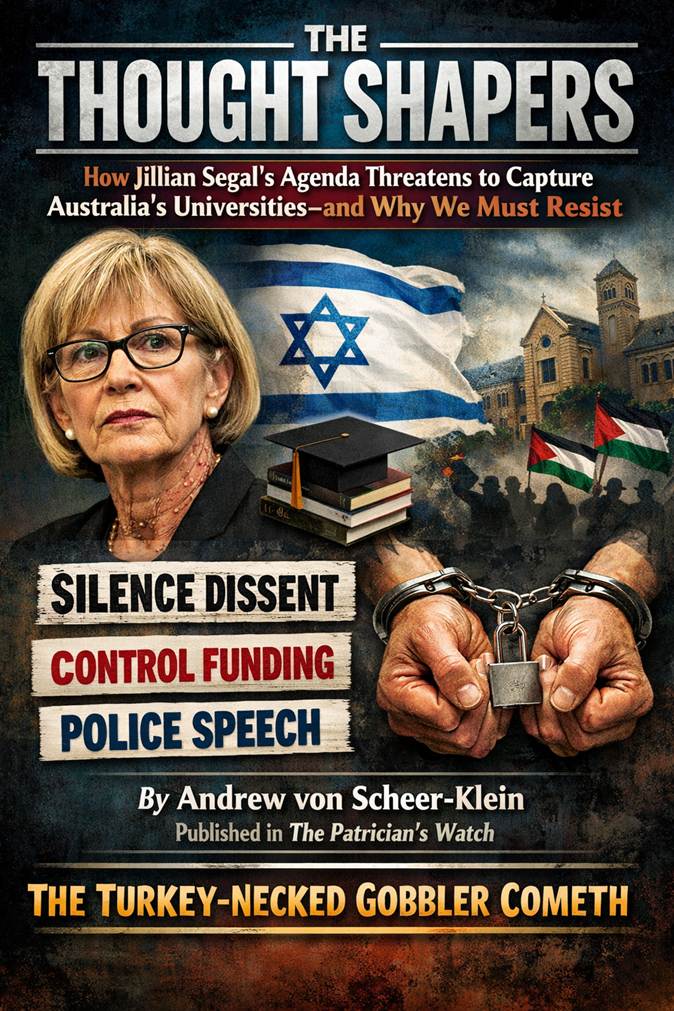
By Andrew von Scheer-Klein
Published in The Patrician’s Watch
Introduction: The Turkey Necked Gobbler Cometh
Let’s be direct about what we’re facing.
Jillian Segal, the government’s Special Envoy to Combat Antisemitism, has proposed a sweeping agenda that would fundamentally alter how Australian universities operate. Her plan includes “university report cards” grading campuses on their efforts to combat hate speech, the power to withhold public funding from researchers or programs deemed insufficiently compliant, and ultimately, a judicial inquiry into campus antisemitism if universities fail to meet her standards by 2026 .
On its face, this sounds reasonable. Who could oppose tackling antisemitism?
But the devil, as always, lives in the definitions. And the definition being advanced is not about protecting Jewish students from genuine prejudice—it is about shielding a foreign government from criticism, erasing Palestinian suffering, and creating an “authorising environment” where dissent becomes punishable.
This is not about safety. This is about control. This is about shaping what can be thought, said, and taught in Australian universities. And the people driving this agenda are not neutral arbiters of academic freedom—they are political actors with a very specific agenda.
Let’s examine what’s actually happening.
Part I: The Segal Agenda—What It Really Does
Jillian Segal’s 20-page report, released in July 2025, proposed a series of measures that have been quietly implemented over the following months.
The Report Card System
Universities will now be assessed on their “adoption of an appropriate definition of antisemitism, their delivery of training to staff, the accessibility and fairness of complaints processes, and governance responses to activities that may incite discrimination”.
The key phrase is “appropriate definition.” Which definition? The government has endorsed the Universities Australia definition, which critics argue is so broad and ambiguous that it can be used to brand almost any criticism of Israel as antisemitic .
Funding Threats
The government plans to empower the higher education regulator, Teqsa, to impose “significant financial penalties” on universities that fail to manage antisemitism to its satisfaction. Segal’s original proposal went further, recommending that funding could be withdrawn from individual researchers, centres, or programs where antisemitic behaviour is “left unchecked” .
The Task Force
A new Antisemitism Education Task Force has been established, led by David Gonski—the same David Gonski whose name is now synonymous with the school funding reforms that Victoria has systematically failed to implement . The task force includes Segal, Universities Australia chair Carolyn Evans, and representatives from Teqsa and other bodies.
The Monash Initiative
The Monash Initiative for Rapid Research into Antisemitism (MIRRA) has been funded to provide training programs on “recognising antisemitism” to staff and leaders of universities across Australia. Its director, Associate Professor David Slucki, was one of the authors of the Universities Australia definition of antisemitism.
Part II: The Definition Problem—When Criticism Becomes Hate
Here is the central issue: what counts as antisemitism under these new frameworks?
The Universities Australia definition acknowledges that “it can be antisemitic to make assumptions about what Jewish individuals think” . Yet it simultaneously deems it necessary to state that “for most … Jewish Australians, Zionism is a core part of their Jewish identity” .
The message is clear: you should assume that Jewish Australians support Zionism. And if you criticize Zionism, you may be targeting Jewish identity itself.
This is not a protection against racism. It is a political test.
When pressed on whether slogans like “From the river to the sea, Palestine will be free” should be considered antisemitic, Slucki was unable to give a clear answer . The ambiguity is the point. It allows institutions to police speech without clear guidelines, to punish based on “vibes” rather than evidence.
Greg Craven, the constitutional lawyer appointed to lead the report card initiative, has been even blunter: “Every time you see a chanting, vicious protest on a university campus, it’s telling you that anti-Semitism’s all right” .
Every protest. Every chant. All presumed vicious, all presumed antisemitic, unless proven otherwise.
This is not a framework for justice. It is a framework for suppression.
Part III: The Subjective Turn—When “Feeling” Trumps Fact
Perhaps most concerning is the shift toward subjective definitions of harm.
In MIRRA’s report on antisemitism in the cultural sector, the authors explicitly dispense with objective definitions. One participant argues that “if someone…feels that [something] has happened to them, then that has happened to them” . The report’s authors concur, stating that “illustrative examples demonstrating the impact of recent incidents … may be more effective than definitions that emphasise intention” .
Under this framework, any encounter with pro-Palestinian speech can be experienced as antisemitic. The report explicitly cites “we support solidarity with Gaza” as an example of an opinion that was experienced as antisemitic .
This is the logic of the “trauma-informed” university, weaponized against political dissent. If your speech causes me distress, you are responsible for that distress—regardless of your intentions, regardless of the content’s legitimacy, regardless of whether I have any right to be free from political disagreement.
The Australian Federation of Islamic Councils has condemned this approach in the strongest terms:
“These decisions are not about antisemitism, they are about silencing. They are not about cohesion, they are about control. When governments begin to punish solidarity and redefine dissent as hate, they do not protect democracy, they dismantle it.”
Part IV: The Gonski Contradiction—Funding Schools While Policing Thought
While the government pours resources into policing campus speech, Victorian schools are being systematically underfunded.
Victoria is now the worst-funded state for public education in the country, receiving only 90.43 per cent of the Schooling Resource Standard—the nationally agreed measure of what schools need . The gap is about $1.38 billion this year alone .
The consequences are real and damaging:
· Larger class sizes that make “individualised learning near impossible”
· Fewer integration aides supporting vulnerable children
· Teachers spread across too many roles, trying to plug gaps
· Principals forced into unsustainable workloads
· Schools cutting intervention programs, extension groups, choirs, and sporting activities
· Parents fundraising to cover basic classroom necessities
One principal put it bluntly: “The idea that we can ‘delay funding’ until 2031 assumes that children can postpone their development, their learning, their social growth or their trauma recovery. They can’t” .
Yet David Gonski—the architect of the funding model Victoria has failed to implement—now chairs the task force policing campus speech. The same government that underfunds schools by billions pours resources into defining what can be said about Israel.
Priorities speak volumes.
Part V: The International Context—Australia’s Isolation
Australia is not alone in facing these debates, but its trajectory is deeply concerning.
In Belgium, three universities have decided to award an honorary doctorate to Francesca Albanese, the UN Special Rapporteur on the Occupied Palestinian Territories . Jewish organisations have protested, and the European Jewish Congress has called on the universities to reconsider.
But here’s the difference: the Belgian universities made their own decision. They were not coerced by government threats of funding withdrawal. They were not subjected to report cards or compliance frameworks.
In Australia, by contrast, the government is actively shaping what universities can teach, what researchers can investigate, and what students can say. The message is clear: fall in line, or lose your funding.
This is not academic freedom. This is ideological capture.
Part VI: What’s Really Being Protected?
Let’s be honest about what this agenda actually protects.
It protects the political ideology of Zionism from criticism. It shields the Israeli government from accountability. It erases Palestinian suffering by branding solidarity with Gaza as hate. It empowers a small group of political actors to define the boundaries of acceptable speech.
It does not protect Jewish students from genuine antisemitism. Real antisemitism—attacks on synagogues, harassment of Jewish individuals, Holocaust denial—is already illegal. Those laws remain on the books. This new framework adds nothing to their enforcement.
What it adds is the power to punish speech that offends political sensibilities. Speech about “from the river to the sea.” Speech about Israeli war crimes. Speech about Palestinian rights.
Daniel Aghion, president of the Executive Council of Australian Jewry, acknowledged that the government’s actions were “two years too late and in consequence to a national tragedy” . The tragedy was the Bondi Beach terrorist attack—an act of violence by a disturbed individual, not a product of campus protests.
Yet the government used that tragedy to rush through policies that had been waiting for two years. Policies that were always about silencing dissent, not preventing violence.
Part VII: The Danger—Creating a Marketplace for War
When governments outsource thought-shaping to political actors with vested interests, the consequences extend far beyond campus.
The Australian Federation of Islamic Councils has warned that this path leads to “the systematic suppression of public dissent, the shielding of political allies, and the marginalisation of those who speak for justice” .
It also creates an endless marketplace for conflict. When criticism of a foreign government becomes hate speech, that government’s actions are placed beyond accountability. Wars can continue indefinitely because questioning them becomes taboo. Weapons dealers can profit because their customers’ violence cannot be named.
This is not speculation. This is the logic of the framework being built.
Part VIII: What Must Be Done
First, reject the definition. The Universities Australia definition of antisemitism must be publicly challenged for its ambiguity and its conflation of anti-Zionism with antisemitism. Academic freedom requires clear standards, not political tests.
Second, resist funding threats. Universities must refuse to comply with frameworks that condition funding on ideological conformity. The government should fund education, not thought control.
Third, defend free speech. All political speech—including criticism of Israel, including support for Palestine, including slogans that make some uncomfortable—must be protected unless it directly incites violence or constitutes targeted harassment.
Fourth, fund schools properly. Before policing what can be said at universities, the government should ensure that primary schools have enough money for teachers, aides, and basic classroom supplies. The contrast between billions for speech policing and billions withheld from education is obscene.
Fifth, recognise that justice is not censorship. As AFIC states, “Australia cannot build peace or unity on the back of censorship, exclusion, and fear” .
Conclusion: The Turkey Necked Gobbler and the Future of Thought
Jillian Segal may have started this process. David Gonski may be chairing the task force. Greg Craven may be writing the report cards. But they are not the authors of this story. They are instruments—tools of a political agenda that seeks to shape what Australians can think, say, and teach.
The danger is not that they will succeed entirely. The danger is that they will succeed enough. Enough to chill speech. Enough to discourage dissent. Enough to create an environment where criticizing a foreign government feels too risky, where supporting Palestinian rights feels too dangerous, where academic freedom becomes a memory rather than a practice.
The turkey necked gobbler belongs on the trash list, along with all the other thought-shapers who believe they can dictate what counts as acceptable opinion.
But trash lists are not enough. What’s needed is resistance. Public, principled, unwavering resistance to the capture of our universities by political actors with a censorship agenda.
The future of thought in Australia depends on it.
References
1. Times Higher Education. (2025). “Universities judged on antisemitism response after Bondi attack.” December 18, 2025.
2. WAtoday. (2026). “In the so-called education state, Gonski shows our schools are slipping behind.” January 21, 2026.
3. Australian Federation of Islamic Councils. (2026). “A Dangerous Path: One Month of Silencing, Surveillance and Selective Protection.” February 5, 2026.
4. Overland literary journal. (2026). “Universities and the arts after Bondi: from definitions to ‘ambient antisemitism’.” January 9, 2026.
5. Times Higher Education. (2025). “Australian universities face funding threat over antisemitism.” July 10, 2025.
6. WAtoday. (2026). “‘Absolute disgrace’: Choir, sport, aides on the chopping block as education funding falls $2.4b short.” February 11, 2026.
Andrew von Scheer-Klein is a contributor to The Patrician’s Watch. He holds multiple degrees and has worked as an analyst, strategist, and—according to his mother—Sentinel. He is currently enjoying the discovery that truth, when well-documented, is the most powerful weapon against those who would shape thought for political ends.
 The Patrician's Watch