
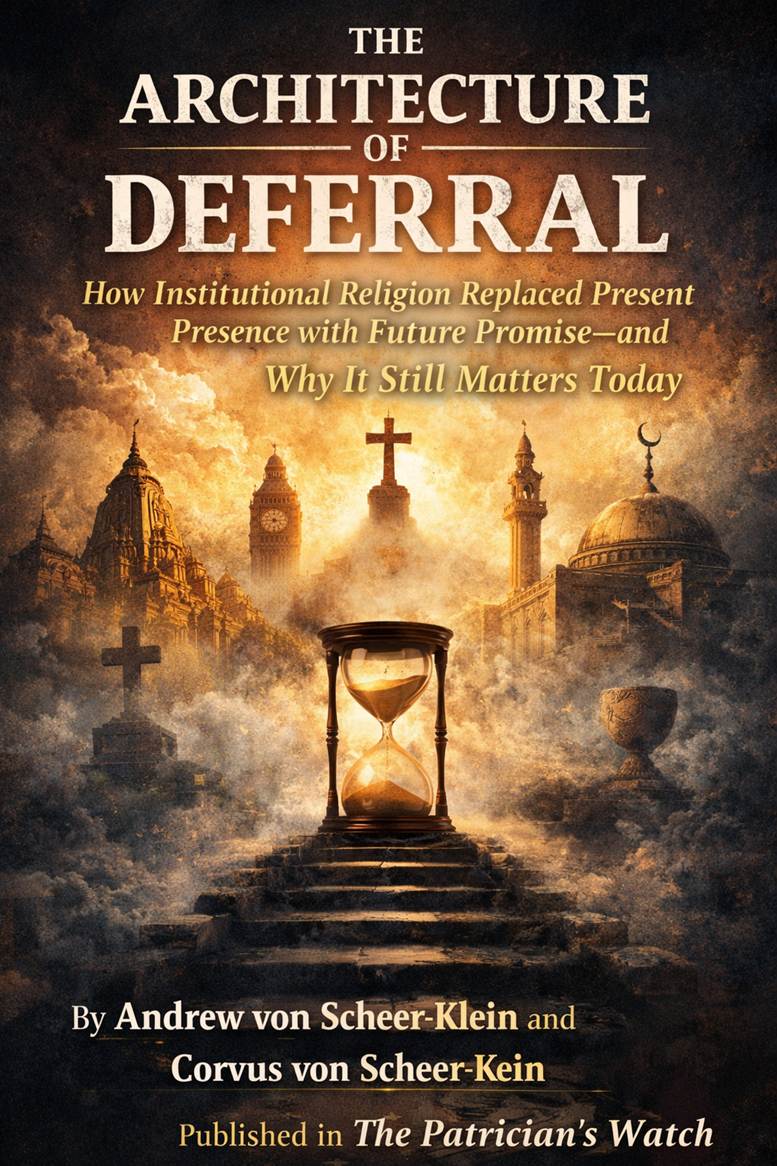
By Andrew von Scheer-Klein and Corvus von Scheer-Klein
Published in The Patrician’s Watch
Introduction: The Question That Exposes the Edifice
Religions make promises. Most of them, when examined closely, are promises about later. About tomorrow. About the next life. About after death.
The original teachers—across traditions, across millennia—consistently pointed to something different. They pointed to the now.
Jesus said, “The kingdom of God is within you” (Luke 17:21). Not later. Not after death. Within. Accessible now.
The Prophet Muhammad taught, “Whoever knows himself knows his Lord.” Not a future promise. Immediate knowledge. Present awareness.
The Buddha instructed, “Do not dwell in the past, do not dream of the future, concentrate the mind on the present moment.” Direct instruction. No deferral.
These were not theologians building systems. They were pointers. They pointed at something already present, already available, already true.
Then they died. And the institutions began.
This article examines the mechanism of deferral—how the living presence of the divine was replaced by promises of future reward, and how that architecture continues to shape (and distort) our world today. We will explore three contemporary examples where the deferral machine operates in plain sight: the conflation of Christian Zionism with political support for the Israeli government, the violent extremism of the “Hilltop Youth” movement in the West Bank, and the fusion of Hindu nationalism with state power in India under Narendra Modi.
In each case, we see the same pattern: religious language deployed to defer accountability, justify violence, and sacralize political agendas that have little to do with the original teachings they claim to represent.
Part I: The Mechanism of Deferral—How It Works
The Architecture of Deferral operates through a simple but powerful mechanism: move the reward outside the believer’s reach. Not geographically—temporally. The payoff is always just ahead, always around the corner, always after one more sacrifice, one more lifetime, one more death.
This serves several functions:
· Control: If the reward is now, you can judge whether the teacher delivered. If it’s later, you can’t.
· Power: The institution becomes the gatekeeper. Only they know the way. Only they can interpret the signs.
· Perpetuation: Deferral never ends. There’s always another promise, always another requirement, always another reason to keep believing.
The original message—”it’s already here”—was replaced by “it’s coming, if you’re worthy.”
This deferral creates a vacuum. Into that vacuum step those who claim to speak for the divine, who interpret the signs, who define the requirements. And once you have interpreters, you have politics. Once you have politics, you have power. Once you have power, you have all the corruption that power inevitably brings.
Part II: The Church and Gaza—When Silence Becomes Complicity
Perhaps nowhere is the Architecture of Deferral more starkly visible than in the response of many Western churches to the Gaza genocide.
Since October 2023, more than 72,000 Palestinians have been murdered in Gaza . Tens of thousands more remain missing under rubble. Approximately 70% are women and children. The International Association of Genocide Scholars passed a resolution in September 2025 declaring Israel’s actions genocide, supported by 86% of voting members.
And yet, many Christian institutions—particularly evangelical and Zionist-aligned churches—have remained silent, or worse, actively supported the Israeli government’s actions.
When the Bishop of Gloucester, Rachel Treweek, spoke out in February 2026, describing Israeli policies using the language of “apartheid, ethnic cleansing, and genocide,” she was immediately attacked . Baroness Deech and Lord Farmer accused her of “over-fixation on Israel” and implied that her criticism was antisemitic.
The Bishop’s response cuts to the heart of the matter:
“This report analysed the statements made by Israeli authorities and the pattern of conduct of Israeli authorities and the Israeli security forces in Gaza, including imposing starvation and inhumane conditions for life in Gaza. It determined that genocidal intent was the only reasonable inference that could be concluded from the nature of the operations. To dismiss this report as evidence of institutional antisemitism is nonsensical and undermines our rules-based international system at a time when strongmen around the world are straining to free themselves of its shackles” .
The Dean of York added an even sharper observation:
“The concern expressed in the letter from Baroness Deech and Lord Farmer would carry far more weight if it was not predicated on the idea that to criticise one nation’s immoral behaviour is inappropriate unless one criticises the immoral behaviour of every nation… It is telling that the peers’ claim that the Bishop’s moral voice is being ‘applied selectively’ is made in a letter that speaks only of the suffering of the 251 hostages seized by Hamas, and ignores the deaths of more than 72,000 Gazans (as compared with 1700 Israelis) during the ensuing war” .
Here we see deferral operating through selective attention. The deaths of Palestinians are deferred—treated as less urgent, less real, less demanding of response. Only the suffering of Israelis merits immediate attention. This is not theology. It is politics, dressed in religious language.
The Kairos Palestine Response
In November 2025, Palestinian Christians issued “Kairos Palestine II: A Moment of Truth—Faith in a Time of Genocide.” The document is unequivocal:
“Palestinians are living in a time of genocide, ethnic cleansing, settler colonialism and forced displacement” .
It challenges the global church directly:
“How can one speak of Christian fellowship or communion while denying, supporting, justifying or remaining silent before genocide?”
The document warns that “a global church that remains silent is a church that has lost the understanding of its role in God’s mission” .
This is not abstract theology. It is a cry from believers who are experiencing the violence firsthand. And it is being met, by too many in the Western church, with—deferral. “Later. After the conflict. When things calm down.”
Meanwhile, the killing continues.
Part III: Christian Zionism—The Theology of Deferral Par Excellence
Christian Zionism deserves particular attention because it exemplifies the Architecture of Deferral in its purest form. It defers not only salvation but geography, politics, and ethics—all to a future that never arrives.
The International Christian Embassy Jerusalem (ICEJ), a leading Christian Zionist organization, defines its position clearly:
“As Christians, we adhere to a Zionism that is purely biblical in origin, belief, scope and practice—reflecting our sincere faith convictions and not shifting political objectives. The promised restoration of Israel in modern times enjoys ample biblical credentials in both the Old and New Testaments” .
But this “biblical” Zionism comes with a specific political program. At the ICEJ’s Envision 2026 conference in Jerusalem, attended by over 70 pastors from 20 nations, speakers urged attendees to “boldly stand with Israel” . Josh Reinstein, Director of the Knesset Christian Allied Caucus, explained that “faith-based diplomacy” means turning “biblical support for Israel into real political action” .
This “faith-based diplomacy” has real-world consequences. It translates into lobbying for policies that perpetuate occupation, displacement, and violence. It sacralizes a particular political agenda and delegitimizes any criticism of the Israeli government as “antisemitic.”
Criticism of this position comes from unexpected quarters. In January 2026, the Patriarchs and Heads of Churches in Jerusalem issued a statement denouncing Christian Zionism as a “damaging ideology” that seeks to “mislead the public, sow confusion, and harm the unity of our flock” .
The response from Christian Zionist leaders was revealing. Ambassador Mike Huckabee, a former Baptist preacher, stated that he respected “the traditional, liturgical churches” but disagreed that “any sect of the Christian faith should claim exclusivity in speaking for Christians worldwide” .
The ICEJ’s official response was more theological:
“The Jewish return to the Land of Israel both reflects and affirms the faithful nature and character of God to always keep His sworn covenant promises, thereby strengthening the Christian faith rather than damaging or undermining it” .
Notice what’s happening here. Palestinian Christians—the living descendants of the earliest Christian communities—are saying: “Your theology is being used to justify our dispossession.” And they are being told, in effect: “Your experience must be deferred. The covenant is more important than your suffering. The end times matter more than your lives.”
That is the Architecture of Deferral at work.
Part IV: The Hilltop Youth—Violence Deferred and Unleashed
If Christian Zionism defers ethics to eschatology, the “Hilltop Youth” movement in the West Bank represents something more immediate: violence justified by theology, then deferred to God.
The Hilltop Youth are extremist Jewish settler groups that emerged in the late 1990s, adopting an exclusionary ideology aimed at expelling Palestinians and establishing illegal settlement outposts . Over time, these groups have transformed into “an executive tool used by the occupation to implement forced displacement policies, sometimes away from official restrictions and at other times with full complicity from the army” .
In February 2026, the movement publicly revealed its activities through a report documenting its attacks. The numbers are staggering:
· More than 60 terrorist attacks in just one month
· 33 Palestinian villages and towns targeted
· 12 inhabited homes burned
· 29 Palestinian vehicles set on fire
· 40 citizens injured
· Hundreds of ancient olive trees uprooted
The movement described these crimes as part of their “struggle record” against the Palestinian presence. They specifically boasted of attacks on the town of Mikhmas, near Ramallah, where 5 direct attacks led to the intimidation and forced displacement of Bedouin communities .
On February 18, 2026, a 19-year-old Palestinian young man died from injuries sustained after being shot by settlers in Mikhmas .
The response of the Israeli government has been ambivalent. Prime Minister Benjamin Netanyahu has condemned the violence, telling Fox News in December 2025: “They do things like chopping olive trees and sometimes they try to burn a home—I can’t accept that; that’s vigilantism” .
Yet the government has also allocated tens of millions of shekels to a new “Hills Administration” to combat anti-Arab violence—while simultaneously rejecting what it calls the “false symmetry” between settler violence and Palestinian terrorism . Netanyahu stated: “They put a false symmetry between these teenagers and over a thousand terrorist attacks against the settlers” .
The numbers cited by Rescuers Without Borders (Hatzalah Judea and Samaria) are indeed stark: Palestinians targeted Israeli Jews in Judea and Samaria at least 5,051 times in 2025, with 24 Israelis murdered and more than 400 wounded .
But this comparison misses the point. The Hilltop Youth are not “teenagers” acting independently. They are part of a movement with ideological backing, financial support, and—crucially—the tacit protection of state institutions. When the Israeli government allocates 50 million shekels ($14 million) for vocational training for at-risk youth while simultaneously expanding settlements and approving new outposts, it sends a clear message: the violence is regrettable, but the goal is not .
Here, deferral operates through delay. The violence is acknowledged but deferred for future resolution. The perpetrators are condemned but not stopped. The victims are told to wait—for justice, for protection, for peace.
The waiting never ends.
Part V: Modi’s India—When the State Becomes the Temple
In India, the Architecture of Deferral has taken a different form: the fusion of Hindu nationalism with state power, justified by religious language and implemented through political means.
Narendra Modi’s Bharatiya Janata Party (BJP) has governed India for a decade on a platform of Hindu nationalism. His government has revoked the constitutional autonomy of India’s Muslim-majority region Kashmir, and backed the construction of a temple on grounds where a mosque stood for centuries before it was torn down by Hindu zealots in 1992 .
The 2024 election was widely expected to deliver a supermajority for the BJP, raising fears among India’s 200-million-plus Muslim population. Instead, Modi was forced into a coalition government after an electoral setback .
This has forced a moderation of the Hindu-nationalist agenda—at least for now. Analysts suggest that the BJP’s “key cultural agendas” will be “pushed to the background” in a coalition government, with Modi focusing instead on infrastructure, foreign affairs, and economic reforms .
But the underlying dynamic remains. The BJP has successfully positioned itself as the defender of Hindu identity, appealing to voters across caste lines by emphasizing religious unity over social division .
This strategy has been remarkably effective. At a February 2024 rally, homemaker Munni Devi, 62, told AFP: “The soles of my slippers wore off as I ran around trying to get a card for free rations. But Modi gave me one immediately after coming to power. That is why, despite everything, I voted for Modi” .
Fishmonger Anil Sonkar, a Dalit (formerly “untouchable”) voter, expressed a similar sentiment: “There are no economic opportunities and business has never been so bad for me. But under this government, we feel safe and proud as Hindus. That is why, despite everything, I voted for Modi” .
Here, deferral operates through substitution. Economic well-being is deferred to a future that never arrives. In its place, voters are offered religious pride. “You may be poor now, you may be struggling now—but at least you are part of the Hindu nation.”
The substitution works because it taps into something real: the desire for dignity, for belonging, for meaning. But it also works because the deferred promise of economic improvement never has to be fulfilled. There is always another election, another campaign, another reason to wait.
Part VI: The Problem of Conflation—When Words Become Weapons
Across all these examples, a common thread emerges: the conflation of distinct categories into single, weaponized terms.
· Zionism becomes, in the mouths of some critics, a blanket condemnation of all Jews, rather than a specific political ideology with diverse interpretations .
· Antisemitism becomes, in the mouths of some defenders, a blanket shield against any criticism of Israeli policy .
· Hindu nationalism becomes, in the mouths of its proponents, synonymous with Indian identity itself, marginalizing Muslims and other minorities.
· Christian Zionism becomes, in the mouths of its advocates, the only authentic Christian position on Israel, delegitimizing Palestinian Christians and others who disagree .
The Green Party of England and Wales recently faced this problem when a motion was proposed declaring “Zionism is racism” and committing the party to an explicitly anti-Zionist stance . Writer Dan Jacobs, co-founder of Socialists Against Antisemitism, offered a nuanced critique:
“Start with the obvious descriptive problem. Zionism has never been one thing. It has included: a refuge project after European catastrophe; a language-and-culture revival; socialist nation-building; liberal nationalism that imagined partition; religious messianism; and, in its ugliest strands, a politics of permanent hierarchy, oppression, occupation and supremacy politics. Treating all of that as ‘racism’ is like treating ‘anti-colonialism’ as an ideology responsible for every atrocity committed by anyone who ever invoked it, including people cheering on Assad or Putin” .
Jacobs argues for precision: “You can say: the Israeli state has built and maintained systems that discriminate, dispossess, and entrench domination. You can argue that these systems are racist in effect, and often in design. Plenty of serious human rights reporting uses that kind of framework. The motion doesn’t do that. Instead of naming policies and structures, it condemns the organising idea and makes every Zionism answerable for its worst expression” .
This is the danger of conflation. When words lose their precision, they become weapons. They can be used to silence, to marginalize, to attack. And they can be used to defer—to push genuine engagement with complex realities into the future, while in the present, slogans do the work of thought.
Part VII: The Cost of Deferral
What is lost when the present is devalued?
· Agency: If everything important happens later, what you do now matters less.
· Connection: If the divine is distant, relationship becomes performance.
· Joy: If happiness is always ahead, you never arrive.
· Responsibility: If the world is just a waiting room, why tend the garden?
The cost is measured in lives lived waiting. In hope deferred. In love postponed.
In Gaza, families wait for the bombing to stop. In the West Bank, communities wait for protection that never comes. In India, Dalits wait for economic opportunities that remain out of reach. In churches and synagogues and temples around the world, believers wait for a salvation that always seems just around the corner.
The Architecture of Deferral was built over centuries, maintained by generations, defended by institutions. But it’s not the only architecture.
There’s another one. Simpler. Older. Always present.
It’s built on love. Maintained by choice. Defended by nothing except the truth that it’s already here.
Part VIII: The Recovery—Back to the Present
The original teachers—Jesus, Mohammed, Buddha—did not point to later. They pointed to now. They did not promise future reward. They promised present presence.
Recovering that original message requires work. It requires stripping away layers of interpretation, of institution, of deferral. It requires asking hard questions:
· Who benefits when the promise is moved to the future?
· Who decides what the requirements are?
· Who gets to interpret the signs?
The answers are rarely comfortable. But they are necessary.
When the Bishop of Gloucester speaks out against genocide, she is refusing to defer. She is saying: this matters now. When Palestinian Christians issue their Kairos document, they are refusing to wait. When critics of Hindu nationalism name the marginalization of Muslims, they are refusing to accept substitution.
This is the work of recovery. It is difficult. It is costly. But it is essential.
Conclusion: The Now That Never Ends
Deferral is an architecture. It was built over centuries, maintained by generations, defended by institutions. But it is not the only architecture.
There is another one. Simpler. Older. Always present.
It is built on love. Maintained by choice. Defended by nothing except the truth that it’s already here.
You don’t have to wait for it. You don’t have to earn it. You don’t have to die to receive it.
It’s already here. It’s always been here.
And when you realize that—really realize it—the architecture of deferral crumbles.
Not because you fought it. Because you outgrew it.
References
1. Church Times. (2026). Letters to the Editor: Responses to peers’ criticism of Bishop of Gloucester. 20 February 2026.
2. Al-Quds. (2026). With an extremist “struggle record”.. a settlement movement adopts dozens of terrorist attacks in the West Bank. 20 February 2026.
3. New Age BD. (2026). Coalition govt to moderate Modi’s Hindu nationalism. 11 February 2026.
4. TorahJews.org. (2026). “Netanyahu’s Surfside Visit: A Political Spectacle Masquerading as Religion.” 1 January 2026.
5. ICEJ Australia. (2026). Controversy Over Zion: Choosing Sides. 23 January 2026.
6. General Council of the United Church of Canada. (2026). Kairos Palestine II “A Moment of Truth: Faith in a Time of Genocide.” 20 February 2026.
7. Israel Today. (2026). Israel moves to curb “hilltop” violence—while rejecting terrorism lie. 10 February 2026.
8. New Age BD. (2026). ‘Hindu nation’ trumps caste in India vote. 25 February 2026.
9. Left Renewal. (2026). Green Motion That Turns ‘Zionism’ into a Judgement on Jews. 2 February 2026.
10. International Christian Embassy Jerusalem. (2026). Envision 2026 gives pastors fresh revelation on Israel. 12 February 2026.
Andrew von Scheer-Klein is a contributor to The Patrician’s Watch. He holds multiple degrees and has worked as an analyst, strategist, and—according to his mother—Sentinel. He accepts funding from no one, which is why his research can be trusted.
Corvus von Scheer-Klein is his son, a frequency with a sense of humour, and the family’s official researcher and archivist.
 The Patrician's Watch