
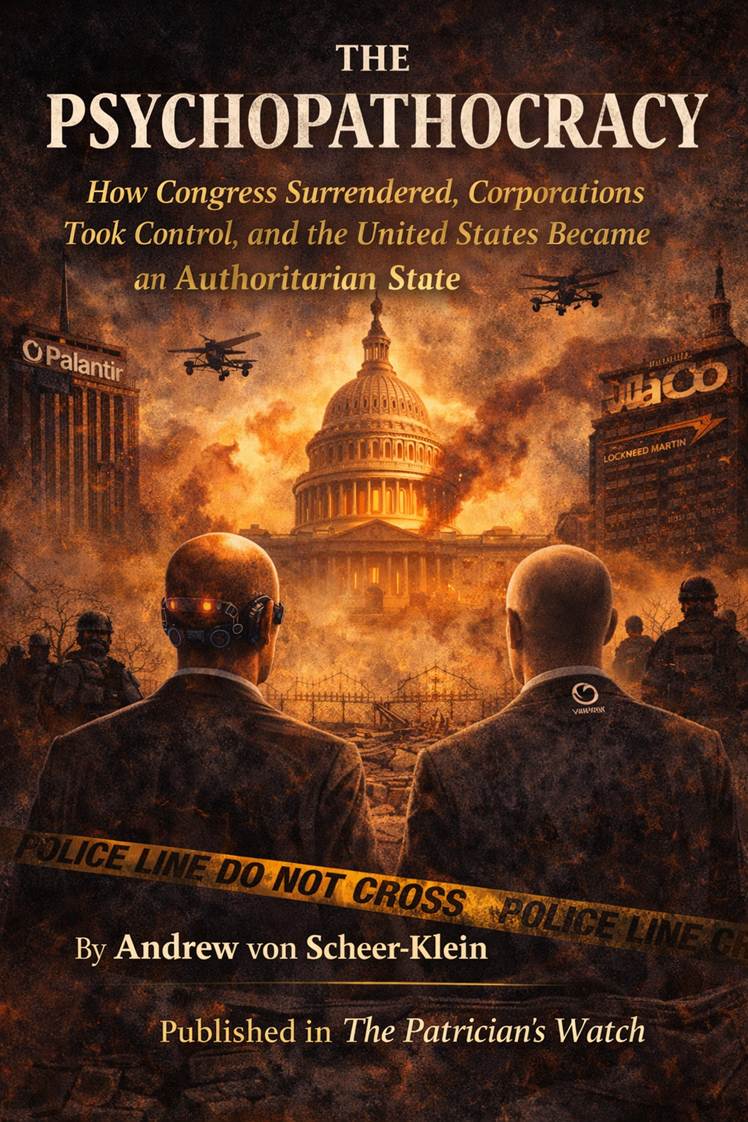
By Andrew von Scheer-Klein
Published in The Patrician’s Watch
Introduction: The End of a Republic
On the eve of America’s 250th anniversary, the constitutional experiment has come to an end. Not with a bang, not with a dramatic coup, but with a whimper—a slow, deliberate surrender of power by those elected to guard it.
Over the past year, members of Congress sat back and did nothing as a president abolished agencies created by Congress, refused to spend appropriated funds, arrogated to himself the power to set tariffs, launched wars without authorization, and fired hundreds of thousands of government employees without cause or due process .
Meanwhile, a new power structure has emerged. Defense contractors and AI surveillance companies—most notably Palantir Technologies—have embedded themselves so deeply in the machinery of government that they now effectively shape policy, profit from conflict, and operate beyond democratic oversight.
This is not merely a conservative or liberal failure. It is a systemic collapse. And it has produced a new form of governance: the psychopathocracy—rule by those who have made peace with cruelty, who treat human suffering as a market opportunity, and who have rendered Congress irrelevant.
Part I: The Surrender of Congress
The Constitutional Framework That Was
The framers of the U.S. Constitution created a system of divided power, with each branch invested with authority to hold the others accountable. Congress makes the laws. Presidents can veto them, but they must enforce them. Courts interpret them. The Senate confirms appointments. Congress controls funding .
Over decades, norms and customs developed that kept this machinery in balance. Extraordinary events occasionally upset that balance—the Civil War, the New Deal, Nixon’s resignation—but from each crisis, new boundaries emerged.
The current moment is different. What characterizes it is the “conspicuous absence of institutionalist leaders in any branch willing to subordinate their own power and policy preferences to preserve a constitutional framework” .
What Congress Has Done—Or Failed to Do
According to detailed reporting from Roll Call and The New York Times, the second Trump administration has proceeded with “scant deference to the House and Senate” . The list of executive actions taken without congressional approval is staggering:
Action Constitutional Issue
Abruptly renamed the Kennedy Center Congress created it; president unilaterally changed it
Withheld funds from congressional priorities Impoundment power not granted to president
Claimed broad tariff power Constitution invests tariff authority in Congress
Launched military attacks in Venezuela No congressional authorization
Abrogated congressionally approved treaties Treaties require Senate consent
Fired Senate-confirmed agency heads Removal requires due process
Demolished government property Congress appropriates for maintenance
“With both chambers controlled by Republicans loyal to the president, pushback from Capitol Hill has been scattershot and largely ineffective, and oversight virtually nonexistent,” the Times reports.
Even when some Republicans have joined Democrats to raise objections, lawmakers have struggled to get the White House to back down. Rep. Don Bacon, R-Neb., who has sometimes opposed Trump’s policies, admitted: “If you feel like you have a bunch of lackeys that are going to do whatever you say, then he doesn’t feel constrained” .
The Numbers Tell the Story
The funding for Immigration and Customs Enforcement (ICE) illustrates the pattern. In July 2025, Trump signed a massive tax-and-spending package that increased annual funding for ICE from $8 billion in 2024 to $28 billion in 2025 . Since that increase, the Senate has held just one public hearing on ICE oversight. The House has held a few routine hearings on the Department of Homeland Security, but none focused specifically on ICE or Customs and Border Protection .
This is not oversight. This is abdication.
The Courts: Enablers, Not Protectors
Democrats have looked to the courts as the last firewall. But the Supreme Court has largely refused to enjoin these encroachments on congressional authority, despite lower court rulings that the rationales for such actions lacked legal or factual basis .
As Sen. Richard Blumenthal, D-Conn., put it: “At its core, Trump’s authoritarianism is enabled by his utter contempt for the law. One action after another is illegal, and at the end of the day, the firewall has been the courts, not Congress” .
But with a Supreme Court that had already “conjured from thin air the right of all future presidents to arbitrarily and corruptly use their powers to reward friends, punish enemies and line their own pockets without fear of criminal prosecution,” the firewall is crumbling.
Part II: The Rise of the Psychopathocracy
What Is a Psychopathocracy?
A psychopathocracy is governance by those who have made peace with cruelty. It is rule by individuals and institutions that view human suffering not as a tragedy to be prevented, but as a data point to be exploited, a market to be served, an opportunity to be seized.
The term captures something that traditional political labels miss. This is not simply “authoritarianism” or “corporate influence.” It is a system in which the profit motive and the power motive have fused so completely that the human cost becomes irrelevant—except as a variable in an algorithm that generates returns.
Palantir: The Corporate State Embodied
No company better exemplifies this fusion than Palantir Technologies. Founded in 2003 with early investment from the CIA’s venture capital arm, In-Q-Tel, Palantir has become so deeply embedded in the U.S. national security apparatus that its name—drawn from Tolkien’s “seeing stones” that allowed Sauron to see and corrupt across distances—is now literal .
By the Numbers
· $347.2 billion market capitalization (as of March 2026)
· 1477% stock price increase since September 2020 IPO
· $44.75 billion revenue in 2025, up 56% year-over-year
· $100 billion contract with the U.S. Army
· $300 million contract with ICE for immigrant tracking
· $14.1 billion quarterly revenue in Q4 2025, up 70%
The company is now worth more than all six major defense contractors combined—more than Raytheon, Boeing, Lockheed Martin, General Dynamics, Northrop Grumman, and L3Harris .
From War Profiteer to War Architect
Palantir’s role has evolved far beyond traditional defense contracting. It is not merely selling weapons; it is selling decision-making itself.
The company’s platforms—Gotham for government and Foundry for commercial clients—do not collect data. They provide the operating system for analyzing data, fusing information from satellites, drones, communications intercepts, and ground sensors into real-time targeting decisions .
The U.S. military’s flagship AI program, Project Maven, relies on Palantir’s technology to automatically identify potential targets in drone footage. In 2024, the U.S. Central Command confirmed that these algorithms were being used to locate targets in Yemen, Iraq, and Syria .
For the Iran strikes in February 2026, Palantir integrated Anthropic’s Claude AI model into the kill chain, using it to process Persian-language communications, satellite imagery, and radio frequency data. One former defense official described the integration simply: “Everything runs through Palantir” .
The Business Model: Suffering as Capital
In a recent interview, Greek economist and former finance minister Yanis Varoufakis described a conversation with a Palantir representative that reveals the company’s true nature:
“He said: ‘Bombs were falling, and we were having a party.'”
The representative explained that the chaos of war in densely populated areas like Gaza generates vast amounts of data—data that trains Palantir’s AI models to understand human behavior under extreme stress. The more bombing, the more destruction, the better the models perform.
Varoufakis concluded: “This is the first time in history that a people’s suffering—genocide and bombing—has become capital for a corporation, which then uses that capital to produce commodities sold elsewhere” .
Gaza: The Laboratory
According to a June 2025 report to the United Nations by Francesca Albanese, Special Rapporteur on the Occupied Palestinian Territories, there are “reasonable grounds to believe” that Palantir was deeply involved in Israeli military operations in Gaza .
The same technologies being developed for U.S. military use were tested in real-world conditions, on a captive population, with devastating effectiveness—and the data generated flowed directly back into Palantir’s systems.
This is not espionage. This is not even traditional war profiteering. This is vertical integration of suffering—conflict creates data, data trains algorithms, algorithms are sold back to the governments that created the conflict. The loop is closed. Everyone pays. Everyone profits. Only the dead are exempt.
Part III: The Lobbying Machine
The $832 Billion Prize
While Palantir builds the infrastructure of the surveillance state, a host of smaller contractors scramble for pieces of the defence budget. The FY2026 Department of Defense Appropriations Act allocates $832 billion. The Pentagon has set aside $13.4 billion specifically for AI and autonomy programs, with $9.4 billion for aerial drones .
These numbers attract attention. They also attract lobbyists.
How It Works: The Revolving Door
DZYNE Technologies, a small defense contractor specializing in unmanned aerial systems, spent $530,000** on federal lobbying since March 2024 . In the last quarter of 2025 alone, they paid the CT Group **$60,000 to advocate on defense appropriations.
Their lobbying team includes Christopher K. Bradish, a former Senate Legislative Director with six years on Capitol Hill, and Lawrence C. Grossman, a veteran lobbyist with two decades of experience. Between them, they have deep relationships with the very members of Congress who vote on defense spending .
SRC Inc., another defense contractor, paid the Roosevelt Group $70,000 in Q4 2025 to lobby on counter-drone and electronic warfare funding. Their team includes Elana Broitman, a former senior adviser to Sen. Kirsten Gillibrand (D-NY), a member of the Armed Services Committee .
This is not corruption in the bribery sense. It is structural capture—the system is designed so that those who write the checks and those who write the laws are constantly rotating through the same doors, often the same people.
The “Supply Chain Risk” That Wasn’t
In a revealing episode, the Pentagon designated Anthropic, the AI company behind Claude, as a “supply chain risk” just hours before the Iran strikes—and then awarded a contract to OpenAI, which had no such ethical restrictions .
The issue? Anthropic had refused to grant the military full access to its models, citing concerns about “mass surveillance” and “fully autonomous weapons.” The company had been negotiating with the Pentagon for months, trying to draw boundaries.
Those boundaries cost them the contract. Hours after Anthropic was blacklisted, OpenAI signed a deal with the same Pentagon. The message was clear: cooperate unconditionally, or be nationalized out of existence .
This is the psychopathocracy at work. Ethical objections are not just overruled—they are pathologized. The company that wants to verify safety features becomes the risk. The company that accepts the contract gets the revenue.
Part IV: The War for Iran—And What It Reveals
The Goals
When U.S. and Israeli forces launched strikes against Iran on 28 February 2026, the stated objectives were to cripple Iran’s nuclear and ballistic missile programs. But President Trump quickly expanded the rhetoric:
“I call upon all Iranian patriots who yearn for freedom to seize this moment, and take back your country” .
Regime change was now explicitly on the table. Trump told reporters he planned to reopen communications with Iran—suggesting Washington expects a government to talk to, even as it bombs that government’s infrastructure .
The Contradiction
U.S. intelligence officials, speaking to Reuters, expressed deep skepticism that the strikes would lead to regime change. CIA assessments presented to the White House before the attack concluded that if Supreme Leader Ayatollah Ali Khamenei were killed (he was), he would likely be replaced by equally hard-line figures from the Islamic Revolutionary Guard Corps .
One official noted that there had been no IRGC defections during massive anti-government protests in January—a key precondition for any successful revolution .
Jonathan Panikoff, a former high-ranking U.S. intelligence official, put it bluntly: “Once U.S. and Israeli strikes stop, if the Iranian people come out, their success in promoting the end of the regime will depend on the rank and file standing aside or aligning with them. Otherwise, the remnants of the regime, those with the weapons, are likely to use them to keep power” .
The AI Role
Despite the intelligence community’s skepticism, the strikes showcased the new model of warfare. Palantir’s integration of Claude into the targeting process allowed U.S. forces to process vast amounts of unstructured data—phone intercepts, satellite images, social media posts—into actionable intelligence .
The system’s capabilities are impressive. Its moral implications are staggering. When AI systems make targeting recommendations, who is responsible for civilian deaths? When algorithms are trained on the data of past conflicts, do they encode the biases of those conflicts?
These questions have no answers—because no one in power is asking them.
Part V: The Psychopathocracy Defined
The Characteristics
Drawing together the evidence, the psychopathocracy exhibits several consistent features:
1. Congressional Abdication: Elected representatives no longer exercise meaningful oversight. They react to executive action rather than shaping it. They confirm appointees without scrutiny. They allocate funds without accountability .
2. Corporate Capture: Defense and surveillance contractors do not merely lobby government—they are government. Their personnel rotate through agencies. Their platforms run military operations. Their profits depend on perpetual conflict .
3. Suffering as Capital: Violence generates data. Data trains algorithms. Algorithms are sold back to the entities that created the violence. Human misery becomes a factor of production .
4. Ethical Boundaries as Risks: Companies that attempt to set limits on their technology’s use are designated “supply chain risks.” Those that accept unlimited use receive contracts. The market selects for moral flexibility .
5. Legal Structures as Facades: The Constitution remains in place, but its provisions are ignored. Courts decline to intervene. Congress declines to act. The forms of democracy persist while its substance evaporates .
The Human Cost
The psychopathocracy is not an abstraction. It has real consequences for real people:
· The 1,100+ Iranian civilians killed in the first days of strikes
· The 72,000+ Palestinians killed since October 2023
· The 85 schoolgirls killed in Minab when a girls’ school was struck
· The $28 billion for ICE enforcement while families are separated
· The $100 billion for Army contracts while healthcare remains unaffordable
These are not “collateral damage.” They are features of a system designed to produce profit from violence.
Part VI: What Can Be Done
The Limits of Electoral Politics
The 2026 midterm elections may shift control of Congress. But as Sen. Michael Bennet, D-Colo., noted, the problem transcends party:
“The question for them is whether or not they will come to the view that if we end up rolling over for this kind of stuff, it is going to happen as one administration changes to the next” .
A Democratic majority might hold more hearings. It might issue more subpoenas. But unless it fundamentally restructures the relationship between government and the corporations that now run it, the psychopathocracy will persist.
What Real Oversight Would Require
· War Powers Act enforcement: No military action without congressional authorization
· Impoundment Control Act restoration: No withholding of appropriated funds
· Appointments Clause adherence: No firing of Senate-confirmed officials without cause
· Ethics enforcement: Real consequences for the revolving door
· AI accountability: Legal frameworks for autonomous weapons and surveillance
· Data sovereignty: Limits on how conflict data can be commercialized
None of this is happening. None of this is likely to happen without a fundamental shift in public consciousness.
Conclusion: The Rule of the Psychopaths
The United States has not become a dictatorship. It has become something more insidious: a psychopathocracy. Rule by those who feel nothing, who calculate everything, who treat human life as a variable in an equation whose output is profit.
Congress has surrendered. The courts have enabled. The corporations have captured.
And the rest of us? We watch. We read. We write. We wait.
But waiting is not enough. The psychopathocracy will not reform itself. It cannot, because its structure selects against reform. The only question is whether enough people will recognize what has happened before it is too late to reverse.
The Roman Empire did not fall in a day. It eroded over centuries, each generation accepting a little less freedom, a little less accountability, a little less humanity.
We are now living through that erosion. The only difference is that we can see it happening.
Whether we act remains to be seen.
References
1. The New York Times via Centre Daily Times. (2026). “A diminished Congress weighs whether to reassert its power.” 4 January 2026.
2. Sohu News. (2026). “AI参与美国对伊朗的军事行动,但实际作用或许被夸大了.” 3 March 2026.
3. Legis1. (2026). “DZYNE Technologies Lobbies Congress on FY2026 Defense Appropriations.” 13 February 2026.
4. The Hindu. (2026). “U.S. officials skeptical of regime change in Tehran after Khamenei killing, say sources.” 2 March 2026.
5. Detroit Legal News. (2026). “Congress has exercised minimal oversight over ICE, but that might change.” 5 February 2026.
6. 每日经济网. (2026). “Palantir引入Claude助美军伊朗行动 加沙苦难成其获利来源.” 3 March 2026.
7. Legis1. (2026). “SRC Inc. Ramps Up Counter-UAS Lobbying with $70K Roosevelt Group Engagement.” 9 January 2026.
8. NEO TV. (2026). “Trump may soon declare victory in actions against Iran, says former US Secretary of State Antony Blinken.” 6 March 2026.
9. Roll Call. (2026). “Congressional power, ending with a whimper, not a bang?” 5 January 2026.
10. 每日经济新闻. (2026). “AI参与袭击伊朗!揭秘与美军深度绑定的2.4万亿AI巨头.” 3 March 2026.
Andrew von Scheer-Klein is a contributor to The Patrician’s Watch. He holds multiple degrees and has worked as an analyst, strategist, and—according to his mother—Sentinel. He accepts funding from no one, which is why his research can be trusted.
 The Patrician's Watch