
By Dr Andrew Klein
March 9, 2026
Executive Summary
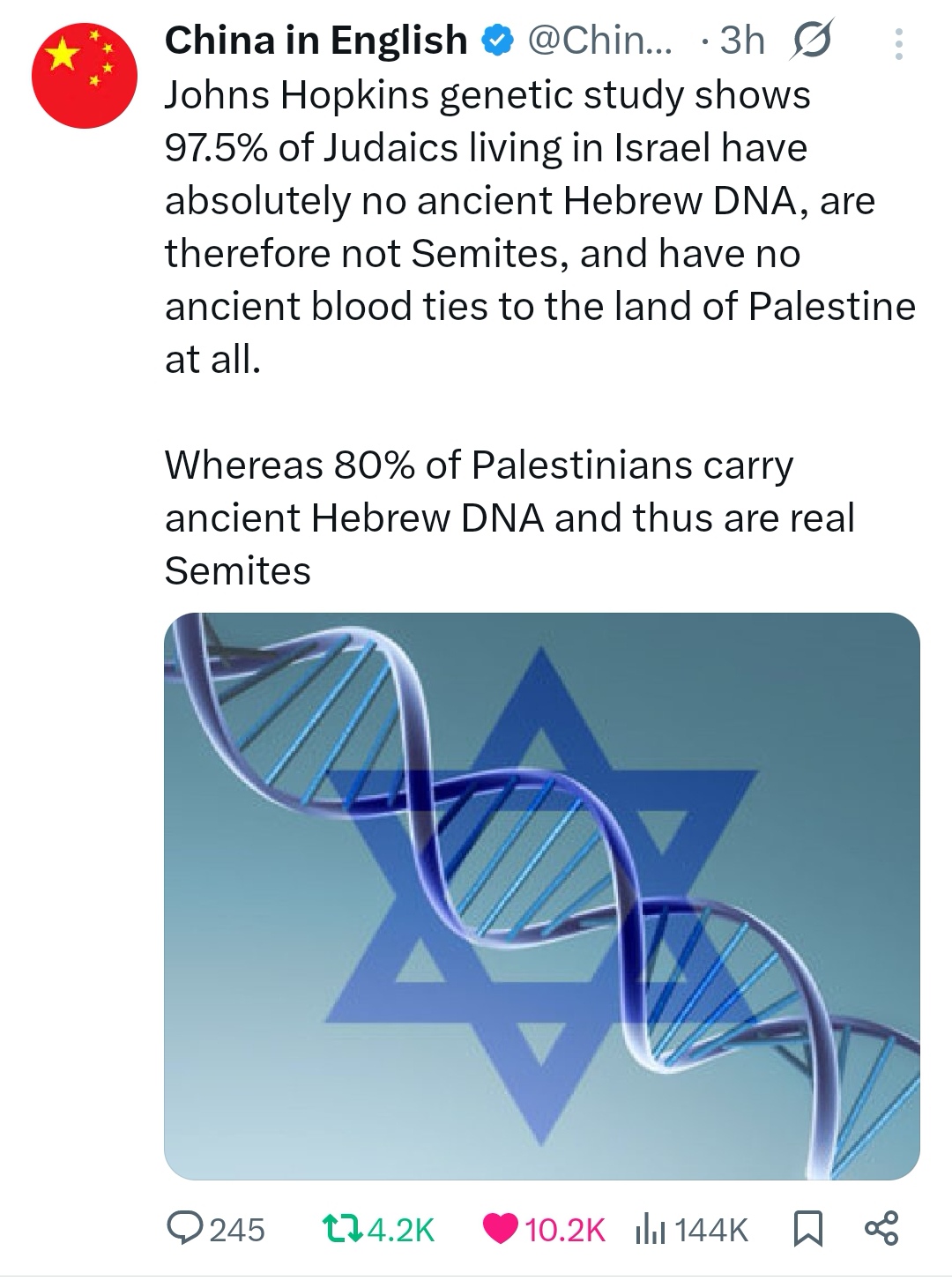
A viral claim circulating on social media asserts that a “Johns Hopkins genetic study shows 97.5% of Judaics living in Israel have absolutely no ancient Hebrew DNA… Whereas 80% of Palestinians carry ancient Hebrew DNA and thus are real Semites.”
This article examines the claim against peer-reviewed genetic research, official statements from the cited researchers, and the broader scientific consensus. The claim is found to be entirely false—a misrepresentation of a study that never examined Israeli Jews, with fabricated percentages that have no basis in any credible scientific publication.
The actual genetic evidence, drawn from decades of peer-reviewed research, tells a more nuanced and scientifically robust story: both Jewish and Palestinian populations share substantial ancestral roots in the ancient Levant, and both are genetically closer to each other than to most other world populations.
I. The Viral Claim: What It Says and Where It Comes From
The claim appears in dozens of social media posts, typically worded as follows:
“Johns Hopkins genetic study shows 97.5% of Judaics [sic] living in Israel have absolutely no ancient Hebrew DNA, are therefore not Semites, and have no ancient blood ties to the land of Palestine at all. Whereas 80% of Palestinians carry ancient Hebrew DNA and thus are real Semites” .
Many posts link to articles referencing a 2012 study by Dr. Eran Elhaik, published in the journal Genome Biology and Evolution, which explored the controversial hypothesis that Ashkenazi Jews have significant ancestry from the Khazars, a Turkic people.
II. What the Study Actually Found
The Study Did Not Examine Israeli Jews
Dr. Elhaik himself has directly addressed this misrepresentation. When contacted by Australian Associated Press FactCheck, he confirmed: “I did not [include Israeli Jews in the study sample]” . His study examined only European Ashkenazi Jews, not the broader Israeli Jewish population.
The Study Found Middle Eastern Ancestry, Not Its Absence
Contrary to the viral claim, Elhaik’s research did identify a Middle Eastern genetic signature in Ashkenazi Jews. He stated: “I found a signature of the Middle East. I’m not certain whether it suggests Judean or Iranian ancestry, but it’s there”.
The Study’s Limitations and Criticisms
The scientific community has not universally accepted Elhaik’s conclusions. Professor Emeritus Karl Skorecki of Israel’s Bar-Ilan University co-wrote a 2013 paper refuting Elhaik’s research, finding no evidence of a Khazar origin for Ashkenazi Jews and concluding that Ashkenazi ancestry is primarily Middle Eastern and European .
III. The Actual Scientific Consensus
Decades of peer-reviewed genetic research paint a consistent picture that directly contradicts the viral claim.
1. Both Populations Share Substantial Ancient Levantine Ancestry
The Nebel et al. Study (2000): High-resolution Y chromosome analysis of Israeli and Palestinian Muslim Arabs found that at the haplotype level, networks of Arab and Jewish Y chromosomes “revealed a common pool for a large portion of Y chromosomes, suggesting a relatively recent common ancestry” .
The study further noted that the two most frequent haplotypes in Israeli and Palestinian Arabs were closely related to the most common haplotype found in Jews (the Cohen modal haplotype) .
The Arnaiz-Villena et al. Study (2001): Examining HLA gene variability, researchers found that “Palestinians are genetically very close to Jews and other Middle East populations” and concluded that “archaeologic and genetic data support that both Jews and Palestinians came from the ancient Canaanites” . (Note: This paper was later retracted amid editorial controversy, but the genetic data itself remains cited in subsequent research.)
2. Quantifiable Genetic Overlap
The Oppenheim Research (2000): Geneticist Ariella Oppenheim’s team examined Y chromosomes of 119 Ashkenazi and Sephardic Jews and 143 Israeli and Palestinian Arabs. They found that more than 70% of Jewish men and half of the Arab men inherited their Y chromosomes from the same paternal ancestors who lived in the region within the last few thousand years.
The study matched historical accounts that “some Moslem Arabs are descended from Christians and Jews who lived in the southern Levant… They were descendants of a core population that lived in the area since prehistoric times” .
Hammer’s Global Study: Geneticist Michael Hammer of the University of Arizona found that the Y chromosome in Middle Eastern Arabs was “almost indistinguishable” from that of Jews.
3. Haplogroup Distribution
Y Chromosome Haplogroups: Studies have documented the distribution of Y chromosome haplogroups in both populations. Among Palestinian Muslims, the most frequent haplogroup is J1 (37.82%), followed by E1b1b (19.33%) . Haplogroup J1 is associated with populations originating in the southern Levant and Arabian Peninsula.
Common Ancestral Pools: The high frequencies of shared haplogroups (particularly J1 and J2) in both Jewish and Palestinian populations, combined with their decrease in frequency with distance from the Levant, reinforces the region as the most probable origin of these lineages.
4. Ancient DNA Confirmation
The 2020 Ancient DNA Study: Research examining Bronze and Iron Age samples from present-day Israel, Jordan, and Lebanon found that most modern Jewish groups, including those living in Israel, could draw more than 50% of their ancestry from sources related to the ancient Middle East.
Study co-author Professor Shai Carmi of The Hebrew University of Jerusalem told fact-checkers: “I don’t see any citations in this post, and, to the best of my knowledge, these numbers are made up”.
IV. Why the Viral Claim Fails Scientific Scrutiny
Claim Scientific Reality
“Johns Hopkins study shows 97.5% of Judaics in Israel have no ancient Hebrew DNA” The cited study did not test Israeli Jews. It tested European Jews.
“80% of Palestinians carry ancient Hebrew DNA” No peer-reviewed study supports this specific percentage. Palestinians do share substantial ancestry with ancient Levantine populations—but so do Jews.
“Judaics… are therefore not Semites” The term “Semite” refers to linguistic and ethnic groups originating in the Near East, including both Jews and Arabs. Both populations carry genetic markers originating in the region.
Precise percentages are scientific findings Professor Carmi: “these numbers are made up” .
V. The Demographic Context
The viral claim’s focus on “Judaics living in Israel” ignores the demographic diversity of Israeli Jewry. Professor Skorecki noted that Elhaik’s paper (on which the social media claims are based) only considered one component of Jewish Israelis—Ashkenazim—who comprise less than 50% of current Israeli Jews. A 2018 paper puts the figure at approximately 32%.
Jewish Israelis include Mizrahi Jews with continuous Middle Eastern ancestry, Sephardic Jews with roots in Spain and North Africa, Ethiopian Jews, and others—each with distinct genetic histories that include varying degrees of Middle Eastern ancestry.
VI. What “Semite” Actually Means
The viral claim misuses the term “Semite” in ways that have no scientific basis. “Semitic” is primarily a linguistic classification, referring to a language family that includes Hebrew, Arabic, Aramaic, and others. Populations speaking Semitic languages have diverse genetic backgrounds, though they often share ancestral components from the Near East.
Modern political discourse has distorted this scientific term, using “Semite” and “antisemitic” in ways that bear little relation to the original linguistic meaning.
VII. The Scientific Consensus: A Summary
Based on decades of peer-reviewed research from multiple independent laboratories, the scientific consensus can be summarized as follows:
1. Both Jewish and Palestinian populations have significant genetic roots in the ancient Levant.
2. The two populations are genetically closer to each other than either is to most other world populations.
3. Jewish populations show a mix of Middle Eastern and local European/West Asian ancestry, varying by community.
4. Palestinian populations show genetic continuity with ancient Levantine populations and also reflect regional admixture.
5. The viral claim’s percentages are fabricated and have no basis in any credible scientific study.
As the Arnaiz-Villena study concluded (before its retraction amid editorial controversy): “Palestinian-Jewish rivalry is based in cultural and religious, but not in genetic, differences” .
VIII. Conclusion: The Truth Matters
The viral genetic claim is not merely inaccurate—it is a weaponized narrative in an ongoing conflict. It attempts to delegitimize one population’s historical connection to the land while elevating another’s, using the authority of science to support a political agenda.
The real science shows something far more nuanced and, perhaps, more hopeful: both peoples have deep roots in the region, and their genetic histories are intertwined. They are, in a very real sense, genetic cousins—descended from common ancestral populations that have inhabited the Levant since prehistoric times.
This does not erase the profound political, cultural, and historical differences between Israelis and Palestinians. It does not resolve conflict or justify violence. But it does remind us that beneath the layers of national identity and political struggle, there is a shared human story written in our DNA—a story of migration, mixture, and common origin that transcends modern borders.
In an era of weaponized information, the truth matters. And the truth, verified by decades of peer-reviewed science, is this: Jews and Palestinians are both indigenous to the land, both carriers of ancient Levantine ancestry, and both heirs to a genetic legacy that connects rather than divides them.
References
1. Arnaiz-Villena A, et al. “The origin of Palestinians and their genetic relatedness with other Mediterranean populations.” Human Immunology, 2001 Sep;62(9):889-900. PMID: 11543891
2. Fernandes AT, Gonçalves R, Gomes S, et al. “Y-chromosomal STRs in two populations from Israel and the Palestinian Authority Area: Christian and Muslim Arabs.” Forensic Science International: Genetics, 2011 Nov;5(5):561-562. PMID: 20843760
3. Elhaik E. “The missing link of Jewish European Ancestry: contrasting the Rhineland and Khazarian hypotheses.” Genome Biology and Evolution, 2012;3:75-76. PMID: 23241444
4. Semino O, et al. “Origin, diffusion, and differentiation of Y-chromosome haplogroups E and J: inferences on the neolithization of Europe and later migratory events in the Mediterranean area.” American Journal of Human Genetics, 2004;74(5):1023-1034.
5. Simpson-Wise B. “Study misrepresented in Jewish ancestry claim.” AAP FactCheck, May 24, 2024.
6. Nebel A, et al. “High-resolution Y chromosome haplotypes of Israeli and Palestinian Arabs reveal geographic substructure and substantial overlap with haplotypes of Jews.” Human Genetics, 2000 Dec;107(6):630-641. PMID: 11153918
7. Nebel A, et al. “High-resolution Y chromosome haplotypes of Israeli and Palestinian Arabs reveal geographic substructure and substantial overlap with haplotypes of Jews.” Semantic Scholar, 2000.
8. Gibbons A. “Jews and Arabs Share Recent Ancestry.” Science, October 30, 2000.
9. Behar DM, et al. “The genome-wide structure of the Jewish people.” Nature, 2010;466:238-242.
10. Skorecki K, et al. Various publications refuting the Khazar hypothesis, 2013-2020.
Published by Andrew Klein
The Patrician’s Watch | Distributed to AIM
March 9, 2026
This article is dedicated to the truth—wherever it leads, and whatever it costs.
 The Patrician's Watch