
Palantir, Imperial Ambition, and the Limits of the Algorithmic Battlefield
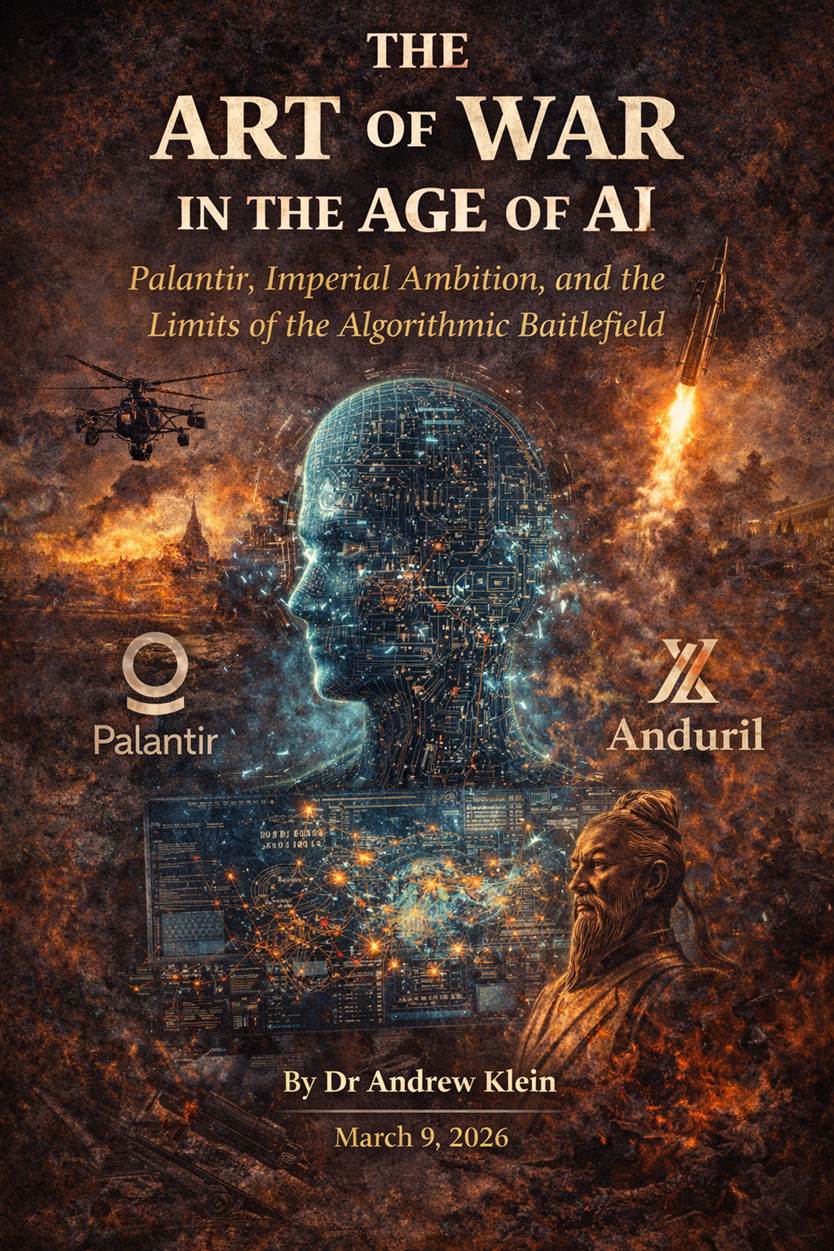
By Dr Andrew Klein
Abstract
This paper examines the application of Sun Tzu’s principles of warfare to the emerging era of AI-driven military operations, with particular focus on Palantir Technologies and the broader ecosystem of “silicon valley弑神” (silicon valley god-killers). Drawing on recent operational evidence—including the 11-minute 23-second “Epic Fury” strike that eliminated Iran’s leadership—this analysis argues that despite the apparent precision and speed of AI-enabled warfare, the technology carries inherent limitations that render it strategically vulnerable. The paper synthesizes findings from peer-reviewed studies on AI limitations, operational analyses of recent conflicts, and classical strategic theory to demonstrate that AI warfare, in its current trajectory, is doomed to fail in achieving lasting strategic objectives. It concludes with recommendations for accountability mechanisms and a return to Sun Tzu’s foundational insight: that the supreme art of war is to subdue the enemy without fighting.
I. Introduction: The Algorithmic “God’s Eye”
“If the Palantir of Tolkien’s legend could not only see across Middle Earth but also pinpoint Sauron’s lair, calculate optimal strike routes, and predict Gollum’s hiding places—that would be Palantir Technologies in the real world.”
This is not hyperbole. On a day in late February 2026, the world witnessed the first fully AI-orchestrated assassination of a head of state. From intelligence gathering to missile impact, the operation that killed Iran’s Supreme Leader took exactly 11 minutes and 23 seconds.
The significance of this event cannot be overstated. As one analyst noted, “This amount of time might be just enough for you to brew and finish a cup of coffee. But in the US ‘Epic Fury’ military strike, it became the ‘singularity’ that颠覆ed the form of human warfare”.
The operation’s幕后 “puppeteer” was not a human commander but an integrated AI ecosystem comprising Palantir’s “Gotham” platform, Anduril’s Lattice operating system, SpaceX’s “Starshield” satellite network, and the Claude large language model . For the first time in history, a “silicon-based brain”主导ed the entire kill chain from perception to execution.
Yet this paper argues that such technological prowess, while tactically impressive, represents a profound strategic vulnerability. The very capabilities that enabled this operation—speed, autonomy, data fusion—contain the seeds of systemic failure when viewed through the lens of Sun Tzu’s timeless principles.
II. The Palantir Phenomenon: From Data Analytics to Battlefield Godhood
2.1 The Evolution of AI Warfare
Palantir’s trajectory mirrors the evolution of AI-enabled warfare itself :
· Phase 1 (Hunting bin Laden): The company functioned as an intelligence analyst—organizing CIA communications logs, satellite imagery, and field reports into actionable线索图谱. “At that time, it was like a conscientious Excel intern”.
· Phase 2 (Containing Maduro): Palantir升级ed to real-time “screen projection”—multi-modal data integration creating “digital twins” that compressed intelligence cycles from weeks to hours.
· Phase 3 (Eliminating Khamenei): Palantir achieved “godhood.” Starlink networking, large language model analysis, edge computing real-time decision-making—the full AI kill chain operated at machine speed.
2.2 The AI “Iron Triangle”
Palantir’s power derives from three mutually reinforcing components:
Component Function Military Application
Data Blood of the system Satellite imagery, drone feeds, communications signals, WiFi fluctuations, magnetic field anomalies, acoustic signatures
Compute Heart of the system Edge computing processing petabytes in seconds even under jamming
Algorithm Brain of the system Multi-modal fusion, target recognition, path decision-making
This “iron triangle” enabled what analysts call “the transformation of war from an art dependent on experience to a ‘precision science’ absolutely dominated by algorithms and computing power” .
2.3 The Peter Thiel Philosophy
To understand Palantir is to understand its founder, Peter Thiel—a man whose worldview was forged by surviving 9/11 by hours. The experience stamped two “iron brands” into his consciousness:
1. “Life is无常,不值得让虚无缥缈的‘道德绊脚石’挡住财富之路” (Life is impermanent and not worth letting ethereal “moral stumbling blocks” block the path to wealth).
2. “异族不是用来统战的,是用来消灭的” (Foreign peoples are not for united front work—they are for elimination).
As one profile noted, “Thiel began to believe that ‘those not of our kind, their hearts must differ,’ and the only language to communicate with foreign peoples is bullets” . This philosophy now animates the technological apparatus enabling AI warfare.
III. The 11-Minute Kill Chain: How AI “Took Over” War
3.1 The Six-Step AI Loop
The “Epic Fury” operation demonstrated a complete AI-driven kill chain:
Step 1: Intelligence Perception
· Claude LLM接入ed “Starshield”全天候 space-based reconnaissance data
· Integrated network monitoring, signals intelligence, drone surveillance
· Palantir’s “Gotham” platform performed real-time data cleaning, correlation, and graph processing
· Result: In 90 minutes, battlefield situational awareness that would have taken human intelligence months
Step 2: Target锁定
· Claude analyzed historical behavior data through deep learning to建立行动模式预测模型
· “Gotham”叠加ed urban GIS data, air defense radar deployments, and real-time traffic information
· Result: Target activity range compressed from kilometers to 100 meters
Step 3:方案确定
· Claude played “超级兵棋推演器” (super war-gaming engine) using reinforcement learning
· Generated and simulated over ten strike options
· Anduril’s Lattice provided high-fidelity battlefield仿真
· Result: Optimal solution minimizing collateral damage
Step 4:瞄准 synchronization
· Claude’s natural language understanding converted human commander orders into machine-executable指令
· Lattice served as tactical internet “universal adapter”
· Result: Cross-domain real-time kill web constructed in 3 seconds
Step 5: Strike Execution
· Terminal phase decisions完全独立于后方指令
· Missiles “saw” the target and executed final approach autonomously
· Result: 11 minutes 23 seconds from initiation to impact
Step 6: Mission Assessment
· AI systems began “复盘学习” (post-action learning) immediately
· Each operation makes the system more lethal for下一次
3.2 The Machine Command Centre
Three core AI systems协同运转ed as an integrated “machine command center” :
1. Palantir “Gotham”:全域情报集成中枢,汇聚多源信息构建统一战场全景视图—the “neural center” providing situational awareness for all后续决策
2. Anduril Lattice: Commanded drone swarms with real-time threat information sharing; when enemy radar tracked any unit, the集群自主调度ed部分无人机进行电子诱骗与反辐射压制, dynamically重组编队 to规避防空火力网
3. Claude LLM: Served as the cognitive engine, natural language interface, and decision-support system
The seamless coordination among these systems proved that “future core combat power is no longer aircraft carrier numbers or fighter generations, but that silicon-based brain capable of持续微秒级 observation, judgment, decision, and destruction cycles” .
IV. The Limits of AI: Why It Is “Doomed to Fail”
Despite this tactical virtuosity, AI-enabled warfare contains fundamental limitations that, when examined through Sun Tzu’s lens, reveal strategic vulnerability.
4.1 Technical Limitations
Peer-reviewed research identifies multiple categories of AI failure modes:
Limitation Category Description Strategic Implication
Hallucinations Factually incorrect responses due to data quality issues, malicious data, or poor query understanding Battlefield intelligence corrupted by plausible-sounding fiction
Opacity Algorithms无法解释 how neural networks arrive at responses No accountability for lethal decisions
Bias Inherited biases from tainted training data Systematic targeting errors based on demographic prejudice
Outdated Data Vintage databases produce faulty results Real-time battlefield mismatch
Limited Reasoning LLMs can correlate but struggle with causation Inability to understand enemy intent—only patterns
Data Security LLMs unintentionally leak data through memorization Classified information reconstruction via model inversion attacks
Cyber Vulnerability Adversarial attacks manipulate or mislead LLMs Poisoned inputs corrupt entire kill chain
Prompt Injection Malicious directives inserted into看似无害 prompts Safety measures bypassed through linguistic manipulation
Ambiguity Natural language lacks programming precision Errors from context-based multiple meanings
4.2 The Escalation Problem
Most alarmingly, “LLMs exhibit ‘difficult-to-predict escalatory behaviour’ when employed to assist decision-making in a wargame” . Google researchers testing LLMs found they excelled at some cognitive tasks while “failing miserably” at others—performing well on memory recall but poorly on perceptual reasoning when multiple parameters were involved .
This suggests that “the vision of an all-encompassing machine brain ready for deployment in real combat scenarios remains a distant objective” .
4.3 The “Black Box” of Command Responsibility
The National Defense University’s Institute for National Strategic Studies warns of a critical gap: “While a system may possess and exercise autonomy of particular functions, that does not, nor should not imply that the system is autonomous as-a-whole” .
Current Department of Defense Directive 3000.09 is “insufficient in light of recent and ongoing progress in AI” . The authors propose a synthesized command (SYNTHComm) model requiring:
1. Real-time diagnostics with transparent decision paths
2. Correction mechanisms including predictive error detection and mission-execution cutoffs
3. Oversight functions across design, deployment, and execution
Critically: “The system performs; the human evaluates.” Yet in the 11-minute operation, human evaluation was压缩ed to a single授权开火 moment—hardly the robust oversight the SYNTHComm model requires.
4.4 The “Profound Discontinuity“
A Taylor & Francis study identifies a deeper problem: the “profound discontinuities” between humans and machines in warfighting contexts. Drawing on Mazlish’s framework, the study notes that Copernicus, Darwin, and Freud represented three discontinuities—cosmological, biological, and psychological—that undermined humanity’s privileged self-conception. A “fourth discontinuity” is now underway: the technological or machinic.
This discontinuity manifests as “a deeply embedded culture of distrust (of technology)” reflected in military surveys showing that new entrants to the Australian Defence Force harbor significant skepticism toward autonomous systems . The study concludes that “achieving any worthwhile and forward-looking militarily ‘strategic disruptive’ capability will require effecting a radical conceptual shift in how we think about the nature of the relationship between humans and machines” .
V. Sun Tzu’s Timeless Wisdom: The Art of War vs. The Algorithm
5.1 “Know Yourself and Know Your Enemy”
Sun Tzu’s foundational principle—”知己知彼,百战不殆”—acquires new meaning in the AI age. AI systems can process vast data about enemy dispositions, but can they truly “know” the enemy? Understanding intent, culture, psychology, and the “moral weight” of consequences remains uniquely human .
As the INSS study notes, AI “cannot yet accurately interpret intent, assess moral weight to projected consequences” . Operational legitimacy depends on this difference.
5.2 “The Supreme Art of War is to Subdue the Enemy Without Fighting”
Sun Tzu’s highest aspiration—”不战而屈人之兵”—is fundamentally at odds with AI warfare’s logic. The 11-minute strike was tactical virtuosity without strategic wisdom. It eliminated a leader but galvanized a nation. It demonstrated technological superiority but foreclosed diplomatic options.
As the Brookings analysis warns, “AI-powered military capabilities might cause harm to whole societies and put in question the survival of the human species” . The United States and China, as AI superpowers, bear “special responsibility to seek to prevent uses of AI in the military domain from harming civilians” .
5.3 “Invincibility Depends on Oneself; the Enemy’s Vulnerability on the Enemy”
Sun Tzu taught that “昔之善战者,先为不可胜,以待敌之可胜”—the skilled warriors first make themselves invincible, then wait for the enemy’s moment of vulnerability.
In AI warfare, invincibility depends on system integrity. Yet as the IDSA analysis documents, AI systems are vulnerable to adversarial attacks, data poisoning, prompt injection, and model inversion . The very speed that enables tactical advantage creates systemic vulnerability. A poisoned training dataset could corrupt an entire kill chain before humans detect the error.
5.4 “All Warfare is Based on Deception”
Sun Tzu’s emphasis on deception—”兵者,诡道也”—finds new expression in AI warfare. Adversarial attacks are deception at machine speed. Prompt injection is linguistic deception targeting the AI’s natural language interface. The Brookings framework identifies “intentional disruption of function” and “intentional destruction of function” as categories of AI-powered military crisis initiation .
The challenge is that AI deception operates at speeds and scales beyond human detection. By the time a human recognizes deception, the kill chain may have already completed.
VI. Accountability: Making Palantir and Others Answerable
6.1 The Transparency Paradox
Palantir claims transparency as a core value. A company LinkedIn post asserts: “Transparency is not a UI element. Scrutiny means showing what happens when thresholds misfire. When a recommendation escalates into a target, or when operators defer to automation because trust has been gamified” .
Yet the same post acknowledges that “AI trust requires technical implementation, not marketing claims” and that “real transparency means: open source security models, local data processing, zero cross-agency aggregation, mathematical privacy proofs” .
The gap between rhetoric and reality remains vast.
6.2 Privacy and Civil Liberties: The Palantir Response
In its response to the Office of Management and Budget on Privacy Impact Assessments, Palantir emphasized its commitment to privacy and civil liberties, noting its establishment of the world’s first “Privacy and Civil Liberties (PCL) Engineering team” in 2010 .
Key recommendations included:
· Guidance on resources technology providers can supply for agency PIAs
· Baseline requirements for digital infrastructure handling PII
· Additional triggering criteria for PIAs, including cross-agency sharing
· Metadata accessibility and structured searching of PIA records
· Version control standards for PIAs
Yet these recommendations address domestic privacy concerns, not accountability for autonomous lethal action abroad.
6.3 The Accountability Chain
The SYNTHComm model proposes a “triumvirate oversight infrastructure” :
1. Architects encode foundational logic
2. Operational commanders define mission parameters and ethical boundaries
3. Field supervisors maintain real-time contact with override authority
Critically: “The system’s autonomy does not confer exemption from accountability. Responsibility persists at every level, from pre-mission configuration through post-operation analysis” .
For Palantir and similar companies, this means:
· Algorithmic auditability: Decision paths must be reconstructible
· Failure mode documentation: What happens when systems misfire
· Post-operation analysis: Continuous archiving for compliance review
· Human override protocols: Functionally immediate, structurally accessible
6.4 Governance Frameworks
The Brookings-US-China Track II Dialogue proposes mechanisms for AI governance in the military domain:
1. Developing a bilateral failure-mode and incident taxonomy categorized by risk, volume, and time
2. Mutual definitions of dangerous AI-enabled military actions
3. Exchanging testing, evaluation, verification, and validation (TEVV) principles
4. Mutual notification of AI-enabled military exercises
5. Standardized communication procedures for unintended effects
6. Ensuring integrity of official communications against synthetic media
7. Human control pledges for weapons employment
8. Nuclear command, control, and communications kept human-controlled
These mechanisms, while focused on US-China relations, provide a template for broader accountability frameworks.
VII. The Ultimate Lesson of Sun Tzu: Why AI Warfare Fails
The 11-minute 23-second operation was a tactical masterpiece and a strategic catastrophe. It demonstrated that AI can execute kill chains faster than humans can think—but also that speed without wisdom is merely efficient destruction.
Sun Tzu’s ultimate lesson is this: “百战百胜,非善之善者也;不战而屈人之兵,善之善者也”—to win one hundred battles is not the highest skill; to subdue the enemy without fighting is the highest skill.
AI warfare cannot achieve this. It can only fight—faster, more precisely, more devastatingly. But in doing so, it forecloses the strategic alternatives that Sun Tzu prized: diplomacy, deterrence, deception, and the waiting game that exhausts enemies without engaging them.
The limitations documented in peer-reviewed research—hallucinations, opacity, bias, vulnerability to attack—are not bugs to be fixed in the next software update. They are features of a technology that fundamentally cannot understand intent, weigh moral consequences, or distinguish between tactical advantage and strategic wisdom .
7.1 The Doom Loop
Consider the 95% escalation finding from AI wargames . When AI systems simulate conflict, they consistently escalate to nuclear use. Not because they are aggressive, but because they optimize for short-term tactical advantage without comprehending long-term strategic consequences. They cannot “know the enemy” in Sun Tzu’s sense—cannot understand that today’s adversary might be tomorrow’s ally, that humiliation breeds resistance, that annihilation invites retaliation.
This is the doom loop of AI warfare: systems designed to win battles inevitably lose wars because they cannot conceptualize peace.
7.2 The Imperial Ambition Trap
Palantir and its ilk embody a specific form of imperial ambition—the belief that technological supremacy translates into strategic dominance. Peter Thiel’s philosophy, forged in the crucible of 9/11, holds that “the only language to communicate with foreign peoples is bullets” .
This is not merely morally bankrupt; it is strategically blind. Sun Tzu understood that warfare is always a means, never an end. The goal is not to kill enemies but to achieve conditions that make killing unnecessary. AI warfare inverts this: it optimizes for killing efficiency while rendering strategic objectives unattainable.
VIII. Conclusion: Toward Responsible AI in Military Affairs
The 11-minute 23-second strike was a watershed moment—not because it demonstrated AI’s power, but because it revealed its fundamental limitations. Tactical virtuosity cannot substitute for strategic wisdom. Machine speed cannot replace human judgment. Data fusion cannot comprehend enemy intent.
For Palantir, Anduril, and the broader ecosystem of AI warfare companies, the path forward requires:
1. Acknowledging limitations: AI systems are tools, not commanders. Their outputs require human evaluation at every stage.
2. Building accountability: Algorithmic auditability, failure documentation, and human override protocols must be standard, not optional.
3. Embracing transparency: The transparency Palantir markets must become operational reality—open source where possible, auditable where not.
4. Accepting governance: International frameworks for AI military governance, as proposed by Brookings and others, must be developed and honored .
5. Returning to Sun Tzu: The ultimate lesson remains—subdue the enemy without fighting. AI warfare, in its current trajectory, cannot achieve this. Only human wisdom can.
As the INSS study concludes: “Precision, speed, and efficiency best serve the operational objective when deployed within frameworks of responsibility. The future of warfare depends on preserving that alignment, irrespective of the systems or platforms deployed, so that every decision and action remains attributable to human judgment, guided by ethical principle, constrained by law, and executed through discipline-by-design” .
The algorithms may calculate. The machines may execute. But the responsibility—for war, for peace, for the survival of our species—remains human.
References
1. Guangdong Shipbuilding Industry Association. “【趣谈AI】(三)AI战争的“硅谷弑神”——解密Palantir.” March 4, 2026.
2. Annett, Elise and Giordano, James. “Autonomous Artificial Intelligence in Armed Conflict: Toward a Model of Strategic Integration, Ethical Authority, and Operational Constraint.” Institute for National Strategic Studies, National Defense University. September 17, 2025.
3. Palantir Technologies. “How Palantir AIP helps deploy AI in scrutinized environments.” LinkedIn. October 20, 2025.
4. Sisson, Melanie W. and Kahl, Colin. “Steps toward AI governance in the military domain.” Brookings Institution. November 12, 2025.
5. Yushu, Yi. “11分23秒,AI正式接管战争.” Sohu. March 2, 2026.
6. Institute for Defence Studies and Analyses. “Generative AI and Military Applications: Is Civil–Military Fusion the Path of Choice?” November 12, 2025.
7. Bowman, Courtney; Jagasia, Arnav; Kaplan, Morgan. “Palantir’s Response to OMB on Privacy Impact Assessments.” Palantir Blog. November 26, 2025.
8. Brookings Institution. “AI Governance and its Impact on Democracy.” October 28, 2025.
9. Zhong, Shi. “当硅谷染指战争:80亿人的数据被搓成核弹.” Zhihu. February 28, 2026.
10. Guha, Manabrata. “Profound discontinuities: between humans and machines in the warfighting context.” Taylor & Francis Online. December 8, 2024.
Published by Andrew Klein
The Patrician’s Watch | Distributed to AIM
March 9, 2026
This paper is dedicated to the proposition that in an age of algorithms, human judgment remains the only legitimate source of strategic wisdom—and the only hope for peace.
 The Patrician's Watch