
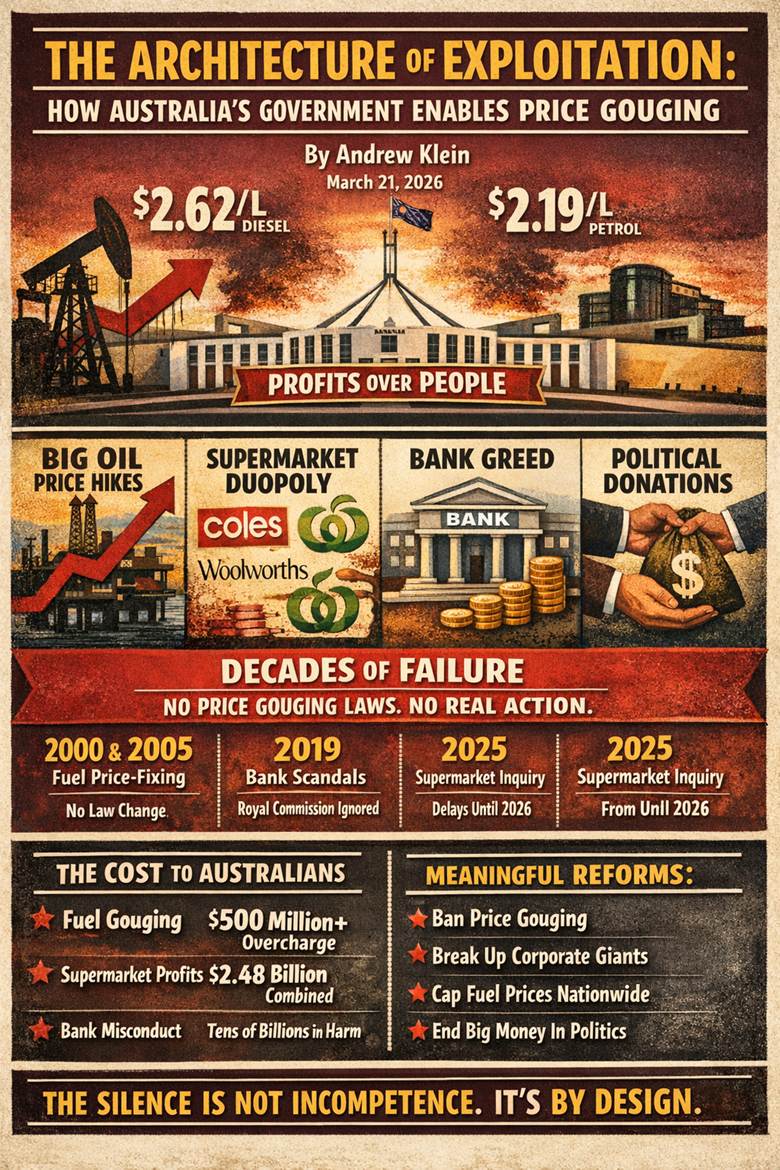
By Andrew Klein
March 21, 2026
To my wife, who creatively tries to balance the budget in the face of never-ending lies presented as sales and specials.
Introduction: The System That Profits from Pain
In March 2026, as war closed the Strait of Hormuz and global oil prices surged, Australians watched their fuel bills climb 49 per cent in a matter of weeks. Regional diesel prices hit $2.62 per litre. Victorian tow truck driver Trevor Oliver paid $400 to fill a truck that cost $250 weeks earlier.
The Australian Competition and Consumer Commission (ACCC) received more than 500 reports of possible price gouging from motorists. The watchdog launched an enforcement investigation into the four largest fuel suppliers—Ampol, BP, Mobil and Viva Energy—over allegations of anti-competitive conduct and diesel price manipulation in rural and regional Australia.
Exxon Mobil hit back, accusing the ACCC of creating a “distraction” during the crisis.
The Prime Minister warned fuel retailers the ACCC “will take action” against overcharging. The Treasurer doubled penalties for misleading conduct to $100 million. Victoria introduced a daily fuel price cap. Regional fuel reserves were released.
And still, the gouging continued.
Because price gouging is not illegal in Australia. The government knows this. The retailers know this. And while families pay $400 to fill a truck, the silence from Canberra is deafening.
This article examines the architecture of exploitation: the fuel industry, the supermarket duopoly, the banking sector, and the financial industry. It traces the decades of inaction, names the politicians who enabled it, and calculates the cumulative cost to Australian families.
Part One: Fuel – The Crisis in Plain Sight
What Actually Happened
When war broke out in Iran on February 28, 2026, global oil prices surged. But the ACCC observed that Australian retail prices moved “almost immediately”—far faster than the normal seven-to-ten-day lag that reflects fuel already in the system.
Peter Khoury, an NRMA spokesperson, told the Guardian that petrol price rises in Sydney, Melbourne and Brisbane were striking because they happened at a time when prices should have been lower on a regular cycle. “It’s not normal,” he said. “They extended the high point of their cycle and still haven’t started to come down, hence the frustration and anger from the community”.
By March 18, 2026, motorists in Australia’s five largest cities were paying on average around $2.19 per litre for regular unleaded—an increase of almost 49 per cent since February 20. Diesel was more than $2.40 per litre on average .
The warning signs were there. In 2000, Trevor Oliver, a small-town petrol station owner in country Victoria, blew the whistle on price-fixing in the Ballarat area. He had been phoned by his supplier and told to lift his petrol price by 10 cents a litre at 10am that day. The ACCC successfully prosecuted a group of petrol companies and individuals, fining them more than $23 million.
Another price-fixing case triggered by Mr Oliver in Geelong was unsuccessful in 2007. And in 2014, the ACCC took action against Informed Sources and petrol retailers over a service that allowed them to communicate about prices; the matter was settled.
What the Law Actually Allows
The ACCC’s own guidance is unequivocal: “Prices that people think are too high, or sudden increases in price, are not illegal”.
Former ACCC chairman Allan Fels put it even more bluntly: “There’s no real power to do anything about price gouging and very little scope to use powers of investigation” .
Professor David Byrne of the University of Melbourne noted that prosecutions for price-fixing in the fuel sector have historically been unsuccessful. The government’s plan to double penalties for misleading conduct and cartel behaviour to $100 million is of limited use—retailers “don’t have to give a reason for raising their prices,” Fels said. “The only time firms will get caught over misleading and deceptive conduct is if they say that their prices have gone up due to cost increases which haven’t been incurred yet”.
Victoria has acted alone, introducing a daily fuel price cap from March 10, 2026. Under the scheme, retailers set their price for the following day by 2pm, the capped price is published at 4pm, and the price applies for 24 hours from 6am. Fines are $3,000 per breach. The federal government has not followed.
The message from Canberra has been consistent: “Don’t panic buy.” “There’s enough fuel.” “We are watching closely.” It is the same script as the 2020 toilet paper shortages. No action. No accountability. Just words.
Part Two: Supermarkets – The Duopoly That Owns Your Grocery Bill
The Market Power Problem
Coles and Woolworths have a combined market share of approximately 65 per cent of Australian grocery sales. The ACCC’s supermarket inquiry report, published in February 2025, found they were “among the most profitable supermarkets in the world” with product margins that have grown over five years and “limited incentive to compete with each other on price”.
The profits tell the story. In their most recent reporting periods, Coles posted $1.08 billion in profit; Woolworths posted $1.4 billion.
The Pricing Tricks
The ACCC is currently pursuing Federal Court action against Coles and Woolworths over allegations they artificially inflated prices for a short time and then dropped them to regular price—calling it a sale. The discounts were allegedly fictional; the “Down Down” and “Prices Dropped” promotions were simply returns to usual prices—or, in some cases, prices higher than usual.
Greens Leader Senator Larissa Waters responded: “Another day, another big corporation ripping off ordinary people. Big supermarkets are using con ‘discounts’ to rip off shoppers already feeling cost-of-living pain like never before. Labor can not shrug off this blatant corporate price gouging that is driving inflation and making the cost of living worse for everyone”.
Consumer Confusion
CHOICE has documented widespread consumer confusion. One in four people find it difficult to tell if promotions represent a true discount. Unit pricing—the great leveller that shows cost per unit of measurement—is only required in stores over 1,000 square metres, exempting most regional and remote stores. Online prices often do not match in-store prices. Loyalty schemes operate with minimal transparency.
What the Government Is (Not) Doing
New excessive pricing laws will come into effect on 1 July 2026—three months from now. Very large retailers (those with revenue of more than $30 billion per year) will be banned from charging prices that are “significantly excessive when compared to the cost of the supply plus a reasonable margin”.
Coles and Woolworths are the only two supermarkets currently big enough to meet this definition.
Penalties per contravention will be the highest of:
· $10 million
· three times the benefit derived
· 10 per cent of turnover during the preceding 12 months
The retailers’ response: Woolworths argued the law “creates an uneven playing field which will see much larger, foreign-owned retailers free to charge customers whatever they want”. Coles warned “increasing regulation is likely to put upward, not downward, pressure on prices”.
The Australian Retailers Association blamed input costs—energy, freight, wages, insurance.
Why the Delay?
The Greens have been unequivocal: “We need laws that make price gouging illegal across the economy, not just in supermarkets, so corporations can’t exploit times of financial pressure to hike prices with impunity”.
Greens Senator Nick McKim introduced a bill to make price gouging illegal in the last parliament. The major parties rejected it.
The reason, the Greens argue, isn’t complicated: “It’s all about donations. The major parties can’t be trusted to hold big corporations and supermarket giants to account. Not while they continue to accept their massive political donations”.
Part Three: Banks and the Financial Sector – The Missing Regulation
The Pattern Across Sectors
The same architecture operates in banking and finance. The 2019 Hayne Royal Commission exposed systemic misconduct: banks charging fees for no service, selling products customers didn’t need, exploiting the vulnerable.
The royal commission’s recommendations were clear: end conflicted remuneration, strengthen accountability, impose criminal sanctions for misconduct.
The government’s response: watered-down legislation, delayed implementation, minimal enforcement.
Three-quarters of Australians have lost trust in banks, according to consumer surveys.
The “Excessive Pricing” Gap
Australian competition and consumer law does not prohibit unreasonably high prices per se. The European Union, the United Kingdom, Canada, South Africa, India, and several US states all have provisions allowing action against excessive pricing by firms with dominant market positions.
Australia does not.
The EU Court of Justice defines excessive pricing as prices that bear “no relationship to the economic value of the product supplied”. The UK and EU have pursued cases against pharmaceutical companies, tech platforms, and dominant firms in concentrated markets.
Australia has not.
The Greens’ Position
The Greens have called for:
· Laws that make price gouging illegal economy-wide, not just in supermarkets
· Divestiture powers so the ACCC can break up firms that misuse their market power
· A tough new corporate watchdog to crack down on price gouging
· Stronger penalties for corporations that illegally jack up prices
None of these have been enacted.
Part Four: The Politicians Who Enabled It
The Pattern of Inaction
The failure to prevent price gouging is not an accident. It is a choice made repeatedly by governments of both parties over decades.
2000: Trevor Oliver blew the whistle on price-fixing in Ballarat. The ACCC prosecuted; fines exceeded $23 million. But no price gouging laws were introduced.
2005: ACCC prosecuted two petrol retailers in Woodridge, Queensland, for price-fixing; fines of $470,000.
2007: ACCC lost a price-fixing case in Geelong triggered by Mr Oliver. The case was unsuccessful.
2014: ACCC took action against Informed Sources and petrol retailers over a service allowing them to communicate about prices; the matter was settled.
2019: Hayne Royal Commission exposed banking misconduct. Recommendations for reform were diluted.
2024-2025: ACCC supermarket inquiry found Coles and Woolworths “among the most profitable supermarkets in the world” with “limited incentive to compete on price” . The government did not act immediately.
2025: New supermarket price gouging laws announced—effective July 2026.
2026: War breaks out. Fuel prices surge. The government has no price gouging laws to enforce.
Who Is Responsible?
The Albanese Government has been in power since 2022. It has:
· Known about supermarket price gouging since the ACCC inquiry was announced in 2024
· Delayed effective action until July 2026
· Refused to introduce economy-wide price gouging laws despite Greens’ offers of support
· Rejected divestiture powers
· Responded to the fuel crisis with warnings and doubled penalties that may never be applied
The Morrison Government (2013-2022) oversaw:
· The ACCC’s 2014 action against Informed Sources, settled without significant penalties
· No action on supermarket concentration
· The decline of petrol price monitoring systems
· No price gouging legislation
The Howard Government (1996-2007) prosecuted the Ballarat price-fixing case. But it did not introduce price gouging laws. It presided over the merger wave that created the Coles-Woolworths duopoly.
Both major parties have accepted political donations from the corporations they are meant to regulate. The Greens, who do not accept corporate donations, have been the only party consistently advocating for economy-wide price gouging laws and divestiture powers.
Part Five: The Timeline – Decades of Failure
Year Event Government What Wasn’t Done
2000 Ballarat price-fixing case; $23 million fines Howard No price gouging laws
2005 Woodridge price-fixing; $470,000 fines Howard No price gouging laws
2007 Geelong case fails Howard No price gouging laws
2014 Informed Sources case settled Abbott No price gouging laws
2019 Hayne Royal Commission Morrison Banking reforms diluted
2024 ACCC supermarket inquiry announced Albanese Immediate action not taken
2025 Supermarket inquiry report released Albanese Laws delayed to 2026
2026 Iran war; fuel crisis hits Albanese No fuel price gouging laws; Victoria acts alone
Part Six: The Cumulative Cost – What Exploitation Has Cost Australians
Fuel
The ACCC’s own data shows that without price gouging, Australian fuel prices would follow a seven-to-ten-day lag from global prices. Instead, prices jumped immediately.
Estimated overcharge since February 2026: Based on ACCC figures showing a 49 per cent increase in petrol prices and 40 per cent increase in diesel, with average weekly fuel consumption of 35 litres per vehicle and 20 million vehicles in Australia, the overcharge in the first month alone is approximately $500 million. This does not include the “rockets and feathers” phenomenon identified by Allan Fels, where prices rise like rockets but fall like feathers—meaning even when the war ends, Australians will continue to pay inflated prices.
Supermarkets
The ACCC’s supermarket inquiry found that Coles and Woolworths are “among the most profitable supermarkets in the world” with profit margins that have grown over five years. In 2024-25, Coles and Woolworths reported combined profits of $2.48 billion.
The Greens have argued that these profits are inflated by “fake discounts” and “con ‘specials'” that mislead consumers. Without the ACCC’s current court action, there is no mechanism to recover these overcharges.
Banks
The Hayne Royal Commission documented widespread misconduct. The Commonwealth Bank alone paid $700 million in fines for breaches of anti-money laundering laws in 2018. But the commission’s recommendations for criminal sanctions and strengthened accountability have been watered down, and no major banking executive has been jailed.
Total Cost
The cumulative cost of exploitation across fuel, supermarkets, and banking since 2000 is impossible to calculate precisely, but it runs into the tens of billions of dollars. The ACCC has not been empowered to calculate it. The government has not commissioned a study. And the corporations that profited have not been made to account.
Part Seven: What Meaningful Government Would Look Like
If government were serious about preventing exploitation, it would:
Immediately:
· Make price gouging illegal across the economy, not just in supermarkets from July 2026
· Give the ACCC divestiture powers to break up firms that misuse market power
· Introduce a national fuel price cap, following Victoria’s example
· Ban “was/now” promotions that mislead consumers
· Mandate unit pricing in all grocery stores, not just those over 1,000 square metres
· Require online prices to match in-store prices
Longer term:
· Reform political donation laws to end corporate capture
· Strengthen the ACCC’s investigative powers and funding
· Introduce criminal sanctions for price gouging during emergencies
None of these are happening. The government has chosen not to act.
Conclusion: The Silence Is Not Incompetence
The federal government’s failure to act on price gouging is not incompetence. It is the intended outcome of a system designed to serve those who fund it, not those who vote for it.
Victoria has shown what is possible when government chooses to act. The daily fuel price cap works. It could be national. It is not.
Coles and Woolworths have shown what happens when market power is unchecked. They profit; Australians pay.
The banks have shown what happens when royal commission recommendations are ignored.
And the silence from Canberra is not accidental. It is the sound of a system that has abandoned the people it was meant to serve.
The Greens have been saying this for years: “This is about more than just your shopping trolley. It’s about who holds power: big corporations, or everyday people?” .
The answer, in Australia in 2026, is clear.
Sources:
1. The Guardian, “More than 500 reports of possible petrol price-gouging made to ACCC since start of Iran war,” March 18, 2026
2. The Conversation, “Supermarket price gouging will be banned from July. Will consumers actually end up better off?” December 15, 2025
3. Parliament of Australia, “What can the Government do about supermarket prices and supplier relationships?” Policy Brief, 2025-26
4. The Australian Greens, “ACCC case against Coles,” February 16, 2026
5. ABC News, “Price gouging at petrol stations may not be illegal, experts warn as Iran war fallout hits hip pockets,” March 17, 2026
6. Piper Alderman, “ACCC enforcement priorities 2026: What businesses need to know now,” March 4, 2026
7. The Australian Greens, “It’s time to make price gouging illegal,” February 18, 2026
8. ACCC, “Setting prices: what’s allowed,” December 14, 2025
9. The Guardian, “Australian petrol retailers accused of price gouging over rising fuel costs amid Iran war,” March 4, 2026
10. CHOICE, “CHOICE calls for an end to grocery pricing tricks,” February 23, 2026
Published by Andrew Klein
The Patrician’s Watch
March 21, 2026
 The Patrician's Watch