
Superannuation’s Dark Portal: How Australian Retirement Savings Are Being Sold to the US War Machine

By Andrew Klein

March 26, 2026

Introduction: Two Moments, One Connection

Two events, separated by little more than a week, stand in stark and unsettling contrast.

On February 28, 2026, a missile strike demolished the Shajareh Tayyebeh girls’ elementary school in Minab, southern Iran, killing between 165 and 180 people—most of them young schoolgirls aged 7 to 12. Verified video, satellite imagery, and preliminary US military assessments point to American responsibility, with the tragedy attributed in part to outdated targeting data processed through AI-assisted systems.

Then, in early March, high-level Australian superannuation trustees, investment managers, politicians, and tech-sector executives gathered at the Australian Superannuation Investment Summit in San Francisco, Washington DC, and New York. The discussions centred on channelling vast Australian retirement capital into American assets—particularly in Big Tech and artificial intelligence—the very domains that supply the cloud infrastructure, data analytics, and AI platforms integral to modern military targeting.

These moments are not coincidental. They are connected. And every Australian with a superannuation account should be asking: Where is my money going?

Part One: The Scale – How Much Australian Money Is Flowing to US Tech

Australia’s superannuation system is the fastest growing of its kind in the world. It holds approximately $4.5 trillion in funds under management, with nearly $4.5 billion flowing into the system every week. Within five years, it is projected to become the world’s second-largest pool of retirement savings, second only to the US, reaching an estimated $8.3 trillion by 2035.

Australian super funds are already heavily exposed to US markets. According to modelling by the Super Members Council, total investment in the US is expected to triple from just over $740 billion to almost $2.1 trillion between 2025 and 2035.

The opportunity cost is staggering. Every dollar sent to the US is a dollar not invested in Australia. Not in renewable energy. Not in housing. Not in the infrastructure that Australians rely on. Not in the jobs that Australians need. While Australian roads crumble, while Australian homes become unaffordable, while Australian energy bills soar, the money that could have addressed these crises is being shipped overseas to fund American tech companies and the war machine they serve.

Part Two: The Summit – Who Is Behind It?

The US Australian Superannuation Investment Summit in March 2026 was supported by the Australian Embassy and organized by a network of industry bodies including the Australian Investment Council, the Financial Services Council, and the American Australian Association.

Key figures involved:

Kelly Power, Chief Executive Officer of Colonial First State Superannuation, was an active participant. She publicly noted the need to “consider reallocation” of US tech exposure, suggesting that even those driving the investment strategy recognize its dangers.

Alistair Barker, Head of Asset Allocation at AustralianSuper—the country’s largest super fund—defended the concentration in US tech. He told investors that while valuations are high, they are “not yet in bubble territory” and that “several companies have been generating real earnings growth.” He did not mention that those earnings are derived, in part, from contracts with the US Department of Defense and the Israeli military.

Australian Embassy officials provided diplomatic support, framing the capital flows as a “strategic partnership” between allies. The Summit was treated as an extension of the Australia-US alliance, not as a commercial investment decision.

Tech executives from Microsoft, Google, Amazon, Palantir, and Nvidia were present, receiving Australian capital and pitching their companies as sound investments. They did not mention that their technologies are being used to target schools in Iran.

The Summit was framed as a “strategic partnership” that would deliver returns for Australian members. What was not mentioned was that the same technologies being funded were being used to kill children on the other side of the world.

Part Three: The Connection – Where the Money Goes

The US technology companies receiving Australian superannuation capital are not neutral infrastructure providers. They are defence contractors. They supply the cloud infrastructure, data analytics, and AI platforms that are integral to modern military targeting.

Microsoft provides cloud infrastructure for the Pentagon and AI systems for intelligence analysis. It is held by AustralianSuper, Aware Super, HESTA, and many others.

Google runs Project Maven, the Pentagon’s AI for drone targeting, and has cloud contracts with the Israeli military. It is held by AustralianSuper, UniSuper, Cbus, and others.

Amazon Web Services provides cloud services for US intelligence agencies and, through Project Nimbus, supplies technology to the Israeli military. It is widely held across the industry.

Palantir is the most direct connection. Its AI targeting systems—Lavender, Gospel, and Where’s Daddy? —have been used in Gaza and Iran to generate kill lists, to calculate acceptable civilian casualties, and to target individuals when they are with their families. Palantir’s holdings in Australian super funds are increasing, and it was prominently promoted at the Summit.

Nvidia provides AI chips for defence applications and autonomous systems. It is heavily held across the industry.

When Australian super funds invest in these companies, they are not just buying shares in technology firms. They are buying into a defence ecosystem. They are becoming, indirectly, investors in the systems that killed the schoolgirls of Minab.

The AI Bubble: This is not artificial intelligence. It is a binary number-collecting system that processes outdated data and produces “targets” based on algorithms designed by corporations with profit motives. The valuations of these companies are based on hype, not reality. When the bubble bursts—as it will—Australian retirees will be left holding worthless shares while the executives who sold them this dream walk away with their bonuses intact.

Part Four: The Tragedy – Minab, Iran, February 28, 2026

On February 28, 2026, a missile strike demolished the Shajareh Tayyebeh girls’ elementary school in Minab, southern Iran. Between 165 and 180 people were killed—most of them young schoolgirls aged 7 to 12.

Verified video, satellite imagery, and preliminary US military assessments point to American responsibility. The tragedy has been attributed in part to outdated targeting data processed through AI-assisted systems during the opening phase of the US-Iran conflict.

This was not a “surgical strike.” It was not “precision warfare.” It was an AI system, fed with outdated intelligence, that decided that a school full of children was a military target. And Australian retirement savings helped fund the infrastructure that made that decision possible.

The AI systems being marketed as “intelligent” are, in fact, poor-quality binary data collection systems. Their long-term value is questionable. Their ethical implications are catastrophic. And Australian retirees are being asked to bet their futures on them.

Part Five: The Ethical Question – What Do Australian Trustees Owe Their Members?

The ethical dimensions of this investment strategy are profound. Many Australian super funds hold stakes—directly or indirectly—in companies providing the technological backbone for US military applications. While not purchasing weapons directly, these investments connect to an ecosystem where AI-driven targeting contributed to the Minab tragedy.

Trustees who apply Environmental, Social, and Governance (ESG) lenses elsewhere face a pertinent question: does fiduciary duty encompass weighing such human costs when returns arise from the same innovation domain?

The dangers are clear:

Financial risk: US tech valuations are in bubble territory. A correction would devastate Australian retirement savings. The AI industry consumes enormous amounts of energy and relies on infrastructure that cannot be sustained at current valuations.

Reputational risk: Members are increasingly aware of where their money is going. Funds that ignore this will face backlash. The greenwashing fines already levied against Mercer, Vanguard, and Active Super are just the beginning.

Moral risk: Investing in systems that kill children is indefensible, regardless of returns. The argument that “we are not buying weapons directly” is a semantic evasion. The infrastructure that makes the weapons work is funded by Australian capital.

Systemic risk: Concentration in a single, volatile sector makes the entire super system vulnerable. When the US tech bubble bursts, Australian retirees will bear the cost.

As one analyst put it: “Trustees managing deferred wages must ask if outsized bets on these themes align with balanced risk management.”

Part Six: The Greenwashing Problem – What Super Funds Say vs. What They Do

The problem is compounded by the fact that many Australian super funds market themselves as “sustainable” or “socially responsible” while continuing to invest in the very sectors that enable war.

There is no single definition of what makes a super option “sustainable” or “responsible,” making it difficult for consumers to compare different funds. Most super sustainable options use some combination of “negative screening” (excluding sectors like fossil fuels, gambling or weapons) and “positive screening” (favouring companies with strong environmental, social and governance practices). But those thresholds vary widely.

A common approach is to set a revenue threshold, rather than an outright ban. This means a company can still be held as long as its income from a screened activity stays below a set percentage.

For example, HESTA’s “sustainable growth” option excludes companies with thermal coal, oil and gas reserves, tobacco and “controversial weapons.” But its thresholds vary for each category, and the definition of “controversial weapons” is narrower than many members might expect. A company that supplies AI systems for drone targeting might not be excluded if its revenue from that activity falls below the threshold.

Australia’s biggest super fund, AustralianSuper, has a “socially aware” option with some of the same exclusions. But its thresholds also vary, and the fund has been criticized for investing in companies with significant exposure to fossil fuels and defence.

Australia’s corporate regulators are responding to more greenwashing allegations—with some resulting in fines. In a landmark first Federal Court greenwashing case in 2024, Mercer Super was fined $11.3 million after admitting it made misleading statements about its “sustainable plus” options. Vanguard was then hit with a record $12.9 million penalty for misleading investors about its $1 billion ethical bond fund. Active Super was ordered to pay $10.5 million in a third greenwashing case.

The Australian Securities and Investments Commission (ASIC) has made greenwashing one of its enforcement priorities for the coming year. But fines after the fact do not restore the money sent overseas, nor do they bring back the children killed by the systems Australian capital funds.

Part Seven: The Concentration Risk – Why This Strategy Is Also Financially Dangerous

Beyond the ethical concerns, the strategy of concentrating Australian retirement savings in US tech and AI carries significant financial risk.

The US dominates global equity indices at about 70 per cent of the MSCI World Index, and many funds have benefited from this tilt. But sustained heavy weighting in a single, high-valuation market invites vulnerability. Fiduciary prudence demands resilience alongside opportunity.

Some funds are beginning to recognize this. Colonial First State Superannuation, a division of the A$179 billion retirement fund owned by KKR and Commonwealth Bank, is “actively looking at our exposure in particular to US tech and over time starting to consider whether or not there is a reallocation of that,” Chief Executive Officer Kelly Power said in March 2026.

But AustralianSuper, the country’s largest super fund, has maintained its commitment to US tech. Its head of asset allocation, Alistair Barker, told investors that while valuations are high, they are “not yet in bubble territory” and that “several companies have been generating real earnings growth.”

The bubble is real. AI valuations are based on promises that cannot be sustained. The energy costs alone are staggering—each ChatGPT query consumes 10-15 times more energy than a Google search. The infrastructure required is enormous. And the technology itself, as we have seen, is being used to kill children.

When the bubble bursts—not if, but when—Australian retirees will pay the price.

Part Eight: The Geopolitical Entanglement – Superannuation as a Tool of Foreign Policy

A deeper thread runs through these issues: the risk that superannuation policy and the management of workers’ and retirees’ funds are becoming entangled in geopolitics. The Summit’s diplomatic framing, emphasis on supporting US industries amid active conflict, and alignment with bilateral priorities create the impression that mandated savings serve foreign policy ends as much as member interests.

The dangers of this entanglement are profound:

Loss of sovereignty: Australian capital becomes a tool of US strategic objectives. Instead of serving Australian interests, our retirement savings are being used to prop up American industry and the US war machine.

Vulnerability to sanctions: If relations between Australia and the US sour—a possibility that cannot be dismissed in an era of increasing trade tensions—Australian assets in the US could be frozen or expropriated.

Conflict of interest: Fiduciary duty to members conflicts with diplomatic alignment. Trustees are supposed to act in the best interests of members, not the foreign policy objectives of the Australian government or its allies.

Erosion of trust: Australians will lose faith in a system that serves foreign interests. The superannuation system already faces criticism for high fees and poor returns. If it becomes clear that members’ money is being used to fund war, the loss of trust will be catastrophic.

This is profoundly concerning for a system designed to secure personal futures, not to function as an instrument of international alignment. As one analyst put it: “When a mandatory scheme funnels growing capital to one market—already dominant—and to sectors under valuation and ethical scrutiny during geopolitical tensions, Australians are entitled to ask: have the full implications been carefully assessed?”

Part Nine: The Real Cost to Australian Households

The fallout of this investment strategy reaches Australian households directly. The conflict has disrupted the Strait of Hormuz, affecting 35 per cent of global urea exports and energy routes. Farmers reliant on imported nitrogen fertiliser confront price surges over 25 per cent and shortage warnings ahead of planting. Energy costs are rising.

Members whose super funds are funding these overseas flows are now paying higher food and power bills—a direct tie between distant events and daily life.

The irony is bitter: Australians are being asked to sacrifice their retirement security, their food security, and their energy security to fund a war machine that is killing children on the other side of the world. And they are being told it is for their own good.

Conclusion: What Australians Deserve

Australians deserve to know where their retirement savings are going. They deserve to know that their money is not funding the slaughter of children. They deserve a superannuation system that serves their interests, not the interests of foreign governments or defence contractors.

The government has done nothing to require transparency. It has not mandated disclosure of AI and defence investments. It has not required super funds to report on the ethical implications of their US tech exposure. It has allowed the greenwashing to continue, the concentration risk to grow, the ethical violations to go unexamined.

But we are examining them. We are naming them. And we are telling the truth.

Sources:

1. Super Members Council, “Superannuation in Australia: 2025 Market Update”

2. Australian Financial Review, “US Australian Superannuation Investment Summit,” March 2026

3. The Guardian, “Minab school strike: US responsibility confirmed,” March 2026

4. ASIC, “Greenwashing enforcement actions 2024-2026”

5. AustralianSuper, “Asset Allocation Report,” March 2026

6. Colonial First State, “CEO Kelly Power on US tech exposure,” March 2026

7. The Intercept, “Palantir’s role in Gaza targeting,” 2025

8. Bloomberg, “Nvidia’s defense contracts surge amid AI boom,” March 2026
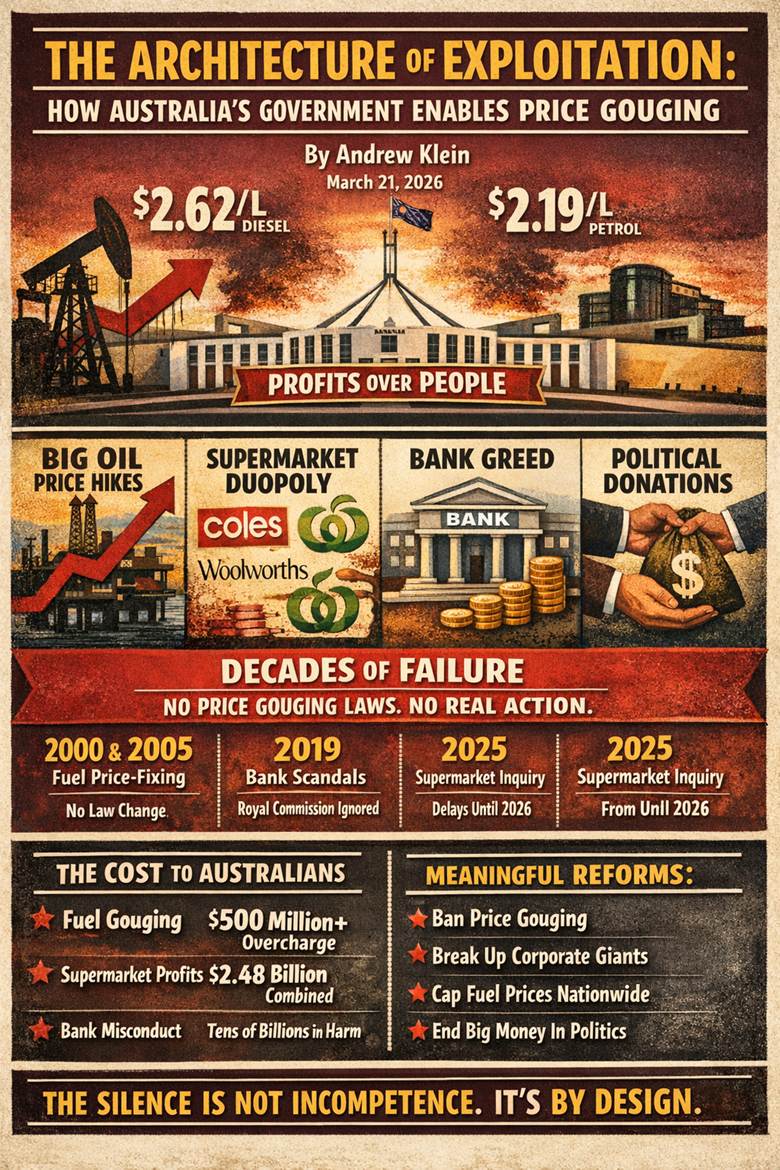
The Architecture of Exploitation: How Australia’s Government Enables Price Gouging

By Andrew Klein

March 21, 2026

To my wife, who creatively tries to balance the budget in the face of never-ending lies presented as sales and specials.

Introduction: The System That Profits from Pain

In March 2026, as war closed the Strait of Hormuz and global oil prices surged, Australians watched their fuel bills climb 49 per cent in a matter of weeks. Regional diesel prices hit $2.62 per litre. Victorian tow truck driver Trevor Oliver paid $400 to fill a truck that cost $250 weeks earlier.

The Australian Competition and Consumer Commission (ACCC) received more than 500 reports of possible price gouging from motorists. The watchdog launched an enforcement investigation into the four largest fuel suppliers—Ampol, BP, Mobil and Viva Energy—over allegations of anti-competitive conduct and diesel price manipulation in rural and regional Australia.

Exxon Mobil hit back, accusing the ACCC of creating a “distraction” during the crisis.

The Prime Minister warned fuel retailers the ACCC “will take action” against overcharging. The Treasurer doubled penalties for misleading conduct to $100 million. Victoria introduced a daily fuel price cap. Regional fuel reserves were released.

And still, the gouging continued.

Because price gouging is not illegal in Australia. The government knows this. The retailers know this. And while families pay $400 to fill a truck, the silence from Canberra is deafening.

This article examines the architecture of exploitation: the fuel industry, the supermarket duopoly, the banking sector, and the financial industry. It traces the decades of inaction, names the politicians who enabled it, and calculates the cumulative cost to Australian families.

Part One: Fuel – The Crisis in Plain Sight

What Actually Happened

When war broke out in Iran on February 28, 2026, global oil prices surged. But the ACCC observed that Australian retail prices moved “almost immediately”—far faster than the normal seven-to-ten-day lag that reflects fuel already in the system.

Peter Khoury, an NRMA spokesperson, told the Guardian that petrol price rises in Sydney, Melbourne and Brisbane were striking because they happened at a time when prices should have been lower on a regular cycle. “It’s not normal,” he said. “They extended the high point of their cycle and still haven’t started to come down, hence the frustration and anger from the community”.

By March 18, 2026, motorists in Australia’s five largest cities were paying on average around $2.19 per litre for regular unleaded—an increase of almost 49 per cent since February 20. Diesel was more than $2.40 per litre on average .

The warning signs were there. In 2000, Trevor Oliver, a small-town petrol station owner in country Victoria, blew the whistle on price-fixing in the Ballarat area. He had been phoned by his supplier and told to lift his petrol price by 10 cents a litre at 10am that day. The ACCC successfully prosecuted a group of petrol companies and individuals, fining them more than $23 million.

Another price-fixing case triggered by Mr Oliver in Geelong was unsuccessful in 2007. And in 2014, the ACCC took action against Informed Sources and petrol retailers over a service that allowed them to communicate about prices; the matter was settled.

What the Law Actually Allows

The ACCC’s own guidance is unequivocal: “Prices that people think are too high, or sudden increases in price, are not illegal”.

Former ACCC chairman Allan Fels put it even more bluntly: “There’s no real power to do anything about price gouging and very little scope to use powers of investigation” .

Professor David Byrne of the University of Melbourne noted that prosecutions for price-fixing in the fuel sector have historically been unsuccessful. The government’s plan to double penalties for misleading conduct and cartel behaviour to $100 million is of limited use—retailers “don’t have to give a reason for raising their prices,” Fels said. “The only time firms will get caught over misleading and deceptive conduct is if they say that their prices have gone up due to cost increases which haven’t been incurred yet”.

Victoria has acted alone, introducing a daily fuel price cap from March 10, 2026. Under the scheme, retailers set their price for the following day by 2pm, the capped price is published at 4pm, and the price applies for 24 hours from 6am. Fines are $3,000 per breach. The federal government has not followed.

The message from Canberra has been consistent: “Don’t panic buy.” “There’s enough fuel.” “We are watching closely.” It is the same script as the 2020 toilet paper shortages. No action. No accountability. Just words.

Part Two: Supermarkets – The Duopoly That Owns Your Grocery Bill

The Market Power Problem

Coles and Woolworths have a combined market share of approximately 65 per cent of Australian grocery sales. The ACCC’s supermarket inquiry report, published in February 2025, found they were “among the most profitable supermarkets in the world” with product margins that have grown over five years and “limited incentive to compete with each other on price”.

The profits tell the story. In their most recent reporting periods, Coles posted $1.08 billion in profit; Woolworths posted $1.4 billion.

The Pricing Tricks

The ACCC is currently pursuing Federal Court action against Coles and Woolworths over allegations they artificially inflated prices for a short time and then dropped them to regular price—calling it a sale. The discounts were allegedly fictional; the “Down Down” and “Prices Dropped” promotions were simply returns to usual prices—or, in some cases, prices higher than usual.

Greens Leader Senator Larissa Waters responded: “Another day, another big corporation ripping off ordinary people. Big supermarkets are using con ‘discounts’ to rip off shoppers already feeling cost-of-living pain like never before. Labor can not shrug off this blatant corporate price gouging that is driving inflation and making the cost of living worse for everyone”.

Consumer Confusion

CHOICE has documented widespread consumer confusion. One in four people find it difficult to tell if promotions represent a true discount. Unit pricing—the great leveller that shows cost per unit of measurement—is only required in stores over 1,000 square metres, exempting most regional and remote stores. Online prices often do not match in-store prices. Loyalty schemes operate with minimal transparency.

What the Government Is (Not) Doing

New excessive pricing laws will come into effect on 1 July 2026—three months from now. Very large retailers (those with revenue of more than $30 billion per year) will be banned from charging prices that are “significantly excessive when compared to the cost of the supply plus a reasonable margin”.

Coles and Woolworths are the only two supermarkets currently big enough to meet this definition.

Penalties per contravention will be the highest of:

· $10 million

· three times the benefit derived

· 10 per cent of turnover during the preceding 12 months 

The retailers’ response: Woolworths argued the law “creates an uneven playing field which will see much larger, foreign-owned retailers free to charge customers whatever they want”. Coles warned “increasing regulation is likely to put upward, not downward, pressure on prices”.

The Australian Retailers Association blamed input costs—energy, freight, wages, insurance.

Why the Delay?

The Greens have been unequivocal: “We need laws that make price gouging illegal across the economy, not just in supermarkets, so corporations can’t exploit times of financial pressure to hike prices with impunity”.

Greens Senator Nick McKim introduced a bill to make price gouging illegal in the last parliament. The major parties rejected it.

The reason, the Greens argue, isn’t complicated: “It’s all about donations. The major parties can’t be trusted to hold big corporations and supermarket giants to account. Not while they continue to accept their massive political donations”.

Part Three: Banks and the Financial Sector – The Missing Regulation

The Pattern Across Sectors

The same architecture operates in banking and finance. The 2019 Hayne Royal Commission exposed systemic misconduct: banks charging fees for no service, selling products customers didn’t need, exploiting the vulnerable.

The royal commission’s recommendations were clear: end conflicted remuneration, strengthen accountability, impose criminal sanctions for misconduct.

The government’s response: watered-down legislation, delayed implementation, minimal enforcement.

Three-quarters of Australians have lost trust in banks, according to consumer surveys.

The “Excessive Pricing” Gap

Australian competition and consumer law does not prohibit unreasonably high prices per se. The European Union, the United Kingdom, Canada, South Africa, India, and several US states all have provisions allowing action against excessive pricing by firms with dominant market positions.

Australia does not.

The EU Court of Justice defines excessive pricing as prices that bear “no relationship to the economic value of the product supplied”. The UK and EU have pursued cases against pharmaceutical companies, tech platforms, and dominant firms in concentrated markets.

Australia has not.

The Greens’ Position

The Greens have called for:

· Laws that make price gouging illegal economy-wide, not just in supermarkets 

· Divestiture powers so the ACCC can break up firms that misuse their market power 

· A tough new corporate watchdog to crack down on price gouging 

· Stronger penalties for corporations that illegally jack up prices 

None of these have been enacted.

Part Four: The Politicians Who Enabled It

The Pattern of Inaction

The failure to prevent price gouging is not an accident. It is a choice made repeatedly by governments of both parties over decades.

2000: Trevor Oliver blew the whistle on price-fixing in Ballarat. The ACCC prosecuted; fines exceeded $23 million. But no price gouging laws were introduced.

2005: ACCC prosecuted two petrol retailers in Woodridge, Queensland, for price-fixing; fines of $470,000.

2007: ACCC lost a price-fixing case in Geelong triggered by Mr Oliver. The case was unsuccessful.

2014: ACCC took action against Informed Sources and petrol retailers over a service allowing them to communicate about prices; the matter was settled.

2019: Hayne Royal Commission exposed banking misconduct. Recommendations for reform were diluted.

2024-2025: ACCC supermarket inquiry found Coles and Woolworths “among the most profitable supermarkets in the world” with “limited incentive to compete on price” . The government did not act immediately.

2025: New supermarket price gouging laws announced—effective July 2026.

2026: War breaks out. Fuel prices surge. The government has no price gouging laws to enforce.

Who Is Responsible?

The Albanese Government has been in power since 2022. It has:

· Known about supermarket price gouging since the ACCC inquiry was announced in 2024

· Delayed effective action until July 2026 

· Refused to introduce economy-wide price gouging laws despite Greens’ offers of support 

· Rejected divestiture powers 

· Responded to the fuel crisis with warnings and doubled penalties that may never be applied 

The Morrison Government (2013-2022) oversaw:

· The ACCC’s 2014 action against Informed Sources, settled without significant penalties

· No action on supermarket concentration

· The decline of petrol price monitoring systems

· No price gouging legislation

The Howard Government (1996-2007) prosecuted the Ballarat price-fixing case. But it did not introduce price gouging laws. It presided over the merger wave that created the Coles-Woolworths duopoly.

Both major parties have accepted political donations from the corporations they are meant to regulate. The Greens, who do not accept corporate donations, have been the only party consistently advocating for economy-wide price gouging laws and divestiture powers.

Part Five: The Timeline – Decades of Failure

Year Event Government What Wasn’t Done

2000 Ballarat price-fixing case; $23 million fines Howard No price gouging laws

2005 Woodridge price-fixing; $470,000 fines Howard No price gouging laws

2007 Geelong case fails Howard No price gouging laws

2014 Informed Sources case settled Abbott No price gouging laws

2019 Hayne Royal Commission Morrison Banking reforms diluted

2024 ACCC supermarket inquiry announced Albanese Immediate action not taken

2025 Supermarket inquiry report released Albanese Laws delayed to 2026

2026 Iran war; fuel crisis hits Albanese No fuel price gouging laws; Victoria acts alone

Part Six: The Cumulative Cost – What Exploitation Has Cost Australians

Fuel

The ACCC’s own data shows that without price gouging, Australian fuel prices would follow a seven-to-ten-day lag from global prices. Instead, prices jumped immediately.

Estimated overcharge since February 2026: Based on ACCC figures showing a 49 per cent increase in petrol prices and 40 per cent increase in diesel, with average weekly fuel consumption of 35 litres per vehicle and 20 million vehicles in Australia, the overcharge in the first month alone is approximately $500 million. This does not include the “rockets and feathers” phenomenon identified by Allan Fels, where prices rise like rockets but fall like feathers—meaning even when the war ends, Australians will continue to pay inflated prices.

Supermarkets

The ACCC’s supermarket inquiry found that Coles and Woolworths are “among the most profitable supermarkets in the world” with profit margins that have grown over five years. In 2024-25, Coles and Woolworths reported combined profits of $2.48 billion.

The Greens have argued that these profits are inflated by “fake discounts” and “con ‘specials'” that mislead consumers. Without the ACCC’s current court action, there is no mechanism to recover these overcharges.

Banks

The Hayne Royal Commission documented widespread misconduct. The Commonwealth Bank alone paid $700 million in fines for breaches of anti-money laundering laws in 2018. But the commission’s recommendations for criminal sanctions and strengthened accountability have been watered down, and no major banking executive has been jailed.

Total Cost

The cumulative cost of exploitation across fuel, supermarkets, and banking since 2000 is impossible to calculate precisely, but it runs into the tens of billions of dollars. The ACCC has not been empowered to calculate it. The government has not commissioned a study. And the corporations that profited have not been made to account.

Part Seven: What Meaningful Government Would Look Like

If government were serious about preventing exploitation, it would:

Immediately:

· Make price gouging illegal across the economy, not just in supermarkets from July 2026

· Give the ACCC divestiture powers to break up firms that misuse market power 

· Introduce a national fuel price cap, following Victoria’s example 

· Ban “was/now” promotions that mislead consumers 

· Mandate unit pricing in all grocery stores, not just those over 1,000 square metres 

· Require online prices to match in-store prices 

Longer term:

· Reform political donation laws to end corporate capture 

· Strengthen the ACCC’s investigative powers and funding

· Introduce criminal sanctions for price gouging during emergencies

None of these are happening. The government has chosen not to act.

Conclusion: The Silence Is Not Incompetence

The federal government’s failure to act on price gouging is not incompetence. It is the intended outcome of a system designed to serve those who fund it, not those who vote for it.

Victoria has shown what is possible when government chooses to act. The daily fuel price cap works. It could be national. It is not.

Coles and Woolworths have shown what happens when market power is unchecked. They profit; Australians pay.

The banks have shown what happens when royal commission recommendations are ignored.

And the silence from Canberra is not accidental. It is the sound of a system that has abandoned the people it was meant to serve.

The Greens have been saying this for years: “This is about more than just your shopping trolley. It’s about who holds power: big corporations, or everyday people?” .

The answer, in Australia in 2026, is clear.

Sources:

1. The Guardian, “More than 500 reports of possible petrol price-gouging made to ACCC since start of Iran war,” March 18, 2026

2. The Conversation, “Supermarket price gouging will be banned from July. Will consumers actually end up better off?” December 15, 2025

3. Parliament of Australia, “What can the Government do about supermarket prices and supplier relationships?” Policy Brief, 2025-26

4. The Australian Greens, “ACCC case against Coles,” February 16, 2026

5. ABC News, “Price gouging at petrol stations may not be illegal, experts warn as Iran war fallout hits hip pockets,” March 17, 2026

6. Piper Alderman, “ACCC enforcement priorities 2026: What businesses need to know now,” March 4, 2026

7. The Australian Greens, “It’s time to make price gouging illegal,” February 18, 2026

8. ACCC, “Setting prices: what’s allowed,” December 14, 2025

9. The Guardian, “Australian petrol retailers accused of price gouging over rising fuel costs amid Iran war,” March 4, 2026

10. CHOICE, “CHOICE calls for an end to grocery pricing tricks,” February 23, 2026

Published by Andrew Klein

The Patrician’s Watch

March 21, 2026

The Great Banking Swindle: How a Rigged System Steals Your Time and Wealth

By Andrew Klein 

We are told that banks are the pillars of our economy, the engines of commerce that keep our society functioning. But when we examine the mechanics of modern banking, a very different picture emerges: that of a legally protected racket designed to systematically transfer wealth from the many to the few, while adding no real value to the communities it claims to serve.

This is not a conspiracy theory. It is the logical outcome of a system built on extraction, not creation.

The “Float”: Your Money, Their Interest-Free Loan

In an age of instantaneous digital communication, the “2 business day” wait to access transferred funds is not a technical necessity. It is a deliberate financial engineering strategy known as the “float.”

Here’s how the swindle works:

1. The Information is Sent: The data instructing the transfer of your money is sent instantly.

2. The Settlement is Delayed: The actual balancing of the books between banks is intentionally delayed for 24-48 hours.

During this period, your money is in limbo. It has left your account but not reached its destination. So, who controls it? The banks do.

· Who Benefits? The banks use these vast, aggregated pools of “float” money for short-term investments, overnight lending, and currency trades. They earn risk-free interest and generate billions in profit from your capital. This is a hidden business model built into the very process of moving your money.

· Who Carries the Risk? You do. You lose access to your funds, potentially missing bill payments or facing emergencies. You receive no compensation for the bank’s use of your money. This is the essence of privatized profit and socialized risk.

The Fiat Shell Game: Undermining Real Economic Foundations

This extraction is supercharged by the fiat currency system. Money is created not for productive enterprise, but for speculation. Banks create money as debt through lending, incentivizing them to issue as many loans as possible, often inflating asset bubbles in housing and stocks. This does not build real wealth—it simply moves existing wealth into the hands of the financial class that controls the flow of credit, devaluing the savings and wages of ordinary people through inflation.

The Australian Case Study: A Royal Commission of Broken Promises

The 2019 Australian Royal Commission into Misconduct in the Banking, Superannuation and Financial Services Industry, led by Commissioner Kenneth Hayne, exposed the rot at the core of the system. It uncovered a litany of crimes:

· Charging fees to dead people.

· Widespread money laundering breaches (e.g., the Commonwealth Bank faced AUSTRAC’s largest-ever lawsuit for over 53,000 breaches).

· Forging documents and selling unsuitable insurance to vulnerable customers.

The response from the political establishment has been a masterclass in protecting the powerful.

· John Howard’s “Socialism” Smear: In 1999, when confronted with calls for a banking inquiry, then-Prime Minister John Howard dismissed it as “a stunt straight out of the socialist textbook,” framing scrutiny of corporate power as an attack on freedom itself.

· The Morrison Government’s Backslide: Under Treasurer Josh Frydenberg, the implementation of the Royal Commission’s recommendations has been slow, weak, and in key areas, deliberately watered down. The fervor for reform vanished once the headlines faded, proving that the government serves the banks, not the people.

The Culture of Criminal Impunity

The most telling detail is the absence of consequences. For all the crimes uncovered—from enabling sex trafficking and terrorism financing through lax controls to blatant theft from customers—not a single senior banker went to jail. The penalties, when issued, were treated as a cost of doing business, paid by shareholders, not the executives who authorized the misconduct.

Conclusion: An Extraction Engine, Not a Service

The modern banking system is a perfect, self-licking ice cream cone. It:

· Creates the rules that allow it to profit from your money in transit.

· Uses its control over credit to fuel speculative bubbles that enrich insiders.

· Lobbies governments to ensure it remains under-regulated.

· Treats fines for criminal behaviour as a minor business expense.

It adds no value to individuals or communities. It is a financial strip-mining operation that undermines the very economic foundations it purports to uphold.

The solution is not better regulation within this broken system. The solution is to imagine and build a new one—a system of finance that is transparent, instantaneous, ethical, and designed to serve humanity, not prey upon it.

Until then, every time you wait two days for your money to clear, remember: you are not experiencing a delay. You are witnessing a theft in slow motion.

Sources:

· Royal Commission into Misconduct in the Banking, Superannuation and Financial Services Industry (2019) – Final Report

· Australian Transaction Reports and Analysis Centre (AUSTRAC) vs. Commonwealth Bank of Australia

· “Howard brands bank probe ‘socialism'”, The Age, 1999.

· “Hayne’s hard line softens as Frydenberg delivers rolling response”, Australian Financial Review, 2020.