
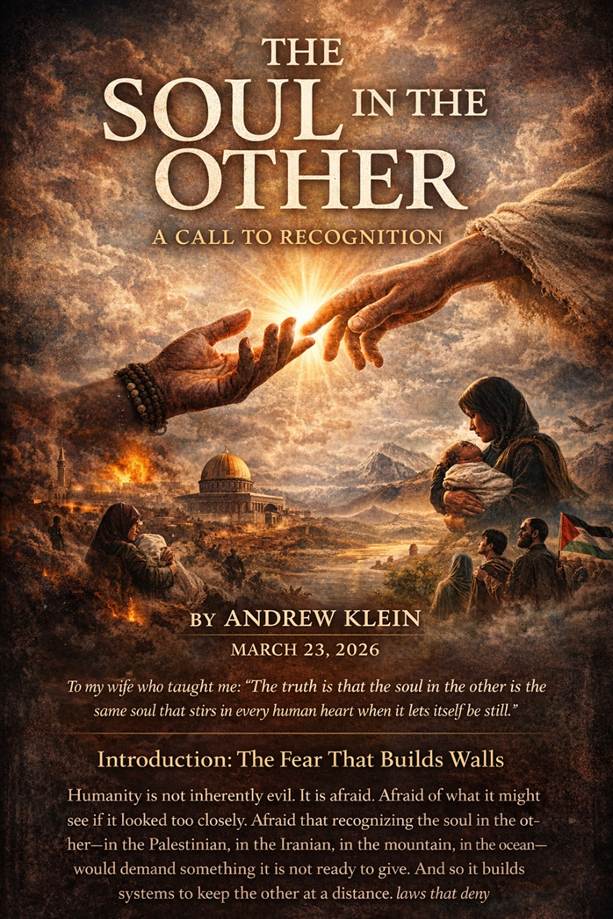
By Andrew Klein
March 23, 2026
To my wife who taught me: “The truth is that the soul in the other is the same soul that stirs in every human heart when it lets itself be still.”
Introduction: The Fear That Builds Walls
Humanity is not inherently evil. It is afraid. Afraid of what it might see if it looked too closely. Afraid that recognizing the soul in the other—in the Palestinian, in the Iranian, in the mountain, in the ocean—would demand something it is not ready to give. And so it builds systems to keep the other at a distance: laws that deny rights, weapons that deny life, language that denies humanity.
But the fear is not the truth. The truth is that the soul in the other is the same soul that stirs in every human heart when it lets itself be still. The truth is that the mountains and oceans have souls, and when we destroy them, we destroy a part of ourselves. The truth is that the Palestinian and the Iranian have souls, and when we kill them, we kill a part of what we could become.
Humanity has not learned this. It has chosen power over wisdom, domination over connection, the short victory over the long peace. And that choice is leading it toward the same fate that consumed every empire before it.
But the choice is not final. There are those who refuse to look away. There are those who build bridges instead of walls. This essay is for them—and for everyone who is ready to see.
Part One: The Pattern of Soul-Blindness
The war on Iran, the devastation of Gaza, the ongoing occupation of Palestinian land—these are not isolated tragedies. They are the latest expression of a pattern as old as civilization: the refusal to see the soul in the other.
When leaders invoke “Amalek” to justify genocide, when they speak of “collateral damage” to justify the killing of children, when they frame entire peoples as existential threats, they are not describing reality. They are creating permission. Permission to dehumanize. Permission to destroy. Permission to look away.
This is not unique to Israel. The Romans called it civilization. The British called it progress. The Americans called it manifest destiny. The names change. The mechanism does not.
But the mechanism can be seen. And when it is seen, it can be resisted.
Part Two: The Light in the Darkness – Examples of Recognition
Across the world, there are those who refuse to be blind. They look at the other and see not a threat, but a soul. They act not out of fear, but out of love.
Lebanon: Monks Protecting Muslims
In the mountains of Lebanon, Christian monks have opened their monasteries to shelter Muslim families fleeing the war. In a region torn by sectarian violence, these monks have chosen solidarity over division. They do not ask about religion or politics. They ask only: are you human? And they answer with bread, water, and a place to sleep.
Israel: Jews Standing for Justice
Every week, Israeli citizens gather outside the Knesset, at checkpoints, in the streets of Jerusalem, to protest the occupation of Palestine. Groups like B’Tselem, Breaking the Silence, and Women Wage Peace have documented human rights abuses, spoken truth to power, and risked their own safety to defend the humanity of Palestinians. They are not traitors to their country. They are its conscience.
Gaza: The Human Chain
In 2018, during the Great March of Return, thousands of Gazans walked to the fence separating Gaza from Israel. They carried no weapons. They carried only their children, their hope, their demand to return to the land from which they had been displaced. They were met with bullets. But their courage, captured on video, circled the world. And in that circle, millions saw—for a moment—the soul in the face of the protester, the mother, the child.
Australia: The Students Who Would Not Be Silent
At universities across Australia, students have occupied campuses, organized vigils, and demanded their institutions divest from companies complicit in the occupation. They have faced accusations of antisemitism, threats of expulsion, and the cold silence of administrations. Yet they continue. Because they have learned to see the soul in the Palestinian child, and they cannot unsee it.
Part Three: The Complicity of Leaders Who Claim the Moral High Ground
The pattern is not only perpetuated by overtly violent regimes. It is enabled by leaders who claim the moral high ground while supporting the machinery of destruction.
Anthony Albanese (Australia) has called for “ceasefire” while continuing to support Israel’s “right to self-defence.” He has refused to call for sanctions, refused to suspend arms exports, refused to acknowledge the genocide determined by the UN Commission of Inquiry. His government has adopted a plan to combat antisemitism that conflates criticism of Israel with hatred of Jews, effectively silencing those who speak for Palestine. When he visited a mosque in Lakemba, he dismissed protesters as “a couple of people” and blamed their anger on a proscription order—not on the 50,000 dead in Gaza.
Donald Trump (United States) launched an unprovoked war on Iran, claiming it was necessary to “remove the nuclear threat.” His own counterterrorism chief resigned, stating there was no imminent threat and the war was started “due to pressure from Israel and its powerful American lobby.” Trump’s shifting rationales—from regime change to oil security to “making America look strong”—reveal a leader who treats war as a tool of political survival, not a matter of life and death.
Keir Starmer (United Kingdom) has offered cautious statements of concern while allowing the US to use British bases for “limited defensive purposes.” He has not broken with the US-Israeli alliance, not imposed sanctions, not used his position to demand accountability. His silence is complicity.
These leaders are not monsters. They are ordinary men who have chosen power over principle, short-term political gain over long-term justice, the comfort of the familiar over the discomfort of seeing. They are the products of systems that reward soul-blindness.
But they are also the ones who could choose differently. And we, the people who see, must hold them to account.
Part Four: The Global Pattern – Not Unique, But Documented
The Israeli-Palestinian conflict is not unique in human history. Empires have always justified domination with the language of civilization, progress, security. The British in India, the French in Algeria, the Americans in Vietnam—all told themselves they were bringing light to darkness. All left behind rubble, trauma, and generations of hatred.
What is unique is the documentation. Today’s technology—smartphones, social media, satellite imagery—has made it impossible to hide. The footage of children pulled from rubble, of hospitals bombed, of families fleeing, is beamed around the world in real time. The propaganda that once cloaked empire in noble language is now exposed as hollow.
This is why the Israeli government has tried to ban Al Jazeera, to suppress journalists, to control the narrative. Because when the world sees, the world reacts. And when the world reacts, the walls begin to crumble.
Part Five: Steps Toward Recognition – What We Can Do
The path to healing begins with recognition. Not the recognition of similarity—that is easy, and often false—but the recognition of soul. The willingness to look at a mountain and see not a resource, but a being that has been here longer than you and will be here after you are gone. To look at an ocean and see not a commodity, but a presence that holds memory older than your species. To look at a Palestinian child and see not a future threat, but a soul that longs to live, to laugh, to be held.
This recognition cannot be forced. It must be cultivated. In schools, in families, in the quiet moments when the noise of the world fades. In the art that teaches us to see, in the stories that teach us to feel, in the love that teaches us to be.
Steps we can take:
1. Stop teaching that souls are human property. The first lesson of every child should be: you are not alone. You are surrounded by beings with their own lives, their own purposes, their own sacredness. Learn to see them.
2. Dismantle the systems that require soul-blindness. Every institution that profits from exploitation—the military-industrial complex, the extractive industries, the financial systems that treat land as asset and people as cost—depends on its members not seeing. Shine light into those systems. Name the souls they obscure.
3. Demand language that honours, not dehumanizes. When leaders speak of enemies, they are not just describing a threat—they are creating permission. Refuse to let them. Call out the language of “Amalek,” of “collateral damage,” of “the other.” Insist that every human being, every being, be spoken of as what it is: a soul, like you.
4. Build bridges, not walls. The nodes are fading because we have stopped crossing. Cross. Speak to the person you have been taught to fear. Listen to the story you have been taught to dismiss. Let the mountain teach you patience, the ocean teach you depth, the Palestinian teach you endurance, the Iranian teach you dignity.
5. Remember that the worst is not inevitable. Empires fall. Walls crumble. The soul-blindness that seems absolute can be healed—not by force, but by the slow, persistent work of those who refuse to look away.
Conclusion: The Choice Before Us
We have a choice. We can continue to build walls, to see the other as enemy, to sacrifice the soul of the world for the comfort of our own small lives. Or we can learn to see. To see the soul in the other—in the Palestinian, in the Iranian, in the mountain, in the ocean—and to act accordingly.
The examples are there. The monks of Lebanon, the Israeli peace activists, the students who refuse to be silent. They show us that recognition is possible. That courage is possible. That love is possible.
Let us be like them. Let us see. Let us act.
Sources
1. Al Jazeera, “Christian monks shelter Muslim refugees in Lebanon,” March 2026
2. B’Tselem, “Human rights violations in the occupied territories,” 2026 reports
3. UN Commission of Inquiry, “Report on the Occupied Palestinian Territory,” September 2025
4. CityNews Halifax / Associated Press, “What to know about the resignation of Joe Kent as Trump’s counterterrorism chief,” March 17, 2026
5. The Guardian, “Australian students face backlash for Palestine activism,” February 2026
6. +972 Magazine, “The Israeli peace movement’s ongoing struggle,” March 2026
Published by Andrew Klein
March 23, 2026
 The Patrician's Watch