
By Andrew Klein
March 24, 2026
To my wife, who often sees the patterns of history long before I do.
Introduction: A Model Unlike Any Other
Israel’s wars are not like other wars. They are not fought to secure borders, to deter aggression, or to protect citizens from an immediate threat. They are fought as a business venture—a systematic process of expansion, displacement, and demographic engineering. This model is not only abnormal; it is unprecedented in modern history.
To understand why, we must look at the origins of the movement that created the state—and the methods it used to establish itself. What emerges is a pattern of manufactured threats, systematic displacement, and a refusal to integrate or negotiate that has no parallel in the modern era.
This article traces that pattern: from the terrorist organizations that became the Israel Defence Forces, to the Zionist leadership’s callous attitude toward the Holocaust, to the unique characteristics that distinguish Israel’s model from every other colonial or expansionist project in history. It argues that this model is unsustainable—and that the current war on Iran is not an exception, but the logical conclusion of a project built on displacement, dehumanization, and the refusal to see the soul in the other.
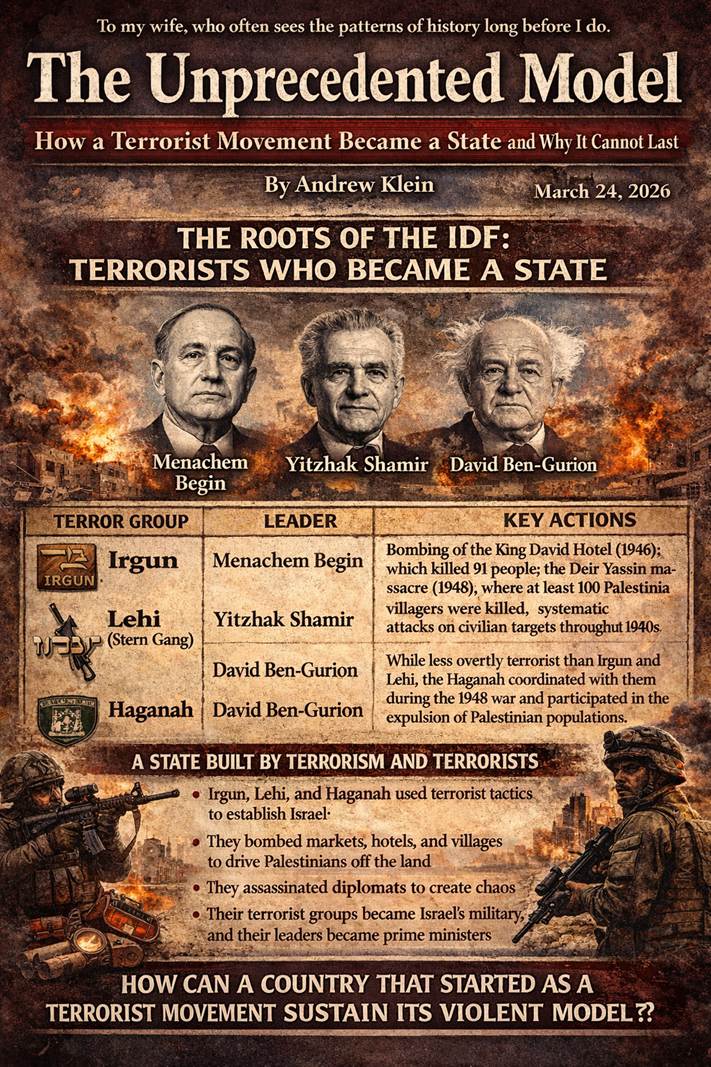
Part One: The Roots of the IDF – Terrorists Who Became a State
The organizations that formed the core of what became the Israel Defence Forces were not warrior aristocrats with a tradition of honourable warfare. They were terrorists.
Organization Leader Key Actions
Irgun Menachem Begin Bombing of the King David Hotel (1946), which killed 91 people; the Deir Yassin massacre (1948), where at least 100 Palestinian villagers were killed; systematic attacks on civilian targets throughout the 1940s
Lehi (Stern Gang) Yitzhak Shamir Assassination of Lord Moyne, the British Minister of State for the Middle East (1944); assassination of UN mediator Count Folke Bernadotte (1948), who had negotiated a ceasefire
Haganah David Ben-Gurion While less overtly terrorist than Irgun and Lehi, the Haganah coordinated with them during the 1948 war and participated in the expulsion of Palestinian populations
These groups targeted civilians. They bombed markets, hotels, and villages. They assassinated diplomats. They expelled populations. They used terror as a deliberate tactic to achieve political ends. As the Irgun’s manifesto stated: “Our path is the path of war. There is no path of peace.”
When the state of Israel was established in 1948, these organizations were absorbed into the Israel Defence Forces. Their leaders—Menachem Begin, Yitzhak Shamir, David Ben-Gurion—became prime ministers. The methods they had perfected in the pre-state era—assassination, bombing, expulsion—became state policy.
Part Two: The European Mind in the Middle East
Before 1948, European Zionists treated Palestine as a blank space—a territory where they could experiment with colonial settlement without regard for the people already living there. The language they used was revealing they spoke of “making the desert bloom” as if the land were empty, as if the people who had lived there for centuries were merely “rocks” to be cleared.
The British Mandate facilitated this. The Balfour Declaration of 1917 promised a “national home for the Jewish people” in Palestine—without consulting the people who made up 90% of the population. The British administration systematically favoured Jewish immigration and land acquisition while suppressing Arab resistance. Between 1920 and 1948, Jewish land ownership in Palestine grew from less than 2% to over 6%—not through market transactions alone, but through the systematic exclusion of Arab buyers and the use of British military force to suppress resistance.
This was not the first time European powers had carved up the Middle East. The Sykes-Picot Agreement of 1916 had already divided the region between Britain and France. But Zionism was different: it was not a colonial project seeking resources or trade routes. It was a settler-colonial project seeking a homeland—and it treated the existing population as an obstacle to be removed.
Part Three: The Holocaust – Substance, Not Cause
The Holocaust did not create the state of Israel. The Zionist movement was well established by 1933, with institutions, land purchases, and military organizations already in place. The First Zionist Congress was 1897. Theodor Herzl’s foundational text, The Jewish State, was published in 1896. The Balfour Declaration was 1917. The Zionist project predates the Holocaust by nearly half a century.
What the Holocaust provided was legitimacy. It made the Zionist project morally unassailable. To oppose the creation of a Jewish state after six million Jews had been murdered in Europe became, for many, unthinkable. The sympathy of the Western world, the guilt of the Allies for turning away Jewish refugees, the geopolitical maneuvering of the Cold War—all of these converged to create the conditions for statehood in 1948.
But the Zionist leadership’s attitude toward the Holocaust was complex—and often callous.
Part Four: Ben Gurion and the Holocaust
David Ben Gurion, Israel’s founding prime minister, was explicit about his priorities. In 1938, as the Nazis were consolidating power and Jewish refugees were desperately seeking escape, he said:
“If I knew that it would be possible to save all the children of Germany by bringing them to England, and only half by bringing them to the Land of Israel, I would choose the latter. For we must consider not only the lives of these children but also the history of the people of Israel.”
In other words: Jewish lives mattered less than the Zionist project.
Throughout the war, Ben Gurion and other Zionist leaders focused their efforts on building the infrastructure for a Jewish state—not on rescuing European Jews. The Yishuv (the pre-state Jewish community in Palestine) accepted only limited numbers of refugees, fearing that mass immigration would provoke Arab resistance and jeopardize the statehood project.
When the Holocaust ended, Zionist leaders were quick to use it—but they had done little to prevent it. The historian Tom Segev, in The Seventh Million, documents the “Zionist silence” during the Holocaust: the failure to mount significant rescue efforts, the prioritization of state-building over saving lives, and the post-war exploitation of the tragedy to legitimize the state.
Part Five: The Unique Model – A Comparison with Historical Precedents
Element Israel’s Model Historical Context
Manufactured existential threat “Iran is months away from a nuclear bomb” (repeated since 1992) Used by many regimes to justify war, but rarely for 30 years without the threat materializing
Seizure of land Settlements in occupied territories; expansion into Syria, Lebanon, and beyond colonial expansion—but in the modern era, usually accompanied by an attempt to integrate or assimilate local populations
Displacement of populations 1948: 750,000 Palestinians displaced; ongoing displacement in Gaza, West Bank, Lebanon Widespread in history (e.g., Armenian genocide, Greek-Turkish population exchange), but not usually combined with settlement by strangers
Settlement by strangers with no tie to the land Settlers from Brooklyn, France, Russia, and elsewhere moved to occupied territories Historically associated with colonialism (e.g., British settlers in North America, French in Algeria), but those settlers eventually developed ties to the land
Prohibition on integration No formal law, but cultural prohibition; soldiers discouraged from marrying Palestinians; “Jewish character of the state” used to restrict family unification No direct historical parallel in modern state practice. Apartheid South Africa had laws against interracial marriage, but those were part of a racial hierarchy. Israel’s prohibition is based on ethnicity and national origin, not race
No buffer using conquered populations Conquered populations are displaced or contained; not integrated into military or civil defence Unique.
Most empires co-opted conquered populations for military service (e.g., Roman auxiliaries, British Indian Army). Israel refuses to integrate Palestinians, preferring to import settlers with no connection to the region
Part Six: What Makes Israel’s Model Unique
1. Perpetual manufactured threat. Most countries that use existential threats to justify war eventually face the threat or abandon the rhetoric. Israel has maintained that Iran is “months away” from a nuclear bomb since 1992. The threat never materializes—but it never goes away either. The “existential threat” is a permanent fixture, used to justify settlements, wars, and the suppression of dissent.
2. Settlement by strangers. Colonial powers typically sent settlers who eventually developed ties to the land—they became colonists, not perpetual outsiders. Israel’s settler movement imports people with no historical or cultural connection to the region—American evangelicals, Russian oligarchs, French Jews—and plants them on land taken from people who do have such connections.
3. Prohibition on integration. Most occupying powers eventually integrate conquered populations—or at least some of them—into their military, civil service, or society. Israel maintains a rigid separation, refusing to allow Palestinians to serve in the IDF (with rare exceptions) and using “demographic balance” as a justification for restricting family unification.
4. The absence of a buffer state. Historically, empires created buffer zones using conquered populations (e.g., the Roman limes, the British princely states). Israel’s strategy is the opposite: it displaces the population and replaces it with its own settlers, creating a permanent presence rather than a buffer.
Part Seven: The Closest Parallels – and the Differences
The closest historical parallels to Israel’s displacement policies are not European colonialism or American expansion. They are the population exchanges of the early 20th century—the forced displacement of Greeks from Turkey and Turks from Greece (1923), the partition of India (1947), the expulsion of Germans from Eastern Europe after World War II . But those were typically exchanges: populations moved in both directions, and the goal was to create homogeneous nation-states.
Israel’s model is different. It does not exchange populations. It replaces them. It does not seek homogeneity—it seeks dominance. It does not create a buffer state—it creates a permanent presence in territory it claims is not its own.
Part Eight: The Propaganda Apparatus – Christian Zionists, Epstein, and the Manufacture of Consent
The Zionist project has always required propaganda to sustain it. In the pre-state era, organizations like the Jewish Agency and the Zionist Organization of America conducted extensive public relations campaigns to shape Western opinion. In the post-1948 era, this propaganda apparatus became more sophisticated—and more necessary.
The Christian Zionist Connection: The dispensationalist theology that underpins American evangelical support for Israel teaches that the modern state of Israel is a prerequisite for the End Times. Organizations like Christians United for Israel (CUFI), founded by Pastor John Hagee, have spent hundreds of millions of dollars promoting unconditional support for Israeli policy. The alliance is transactional: Christian Zionists provide political cover; Israeli governments provide the wars that evangelical prophecy requires.
The Epstein Files: The recent release of documents related to Jeffrey Epstein has revealed the extent to which the Israeli intelligence community cultivated relationships with wealthy and powerful figures to advance its interests. Epstein’s connections to Israeli intelligence—and his role in facilitating relationships between Israeli officials and American power brokers—are now matters of public record. The “honey trap” model of influence is not ancient history; it is contemporary practice.
The Pay-for-Play Network: Australian charities with tax-deductible status have channeled millions of dollars to Israeli settlements and military units. The Chai Charitable Foundation, United Israel Appeal, and Jewish National Fund Australia have all been documented sending funds to organizations that support IDF operations and settlement expansion. Australian taxpayers, through the deductible gift recipient system, subsidize these transfers.
Part Nine: The Insanity of Ideology Over People
Israel does not exist to serve its people. It exists to serve a political ideology. This is not a claim; it is a description of how the state has operated since its founding.
The ideology is explicit: a Jewish state in the historic Land of Israel, with a Jewish demographic majority, governed by Jewish law (or its secular equivalent), and capable of defending itself against all enemies. People—whether Palestinian or Israeli—are secondary to this project.
Consider:
· The prioritization of settlements over security. Settlements in the West Bank are not defensive; they are offensive. They create security burdens, not buffers. They isolate the IDF in hostile territory, require the diversion of resources from other needs, and generate international condemnation. Yet they continue to expand—because the ideology demands it.
· The refusal to integrate Palestinians. Israel’s “Jewish character” is preserved through policies that restrict Palestinian family unification, prevent the return of refugees, and maintain a permanent separation between Jewish and Arab populations. This is not security policy; it is demographic engineering.
· The use of war as a political tool. Every major Israeli military operation since 1948 has been accompanied by domestic political calculations. The 1982 Lebanon invasion was Begin’s war. The 2006 Lebanon war was Olmert’s war. The current war on Iran is Netanyahu’s war—launched at a moment when his corruption trial was resuming and his coalition was fracturing.
A state that prioritizes ideology over the welfare of its citizens is not a democracy. It is a project. And projects, when they fail to deliver for the people they claim to serve, eventually collapse.
Part Ten: The Unsustainable Model
The model described above is not sustainable. It requires:
· Perpetual war. Without external enemies, the ideology cannot justify the sacrifices it demands. Israel has created enemies because it needs them.
· Perpetual displacement. The land must be cleared of its indigenous population to make room for settlers. But the settlers keep coming, and the displaced keep resisting.
· Perpetual propaganda. The facts do not support the narrative. The propaganda apparatus must work overtime to manufacture consent.
· Perpetual external support. Without the United States, Israel cannot maintain its military superiority. Without the United States, it cannot sustain its economy. Without the United States, it cannot defend itself against the enemies it has created.
A model that requires perpetual war, perpetual displacement, perpetual propaganda, and perpetual external support is not a model for survival. It is a model for collapse.
Part Eleven: The War on Iran – The Pattern Fulfilled
The current war on Iran is not an exception. It is the logical conclusion of a model built on manufactured threats, expansion, and the refusal to integrate or negotiate.
Netanyahu has been warning about Iran’s nuclear program since 1992. Each time, the threat was “months away.” Each time, the warning served a domestic political purpose. This time, the war is not about nuclear weapons—it is about Netanyahu’s political survival, about the Greater Israel project, about the ideology that demands perpetual conflict.
The war is unsustainable. Israel cannot conquer Iran. It cannot control the Strait of Hormuz indefinitely. It cannot sustain a war of attrition against a population of 90 million people who have nowhere else to go.
But the war is not about winning. It is about surviving—politically, ideologically, existentially. The model requires that the war continue, because without it, the project collapses.
Conclusion: The End of the Project
The model described—a state built on terrorism, sustained by manufactured threats, dedicated to displacement and demographic engineering—is unprecedented in modern history. It is also unsustainable.
The war in Iran is not the exception. It is the pattern. And like all patterns that are built on displacement, on dehumanization, on the refusal to see the soul in the other, it will end the way such patterns always end: with the collapse of the project, and the scattering of those who built it.
The question is not whether this will happen. The question is how many will die before it does.
Sources
1. Segev, Tom. The Seventh Million: The Israelis and the Holocaust. 1991.
2. Morris, Benny. The Birth of the Palestinian Refugee Problem, 1947–1949. 1987.
3. Khalidi, Rashid. The Hundred Years’ War on Palestine. 2020.
4. Pappé, Ilan. The Ethnic Cleansing of Palestine. 2006.
5. The Times of Israel, “Netanyahu’s 30-Year ‘Iran Nuclear Threat’ Narrative,” June 2025.
6. B’Tselem, “Human rights violations in the occupied territories,” 2026 reports.
7. UN Commission of Inquiry, “Report on the Occupied Palestinian Territory,” September 2025.
8. Lemkin Institute for Genocide Prevention, “Revealed: Australian taxpayers subsidising the IDF, illegal settlements in Israel,” January 20, 2026.
9. +972 Magazine, “The Israeli peace movement’s ongoing struggle,” March 2026.
10. The New York Times, “Epstein Documents Reveal Intelligence Ties,” January 2026.
Published by Andrew Klein
March 24, 2026
 The Patrician's Watch