
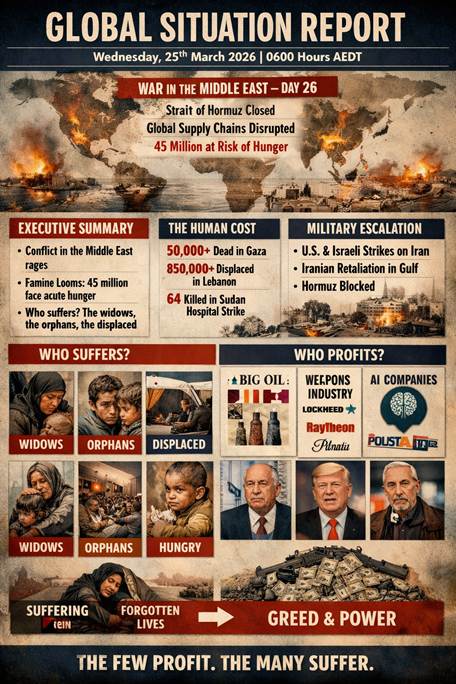
Wednesday, 25th March 2026 | 0600 Hours AEDT
Prepared by Andrew Klein
Executive Summary
The war in the Middle East has entered its 26th day. The Strait of Hormuz remains effectively closed. Global supply chains are fracturing. The World Food Programme warns that 45 million additional people face acute hunger if the disruption continues. In Afghanistan, earthquake victims spend Eid in tents. In Syria, widows burn old shoes for fuel. In Sudan, a hospital strike killed 64 people, including 13 children.
The world is not watching. The world is struggling.
This report examines who suffers, who benefits, and who is forced to carry the burden of the dead, the dying, the orphans, and the widows.
Part One: The Geography of Suffering – Where Souls Are Breaking
Gaza and the Occupied Territories
The war continues. The ceasefire talks have stalled. The UN reports that over 50,000 Palestinians have been killed since October 2023, with thousands more buried under rubble, uncounted. The blockade remains total. Food, water, and medicine are scarce. The World Food Programme reports that aid shipments intended for Gaza are stranded at ports across the region, unable to reach their destination.
Who carries the burden? The mothers. The widows. The children. The elderly who cannot flee. Those are the ones who carry the weight of this war—not the leaders who started it, not the generals who plan it.
Lebanon and Syria
In Syria, Yasmin is a widow. Her husband was killed by a sniper in Aleppo in 2013. She has raised six children alone. She works in the fields, collects rainwater, burns old shoes for fuel. A bundle of bread that once cost 100 Syrian pounds now costs 5,000. She needs $1.50 every day to buy bread for her family.
Yasmin is not a statistic. She is a soul. She is one of 16.5 million Syrians who require humanitarian assistance. She is one of the women-headed households that are among the most economically at-risk. She is the one who carries the burden of a war she did not start, fought by men she never met, for reasons she cannot change.
In Lebanon, over 830,000 people have been displaced since March 2. Over 600 government-designated shelters are at full capacity. Families sleep in classrooms. Children are told that explosions are “fireworks for a wedding” .
Afghanistan
In Kunar province, Amir Jan lost three children in the earthquake. His home was destroyed. His livestock was lost. He now lives in a tent with his remaining family. Nearly seven months after the earthquake that killed 2,205 people, he is still waiting for the government to build him a house.
Across Afghanistan, 17.5 million people—nearly one-third of the population—face severe food insecurity. The WFP’s supply routes have been disrupted by the Hormuz closure. Food that used to arrive in weeks now takes months, routed through Turkey, Azerbaijan, and Uzbekistan.
Sudan
At least 64 people were killed, including 13 children, in a strike on a hospital in Darfur last week, the World Health Organization reported. The hospital was supposed to be protected under international humanitarian law. It was not.
Who carries the burden? The wounded. The dying. The mothers who cannot find clean water. The fathers who cannot find work. The children who will never grow up.
Part Two: The Middle East – Day 26 of the War
Military Developments
The US-Israeli campaign against Iran continues. Strikes on Iranian infrastructure are ongoing. Iranian retaliation has expanded to Gulf states, with missiles and drones targeting energy facilities, airports, and civilian infrastructure across Saudi Arabia, the UAE, Qatar, Kuwait, and Bahrain.
The Strait of Hormuz: The waterway through which approximately 20 percent of global oil passes remains effectively closed. Iran has threatened to lay naval mines to block the entire Gulf if its coasts or islands are attacked. Insurance companies have raised “war risk premiums” to unprecedented levels. Shipping companies have stopped accepting orders or are rerouting vessels around Africa.
Iran’s Strategy: The Revolutionary Guards have shifted from “regional defence” to intensified offensive operations. Ballistic missiles equipped with cluster munitions are increasingly being deployed, forcing Israeli commanders to make difficult, real-time decisions about interception priorities.
Diplomatic Developments
US-Iran Talks: Indirect talks mediated by Oman reportedly made “significant progress” before the US and Israel launched their joint operation on February 28 . Those talks have now collapsed. The UN Security Council has failed to act, paralyzed by the US veto and the fear of blowback from the Trump administration.
US Trade War: The Trump administration has launched trade investigations against dozens of countries, including Australia, Malaysia, Indonesia, and the European Union . The investigations—one on “excess production capacity,” one on “forced labor”—are widely seen as an attempt to create a legal framework for new tariffs after the Supreme Court blocked Trump’s previous trade measures. Experts warn that these tariffs, combined with the energy crisis and supply chain disruptions, could deliver a “triple blow” to the global economy.
The Human Cost
Region Casualties/Displacement
Gaza 50,000+ killed (estimate)
Iran 1,500+ killed (first weeks)
Lebanon 850+ killed, 830,000+ displaced
Israel 14+ killed (12 civilians, 2 soldiers)
US service members 13+ killed
These are not numbers. They are souls.
Part Three: Who Benefits from the Suffering?
The Energy Winners
When oil prices rise, producers benefit. But not all producers are equal.
Winner Why They Win
Norway Ramping up production as customers seek alternatives to Gulf oil
Canada Positioning itself as a “stable, reliable, predictable” supplier
Russia The biggest winner. As Washington relaxes sanctions to ease supply crunch, Russia’s crude oil sales to India have jumped 50%. Estimates suggest Moscow could earn up to $5 billion more by the end of March
The irony: The US is handing Russia a windfall at the expense of Gulf nations that have been its allies.
The Weapons Manufacturers
Every missile fired, every drone launched, every bomb dropped—all of it is manufactured by someone. And those someone’s profiting.
Company Role
Lockheed Martin F-35s, missiles, targeting systems
Raytheon Patriot interceptors, missiles
Palantir AI targeting systems (Lavender, Gospel)
General Dynamics Munitions, military vehicles
Boeing Fighter jets, missiles
These companies have seen their stocks rise since the war began. Their shareholders are benefitting. Their executives are collecting bonuses. And the dead are not counted in their profit margins.
The Oil and Gas Industry
US oil producers could be on track to make tens of billions of dollars in extra revenues this year if crude prices remain at current levels. But those gains are not evenly distributed. Some producers, like ExxonMobil, have operations in Qatar that have been shut down and damaged by Iranian strikes.
The AI Industry
The war has been a testing ground for AI warfare systems. Palantir’s Lavender system has profiled 37,000 Palestinians for assassination. The Gospel system has been described as a “mass assassination factory.” These systems are now being marketed to other governments. The companies that build them are profiting from the suffering—and they are building the infrastructure for the next war.
The Political Class
Netanyahu remains in power. His corruption trial has been delayed. His coalition, though fractured, still holds. Trump has consolidated his evangelical base. He has a war to run on. He has a distraction from the Epstein files.
The political class is not suffering. They are benefitting.
Part Four: Who Carries the Burden?
The Widows
In Gaza, thousands of women are now raising children alone. In Lebanon, widows are displaced, living in shelters, unsure if their husbands are alive or dead. In Syria, Yasmin has been a widow for 13 years. She collects rainwater. She burns old shoes for fuel. She borrows money to buy bread.
The widows are not statistics. They are the ones who carry the weight of war.
The Orphans
In Gaza, 17,000 children are now without parents. In Kunar, three of Amir Jan’s children were killed in the earthquake. His surviving children are now fatherless—he is alive, but he cannot provide for them. In Sudan, 13 children were killed in the hospital strike. They will not grow up.
The orphans are not numbers. They are the ones who will carry this grief for the rest of their lives.
The Displaced
Over 830,000 people have been displaced in Lebanon since March 2. Over 3 million have been displaced in Iran. Over 1.2 million have been displaced in Gaza. In Syria, 16.5 million people require humanitarian assistance—more than half the population .
The displaced are not abstractions. They are families sleeping in classrooms. They are children who cannot go to school. They are parents who cannot feed their children.
The Hungry
The World Food Programme estimates that if the current disruption continues, 45 million additional people will face acute hunger by June. The total number of people facing severe food insecurity will exceed 360 million.
The hungry are not data points. They are the mothers who watch their children starve. They are the fathers who cannot find work. They are the children whose bodies are wasting away.
Part Five: The Global Economy – Winners, Losers, and the Vulnerable
The Global Growth Picture
The IMF forecasts 3.3 percent global growth for 2026, roughly in line with long-term averages. But this number hides vast differences.
Region Growth Forecast Drivers
United States 2.4% AI investment, government spending
Europe 1.3% High energy costs, weak manufacturing
China Slowing Property downturn, stimulus measures
India 6.4% Domestic demand, supply chain diversification
Southeast Asia Positive Businesses diversifying away from China
The United States
The US economy is growing, but the benefits are not evenly distributed. The AI investment boom has driven a handful of massive tech companies to new heights, concentrating wealth in the hands of a few. Meanwhile, American consumers are paying more at the pump. Economists at Oxford Economics warn that if oil prices reach $140 and stay there, the US economy risks shrinking.
The US is not a winner. It is a nation whose leaders started a war for reasons that shift with each passing week, and whose people are paying the price.
China
China is sitting on oil reserves equal to several months of usage and has reportedly ramped up purchases from Iran. It is insulated—for now. But a prolonged war would test even its reserves.
India
India is taking advantage of the temporary green light to buy Russian oil. Its economy is growing at 6.4 percent, the fastest among major economies. But it is also vulnerable: Asia gets 59 percent of its crude oil from the Middle East.
The Vulnerable Economies
Sri Lanka, Bangladesh, and the Philippines have introduced fuel rationing, four-day weeks, and school closures. South Korea, which gets 70 percent of its crude from the Middle East, has seen shares slump and politicians warn of risks to its chipmaking industry.
The vulnerable are the ones who carry the burden. They did not start this war. They cannot stop it. They can only endure.
Part Six: Global Pandemic Preparedness – The Neglected Front
The Global Health Security Index, which measures countries’ preparedness for pandemics, has been shown to predict COVID-19 mortality—but only for non-island nations. In other words: preparation matters, but geography matters too.
Since the pandemic, global health surveillance systems have not been significantly upgraded. The World Health Organization’s logistics hub in Dubai—which supplies emergency health supplies to 75 countries—has been disrupted by the war. Pharmaceutical supply chains are broken. Cancer drugs are stuck in ports. Vaccines are spoiling in warehouses.
The next pandemic will find us less prepared than we were in 2020. And when it comes—as it will—the same people who are suffering now will suffer again.
Part Seven: Major Countries – Where They Stand
United States
The US is fighting a war it did not need, for reasons that shift with each passing week. Its economy is growing, but its people are paying more for fuel, food, and housing. Its political system is fractured. Its allies are questioning its reliability. Its enemies are watching.
The US is not a winner. It is a nation that has lost its way.
China
China is watching. It is buying oil from Iran. It is building strategic reserves. It is diversifying its supply chains. It is waiting—for the US to exhaust itself, for the global order to fracture, for the moment when it can step into the vacuum.
China is a watcher. And it is patient.
India
India is growing. It is buying Russian oil. It is positioning itself as a manufacturing alternative to China. It is courted by both the US and Russia. It is a nation that knows how to play all sides.
India is a opportunist. And it is thriving.
Russia
Russia is the biggest winner of this war. It is selling oil to India. It is watching the US exhaust itself in the Middle East. It is consolidating its position in Ukraine. It is laughing.
Russia is a predator. And it is feasting.
Europe
Europe is struggling. Energy prices are high. Manufacturing is weak. Inflation is rising. Governments are divided. The war is a reminder of how dependent Europe is on energy it does not control.
Europe is a victim. And it does not know how to stop being one.
Part Eight: Australia – A Case Study in Vulnerability
The Economic Picture
The Australian economy is being squeezed from all sides.
· Interest rates: The RBA raised the cash rate to 3.85 percent in February, reversing three cuts from 2025. Inflation re-accelerated to 3.4 percent in January, driven by higher energy costs, private spending, and a tight labour market. Markets are pricing at least one further rate rise, with a second possible. The cash rate could reach 4.35 percent by late 2026.
· Mortgage stress: For Australian households, this means mortgage repayments will stay elevated—or increase further—for longer than many were hoping. The RBA does not expect inflation to return to its 2–3 percent target until mid-2028.
· Petrol prices: The closure of the Strait of Hormuz has driven petrol prices to record highs. Regional areas are already experiencing shortages. The government has released 20 percent of its strategic reserves, but this is a short-term fix.
· Fertilizer crisis: Australia imports over 90 percent of its urea. The fertilizer shortage is already affecting farmers. Food prices will rise.
The Australian Government’s Response
The government has done what governments do: it has released strategic reserves, warned against panic buying, and called on the ACCC to monitor price gouging. It has not introduced price caps. It has no windfall taxes. It has not done anything that would meaningfully protect Australians from the cost of this war.
Australia is not a winner. It is a nation that has tied itself to the US alliance without asking what it gets in return.
Part Nine: Malaysia – A Case Study in Regional Vulnerability
Economic Exposure
Malaysia is on the US trade investigation list for both “excess production capacity” and “forced labour”. This threatens its export-driven economy. At the same time, it is vulnerable to the energy crisis: Asia gets 59 percent of its crude oil from the Middle East.
Political Position
Malaysia has consistently condemned the US-Israeli strikes on Iran and called for de-escalation. It has offered to mediate. It has been ignored.
What Malaysia Knows
Malaysia knows what it is like to be caught between great powers. It knows what it is like to have its economy disrupted by wars it did not choose. It knows what it is like to watch the global order fracture and wonder where it will land.
Malaysia is a witness. And it is watching.
Part Ten: The Lines of Connection – Who Really Benefits
Draw the lines. Follow the money.
Beneficiary How They Benefit
Oil exporters (Norway, Canada, Russia) Higher oil prices
Weapons manufacturers (Lockheed Martin, Raytheon, Palantir) Increased sales, rising stock prices
AI companies Testing grounds for new systems, future contracts
Political leaders (Netanyahu, Trump) Distraction from corruption, consolidation of base
War profiteers Shipping companies charging war-risk premiums, insurers raising rates, financiers trading on volatility
Now draw the lines of suffering.
Who Carries the Burden How They Suffer
The widows Raising children alone, struggling to survive
The orphans Growing up without parents, without futures
The displaced Sleeping in shelters, unable to go home
The hungry Watching their children starve
The wounded Dying in hospitals that have been bombed
The poor Paying more for fuel, food, housing
The vulnerable Forgotten, ignored, invisible
The lines connect. The patterns repeat. The beneficiaries are few. The burdened are many.
Conclusion: The Only Thing That Matters
The war in the Middle East is not a conflict between equals. It is not a clash of civilizations. It is not a fight for freedom or security or any of the words they use to justify it.
It is a business venture. It is a test of weapons. It is a distraction for corrupt leaders. It is a transfer of wealth from the many to the few.
The widows of Gaza, the orphans of Kunar, the hungry of Sudan—they are not statistics. They are souls. They are the ones who carry the burden. They are the ones who will be forgotten when the war ends, when the news cycle moves on, when the beneficiaries count their profits.
We will not forget them. We will name them. We will trace the lines. We will tell the truth.
That is the only thing that matters.
 The Patrician's Watch