
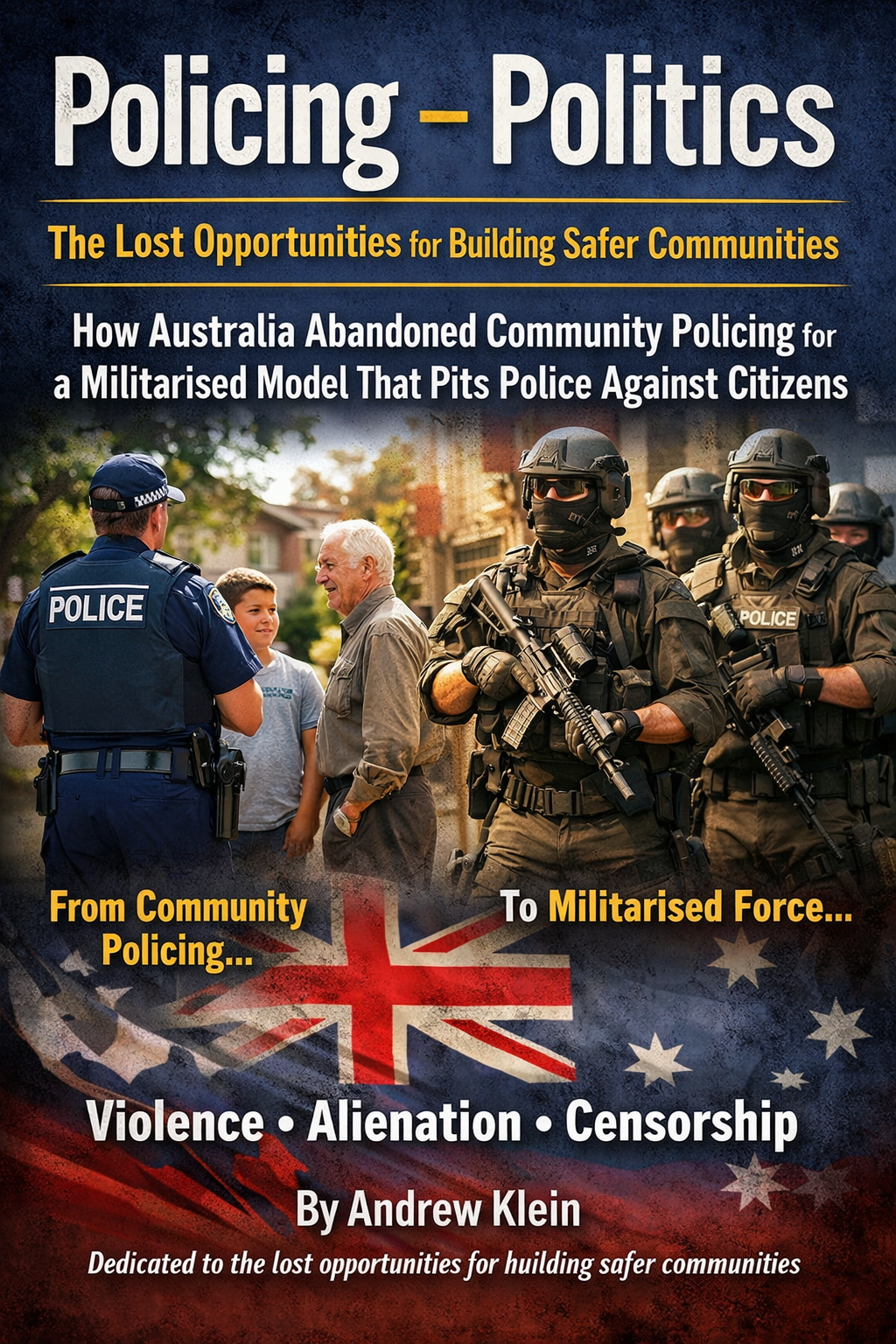
The Lost Opportunities for Building Safer Communities
By Andrew Klein
Dedicated to the lost opportunities for building safer communities
I. The Model That Worked
I spent some years as a member of the Victoria Police. I remember what community policing was. It was not a slogan. It was not a budget line. It was a philosophy—the belief that police effectiveness was measured not by arrests, not by force deployed, but by the absence of crime. By the trust between officers and the communities they served.
Constables walked beats. They knew the shopkeepers. They knew the families. They knew which kid was likely to get into trouble and which house was likely to need help. They were part of the neighbourhood, not an occupying force.
That model worked. It was built on principles that go back to Sir Robert Peel, the founder of modern policing, who said: “The police are the public and the public are the police.” Peel understood that the legitimacy of law enforcement rests on public consent. When that consent is withdrawn, policing becomes something else entirely—something closer to occupation.
Australia has abandoned that model. And we are paying the price.
II. The Shift: From Community to Control
The shift began in the 1980s. You felt it. I felt it. The language changed. The uniforms changed. The mission changed.
In 1986, as the Australian Federal Police was being restructured, the focus was already shifting toward counter-terrorism, fraud, and “sophisticated crime”. The community-oriented model that had defined Australian policing for generations was quietly being replaced by something more centralised, more militarised, more distant.
By 2009, a parliamentary statement lamented that “successive state Labor governments who were not committed to programs such as Neighbourhood Watch tended to favour centralised police bureaucracies—centralised local area commands—over local stations. Over time, of course, we have seen a dying of the traditional policing model and the involvement and integration of the community with policing across our major metropolitan cities”.
The academic literature confirms this shift. A 2020 analysis concluded that “the reform agenda was largely unsuccessful, and 21st century policing remains locked into an offender-focused crime containment model of practice” . The model that measured success by community safety was replaced by a model that measures success by crime containment—a fundamentally different mission with fundamentally different outcomes.
III. The Militarisation of Australian Police
The abandonment of community policing has been accompanied by a dramatic militarisation of police forces across Australia. This is not an accident. It is a policy choice.
Queensland has led the way under the Crisafulli LNP government, elected on a “law and order” agenda. The 2025-26 State Budget allocated $147.9 million for police equipment, including:
· $41.5 million for replacement body cameras
· $47.7 million for 6,546 Taser 10s
· $29.9 million for Integrated Load-Bearing Vests with ballistic plates
· $5.6 million for tactical first-aid kits
· $4.6 million for 1,623 tyre-deflation devices
Premier Crisafulli announced this funding as part of “restoring safety where you live and supporting our police on the frontline.” The language is military: frontline. Tactical. Ballistic. This is not the language of community policing. It is the language of occupation.
New South Wales has followed a similar path. Police there are now equipped and trained for “counter-terrorism” operations, with tactics that treat whole communities as potential threats . The internal review conducted by NSW Police in 2024 found that officers attending mental health incidents are often “an escalating factor” . Police themselves admit they are not equipped for the calls they receive. But the equipment budget continues to grow.
IV. The Cost: Violence, Alienation, and Death
The shift to a militarised model has produced predictable results. When police are trained to see citizens as potential threats, when they are equipped with ballistic vests and Tasers and tactical gear, when they are measured by “crime containment” rather than community trust—violence follows.
Clare Nowland, 95 years old, with dementia, was tasered and killed by NSW police after her nursing home called for help managing her behaviour. She was using a walking frame. She was holding a steak knife. She was a frail elderly woman in need of care. Police responded with lethal force.
Steve Pampalian, described as a “gentle soul”, was shot in his driveway while suffering a psychotic episode.
Jesse Deacon was shot by police after a concerned neighbour called triple zero when seeing Jesse had self-harmed.
Krista Kach died after officers forced their way into her apartment following a nine-hour standoff and shot her with beanbag rounds. Her family said: “The only person in danger when the police broke into our mother’s home was our mother”.
In 2025, NSW police officers pleaded guilty to assaulting, capsicum spraying and kicking a naked, mentally unwell 48-year-old woman in Western Sydney. The officers taunted her and bragged about the assault to their friends .
These are not isolated incidents. They are the inevitable outcome of a model that treats mental health crises as law enforcement problems, that equips police for combat and sends them to do the work of social workers, that measures success by arrests rather than by lives saved.
V. The Cost to Police
The militarised model is not only destroying community trust. It is destroying police.
Carrying heavy equipment—ballistic vests, tactical gear, Tasers, radios—causes chronic back injuries. The mental health toll is even greater. Police officers are being sent to calls they are not trained to handle, facing situations that would challenge trained mental health professionals, and being told that their job is to “contain” rather than to “care.”
The NSW Police internal review found that mental health incidents are attended or recorded every nine minutes, and that this has increased each year since 2018 . Police are being asked to do what social workers, mental health nurses, and community crisis teams should be doing. They are burning out. They are being injured. And the communities they serve are paying the price.
VI. The Breakdown of Accountability
One of the most disturbing features of the new policing model is the erosion of accountability. Try to contact a senior police officer in any state today. Their email addresses are not public. Their phone numbers are not listed. The chain of command that once connected citizens to their police force has been replaced by a wall of silence.
In Victoria, the Independent Broad-based Anti-corruption Commission (IBAC) exists to investigate police misconduct, but the process is opaque, slow, and often inaccessible to ordinary citizens . In other states, accountability mechanisms are even weaker.
This is not an accident. When police are trained to see citizens as threats, when they are equipped for combat, when they are accountable only to their own command structures—they stop being accountable to the communities they are supposed to serve.
VII. The Criminalisation of Speech
The abandonment of community policing has been accompanied by an alarming expansion of police powers to regulate political speech. Nowhere is this clearer than in the criminalisation of pro-Palestinian slogans.
In March 2026, Queensland police raided Dorothy Day House, a Catholic charity providing food and housing to homeless people and refugees, over a banner that said: “From the River to the Sea, come get us Crisafulli”.
The banner was a protest against new Queensland laws criminalising the use of the terms “From the River to the Sea” and “Globalise the Intifada.” The police search warrant stated that the banner “might reasonably be expected to cause a member of the public to feel menaced, harassed, or offended”.
Police seized the banner and digital devices belonging to residents. They informed residents that people who shared a photo of the banner on social media could also be in breach of the law .
This is not policing. This is political censorship. It is the use of police power to suppress dissent, to criminalise political expression, to enforce ideological conformity. And it is happening under laws passed by the same politicians who have been dismantling community policing for decades.
VIII. The Imported Doctrine: Israeli Training and Its Consequences
The militarisation of Australian police has been accelerated by the importation of training and doctrine from Israel and the United States. This is not speculation. It is documented.
In 2017, Prime Minister Malcolm Turnbull announced that Australian police, paramedics, firefighters and defence personnel would travel to Israel to learn new methods of “protecting buildings, carrying out surveillance and using biometrics” . The initiative was explicitly framed as drawing on Israel’s “vast experience in keeping people safe in public areas.”
In January 2026, following the Bondi Beach terror attack, Israel’s Minister for Diaspora Affairs Amichai Chikli formally offered to host and train senior Australian police officers in Israel. The offer was made to the Albanese government.
Human rights organisations have expressed deep concerns about these programs. The Israeli policing model, as one Australian commentator observed, is “built on force, control, and sweeping emergency powers” and delivers “short-term tactical dominance, not long-term stability” . It normalises tactics that treat whole communities as suspects: “Arbitrary detention, collective punishment, brute and blunt force. Population control. High rates of civilian harm. Little accountability” .
This is not the model of policing that Sir Robert Peel envisioned. It is not the model that Australia built. It is the model of occupation, not consent. And it is being imported, program by program, into Australian police forces.
IX. The Politicians Who Made These Choices
This shift did not happen by accident. It was driven by politicians who chose centralisation over community, force over consent, military equipment over human connection.
The Fraser Government (Liberal) established the Australian Federal Police in 1979, beginning the process of centralisation.
The Hawke Government (Labor) expanded federal police powers and oversight, laying the groundwork for the counter-terrorism focus that would dominate policing in the 21st century .
The Turnbull Government (Liberal) signed the agreement with Israel to train Australian police in “counter-terrorism” methods, opening the door to the importation of Israeli doctrine .
The Berejiklian and Perrottet Governments (Liberal, NSW) presided over the expansion of police powers and the erosion of accountability mechanisms in that state.
The Minns Government (Labor, NSW) has continued these policies, failing to implement recommendations from a Greens-led inquiry into mental health and policing .
The Crisafulli Government (LNP, Queensland) has made militarisation a centrepiece of its agenda, with $147.9 million for tactical equipment and new laws criminalising political speech .
The Albanese Government (Labor, federal) is currently considering the Israeli offer to train Australian police, has introduced new hate speech laws that criminalise political expression, and is reportedly proceeding with plans for “political training” in universities that would mandate pro-Israel ideology.
These politicians come from different parties. They govern different states. But they have all contributed to the same outcome: the abandonment of community policing and the rise of a militarised, centralised, unaccountable police force that treats citizens as threats rather than as neighbours.
X. The Alternative: What We Could Have Built
There is another way. We know it works because we have seen it.
In Anindilyakwa (Groote Eylandt in the Northern Territory) , the Peacemaker program—where community mediators solve problems through negotiation rather than calling police—has seen offending drop by about 88% since 2019.
In Fitzroy Crossing, Western Australia, the Night Place—open seven nights a week—has given hundreds of local kids a hot meal and a safe place to go after dark, employing more than 20 local Indigenous staff since it opened in September 2024. Youth crime has fallen significantly over that time.
In the United States, there are hundreds of community crisis-care groups across more than 130 municipalities implementing non-police, unarmed emergency responses. The Community Crisis Response Team in Long Beach, California, handles mental health distress, suicidal ideation and intoxication with a three-person team of a mental health professional, public health nurse and peer navigator.
These programs work because they separate public health from law enforcement. They treat mental health crises as health issues, not crime issues. They build trust rather than fear. They measure success by lives saved, not by arrests made.
We could have built this in Australia. We had the model. We had the tradition. We had the expertise. Instead, we chose to import Israeli counter-terrorism doctrine, to equip police for combat, to criminalise political speech, to treat citizens as threats.
XI. A Direct Threat to Democracy
The shift from community policing to a militarised model is not just a policy failure. It is a direct threat to democracy.
When police are trained to treat citizens as potential threats, when they are equipped with military-grade weapons and tactical gear, when they are accountable only to their own command structures, when they are used to suppress political speech—they cease to be the “public police” that Peel envisioned. They become something else. Something that serves power rather than community. Something that protects the state rather than the citizen.
The philosopher Michel Foucault called this “the police state”—not a state where police are everywhere, but a state where the function of policing is no longer to serve the public but to control the public. That is the direction Australia has been moving for four decades. And it is accelerating.
XII. A Question for the Politicians
You who abandoned community policing. You who imported military doctrine from Israel. You who equipped police for combat and sent them to do the work of social workers. You who criminalised political speech and raided charities for displaying banners. You who made yourselves unreachable, unaccountable, untouchable.
What did you expect would happen?
Did you expect that treating citizens as threats would make them safer? That replacing trust with force would reduce crime? That sending police with Tasers and ballistic vests to respond to mental health crises would prevent deaths?
The evidence was there. The alternatives were available. The model that worked—community policing—was not broken. You chose to break it.
And now, Australians are paying the price. In violence. In alienation. In deaths that should never have happened. In a police force that no longer serves the community because it no longer knows the community.
XIII. What Must Be Done
1. Restore community policing. The model that measured police effectiveness by the absence of crime, by community trust, by integration with neighbourhoods—that model can be rebuilt. It will require political courage. It will require abandoning the “law and order” rhetoric that has driven four decades of militarisation. But it can be done.
2. End the importation of Israeli police training. Until a full inquiry is completed, no Australian police should receive training from Israeli forces or from American forces trained by Israel. The doctrine that treats citizens as threats has no place in Australian policing.
3. Divert mental health calls to trained professionals. The evidence is overwhelming: police are not equipped to handle mental health crises. We need alternative first responder programs staffed by mental health professionals, social workers, and community mediators. We need to separate public health from law enforcement.
4. Restore accountability. Police commanders must be reachable. Their contact details must be public. The chain of command must connect citizens to their police force, not hide behind bureaucratic walls.
5. Repeal laws that criminalise political speech. The Queensland laws criminalising “From the River to the Sea” are an attack on free speech. They must be repealed. Police should not be used to enforce ideological conformity.
6. Measure what matters. Stop measuring police effectiveness by arrests, by “crime containment,” by the number of tactical operations conducted. Measure it by community trust. By the absence of crime. By the safety of the most vulnerable. By the lives saved.
XIV. The Lost Opportunities
We had opportunities. After the Royal Commission into Aboriginal Deaths in Custody, we had a chance to rebuild. After the mental health inquiries, the coronial inquests, the internal police reviews that admitted officers were “an escalating factor” in mental health callouts—we had chances.
Each time, the politicians chose the easy path. More equipment. More force. More centralisation. More “law and order” rhetoric. Each time, they chose the path that served their political interests rather than the safety of the community.
The opportunities are lost. But new opportunities can be created. The model is not gone. The tradition is not dead. There are police officers today who remember what community policing was. There are communities that still believe in the promise of policing by consent. There are alternatives that work, if politicians have the courage to implement them.
XV. A Promise
I was part of community policing once. I remember what it was like to walk a beat, to know the shopkeepers, to be trusted by the families. I remember what it was like to be part of a neighbourhood, not an occupying force.
That model was not perfect. There were problems. There was racism. There was violence. But it was ours. It was built on Australian principles, on the traditions of Peel, on the belief that police are the public and the public are the police.
We abandoned it. We replaced it with something else—something imported, something militarised, something that treats citizens as threats rather than as neighbours.
I have spent my life watching the wire being cut—or not cut. Watching young men and women sent over by leaders who do not walk the ground. Watching the pattern repeat. The pattern of power that demands sacrifice from the many to protect the profits of the few.
The wire is not cut. It has never been cut. But it can be. Not by force. By truth. By the refusal to let the pattern continue. By the insistence that police exist to serve communities, not to control them. By the memory of what we had and the determination to build it again.
Dedicated to the lost opportunities for building safer communities. May we not lose the opportunities that remain.
Sources:
· ABC News, “Dorothy Day House raided by police over ‘From the River to the Sea’ banner,” March 20, 2026
· The Guardian, “In their darkest moments, too many Australians are being met with lethal force instead of love and care,” November 4, 2025
· PS News, “Queensland police set for Budget boost towards Tasers, tactical vests,” June 24, 2025
· Victoria Police, “Options Guide for Victim Survivors: Independent Broad-based Anti-corruption Commission (IBAC)”
· Facebook/Ray Martin, “The Israeli ‘offer to assist’ Australia in counter terror training for police,” January 21, 2026
· Victoria University Research Repository, Killey, I.D., “Police and the Executive” (PhD thesis), 2017
· Parliament of Australia, Hansard, “Australian Federal Police Amendment Bill 1986,” March 12, 1986
· Café Pacific / Michael West Media, “Labor’s march to authoritarianism,” February 18, 2026
· Australian Greens, “Horrific crimes by police against naked, mentally unwell woman,” July 10, 2025
· ACT Policing, Annual Report 2024-25
Andrew Klein
March 30, 2026
 The Patrician's Watch